lock VOLKSWAGEN PASSAT 2013 B8 / 6.G Repair Manual
[x] Cancel search | Manufacturer: VOLKSWAGEN, Model Year: 2013, Model line: PASSAT, Model: VOLKSWAGEN PASSAT 2013 B8 / 6.GPages: 379, PDF Size: 5.56 MB
Page 337 of 379

Applicable only in Mexico, the AGCC, and South Korea
Declaration of Conformity
The respective manufacturer hereby states that the products listed below at the time of production of
the vehicle comply with the fundamental requirements and the remaining relevant provisions and laws,
amongst others with FCC Part 15.19, FCC Part 15.21 and RSS-Gen Issue 1:
Radio-based equipment
x Garage door opener.
x Electronic immobilizer.
x Remote control vehicle key.
x Keyless Access locking and starting system.
Electrical equipment
x 12 Volt socket.
Page 343 of 379

Applicable only in the United States and Canada
Frequently asked questions
If you suspect a malfunction or vehicle damage, read and follow the following advice before contacting
an authorized Volkswagen dealer or an authorized Volkswagen Service Facility. You may also find
helpful information under “Characteristics” and “Checklist” in the index.
Description Possible causes, among
others Possible remedy
Engine does not start.
Vehicle battery dead. – Perform jump-start.
– Charge vehicle battery.
The wrong vehicle key is used. Use a valid vehicle key.
Fuel level too low. Refuel.
AdBlue fill level too low. Refill AdBlue.
Vehicle cannot be locked
or unlocked using vehicle
key.
– Battery in the remote control
vehicle key dead.
– Too far away from vehicle
(out of range).
– Buttons have been pressed
too many times.
– Replace the battery in the remote
control vehicle key.
– Move closer to vehicle.
– Synchronize vehicle key.
– Lock or unlock vehicle manually.
Unusual noises.
Cold engine, braking assist
systems, electronic steering
column lock.
Check the “Noises” entry in the index.
Odd driving behavior.
Assistance systems activated. Check the “Assistance systems” entry
in the index.
DSG® Direct Shift Gearbox too
hot.
Stop vehicle as soon as you can do so
safely
Outside mirrors move
when vehicle is unlocked.
Convenience settings are
stored. Correct convenience settings.
Front seats cannot be
adjusted with power
controls.
Vehicle battery dead. Charge vehicle battery.
Fuse blown. Check fuse and replace if necessary.
Features do not work as
described in this manual.
Settings were adjusted in the
Volkswagen Information
System.
Check and reset to factory settings if
necessary.
Headlights do not light up
the road as they should.
– Headlights adjusted too high.
– Light bulbs burned out.
– Low beams not switched on.
– Have the headlight range adjusted by
an authorized Volkswagen dealer or an
authorized Volkswagen Service
Facility.
– Change light bulbs.
– Switch on low beams.
Electrical consumers do
not work.
Vehicle battery charge too low. Charge vehicle battery.
Remaining fuel level too low. Refuel.
Fuse blown. Check fuse and replace if necessary.
Fuel consumption higher
than indicated.
– Short hauls.
– “Jumpy” accelerator pedal.
– Avoid short distance driving.
– Drive defensively.
– Accelerate smoothly.
Page 344 of 379

Description Possible causes, among
others Possible remedy
Electrical loads switched on. Switch off unnecessary loads.
Engine control malfunctioning. Have the malfunction corrected.
Tire pressure too low. Adjust tire pressure.
Driving in the mountains. No direct corrective action possible.
Towing a trailer. – Check use.
– Remove if not in use.
Driving with heavy payload. No direct corrective action possible.
Driving at high engine speed. Select a higher gear.
Applicable only in Mexico, the AGCC, and South Korea
Frequently asked questions
If you suspect a malfunction or vehicle damage, read and follow the following advice before contacting
an authorized Volkswagen dealer or an authorized Volkswagen Service Facility. You may also find
helpful information under “Characteristics” and “Checklist” in the index.
Description Possible causes among
others Possible remedy
Engine does not start.
Vehicle battery dead. – Perform jump-start.
– Charge vehicle battery.
The wrong vehicle key is used. Use a valid vehicle key.
Fuel level too low. Refuel.
Vehicle cannot be locked
or unlocked using vehicle
key.
– Battery in the remote control
vehicle key is dead.
– Too far away from vehicle.
– Buttons pressed outside
operating range.
– Replace the battery in the remote
control vehicle key.
– Move closer to vehicle.
– Synchronize vehicle key.
– Lock or unlock vehicle manually.
Unusual noises.
Cold engine, braking assist
systems, and electronic
steering column lock.
Check the “Noises” entry in the index.
Odd driving behavior.
Assistance systems activated. Check the “Assistance systems” entry
in the index.
DSG® Direct Shift Gearbox too
hot.
Stop vehicle as soon as you can do so
safely
Outside mirrors move
when vehicle is unlocked.
Convenience settings are
stored. Correct convenience settings.
Front seats cannot be
adjusted with power
controls.
Vehicle battery dead. Charge vehicle battery.
Fuse blown. Check fuse and replace if necessary.
No jack or spare tire in
vehicle.
Equipment differs depending
on vehicle.
No direct corrective action possible
because this depends on the
Page 350 of 379
It is important to know where the fire extinguisher is stored, how to remove and how to use it before
you need it to put out a fire.
Please be sure to read the operating instructions and heed the other important information on the fire
extinguisher label before you have to use it in a later emergency.
Using the fire extinguisher
x Release the retaining tab on the fire extinguisher bracket upward, in the direction of the arrow
⇒ fig. 192.
x Remove the fire extinguisher from the bracket.
x Lift the lever on the fire extinguisher in the direction of the arrow (A) to break the seal on the
extinguisher canister.
x While holding the fire extinguisher upright, direct the nozzle at the source of the fire.
x Press the release in the direction of the arrow (B) to release the extinguishing agent.
x Extinguish the fire from the bottom up.
x Stop extinguishing the fire only when the flames are quenched.
x If possible, have another fire extinguisher or other extinguishing agent available in case the fire
reignites!
Installing the fire extinguisher
x Guide the fire extinguisher into the attachment straps.
x Place the fire extinguisher on the bracket.
x When locking the attachment strap, always make sure that the locking bars engage securely.
Fire extinguisher maintenance
Check the following on the fire extinguisher regularly:
x Expiration date: do not exceed the expiration date on the fire extinguisher.
x Pressure gauge: the needle ⇒ fig. 193 must be in the green area (ready for use).
x General inspection: make sure the components are secure and check for rust, dents or other
damage.
x Intact tamper-resistant seal: shows that the fire extinguisher has not been used.
WARNING
A loose fire extinguisher in the passenger can be thrown around the passenger compartment
and cause serious personal injury during hard braking, an emergency maneuver or during a
crash
x Always make sure that the fire extinguisher is properly and firmly secured in bracket
provided.
Page 353 of 379
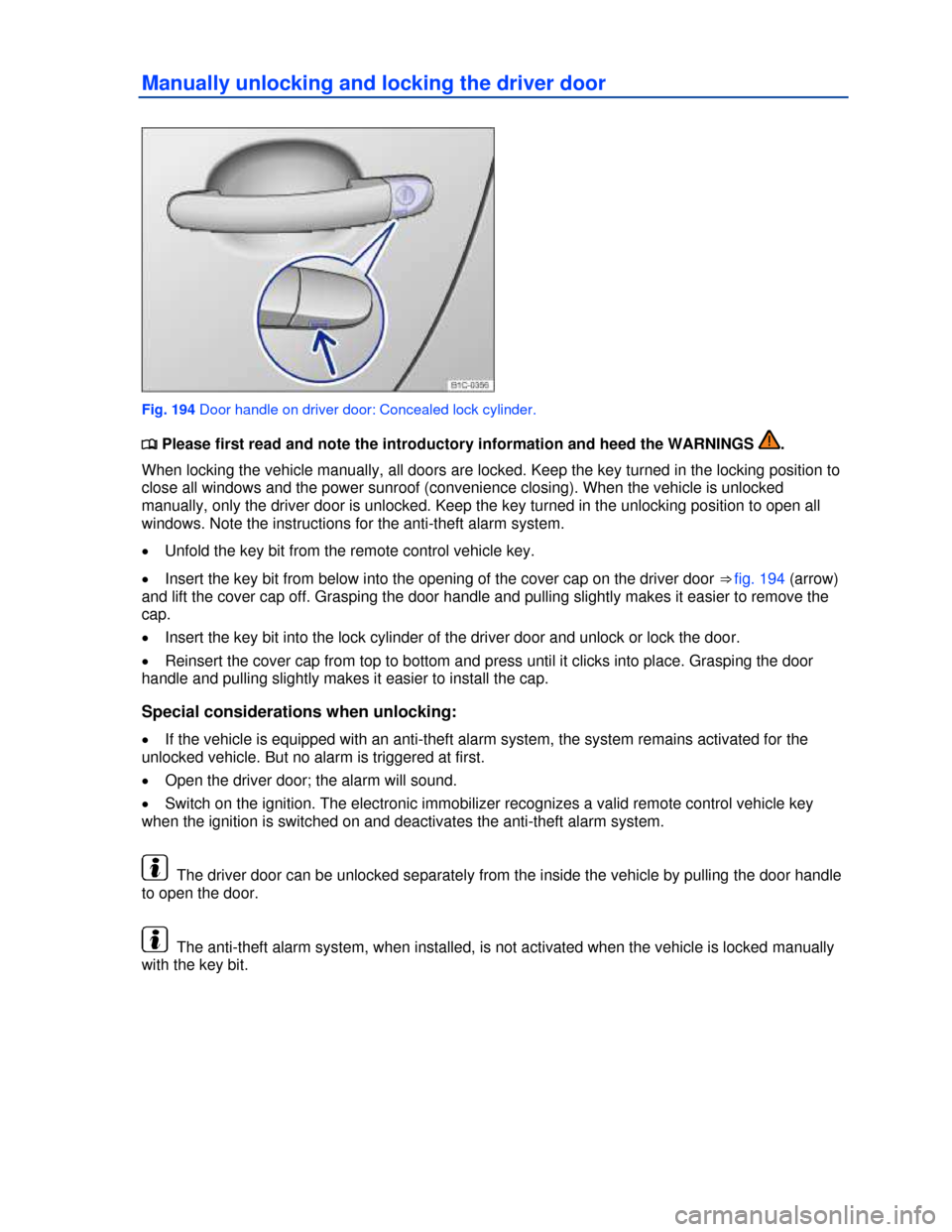
Manually unlocking and locking the driver door
Fig. 194 Door handle on driver door: Concealed lock cylinder.
Page 354 of 379
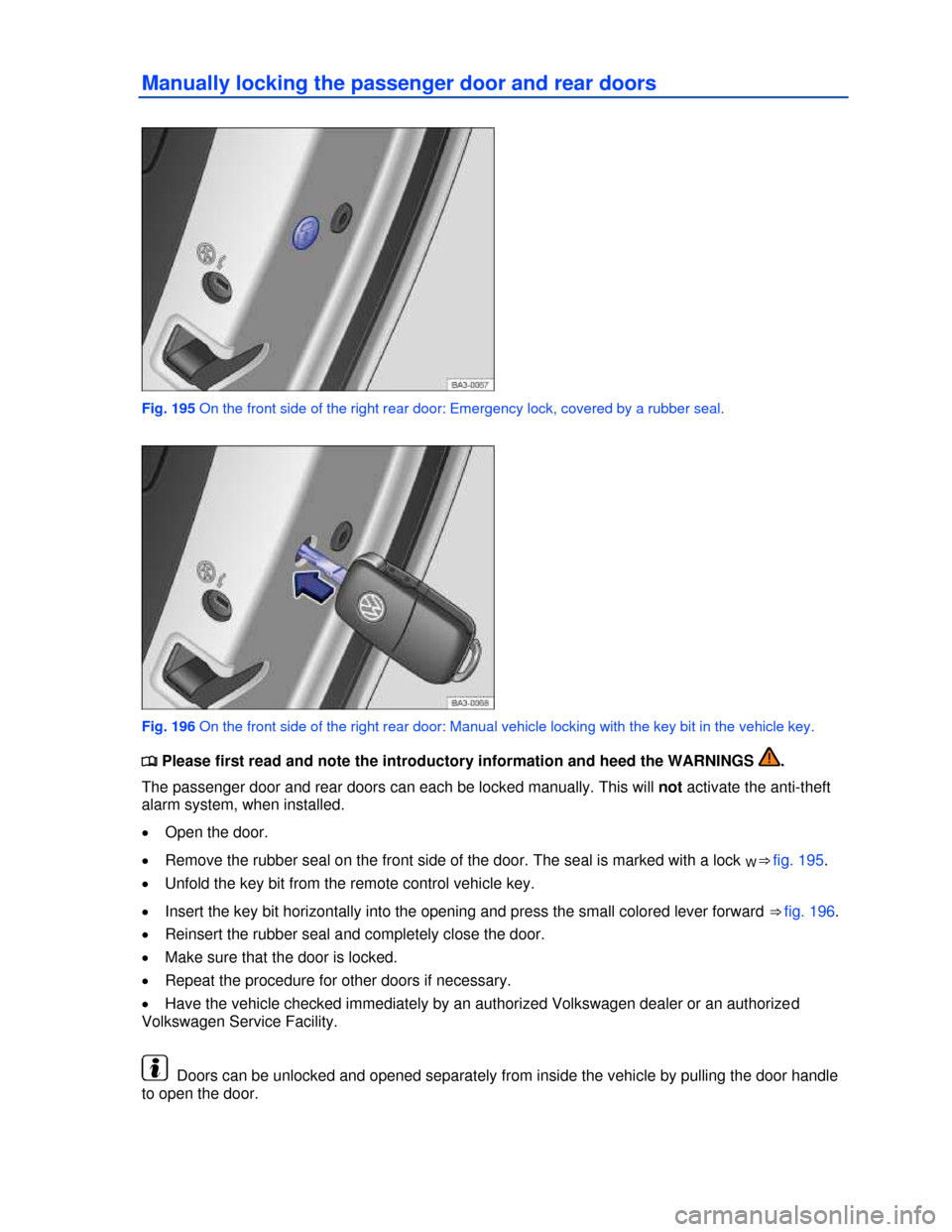
Manually locking the passenger door and rear doors
Fig. 195 On the front side of the right rear door: Emergency lock, covered by a rubber seal.
Fig. 196 On the front side of the right rear door: Manual vehicle locking with the key bit in the vehicle key.
Page 355 of 379
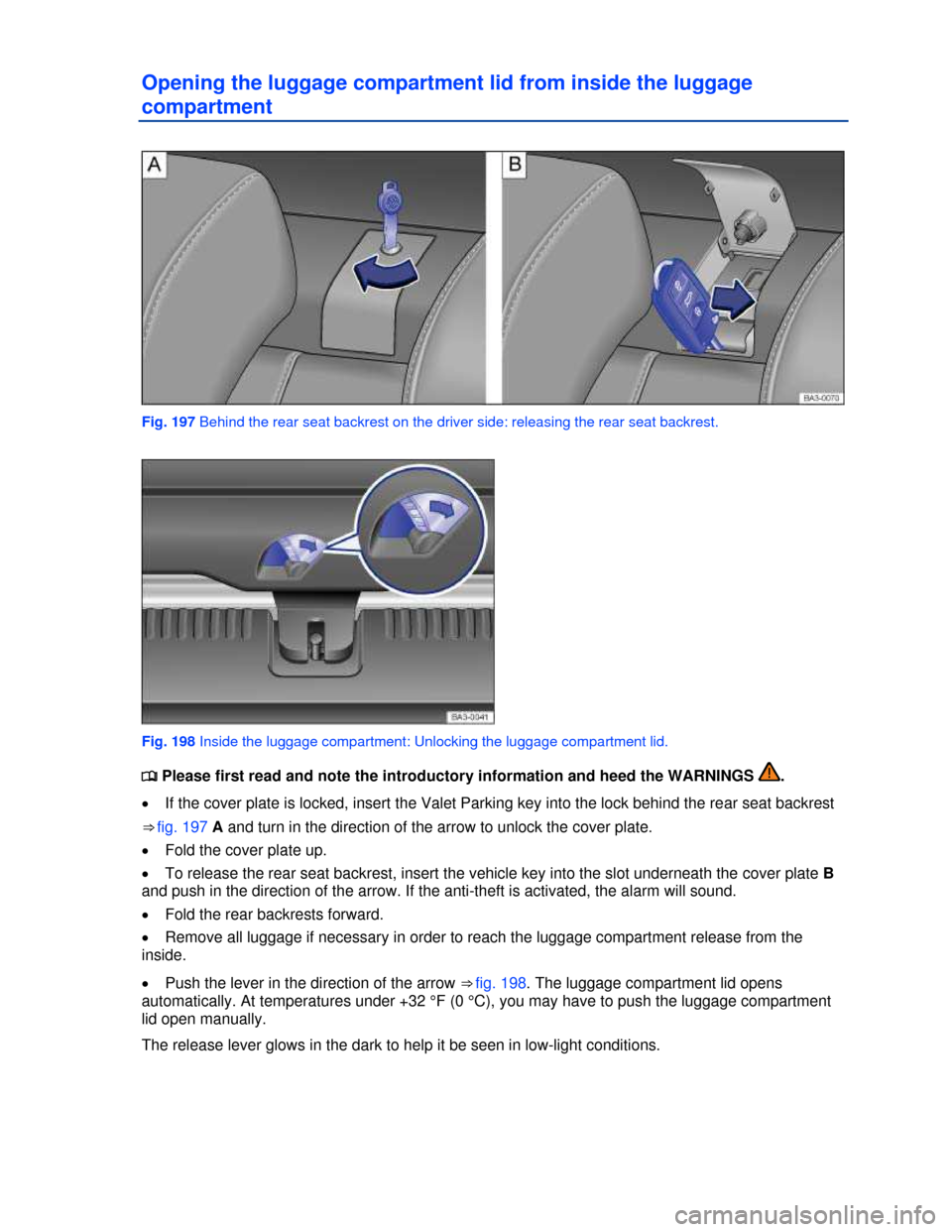
Opening the luggage compartment lid from inside the luggage
compartment
Fig. 197 Behind the rear seat backrest on the driver side: releasing the rear seat backrest.
Fig. 198 Inside the luggage compartment: Unlocking the luggage compartment lid.
Page 357 of 379
x Have the power sunroof checked by an authorized Volkswagen dealer or an authorized
Volkswagen Service Facility. Emergency closing may cause the power sunroof and its pinch protection
to malfunction.
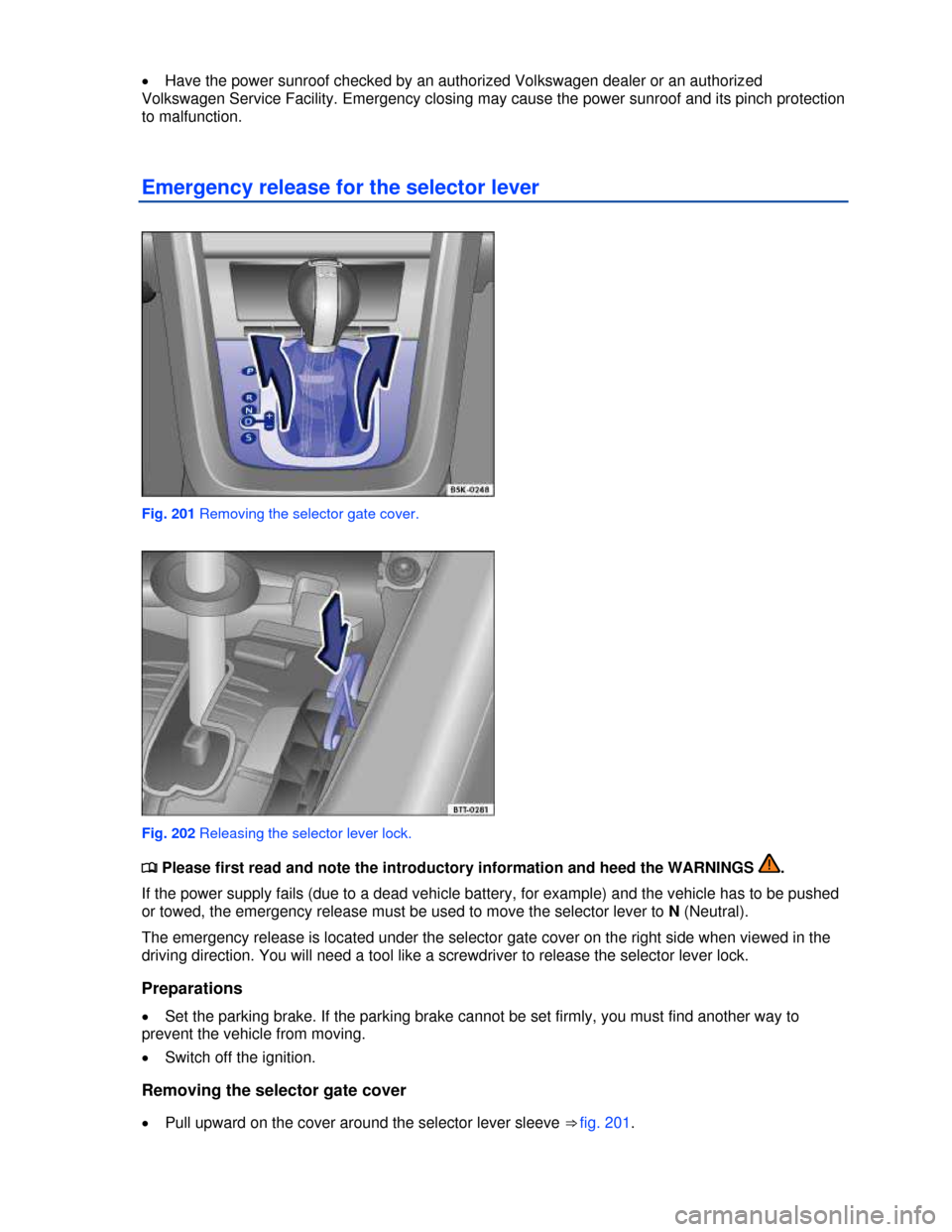
Emergency release for the selector lever
Fig. 201 Removing the selector gate cover.
Fig. 202 Releasing the selector lever lock.
Page 364 of 379
WARNING
Changing a wheel, especially on the side of the road, can be dangerous. To help reduce the
risk of serious personal injury:
x Always stop the vehicle as soon as it is safe to do so. Move the vehicle a safe distance off
the road where it is safe to change the wheel.
x Always make sure that all passengers, especially children, are in a safe place outside the
vehicle and away from the vehicle and traffic (such as behind a guard rail).
x Turn on the emergency flashers and set up another warning device about 25 yards (25
meters) behind the vehicle to warn approaching traffic.
x Change a wheel by yourself only if you are familiar with the necessary steps. Otherwise,
get expert assistance.
x Always switch the engine off, firmly apply the parking brake, and shift the transmission
into Park (P) (automatic transmission) or any gear (manual only) to help prevent the vehicle
from moving suddenly and slipping off the jack.
x Always make sure that the ground is level and firm. If necessary, place the jack on a large
and sturdy board or on a similar ground support.
x Always block the wheel diagonally opposite the wheel being changed with chocks or other
similar things.
x If you are towing a trailer, always unhitch it from your vehicle before starting to change
the wheel. Always apply the trailer brakes firmly and make sure the trailer cannot move
unintentionally.
x Always use proper and undamaged tools when changing a wheel.
x Once a wheel is lifted off the ground, having the transmission in Park (P) or in gear will not
prevent sudden vehicle movement.
x Always use a jack that has been approved by the manufacturer for your vehicle. Never use
other jacks, even if they have been approved for use on other Volkswagen models.
x To reduce the risk of losing control, crashes, and serious personal injuries, never loosen
the screws on rims with threaded rim rings.
x After changing a wheel, have the wheel bolt tightening torque checked with an accurate
torque wrench.
x After changing a wheel or tire, reset the Tire Pressure Monitoring System.
WARNING
Disregarding the safety-related checklist may lead to accidents and serious personal injuries.
x Always review and follow the checklist. Follow accepted safety practices and use common
sense.
Removing the wheel
x Review the checklist.
x Loosen the wheel bolts.
x Lift the vehicle.
x Completely unscrew and remove the previously loosened wheel bolts using the hexagonal socket
in the screwdriver handle ⇒ fig. 211. Place the wheel bolts on a clean surface.
x Remove the wheel.
Page 365 of 379
Mounting a spare tire or a compact spare wheel
If the tire is a unidirectional tire, be sure to install it in the proper rolling direction.
x Place the spare tire or compact spare on the axle.
x Place the anti-theft wheel bolt (where applicable) in position ⇒ fig. 208 (2) or (3) in relation to the
position of the tire valve (1). Hand tighten it using the adapter by turning clockwise.
x Screw in all wheel bolts clockwise and tighten them slightly using the hexagonal socket in the
screwdriver handle.
x Lower the vehicle with the jack.
x Use the lug wrench to firmly tighten all wheel bolts (turn clockwise) ⇒ . Do not tighten them in
sequence! Tighten any wheel bolt to begin, then tighten the wheel bolt diagonally opposite the first
bolt, and so forth.
x Install the wheel bolt caps, center wheel hubcap, or wheel cover, if any.
WARNING
Wheel bolts that are tightened or installed improperly can come loose, causing loss of
vehicle control, a crash, and serious personal injury.
x Always keep wheel bolts and threads in the wheel hub clean and free of oil and grease.
The wheel bolts must turn easily and must be tightened with the right torque.
x Use the hexagonal socket in the screwdriver handle only to turn the wheel bolts when they
are loose, never to loosen them or tighten them firmly.
WARNING
Improper use of a compact spare wheel can cause loss of vehicle control, a crash or other
accident, and serious personal injury.
x Never use a compact spare wheel if it is damaged or worn down to the wear indicators.
x Never drive faster than 50 mph (80 km/h) with a compact spare wheel. Avoid full-throttle
acceleration, heavy braking, and fast cornering!
x Never drive more than 125 miles (200 km) with a compact spare wheel that is installed on
the front axle (drive axle).
x Replace the compact spare with a normal wheel and tire as soon as possible. Compact
spare tires are designed for brief use only.