pull VOLKSWAGEN PASSAT 2015 B8 / 6.G User Guide
[x] Cancel search | Manufacturer: VOLKSWAGEN, Model Year: 2015, Model line: PASSAT, Model: VOLKSWAGEN PASSAT 2015 B8 / 6.GPages: 397, PDF Size: 5.66 MB
Page 182 of 397

Rim diameter
The nominal diameter of the wheel's tire bead seating surface. If you change your wheel size, to wheels of a different diameter, you will have to purchase new tires to match the new wheels.
Rim size
Designation means rim diameter and width.
Rim type designation
The industry or manufacturer's designation for a rim by style or code.
Rim width
The nominal distance between wheel rim flanges.
Section width
The linear distance between the exteriors of the sidewalls of an inflated tire, excluding elevations due to labeling decoration, or protective bands.
Sidewall
The portion of a tire between the bead and the tread.
Sidewall separation
The parting of the rubber compound from the cord material in the sidewall.
Speed rating (letter code)
A standardized letter code indicating the maximum speed at which a tire is designed to be driven for extended periods of time. The ratings range from 93 mph or 150 km/h (“P”) to 186 mph or (300 km/h) “Y”.
The speed rating letter code, where applicable, is molded on the tire sidewall ⇒ Tire labeling. You may not find this information on all tires because it is not required by law.
Tire Pressure Monitoring System
A system that detects when at least one of a vehicle's tires is underinflated and illuminates a low tire-pressure warning light.
Tread
The portion of a tire that normally touches the road.
Tread rib
A tread section running circumferentially around a tire.
Tread separation
Tire failure caused by the tread pulling away from the tire carcass.
Tread wear indicators (TWI)
Raised areas within the main tread grooves that show, visually, when tires are worn and near the end of their useful life
Uniform Tire Quality Grading (UTQG)
A tire information system developed by the U.S. National Highway Traffic Safety Administration (NHTSA) that is designed to help buyers compare tires. UTQG is not a safety rating, nor is it a guaran-tee that a tire will last for a certain number of miles or perform a certain way. It gives tire buyers more information to compare with factors such as price, brand loyalty and dealer recommendations. Under UTQG, tires are graded by the tire manufacturers in 3 areas: tread wear, traction and temperature resistance. UTQG information is molded into the tire sidewalls.
Page 202 of 397

Key to ⇒ fig. 140:
(1) Valet parking key in holder.
(2) SET button for Tire Pressure Monitoring System (TPMS) ⇒ Tire Pressure Monitoring System (TPMS).
(3) Button for Valet Parking feature ⇒ Valet Parking feature.
(4) Owner's Manual in Owner's Manual slot.
(5) Holder for pen and notepad.
Opening and closing the glove compartment
If necessary, unlock the glove compartment. It is locked when the key slot is vertical.
To open, pull the handle ⇒ fig. 139.
To close, push the lid up.
Owner's Manual slot
The slot at the top of the glove compartment is designed to hold the Owner's Manual.
The Owner's Manual is in this glove compartment slot ⇒ fig. 140 (4).
Always keep the Owner's Manual in this slot.
Holder for the valet parking key
There is a holder for the valet parking key ⇒ Vehicle key set in the glove compartment.
The holder is on the left side of the glove compartment (1).
You should keep the valet parking key in this holder. Slide the valet key into the holder from above, do not snap it into the holder from the front.
Holder for pen and notepad
There are holders for a pen and a notepad in the glove compartment cover (5).
Buttons in the glove compartment
The Tire Pressure Monitoring System (TPMS) SET button ⇒ Tire Pressure Monitoring System
(TPMS) and recalibration with the SET button (2) and the Valet Parking button ⇒ Valet Parking fea-ture (1) are also located in the glove compartment.
WARNING
An open glove compartment door can increase the risk of serious injury during sudden brak-ing or driving maneuvers or in a crash.
x Always keep the glove compartment closed while the vehicle is moving.
NOTICE
In some vehicle models, design considerations have made it necessary to have openings in the glove compartment behind the Owner's Manual slot, for example. Small items may fall through these openings and get behind the instrument panel. This can cause unusual noises and dam-age the vehicle. Never put any small objects in the glove compartment for this reason.
Page 231 of 397

Using Tiptronic with the shift paddles behind the steering wheel
x The paddles ⇒ fig. 161 work when the selector lever is in the Tiptronic position or when the selec-tor lever is in Drive (D) or Sport Drive (S). You do not have to move the selector lever over to the right into the Tiptronic position.
x To upshift, pull the paddle + /&& on the right toward you.
x To downshift, pull the paddle – on the left toward you.
x To switch off Tiptronic mode, pull the paddle on the right + /&& toward you and hold it there for about 1 second.
Tiptronic will switch off automatically if the shift paddles have not been used for a while and the selec-tor lever is not in the Tiptronic position.
NOTICE
x During acceleration, the transmission will shift automatically into the next higher gear before reaching maximum engine speed (rpm).
x If you use Tiptronic to shift into a lower gear, the transmission will downshift only when doing so will not over-rev the engine.
Driving with automatic transmission
Page 326 of 397

Replace worn or damaged wiper blades immediately. Replacement blades may be purchased from any authorized Volkswagen dealer or authorized Volkswagen Service Facility.
Lifting and tilting windshield wiper arms
Move the wiper arms to the service position before lifting them away from the windshield ⇒ Wind-shield wiper and washer.
It is not possible to lift the wiper arms away from the windshield when they are not in the service position.
When lifting or replacing a wiper blade on a window, grip it only by its mounting and not by the blade itself.
Cleaning the wiper blades
x Lift the wiper arm(s) away from the windshield.
x Using a soft cloth, carefully remove dust and dirt from the wiper blades.
x If the blades are very dirty, carefully clean them with a sponge or cloth ⇒ .
x Carefully fold the wiper arm back down onto the windshield.
Changing wiper blades
x Lift the wiper arm away from the windshield.
x Press and hold the release button ⇒ fig. 190 (1).
x While lifting the wiper blade in the direction of the wiper arm, pull off the wiper blade in the direction of the arrow. This may require moderate force.
x Install a new wiper blade of same length and type onto the wiper arm by pushing in the opposite direction of the arrow until it latches.
x Carefully fold the wiper arm back down onto the windshield.
WARNING
Worn or dirty wiper blades reduce visibility and increase the risk of accidents and severe injuries.
x Always change wiper blades if they are damaged or worn, and if they cannot clean the windows sufficiently.
NOTICE
x Damaged or dirty wiper blades can scratch the windshield.
x Solvents, abrasive sponges and sharp-edged objects will damage the graphite coating on the wiper blades.
x Do not clean the windows with gasoline, nail polish remover, paint thinner or similar fluids.
x To help prevent damage to the engine hood and the windshield wiper arms, lift the wiper arms away from the windshield only when they are in the service position.
Waxing and polishing vehicle paint
Page 369 of 397
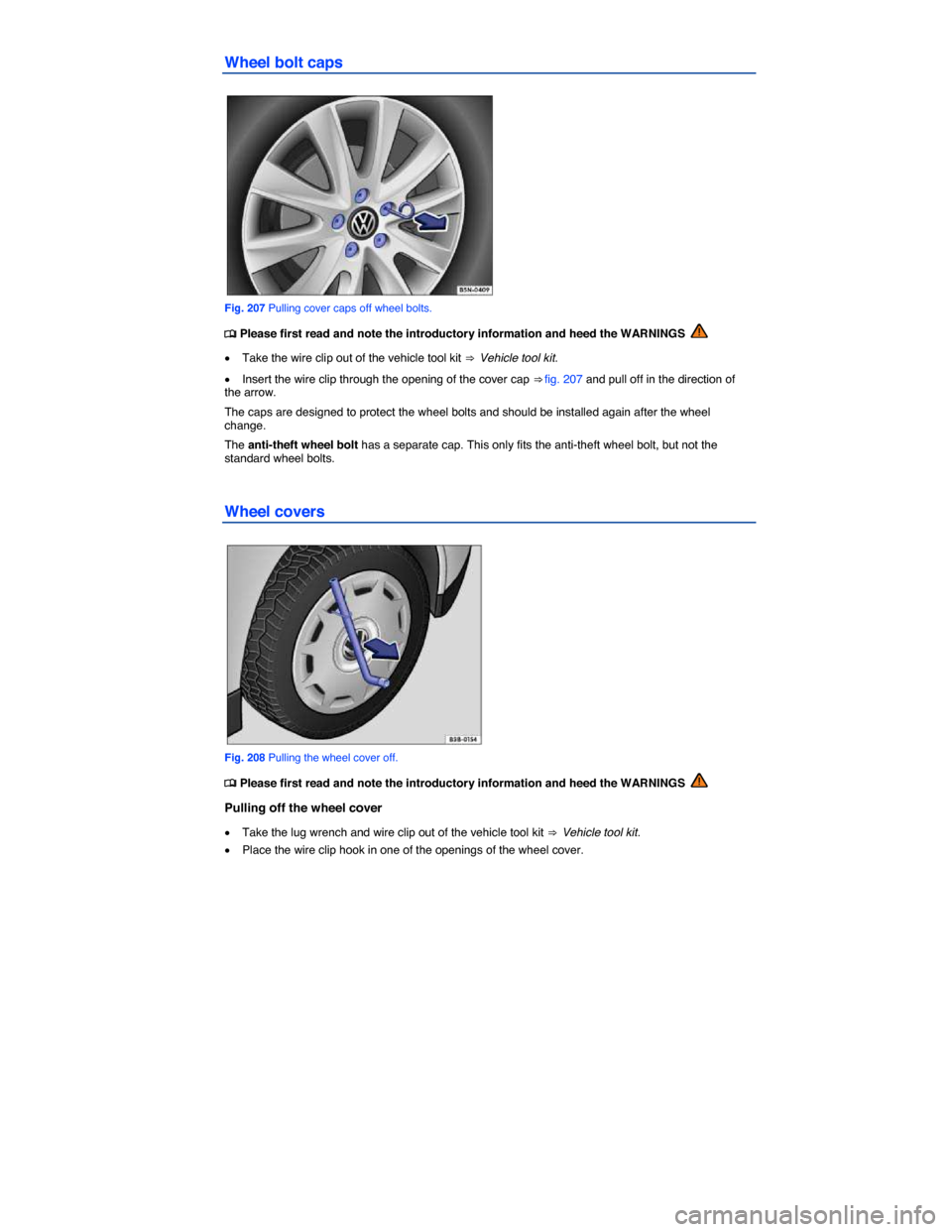
Wheel bolt caps
Fig. 207 Pulling cover caps off wheel bolts.
Page 370 of 397

x Slide the lug wrench through the clip ⇒ fig. 208 and pull the wheel cover off in the direction of the arrow.
Installing the wheel cover
Where applicable: Before installing the wheel cover, the anti-theft wheel bolt must be screwed into
position ⇒ fig. 210 (2) or (3) in relation to the position of the tire valve. Otherwise, the wheel cover cannot be installed.
Make sure that the valve cutout is aligned with the valve ⇒ fig. 210 (1), and press the wheel cover onto the wheel rim. Make sure that the wheel cover is latched onto the rim along the entire circumference.
Page 381 of 397

Color Current strength in amps
Brown 7,5
Red 10
Blue 15
Yellow 20
White or clear 25
Green 30
Orange 40
Opening the fuse box in the instrument panel
x Pull the lower part of the cover in the direction of the arrow ⇒ fig. 214 and remove the cover from the bottom.
x On the inside of the cover there are plastic tweezers for removing and inserting fuses.
x To install, guide the cover from the bottom into the instrument panel and push in the direction
opposite to the arrow ⇒ fig. 214 until you can hear it latch into place.
Opening the fuse box in the engine compartment
x Open the engine hood ⇒
x Move the release tabs in the direction of the arrows ⇒ fig. 215 to unlock the fuse box cover.
x Remove the cover upward.
x To install push the cover onto the fuse box. The locking tabs must latch with an audible “click”.
Vehicles with battery located in the luggage compartment
There are additional fuses above the vehicle battery behind the panel on the left side of the luggage compartment. Have these fuses replaced by an authorized Volkswagen dealer or authorized Volkswagen Service Facility.
NOTICE
x To help prevent vehicle damage, be careful when removing fuse box covers and be sure to reinstall them properly.
x Open fuse boxes must be protected from dirt and moisture. Dirt and moisture in fuse boxes can cause damage to the electrical system.
The vehicle contains other fuses in addition to those mentioned in this section. Have these fuses replaced by an authorized Volkswagen dealer or an authorized Volkswagen Service Facility.