Safe VOLKSWAGEN PASSAT 2015 B8 / 6.G Workshop Manual
[x] Cancel search | Manufacturer: VOLKSWAGEN, Model Year: 2015, Model line: PASSAT, Model: VOLKSWAGEN PASSAT 2015 B8 / 6.GPages: 397, PDF Size: 5.66 MB
Page 241 of 397
When the ignition is switched on, several warning and indicator lights come on briefly for a function check. They go out after a few seconds.
WARNING
Failure to heed warning lights and instrument cluster text messages can cause the vehicle to break down in traffic and result in a collision and serious personal injury.
x Never ignore warning lights or text WARNINGS.
x Always stop the vehicle as soon as it is safe to do so.
WARNING
Driving with bad brakes can cause a collision and serious personal injury.
x If the brake warning light "2!+% or H does not go out, or lights up when driving, either the brake fluid level in the reservoir is too low or there is a fault in the brake system. Stop the
vehicle as soon as you can do so safely and get expert assistance ⇒ Brake fluid.
x If the brake warning light "2!+% or H lights up at the same time as the ABS warning light !"3 or J, the ABS may not be working properly. This could cause the rear wheels to lock up rela-tively quickly during braking. Rear wheel brake lock-up can cause loss of vehicle control.
x If you believe the vehicle is safe to drive, drive slowly and very carefully to the nearest authorized Volkswagen dealer, authorized Volkswagen Service Facility, or other qualified workshop and have the brake system inspected. Avoid sudden hard braking and steering.
x If the ABS indicator light !"3 or J does not go out, or if it lights up while driving, the ABS system is not working properly. The vehicle can then be stopped only with the standard brakes (without ABS). You will not have the protection ABS provides. Contact your author-ized Volkswagen dealer or an authorized Volkswagen Service Facility as soon as possible.
x If the symbol "2!+% 7%!2 or I lights up in the instrument cluster display, whether alone or together with a text message, immediately contact an authorized Volkswagen dealer or au-thorized Volkswagen Service Facility to have the brake pads checked and, if necessary, re-placed.
NOTICE
Failure to heed warning lights or text WARNINGS can result in vehicle damage.
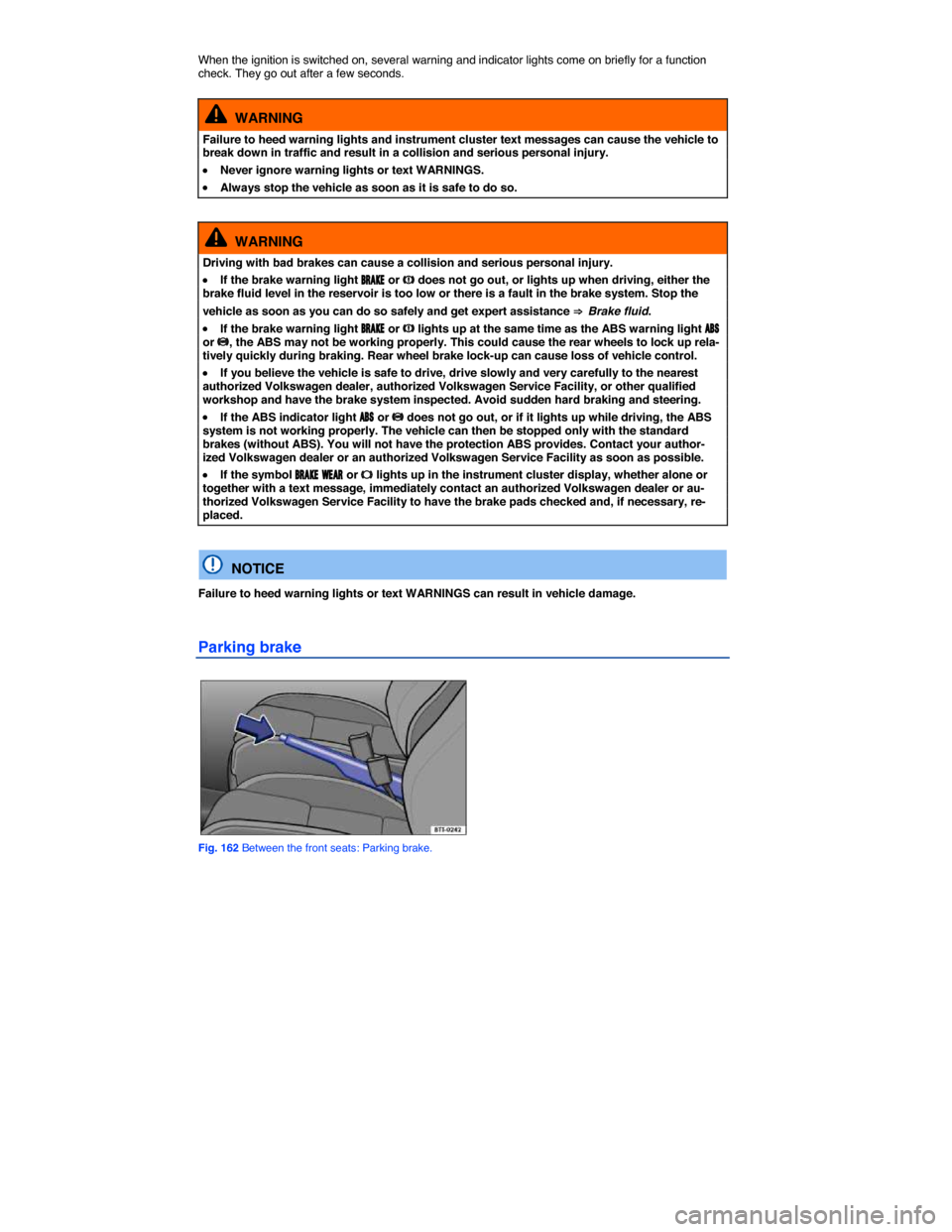
Parking brake
Fig. 162 Between the front seats: Parking brake.
Page 244 of 397

Brakes coated with road salt also react slower and need longer stopping distances. If there is salt on the roads and you are not braking regularly, brake carefully and gently from time to time to remove any
salt coating from the brake discs and pads ⇒ .
Brake disc corrosion (rust) and dirt build-up on the brake pads are more likely to occur if the vehicle is not driven much or is driven only for short distances with little braking. If the brakes have not been used and there is some rust on the discs, clean the brake discs and pads once in a while by carefully braking a couple of times while driving at relatively high speed to help clean the brake discs and pads.
Make sure nobody is behind you and that you do not endanger yourself or others ⇒ .
Brake system malfunction
If you brake and find that vehicle doesn't brake nearly as well as it used to (sudden increase in stop-ping distance), a brake circuit may have failed. The brake warning light H or "2!+% will come on and a message may appear in the instrument cluster display. If you believe the vehicle is safe to drive, immediately take it to the nearest authorized Volkswagen dealer or authorized Volkswagen Service Facility for repair. Drive slowly and very carefully, allow for the longer stopping distance, and be ready to push longer and harder on the brake pedal to slow the vehicle down.
Brake booster
The brake booster works only when the engine is running. It increases the force on the brakes above and beyond the pressure put on the brake pedal by the driver.
If the brake booster is not working, or if the vehicle has to be towed, you will have to push the brake pedal harder to make up for the lack of booster assistance and the resulting longer stopping distance
⇒ .
WARNING
New brake pads do not provide maximum braking performance.
x New brake pads do not have the best stopping power for the first 200 miles (320 km) and must be “broken in.” You can compensate for the slightly reduced braking force by putting more pressure on the brake pedal.
x Drive with extra care while the new brake pads are being broken in. This reduces the risk of collisions and serious personal injuries due to a loss of control over the vehicle.
x Never follow other vehicles too closely or put yourself into other situations that might require sudden, hard braking, especially when the brake pads have not been broken in.
WARNING
Overheated brakes will reduce the vehicle's stopping power and increase stopping distances considerably.
x When driving downhill, the brakes have to work especially hard and heat up quickly.
x Before driving downhill, especially on hills that are long or steep, always reduce speed and shift into lower gear (manual or automatic transmission). This will let the vehicle use engine braking and reduce the load on the brakes. Otherwise, the brake system could over-heat and possibly fail. Only use the brakes when you need them to slow the vehicle down more or to stop.
x A damaged front spoiler or a non-standard spoiler can reduce airflow to the brakes and make them overheat.
Page 247 of 397

fast cornering. XDL applies enough brake pressure to this wheel in order to stop the slippage. This improves traction, which helps the vehicle stay on track.
WARNING
Driving fast on icy, slippery, or wet roads can lead to a loss of control and result in serious personal injury for you and your passengers.
x Always adjust your speed and driving style to road, traffic, weather, and visibility condi-tions. Never let the additional safety that ESC, ABS, BAS, ASR, and EDL can provide tempt you into taking extra risks.
x Braking assistance systems cannot overcome the laws of physics and always prevent loss of vehicle control. Slippery and wet roads are still dangerous even with ESC and the other systems!
x Driving too fast on wet roads can cause the wheels to lose contact with the road and “hy-droplane.” A vehicle that has lost road contact cannot be braked, steered, or controlled.
x These systems cannot reduce the risk of accident, for example if you drive too fast for conditions or if you do not keep your distance from the vehicle in front of you.
x Although these systems are very effective and can help you control the vehicle in many difficult situations, always remember that your vehicle handling control is limited by tire trac-tion.
x When accelerating on a slippery surface, for example on ice and snow, depress the accel-erator carefully. Even with these systems, the wheels may start to spin, leading to a loss of vehicle control.
WARNING
The effectiveness of ESC can be significantly reduced if other components and systems that affect vehicle dynamics, including but not limited to brakes, tires, and other systems men-tioned above, are not properly maintained or functioning.
x Always remember that vehicle alterations or modifications can affect the functioning of the ABS, BAS, ASR, EDL, and ESC systems.
x Changing the vehicle suspension or using an unapproved tire / wheel combination can change the way the ABS, BAS, ASR, EDL, and ESC systems work and reduce their effective-ness.
x The effectiveness of ESC is also determined by the tires fitted ⇒ page 161, Tires and wheels.
All 4 wheels must be equipped with identical tires in order for ESC and ASR to work properly. Differences in the tread circumference of the tires can cause the system to reduce the engine power when it is not expected.
If ABS is not working, ESC, ASR, and EDL will also not work.
You may hear noises when these systems are active.
.
Page 262 of 397

1) Do not use the Rear View Camera system in the following situations:
– If the rear of the vehicle is heavily loaded.
– When the luggage compartment lid is open.
– If the driver is not familiar with the system.
– If the position or angle of the camera has changed, such as after a rear-end collision. Have the system checked by an authorized Volkswagen dealer or an authorized Volkswagen Service Facility.
2) Examples of optical distortion by the camera
The Rear View Camera system displays only two-dimensional images. Recesses and protruding objects on the ground or protruding parts on other vehicles are difficult or impossible to identify due to the lack of depth of field.
Objects or another vehicle may seem closer or farther away on the screen than they really are:
– When driving from a level surface onto an upward or downward slope.
– When driving up or down a slope onto a level surface.
– If the rear of the vehicle is heavily loaded.
– When approaching protruding objects. These objects can disappear from the field of view when backing up.
Cleaning the camera lens
Keep the camera lens clean and free of snow and ice:
x Engage the parking brake.
x Wet the camera lens with a commercially available alcohol-based glass cleaner and clean with a
dry cloth ⇒ .
x Remove snow with a brush.
x Remove ice with deicer spray ⇒ .
NOTICE
x Never use abrasive cleaning agents to clean the camera lens.
x Never remove snow or ice on the camera lens with warm or hot water. This can damage the camera lens.
Volkswagen recommends practicing parking with Rear View Camera system in a safe place with little or no traffic or in a parking lot under good visibility and weather conditions in order to familiarize yourself with the system, the orientation lines and the way they work.
Rear View Camera system does not work when the luggage compartment lid is open.
Page 274 of 397

WARNING
Even if empty, portable fuel containers can leak and cause a fire and serious personal inju-ries, especially in a crash.
x For your safety, we strongly recommend that you do not travel with a portable fuel con-tainer in your vehicle.
x If, under exceptional circumstances, you must transport a portable fuel container, please observe the following:
– Never fill a portable fuel container while it is anywhere in or on the vehicle (for exam-ple, in the luggage compartment or on top of the luggage compartment lid). Static electric-ity can build up while filling and can ignite fuel vapors, causing a fire.
– Always place a portable fuel container on the ground before filling. Never spill fuel inside the vehicle or luggage compartment. Fuel vapors are highly flammable.
– Always keep the filler nozzle completely inside the portable container before and dur-ing filling.
– If filling a portable container made of metal, the filler nozzle must always be in contact with the container. This will help prevent static electricity from discharging and causing a fire.
– Always observe local and state or provincial laws about the use, storage, and transpor-tation of portable fuel containers.
– Make certain that the portable fuel container meets industry standards, such as ANSI / ASTM F852-86.
NOTICE
x Remove fuel spills from the vehicle immediately to help prevent damage to the paint, tires, and wheel housings.
x Refueling with gasoline when your vehicle has a diesel engine or refueling with diesel fuel when your vehicle has a gasoline engine can cause very serious and expensive engine and fuel system damage that is not covered by any Volkswagen Limited Warranty.
x If you put any amount of incorrect fuel in the fuel tank, do not start the engine under any circumstances. Immediately contact the nearest authorized Volkswagen dealer or authorized Volkswagen Service Facility for assistance. These fuels contain substances that can severely damage the fuel system and the engine if the engine is started.
x Vehicles with diesel engines must never be refueled or driven with gasoline, kerosene, heating oil, or other non-specified fuels that have not been expressly approved for use with the diesel engine. Other kinds of fuel can cause serious damage to the fuel system and the engine that is not covered by any Volkswagen Limited Warranty.
Fuels can pollute the environment. Spilled fuel must be collected and disposed of properly, following all applicable environmental regulations.
There is no emergency release for the fuel filler flap. Contact an authorized Volkswagen dealer or an authorized Volkswagen Service Facility for assistance.
Page 280 of 397

d Engine oil level ⇒ Engine oil
d Engine coolant level ⇒ Engine coolant
d Brake fluid level ⇒ Braking and parking
d Tire pressure ⇒ Tires and wheels
d Vehicle lighting necessary for driving safety:
– Turn signals
– Parking lights, low beams and high beams
– Taillights
– Brake lights
– License plate lights
Information regarding changing light bulbs ⇒ Replacing light bulbs.
WARNING
Disregarding the safety-related checklist may lead to accidents and injuries.
x Please note and follow the points listed in the checklist.
Page 291 of 397

WARNING
Store AdBlue only in its closed original container and in a safe place.
x To reduce the risk of poisoning, never keep AdBlue in empty food or beverage containers that might mislead someone into drinking from them.
x Always store AdBlue outside the reach of children.
NOTICE
x Use only AdBlue that has been explicitly approved by Volkswagen. Using other types of AdBlue can damage your vehicle's engine.
x Never mix water or any other substances or additives with AdBlue. Damage caused by such additives will not be covered by any Volkswagen limited warranty.
x Never put AdBlue into the diesel fuel tank! Otherwise the engine may be damaged!
x Do not carry a refill container in the vehicle all the time or routinely. Due to temperature fluctuations and damage, the container could start leaking and the AdBlue could damage the vehicle interior.
Dispose of the refill container in an environmentally-responsible manner.
Appropriate AdBlue refill containers can be obtained from an authorized Volkswagen dealer or an authorized Volkswagen Service Facility.
Page 293 of 397

WARNING
The engine compartment of any motor vehicle is a potentially dangerous area and can cause serious personal injury.
x Always use extreme caution when doing any work in the engine compartment. Always follow commonly accepted safety practices and use common sense. Never risk personal injury.
x Never perform any work in the engine compartment unless you know exactly how to carry out the job and have the correct technical information and the correct tools.
x If you are uncertain about what to do, have the work performed by an authorized Volkswagen dealer, an authorized Volkswagen Service Facility, or another qualified work-shop. Serious personal injury may result from improperly performed work.
x We strongly recommend that you always have HID – High Intensity Discharge (Xenon) headlights and H7 bulbs replaced by a qualified technician. Serious personal injury may re-sult from improperly performed work.
x Never open or close the engine hood if steam or coolant is escaping. Hot steam or coolant can cause serious burns. Always wait until you no longer see or hear steam or coolant escap-ing from the engine.
x Always let the engine cool down completely before carefully opening the hood.
x Hot parts of the engine and the exhaust system will burn skin on contact.
x When the engine has cooled down and you are ready to open the hood:
– Firmly apply the parking brake and shift the transmission into Park (P) (automatic) or Neutral (manual only).
– Take the vehicle key out of the ignition.
– On vehicles with Keyless Access, make sure that the remote control vehicle key is out of range of the vehicle and that the vehicle cannot be started by depressing the starter
button ⇒ Starter button.
– Always keep children and others away from the engine compartment and never leave them unsupervised.
x The engine coolant system is under pressure when the engine is hot. Never unscrew the coolant expansion tank cap when the engine is hot. Hot coolant can spray out and cause severe burns and other serious injuries.
– Turn the cap slowly and very carefully in a counterclockwise direction while applying light downward pressure on the top of the cap.
– Always protect your face, hands, and arms from hot escaping coolant or steam by covering the cap with a large, thick rag.
x Never spill fluids on the engine or exhaust system when refilling. Spilling fluids onto hot parts of the engine or exhaust system can cause a fire.
Page 296 of 397

WARNING
Failure to heed warning lights and instrument cluster text messages can cause the vehicle to break down in traffic and result in a collision and serious personal injury.
x Never ignore warning lights or text WARNINGS.
x Always stop the vehicle as soon as it is safe to do so.
Preparing to work in the engine compartment
Page 315 of 397

More information:
x ⇒ Booklet Warranty and Maintenance
x Preparations for working in the engine compartment
x Parts, accessories, repairs and modifications
WARNING
Working on the batteries or the electrical system in your vehicle can cause serious acid burns, fires, explosions, or electrical shocks. Always read and heed the following WARNINGS and safety precautions before working on the batteries or the electrical system.
x Before working on the electrical system, always switch off the ignition and all electrical consumers and disconnect the negative (-) cable from the standard 12 Volt battery.
x When you change a light bulb, always switch off the light first.
x Always keep children away from battery acid and vehicle batteries in general.
x Always wear eye protection. Never let battery acid or lead particles come into contact with your eyes, skin, or clothing.
x Sulfuric battery acid is very corrosive. It can burn unprotected skin and cause blindness. Always wear protective gloves and eye protection. To reduce your risk of injury, never tilt the batteries, as this could spill acid through the vents and burn you.
x If you get battery acid in your eyes or on your skin, immediately rinse with cold water for several minutes and then get immediate medical attention. If you swallow any battery acid, get medical attention immediately.
x When disconnecting the batteries from the vehicle electrical system, always disconnect the negative cable (-) first and then the positive cable (+).
x Always switch off all electrical consumers before reconnecting 12 Volt batteries. Recon-nect the plus cable (+) first and then the negative cable (-). Never reverse the polarity of the connections. This could cause a fire.
x A highly explosive mixture of gases is given off when the battery is being charged.
x Do not smoke and avoid fires, sparks, and open flames when working. Never create sparks or electrostatic charges when handling cables and electrical equipment. Never short circuit the battery terminals. High-energy sparks can cause serious personal injury.
x Never use or attempt to charge a damaged or frozen battery, or a battery that was frozen but has thawed. Charging a frozen or thawed battery could cause explosions and chemical burns! Replace damaged or frozen vehicle batteries immediately. A dead battery can freeze at temperatures around +32 °F (0 °C).
x If the battery has a vent line or tube, make sure that it is properly connected to the battery.
x Always make sure that the vent line is securely attached to a vehicle battery that is located in the luggage compartment.
WARNING
California Proposition 65 Warning
x Battery posts, terminals, and related accessories contain lead and lead components, chemicals known to the State of California to cause cancer and reproductive harm. Wash your hands after handling.
NOTICE
x Do not expose the vehicle battery to direct sunlight for an extended period of time as ultra-violet rays may damage the battery housing.