fuel VOLKSWAGEN PASSAT CC 2015 1.G Owner's Guide
[x] Cancel search | Manufacturer: VOLKSWAGEN, Model Year: 2015, Model line: PASSAT CC, Model: VOLKSWAGEN PASSAT CC 2015 1.GPages: 578, PDF Size: 8.42 MB
Page 356 of 578

Vehicles with gear recommendation aid in fuel efficient driving by in-
dicating the optimum time to shift gears.
Coasting
If you take your foot off the accelerator, fuel delivery to the engine is
interrupted, which lowers fuel consumption.
Therefore, when nearing a red stop light, for instance, allow the vehi-
cle to coast without using the accelerator. Press the clutch pedal and
release it only if the vehicle moving too slowly or the coasting dis-
tance is too long. The engine will then continue to run at idle.
In situations where the vehicle will be stopped for a longer period of
time, such as at a railroad crossing, physically switch off the engine.
Defensive driving and “flowing” with traffic
Frequent braking and acceleration increase fuel consumption signifi-
cantly. Just by driving defensively and keeping a sufficiently large
distance away from the vehicle in front of you can make up for the
speed fluctuations caused by taking your foot off the accelerator. Ac-
tive braking and accelerating is then not necessarily required.
Calm and smooth driving
Consistency is more important than speed. The more smoothly you
drive, the less fuel the vehicle consumes.
When driving on the highway or freeway, a constant, moderate speed
is more efficient and economical than constantly accelerating and
braking. Usually you can reach your destination just as quickly by
driving at a moderate, but steady speed.
The cruise control system can assist in maintaining a uniform driving
style.
Moderate use of extra electrical loads
Comfort inside the vehicle is nice and important, but it is important to
use them in an environmentally conscious manner.
Some devices can increase fuel consumption when activated (exam-
ples):
Climate control system (air conditioner): If the air conditioner has to
produce starkly contrasting temperatures, it requires a large amount
of energy, which is generated by the engine. The temperature in the
vehicle should therefore not be extremely different from that of the
Page 357 of 578
outside temperature. It may be helpful to ventilate the vehicle before
driving and then to drive a short distance with the windows open. Af-
ter that, switch on the air conditioner with the windows closed. Keep
the windows closed when driving at high speeds. Open windows in-
crease fuel consumption.
Switch off seat heating once it has served its purpose.
Switch off the rear window defroster as soon as the windows are
free of fog and ice.
Additional factors that increase fuel consumption (examples):
Malfunctioning engine control.
Driving in the mountains.
Towing a trailer.
NOTICE
Never let the vehicle coast or roll down a hill in Neutral (N), es-
pecially when the engine is not running. The transmission will
not be lubricated and will be damaged.
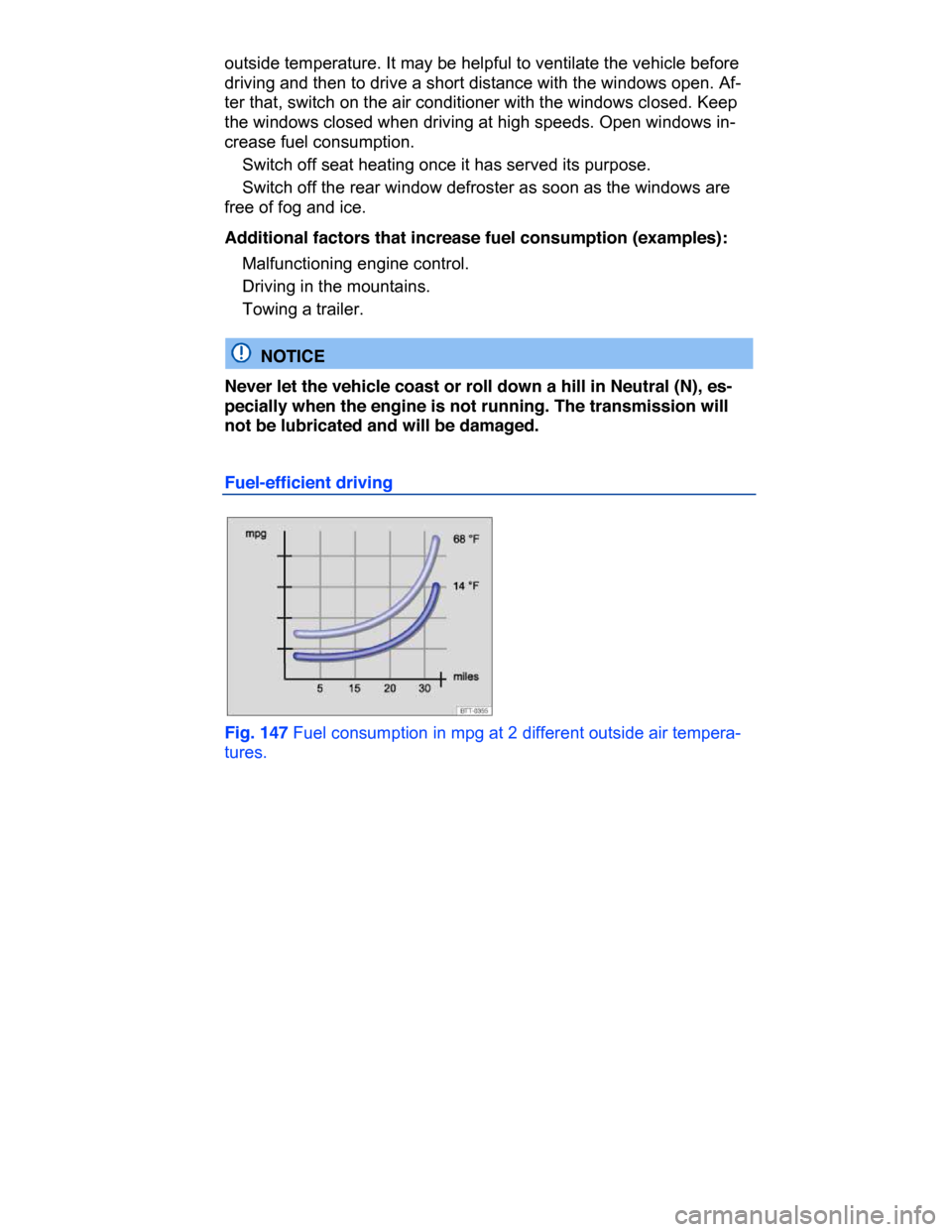
Fuel-efficient driving
Fig. 147 Fuel consumption in mpg at 2 different outside air tempera-
tures.
Page 358 of 578
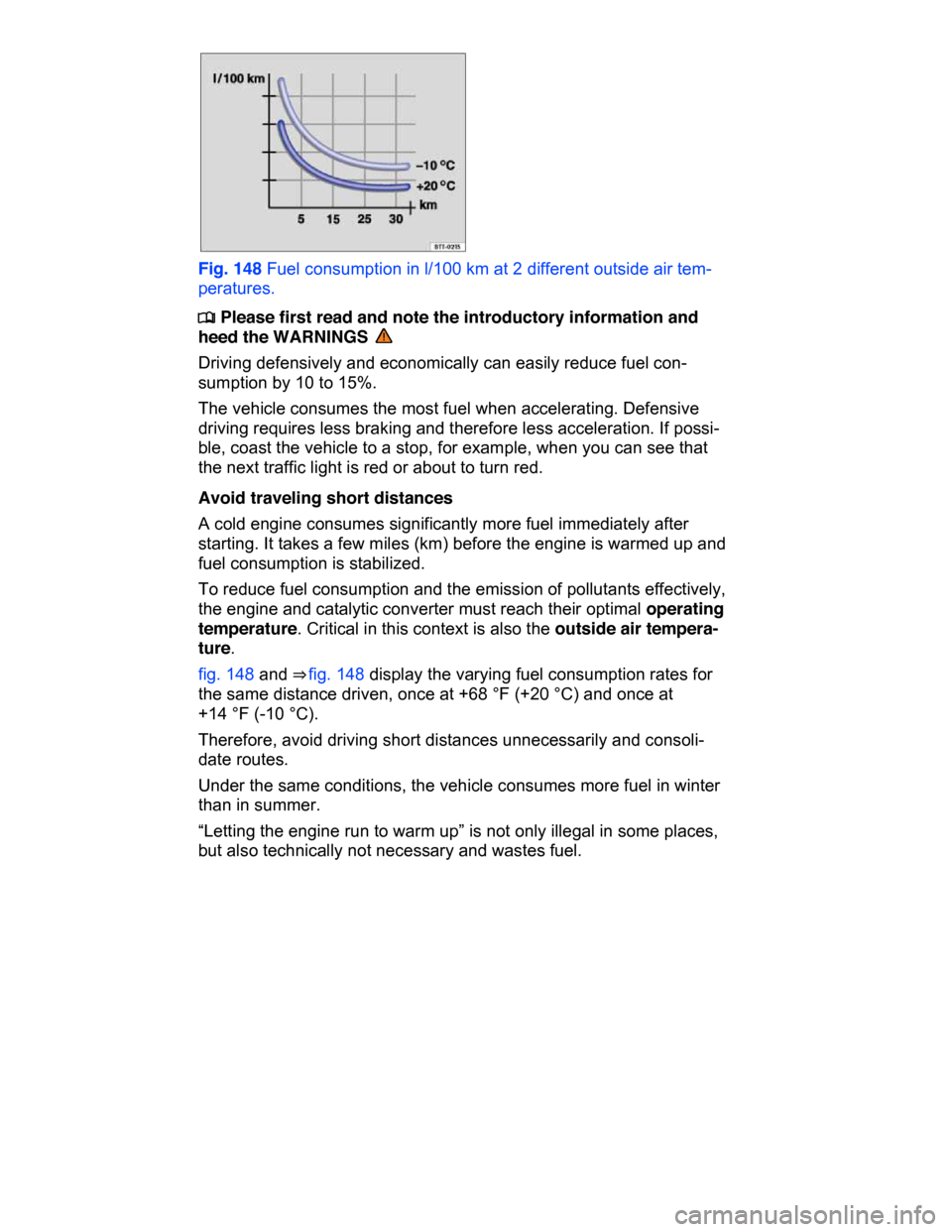
Fig. 148 Fuel consumption in l/100 km at 2 different outside air tem-
peratures.
Page 359 of 578

Adjust the tire pressure
The proper tire pressure helps reduce rolling resistance as well as
fuel consumption.
When purchasing new tires, always make sure that the tires are opti-
mized for lower rolling resistance.
Use low viscosity engine oil
Fully “synthetic,” low viscosity engine oils that expressly comply with
Volkswagen oil quality standards reduce fuel consumption. Low vis-
cosity engine oils reduce the frictional resistance on the engine and
are distributed more evenly and quickly, particularly when cold-
starting the engine. The effect is particularly apparent in vehicles that
frequently travel short distances.
Always ensure the right engine oil level is maintained and keep to the
scheduled service intervals (engine oil changes).
Make sure the engine oil that you purchase expressly complies with
Volkswagen oil quality standards and is the oil approved by
Volkswagen for your vehicle.
Avoid unnecessary weight
The lighter the vehicle, the more economical and eco-friendly it will
be. For example, an extra 220 lbs (100 kg) of weight increases fuel
consumption by up to 1 pint per 60 miles (0.3 l/100 km).
Remove all unnecessary items and unnecessary dead weight from
the vehicle.
Remove unnecessary aftermarket components
The more aerodynamic the vehicle, the less fuel it will consume. Af-
termarket components such as bicycle racks reduce its aerodynamic
performance.
Therefore, remove unnecessary structures and unused rack systems,
particularly if planning to drive at higher speeds.
Page 361 of 578

WARNING
Driving with too little fuel in the fuel tank increases the risk of
stalling, especially when driving up and down hills.
If your vehicle stalls suddenly, this can cause an accident
and serious personal injuries.
Driver assistance and braking assistance systems can mal-
function when there is too little fuel in the tank and cause you
to lose control of the vehicle.
Never drive until the fuel tank is almost empty.
Hill Hold
Page 368 of 578

In order to: You must ⇒ fig. 151 Result:
Resume speed
stored in cruise
control.
Pull the lever briefly to
the 2%35-% position (1).
Cruise control resumes
speed previously set.
If there is not a previously
stored speed, the cruise
control system stores and
maintains the current
speed.
If the cruise control is al-
ready regulating vehicle
speed, the stored speed
is increased by 1 mph
(1 km/h) each time the
lever is pulled.
Increase set
speed (while
cruise control is
actively control-
ling vehicle
speed).
Push the lever briefly
to the 30%%$ + posi-
tion (+) to increase the
set speed in incre-
ments of 5 mph
(10 km/h) and store.
The vehicle will accelerate
until the new higher speed
is reached and saves the
new higher speed in the
memory.
Push and hold the
lever in the 30%%$ +
position (+) to in-
crease the set speed
continuously until the
higher desired speed
is reached and the
lever is released.
Reduce set
speed (while
cruise control is
actively control-
ling vehicle
speed).
Push the lever briefly
to the 30%%$ – posi-
tion (–) to reduce the
set speed continuous-
ly in increments of
5 mph (10 km/h) and
store.
Cruise control will slow
the vehicle down without
braking by reducing the
flow of fuel to the engine
until the new lower speed
is reached and saves the
new lower speed in the
Page 395 of 578

Refueling
Page 396 of 578

WARNING
Improper refueling or handling of fuel is dangerous and can
cause fire, explosion, and severe burns.
Always make sure that the fuel filler cap is screwed on all the
way. This helps keep fuel from spilling out or evaporating.
Fuel is highly flammable and explosive; it can cause severe
burns and other severe injuries.
Failure to shut the engine off while refueling and/or to insert
the pump nozzle all the way into the fuel filler neck can cause
fuel to overflow and to spray out. Fuel spray and overflowing
fuel are dangerous because they can cause fire and serious
personal injury.
During refueling, the engine and the ignition must be
switched off for safety reasons.
Never use a mobile telephone, CB radio, or other radio
equipment while refueling. The electromagnetic radiation can
cause sparks that can ignite fuel vapors and cause a fire.
Never get back into your vehicle while refueling. If in excep-
tional circumstances you must get back in your vehicle while
refueling, make certain that you close the door and touch metal
to discharge static electricity before touching the filler nozzle
again. This helps avoid the buildup of static electricity, which
can cause sparks that can ignite fuel vapors released during
refueling.
Never smoke or have an open flame (or sparks, cigarettes, or
other smoldering objects) anywhere in or near your vehicle
when refueling or filling a portable fuel container.
Follow all safety instructions and procedures that apply at
the service station where you refuel.
Never spill fuel in the vehicle or the luggage compartment.
Page 397 of 578

WARNING
Even if empty, portable fuel containers can leak and cause a
fire and serious personal injuries, especially in a crash.
For your safety, we strongly recommend that you do not
travel with a portable fuel container in your vehicle.
If, under exceptional circumstances, you must transport a
portable fuel container, please observe the following:
– Never fill a portable fuel container while it is anywhere in or
on the vehicle (for example, in the luggage compartment or
on top of the luggage compartment lid). Static electricity can
build up while filling and can ignite fuel vapors, causing a
fire.
– Always place a portable fuel container on the ground be-
fore filling. Never spill fuel inside the vehicle or luggage
compartment. Fuel vapors are highly flammable.
– Always keep the filler nozzle completely inside the portable
container before and during filling.
– If filling a portable container made of metal, the filler nozzle
must always be in contact with the container. This will help
prevent static electricity from discharging and causing a fire.
– Always observe local and state or provincial laws about the
use, storage, and transportation of portable fuel containers.
– Make certain that the portable fuel container meets indus-
try standards, such as ANSI/ASTM F852-86.
NOTICE
Remove fuel spills from the vehicle immediately to help pre-
vent damage to the paint, tires, and wheel housings.
Refueling with gasoline when your vehicle has a diesel engine
or refueling with diesel fuel when your vehicle has a gasoline
engine can cause very serious and expensive engine and fuel
system damage that is not covered by any Volkswagen Limited
Warranty.
If you put any amount of incorrect fuel in the fuel tank, do not
start the engine under any circumstances. Immediately contact
the nearest authorized Volkswagen dealer or authorized
Volkswagen Service Facility for assistance. These fuels contain
Page 398 of 578
substances that can severely damage the fuel system and the
engine if the engine is started.
Fuels can pollute the environment. Spilled fuel must be collected
and disposed of properly, following all applicable environmental regu-
lations.
There is no emergency release for the fuel filler flap. Contact an
authorized Volkswagen dealer or an authorized Volkswagen Service
Facility for assistance.
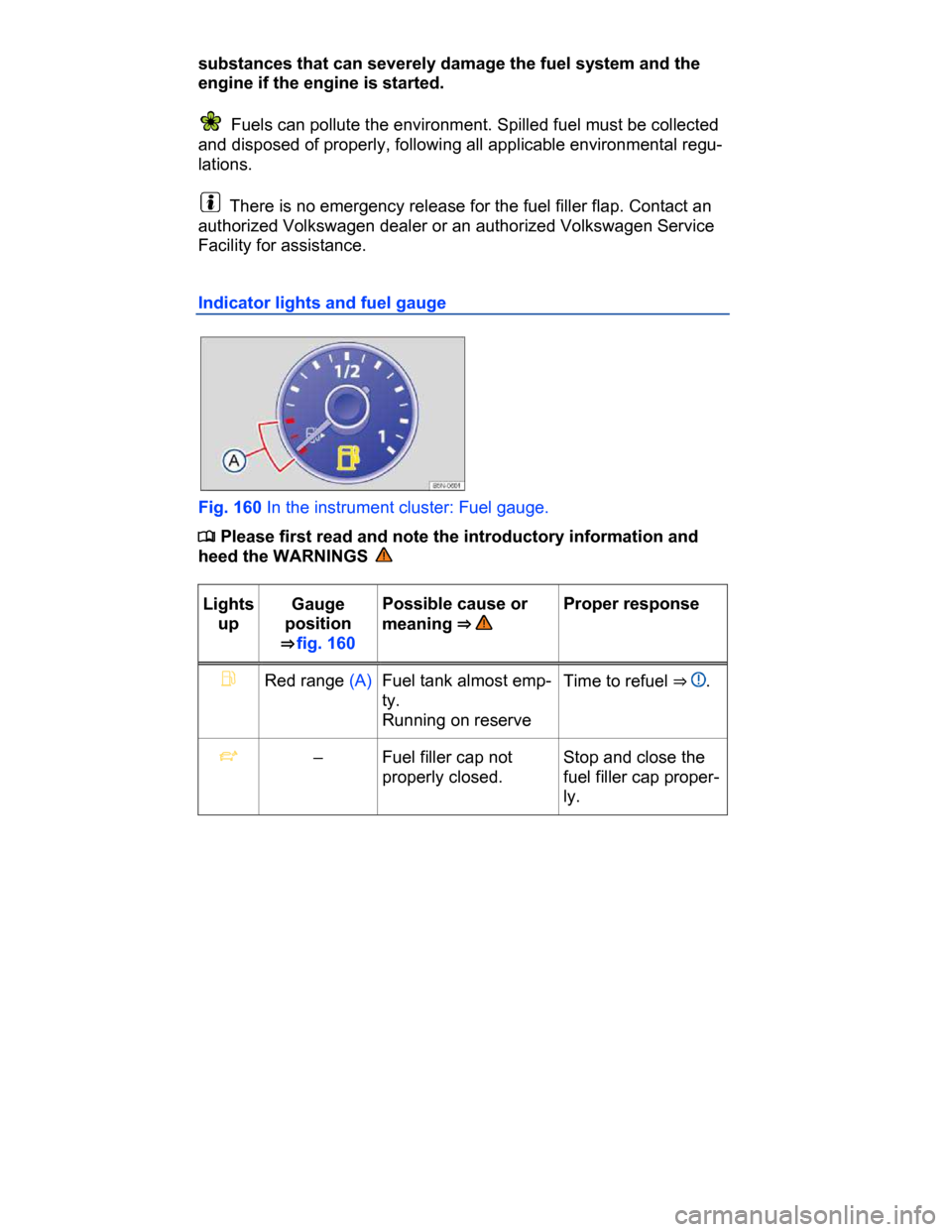
Indicator lights and fuel gauge
Fig. 160 In the instrument cluster: Fuel gauge.