seats VOLKSWAGEN POLO 2015 Owner´s Manual
[x] Cancel search | Manufacturer: VOLKSWAGEN, Model Year: 2015, Model line: POLO, Model: VOLKSWAGEN POLO 2015Pages: 100, PDF Size: 4.14 MB
Page 80 of 100
Downloaded from www.Manualslib.com manuals search engine 12/29/2015Bedienungsanleitung < Service & Zubehör < Volkswagen Deutschland
45/136
Warning lamp
Incorrectly fastened or unfastened seat belts increase the risk of severe or fatal injuries. Seat belts will only offer the optimum level of protection
when they are fastened and used properly.
Seat belts are the most effective means of reducing the risk of serious and fatal injuries in the event of an accident. Seat belts must always
be fastened properly when the vehicle is in motion to protect the driver and all vehicle occupants.
Before every trip, each vehicle occupant must adopt the correct sitting position, correctly fasten the seat belt belonging to their seat and
keep it fastened properly throughout the trip. This applies to all vehicle occupants and also in urban traffic.
While the vehicle is in motion, secure all children travelling in the vehicle in a restraint system suitable for their weight and height. They must
also wear correctly fastened seat belts → Child seats .
Only start driving when all passengers have correctly fastened their seat belts.
Only ever insert the latch plate into the buckle of the associated seat, and always ensure that it engages properly. Using a buckle that does
not belong to the seat that you are occupying reduces the level of protection and can lead to severe injuries.
Avoid allowing foreign bodies or liquids to enter the slot for the seat belt buckle. This could prevent the belt buckle and seat belt from
working properly.
Never unfasten the seat belt while the vehicle is in motion.
Never allow more than one person to share the same seat belt.
Never travel when children or babies are being carried on somebody's lap and fastened with the same belt.
Never travel wearing loose, bulky clothing (such as an overcoat over a jacket). This could prevent the seat belts from fitting and functioning
properly.
WARNING
Damaged seat belts are very dangerous and can cause severe or fatal injuries.
Never damage the belt by trapping it in the door or in the seat mechanism.
If the belt webbing or any other part of the seat belt becomes damaged, the seat belt may tear during an accident or sudden braking
manoeuvre.
Have damaged seat belts immediately replaced by new seat belts that have been approved by Volkswagen for the vehicle. Seat belts
subjected to stress and stretched during an accident must be replaced by a qualified workshop. Renewal may be necessary even if there is
no apparent damage. The belt anchorage should also be checked.
Never try to repair, modify or remove the seat belts yourself. All repairs to the seat belts, belt retractors and buckles must be carried out by a
qualified workshop.
WARNING
Page 87 of 100
Downloaded from www.Manualslib.com manuals search engine 12/29/2015Bedienungsanleitung < Service & Zubehör < Volkswagen Deutschland
52/136
risk of severe or fatal injuries. Correct seat belt routing also holds the vehicle occupants in position so that an inflating airbag can offer the
maximum level of protection. Therefore you must always fasten your seat belt and ensure that the seat belt routing is correct.
Assuming an incorrect sitting position can cause severe or fatal injuries → Adjusting the seat position .
Correct seat belt routing
The shoulder part of the seat belt must always lie on the centre of the shoulder, never across the neck, over or under the arm or behind the
back.
The lap part of the seat belt must always lie across the pelvis, never across the stomach.
The seat belt must always lie flat and snugly on the body. Tighten the belt if necessary.
For pregnant women the seat belt must be positioned evenly over the chest and as low as possible over the pelvis. It must lie flat so that no
pressure is exerted on the lower body – this applies in every stage of pregnancy → Fig. 57 .
Correct seat belt routing according to height
The following equipment can be used to adjust the seat belt routing:
Belt height adjuster for the front seats → Belt height adjuster .
Height-adjustable front seats → Adjusting the seat position .
If a person's physical build prevents them from routing the seat belt properly, contact a qualified workshop to find out about any special
modifications so that the seat belts and airbags can provide the optimum level of protection. Volkswagen recommends using a Volkswagen
dealership for this purpose.
Belt height adjuster
Incorrect seat belt routing can cause severe injuries in the event of an accident or a sudden braking or driving manoeuvre.
The seat belts only offer best protection when the backrests are in an upright position and the seat belts have been fastened properly.
The seat belt itself or a loose seat belt can cause serious injuries if the seat belt shifts from harder body parts in the direction of softer body
parts (e.g. stomach).
The shoulder part of the seat belt must lie on the centre of the shoulder and never under the arm or across the neck.
The seat belt must lie flat and snugly on the chest.
The lap part of the seat belt must lie across the pelvis and never across the stomach. The seat belt must lie flat and snugly on the pelvis.
Tighten the belt if necessary.
For pregnant women, the lap part of the seat belt must be as low as possible over the pelvis and lie flat around the bulge of the belly.
Do not twist the belt webbing while the seat belt is being worn.
Never hold the seat belt away from the body by hand.
The belt webbing should not lie over hard or fragile objects, such as glasses, pens or keys.
Never use seat belt clips, retaining rings or similar items to alter the seat belt routing.
WARNING
Page 88 of 100
Downloaded from www.Manualslib.com manuals search engine 12/29/2015Bedienungsanleitung < Service & Zubehör < Volkswagen Deutschland
53/136
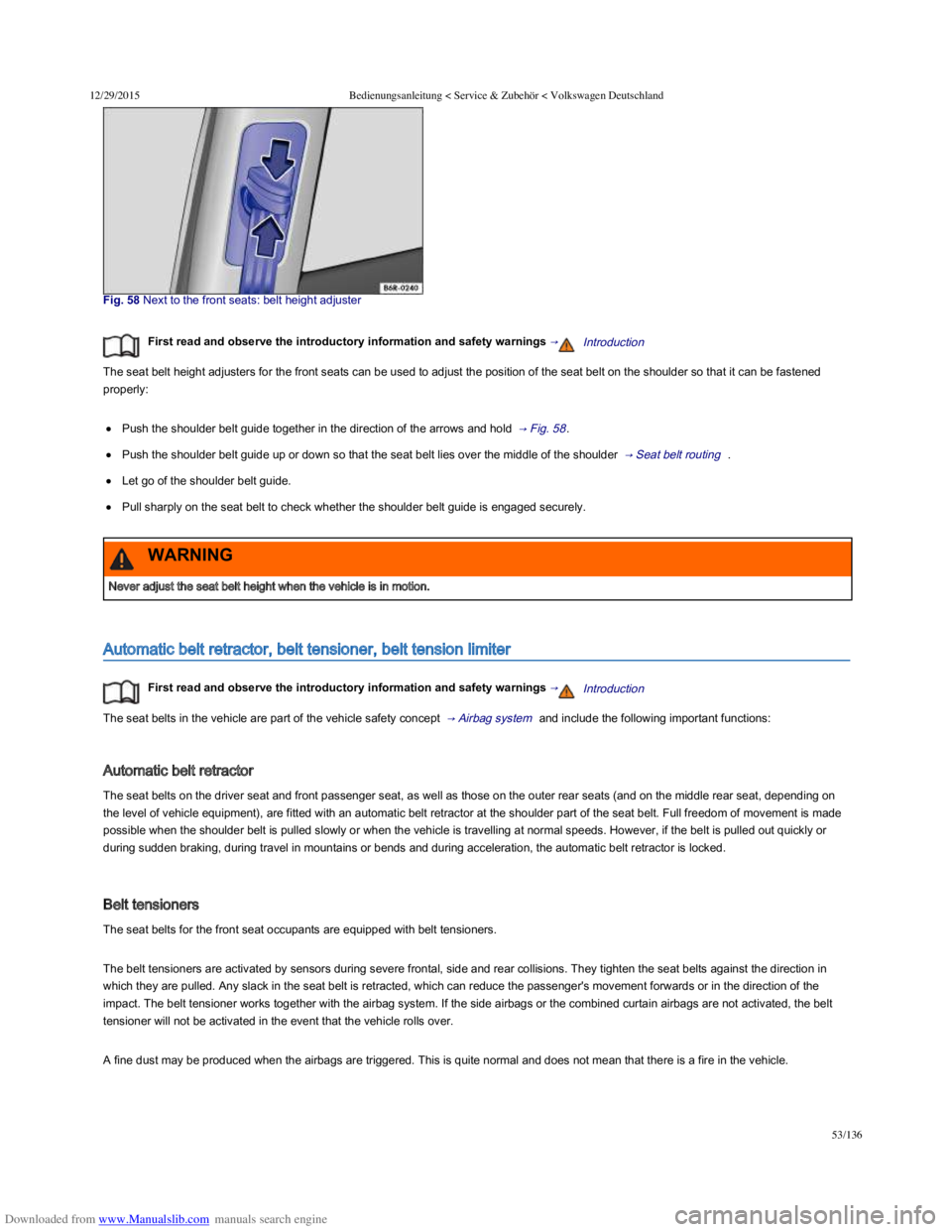
Fig. 58 Next to the front seats: belt height adjuster
First read and observe the introductory information and safety warnings →Introduction
The seat belt height adjusters for the front seats can be used to adjust the position of the seat belt on the shoulder so that it can be fastened
properly:
Push the shoulder belt guide together in the direction of the arrows and hold → Fig. 58 .
Push the shoulder belt guide up or down so that the seat belt lies over the middle of the shoulder → Seat belt routing .
Let go of the shoulder belt guide.
Pull sharply on the seat belt to check whether the shoulder belt guide is engaged securely.
Automatic belt retractor, belt tensioner, belt tension limiter
First read and observe the introductory information and safety warnings →Introduction
The seat belts in the vehicle are part of the vehicle safety concept → Airbag system and include the following important functions:
Automatic belt retractor
The seat belts on the driver seat and front passenger seat, as well as those on the outer rear seats (and on the middle rear seat, depending on
the level of vehicle equipment), are fitted with an automatic belt retractor at the shoulder part of the seat belt. Full freedom of movement is made
possible when the shoulder belt is pulled slowly or when the vehicle is travelling at normal speeds. However, if the belt is pulled out quickly or
during sudden braking, during travel in mountains or bends and during acceleration, the automatic belt retractor is locked.
Belt tensioners
The seat belts for the front seat occupants are equipped with belt tensioners.
The belt tensioners are activated by sensors during severe frontal, side and rear collisions. They tighten the seat belts against the direction in
which they are pulled. Any slack in the seat belt is retracted, which can reduce the passenger's movement forwards or in the direction of the
impact. The belt tensioner works together with the airbag system. If the side airbags or the combined curtain airbags are not activated, the belt
tensioner will not be activated in the event that the vehicle rolls over.
A fine dust may be produced when the airbags are triggered. This is quite normal and does not mean that there is a fire in the vehicle.
Never adjust the seat belt height when the vehicle is in motion.
WARNING
Page 89 of 100
Downloaded from www.Manualslib.com manuals search engine 12/29/2015Bedienungsanleitung < Service & Zubehör < Volkswagen Deutschland
54/136
Belt tension limiter
The belt tension limiter reduces the pressure exerted by the seat belt on the body during an accident.
All safety requirements must be observed when the vehicle or components of the system are scrapped. Qualified workshops are familiar
with these requirements → Service and disposal of belt tensioners .
Service and disposal of belt tensioners
First read and observe the introductory information and safety warnings →Introduction
Seat belts may become damaged during any work on the belt tensioners or while removing or refitting any vehicle parts in conjunction with any
other repair work. This damage will not always be noticeable. The consequence may be that the belt tensioners could function incorrectly, or not
function at all, in the event of an accident.
Regulations must be observed to ensure that the effectiveness of the belt tensioner is not reduced and that removed parts do not cause any
injuries or environmental pollution. Qualified workshops are familiar with these requirements.
The airbag modules and belt tensioners may contain perchlorate. Please comply with legislation regarding disposal.
Introduction
This chapter contains information on the following subjects:
→ Types of front passenger front airbag system
→ Indicator lamps
→ Description and function of the airbags
→ Front airbags
→ Switching the front passenger front airbag on and off manually using the key-operated switch
→ Side airbags
→ Combined curtain and side airbags
→ Curtain airbags
The vehicle is equipped with a front airbag for the driver and front passenger. The front airbags can provide front seat occupants with additional
chest and head protection if the seat, seat belts, head restraints and, in the case of the driver, steering wheel are adjusted and used correctly.
Airbags are meant only for additional protection. The airbags are not a substitute for seat belts. Seat belts must always be worn, even when the
front seats are equipped with front airbags.
Additional information and warnings:
Driving tips → Driving tips
The risk of severe or fatal injuries may be increased if the seat belts, automatic belt retractors and belt tensioners are not used correctly, or if
they are repaired by a non-professional. As a result, the belt tensioners may not be triggered when they should, or they may be triggered
unexpectedly.
Any repairs, adjustments or removal and refitting of parts in the belt tensioners or seat belts should always be carried out by a qualified
workshop and never by yourself → Accessories, modifications, repairs and renewal of parts .
Belt tensioners and automatic belt retractors cannot be repaired. They must be replaced.
WARNING
Airbag system
Page 90 of 100
Downloaded from www.Manualslib.com manuals search engine 12/29/2015Bedienungsanleitung < Service & Zubehör < Volkswagen Deutschland
55/136
Central locking system → Central locking system
Correct sitting position → Adjusting the seat position
Seat belts → Seat belts
Child seats → Child seats
Cleaning and caring for the interior → Cleaning and caring for the interior
Accessories, modifications, repairs and renewal of parts → Accessories, modifications, repairs and renewal of parts
Consumer information → Consumer information
Never rely solely on the airbag system for your protection.
Even if an airbag is triggered, it only offers auxiliary protection.
The airbag system offers the best level of protection, and reduces the risk of injury, when seat belts are properly worn → Seat belts .
Before every trip, each vehicle occupant must adopt the correct sitting position, correctly fasten the seat belt belonging to their seat and
keep it fastened properly throughout the trip. This applies to all vehicle occupants and also in urban traffic.
WARNING
The risk of injury increases if there are any objects between the vehicle occupants and the deployment area of the airbag when it is triggered.
This will alter the deployment zone of the airbag, or the objects will be flung against the body.
Never hold any objects in your hand or on your lap while the vehicle is in motion.
Never transport any objects on the front passenger seat. The objects could enter the deployment zone of the airbag during sudden braking
or driving manoeuvres and then be flung dangerously through the vehicle interior if the airbag is activated.
Vehicle occupants sitting on the front seats and rear outer seats must never carry any people, pets or objects in the deployment zone
between themselves and the airbags. Make sure that children and passengers also keep to this rule.
WARNING
The airbag system can only be triggered once. The system will have to be replaced if the airbags have been triggered.
Airbags that have been triggered, and any affected system parts, must immediately be replaced with new parts that are approved by
Volkswagen for the vehicle.
Repairs and modifications to your vehicle should only be carried out by a qualified workshop. Qualified workshops have the necessary tools,
diagnostic equipment, repair information and qualified personnel.
Never use recycled airbag components or components that have been taken from end-of-life vehicles in your vehicle.
Never alter any components of the airbag system.
WARNING
Page 93 of 100
Downloaded from www.Manualslib.com manuals search engine 12/29/2015Bedienungsanleitung < Service & Zubehör < Volkswagen Deutschland
58/136
their deployment zones within milliseconds. Once a vehicle occupant wearing a seat belt starts to sink into the inflated airbag, the gas inside the
airbag starts to escape to cushion the occupant and slow down their movement. This can reduce the risk of severe and fatal injuries. A triggered
airbag will not always prevent other injuries from occurring, such as swelling, bruising, burning and grazing.
Airbags provide no protection for the arms or lower body.
The most important factors for triggering the airbag are the type of accident, the angle of impact, the vehicle speed and the type of object with
which the vehicle collides. Therefore, visible damage to the vehicle does not always mean that the airbag should have been triggered.
Whether or not the airbag triggers is determined by the vehicle deceleration rate caused by the collision and registered by the electronic control
unit. If this rate is below the reference value programmed into the control unit, the airbags will not be triggered, even though the vehicle may be
badly damaged as a result of the collision. Vehicle damage, repair costs or even the lack of vehicle damage in an accident do not necessarily
give an indication of whether an airbag should inflate or not. It is not possible to define a range of vehicle speeds and reference values, since the
circumstances will vary considerably between one collision and another. It is therefore impossible to cover every possible kind and angle of
impact that would trigger the airbags. Important factors in the triggering of the airbag include the nature (hard or soft) of the object that the vehicle
hits, the angle of impact, and the vehicle speed.
Airbags only serve as a supplement to the three-point seat belt in some accident situations when the vehicle braking is sufficient to trigger the
airbags. Airbags can only be triggered once and only in certain situations. The seat belts are always there to provide protection in situations in
which the airbags are not triggered or have already been triggered. For example, if the vehicle collides with a further vehicle following the initial
collision, or is hit by another vehicle.
The airbag system is part of the vehicle's overall passive safety concept. The airbag system can only work effectively when the occupants are
wearing their seat belts correctly and have assumed a proper sitting position → Adjusting the seat position .
Components of the vehicle safety concept
The following vehicle safety equipment makes up the vehicle's safety concept to reduce the risk of severe and fatal injuries. Some of this
equipment may not be fitted in your particular vehicle. It may not be available at all in some countries.
Optimised seat belts for all seats.
Belt tensioners for driver and front passenger.
Belt tension limiter for the driver, front passenger and, if applicable, for the rear outer seats.
Belt height adjuster for the front seats.
Warning lamp .
Front airbags for driver and front passenger.
Combined curtain and side airbags for the driver and front passenger.
Curtain airbags on the right and left.
Airbag indicator lamp .
PASSENGER AIR BAG Indicator lamp in top area of the centre console.
Control units and sensors.
Height-adjustable head restraints optimised for rear impact.
Adjustable steering column.
If fitted, ISOFIX anchor points for child seats on the rear outer seats.
If applicable, securing points for the top tether for child seats.
Situations when the front, side, head or combined curtain and side airbags will not be triggered:
If the ignition is switched off during a collision.
Page 95 of 100
Downloaded from www.Manualslib.com manuals search engine 12/29/2015Bedienungsanleitung < Service & Zubehör < Volkswagen Deutschland
60/136
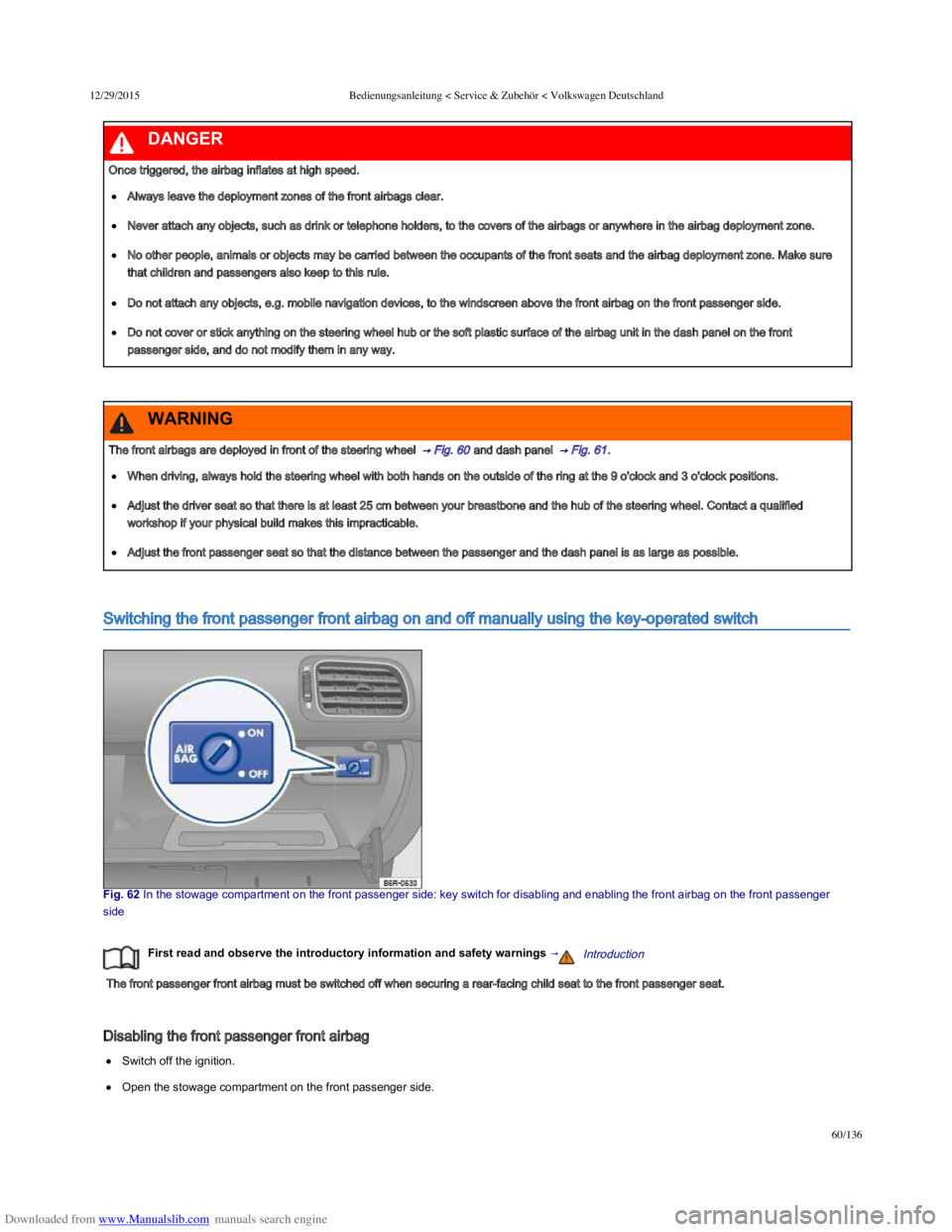
Switching the front passenger front airbag on and off manually using the key-operated switch
Fig. 62 In the stowage compartment on the front passenger side: key switch for disabling and enabling the front airbag on the front passenger
side
First read and observe the introductory information and safety warnings →Introduction
The front passenger front airbag must be switched off when securing a rear-facing child seat to the front passenger seat.
Disabling the front passenger front airbag
Switch off the ignition.
Open the stowage compartment on the front passenger side.
Once triggered, the airbag inflates at high speed.
Always leave the deployment zones of the front airbags clear.
Never attach any objects, such as drink or telephone holders, to the covers of the airbags or anywhere in the airbag deployment zone.
No other people, animals or objects may be carried between the occupants of the front seats and the airbag deployment zone. Make sure
that children and passengers also keep to this rule.
Do not attach any objects, e.g. mobile navigation devices, to the windscreen above the front airbag on the front passenger side.
Do not cover or stick anything on the steering wheel hub or the soft plastic surface of the airbag unit in the dash panel on the front
passenger side, and do not modify them in any way.
DANGER
The front airbags are deployed in front of the steering wheel → Fig. 60 and dash panel → Fig. 61 .
When driving, always hold the steering wheel with both hands on the outside of the ring at the 9 o'clock and 3 o'clock positions.
Adjust the driver seat so that there is at least 25 cm between your breastbone and the hub of the steering wheel. Contact a qualified
workshop if your physical build makes this impracticable.
Adjust the front passenger seat so that the distance between the passenger and the dash panel is as large as possible.
WARNING
Page 98 of 100
Downloaded from www.Manualslib.com manuals search engine 12/29/2015Bedienungsanleitung < Service & Zubehör < Volkswagen Deutschland
63/136
Combined curtain and side airbags
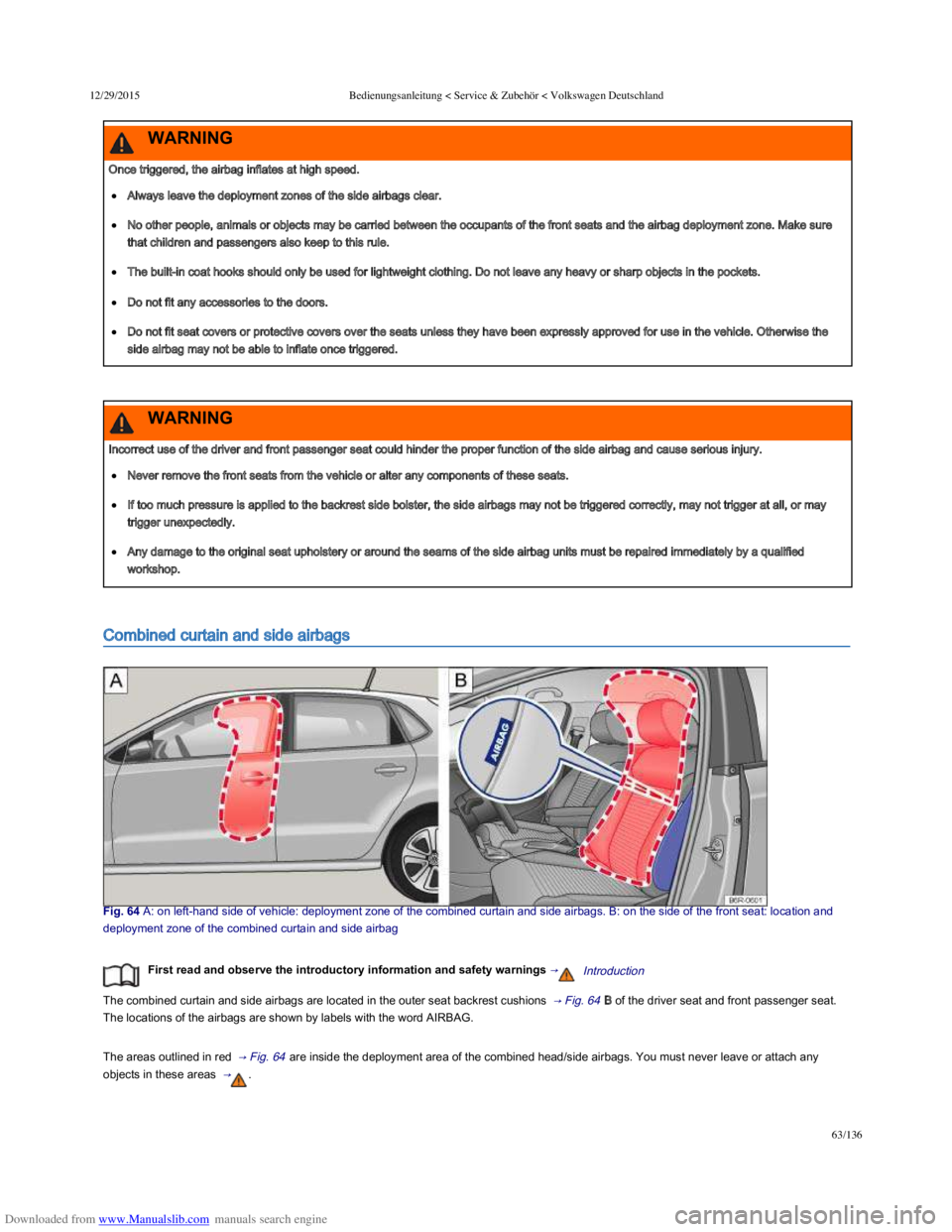
Fig. 64 A: on lefthand side of vehicle: deployment zone of the combined curtain and side airbags. B: on the side of the front seat: location and
deployment zone of the combined curtain and side airbag
First read and observe the introductory information and safety warnings →Introduction
The combined curtain and side airbags are located in the outer seat backrest cushions → Fig. 64 B of the driver seat and front passenger seat.
The locations of the airbags are shown by labels with the word AIRBAG.
The areas outlined in red → Fig. 64 are inside the deployment area of the combined head/side airbags. You must never leave or attach any
objects in these areas → .
Once triggered, the airbag inflates at high speed.
Always leave the deployment zones of the side airbags clear.
No other people, animals or objects may be carried between the occupants of the front seats and the airbag deployment zone. Make sure
that children and passengers also keep to this rule.
The built-in coat hooks should only be used for lightweight clothing. Do not leave any heavy or sharp objects in the pockets.
Do not fit any accessories to the doors.
Do not fit seat covers or protective covers over the seats unless they have been expressly approved for use in the vehicle. Otherwise the
side airbag may not be able to inflate once triggered.
WARNING
Incorrect use of the driver and front passenger seat could hinder the proper function of the side airbag and cause serious injury.
Never remove the front seats from the vehicle or alter any components of these seats.
If too much pressure is applied to the backrest side bolster, the side airbags may not be triggered correctly, may not trigger at all, or may
trigger unexpectedly.
Any damage to the original seat upholstery or around the seams of the side airbag units must be repaired immediately by a qualified
workshop.
WARNING
Page 99 of 100

Downloaded from www.Manualslib.com manuals search engine 12/29/2015Bedienungsanleitung < Service & Zubehör < Volkswagen Deutschland
64/136
During a side collision, the combined curtain and side airbags will be deployed on the vehicle's side of impact, reducing the risk of injury to the
areas of the vehicle occupants' bodies facing the impact.
Curtain airbags
Fig. 65 On the lefthand side of the vehicle: location and deployment zone of the curtain airbag
First read and observe the introductory information and safety warnings →Introduction
In the interior, a curtain airbag is fitted above the doors on both the driver and front passenger sides → Fig. 65 . The airbag location is identified
by the text AIRBAG.
Once triggered, the airbag inflates at high speed.
Always keep the deployment zones of the combined curtain and side airbags clear.
No other people, animals or objects may be carried between the occupants of the front seats and the airbag deployment zone. Make sure
that children and passengers also keep to this rule.
The built-in coat hooks should only be used for lightweight clothing. Do not leave any heavy or sharp objects in the pockets.
Do not fit any accessories to the doors.
Do not fit seat covers or protective covers over the seats unless they have been expressly approved for use in the vehicle. Otherwise the
combined combined curtain and side airbags may not be able to deploy if it has been triggered.
WARNING
Incorrect use of the driver and front passenger seat could hinder the proper function of the combined curtain and side airbags and cause
serious injury.
Never remove the front seats from the vehicle or alter any components of these seats.
If too much pressure is applied to the backrest side bolster, the combined curtain and side airbags may not be triggered correctly, may not
trigger at all or may trigger unexpectedly.
Any damage to the original seat upholstery or around the seams of the combined curtain and side airbag units must be repaired immediately
by a qualified workshop.
WARNING
Page 100 of 100

Downloaded from www.Manualslib.com manuals search engine 12/29/2015Bedienungsanleitung < Service & Zubehör < Volkswagen Deutschland
65/136
The area in the red frame → Fig. 65 is covered by the curtain airbag when triggered (deployment zone). For this reason, you must never leave or
attach any items in this area → .
In a side collision the curtain airbag is triggered on the impact side of the vehicle.
In a side collision, the curtain airbags reduce the risk of injury to the areas of the body facing the impact for vehicle occupants on the front seats
and outer rear seats.
Introduction
This chapter contains information on the following subjects:
→ Basic information on fitting and using child seats
→ Types of child seat
→ Securing systems
→ Securing a child seat with ISOFIX
→ Securing child seats with the upper strap (top tether)
→ Securing child seats with a seat belt
Using child seats can reduce the risk of injury to the child if there is an accident. Always use child seats when driving with children.
Note the following:
Child seats are classified into groups depending on the size, age and weight of child for which they are designed.
Various securing systems are used to secure child seats in the vehicle.
For safety reasons child seats should always be fitted to the rear seats. They should only be fitted to the front passenger seat in exceptional
cases.
Volkswagen recommends child seats from the Volkswagen range of accessories. These child seats have been developed and approved for use
in Volkswagen vehicles.
Once triggered, the airbag inflates at high speed.
Always leave the deployment zones of the curtain airbags clear.
Never secure any items to the cover or in the deployment zone of the curtain airbag.
Vehicle occupants sitting on the front seats and rear outer seats must never carry any people, pets or objects in the deployment zone
between themselves and the airbags. Make sure that children and passengers also keep to this rule.
The built-in coat hooks should only be used for lightweight clothing. Do not leave any heavy or sharp objects in the pockets.
Do not fit any accessories to the doors.
Do not install any sunblinds onto the side windows unless they have been expressly approved for use in your vehicle.
Only push the sunblinds over to the side windows if no items are attached to them (e.g. pens or the remote control for a garage door).
WARNING
Child seats