belt VOLKSWAGEN POLO 2015 Owner´s Manual
[x] Cancel search | Manufacturer: VOLKSWAGEN, Model Year: 2015, Model line: POLO, Model: VOLKSWAGEN POLO 2015Pages: 100, PDF Size: 4.14 MB
Page 92 of 100
Downloaded from www.Manualslib.com manuals search engine 12/29/2015Bedienungsanleitung < Service & Zubehör < Volkswagen Deutschland
57/136
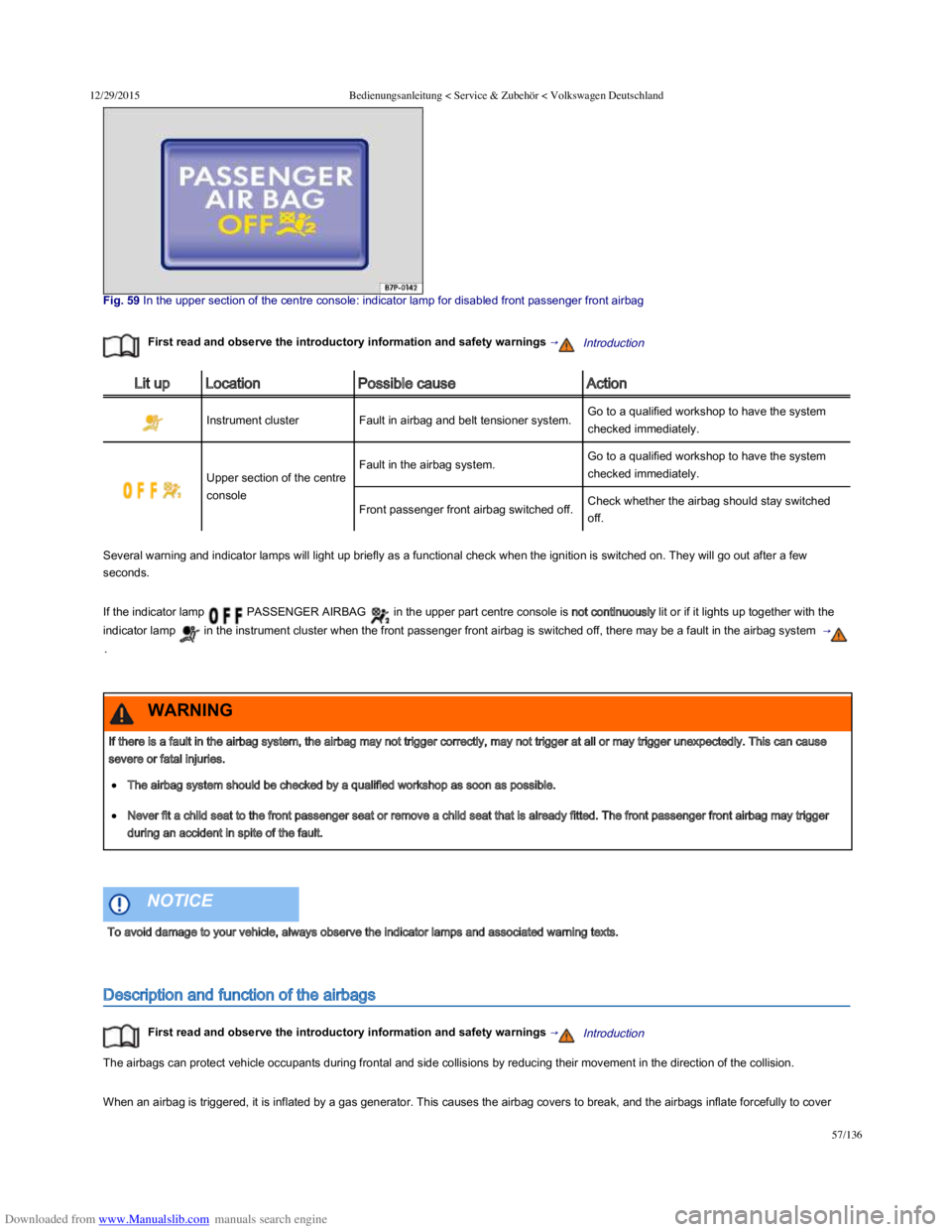
Fig. 59 In the upper section of the centre console: indicator lamp for disabled front passenger front airbag
First read and observe the introductory information and safety warnings →Introduction
Lit upLocationPossible causeAction
Instrument clusterFault in airbag and belt tensioner system.Go to a qualified workshop to have the system
checked immediately.
Upper section of the centre
console
Fault in the airbag system.Go to a qualified workshop to have the system
checked immediately.
Front passenger front airbag switched off.Check whether the airbag should stay switched
off.
Several warning and indicator lamps will light up briefly as a functional check when the ignition is switched on. They will go out after a few
seconds.
If the indicator lamp PASSENGER AIRBAG in the upper part centre console is not continuously lit or if it lights up together with the
indicator lamp in the instrument cluster when the front passenger front airbag is switched off, there may be a fault in the airbag system →
.
Description and function of the airbags
First read and observe the introductory information and safety warnings →Introduction
The airbags can protect vehicle occupants during frontal and side collisions by reducing their movement in the direction of the collision.
When an airbag is triggered, it is inflated by a gas generator. This causes the airbag covers to break, and the airbags inflate forcefully to cover
If there is a fault in the airbag system, the airbag may not trigger correctly, may not trigger at all or may trigger unexpectedly. This can cause
severe or fatal injuries.
The airbag system should be checked by a qualified workshop as soon as possible.
Never fit a child seat to the front passenger seat or remove a child seat that is already fitted. The front passenger front airbag may trigger
during an accident in spite of the fault.
WARNING
To avoid damage to your vehicle, always observe the indicator lamps and associated warning texts.
NOTICE
Page 93 of 100
Downloaded from www.Manualslib.com manuals search engine 12/29/2015Bedienungsanleitung < Service & Zubehör < Volkswagen Deutschland
58/136
their deployment zones within milliseconds. Once a vehicle occupant wearing a seat belt starts to sink into the inflated airbag, the gas inside the
airbag starts to escape to cushion the occupant and slow down their movement. This can reduce the risk of severe and fatal injuries. A triggered
airbag will not always prevent other injuries from occurring, such as swelling, bruising, burning and grazing.
Airbags provide no protection for the arms or lower body.
The most important factors for triggering the airbag are the type of accident, the angle of impact, the vehicle speed and the type of object with
which the vehicle collides. Therefore, visible damage to the vehicle does not always mean that the airbag should have been triggered.
Whether or not the airbag triggers is determined by the vehicle deceleration rate caused by the collision and registered by the electronic control
unit. If this rate is below the reference value programmed into the control unit, the airbags will not be triggered, even though the vehicle may be
badly damaged as a result of the collision. Vehicle damage, repair costs or even the lack of vehicle damage in an accident do not necessarily
give an indication of whether an airbag should inflate or not. It is not possible to define a range of vehicle speeds and reference values, since the
circumstances will vary considerably between one collision and another. It is therefore impossible to cover every possible kind and angle of
impact that would trigger the airbags. Important factors in the triggering of the airbag include the nature (hard or soft) of the object that the vehicle
hits, the angle of impact, and the vehicle speed.
Airbags only serve as a supplement to the three-point seat belt in some accident situations when the vehicle braking is sufficient to trigger the
airbags. Airbags can only be triggered once and only in certain situations. The seat belts are always there to provide protection in situations in
which the airbags are not triggered or have already been triggered. For example, if the vehicle collides with a further vehicle following the initial
collision, or is hit by another vehicle.
The airbag system is part of the vehicle's overall passive safety concept. The airbag system can only work effectively when the occupants are
wearing their seat belts correctly and have assumed a proper sitting position → Adjusting the seat position .
Components of the vehicle safety concept
The following vehicle safety equipment makes up the vehicle's safety concept to reduce the risk of severe and fatal injuries. Some of this
equipment may not be fitted in your particular vehicle. It may not be available at all in some countries.
Optimised seat belts for all seats.
Belt tensioners for driver and front passenger.
Belt tension limiter for the driver, front passenger and, if applicable, for the rear outer seats.
Belt height adjuster for the front seats.
Warning lamp .
Front airbags for driver and front passenger.
Combined curtain and side airbags for the driver and front passenger.
Curtain airbags on the right and left.
Airbag indicator lamp .
PASSENGER AIR BAG Indicator lamp in top area of the centre console.
Control units and sensors.
Height-adjustable head restraints optimised for rear impact.
Adjustable steering column.
If fitted, ISOFIX anchor points for child seats on the rear outer seats.
If applicable, securing points for the top tether for child seats.
Situations when the front, side, head or combined curtain and side airbags will not be triggered:
If the ignition is switched off during a collision.
Page 94 of 100

Downloaded from www.Manualslib.com manuals search engine 12/29/2015Bedienungsanleitung < Service & Zubehör < Volkswagen Deutschland
59/136
If the level of deceleration measured by the control unit is too low during a collision at the front of the vehicle.
During a minor side collision.
During rear collisions.
If the vehicle rolls over.
If the impact speed in a collision is lower than the reference value specified in the control unit.
Front airbags
Fig. 60 Location and deployment zone of the driver front airbag
Fig. 61 Location and deployment zone of the front passenger front airbag
First read and observe the introductory information and safety warnings →Introduction
In conjunction with the seat belts, the front airbag system gives the front occupants additional protection for the head and chest in the event of a
severe frontal collision. Always keep as far away from the front airbag as possible → Adjusting the seat position . This allows the front airbags to
inflate fully when triggered, thus providing maximum protection.
The front airbag for the driver is located in the steering wheel → Fig. 60 A and the front airbag for the front passenger is located in the dash panel
→ Fig. 61 A. The airbag locations are identified by the text AIRBAG.
The areas inside the red lines → Fig. 60 B and → Fig. 61 B are covered by the front airbags when triggered (deployment zone). You must never
leave or attach any objects in these areas → . The factory-fitted accessories, such as the base plate for the mobile telephone holder, will not
be struck when the driver and front passenger front airbags are triggered.
The airbag covers fold out of the steering wheel → Fig. 60 B or dash panel → Fig. 61 B when the driver and front passenger airbags deploy.
Page 100 of 100

Downloaded from www.Manualslib.com manuals search engine 12/29/2015Bedienungsanleitung < Service & Zubehör < Volkswagen Deutschland
65/136
The area in the red frame → Fig. 65 is covered by the curtain airbag when triggered (deployment zone). For this reason, you must never leave or
attach any items in this area → .
In a side collision the curtain airbag is triggered on the impact side of the vehicle.
In a side collision, the curtain airbags reduce the risk of injury to the areas of the body facing the impact for vehicle occupants on the front seats
and outer rear seats.
Introduction
This chapter contains information on the following subjects:
→ Basic information on fitting and using child seats
→ Types of child seat
→ Securing systems
→ Securing a child seat with ISOFIX
→ Securing child seats with the upper strap (top tether)
→ Securing child seats with a seat belt
Using child seats can reduce the risk of injury to the child if there is an accident. Always use child seats when driving with children.
Note the following:
Child seats are classified into groups depending on the size, age and weight of child for which they are designed.
Various securing systems are used to secure child seats in the vehicle.
For safety reasons child seats should always be fitted to the rear seats. They should only be fitted to the front passenger seat in exceptional
cases.
Volkswagen recommends child seats from the Volkswagen range of accessories. These child seats have been developed and approved for use
in Volkswagen vehicles.
Once triggered, the airbag inflates at high speed.
Always leave the deployment zones of the curtain airbags clear.
Never secure any items to the cover or in the deployment zone of the curtain airbag.
Vehicle occupants sitting on the front seats and rear outer seats must never carry any people, pets or objects in the deployment zone
between themselves and the airbags. Make sure that children and passengers also keep to this rule.
The built-in coat hooks should only be used for lightweight clothing. Do not leave any heavy or sharp objects in the pockets.
Do not fit any accessories to the doors.
Do not install any sunblinds onto the side windows unless they have been expressly approved for use in your vehicle.
Only push the sunblinds over to the side windows if no items are attached to them (e.g. pens or the remote control for a garage door).
WARNING
Child seats