tow VOLKSWAGEN SCIROCCO 2017 Owner's Guide
[x] Cancel search | Manufacturer: VOLKSWAGEN, Model Year: 2017, Model line: SCIROCCO, Model: VOLKSWAGEN SCIROCCO 2017Pages: 400, PDF Size: 4 MB
Page 271 of 400

Signal chimes
When the vehicle approaches an obstacle located in the range of the ultrasonic sensors, there are audible signal chimes. An intermittent signal chime means that a sufficiently short distance between the vehicle and an obstacle is detected. The shorter the distance, the shorter the intervals between the chimes. The signal chime will sound continuously if the obstacle is very close.
When there is an imminent risk of collision at the front area of the vehicle, the signal chimes beep at the front of the vehicle. When there is a risk of imminent collision at the rear area of the vehicle, the signal chimes beep at the rear of the vehicle.
If you continue to drive the vehicle closer to the obstacle despite a continuous signal chime, the system will no longer be able to measure the distance.
The intermittent signal chime volume decreases after a few seconds if the distance remains the same. The volume remains constant if the signal chime is continuous. As soon as the vehicle moves away from an obstacle again, the intermittent signal chime switches off automatically. If the vehicle moves towards an obstruction again, the intermittent signal chimes beep automatically.
Display
The graphic on the screen displays the scanned areas in several segments. The closer the vehicle drives towards an obstacle, the closer the segment will move to the vehicle in the display. The collision area has been reached at the latest when the second to last segment is displayed. Do not keep driving!
Vehicles with PDC at the front and rear
Area of the vehicle Distance of the vehicle from an obstacle
Signal tone Segment color if an obstacle has been detected color display only)
(A) Rear center Obstacle not in the vehicle’s path
about 12 – 63 in. (31 – 160 cm) – Grey
Rear side about 12 – 23 in. (31 – 60 cm)
(B) Front center about 12 – 47 in. (31 – 120 cm)
Front side about 12 – 23 in. (31 – 60 cm)
(A) Rear center Obstacle in the vehicle’s path
about 12 – 63 in. (31 – 160 cm) Intermittent tone Yellow
Rear side about 12 – 23 in. (31 – 60 cm)
(B) Front center about 12 – 47 in. (31 – 120 cm)
Front side about 12 – 23 in. (31 – 60 cm)
Page 322 of 400
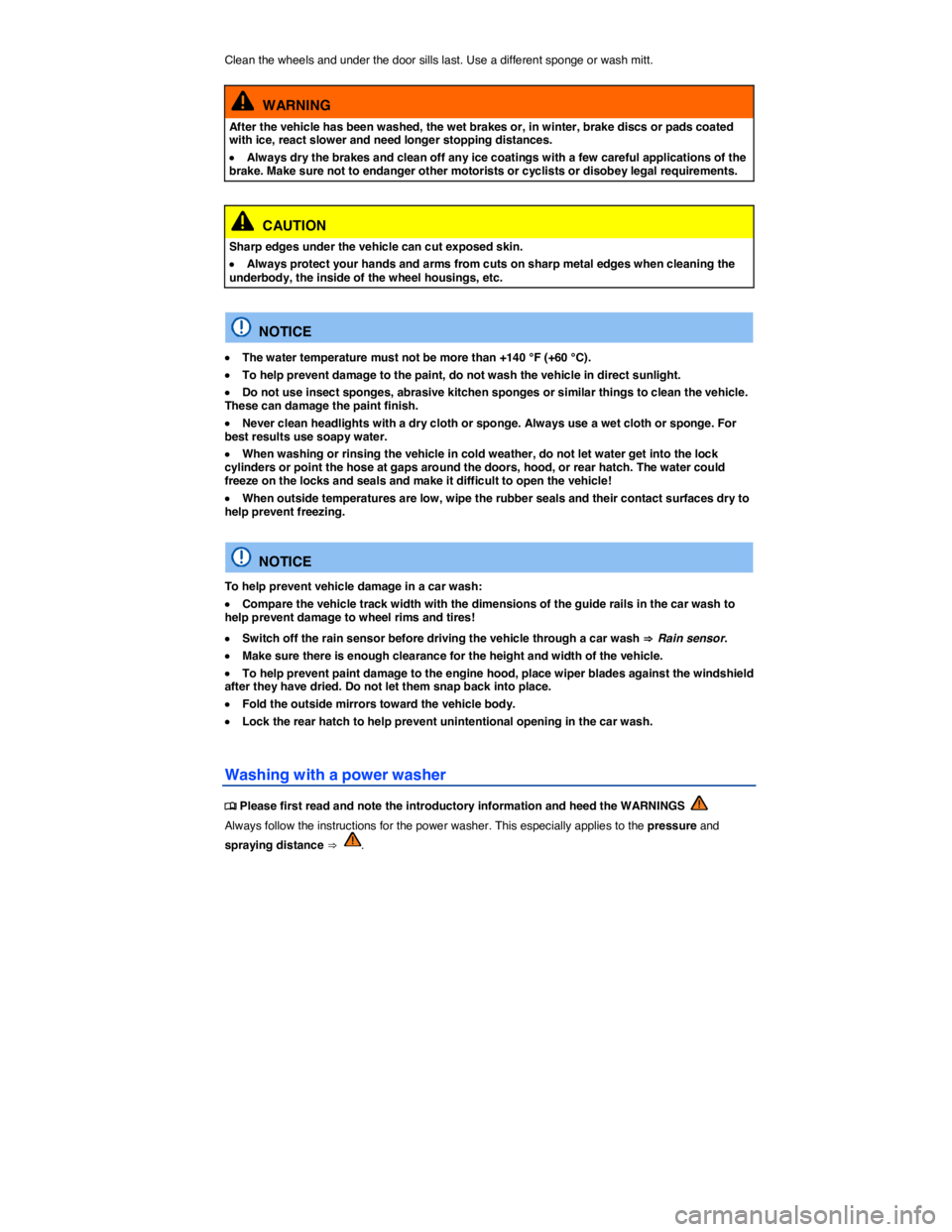
Clean the wheels and under the door sills last. Use a different sponge or wash mitt.
WARNING
After the vehicle has been washed, the wet brakes or, in winter, brake discs or pads coated with ice, react slower and need longer stopping distances.
x Always dry the brakes and clean off any ice coatings with a few careful applications of the brake. Make sure not to endanger other motorists or cyclists or disobey legal requirements.
CAUTION
Sharp edges under the vehicle can cut exposed skin.
x Always protect your hands and arms from cuts on sharp metal edges when cleaning the underbody, the inside of the wheel housings, etc.
NOTICE
x The water temperature must not be more than +140 °F (+60 °C).
x To help prevent damage to the paint, do not wash the vehicle in direct sunlight.
x Do not use insect sponges, abrasive kitchen sponges or similar things to clean the vehicle. These can damage the paint finish.
x Never clean headlights with a dry cloth or sponge. Always use a wet cloth or sponge. For best results use soapy water.
x When washing or rinsing the vehicle in cold weather, do not let water get into the lock cylinders or point the hose at gaps around the doors, hood, or rear hatch. The water could freeze on the locks and seals and make it difficult to open the vehicle!
x When outside temperatures are low, wipe the rubber seals and their contact surfaces dry to help prevent freezing.
NOTICE
To help prevent vehicle damage in a car wash:
x Compare the vehicle track width with the dimensions of the guide rails in the car wash to help prevent damage to wheel rims and tires!
x Switch off the rain sensor before driving the vehicle through a car wash ⇒ Rain sensor.
x Make sure there is enough clearance for the height and width of the vehicle.
x To help prevent paint damage to the engine hood, place wiper blades against the windshield after they have dried. Do not let them snap back into place.
x Fold the outside mirrors toward the vehicle body.
x Lock the rear hatch to help prevent unintentional opening in the car wash.
Washing with a power washer
Page 342 of 400

Changing the vehicle's suspension system can change the way that the airbag system works in a crash. For example, using tire-rim combinations not approved by Volkswagen, lowering the vehicle, changing the stiffness of the suspension, including the springs, suspension struts, shock absorbers etc. can change the forces that are measured by the airbag sensors and sent to the electronic control unit. Some suspension changes can, for example, increase the force levels measured by the airbag sensors and sent to the electronic control unit and make the airbag system deploy in crashes in which it would not deploy if the changes had not been made. Other kinds of changes may reduce the force levels measured by the sensors and prevent the airbag from deploying when it should.
Never install leather upholstery on a vehicle that originally had cloth upholstery. Never install cloth upholstery on a vehicle that originally had leather upholstery. The capacitive passenger detection system for the Advanced Airbag system will not work properly if different upholstery is installed on the passenger seat than the upholstery originally installed on the vehicle when it was originally manufactured.
WARNING
Changing the vehicle's suspension including use of unapproved tire-rim combinations can change airbag performance and increase the risk of serious personal injury in a crash.
x Never install suspension components that do not have the same performance characteristics as the components originally installed on your vehicle.
x Never use tire-rim combinations that have not been approved by Volkswagen.
WARNING
Leaving the optional safety belt extender attached to the safety belt buckle on the front passenger seat when the safety belt is not being used will prevent the Advanced Airbag System from working properly and can increase the risk of serious personal injury in a collision.
x Leaving the extender attached to the safety belt buckle when the front seat is occupied and the safety belt is not being used will signal to the airbag control unit that the front passenger seat is occupied and that the safety belt is being used. The electronic control unit for the airbag system will then receive incorrect information that will
– cause the safety belt pretensioner to deploy unnecessarily in collisions and
– cause the front passenger airbag to deploy later in collisions in which the front airbag would otherwise be triggered earlier to help protect an unrestrained front seat passenger.
x Always remove the safety belt extender when it is not needed and stow it safely.
x Never use the safety belt extender to secure a child restraint.
WARNING
Items stored between the safety belt buckle and the center console can cause safety belt buckle to send the wrong information to the airbag control unit and prevent the Advanced Airbag System from working properly.
x Always make sure that nothing can interfere with the safety belt buckles and that they are not obstructed.
Page 363 of 400

x Slip the cover up and over the selector lever ⇒ .
Emergency release for the selector lever (version A)
x With the screwdriver from the vehicle tool kit, carefully push the release lever ⇒ fig. 172 A in the direction of the arrow and hold it in this position.
x Press the release button in the selector lever handle and shift the selector lever to Neutral (N).
x Carefully press the selector gate cover back in place, making sure that the electrical wiring stays in the correct position and is not pinched or damaged.
Emergency release for the selector lever (version B)
x Push the colored release lever B in the direction of the arrow and hold it in this position.
x Press the release button in the selector lever handle and shift the selector lever to Neutral (N).
x Carefully press the selector gate cover back in place, making sure that the electrical wiring stays in the correct position and is not pinched or damaged.
WARNING
Never shift the transmission out of Park (P) without first firmly applying the parking brake. Otherwise, the vehicle can start to roll unexpectedly, especially on hills or inclines, and cause an accident and serious injuries.
NOTICE
Even with the selector lever is in Neutral (N), the automatic transmission will be damaged if the vehicle is towed (or you let it coast) for an extended period or at high speed with the engine shut off.
Page 372 of 400

WARNING
Changing a wheel, especially on the side of the road, can be dangerous. To help reduce the risk of serious personal injury:
x Always stop the vehicle as soon as it is safe to do so. Move the vehicle a safe distance off the road where it is safe to change the wheel.
x Always make sure that all passengers, especially children, are in a safe place outside the vehicle and away from the vehicle and traffic (such as behind a guard rail).
x Turn on the emergency flashers and set up another warning device about 25 yards (25 meters) behind the vehicle to warn approaching traffic.
x Change a wheel by yourself only if you are familiar with the necessary steps. Otherwise, get expert assistance.
x Always switch the engine off, firmly apply the parking brake, and shift the transmission into Park (P) (automatic transmission) or any gear (manual only) to help prevent the vehicle from moving suddenly and slipping off the jack.
x Always make sure that the ground is level and firm. If necessary, place the jack on a large and sturdy board or on a similar ground support.
x Always block the wheel diagonally opposite the wheel being changed with chocks or other similar things.
x If you are towing a trailer, always unhitch it from your vehicle before starting to change the wheel. Always apply the trailer brakes firmly and make sure the trailer cannot move unintentionally.
x Always use proper and undamaged tools when changing a wheel.
x Once a wheel is lifted off the ground, having the transmission in Park (P) or in gear will not prevent sudden vehicle movement.
x Always use a jack that has been approved by the manufacturer for your vehicle. Never use other jacks, even if they have been approved for use on other Volkswagen models.
x To reduce the risk of losing control, crashes, and serious personal injuries, never loosen the screws on rims with threaded rim rings.
x After changing a wheel, have the wheel bolt tightening torque checked with an accurate torque wrench.
x After changing a wheel or tire, reset the Tire Pressure Monitoring System ⇒ Tire Pressure Monitoring System (TPMS).
Preparations for changing a wheel
Page 373 of 400
6. Have all passengers exit and go to a safe place, such as behind a guard rail.
7. Block the diagonally opposite wheel with chocks or other suitable things.
8. If towing a trailer: Unhitch the trailer from the vehicle and park the trailer properly.
9. If the luggage compartment is loaded: Remove the luggage.
10. Raise and secure the luggage compartment floor.
11. If applicable: Remove the subwoofer ⇒ Removing the subwoofer.
12. Unscrew the fastening screw with washer counterclockwise and remove.
13. Take the spare or compact spare wheel and the vehicle tool kit out of the luggage compartment.
14. Take off the wheel covers ⇒ Wheel trim.
WARNING
Disregarding the safety-related checklist may lead to accidents and serious personal injuries.
x Always review and follow the checklist. Follow accepted safety practices and use common sense.
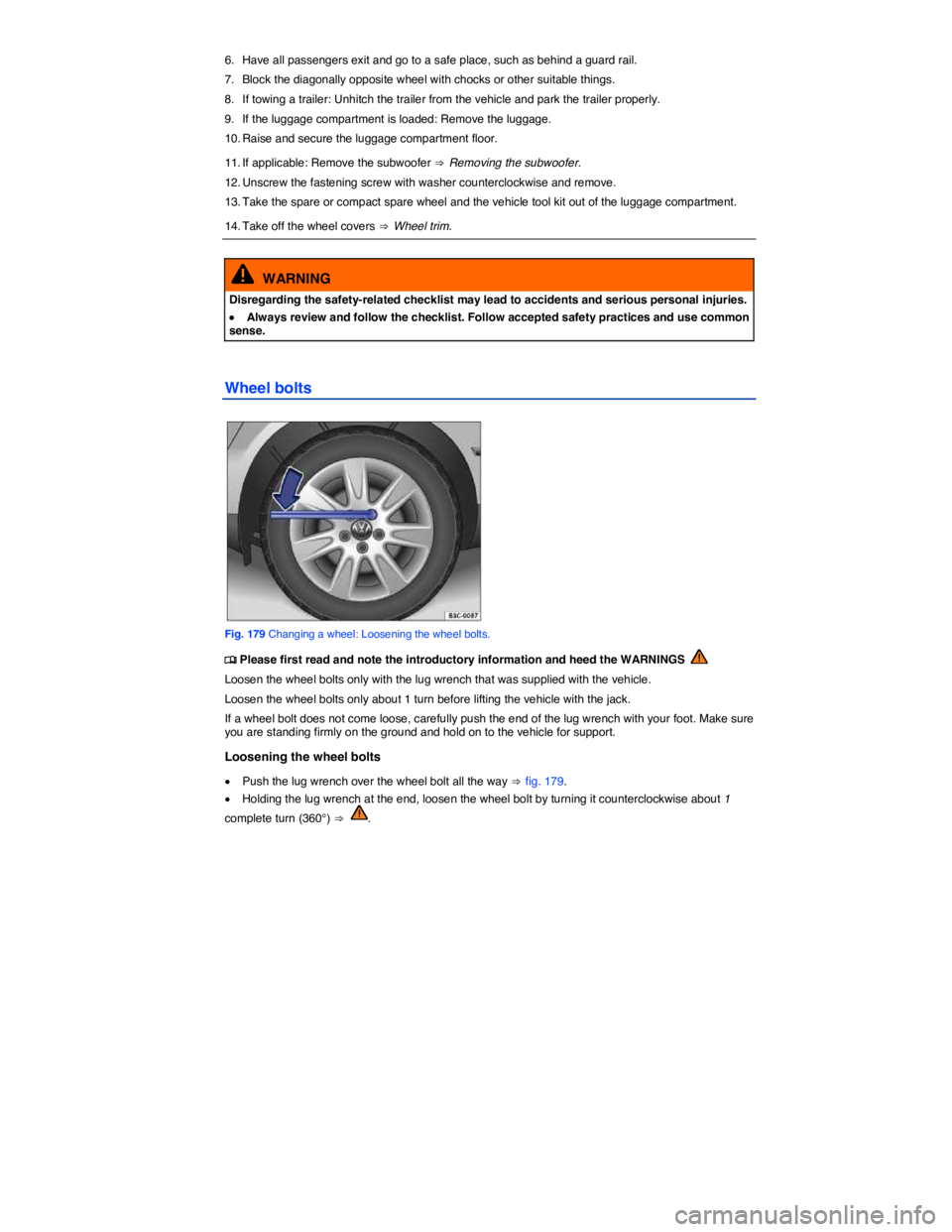
Wheel bolts
Fig. 179 Changing a wheel: Loosening the wheel bolts.
Page 377 of 400
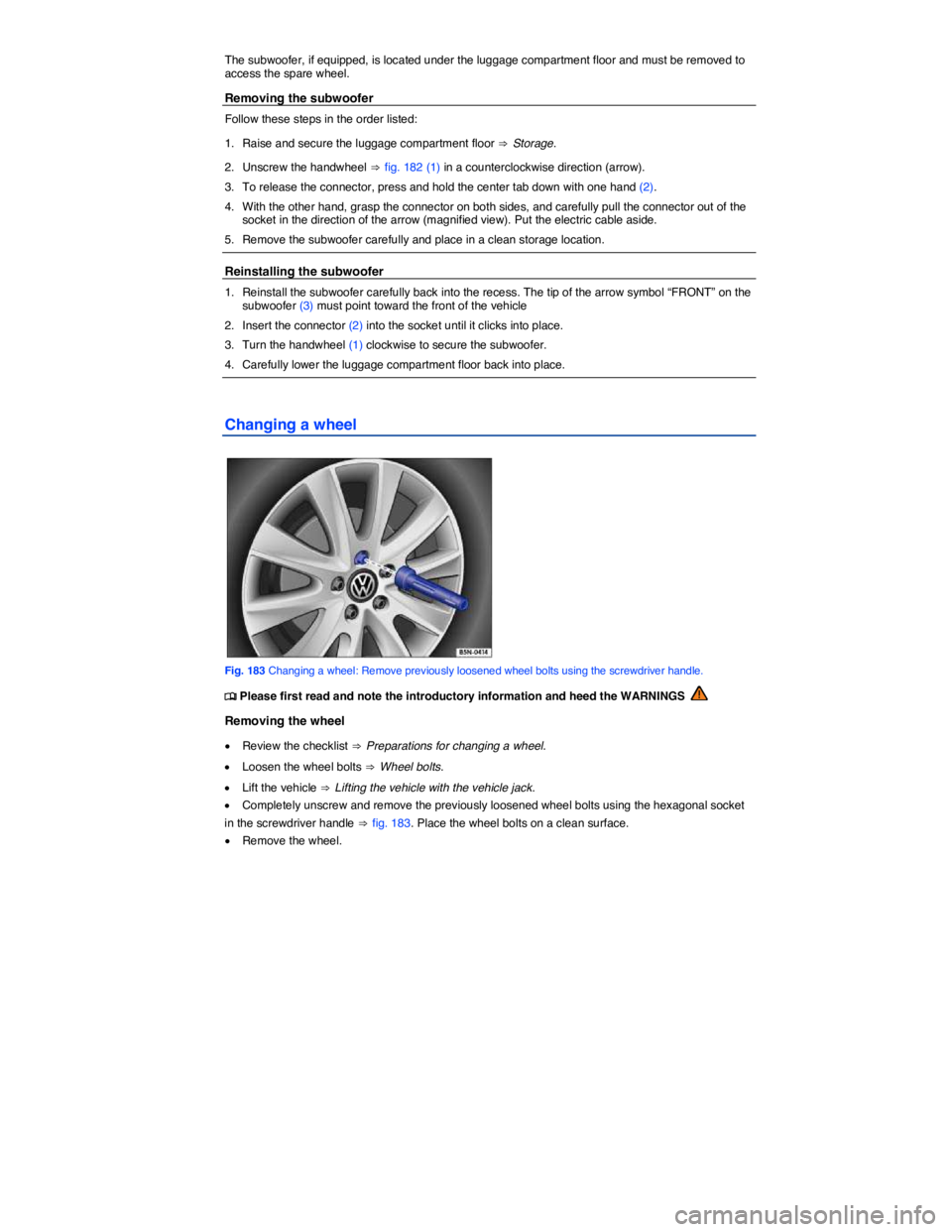
The subwoofer, if equipped, is located under the luggage compartment floor and must be removed to access the spare wheel.
Removing the subwoofer
Follow these steps in the order listed:
1. Raise and secure the luggage compartment floor ⇒ Storage.
2. Unscrew the handwheel ⇒ fig. 182 (1) in a counterclockwise direction (arrow).
3. To release the connector, press and hold the center tab down with one hand (2).
4. With the other hand, grasp the connector on both sides, and carefully pull the connector out of the socket in the direction of the arrow (magnified view). Put the electric cable aside.
5. Remove the subwoofer carefully and place in a clean storage location.
Reinstalling the subwoofer
1. Reinstall the subwoofer carefully back into the recess. The tip of the arrow symbol “FRONT” on the subwoofer (3) must point toward the front of the vehicle
2. Insert the connector (2) into the socket until it clicks into place.
3. Turn the handwheel (1) clockwise to secure the subwoofer.
4. Carefully lower the luggage compartment floor back into place.
Changing a wheel
Fig. 183 Changing a wheel: Remove previously loosened wheel bolts using the screwdriver handle.
Page 381 of 400
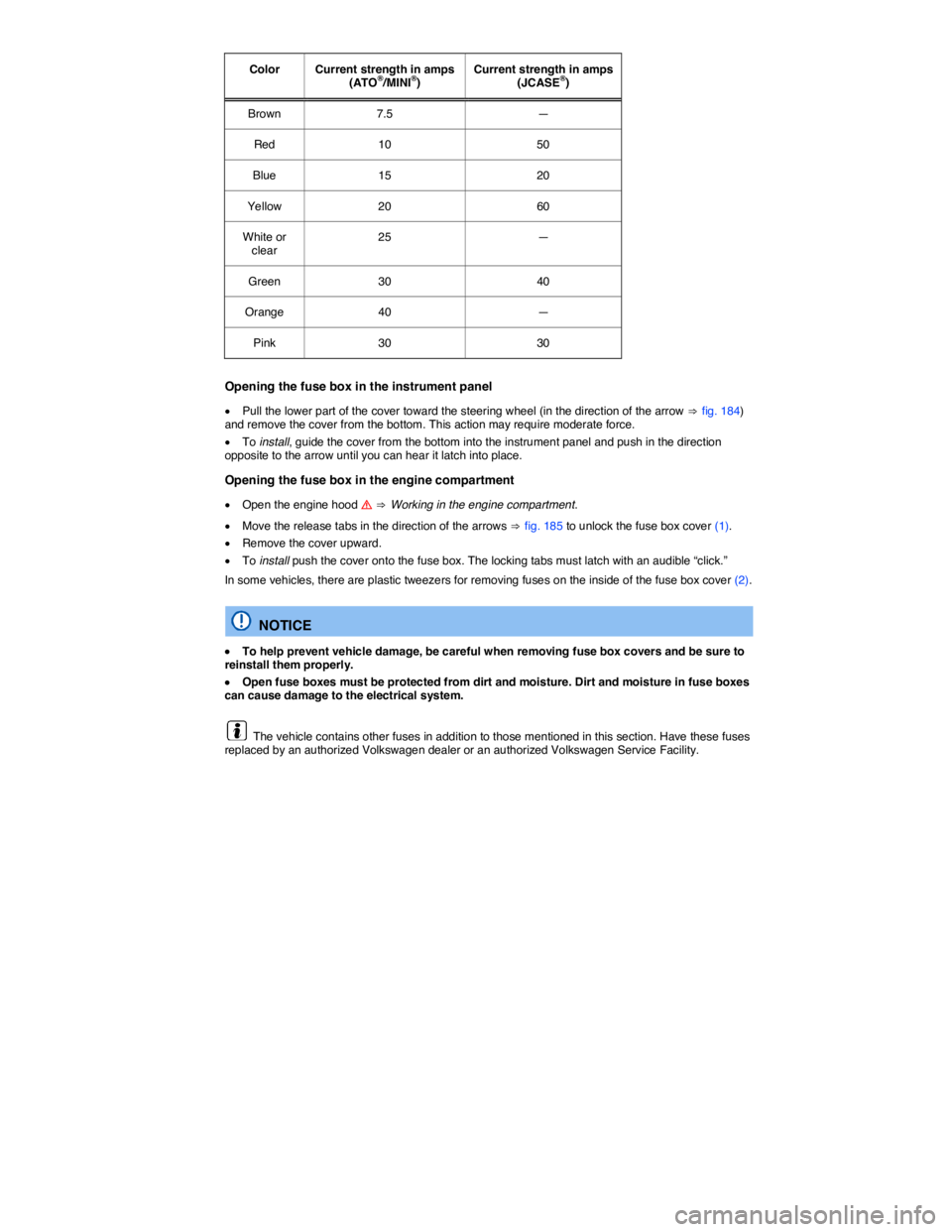
Color Current strength in amps(ATO®/MINI®) Current strength in amps(JCASE®)
Brown 7.5 —
Red 10 50
Blue 15 20
Yellow 20 60
White or clear 25 —
Green 30 40
Orange 40 —
Pink 30 30
Opening the fuse box in the instrument panel
x Pull the lower part of the cover toward the steering wheel (in the direction of the arrow ⇒ fig. 184) and remove the cover from the bottom. This action may require moderate force.
x To install, guide the cover from the bottom into the instrument panel and push in the direction opposite to the arrow until you can hear it latch into place.
Opening the fuse box in the engine compartment
x Open the engine hood
Page 390 of 400

The procedure for attaching and for removing the jumper cables is described below. Perform each of the following steps only in the order described, which follow the letters shown in the illustration
⇒ fig. 189 A – B – C – D.
Attaching jumper cables
1. Switch off the ignition in both vehicles ⇒ Starting and stopping the engine.
2. Open the battery cover in the engine compartment if the battery has a cover ⇒ Vehicle battery.
3. Attach one end of the red jumper cable to the positive terminal (+) of the dead battery: (1) ⇒ .
4. Attach the other end of the red jumper cable to the positive terminal (+) of the good battery (booster battery): (2).
5. Attach one end of the black jumper cable to the negative jump-start terminal ⇒ Jump-start terminal, or if that is not available, to the negative terminal (-) of the battery in the vehicle providing assistance (2) .
6. Attach the other end of the black jumper cable (3) to the negative jump-start terminal ⇒ Jump-start terminal, or if that is not available, a bare metal part of the vehicle with the dead battery. This part should be connected directly to the engine block. You may also attach the cable to the engine
block itself or to the towing eye installed on the front of the vehicle ⇒ Towing. Attach the clamp to a
point that is as far away as possible from the dead battery (1) ⇒ .
7. Route the jumper cables so that they cannot get caught in any moving parts in the engine compartment of either vehicle.
Starting the engine
x Start the engine of the vehicle with the good battery that is providing help and let it run at idle speed.
x Turn on the ignition of the vehicle with the dead battery. If the engine starts, wait 2 to 3 minutes
until it “runs smoothly” before removing the jumper cables as described below ⇒ . If the engine does not start within about 10 seconds, turn off the ignition and wait at least 1 minute; then try again.
Before removing the jumper cables
x Switch off the headlights (if they are on).
x In the vehicle with the dead battery, switch on the heater fan and the rear window defroster. This helps to minimize voltage spikes when the cables are disconnected.
Removing jumper cables
With the engine running, remove the jumper cables in reverse order to the way they were connected.
1. Disconnect the black (-) cable from the vehicle with the dead battery.
2. Disconnect the black (-) cable from the other vehicle (vehicle with the good battery).
3. Disconnect the red (+) cable from the other vehicle (vehicle with the good battery).
4. Disconnect the red (+) cable from the vehicle with the dead battery.
5. Close the battery cover.
6. If necessary, unscrew the towing eye on the front of the vehicle ⇒ Installing the front towing eye.
Page 392 of 400

Towing