airbag off VOLKSWAGEN T-ROC 2019 Owners Manual
[x] Cancel search | Manufacturer: VOLKSWAGEN, Model Year: 2019, Model line: T-ROC, Model: VOLKSWAGEN T-ROC 2019Pages: 502, PDF Size: 8.58 MB
Page 8 of 502

In an emergency
Indicator lamp for the front passenger front airbag switch-off function Airbag system
Driver assist systems Driver assist systems
Controls for the air conditioning system, heating and fresh air system Heating, ventilating,
cooling
Controls for the air conditioning system, heating and fresh air system Heating, ventilating,
cooling
Key to Fig. 9
Lever:
DSG
Page 51 of 502
not only about vehicle maintenance it also ensures that your vehicle
remains roadworthy and in perfect working order. You should therefore have your vehicle serviced
according to the Volkswagen guidelines. Some work may have to be carried out before the date of
the next service if the vehicle is subjected to severe operating conditions. Severe operating
conditions are, for example, regular stop-and-go driving or driving in areas with high levels of dust.
Further information can be obtained from your Volkswagen dealership or qualified workshop.
Sitting position
Introduction
This chapter contains information on the followingsubjects:
Dangers of assuming an incorrect sitting position
Correct sitting posi
Number of seats
The vehicle has a total of five seats: two at the front and three at the rear.
Each seat is equipped with a seat belt.
WARNING
Assuming an incorrect sitting position in the vehicle can increase the risk of severe or fatal injuries
during a sudden driving or braking manoeuvre in the event of a collision or accident or if the airbags
are triggered.
All vehicle occupants must assume a correct sitting position before setting off and maintain this
position throughout the trip. This also applies for the fastening of seat belts.
The number of vehicle occupants must never exceed the number of seats with seat belts in the
vehicle.
Always secure children in the vehicle in an authorised child restraint system which is suitable for
their height and weight Safe transport of childrenand Airbag system
Always keep your feet in the footwell while the vehicle is in motion. Never place your feet on the
seat or dash panel, for example, and never ride with your feet out of the window. The airbag and
seat belt can otherwise not provide optimal protection and can actually increase the risk of injury
during an accident.
Dangers of assuming an incorrect sitting position
First read and observe the introductoryinformation and safety warnings
If the seat belts are not worn or are worn incorrectly, the risk of severe or fatal injuries increases.
Seat belts can provide optimal protection only if seat belt routing is correct. An incorrect sitting
position considerably impairs the level of protection provided by a seat belt. This could lead to
severe or even fatal injuries. The risk of severe or fatal injuries is especially increased when a
Page 54 of 502

Additional points for the front passenger:
Move the backrest into an upright position so that your back rests fully against it.
Push the front passenger seat as far back as possible so that the airbag can provide maximum
protection if it is deployed.
Seat belts
Introduction
This chapter contains information on the followingsubjects:
Warning lamp
Frontal collisions and the laws of physics
What happens to vehicle occupants who have not fastened their seat belts
Seat belt protection
Using seat belts
Fastening and unfastening seat belts
Seat belt routing
Seat belt height adjuster
Belt retractor, belt tensioner, belt tension limiter
Service and disposal of belt tensioners
Proactive occupant protection system
Regularly check the condition of all seat belts. If the belt webbing, belt connections, belt retractor or
seat belt buckle become damaged, the seat belt in question should be replaced immediately by a
qualified workshop
compatible with the vehicle, equipment level and model year. Volkswagen recommends using a
Volkswagen dealership for this purpose.
WARNING
Incorrectly fastened or unfastened seat belts increase the risk of severe or fatal injuries. Seat belts
will only offer the optimum level of protection when they are fastened and used properly.
Seat belts are the most effective means of reducing the risk of serious and fatal injuries in the event
of an accident. Seat belts must always be fastened properly when the vehicle is in motion to protect
the driver and all vehicle occupants.
Page 59 of 502
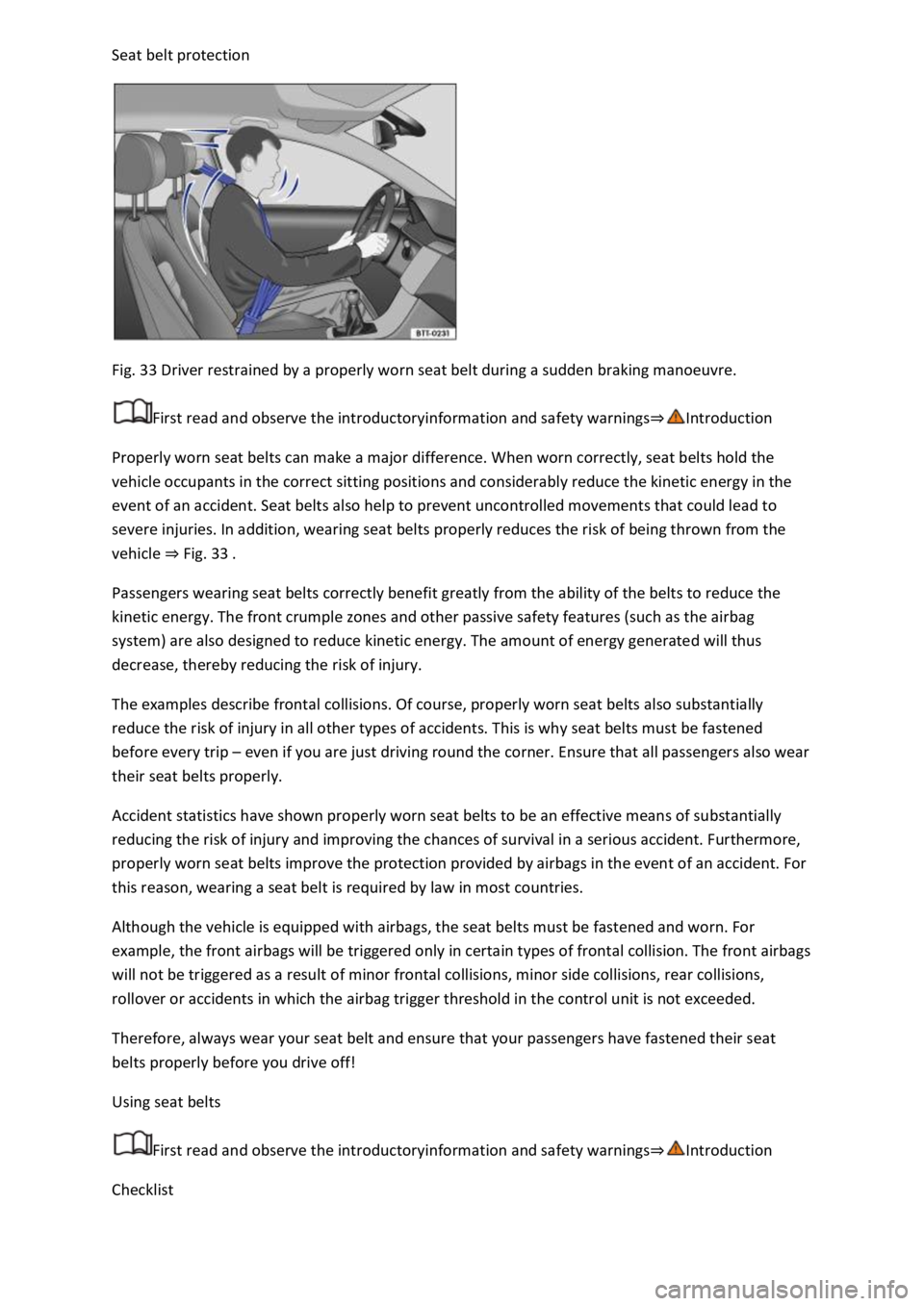
Fig. 33 Driver restrained by a properly worn seat belt during a sudden braking manoeuvre.
First read and observe the introductoryinformation and safety warnings
Properly worn seat belts can make a major difference. When worn correctly, seat belts hold the
vehicle occupants in the correct sitting positions and considerably reduce the kinetic energy in the
event of an accident. Seat belts also help to prevent uncontrolled movements that could lead to
severe injuries. In addition, wearing seat belts properly reduces the risk of being thrown from the
vehicle Fig. 33
Passengers wearing seat belts correctly benefit greatly from the ability of the belts to reduce the
kinetic energy. The front crumple zones and other passive safety features (such as the airbag
system) are also designed to reduce kinetic energy. The amount of energy generated will thus
decrease, thereby reducing the risk of injury.
The examples describe frontal collisions. Of course, properly worn seat belts also substantially
reduce the risk of injury in all other types of accidents. This is why seat belts must be fastened
before every trip even if you are just driving round the corner. Ensure that all passengers also wear
their seat belts properly.
Accident statistics have shown properly worn seat belts to be an effective means of substantially
reducing the risk of injury and improving the chances of survival in a serious accident. Furthermore,
properly worn seat belts improve the protection provided by airbags in the event of an accident. For
this reason, wearing a seat belt is required by law in most countries.
Although the vehicle is equipped with airbags, the seat belts must be fastened and worn. For
example, the front airbags will be triggered only in certain types of frontal collision. The front airbags
will not be triggered as a result of minor frontal collisions, minor side collisions, rear collisions,
rollover or accidents in which the airbag trigger threshold in the control unit is not exceeded.
Therefore, always wear your seat belt and ensure that your passengers have fastened their seat
belts properly before you drive off!
Using seat belts
First read and observe the introductoryinformation and safety warnings
Checklist
Page 62 of 502
damaging the trim.
WARNING
Incorrect seat belt routing can cause severe or fatal injuries in the event of an accident.
The seat belts offer best protection only when the backrests are in an upright position and the seat
belts have been fastened properly according to the occupant's size.
Unfastening seat belts while the vehicle is in motion can lead to severe or fatal injuries in the event
of an accident or sudden braking manoeuvre.
Seat belt routing
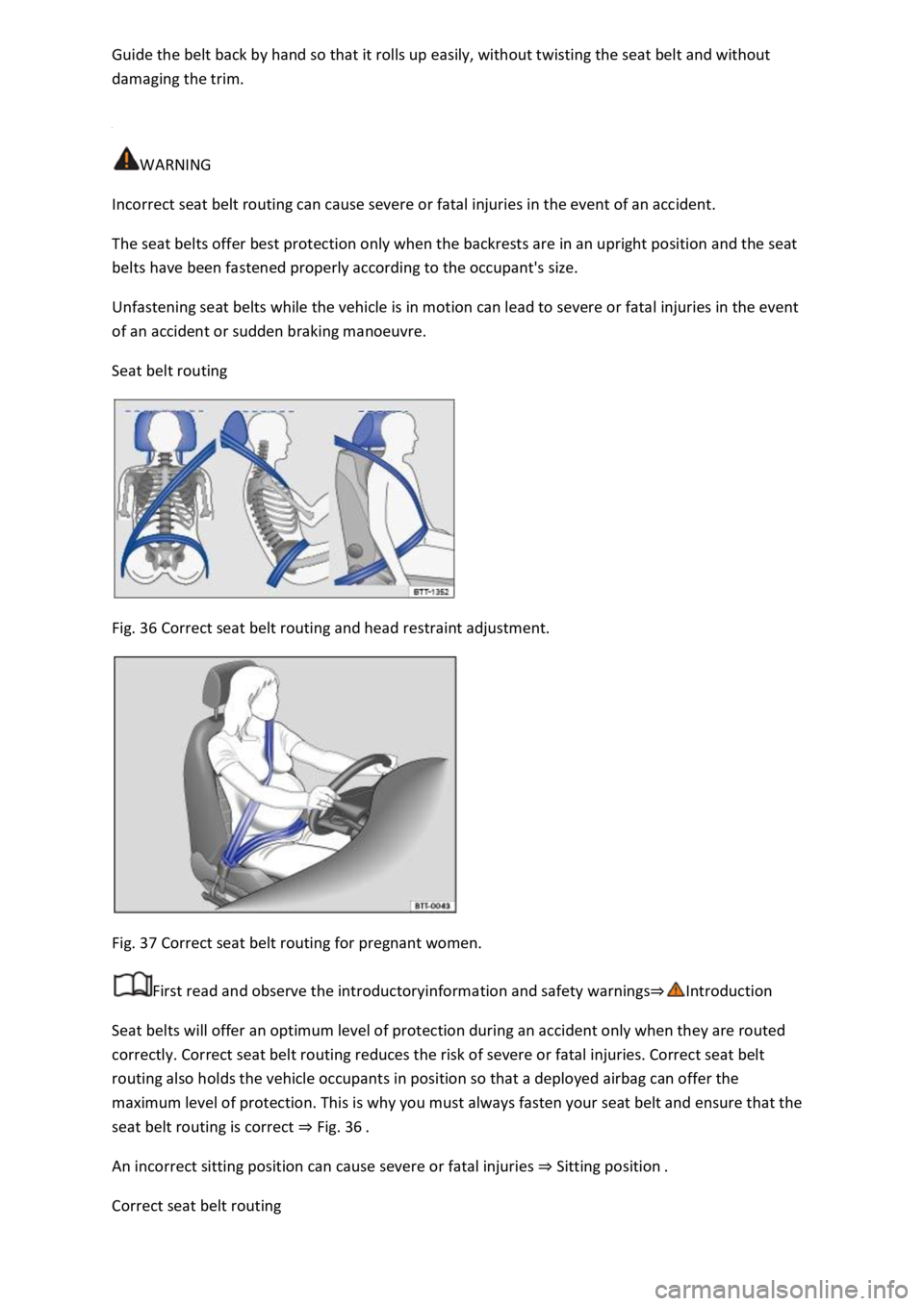
Fig. 36 Correct seat belt routing and head restraint adjustment.
Fig. 37 Correct seat belt routing for pregnant women.
First read and observe the introductoryinformation and safety warnings
Seat belts will offer an optimum level of protection during an accident only when they are routed
correctly. Correct seat belt routing reduces the risk of severe or fatal injuries. Correct seat belt
routing also holds the vehicle occupants in position so that a deployed airbag can offer the
maximum level of protection. This is why you must always fasten your seat belt and ensure that the
seat belt routing is correct Fig. 36
An incorrect sitting position can cause severe or fatal injuries
Correct seat belt routing
Page 63 of 502

neck, over or under the arm or behind the back.
The lap part of the seat belt must always lie across the pelvis, never across the stomach.
The seat belt must always lie flat and snugly on the body. Tighten the belt slightly if necessary.
For pregnant women, the seat belt must be positioned evenly over the chest and as low as possible
over the pelvis. It must also lie flat so that no pressure is exerted on the abdomen this applies in
every stage of pregnancy Fig. 37
Adjusting seat belt routing to body size
The following equipment can be used to adjust the seat belt routing:
Seat belt height adjuster for the front seats Seat belt height adjuster
Height-adjustable front seats Sitting position
WARNING
Incorrect seat belt routing can cause severe injuries in the event of an accident or a sudden braking
or driving manoeuvre.
The seat belts offer best protection only when the backrests are in an upright position and the seat
belts have been fastened properly.
The seat belt itself or a loose seat belt can cause serious injuries if the seat belt shifts from harder
body parts in the direction of softer body parts (e.g. stomach).
The shoulder part of the seat belt must lie on the centre of the shoulder and never under the arm or
across the neck.
The seat belt must lie flat and snugly on the upper body.
The lap part of the seat belt must lie across the pelvis and never across the stomach. The seat belt
must lie flat and snugly on the pelvis. Tighten the belt slightly if necessary.
For pregnant women, the lap part of the seat belt must be as low as possible over the pelvis and lie
flat around the round stomach.
Do not twist the belt webbing while the seat belt is being worn.
Never hold the seat belt away from the body by hand.
The belt webbing should not lie over hard or fragile objects, such as glasses, pens or keys.
Never use seat belt clips, retaining rings or similar items to alter the seat belt routing.
If a person's physical build prevents them from routing the seat belt properly, contact a qualified
workshop to find out about any special modifications so that the seat belts and airbags can provide
Page 67 of 502

cts such as safety barriers, tunnel entrances, heavy rain and ice can impair the
performance of the proactive occupant protection system and thus prevent it from detecting a
collision risk.
Incorrect system activation can occur.
WARNING
Accidents and injuries can occur if the driver is distracted.
Never change settings in the Infotainment system when the vehicle is in motion.
WARNING
Failure to observe illuminated warning lamps and text messages can lead to your vehicle breaking
down in traffic, and can cause accidents and serious injury.
Never ignore any illuminated warning lamps or text messages.
Stop the vehicle as soon as possible and when safe to do so.
NOTICE
Failure to observe illuminated indicator lamps and text messages can lead to your vehicle being
damaged.
Airbag system
Introduction
This chapter contains information on the followingsubjects:
Types of front passenger front airbag system
Indicator lamp
Description and function of the airbags
Front airbags
Switching the front passenger front airbag on and off
The vehicle is equipped with a front airbag for the driver and front passenger. The front airbags can
provide front seat occupants with additional chest and head protection if the seat, seat belts, head
restraints and, in the case of the driver, steering wheel are adjusted and used correctly. Airbags are
designed only for additional protection. The airbag system is not a substitute for the seat belts. Seats
belts must always be worn, even when the front seats are equipped with airbags.
Page 68 of 502

Never rely on the airbag system exclusively for your protection.
The airbag has merely a supportive function for your protection, even if it is triggered.
The airbag system offers the best level of protection and reduces the risk of injury when seat belts
are properly worn Seat belts
Before every trip, each vehicle occupant must adopt the correct sitting position, correctly fasten the
seat belt belonging to their seat and keep it fastened properly throughout the trip. This applies to all
vehicle occupants and also in urban traffic.
WARNING
The risk of injury increases if there are any objects located between the vehicle occupants and the
deployment area of the airbag when it is triggered. This will impinge on the deployment zone of the
airbag or the items will be flung against the body.
Never hold any objects in your hands or on your lap while the vehicle is in motion.
Never transport any objects on the front passenger seat. The objects could enter into the
deployment zone of the airbag during sudden braking or driving manoeuvres and then be flung
dangerously through the vehicle interior if the airbag is activated.
Vehicle occupants sitting on the front seats and rear outer seats must never carry any people, pets
or objects in the deployment zone between themselves and the airbags. Make sure that children and
passengers also keep to this rule.
WARNING
The airbag system can be triggered only once. The system will have to be replaced if the airbags have
been triggered.
Airbags that have been triggered, and any affected system parts, must immediately be replaced with
new parts that are approved by Volkswagen for the vehicle.
Repairs and modifications to your vehicle should be carried out only by a qualified workshop.
Qualified workshops have the necessary tools, diagnostic equipment, repair information and
qualified personnel.
Never use recycled airbag components or components that have been taken from end-of-life
vehicles in your vehicle.
Never alter any components of the airbag system.
WARNING
Page 69 of 502
does not
mean there is a fire in the vehicle.
The fine dust can cause irritation to the skin and eye membranes as well as cause breathing
difficulties, particularly for those people suffering from asthma or other respiratory health problems.
In order to reduce breathing difficulties, get out of the vehicle or open the windows or doors in
order to breathe fresh air.
If you should come into contact with the dust, you should wash your hands and face with a mild
soap and water before eating.
Do not rub the dust into your eyes or into open wounds.
If dust has entered your eyes, rinse them with water.
WARNING
Cleaning agents that contain solvents cause the surface of the airbag modules to become porous. In
an accident that triggers the airbag, loose plastic parts can cause serious injury.
Never clean the dash panel or the airbag covers with cleaning agents that contain solvents.
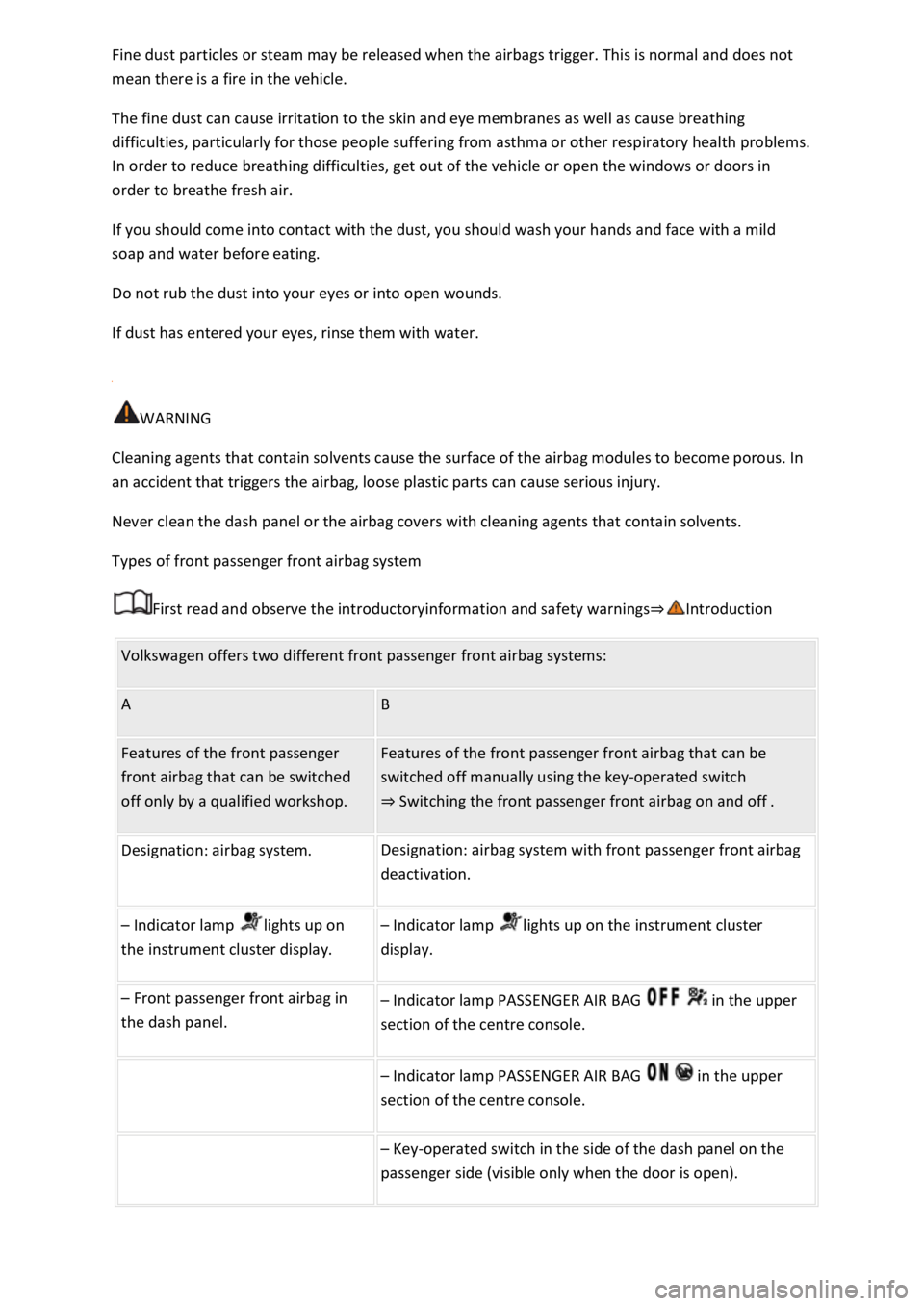
Types of front passenger front airbag system
First read and observe the introductoryinformation and safety warnings
Volkswagen offers two different front passenger front airbag systems:
A B
Features of the front passenger
front airbag that can be switched
off only by a qualified workshop.
Features of the front passenger front airbag that can be
switched off manually using the key-operated switch
Switching the front passenger front airbag on and off.
Designation: airbag system. Designation: airbag system with front passenger front airbag
deactivation.
Indicator lamp lights up on
the instrument cluster display.
Indicator lamp lights up on the instrument cluster
display.
Front passenger front airbag in
the dash panel.
Indicator lamp PASSENGER AIR BAG in the upper
section of the centre console.
Indicator lamp PASSENGER AIR BAG in the upper
section of the centre console.
Key-operated switch in the side of the dash panel on the
passenger side (visible only when the door is open).
Page 73 of 502
anywhere in the airbag deployment zone.
No other people, animals or objects may be carried between the occupants of the front seats and
the airbag deployment zone. Make sure that children and passengers also keep to this rule.
Do not attach any objects, e.g. mobile navigation devices, to the windscreen above the front airbag
on the front passenger side.
Do not cover or stick anything on the steering wheel hub or the soft plastic surface of the airbag unit
on the front passenger side, and do not obstruct or modify them in any way.
WARNING
The front airbags are deployed in front of the steering wheel Fig. 40and dash panelFig. 41
When driving, always hold the steering wheel with both hands on the outside of the rim at the 9
o'clock and 3 o'clock positions.
Adjust the driver seat so that there is at least 25 cm between your breastbone and the hub of the
steering wheel. Contact a qualified workshop if your physical build makes this impracticable.
Adjust the front passenger seat so that the distance between the front passenger and the dash panel
is as large as possible.
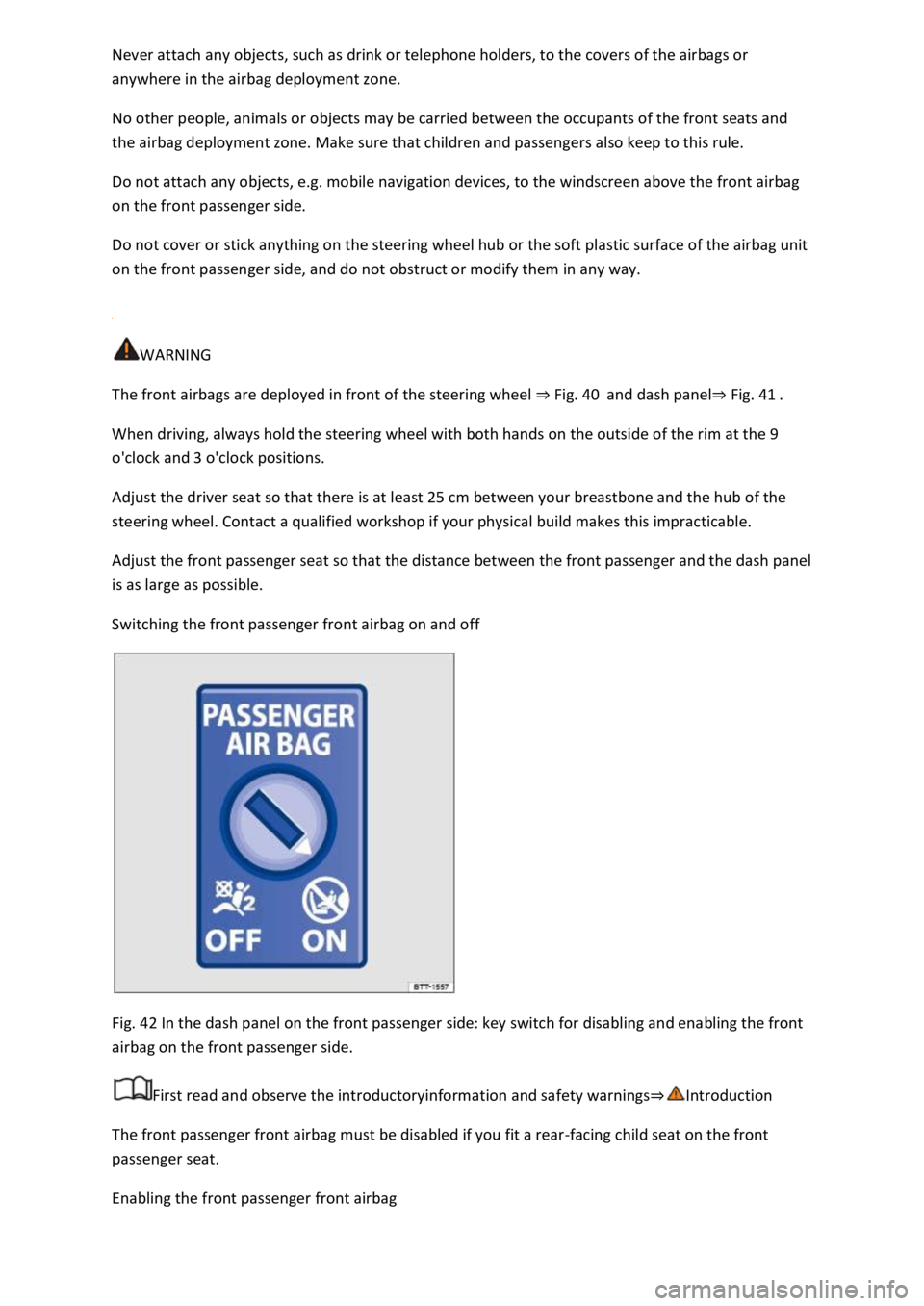
Switching the front passenger front airbag on and off
Fig. 42 In the dash panel on the front passenger side: key switch for disabling and enabling the front
airbag on the front passenger side.
First read and observe the introductoryinformation and safety warnings
The front passenger front airbag must be disabled if you fit a rear-facing child seat on the front
passenger seat.
Enabling the front passenger front airbag