light VOLKSWAGEN T-ROC 2020 Owners Manual
[x] Cancel search | Manufacturer: VOLKSWAGEN, Model Year: 2020, Model line: T-ROC, Model: VOLKSWAGEN T-ROC 2020Pages: 502, PDF Size: 8.58 MB
Page 351 of 502

Colour coding of fuses
Fuses (ATO / MINI / MAXI)
ColourAmp
ratingBlack1 ampsPurple3 ampsOrange5 ampsBrown7.5 ampsRed10 ampsBlue15 ampsYellow20 am
psWhite or clear25 ampsGreen30 ampsLight green40 amps
Fuses (JCASE)
Blue20 ampsPink30 ampsGreen40 ampsRed50 ampsYellow60 amps
Preparations
equipment.
Fuses in the dash panel
Recognising a blown fuse
rom the top and side through
the transparent housing due to the melted metal strip Fig. 174
transparent housing Fig. 174
Changing a fuse
ary, take the plastic pliers Fig. 175
Fig. 175 Fig. 175
lace it with a new fuse of the same amp rating (same colour and same
markings) and same size
NOTICE
You can damage another location in the electrical system by using a fuse with a higher amp rating.
Jump starting
Page 355 of 502

p leads should be removed only in the order D C B
AFig. 177
-volt vehicle battery checked.
WARNING
Jump starting the vehicle incorrectly can cause the 12-volt vehicle battery to explode, which can lead
to serious injuries. Please note the following in order to reduce the risk of the 12-volt vehicle battery
exploding:
-volt vehicle battery and the electrical system can cause serious chemical burns,
fire or electric shocks. Always read the warnings and safety information before carrying out any kind
of work on the 12-volt vehicle battery 12-volt vehicle battery
-volt vehicle
battery.
h the leads in the correct order the positive lead first, followed by the negative.
-insulated parts of the battery clamps must not be allowed to touch. The jump lead
attached to the positive terminal on the 12-volt vehicle battery must not touch electrically
conductive parts of the vehicle.
-volt vehicle battery, using a torch if necessary. If it is light
yellow or colourless, do not jump start the vehicle. Seek expert assistance.
-volt vehicle battery. The hydrogen gas
emitted from the 12-volt vehicle battery could be ignited by sparks.
g if the 12-volt vehicle battery is damaged or if it is or has ever been
frozen.
NOTICE
Once the vehicle has been successfully jump-started, go to a qualified workshop and have the 12-
volt vehicle battery checked.
Tow-starting or towing
Introduction
This chapter contains information on the followingsubjects:
Notes on tow-starting and towing
Page 356 of 502

Tow-starting
Towing
Fitting the rear towing eye
Fitting the front towing eye
Towing requires some experience, especially when using a tow rope. Both drivers should be familiar
with the technique required for towing. Inexperienced drivers should not attempt to tow.
Ensure that no excessive pulling forces occur and take care to avoid jerking movements. When
towing offroad, there is always a risk of overloading the anchorage points.
Observe any legal requirements when towing or tow-starting.
Tow-starting
Tow-starting describes the procedure for starting the vehicle by moving it using another towing
vehicle.
The vehicle can be tow-started with a tow-bar or a tow-rope.
Towing
Towing is where a vehicle that cannot be driven is pulled with the aid of another vehicle.
The vehicle can be towed with a tow-bar or a tow-rope. When the engine is stopped, the gearbox is
not lubricated sufficiently at higher speeds and over long distances:
km/h (30 mph).
km.
Tow rope, tow bar
It is easier and safer to tow a vehicle with a tow bar. Use a tow rope only if you do not have a tow
bar.
The tow rope should be slightly elastic to reduce the strain on both vehicles. It is advisable to use a
tow rope made of synthetic fibre or similarly elastic material.
Towing with a tow truck
If your vehicle is to be raised on one axle for towing, this may only be done using the following axles
according to the gearbox/drive combination:
Front-wheel drive
Manual gearboxFront or rear axleAutomatic gearboxFront axle
WARNING
If a vehicle is being towed, the vehicle handling and braking efficiency will change significantly.
Page 357 of 502
WARNING
Never tow a vehicle that has no power supply.
assistance.
NOTICE
When pushing the vehicle by hand, do not press on the tail light clusters, the side spoilers on the
rear window, the rear spoiler or large panels. This could damage the vehicle and the rear spoiler
could become detached.
NOTICE
Remove and install the cover and the towing eye carefully so as to avoid damage to the vehicle, e.g.
the paintwork.
Notes on tow-starting and towing
First read and observe the introductoryinformation and safety warnings
It is still possible to activate the turn signals in a vehicle that is being towed, even if the hazard
warning lights are switched on. To do this, operate the turn signal lever in the required direction
while the ignition is switched on. The hazard warning lights will not flash while the turn signal is
being used. The hazard warning lights will start flashing again automatically as soon as the turn
signal lever is moved back to the neutral position.
When should your vehicle not be tow-started or towed?
an 50 km.
accident.
If the vehicle cannot be towed on its own four wheels due to one of the above conditions, seek
expert assistance and have the vehicle transported on a recovery vehicle if necessary.
Tow-starting
First read and observe the introductoryinformation and safety warnings
Preparations for tow-starting
Vehicles with an automatic gearbox:
Page 358 of 502

e tow-started. Attempt to start the engine by jump
starting Jump starting
Vehicles with a manual gearbox:
Tow-starting is generally not recommended. If the engine does not start, first attempt to start the
engine by jump starting Jump startingease note that the maximum tow-starting distance for
petrol engines is 50 m.
-rope or the tow-bar only to the towing eyes provided Fitting the rear towing
eyeor Fitting the front towing eye
warning lights.
utral to prevent
driving into the towing vehicle.
NOTICE
When tow-starting, unburnt fuel can enter the catalytic converter and damage it.
Towing
First read and observe the introductoryinformation and safety warnings
Preparations
h the tow-rope or the tow-bar only to the towing eyes provided Fitting the rear towing
eyeor Fitting the front towing eyeor to the towing bracket Trailer towing
-rope is not twisted. Otherwise a towing eye may become unscrewed
during towing.
regulations to the contrary.
Pulling vehicle (front)
tow-rope must be taut before you drive off properly.
Page 372 of 502

You can check whether your vehicle is equipped for the Flexible Service QI6 (Longlife) or Fixed
Service QI1, QI2, QI3, QI4, QI7 (dependent on time or mileage) in the vehicle data Technical data
or on the inside cover of this owner's manual.
Permitted engine oil standards
Petrol engineswith particulate filter1)
Flexible ServiceVW 508 00 or alternatively VW 504 002)Fixed ServiceVW 502 00
Petrol engineswithout particulate filter
Flexible ServiceVW 508 00 or alternatively VW 504 00Fixed ServiceVW 502 00
Diesel engineswith particulate filter1)
Flexible ServiceVW 507 00Fixed ServiceVW 507 00
Diesel engineswithout particulate filter
Flexible ServiceVW 507 00Fixed ServiceVW 505 01
Volkswagen recommends engine oils.
NOTICE
additives is not covered by the warranty.
Using other engine oils can cause engine damage.
d engine oils are not
available. To avoid damaging the engine, a maximum quantity of 0.5 litres of the following engine oil
may be used only once until the next oil change:
SN (API SM).
ards ACEA C3 or API CJ-4.
1) Check with a qualified workshop if you are unsure whether your vehicle is equipped with a
particulate filter. Volkswagen recommends using a Volkswagen dealership for this purpose.
2) Using VW 504 00 instead of VW 508 00 may cause the vehicle's emissions values to increase
slightly.
Changing engine oil
First read and observe the introductoryinformation and safety warnings
Page 377 of 502

lfunctions and engine
damage.
The engine oil level must never be above area Fig. 186
the crankcase breather and escape into the atmosphere via the exhaust system.
Troubleshooting
First read and observe the introductoryinformation and safety warnings
and Engine oil pressure too low
The central warning lamp lights up red and the text message Stop vehicle. Oil pressure. Observe
vehicle wallet is displayed.
Do not drive on!
Switch off the engine and check the engine oil level. Checking the engine oil level Checking the
Do not drive on or allow the engine to run if the
warning lamp is flashing although the engine oil level is correct. The engine could otherwise be
damaged. Seek expert assistance.
and Engine oil level too low
The central warning lamp lights up red and the text message Refill engine oil. is displayed.
Engine oil level is too low. Switch off the engine.
Checking the engine oil level Checking the engine oil level and refilling the engine oil
and Engine oil level low
The central warning lamp lights up yellow and the text message Check oil level. is displayed.
Engine oil level is low. Switch off the engine.
Checking the engine oil level Checking the engine oil level and refilling the engine oil
and Fault in engine oil system
The central warning lamp lights up yellow and the text message Oil sensor: workshop. is displayed.
Engine oil system is faulty. Go to a qualified workshop and have the engine oil sensor checked.
and Engine oil level too high
The central warning lamp lights up yellow and the text message Reduce oil level. is displayed.
Engine oil level is too high. Switch off the engine.
Check the engine oil level. Checking the engine oil level Checking the engine oil level and refilling
the engine oil
Page 380 of 502
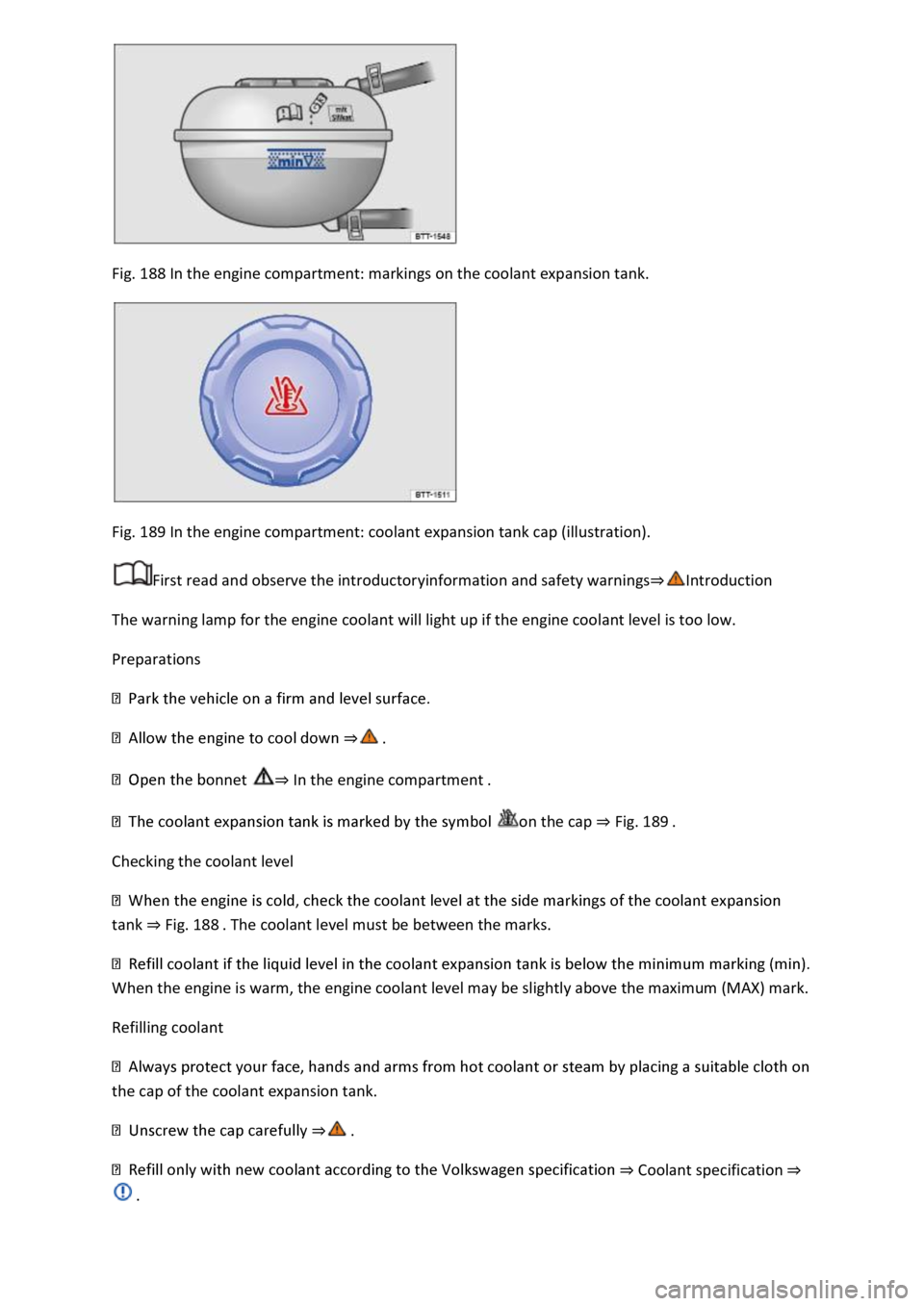
Fig. 188 In the engine compartment: markings on the coolant expansion tank.
Fig. 189 In the engine compartment: coolant expansion tank cap (illustration).
First read and observe the introductoryinformation and safety warnings
The warning lamp for the engine coolant will light up if the engine coolant level is too low.
Preparations
nnet In the engine compartment
on the cap Fig. 189
Checking the coolant level
tank Fig. 188
When the engine is warm, the engine coolant level may be slightly above the maximum (MAX) mark.
Refilling coolant
the cap of the coolant expansion tank.
Coolant specification
Page 383 of 502

standard 501 14 is available from Volkswagen dealerships.
If this brake fluid is not available and it is necessary to use another high-quality brake fluid instead,
brake fluid that is compliant with DIN ISO 4925 CLASS 4 or US standard FMVSS 116 DOT 4 can be
used.
Not all brake fluids that are compliant with DIN ISO 4925 CLASS 4 or US standard FMVSS 116 DOT 4
have the same chemical composition. Some of these brake fluids may contain chemicals that can
damage or destroy brake system components over time.
Volkswagen therefore recommends the use of brake fluid that is compliant with VW standard 501 14
to ensure sustained proper operation of the brake system.
Brake fluid that is compliant with VW standard 501 14 fulfils the requirements of DIN ISO 4925
CLASS 4 or US standard FMVSS 116 DOT 4.
Brake fluid level
The brake fluid level must always be between the MIN and MAX marking on the brake fluid reservoir
or above the MIN marking
The brake fluid level cannot be checked accurately in all models as engine components may partially
conceal the fluid level in the brake fluid reservoir. If the brake fluid level cannot be read exactly,
please go to a qualified workshop.
The brake fluid level drops slightly during vehicle operation as the brake pads wear and the brakes
are automatically adjusted.
Brake fluid level
The indicator lamp lights up red.
Brake fluid level is too low.
Do not drive on! Check the brake fluid level.
If the brake fluid level is too low, inform a qualified workshop. Have the brake system checked.
Changing the brake fluid
The brake fluid should be changed by a qualified workshop. Volkswagen recommends using a
Volkswagen dealership for this purpose. Only brake fluid that conforms with the required
specification should be used.
WARNING
Brake failure or reduced braking efficiency can be caused by the brake fluid level being too low or by
brake fluid that is too old or unsuitable.
Page 385 of 502

safety procedures and have the correct equipment, service fluids and suitable tools. Serious injuries
can be caused by carrying out work incorrectly
workshop. Volkswagen recommends using a Volkswagen dealership for this purpose.
Information for warning and indicator lamps lit up can be found in the troubleshooting at the end of
the chapter Troubleshooting
Location of the 12-volt vehicle battery
The 12-volt vehicle battery is located in the engine compartment.
Explanation of the warnings on the 12-volt vehicle battery
Always wear eye protection!Electrolyte is very corrosive and caustic. Always wear
protective gloves and eye protection!Fire, sparks, naked lights and smoking are prohibited!
A highly explosive mixture of gases is given off when the 12-volt vehicle battery is charging!
Always keep children away from electrolyte and the 12-volt vehicle battery!Always
observe the owner's manual!
WARNING
Any work on the 12-volt vehicle battery and the electrical system can cause serious chemical burns,
fire or electric shocks. Always read and observe the following warnings and safety information
before carrying out any kind of work:
any work on the 12-volt
vehicle battery and also disconnect the negative cable from the 12-volt vehicle battery.
-volt vehicle battery.
12-volt vehicle battery, ensure that your hands, arms and face in particular are protected from acid
spillages.
r work near naked flames or sparks.
discharge.
-volt vehicle battery. It can explode. Damaged 12-volt vehicle batteries
must be replaced as soon as possible.