start stop VOLKSWAGEN T-ROC 2020 Owner's Guide
[x] Cancel search | Manufacturer: VOLKSWAGEN, Model Year: 2020, Model line: T-ROC, Model: VOLKSWAGEN T-ROC 2020Pages: 502, PDF Size: 8.58 MB
Page 305 of 502

WARNING
A roof carrier that has not been approved for the vehicle or a roof carrier that is fitted to a vehicle
that is not approved for use with a roof carrier may cause accidents or injuries.
Use only roof carriers that have been approved by Volkswagen for your vehicle type.
Never use a roof carrier on a vehicle that has not been approved for use with a roof carrier.
A roof carrier that is fitted nevertheless may become loose whilst the vehicle is in motion and fall
from the vehicle roof.
NOTICE
Securing a roof carrier of any kind to a vehicle that is not approved for use with a roof carrier may
lead to severe damage to the vehicle.
Securing roof carriers
First read and observe the introductoryinformation and safety warnings
Special roof carriers must be used to transport luggage, bicycles, skis, surfboards or boats safely
Attaching the roof bars and load carrier
Mount roof bars to the roof railing according to the installation instructions provided.
Once you have fitted the roof bars, you can then secure the respective carrier system on them.
WARNING
Incorrectly attaching and using the roof bars and load carrier could cause the whole roof carrier to
fall off the roof. This could cause accidents and injuries.
Only use roof bars and load carriers when they are undamaged and fitted correctly.
Always fit roof bars and load carriers correctly. Always observe the installation instructions provided
by the manufacturer.
Attach the roof bars only at the specified mounting points.
Special roof carriers for items such as bicycles, skis, surfboards etc. should always be properly
installed. Always observe the installation instructions provided by the manufacturer.
Check that the roof carrier is secured before starting your journey and tighten as necessary after
driving a short distance. During a long trip, check all screw connections and fasteners at each stop.
Do not carry out any modifications or repairs to the roof bars or the load carrier.
Page 307 of 502

The vehicle height exceeds the required clearance height, e.g. in a garage.
NOTICE
Always remove the roof carrier before driving through an automatic car wash.
The height of the vehicle is changed by the installation of a roof carrier and the load secured to it.
Check and compare the height of the vehicle with clearance heights, e.g. for underpasses and garage
doors.
The roof carrier and its load must not obstruct you from opening and closing the glass roof and the
boot lid. The roof aerial must also remain unaffected.
Driving with a fitted roof carrier will increase air resistance and thus increase fuel consumption.
Trailer towing
Introduction
This chapter contains information on the followingsubjects:
Technical requirements
Fitting the removable ball head
Removing the ball head
Notes on towing a trailer
Loading the trailer
Driving with a trailer
Trailer stabilisation
Retrofitting a towing bracket
The vehicle can be used to tow a trailer if it has the required technical equipment for this. The
additional trailer load will affect the amount of wear, fuel consumption and performance of the
vehicle and, in certain circumstances, could shorten the service intervals.
Driving with a trailer not only places an extra load on the vehicle, but also requires increased
concentration on the part of the driver.
Vehicles with start/stop system
When using towing brackets that were not retrofitted by Volkswagen, the start/stop system must be
deactivated manually using the button in the centre console before towing a trailer, and it must
remain deactivated for as long as a trailer is being towed
Page 309 of 502

WARNING
The start/stop system must always be switched off manually when towing a trailer using towing
brackets that have not been retrofitted by Volkswagen. Otherwise faults can occur in the brake
system, possibly resulting in accidents and serious injuries.
NOTICE
Observe the instructions and information for vehicles with an N1 approval Information about
vehicles wit
Always switch off the anti-theft alarm before a trailer is hitched or unhitched or a bicycle carrier is
loaded or unloaded Anti-theft alarm
unintentionally.
With a new engine, do not tow a trailer during the first 1,000 km Running in the engine
Some retrofitted towing brackets may cover the aperture for fitting the towing eye. If so, the towing
eye cannot be used for towing or tow-starting other vehicles. For this reason, the removed ball head
of a retrofitted towing bracket should be kept in the vehicle at all times.
Technical requirements
First read and observe the introductoryinformation and safety warnings
Cooling system
There is an increased load on the engine and the cooling system when towing a trailer. The cooling
system must contain sufficient coolant and be able to cope with the extra load due to trailer towing.
Trailer brake
If the trailer is equipped with its own brake system, comply with the relevant regulations.
Trailer tail light clusters
The trailer tail light clusters must work correctly and meet legal requirements. Do not exceed the
maximum power consumption for the trailer.
Exterior mirrors
If you are unable to see the traffic behind the trailer using the vehicle's standard exterior mirrors,
additional exterior mirrors should be fitted in accordance with any country-specific regulations.
Before setting off, adjust the exterior mirrors so that you have a sufficient view towards the rear.
Page 343 of 502
t clockwise as far as it will go.
Close the bonnet In the engine compartment
Changing the bulbs in the headlights (lights with LED technology)
First read and observe the introductoryinformation and safety warnings
These lamps use LED technology. The LEDs cannot be replaced by customers. If some LEDs fail, this
may be an indication that more elements are on the point of failure. In this case, have the lights
checked and renewed if necessary at a qualified workshop.
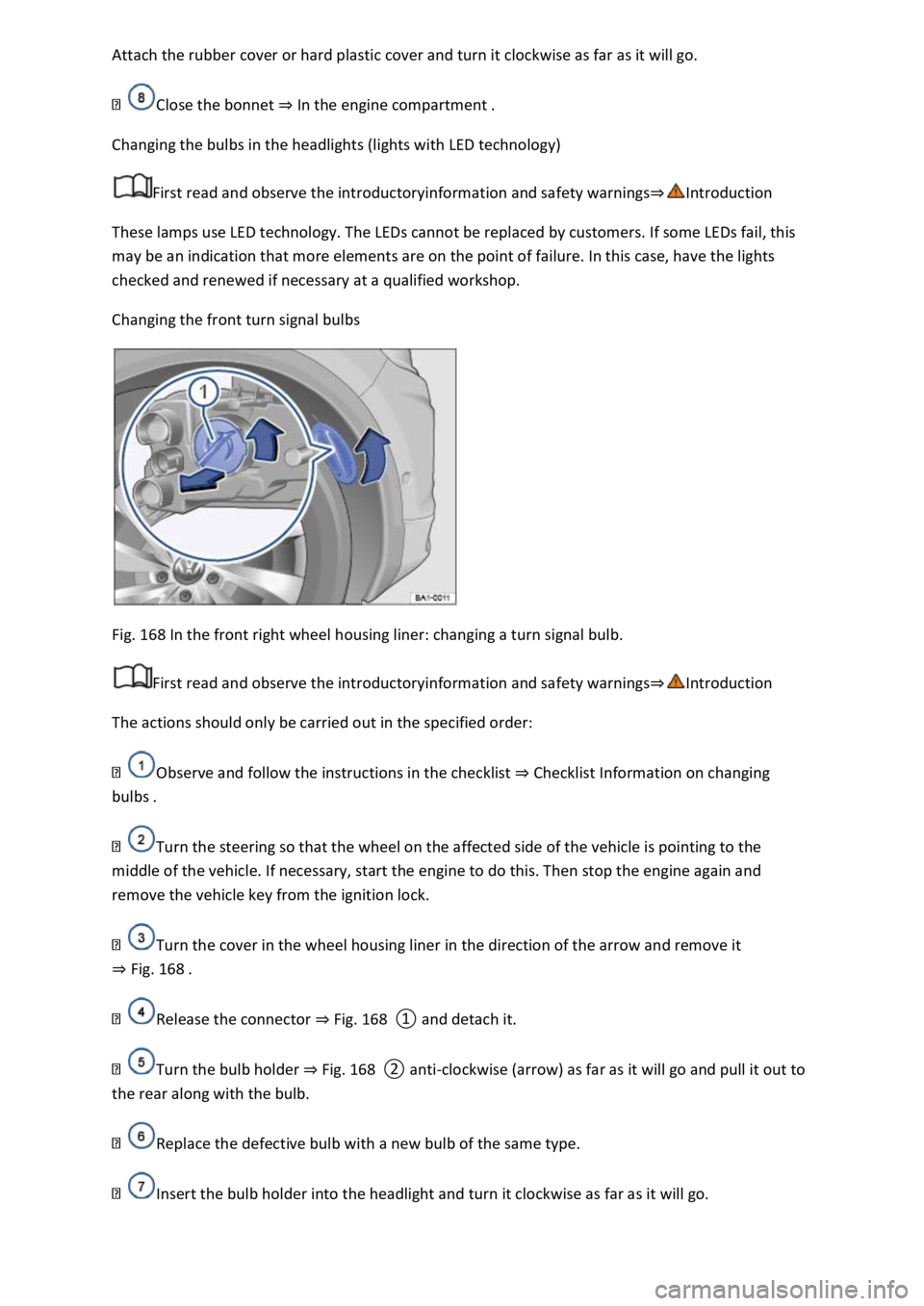
Changing the front turn signal bulbs
Fig. 168 In the front right wheel housing liner: changing a turn signal bulb.
First read and observe the introductoryinformation and safety warnings
The actions should only be carried out in the specified order:
Observe and follow the instructions in the checklist Checklist Information on changing
bulbs
Turn the steering so that the wheel on the affected side of the vehicle is pointing to the
middle of the vehicle. If necessary, start the engine to do this. Then stop the engine again and
remove the vehicle key from the ignition lock.
Turn the cover in the wheel housing liner in the direction of the arrow and remove it
Fig. 168
Release the connector Fig. 168
Turn the bulb holder Fig. 168clockwise (arrow) as far as it will go and pull it out to
the rear along with the bulb.
Replace the defective bulb with a new bulb of the same type.
Insert the bulb holder into the headlight and turn it clockwise as far as it will go.
Page 356 of 502

Tow-starting
Towing
Fitting the rear towing eye
Fitting the front towing eye
Towing requires some experience, especially when using a tow rope. Both drivers should be familiar
with the technique required for towing. Inexperienced drivers should not attempt to tow.
Ensure that no excessive pulling forces occur and take care to avoid jerking movements. When
towing offroad, there is always a risk of overloading the anchorage points.
Observe any legal requirements when towing or tow-starting.
Tow-starting
Tow-starting describes the procedure for starting the vehicle by moving it using another towing
vehicle.
The vehicle can be tow-started with a tow-bar or a tow-rope.
Towing
Towing is where a vehicle that cannot be driven is pulled with the aid of another vehicle.
The vehicle can be towed with a tow-bar or a tow-rope. When the engine is stopped, the gearbox is
not lubricated sufficiently at higher speeds and over long distances:
km/h (30 mph).
km.
Tow rope, tow bar
It is easier and safer to tow a vehicle with a tow bar. Use a tow rope only if you do not have a tow
bar.
The tow rope should be slightly elastic to reduce the strain on both vehicles. It is advisable to use a
tow rope made of synthetic fibre or similarly elastic material.
Towing with a tow truck
If your vehicle is to be raised on one axle for towing, this may only be done using the following axles
according to the gearbox/drive combination:
Front-wheel drive
Manual gearboxFront or rear axleAutomatic gearboxFront axle
WARNING
If a vehicle is being towed, the vehicle handling and braking efficiency will change significantly.
Page 391 of 502

ator. The 12-volt vehicle battery will not be charged by the alternator while the
vehicle is in motion.
Switch off any electrical consumers that are not required. Inform a qualified workshop. Have the
electrical system checked.
The start/stop system cannot start the engine Start/stop system
and vehicle battery (12-volt)
The central warning lamp lights up yellow and the text message 12 V battery low. Charge by driving.
is displayed.
The charge level of the vehicle battery is insufficient.
Recharge the 12-volt vehicle battery by driving the vehicle for an extended time.
The start/stop system cannot start the engine Start/stop system
and vehicle battery (12-volt)
The central warning lamp lights up red and the text message Replace 12 V battery. Workshop. is
displayed.
The vehicle battery condition is not ok.
Seek expert assistance and have the battery checked and replaced if necessary.
The start/stop system cannot start the engine Start/stop system
Wheels and tyres
Tyre monitoring system
Introduction
This chapter contains information on the followingsubjects:
Tyre Pressure Loss Indicator
Troub
The tyre monitoring system warns the driver when the tyre pressures are too low.
The tyre monitoring system monitors various parameters (for example, rolling circumference) of all
wheels using ABS sensors (indirect measurement).
WARNING
The intelligent tyre monitoring system technology cannot overcome the laws of physics, and
functions only within the limits of the system. Incorrect handling of the wheels and tyres can lead to
a sudden loss of pressure in the tyres, tread separation and even tyre blow-out.