warning VOLKSWAGEN T-ROC 2021 Owner´s Manual
[x] Cancel search | Manufacturer: VOLKSWAGEN, Model Year: 2021, Model line: T-ROC, Model: VOLKSWAGEN T-ROC 2021Pages: 502, PDF Size: 9.42 MB
Page 185 of 502

Never leave the vehicle unattended with the engine running, particularly if a gear or driving position
has been selected. The vehicle could move suddenly or something unexpected may happen that may
cause damage, fire and serious injuries.
Never use a start booster. Start boosters could explode and cause the engine to suddenly run at high
revs.
WARNING
Never leave the engine running if you leave the vehicle unattended, particularly if a gear or position
has been selected. The vehicle could move suddenly or something unexpected may happen that may
cause damage, fire or serious injuries.
WARNING
Start boosters could explode or cause the engine to suddenly run at high revs.
Never use a start booster.
NOTICE
The starter and the engine can be damaged if you attempt to start the engine while the vehicle is in
motion or if the engine is started again immediately after it has been switched off.
When the engine is cold, avoid high engine speeds, driving at full throttle and overloading the
engine.
Do not push start or tow start the vehicle. Unburnt fuel could damage the catalytic converter.
NOTICE
If the engine does not start, never use the starter with a gear selected and the vehicle key in the
ignition lock in position ⇒ Fig. 99② for driving or tow-starting, e.g. when the fuel tank is empty.
This could cause damage to the starter.
Fill up with fuel if necessary ⇒ Fuel types and refuelling or jump start the vehicle ⇒ Jump starting .
If the engine does not start, seek expert assistance.
Do not warm up the engine by running it while the vehicle is stationary. Instead, pull off as soon as
there is good visibility through the windows. This helps the engine reach operating temperature
faster and reduces emissions.
Page 186 of 502

Components with a high power consumption are switched off temporarily when the engine is
started.
The engine cannot be started with the starter button, for example, if the button cell in the vehicle
key is weak or flat. In this case, use the emergency start function ⇒ No valid vehicle key recognised .
When starting from cold, the engine may be a little noisy for the first few seconds. This is quite
normal, and no cause for concern.
At outside temperatures of less than +5°C (+41°F), fumes may be detected under a vehicle with a
diesel engine if the fuel-powered supplementary heater is switched on.
Switching off the engine
Bring the vehicle to a standstill ⇒ .
Park the vehicle ⇒ Parking .
Vehicles with ignition lock: turn the vehicle key to position ⇒ Fig. 99⓪ in the ignition lock.
Vehicles with a starter button: press the starter button briefly ⇒ Fig. 100 . If the engine cannot
be switched off, carry out the emergency switch-off procedure ⇒ Engine cannot be switched off .
Follow the instructions in the instrument cluster ⇒ Instrument cluster .
Ignition warning
In order to indicate an active ignition when leaving the vehicle, an acoustic warning signal sounds
when opening the driver door and corresponding warning messages appear on the display of the
instrument cluster.
Warning before leaving the vehicle
Vehicles with DSG dual clutch gearbox: if the selector lever is not in position P, an acoustic
warning signal will sound when the driver door is opened and the warning message Please move
selector lever to position P. will be shown on the instrument cluster display. In this way, a warning is
given that the vehicle could potentially roll away. When you leave the vehicle, the electronic parking
brake also switches on to prevent the vehicle rolling away.
WARNING
Never switch off the engine while the vehicle is in motion. This can lead to a loss of vehicle control,
accidents and serious injuries.
Page 187 of 502

The airbags and belt tensioners will not work if the ignition is switched off.
The brake servo will not work when the engine is switched off. More force is required on the brake
pedal to stop the vehicle.
If the vehicle key is removed from the ignition, the steering lock may activate and you will no longer
be able to steer the vehicle.
WARNING
The components of the exhaust system become very hot. This can cause fires and serious injuries.
Never park the vehicle so that parts of the exhaust system can come into contact with any
inflammable material underneath the vehicle, e.g. undergrowth, leaves, dry grass, spilt fuel etc.
Never apply additional underseal or anti-corrosion coatings to the exhaust pipes, catalytic
converters, heat shields or particulate filter.
NOTICE
If the vehicle has been driven at high load for a long period, the engine can overheat when it is
switched off. In order to avoid damage to the engine, allow the engine to run in neutral position for
approximately 2 minutes before switching it off.
After the engine is switched off, the radiator fan in the engine compartment may run on for some
minutes, even if the ignition is switched off or the vehicle key has been removed. The radiator fan
will switch itself off automatically.
Electronic immobiliser
The immobiliser helps to prevent the engine from being started and driven with an unauthorised
vehicle key.
There is a chip in the vehicle key. The immobiliser is automatically deactivated by this when a valid
vehicle key is inserted in the ignition lock.
The electronic immobiliser is automatically activated when the vehicle key is removed from the
ignition lock. In vehicles with Keyless Access, the vehicle key must be outside the vehicle.
The engine can be started only using a Volkswagen Genuine vehicle key with the correct code.
Coded vehicle keys are available from a Volkswagen dealership.
Problem-free operation of the vehicle is guaranteed only with Volkswagen Genuine vehicle keys.
Troubleshooting
Page 192 of 502

The instrument cluster shows the status of the start/stop system each time the button is pressed.
If the start/stop system has switched the engine off, it will start again as soon as the system is
deactivated manually with the button.
Always deactivate the start/stop system manually when driving through water.
Start/stop mode when Adaptive Cruise Control (ACC) is active
The engine will be switched off after the Adaptive Cruise Control (ACC) has brought the vehicle to a
standstill via an active braking intervention ⇒ Adaptive Cruise Control (ACC) .
The engine will be switched off after the Adaptive Cruise Control (ACC) has brought the vehicle to a
standstill via an active braking intervention ⇒ Adaptive Cruise Control (ACC) .
Vehicles with dual clutch gearbox DSG: when adaptive cruise control (ACC) is activated, the
dual clutch gearbox DSG® can switch to coasting mode.
Vehicles with dual clutch gearbox DSG: when adaptive cruise control (ACC) is activated, the
dual clutch gearbox DSG® can switch to coasting mode.
In the following instances, the engine will restart when the Adaptive Cruise Control (ACC) is active:
If the accelerator is depressed.
When the Adaptive Cruise Control (ACC) has resumed speed and distance control.
If the vehicle ahead has moved on.
WARNING
Never switch off the engine or the ignition while the vehicle is in motion. This can lead to a loss of
vehicle control, accidents and serious injuries.
The airbags and belt tensioners will not work if the ignition is switched off.
The brake servo will not work when the engine is switched off. That is why more pressure on the
brake pedal is needed to brake the vehicle when the engine is switched off.
The power steering will not work when the engine is not running. More power is needed to steer the
vehicle when the engine is switched off.
When the ignition is switched off, the steering lock may activate and you will no longer be able to
steer the vehicle.
The start/stop system must be deactivated if work is to be carried out in the engine compartment.
NOTICE
Page 193 of 502
If the start/stop system is used in very high outside temperatures over a long period, the 12-volt
vehicle battery can be damaged.
The engine stop function may be deactivated automatically if the temperature is above around 38°C
(100°F).
In some cases, it may be necessary to restart the engine manually. Follow any corresponding
messages on the instrument cluster display.
The start/stop function is activated automatically if the Eco driving profile is selected on vehicles
with driving profile selection ⇒ Driving profile selection and 4MOTION Active Control .
Always deactivate the start/stop system manually when driving through water.
Troubleshooting
Engine no longer starts automatically
Vehicles with DSG dual clutch gearbox and coasting function: if the engine does not start
automatically, the warning Error: vehicle power system. Please visit workshop can be displayed in
the instrument cluster.
Start the engine manually ⇒ Starting the engine .
Deactivate the start/stop system manually.
Go to a qualified workshop immediately.
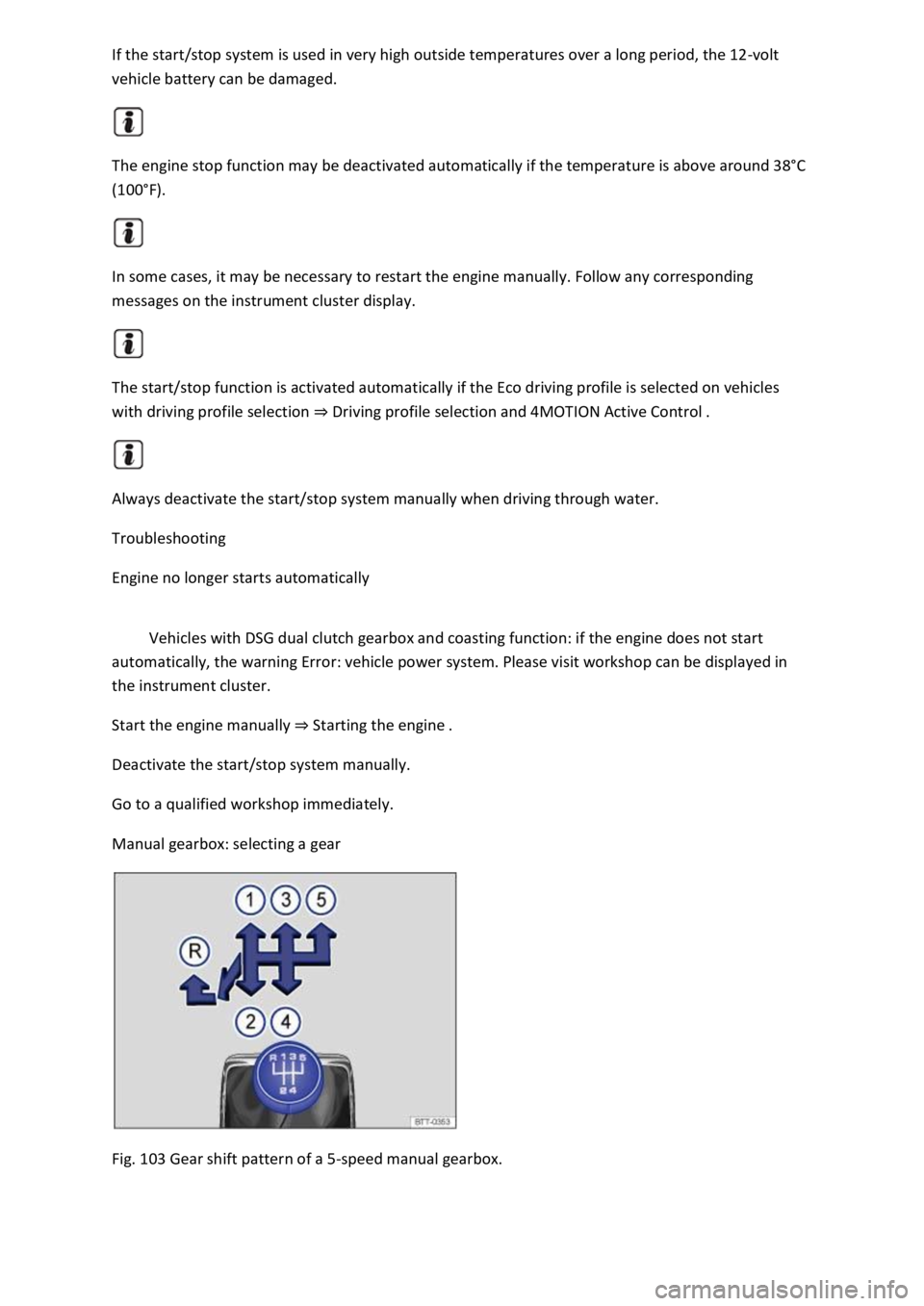
Manual gearbox: selecting a gear
Fig. 103 Gear shift pattern of a 5-speed manual gearbox.
Page 194 of 502
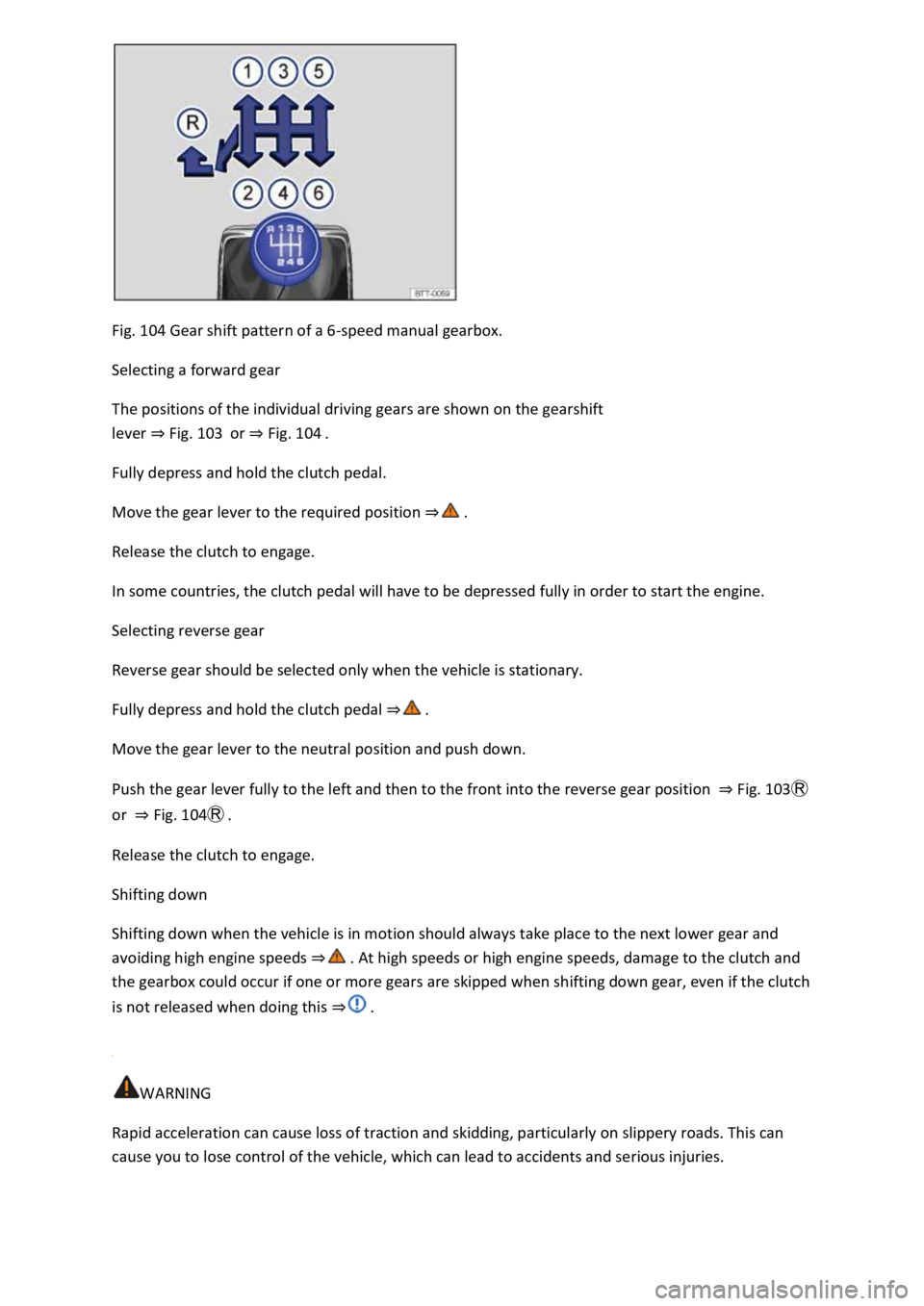
Fig. 104 Gear shift pattern of a 6-speed manual gearbox.
Selecting a forward gear
The positions of the individual driving gears are shown on the gearshift
lever ⇒ Fig. 103 or ⇒ Fig. 104 .
Fully depress and hold the clutch pedal.
Move the gear lever to the required position ⇒ .
Release the clutch to engage.
In some countries, the clutch pedal will have to be depressed fully in order to start the engine.
Selecting reverse gear
Reverse gear should be selected only when the vehicle is stationary.
Fully depress and hold the clutch pedal ⇒ .
Move the gear lever to the neutral position and push down.
Push the gear lever fully to the left and then to the front into the reverse gear position ⇒ Fig. 103Ⓡ
or ⇒ Fig. 104Ⓡ .
Release the clutch to engage.
Shifting down
Shifting down when the vehicle is in motion should always take place to the next lower gear and
avoiding high engine speeds ⇒ . At high speeds or high engine speeds, damage to the clutch and
the gearbox could occur if one or more gears are skipped when shifting down gear, even if the clutch
is not released when doing this ⇒ .
WARNING
Rapid acceleration can cause loss of traction and skidding, particularly on slippery roads. This can
cause you to lose control of the vehicle, which can lead to accidents and serious injuries.
Page 195 of 502

Use fast acceleration only if visibility, weather, road and traffic conditions permit, and other road
users are not put at risk due to the acceleration and driving style.
Always adjust your driving style in accordance with the flow of traffic.
When the TCS is switched off, the drive wheels may spin, especially if the road surface is wet,
slippery or dirty. This may result in you no longer being able to steer or control the vehicle.
WARNING
When the engine is running, the vehicle will start to move as soon as a gear is engaged and the
clutch is released. This also applies when the electronic parking brake has been switched on.
Never engage reverse gear while the vehicle is in motion.
WARNING
Shifting gears incorrectly to gears that are too low can lead to a loss of control over the vehicle, with
accidents and serious injuries as a consequence.
NOTICE
Serious damage to the clutch and gearbox could occur if the gear lever of the manual gearbox is
shifted to a gear which is too low when travelling at high speeds or at high engine speeds. This also
applies if the clutch remains depressed and the gears do not engage.
NOTICE
Please note the following points in order to avoid damage and premature wear:
Do not rest your hand on the gear lever when driving. The pressure from your hand is passed onto
the selector forks in the gearbox.
Ensure that the vehicle has come to a full stop before engaging reverse gear.
Always fully depress the clutch pedal when changing gear.
Do not hold the vehicle by riding the clutch on uphill gradients with the engine running.
Changing up a gear early will help to save fuel and minimise engine noise.
Troubleshooting
Clutch slipping
Page 196 of 502

The indicator lamp lights up yellow.
Clutch is not transmitting the full engine torque.
If necessary, remove foot from the clutch pedal.
Clutch overheated
The indicator lamp lights up yellow.
An acoustic warning may also be given ⇒ .
The clutch can overheat, for example if the vehicle pulls off frequently, travels at a crawl for long
periods, or in stop and go traffic.
Overheating is indicated by the warning lamp and in some cases by additional warning lamps and a
text message in the instrument cluster display.
You can continue to drive.
Clutch faulty
The indicator lamp lights up yellow.
The clutch is faulty.
Drive on carefully!
Seek expert assistance. Failure to do so can cause considerable clutch damage.
DSG® dual clutch gearbox
Function of the DSG® dual clutch gearbox
Description
The vehicle is equipped with a DSG® dual clutch gearbox.
The DSG® dual clutch gearbox is a gearbox which uses dual-clutch technology to change gear
automatically. It uses a dual clutch and two gear train halves to enable very fast gear changes with
no loss of torque. The DSG® dual clutch gearbox thus combines the performance and economy of a
manual gearbox with the comfort and convenience of a conventional automatic gearbox.
Function
Engine power is transferred to the drive shaft via the gearbox. In order to change gears, the power
transmission between the engine and the gearbox has to be interrupted. This is what the clutch is
for.
With the DSG® dual clutch system with its two gear train halves, the engine power is always
connected to one gear train half when driving. Before a gear shift, the next-higher or lower gear is
already preselected in the load-free second gear train half. The clutch on the non-driven gear is then
closed, and the other is opened at the same time. This makes very fast gear changes possible.
Thanks to its design, the DSG® dual clutch gearbox is more efficient than an automatic gearbox.
Whereas in an automatic gearbox the torque converter is constantly in use, in the DSG® dual clutch
Page 198 of 502

– Reverse gear
Reverse gear is selected. May be selected only when the vehicle is stationary.
– Neutral
The gearbox is in the neutral position. No force is transmitted to the wheels and the braking effect of
the engine is not available.
– Standard forward driving position
Position : Normal programme.
All forward gears are shifted up and down automatically. The timing of the gear shift is determined
by the engine load, your individual driving style and the speed of the vehicle.
Position : Sport programme.
The forward gears are automatically changed up later and down earlier than in selector lever
position D. This exploits the engine’s full power reserves. The timing of the gear shift is determined
by the engine load, your individual driving style and the speed of the vehicle.
To change between positions D and S, move the selector lever to the rear ⇒ Fig. 105 .
The selector lever will always return to selector lever position D/S. That also works in the Tiptronic
gate ⇒ Changing gear using Tiptronic .
Selector lever lock
P
N
To release the selector lever lock, switch on the ignition and depress the brake pedal. Then press the
lock button in the selector lever handle in the direction of the arrow ⇒ Fig. 105 .
The selector lever lock is not engaged if the selector lever is moved quickly through position N, e.g.
when shifting from reverse to D/S. This makes it possible, for instance, to rock the vehicle backwards
and forwards if it is stuck in snow or mud. The selector lever lock engages automatically if the lever is
in position N for more than approximately one second without the brake being pressed and when
the vehicle is travelling no faster than approximately 5 km/h (3 mph).
WARNING
Selecting the wrong position can cause you to lose control of the vehicle, which can lead to accidents
and serious injuries.
Never depress the accelerator when selecting a position.
When the engine is running and a position is engaged, the vehicle will start moving as soon as the
brake pedal is released.
Never shift to reverse or selector lever position P while the vehicle is moving.
Page 199 of 502
WARNING
Unintentional vehicle movements can cause serious injury.
The driver must never leave the driver seat when the engine is running and a position has been
selected. If you have to leave the vehicle while the engine is running, always switch on the electronic
parking brake and move the selector lever to position P.
If the engine is running and the selector lever is in position D/S or R, the vehicle must be held by the
foot brake. The vehicle will creep forward even when the engine is idling, as power transmission is
even then not fully interrupted.
Never select reverse or selector lever position P when the vehicle is in motion.
Never leave the vehicle in selector lever position N. The vehicle will roll downhill irrespective of
whether or not the engine is running.
NOTICE
If the electronic parking brake is not switched on when the vehicle is stationary and the brake pedal
is released when the selector lever is in position P, the vehicle may move a few centimetres forwards
or backwards.
If the lever is moved accidentally to N when driving, take your foot off the accelerator. Wait for the
engine to reach idling speed in the neutral position before selecting a position again.
If the selector lever is left in any position other than P for long periods when the engine is switched
off, the 12-volt vehicle battery will discharge.
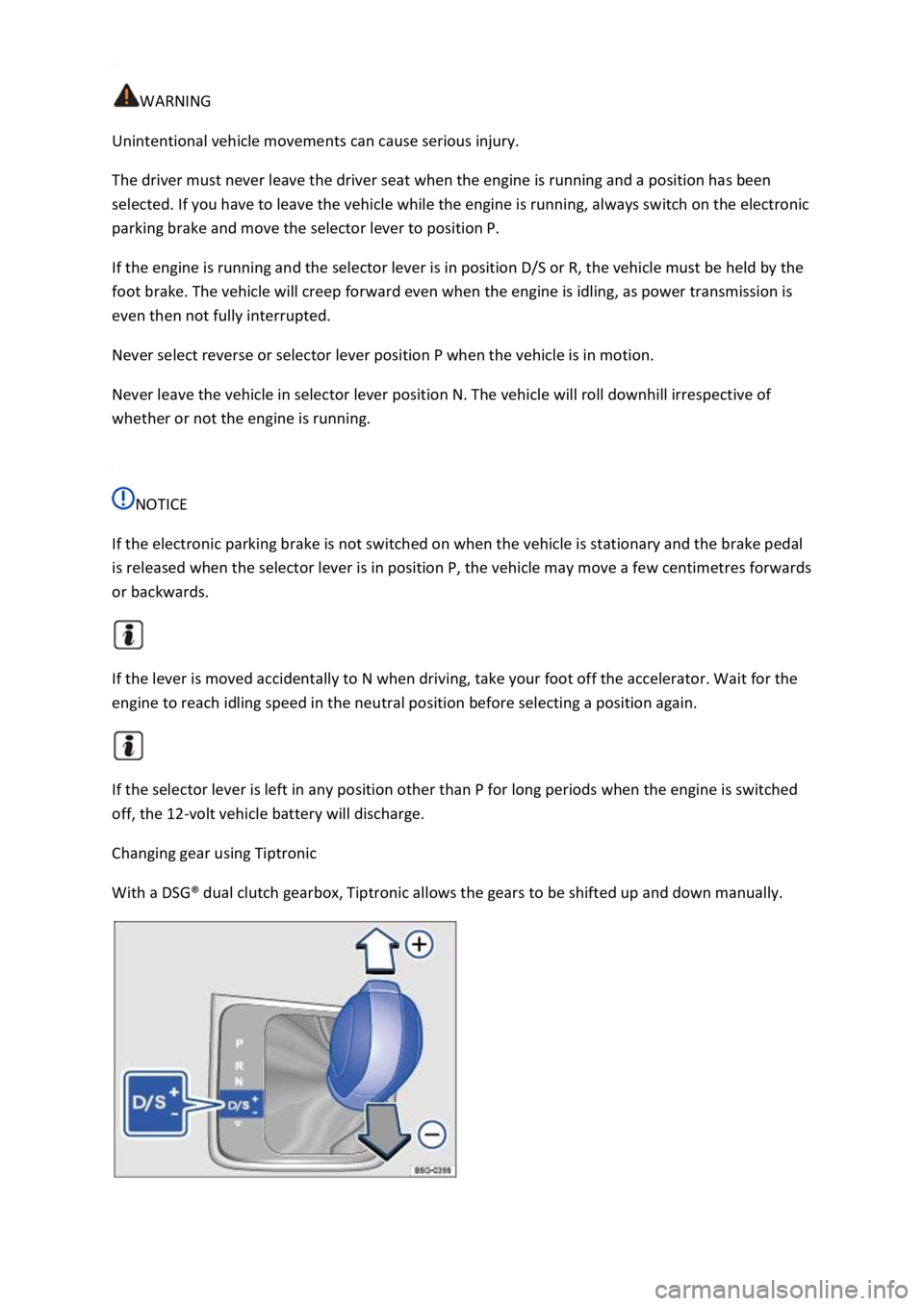
Changing gear using Tiptronic
With a DSG® dual clutch gearbox, Tiptronic allows the gears to be shifted up and down manually.