ad blue VOLKSWAGEN T-ROC 2021 Owner´s Manual
[x] Cancel search | Manufacturer: VOLKSWAGEN, Model Year: 2021, Model line: T-ROC, Model: VOLKSWAGEN T-ROC 2021Pages: 502, PDF Size: 9.42 MB
Page 329 of 502
changes in temperature and damage and the AdBlue® may damage the vehicle interior.
Refilling AdBlue
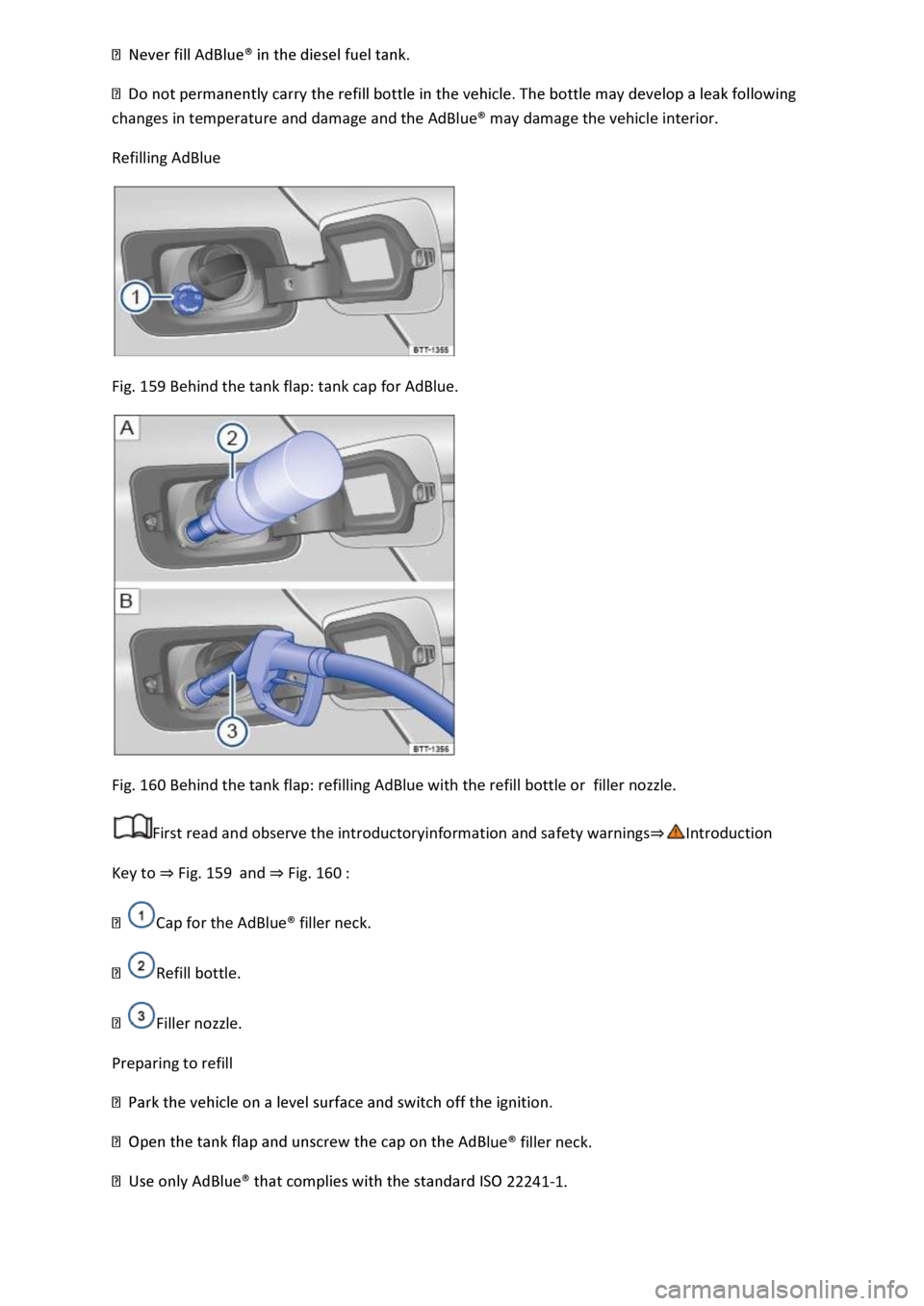
Fig. 159 Behind the tank flap: tank cap for AdBlue.
Fig. 160 Behind the tank flap: refilling AdBlue with the refill bottle or filler nozzle.
First read and observe the introductoryinformation and safety warnings⇒Introduction
Key to ⇒ Fig. 159 and ⇒ Fig. 160 :
Cap for the AdBlue® filler neck.
Refill bottle.
Filler nozzle.
Preparing to refill
lue® filler neck.
22241-1.
Page 330 of 502

Refilling AdBlue® with a refill bottle
eep pressing the refill bottle.
Refilling AdBlue® with a filler nozzle
The AdBlue® tank can be refilled at all AdBlue® pumps for passenger cars.
The filler nozzle may click off prematurely if filling is performed at a truck filling pump. There is a risk
of AdBlue® spilling out due to the much higher filling speed.
The handle of the filler nozzle must point down during refilling in order to guarantee optimum
filling.
Do not continue filling because the AdBlue® tank can be damaged by overfilling ⇒ .
Preparing to drive on
.
NOTICE
Overfilling AdBlue® may damage the tank system and the vehicle.
as possible with a damp cloth and plenty of cold water.
Dispose of the refill bottle in an environmentally friendly way.
Suitable AdBlue® refill bottles are available from a Volkswagen dealership.
Catalytic converter
Page 332 of 502
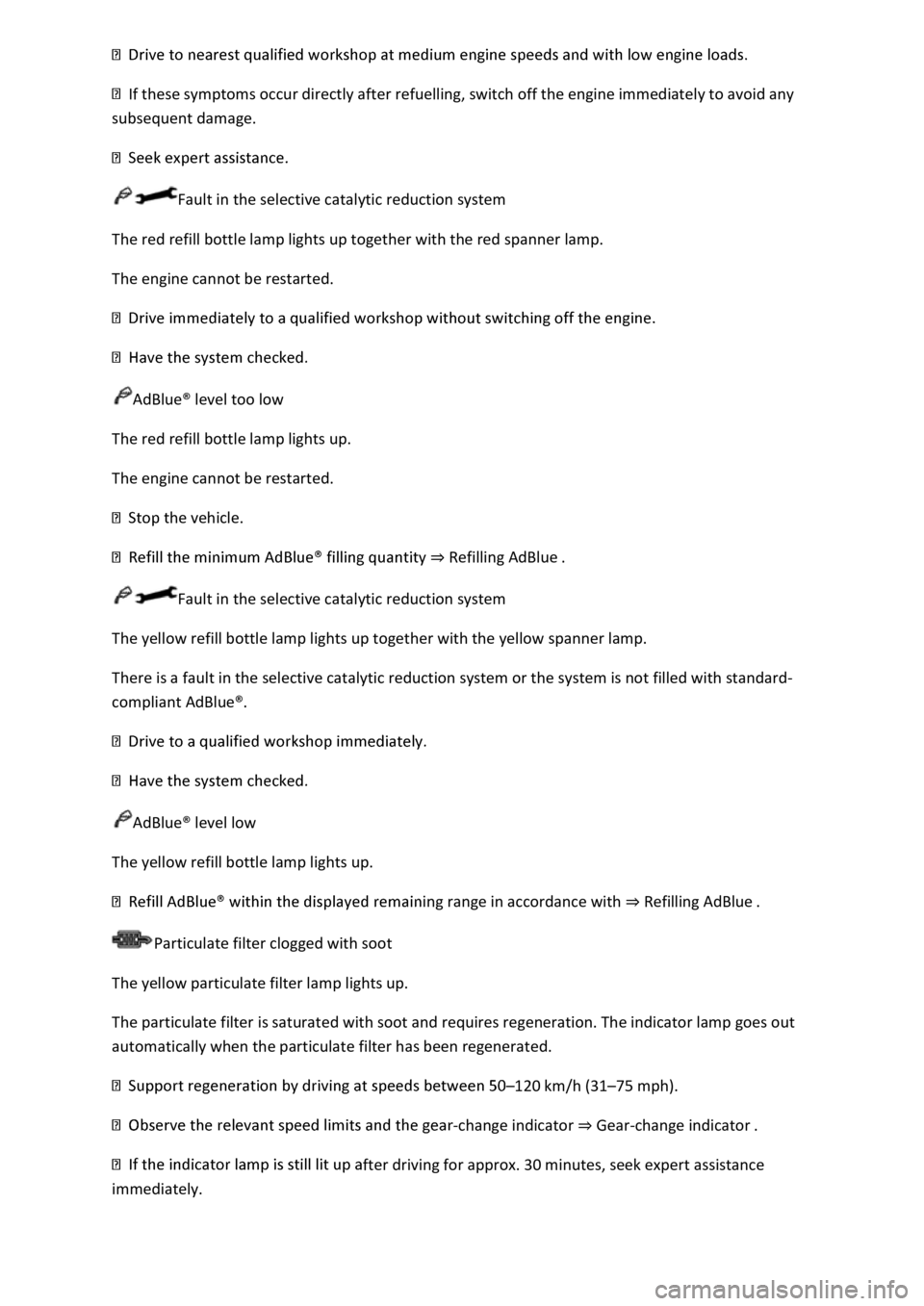
If these symptoms occur directly after refuelling, switch off the engine immediately to avoid any
subsequent damage.
Fault in the selective catalytic reduction system
The red refill bottle lamp lights up together with the red spanner lamp.
The engine cannot be restarted.
AdBlue® level too low
The red refill bottle lamp lights up.
The engine cannot be restarted.
he vehicle.
⇒ Refilling AdBlue .
Fault in the selective catalytic reduction system
The yellow refill bottle lamp lights up together with the yellow spanner lamp.
There is a fault in the selective catalytic reduction system or the system is not filled with standard-
compliant AdBlue®.
AdBlue® level low
The yellow refill bottle lamp lights up.
ing range in accordance with ⇒ Refilling AdBlue .
Particulate filter clogged with soot
The yellow particulate filter lamp lights up.
The particulate filter is saturated with soot and requires regeneration. The indicator lamp goes out
automatically when the particulate filter has been regenerated.
–120 km/h (31–75 mph).
-change indicator ⇒ Gear-change indicator .
fter driving for approx. 30 minutes, seek expert assistance
immediately.
Page 351 of 502

Colour coding of fuses
Fuses (ATO / MINI / MAXI)
ColourAmp
ratingBlack1 ampsPurple3 ampsOrange5 ampsBrown7.5 ampsRed10 ampsBlue15 ampsYellow20 am
psWhite or clear25 ampsGreen30 ampsLight green40 amps
Fuses (JCASE)
Blue20 ampsPink30 ampsGreen40 ampsRed50 ampsYellow60 amps
Preparations
equipment.
⇒ Fuses in the dash panel .
Recognising a blown fuse
rom the top and side through
the transparent housing due to the melted metal strip ⇒ Fig. 174 .
transparent housing ⇒ Fig. 174 .
Changing a fuse
ary, take the plastic pliers ⇒ Fig. 175 ① out of the respective fuse box cover.
⇒ Fig. 175 ① or ⇒ Fig. 175 ①
onto the fuse from the side.
lace it with a new fuse of the same amp rating (same colour and same
markings) and same size ⇒ .
NOTICE
You can damage another location in the electrical system by using a fuse with a higher amp rating.
Jump starting
Page 379 of 502

The coolant additive is dyed purple. The mixture of water and a coolant additive offers anti-freeze
protection down to -25°C (-13°F), protects the alloy parts in the cooling system against corrosion,
prevents limescale deposits and significantly increases the boiling point of the coolant.
When refilling the coolant, a mixture of distilled water and at least 40% coolant additive - G 13 - or -
G 12 plus-plus - (TL-VW 774 G) (both of which are dyed purple) must be used in order to obtain the
optimum corrosion protection ⇒ .
Mixing - G 13 - with the coolant additives - G 12 plus - (TL-VW 774 F), - G 12 - (dyed red) or - G 11 -
(dyed blue-green) will significantly decrease the level of corrosion protection and should therefore
be avoided ⇒ .
WARNING
Insufficient anti-freeze in the coolant system can cause the engine to break down and cause serious
injuries.
ive used must be sufficient for the lowest
ambient temperature that you expect the vehicle to be exposed to.
Vehicle occupants with inadequate winter clothing could then freeze to death as the heating will
also no longer function.
NOTICE
Never mix genuine coolant additives with other coolants that have not been approved by
Volkswagen.
ts from mixing the purple
coolant additive with distilled water) but for example, brown instead of purple, - G 13 - has been
mixed with an unsuitable coolant additive. The coolant must be changed as soon as possible if this is
the case. Failure to observe this warning can result in serious malfunctions or damage to the engine
and cooling system.
Coolant and coolant additives can pollute the environment. Spilt service fluids must be collected and
then disposed of properly and in an environmentally responsible way.
Checking the coolant level and refilling coolant
Page 450 of 502

Electromagnetic radiation
If a mobile phone or two-way radio is used without being connected to the external aerial, the
electromagnetic radiation will not be optimally directed to the outside of the vehicle. Increased
levels of radiation in the vehicle interior can occur in particular in the event of poor reception, e.g. in
rural areas. This can pose a health risk ⇒ .
With some equipment levels, a suitable mobile phone interface may be used to connect the mobile
telephone to the external aerial ⇒BookletInfotainment system,. The connection quality is improved
and the range is increased.
Using the telephone
Many countries require a hands-free system to be used when using a telephone inside the vehicle,
e.g. via a Bluetooth ® connection. Secure the mobile telephone to a suitable holder before using it ⇒
or stow it securely away in one of the stowage compartments provided, e.g. in the centre
console.
Use a compatible mobile phone if the mobile phone interface uses SIM Access Profile (rSAP)
technology. If the LTE mobile standard is supported, use a SIM card with LTE data option.
Radio communication
Observe any legal requirements and the manufacturer's owner's manual when using radio
communication devices. Two-way radios must be approved if they are to be retrofitted in the
vehicle.
Contact your Volkswagen dealership for further information on installing a two-way radio.
WARNING
Mobile telephones which are loosely placed in the vehicle or not properly secured could be flung
through the interior and cause injuries during a sudden driving or braking manoeuvre, or in the
event of an accident.
them safely.
WARNING
If mobile telephones or two-way radios that are not connected to an external aerial are used,
electromagnetic radiation in the vehicle could exceed limit values and thus be a health hazard for
drivers and other vehicle occupants. This also applies to external aerials which have not been
correctly installed.
pacemaker.
breast pocket.
Page 464 of 502
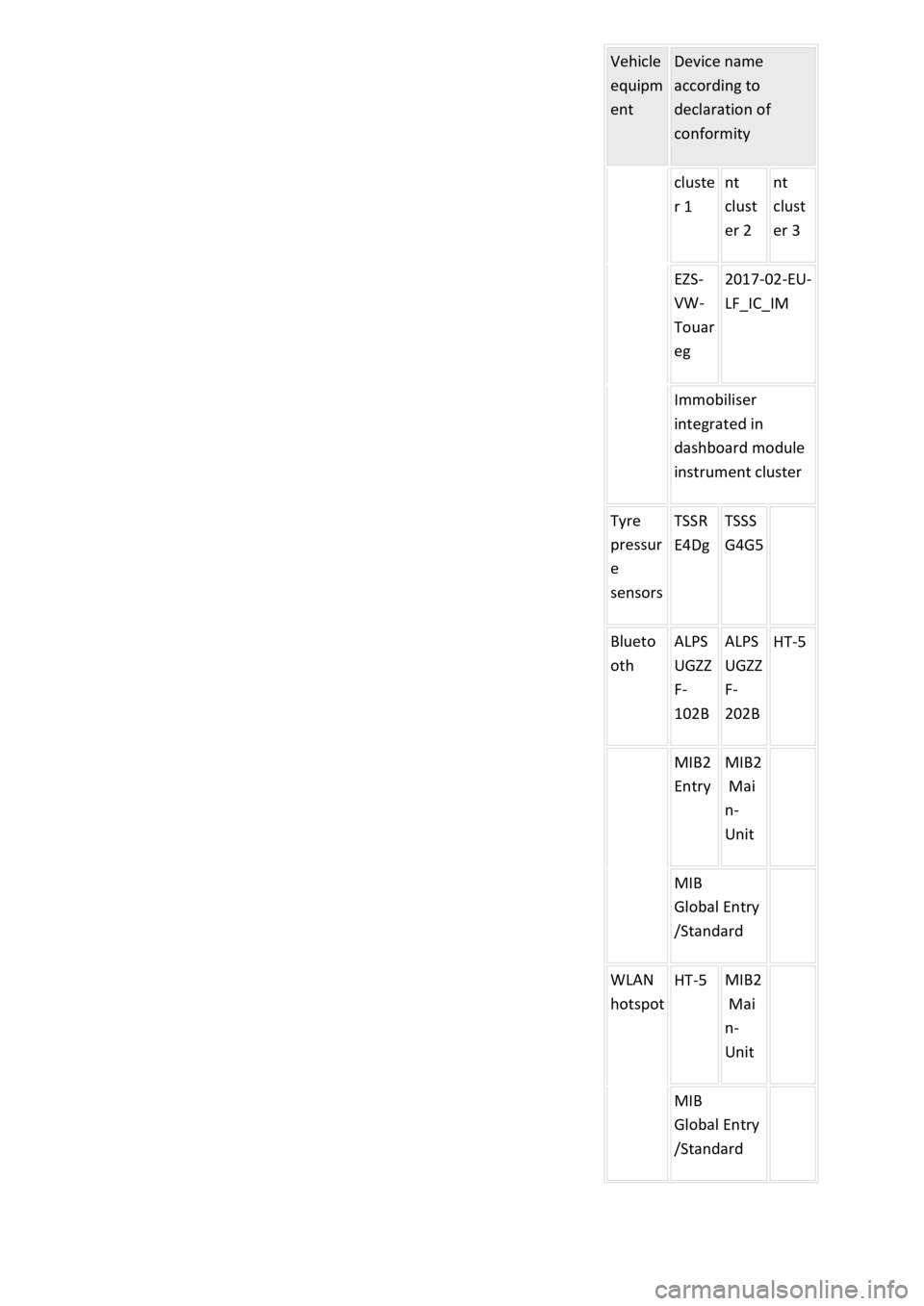
Vehicle
equipm
ent
Device name
according to
declaration of
conformity
cluste
r 1
nt
clust
er 2
nt
clust
er 3
EZS-
VW-
Touar
eg
2017-02-EU-
LF_IC_IM
Immobiliser
integrated in
dashboard module
instrument cluster
Tyre
pressur
e
sensors
TSSR
E4Dg
TSSS
G4G5
Blueto
oth
ALPS
UGZZ
F-
102B
ALPS
UGZZ
F-
202B
HT-5
MIB2
Entry
MIB2
Mai
n-
Unit
MIB
Global Entry
/Standard
WLAN
hotspot
HT-5 MIB2
Mai
n-
Unit
MIB
Global Entry
/Standard
Page 477 of 502
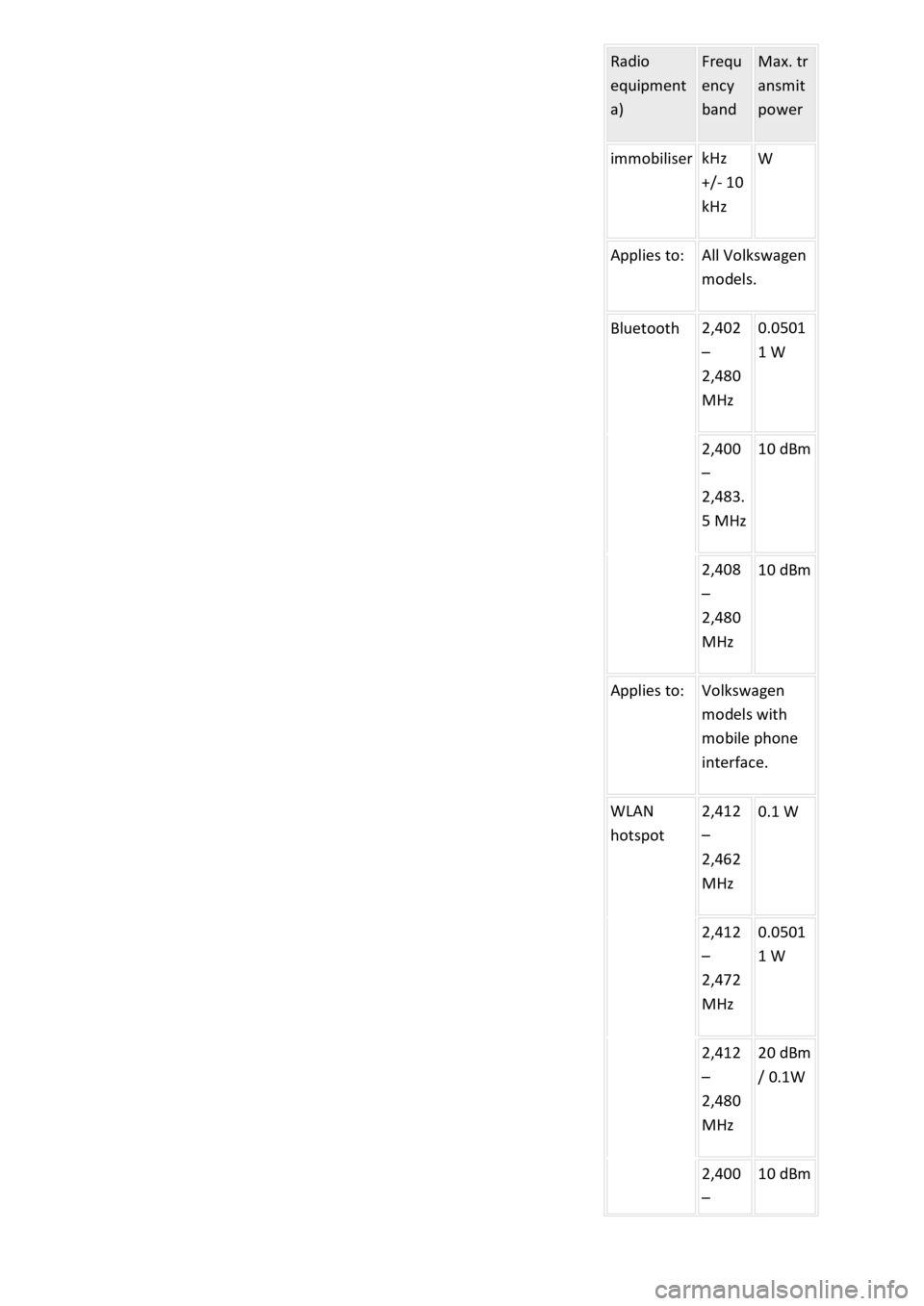
Radio
equipment
a)
Frequ
ency
band
Max. tr
ansmit
power
immobiliser kHz
+/- 10
kHz
W
Applies to: All Volkswagen
models.
Bluetooth 2,402
–
2,480
MHz
0.0501
1 W
2,400
–
2,483.
5 MHz
10 dBm
2,408
–
2,480
MHz
10 dBm
Applies to: Volkswagen
models with
mobile phone
interface.
WLAN
hotspot
2,412
–
2,462
MHz
0.1 W
2,412
–
2,472
MHz
0.0501
1 W
2,412
–
2,480
MHz
20 dBm
/ 0.1W
2,400
–
10 dBm