check engine VOLKSWAGEN T-ROC 2021 Owner´s Manual
[x] Cancel search | Manufacturer: VOLKSWAGEN, Model Year: 2021, Model line: T-ROC, Model: VOLKSWAGEN T-ROC 2021Pages: 502, PDF Size: 9.42 MB
Page 178 of 502

Avoid any abrupt or sudden driving and braking manoeuvres as this could cause the open boot lid to
move unpredictably.
Any objects protruding from the luggage compartment must be marked to ensure that they are
visible to other road users. Comply with legal regulations.
If items protrude out of the luggage compartment, never use the boot lid to wedge them into place
or hold them in position.
If you have to drive with the boot lid open, you must remove any carriers and the loads attached to
them from the boot lid.
WARNING
Poisonous exhaust fumes could enter the vehicle interior when the boot lid is open. This could result
in loss of consciousness, carbon monoxide poisoning, serious injury and accidents.
You should always drive with the boot lid closed in order to prevent poisonous exhaust fumes from
entering the vehicle.
If exceptional circumstances require you to drive with an open boot lid, you must do the following to
reduce the amount of poisonous exhaust fumes that could enter into the vehicle:
Close all windows and the glass roof.
Switch off the air recirculation mode of the heating and fresh air system or air conditioning system.
Open all vents in the dash panel.
Switch the blower for the heating and fresh air system or for the air conditioning system to the
highest setting.
NOTICE
The vehicle height, and possibly the length, are different when the boot lid is open.
Driving through water
Please follow these points in order to prevent damage to your vehicle when driving through water,
for example on flooded streets:
Check how deep the water is before driving through it. The water may be no higher than the lower
edge of the body ⇒ .
Do not drive faster than walking speed.
Never stop the vehicle, reverse or switch off the engine while in water.
Oncoming vehicles will create waves that could increase the water level for your vehicle to such an
extent that it is not safe to drive through the water.
Always deactivate the start/stop system manually when driving through water ⇒ Start/stop system .
Page 188 of 502
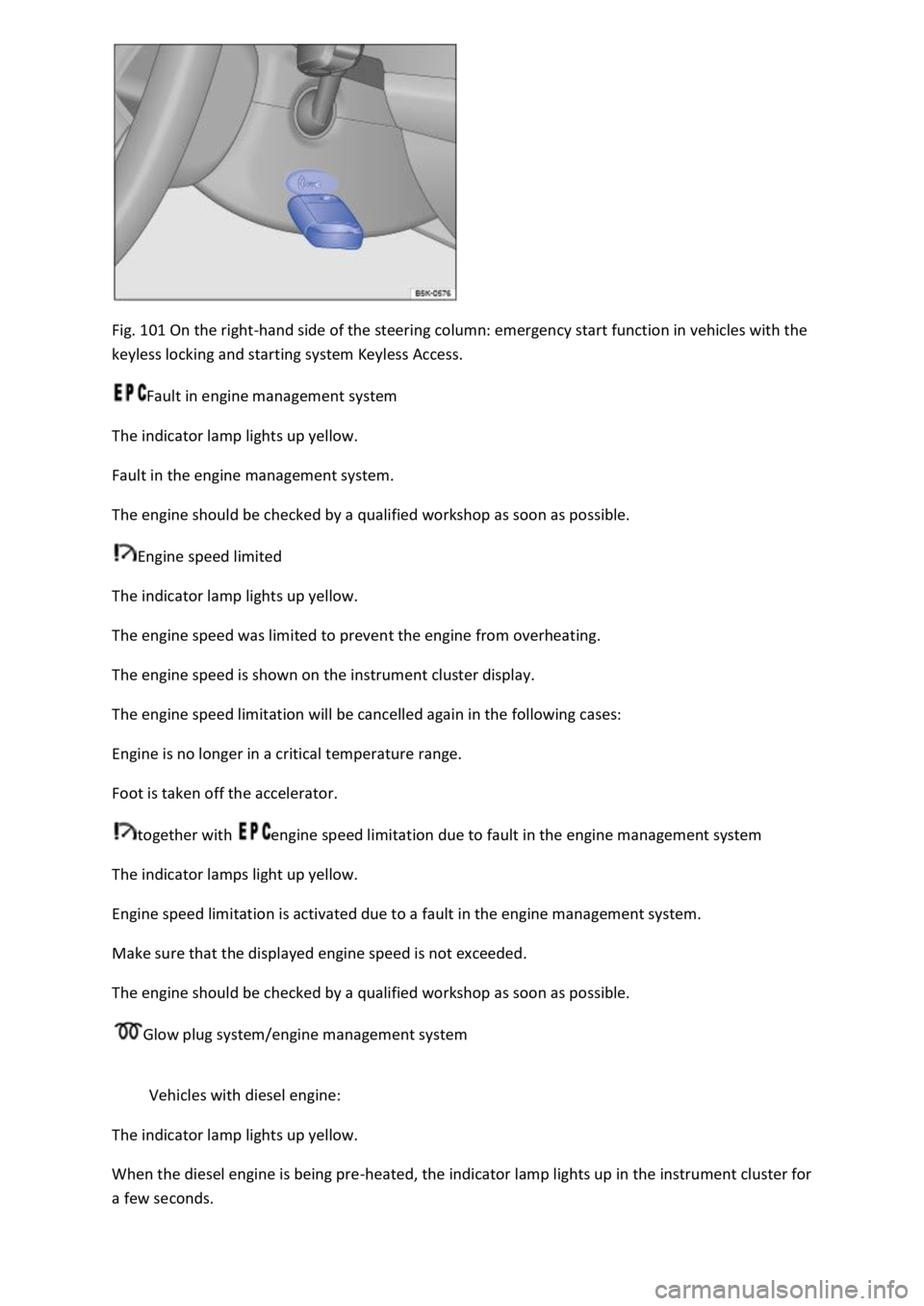
Fig. 101 On the right-hand side of the steering column: emergency start function in vehicles with the
keyless locking and starting system Keyless Access.
Fault in engine management system
The indicator lamp lights up yellow.
Fault in the engine management system.
The engine should be checked by a qualified workshop as soon as possible.
Engine speed limited
The indicator lamp lights up yellow.
The engine speed was limited to prevent the engine from overheating.
The engine speed is shown on the instrument cluster display.
The engine speed limitation will be cancelled again in the following cases:
Engine is no longer in a critical temperature range.
Foot is taken off the accelerator.
together with engine speed limitation due to fault in the engine management system
The indicator lamps light up yellow.
Engine speed limitation is activated due to a fault in the engine management system.
Make sure that the displayed engine speed is not exceeded.
The engine should be checked by a qualified workshop as soon as possible.
Glow plug system/engine management system
Vehicles with diesel engine:
The indicator lamp lights up yellow.
When the diesel engine is being pre-heated, the indicator lamp lights up in the instrument cluster for
a few seconds.
Page 189 of 502

The indicator lamp flashes yellow.
There is a fault in the engine management system.
The engine should be checked by a qualified workshop as soon as possible.
Vehicle key cannot be removed from the ignition lock
An unauthorised vehicle key has been inserted in the ignition lock.
Remove the vehicle key as follows:
Vehicles with DSG dual clutch gearbox
Press the lock button in the selector lever and release.
Remove the vehicle key from the ignition lock.
Vehicles with a manual gearbox
Remove the vehicle key from the ignition lock.
No valid vehicle key recognised
A corresponding display will appear in the instrument cluster.
If the button cell in the vehicle key is weak or discharged, it is possible that the vehicle key will not
be recognised.
In this case, you will need to perform an emergency start:
Depress and hold the brake pedal.
Hold the vehicle key to the right of the steering column trim directly after pressing the starter button
⇒ Fig. 101 .
The ignition is switched on automatically, and in some cases the engine is started.
Engine cannot be switched off
The engine cannot be switched off by briefly pressing the starter button.
In this case it is necessary to perform an emergency switch-off procedure:
Press the starter button twice within a few seconds or press and hold once.
The engine will switch off automatically ⇒ .
Engine cannot be started
A corresponding message will be displayed in the instrument cluster if an unauthorised vehicle key is
used or there is a system fault.
Use an authorised vehicle key.
If the problem persists, seek expert assistance.
Page 205 of 502

After manual unlocking, carefully press the cover into the centre console while ensuring that the
electrical wires are positioned correctly.
Using the flat blade of the screwdriver from the vehicle toolkit, carefully push the release lever in the
direction of the arrow and keep it in this position ⇒ Fig. 109 .
Press the lock button on the front of the selector lever and move the selector lever into position N.
After manual unlocking, carefully press the cover into the centre console while ensuring that the
electrical wires are positioned correctly.
Emergency programme
There is a fault in the system if all the displays on the instrument cluster for the selector lever
positions have a light background. The DSG® dual clutch gearbox is running in an emergency
programme. The vehicle can still be driven in the emergency programme, but only at reduced speed
and not in all gears.
In vehicles with a DSG® dual clutch gearbox, you may no longer be able to select reverse gear.
In all cases, you should have the DSG® dual clutch gearbox checked by a qualified workshop
immediately.
Vehicle does not move even though position is engaged
If the vehicle will not move in the required direction, the system may have selected the position
incorrectly.
Depress the brake pedal and reselect the position.
If the vehicle still does not move in the required direction, there is a system fault. Seek expert
assistance and have the system checked.
WARNING
Never move the selector lever out of the position P if the electronic parking brake is not switched on.
Otherwise the vehicle could move unexpectedly if it is stopped on an uphill or downhill gradient,
which could lead to accidents and serious injuries.
NOTICE
If the vehicle rolls for an extended period or at high speed with the engine switched off and the
selector lever in the position N, the DSG® dual clutch gearbox will be damaged, e.g. when being
towed.
NOTICE
If the display indicates that the gearbox is overheating for the first time, the vehicle must either be
parked safely or driven faster than 20 km/h (12 mph).
Page 209 of 502

The indicator lamp lights up yellow.
The steering should be checked by a qualified workshop as soon as possible.
If the yellow warning lamp remains off after the engine has been restarted and you have driven a
short distance, you do not need to consult a qualified workshop.
Fault in steering
The indicator lamp lights up yellow.
The 12-volt vehicle battery was disconnected.
Drive a short distance at a speed of 15 – 20 km/h (9 – 12 mph).
If the yellow warning lamp is still lit after the engine has been restarted, have the steering checked
by a qualified workshop immediately.
Fault in steering
The indicator lamp flashes yellow.
Turn the steering wheel back and forth.
Switch the ignition off and then on again.
Observe the messages on the instrument cluster display.
Do not continue your journey if the indicator lamp still flashes when the ignition is switched on.
Seek expert assistance.
Steering column is not unlocked or locked
The indicator lamp flashes yellow.
Follow any messages that are on the instrument cluster display.
Switch the ignition off and then on again.
Do not continue your journey if the steering column remains locked when the ignition is switched
on.
Seek expert assistance.
Steering requires increased force
The warning lamp lights up red.
The electromechanical steering has failed.
Do not drive on!
Seek expert assistance.
Driving profile selection and 4MOTION Active Control
Page 215 of 502

Coolant temperature display: the display corresponds to the temperature display on the instrument
cluster ⇒ Coolant temperature display .
Oil temperature display: the display corresponds with the oil temperature display on the instrument
cluster ⇒ Engine oil .
Adapting the display areas to the driving situation
The displayed instruments can be selected according to the driving situation, the ambient conditions
and the offroad conditions:
Sandy terrain: oil, steering angle and coolant temperature display
Inclines: steering angle and coolant temperature display, altimeter
Alpine terrain: steering angle display, altimeter, compass
Offroad driving situations
Introduction
This chapter contains information on the followingsubjects:
⇒ Safety instructions for offroad driving
⇒ Explanation of some technical terms
⇒ Checklist
⇒ General rules and driving tips
⇒ Useful accessories for offroad driving
⇒ Changing gear correctly
⇒ Driving on rough terrain
⇒ Driving through water
⇒ Offroad driving in snow
⇒ Driving on sand and mud
⇒ Driving on steep terrain
⇒ Traversing a slope
⇒ Driving through ditches
⇒ Stuck vehicle
⇒ After offroad driving
You can also drive vehicles with all-wheel drive offroad in addition to on normal roads. It is very
important to read the contents of this section before driving offroad.
The vehicle is not built for expedition-type journeys.
Page 219 of 502
Any rain entering the vehicle when the windows or glass roof are open can soak the interior
equipment and cause damage to the vehicle. Always keep the windows and glass roof closed when
driving offroad.
Explanation of some technical terms
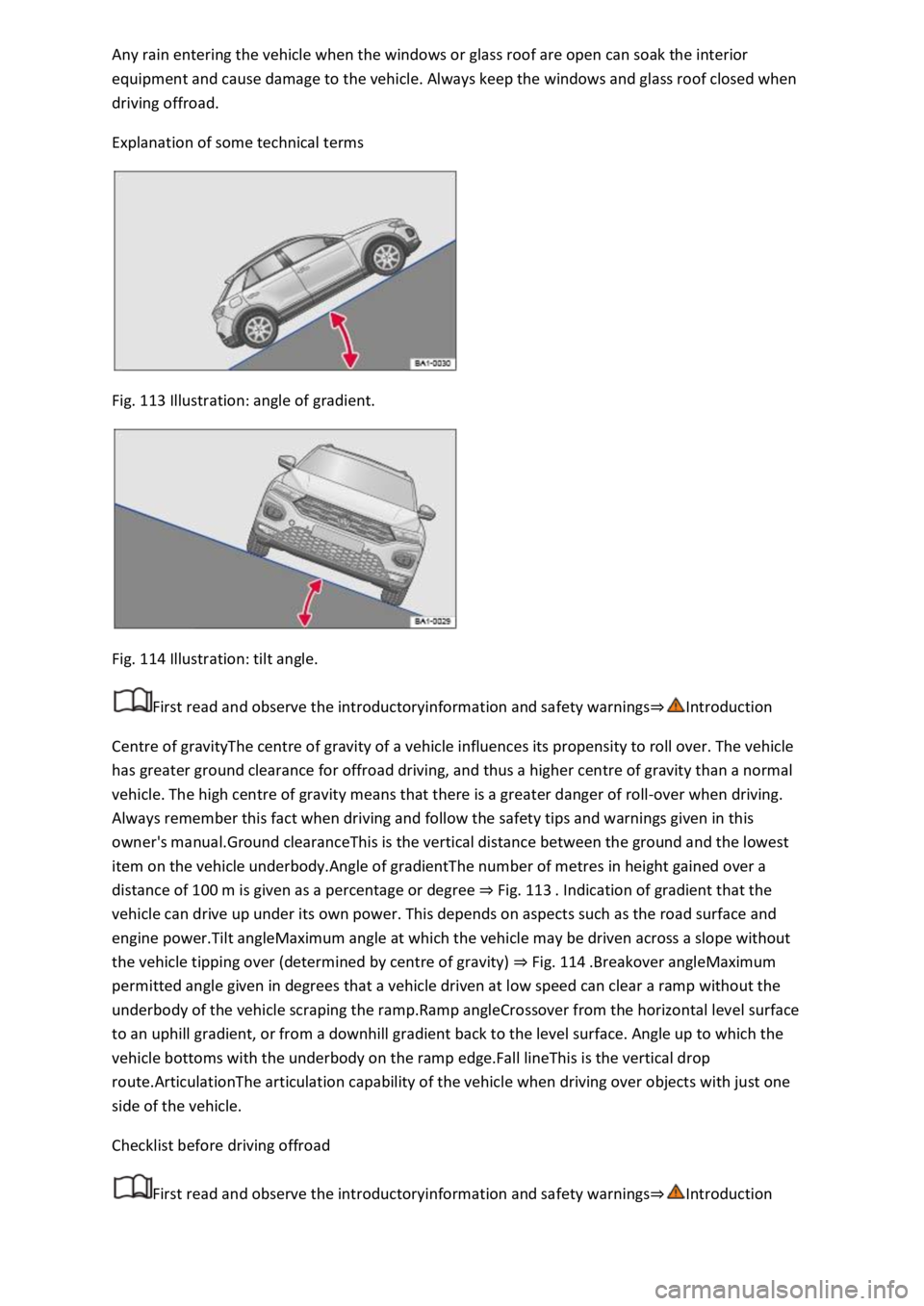
Fig. 113 Illustration: angle of gradient.
Fig. 114 Illustration: tilt angle.
First read and observe the introductoryinformation and safety warnings⇒Introduction
Centre of gravityThe centre of gravity of a vehicle influences its propensity to roll over. The vehicle
has greater ground clearance for offroad driving, and thus a higher centre of gravity than a normal
vehicle. The high centre of gravity means that there is a greater danger of roll-over when driving.
Always remember this fact when driving and follow the safety tips and warnings given in this
owner's manual.Ground clearanceThis is the vertical distance between the ground and the lowest
item on the vehicle underbody.Angle of gradientThe number of metres in height gained over a
distance of 100 m is given as a percentage or degree ⇒ Fig. 113 . Indication of gradient that the
vehicle can drive up under its own power. This depends on aspects such as the road surface and
engine power.Tilt angleMaximum angle at which the vehicle may be driven across a slope without
the vehicle tipping over (determined by centre of gravity) ⇒ Fig. 114 .Breakover angleMaximum
permitted angle given in degrees that a vehicle driven at low speed can clear a ramp without the
underbody of the vehicle scraping the ramp.Ramp angleCrossover from the horizontal level surface
to an uphill gradient, or from a downhill gradient back to the level surface. Angle up to which the
vehicle bottoms with the underbody on the ramp edge.Fall lineThis is the vertical drop
route.ArticulationThe articulation capability of the vehicle when driving over objects with just one
side of the vehicle.
Checklist before driving offroad
First read and observe the introductoryinformation and safety warnings⇒Introduction
Page 220 of 502

Checklist
To ensure your own safety and the safety of your passengers, observe the following points before
driving offroad:
Obtain sufficient information before driving into offroad terrain with the vehicle.
Do not plan day stages that are too long. Take increased fuel consumption for offroad driving into
account.
Fill up the tank. Fuel consumption is considerably higher offroad.
Check that your tyres are suitable for the offroad journey you have planned. Recommendation for
difficult offroad terrain: always have offroad tyres fitted to your vehicle.
Check the tyre pressure on all tyres and correct if necessary. This includes the temporary spare
wheel, if present.
Check engine oil level and refill engine oil as necessary. The engine will be supplied with engine oil
when it is driven on or across a slope only if the engine oil level is sufficient.
Completely refill the washer fluid reservoir with water and washer fluid.
Fit the towing eye at the front or rear. It is not always possible to fit the towing eye when the vehicle
is stuck.
Check the vehicle toolkit and add tools according to individual requirements Useful accessories for
offroad driving.
Stow luggage in the vehicle as evenly and as low as possible. Secure all loose items.
Before driving offroad, Volkswagen recommends attending an offroad driving course, particularly if
you have no or very little experience.
Page 222 of 502

Do not slip the clutch or rest your foot on the clutch when driving offroad. When travelling over
uneven ground, you could press the clutch by mistake and lose control of the vehicle. This also
prevents power being transferred between the engine and the gearbox. In addition, driving with the
clutch partially engaged causes premature wear to the clutch lining.
Useful accessories for offroad driving
First read and observe the introductoryinformation and safety warnings⇒Introduction
The checklist contains just a few items of equipment that can be very useful for offroad driving. If
you have an instruction manual or fitting instructions for these accessories, you should always take
them with you and observe them as necessary when driving offroad.
Checklist
Useful items when driving offroad:
Water, compass, maps and torch with spare batteries.
Winch, tow bar or rope with sufficient strength.
Mobile telephone, shovel, blankets and rubber boots.
Electrical air compressor for connection to the 12-volt sockets in the vehicle to inflate the tyres.
A wooden board approx. 4 cm thick and approx. 1 metre long or an aluminium frame of similar size:
this can be used to free a vehicle stuck in the mud and provide a platform for a vehicle jack.
Snow chains, additional spare wheels, a breakdown set, jack and box spanner.
Changing gear correctly
First read and observe the introductoryinformation and safety warnings⇒Introduction
The correct choice of gear depends on the offroad terrain.
Before attempting to drive through difficult terrain it can be helpful to stop and consider which gear
you should select. After several trips offroad, you will learn which gear to select in conjunction with
the step-down ratio and differential locks for different types of terrain.
General rules
Page 223 of 502

With the correct gear selected, the vehicle will normally not have to be braked so much using the
foot brake when driving downhill as the engine braking effect will normally be sufficient.
You should only depress the accelerator as much as is required. If you accelerate too hard, the
wheels could lose traction and you could lose control of the vehicle.
DSG® dual clutch gearbox
Select position D when driving in normal, flat offroad terrain.
Adjust your speed when driving on soft or slippery ground, and select the highest suitable position
for the Tiptronic.
If driving through mud, sand, water or hilly terrain, drive with Tiptronic in the positions 3 or
2⇒ DSG® dual clutch gearbox .
Use the offroad display ⇒ Offroad display .
Driving on rough terrain
First read and observe the introductoryinformation and safety warnings⇒Introduction
Use the offroad driving profile ⇒ Setting a driving profile .
You should drive through rocky terrain at no faster than walking pace.
If you are not able to drive around a rock, drive carefully onto the rock with one front wheel and
drive over it slowly ⇒ .
NOTICE
You should never drive straight over large obstacles, e.g. boulders or tree stumps, or drive over such
obstacles with one side of the vehicle. Obstacles which require more ground clearance than is
available could damage vehicle components when you drive over them and thus cause the vehicle to
break down.
Even obstacles that are smaller than the available ground clearance could come into contact with
the vehicle underbody and thus cause damage which could lead to a vehicle breakdown. This applies
in particular if there is a hollow or soft ground either in front of or behind the obstacle. This also
applies in cases when you drive too quickly over the obstacle causing the vehicle to bounce.
Escaping engine oil and brake fluid can pollute the environment. Spilt service fluids must be
collected and then disposed of properly and in an environmentally responsible way.
Driving through water
First read and observe the introductoryinformation and safety warnings⇒Introduction
Driving through flooded terrain could damage the vehicle ⇒ Checklist before driving offroad .