heater VOLKSWAGEN T-ROC 2021 Owner´s Manual
[x] Cancel search | Manufacturer: VOLKSWAGEN, Model Year: 2021, Model line: T-ROC, Model: VOLKSWAGEN T-ROC 2021Pages: 502, PDF Size: 9.42 MB
Page 167 of 502

Switching the auxiliary heater on and off using the remote control
Switching on: press the button ⇒ Fig. 93 .
The auxiliary heater is switched on when the LED on the remote control is lit up green.
Switching off: press the button ⇒ Fig. 93 .
The auxiliary heater is switched off when the LED on the remote control is lit up red.
LED in the remote control
The LED ⇒ Fig. 93 ② provides feedback on various operating states when you press a button.
Lit up
greenThe auxiliary heater is switched on.redThe auxiliary heater is switched off.
Flashing irregularly
greenAuxiliary heater disabled: the fuel tank is nearly empty, the 12-volt vehicle battery voltage is
too low or a malfunction has occurred. Refuel and drive long enough to recharge the 12-volt vehicle
battery or visit a qualified workshop.
Flashing regularly
red or greenSwitch-on or switch-off signal has not been received. Move closer to the vehicle.
Lit up or flashing
orangeThe button cell (battery) in the remote control is weak. Replace the button cell.
Range
The remote control has a range of a few hundred metres when the button cell is fully charged.
Maintain a distanced of at least 2 metres between the remote control and the vehicle.
Avoid any obstacles between the remote control and the vehicle.
Hold the remote control with the aerial ⇒ Fig. 93 ① pointing vertically upwards.
Do not cover the aerial.
Adverse weather or a weak battery cell will significantly reduce the range.
Renewing the button cell in the remote control
The button cell in the remote control must be replaced if the indicator lamp does not light up.
Insert a suitable object, e.g. a screwdriver, in the recess on the side in the direction of the arrow
⇒ Fig. 93 .
Use the object to lever off the battery cover.
Slide the battery cover forwards slightly in the direction of the arrow.
Page 186 of 502

Components with a high power consumption are switched off temporarily when the engine is
started.
The engine cannot be started with the starter button, for example, if the button cell in the vehicle
key is weak or flat. In this case, use the emergency start function ⇒ No valid vehicle key recognised .
When starting from cold, the engine may be a little noisy for the first few seconds. This is quite
normal, and no cause for concern.
At outside temperatures of less than +5°C (+41°F), fumes may be detected under a vehicle with a
diesel engine if the fuel-powered supplementary heater is switched on.
Switching off the engine
Bring the vehicle to a standstill ⇒ .
Park the vehicle ⇒ Parking .
Vehicles with ignition lock: turn the vehicle key to position ⇒ Fig. 99⓪ in the ignition lock.
Vehicles with a starter button: press the starter button briefly ⇒ Fig. 100 . If the engine cannot
be switched off, carry out the emergency switch-off procedure ⇒ Engine cannot be switched off .
Follow the instructions in the instrument cluster ⇒ Instrument cluster .
Ignition warning
In order to indicate an active ignition when leaving the vehicle, an acoustic warning signal sounds
when opening the driver door and corresponding warning messages appear on the display of the
instrument cluster.
Warning before leaving the vehicle
Vehicles with DSG dual clutch gearbox: if the selector lever is not in position P, an acoustic
warning signal will sound when the driver door is opened and the warning message Please move
selector lever to position P. will be shown on the instrument cluster display. In this way, a warning is
given that the vehicle could potentially roll away. When you leave the vehicle, the electronic parking
brake also switches on to prevent the vehicle rolling away.
WARNING
Never switch off the engine while the vehicle is in motion. This can lead to a loss of vehicle control,
accidents and serious injuries.
Page 322 of 502

Mounting points
879 mm
at least 65 mm
350 – 420 mm
334 mm
554 mm
1,017 mm
1,051 mm
WARNING
Electrical cables that are not connected properly or are connected incorrectly can cause faults in the
entire vehicle electronics system and also cause accidents and serious injuries.
clusters or to other unsuitable power sources. Use only suitable connectors for connection of the
trailer.
WARNING
The trailer can become detached from the towing vehicle if the towing bracket is unsuitable or
incorrectly fitted. This can cause serious accidents and fatal injuries.
Use only towing brackets which have been approved by Volkswagen for your vehicle type.
Fuel and emission control
Safety notes on handling fuel
WARNING
Incorrect handling of fuel can cause explosions, fire, serious burns and other injuries.
⇒ Switching the auxiliary heater and ventilation on and
off , the ignition, your mobile phone and other radio equipment before refuelling.
Page 325 of 502

pecified on the pump meets the vehicle's
requirements.
-approved service additives in the approved quantity.
emergency, you have to use petrol with an octane number lower than the recommended number,
drive at medium engine speeds and avoid high engine loading. Avoid high engine speeds and heavy
engine loads. Refuel with petrol with the correct octane number as soon as possible.
Diesel
First read and observe the introductoryinformation and safety warnings⇒Introduction
Fill vehicles with a diesel engine only with diesel or diesel with a maximum RME fuel content of 7 %
⇒ .
If you use diesel with a high sulphur content, the service intervals are shorter. Information on
countries where the diesel has a high sulphur content is available from your Volkswagen dealership
or a qualified workshop.
The fuel quality affects the running properties, performance and service life of the engine. Refuel
with fuel that already contains suitable service additives ⇒ .
Information on the fuel standards can be found in the chapter on fuel standards ⇒ Fuel standards .
Winter-grade diesel fuel and filter preheater system
Winter-grade diesel fuel, which can be used at temperatures below -20°C (-4°F), is available during
the cold months. In countries with different climates, diesel with a different temperature behaviour
is offered. Information is available from your Volkswagen dealership, qualified workshops and filling
stations in the respective country.
Diesel vehicles are equipped with a filter preheater system. When using winter-grade diesel fuel, the
fuel system is safe for operation at temperatures down to around -24°C (-11°F). In order to ensure
that the vehicle can also be started at low outside temperatures, Volkswagen recommends parking
the vehicle in a location that is protected from the whether, e.g. in a garage ⇒ Troubleshooting .
Misfuelling prevention device
The tank filler neck in diesel vehicles may be fitted with a misfuelling prevention device. This is
intended to help ensure that the vehicle is refuelled only using diesel filler nozzles.
If the nozzle cannot be inserted correctly into the tank filler neck, first check whether you are using a
diesel filler nozzle. When you have made sure that you are using the correct filler nozzle, move the
diesel filler nozzle to and fro slightly with light pressure. This can open the misfuelling prevention
device and make it possible to refuel the vehicle. If the misfuelling prevention device still remains
closed, go to a qualified workshop and have the system checked.
If it is necessary to refuel the vehicle using a fuel canister in the event of an emergency, the
misfuelling prevention device will not open. In order to nevertheless fill the tank with fuel, pour the
diesel into the tank extremely slowly in very small quantities.
Page 350 of 502
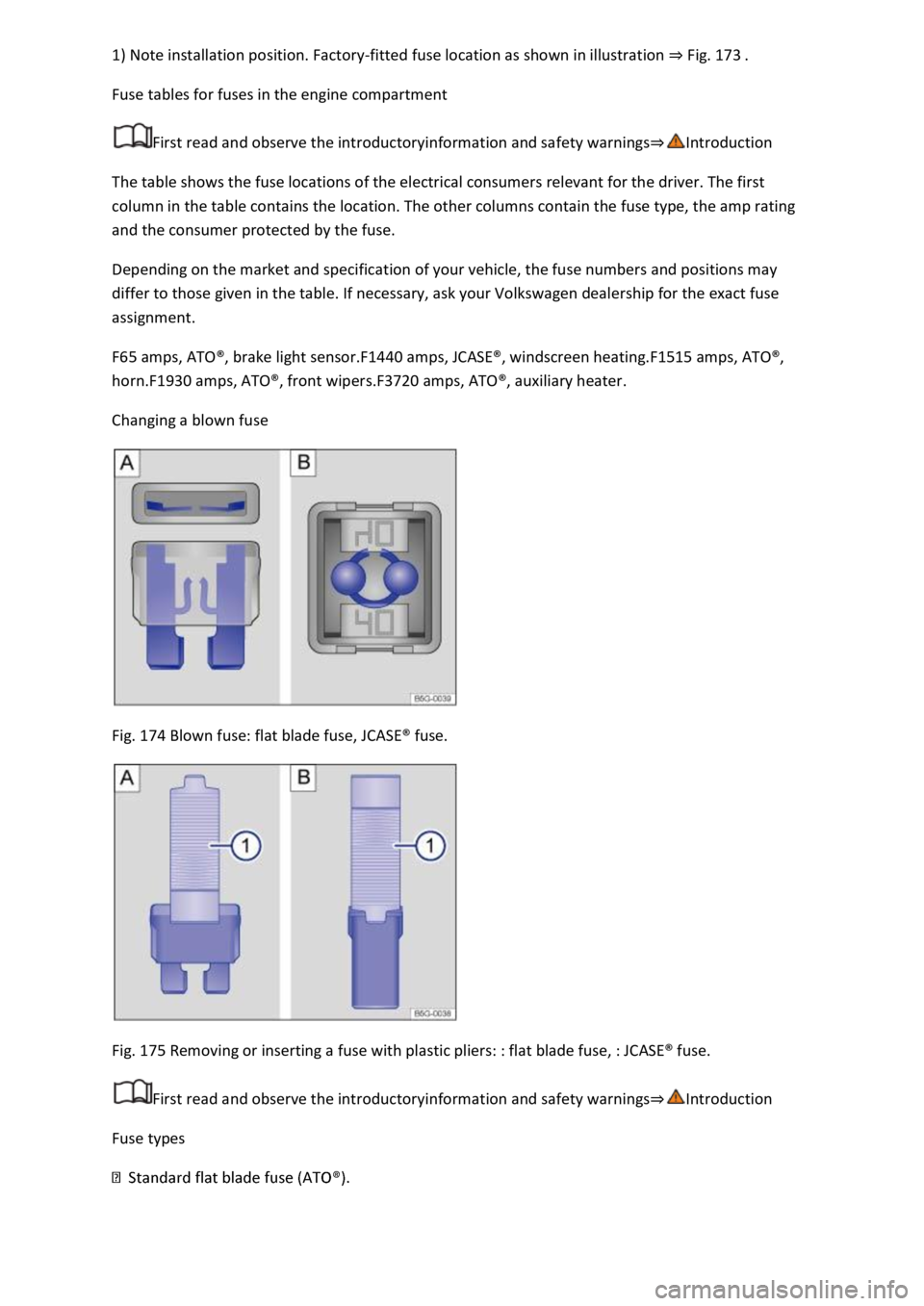
1) Note installation position. Factory-fitted fuse location as shown in illustration ⇒ Fig. 173 .
Fuse tables for fuses in the engine compartment
First read and observe the introductoryinformation and safety warnings⇒Introduction
The table shows the fuse locations of the electrical consumers relevant for the driver. The first
column in the table contains the location. The other columns contain the fuse type, the amp rating
and the consumer protected by the fuse.
Depending on the market and specification of your vehicle, the fuse numbers and positions may
differ to those given in the table. If necessary, ask your Volkswagen dealership for the exact fuse
assignment.
F65 amps, ATO®, brake light sensor.F1440 amps, JCASE®, windscreen heating.F1515 amps, ATO®,
horn.F1930 amps, ATO®, front wipers.F3720 amps, ATO®, auxiliary heater.
Changing a blown fuse
Fig. 174 Blown fuse: flat blade fuse, JCASE® fuse.
Fig. 175 Removing or inserting a fuse with plastic pliers: : flat blade fuse, : JCASE® fuse.
First read and observe the introductoryinformation and safety warnings⇒Introduction
Fuse types
Page 364 of 502

Additional insulating materials such as blankets in the engine compartment could disrupt the
operation of the engine, start fires and lead to severe injuries.
WARNING
Service fluids and some materials in the engine compartment are highly flammable and can cause
fires and serious injuries!
ty of the engine compartment.
injuries.
tem or the electrical
system:
-volt vehicle battery. Ensure that the vehicle is unlocked when the 12-
volt vehicle battery is disconnected as otherwise the anti-theft alarm will be activated.
of heating systems, water heaters or any other open flames.
NOTICE
When filling or changing service fluids, please ensure that the correct service fluids are filled through
the correct openings. The use of incorrect service fluids could result in serious malfunctions and
engine damage.
Service fluids that leak from the vehicle are harmful to the environment. For this reason, you should
regularly check the ground underneath your vehicle. If there are spots of oil or other fluids on the
ground, the vehicle should be inspected by a qualified workshop. Any spilt service fluids must be
disposed of properly.
Preparing the vehicle for working in the engine compartment
Checklist
The following steps should always be carried out in the specified order before working in the engine
compartment ⇒ :
Park the vehicle on a level and stable surface.
Page 387 of 502
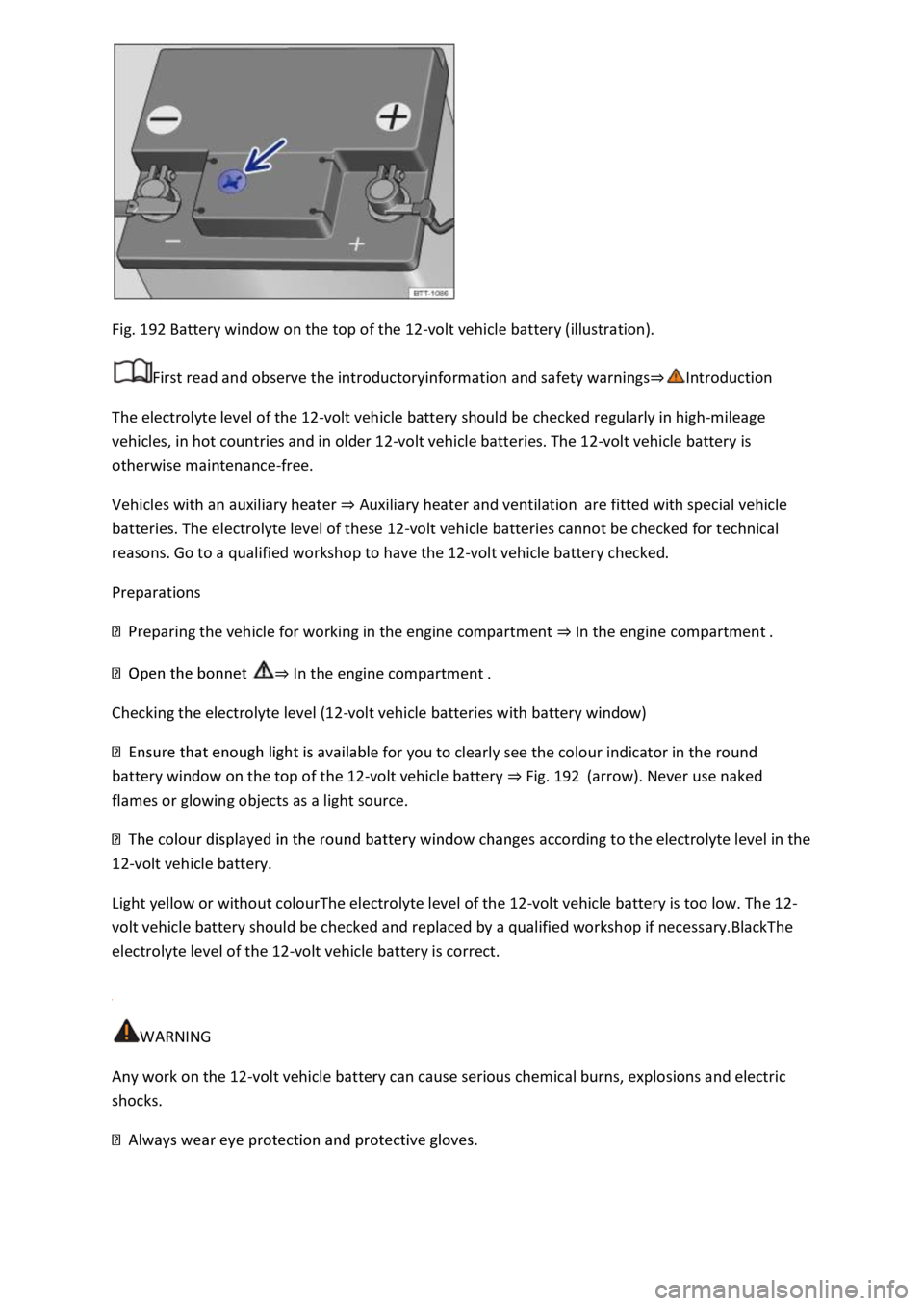
Fig. 192 Battery window on the top of the 12-volt vehicle battery (illustration).
First read and observe the introductoryinformation and safety warnings⇒Introduction
The electrolyte level of the 12-volt vehicle battery should be checked regularly in high-mileage
vehicles, in hot countries and in older 12-volt vehicle batteries. The 12-volt vehicle battery is
otherwise maintenance-free.
Vehicles with an auxiliary heater ⇒ Auxiliary heater and ventilation are fitted with special vehicle
batteries. The electrolyte level of these 12-volt vehicle batteries cannot be checked for technical
reasons. Go to a qualified workshop to have the 12-volt vehicle battery checked.
Preparations
eparing the vehicle for working in the engine compartment ⇒ In the engine compartment .
⇒ In the engine compartment .
Checking the electrolyte level (12-volt vehicle batteries with battery window)
e for you to clearly see the colour indicator in the round
battery window on the top of the 12-volt vehicle battery ⇒ Fig. 192 (arrow). Never use naked
flames or glowing objects as a light source.
s according to the electrolyte level in the
12-volt vehicle battery.
Light yellow or without colourThe electrolyte level of the 12-volt vehicle battery is too low. The 12-
volt vehicle battery should be checked and replaced by a qualified workshop if necessary.BlackThe
electrolyte level of the 12-volt vehicle battery is correct.
WARNING
Any work on the 12-volt vehicle battery can cause serious chemical burns, explosions and electric
shocks.
Page 389 of 502

Connecting the 12-volt vehicle battery
-volt vehicle
battery.
e cable and then the negative cable ⇒ .
Various indicator lamps may light up after the 12-volt vehicle battery has been connected and the
ignition is switched on. They will go out when you drive a short distance at a speed of approximately
15 – 20 km/h (10 – 12 mph). If the indicator lamps remain lit up, the vehicle should be checked by a
qualified workshop.
If the 12-volt vehicle battery was disconnected for an extended period, the system may not able to
calculate or correctly display the time when the next service is due ⇒ Instrument cluster . Observe
the maximum permissible service intervals ⇒ Service .
Automatic switch-off for electrical consumers
The intelligent vehicle electrical system management function automatically implements a range of
measures to prevent the 12-volt vehicle battery from discharging under high loads:
power supply to the 12-volt socket and the cigarette lighter may be interrupted temporarily
while the engine is being started.
The vehicle electrics management system cannot always prevent the 12-volt vehicle battery from
being discharged, for example if the ignition is left on over a long period with the engine off or the
side lights or parking lights are left on over a long period of time.
12-volt vehicle battery is discharged
gnition is switched on.
⇒ Auxiliary heater and ventilation .
WARNING
Incorrectly mounting the battery and using incorrect 12-volt vehicle batteries can cause short
circuits, fire and serious injuries.
-free and leak-proof 12-volt vehicle batteries that have the same
properties, specifications and dimensions as the factory-fitted 12-volt vehicle battery.
WARNING
A highly explosive mixture of gases is given off when the 12-volt vehicle battery is being charged.
Page 462 of 502
Radio
equipm
ent
installe
d in the
vehicle
Manufacturers'
addresses
(auxilia
ry
heater)
Weberstrasse 20
02763 Zittau
GERMANY
Eberspächer
Climate Control
Systems
GmbH & Co. KG
Eberspächerstrasse
24
73730 Esslingen
GERMANY
Auxiliar
y
heater
Webasto
Thermo & Comfort
SE
Friedrichshafener S
trasse 9
82205 Gilching
GERMANY
Tyre
pressur
e
sensors
Huf Hülsbeck &
Fürst GmbH &
Co. KG
Steeger Strasse 17
42551 Velbert
GERMANY
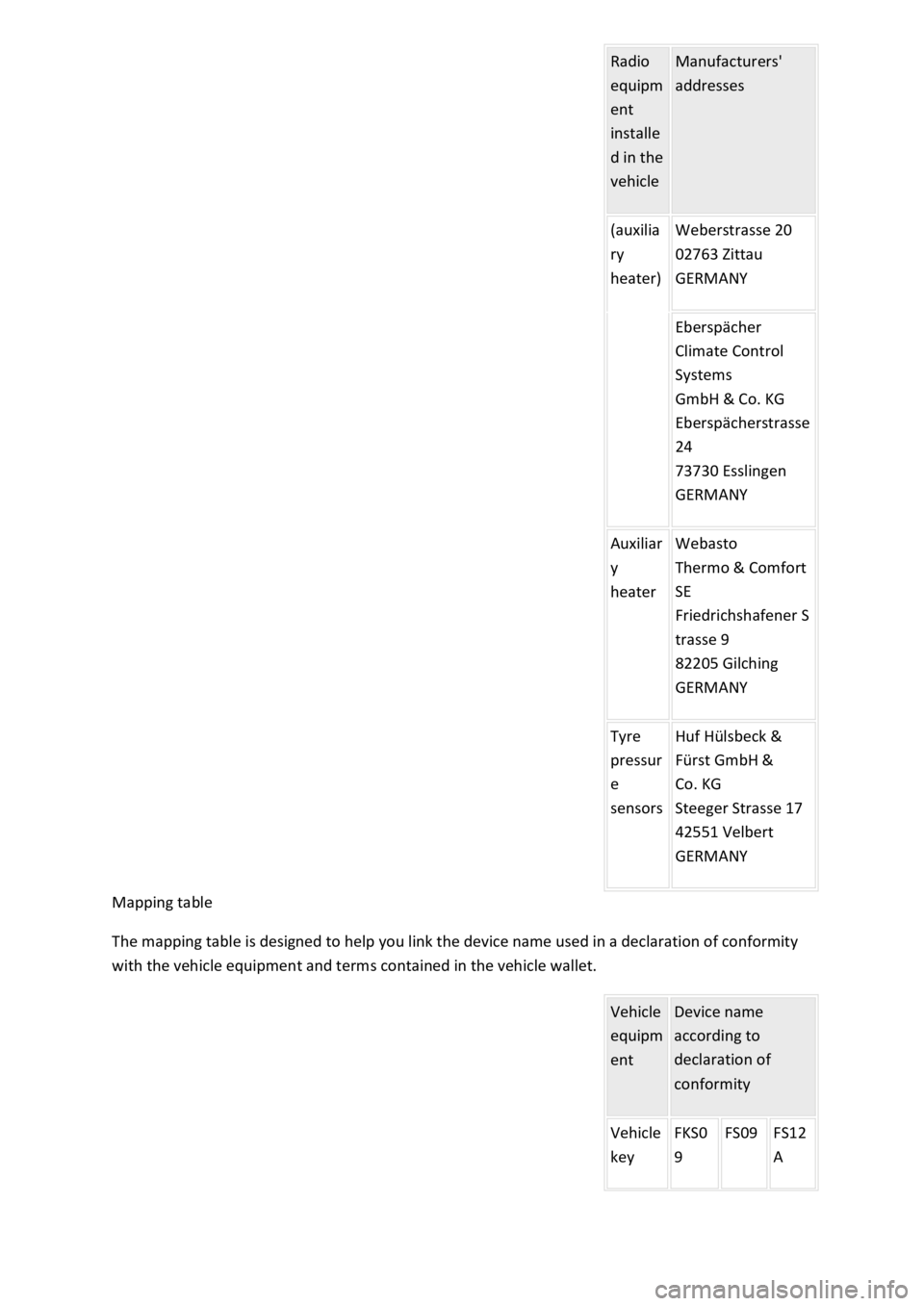
Mapping table
The mapping table is designed to help you link the device name used in a declaration of conformity
with the vehicle equipment and terms contained in the vehicle wallet.
Vehicle
equipm
ent
Device name
according to
declaration of
conformity
Vehicle
key
FKS0
9
FS09 FS12
A
Page 463 of 502

Vehicle
equipm
ent
Device name
according to
declaration of
conformity
FS12
A00
FS12
P
FS12
P00
FS14 FS17
44
FS94
PKET
OUA
RKET
OUA
VWT
OUA
Remot
e
control
(auxilia
ry
heater)
5000
0886
50000886 /
Sender STH
VW
7E0.9
63.51
1.B
7E0.9
63.51
1.C
9019
747B
EasyS
tart R
STH
VW -
5000
0884
Teles
tart
9019747B /
Remote control of
aux heater 868
MHz
Auxiliar
y
heater
(transm
itter/re
ceiver
unit)
50000864 D208L
VW
9019510C /
Receiver of aux
heater 869 MHz
Instrum
ent
cluster,
electro
nic
immobi
liser
BNF_
HL
BNF_
LL
eNSF
NSF_
HL
NSF_
LL1
NSF_
LL3
Instru
ment
Instr
ume
Instr
ume