warning VOLKSWAGEN T-ROC 2021 Owner´s Manual
[x] Cancel search | Manufacturer: VOLKSWAGEN, Model Year: 2021, Model line: T-ROC, Model: VOLKSWAGEN T-ROC 2021Pages: 502, PDF Size: 9.42 MB
Page 345 of 502
Replace the defective bulb with a new bulb of the same type.
Insert the bulb holder into the headlight and turn it clockwise as far as it will go.
Connect the connector to the bulb holder. The connector must audibly click into place.
Push the headlight from the outside into the openings and insert into the bumper.
Use the screwdriver to tighten the securing screws ⇒ Fig. 169 ①.
Fit the cover in the bumper ⇒ Fig. 169 .
Stow the wire hook and screwdriver in the vehicle toolkit.
Changing bulbs in the tail light clusters (LED lights)
First read and observe the introductoryinformation and safety warnings⇒Introduction
These lamps use LED technology. The LEDs cannot be replaced by customers. If some LEDs fail, this
may be an indication that more elements are on the point of failure. In this case, have the lights
checked and renewed if necessary at a qualified workshop. Volkswagen recommends using a
Volkswagen dealership for this purpose.
Changing bulbs in the number plate light (LED lights)
First read and observe the introductoryinformation and safety warnings⇒Introduction
These lamps use LED technology. The LEDs cannot be replaced by customers. If some LEDs fail, this
may be an indication that more elements are on the point of failure. In this case, have the lights
checked and renewed if necessary at a qualified workshop.
Troubleshooting
First read and observe the introductoryinformation and safety warnings⇒Introduction
Fault in vehicle lighting
The indicator lamp lights up yellow.
Fault in vehicle lighting or fault in cornering lights.
Check the vehicle lighting and change the appropriate bulb as required ⇒ Changing bulbs . If all
bulbs are OK or there is a fault in the dynamic cornering light, go to a qualified workshop.
Changing fuses
Introduction
This chapter contains information on the followingsubjects:
⇒ Fuses in the dash panel
Page 346 of 502

⇒ Fuses in the engine compartment
⇒ Fuse table for fuses in the dash panel
⇒ Fuse tables for fuses in the engine compartment
⇒ Changing a blown fuse
At the time of publication we are unable to provide an complete overview of the locations of the
fuses for the electrical consumers. This is because the vehicle is under constant development,
because fuses are assigned differently according to the vehicle equipment level and because several
electrical consumers may use a single fuse. You can obtain more information about the fuse
assignment from a Volkswagen dealership.
Several electrical consumers can share a single fuse. Conversely, a single consumer could have more
than one fuse.
Therefore fuses should only be replaced when the cause of the fault has been rectified. If a new fuse
blows shortly after fitting, have the electrical system checked by a qualified workshop.
WARNING
High voltages in the electrical system can cause electric shocks, serious burns and death.
WARNING
Using unsuitable or repaired fuses and bridging an electrical circuit without fuses can cause a fire
and serious injuries.
fuse with the same amp rating (same colour and markings) and size.
NOTICE
electrical consumers off and remove the vehicle key from the ignition before changing a fuse.
pened. Dirt and moisture in the fuse
boxes can damage the electrical system.
Page 347 of 502
There are other fuses in the vehicle in addition to those described in this chapter. These should be
changed only by a qualified workshop.
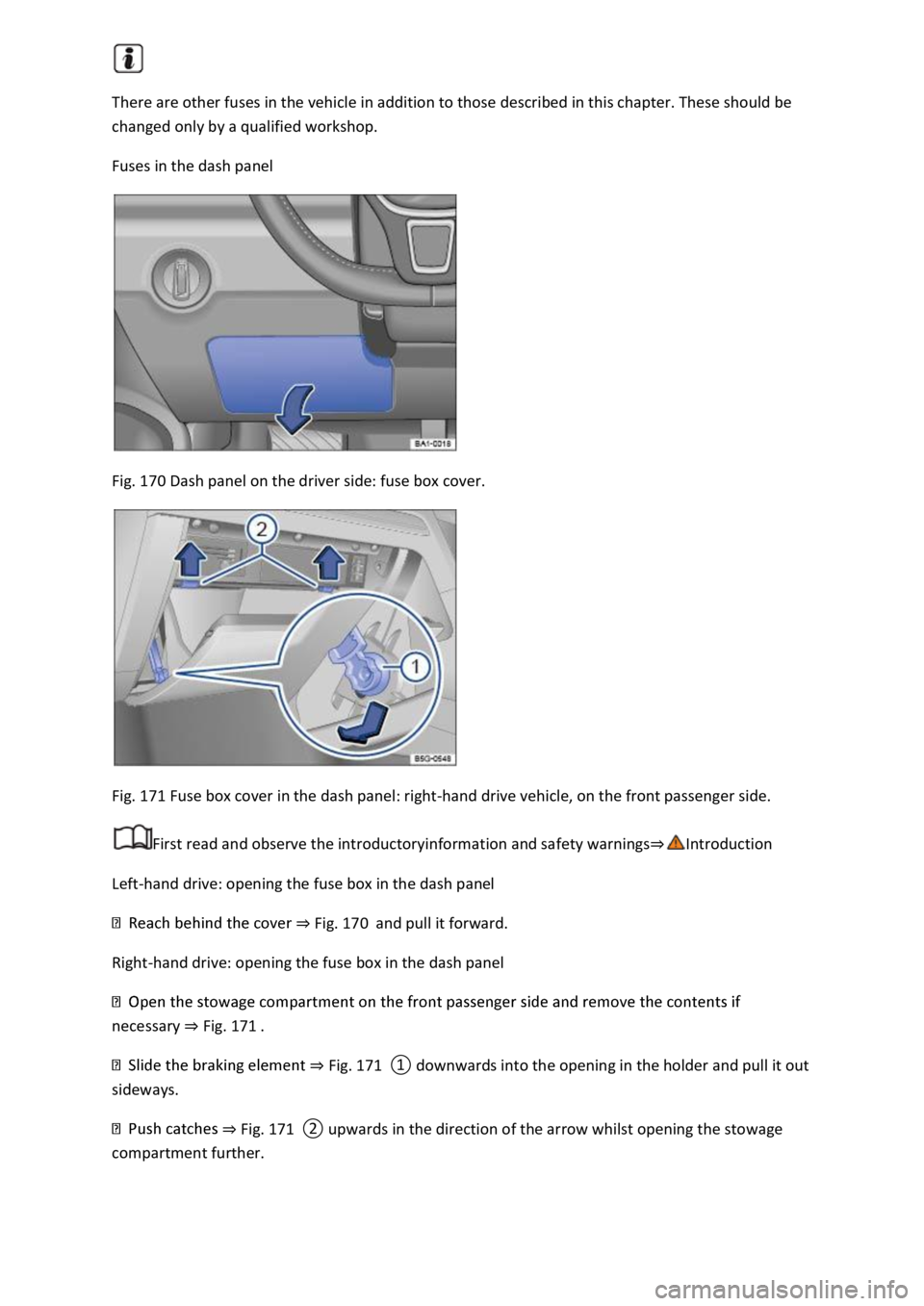
Fuses in the dash panel
Fig. 170 Dash panel on the driver side: fuse box cover.
Fig. 171 Fuse box cover in the dash panel: right-hand drive vehicle, on the front passenger side.
First read and observe the introductoryinformation and safety warnings⇒Introduction
Left-hand drive: opening the fuse box in the dash panel
⇒ Fig. 170 and pull it forward.
Right-hand drive: opening the fuse box in the dash panel
necessary ⇒ Fig. 171 .
⇒ Fig. 171 ① downwards into the opening in the holder and pull it out
sideways.
⇒ Fig. 171 ② upwards in the direction of the arrow whilst opening the stowage
compartment further.
Page 348 of 502
ge compartment into position. Insert brake element into the opening of
the holder and push it upwards until it audibly clicks into place. Carefully push the stowage
compartment forwards beyond the resistance of the catches ⇒ Fig. 171 ②.
NOTICE
e the covers of the fuse boxes carefully and install them again properly so as to avoid
damage to the vehicle.
boxes can damage the electrical system.
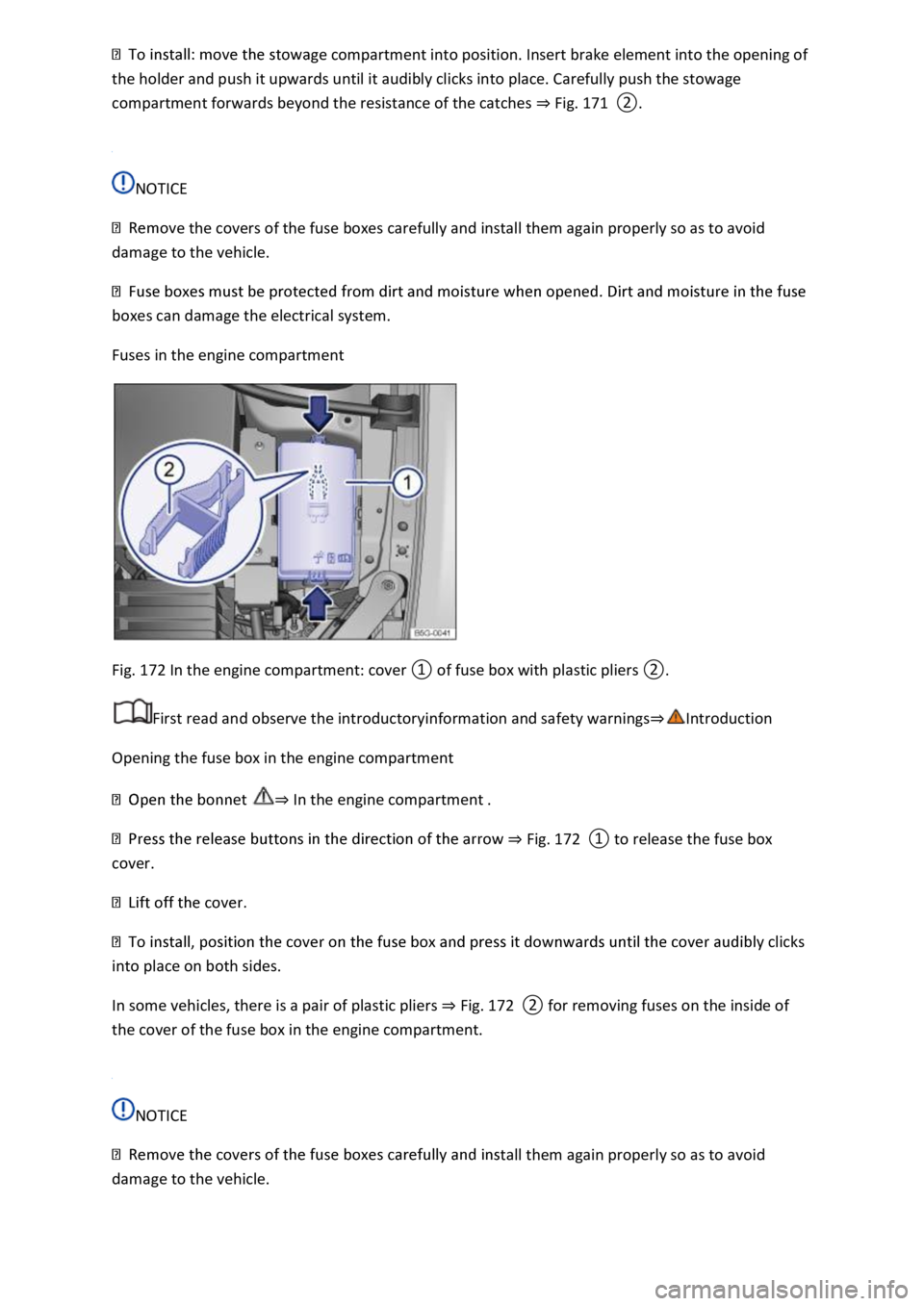
Fuses in the engine compartment
Fig. 172 In the engine compartment: cover ① of fuse box with plastic pliers ②.
First read and observe the introductoryinformation and safety warnings⇒Introduction
Opening the fuse box in the engine compartment
et ⇒ In the engine compartment .
⇒ Fig. 172 ① to release the fuse box
cover.
y clicks
into place on both sides.
In some vehicles, there is a pair of plastic pliers ⇒ Fig. 172 ② for removing fuses on the inside of
the cover of the fuse box in the engine compartment.
NOTICE
tall them again properly so as to avoid
damage to the vehicle.
Page 349 of 502
boxes can damage the electrical system.
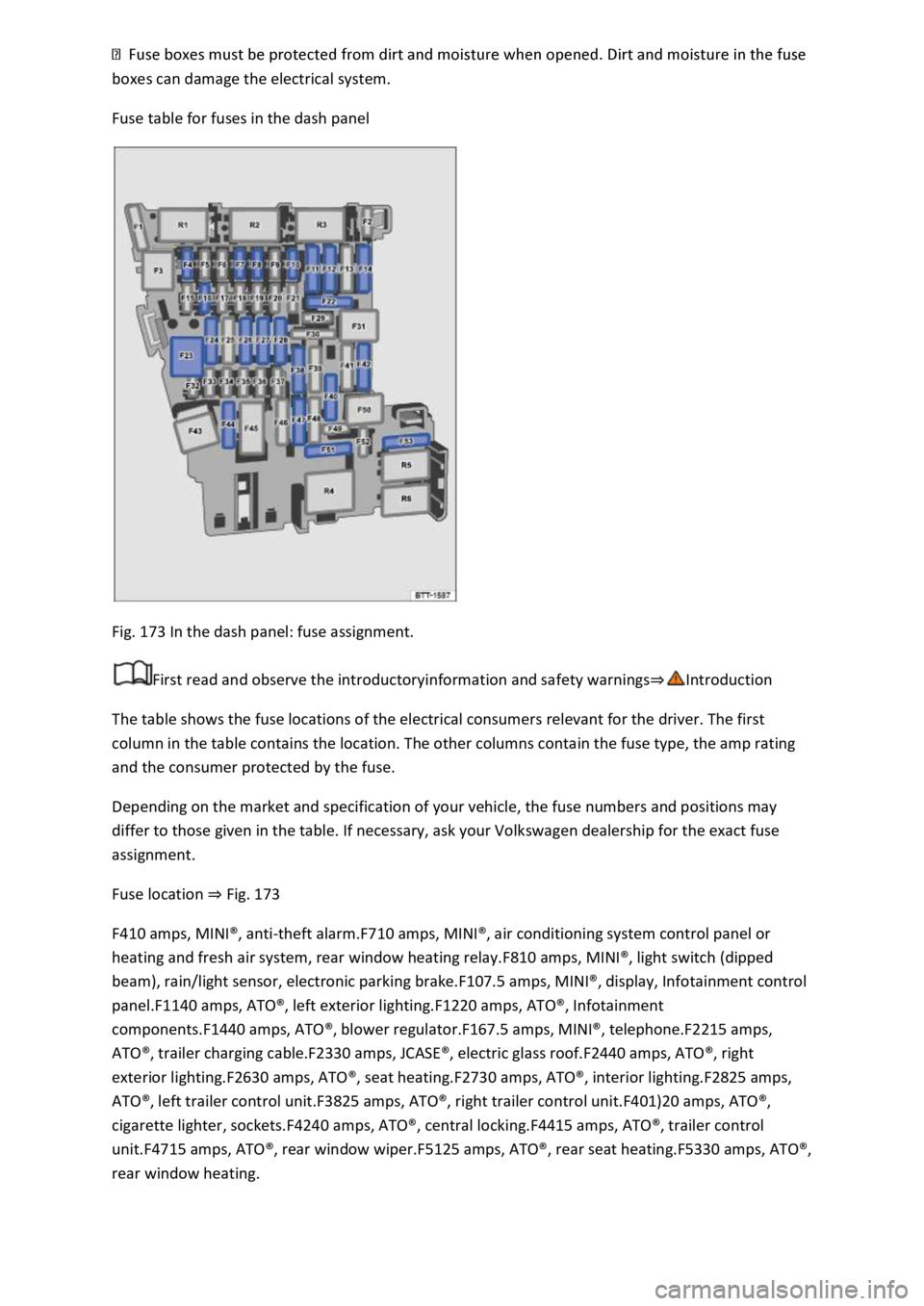
Fuse table for fuses in the dash panel
Fig. 173 In the dash panel: fuse assignment.
First read and observe the introductoryinformation and safety warnings⇒Introduction
The table shows the fuse locations of the electrical consumers relevant for the driver. The first
column in the table contains the location. The other columns contain the fuse type, the amp rating
and the consumer protected by the fuse.
Depending on the market and specification of your vehicle, the fuse numbers and positions may
differ to those given in the table. If necessary, ask your Volkswagen dealership for the exact fuse
assignment.
Fuse location ⇒ Fig. 173
F410 amps, MINI®, anti-theft alarm.F710 amps, MINI®, air conditioning system control panel or
heating and fresh air system, rear window heating relay.F810 amps, MINI®, light switch (dipped
beam), rain/light sensor, electronic parking brake.F107.5 amps, MINI®, display, Infotainment control
panel.F1140 amps, ATO®, left exterior lighting.F1220 amps, ATO®, Infotainment
components.F1440 amps, ATO®, blower regulator.F167.5 amps, MINI®, telephone.F2215 amps,
ATO®, trailer charging cable.F2330 amps, JCASE®, electric glass roof.F2440 amps, ATO®, right
exterior lighting.F2630 amps, ATO®, seat heating.F2730 amps, ATO®, interior lighting.F2825 amps,
ATO®, left trailer control unit.F3825 amps, ATO®, right trailer control unit.F401)20 amps, ATO®,
cigarette lighter, sockets.F4240 amps, ATO®, central locking.F4415 amps, ATO®, trailer control
unit.F4715 amps, ATO®, rear window wiper.F5125 amps, ATO®, rear seat heating.F5330 amps, ATO®,
rear window heating.
Page 350 of 502
1) Note installation position. Factory-fitted fuse location as shown in illustration ⇒ Fig. 173 .
Fuse tables for fuses in the engine compartment
First read and observe the introductoryinformation and safety warnings⇒Introduction
The table shows the fuse locations of the electrical consumers relevant for the driver. The first
column in the table contains the location. The other columns contain the fuse type, the amp rating
and the consumer protected by the fuse.
Depending on the market and specification of your vehicle, the fuse numbers and positions may
differ to those given in the table. If necessary, ask your Volkswagen dealership for the exact fuse
assignment.
F65 amps, ATO®, brake light sensor.F1440 amps, JCASE®, windscreen heating.F1515 amps, ATO®,
horn.F1930 amps, ATO®, front wipers.F3720 amps, ATO®, auxiliary heater.
Changing a blown fuse
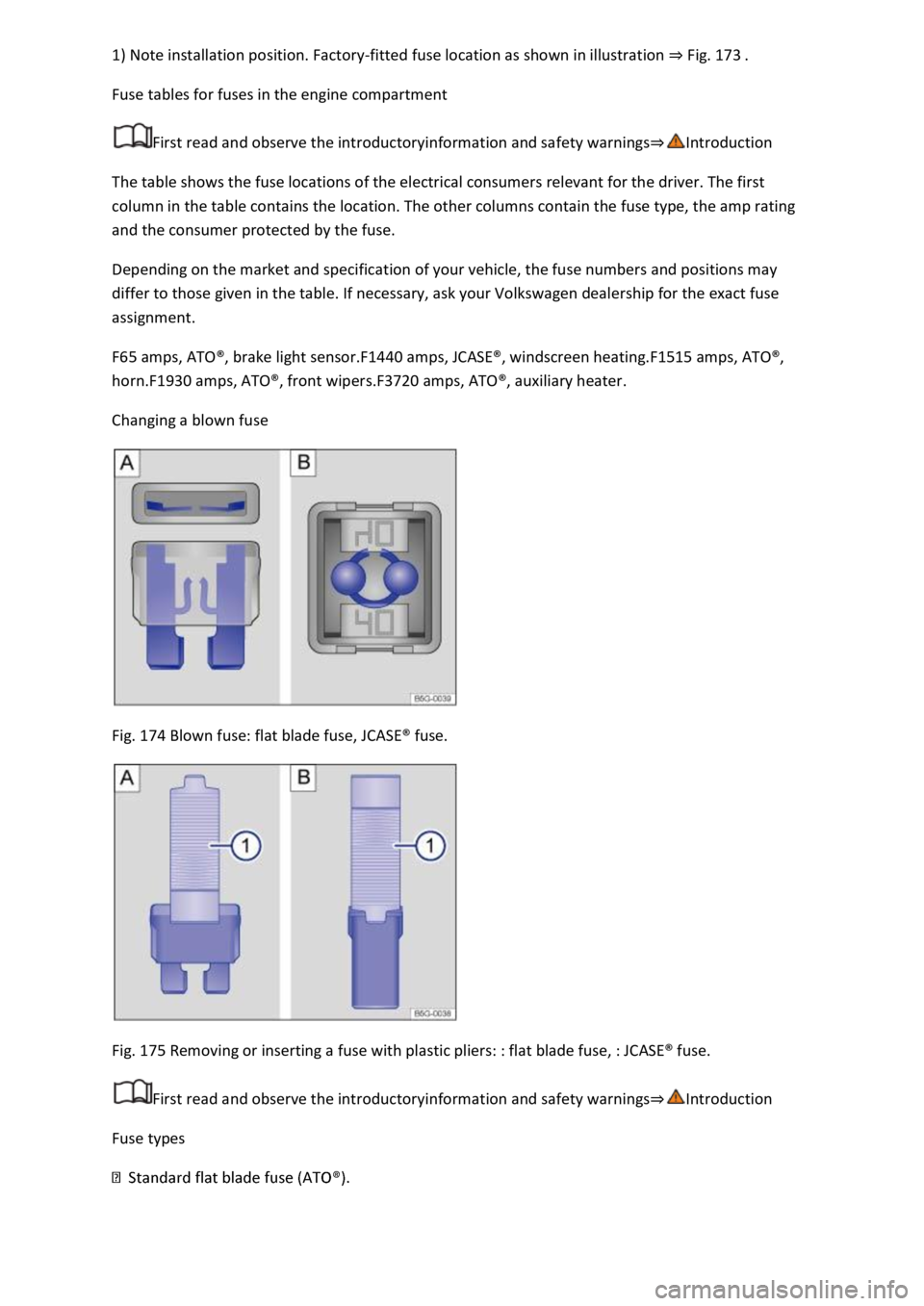
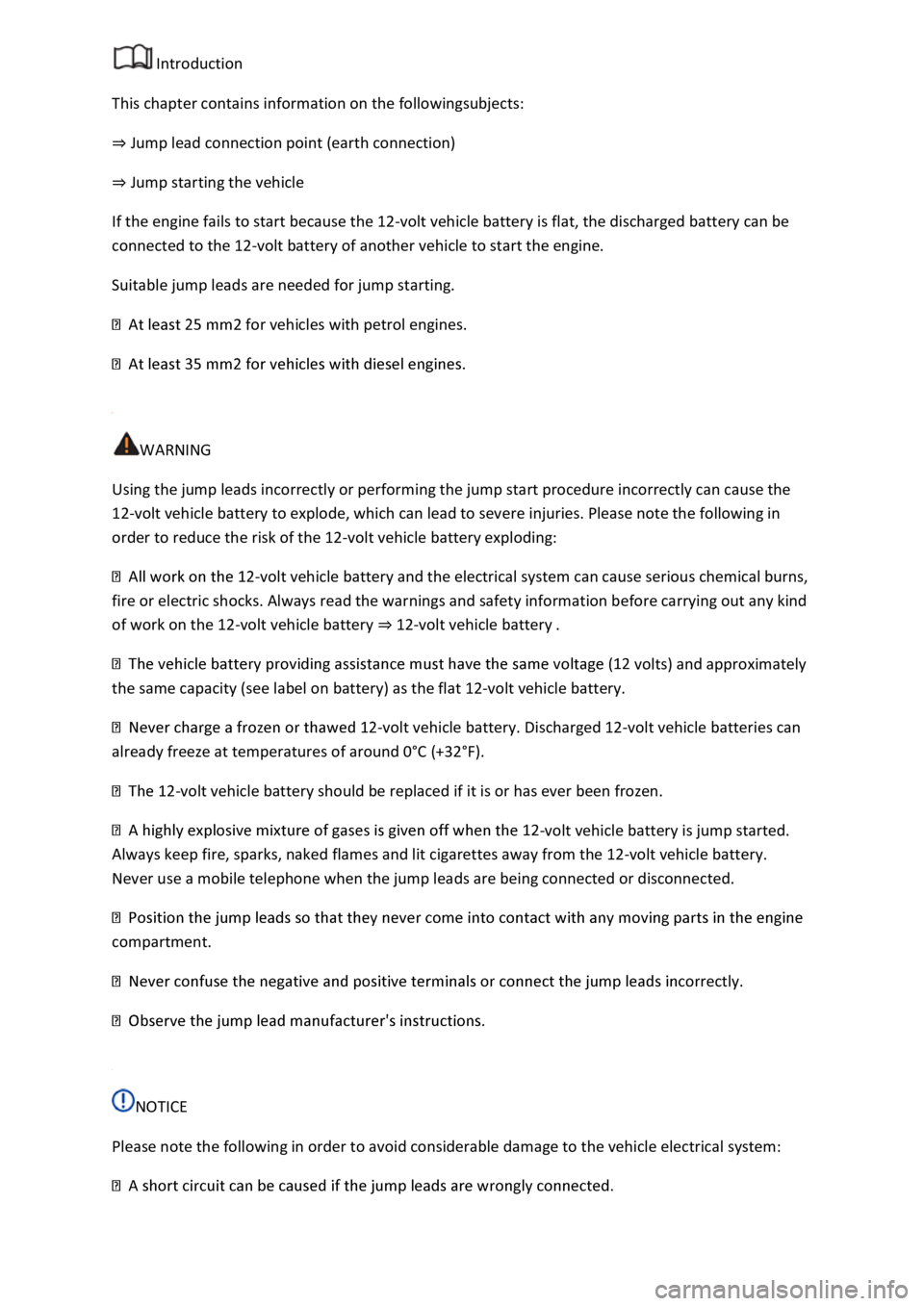
Fig. 174 Blown fuse: flat blade fuse, JCASE® fuse.
Fig. 175 Removing or inserting a fuse with plastic pliers: : flat blade fuse, : JCASE® fuse.
First read and observe the introductoryinformation and safety warnings⇒Introduction
Fuse types
Page 352 of 502
Introduction
This chapter contains information on the followingsubjects:
⇒ Jump lead connection point (earth connection)
⇒ Jump starting the vehicle
If the engine fails to start because the 12-volt vehicle battery is flat, the discharged battery can be
connected to the 12-volt battery of another vehicle to start the engine.
Suitable jump leads are needed for jump starting.
2 for vehicles with petrol engines.
WARNING
Using the jump leads incorrectly or performing the jump start procedure incorrectly can cause the
12-volt vehicle battery to explode, which can lead to severe injuries. Please note the following in
order to reduce the risk of the 12-volt vehicle battery exploding:
-volt vehicle battery and the electrical system can cause serious chemical burns,
fire or electric shocks. Always read the warnings and safety information before carrying out any kind
of work on the 12-volt vehicle battery ⇒ 12-volt vehicle battery .
volts) and approximately
the same capacity (see label on battery) as the flat 12-volt vehicle battery.
-volt vehicle battery. Discharged 12-volt vehicle batteries can
already freeze at temperatures of around 0°C (+32°F).
-volt vehicle battery should be replaced if it is or has ever been frozen.
-volt vehicle battery is jump started.
Always keep fire, sparks, naked flames and lit cigarettes away from the 12-volt vehicle battery.
Never use a mobile telephone when the jump leads are being connected or disconnected.
compartment.
rectly.
NOTICE
Please note the following in order to avoid considerable damage to the vehicle electrical system:
Page 353 of 502
les must not touch each other, as any contact could mean that electricity could flow as
soon as the positive terminals are connected.
Jump lead connection point (earth connection)
Fig. 176 In the engine compartment: jump lead connection point (earth connection).
First read and observe the introductoryinformation and safety warnings⇒Introduction
There is a jump lead connection point (earth connection) in the engine compartment for connecting
the black jump lead ⇒ Fig. 176 ㊀.
The vehicle must be jump-started or used to jump-start another vehicle only via this jump lead
connection point.
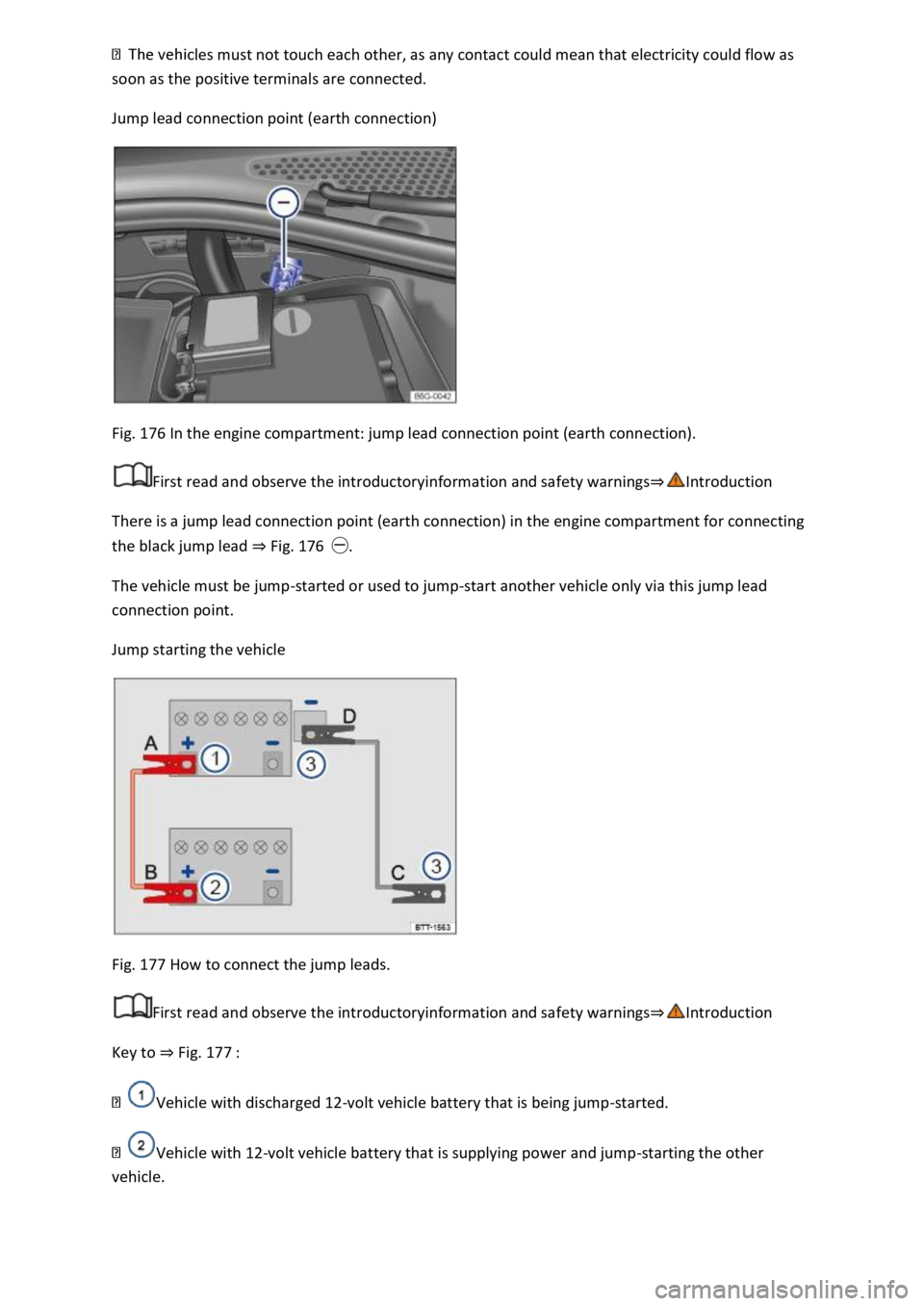
Jump starting the vehicle
Fig. 177 How to connect the jump leads.
First read and observe the introductoryinformation and safety warnings⇒Introduction
Key to ⇒ Fig. 177 :
Vehicle with discharged 12-volt vehicle battery that is being jump-started.
Vehicle with 12-volt vehicle battery that is supplying power and jump-starting the other
vehicle.
Page 355 of 502

on.
p leads should be removed only in the order D – C – B –
A⇒ Fig. 177 .
-volt vehicle battery checked.
WARNING
Jump starting the vehicle incorrectly can cause the 12-volt vehicle battery to explode, which can lead
to serious injuries. Please note the following in order to reduce the risk of the 12-volt vehicle battery
exploding:
-volt vehicle battery and the electrical system can cause serious chemical burns,
fire or electric shocks. Always read the warnings and safety information before carrying out any kind
of work on the 12-volt vehicle battery ⇒ 12-volt vehicle battery .
-volt vehicle
battery.
h the leads in the correct order – the positive lead first, followed by the negative.
-insulated parts of the battery clamps must not be allowed to touch. The jump lead
attached to the positive terminal on the 12-volt vehicle battery must not touch electrically
conductive parts of the vehicle.
-volt vehicle battery, using a torch if necessary. If it is light
yellow or colourless, do not jump start the vehicle. Seek expert assistance.
-volt vehicle battery. The hydrogen gas
emitted from the 12-volt vehicle battery could be ignited by sparks.
g if the 12-volt vehicle battery is damaged or if it is or has ever been
frozen.
NOTICE
Once the vehicle has been successfully jump-started, go to a qualified workshop and have the 12-
volt vehicle battery checked.
Tow-starting or towing
Introduction
This chapter contains information on the followingsubjects:
⇒ Notes on tow-starting and towing
Page 356 of 502

⇒ Tow-starting
⇒ Towing
⇒ Fitting the rear towing eye
⇒ Fitting the front towing eye
Towing requires some experience, especially when using a tow rope. Both drivers should be familiar
with the technique required for towing. Inexperienced drivers should not attempt to tow.
Ensure that no excessive pulling forces occur and take care to avoid jerking movements. When
towing offroad, there is always a risk of overloading the anchorage points.
Observe any legal requirements when towing or tow-starting.
Tow-starting
Tow-starting describes the procedure for starting the vehicle by moving it using another towing
vehicle.
The vehicle can be tow-started with a tow-bar or a tow-rope.
Towing
Towing is where a vehicle that cannot be driven is pulled with the aid of another vehicle.
The vehicle can be towed with a tow-bar or a tow-rope. When the engine is stopped, the gearbox is
not lubricated sufficiently at higher speeds and over long distances:
km/h (30 mph).
km.
Tow rope, tow bar
It is easier and safer to tow a vehicle with a tow bar. Use a tow rope only if you do not have a tow
bar.
The tow rope should be slightly elastic to reduce the strain on both vehicles. It is advisable to use a
tow rope made of synthetic fibre or similarly elastic material.
Towing with a tow truck
If your vehicle is to be raised on one axle for towing, this may only be done using the following axles
according to the gearbox/drive combination:
Front-wheel drive
Manual gearboxFront or rear axleAutomatic gearboxFront axle
WARNING
If a vehicle is being towed, the vehicle handling and braking efficiency will change significantly.