warning VOLKSWAGEN T-ROC 2021 Owner´s Manual
[x] Cancel search | Manufacturer: VOLKSWAGEN, Model Year: 2021, Model line: T-ROC, Model: VOLKSWAGEN T-ROC 2021Pages: 502, PDF Size: 9.42 MB
Page 428 of 502

The air compressor from the breakdown set may be operated from the 12-volt socket, even if the
power rating on the type plate of the air compressor exceeds the maximum power rating of the
socket.
Preparations
First read and observe the introductoryinformation and safety warnings⇒Introduction
Checklist
Always carry out the following actions in the given order ⇒ :
If your vehicle has a flat tyre, park the vehicle on a firm and level surface at a safe distance from
moving traffic.
Switch on the electronic parking brake Parking and manoeuvring.
DSG® dual clutch gearbox: move the selector lever to position P DSG® dual clutch gearbox.
Switch off the engine and remove the key from the ignition.
Manual gearbox: select a gear Manual gearbox: selecting a gear.
Ask all vehicle occupants to leave the vehicle and stand at a safe distance away from moving traffic.
Switch on the hazard warning lights and set up the warning triangle In an emergency. Observe any
legal requirements.
Check whether the puncture can be repaired with the breakdown set The tyre sealant must not be
used:.
When towing a trailer: unhitch the trailer from the vehicle and park it properly .
Page 429 of 502

Remove any items of luggage from the luggage compartment.
Take the breakdown set out of the luggage compartment.
Take the sticker ① from the breakdown set and stick it on the dash panel within the driver's field
of vision.
Do not remove foreign objects (e.g. screws or nails) from the tyre.
WARNING
Ignoring any of the items on this important safety checklist can lead to accidents and severe injuries.
Sealing and inflating tyres
First read and observe the introductoryinformation and safety warnings⇒Introduction
Sealing a tyre
⇒ Fig. 208⑤ to unscrew the valve core from the tyre valve. Place
the core on a clean surface.
⇒ Fig. 208③ vigorously to and fro several times.
⇒ Fig. 208② tightly onto the tyre filler bottle in a clockwise direction. The
plastic foil on the closure is pierced automatically.
⇒ Fig. 208② and place the open end fully on the tyre valve.
⇒ Fig. 208⑤ to screw the valve core back into the tyre valve.
Inflating the tyre
⇒ Fig. 209④ of the air compressor tightly onto the tyre valve.
⇒ Fig. 209② is closed.
-volt plug ⇒ Fig. 209⑤ into one of the vehicle's 12-volt sockets ⇒ Electrical sockets .
Page 430 of 502

⇒ Fig. 209① to switch on the air compressor.
– 2.5 bar (29 – 36 psi/200 –
250 kPa) ⇒ . Maximum running time: 8 minutes⇒ .
– 2.5 bar (29 – 36 psi/200 – 250 kPa) cannot be achieved, unscrew the tyre
filler hose from the tyre valve.
metres forward or back so that the sealing compound is evenly
distributed in the tyre.
again.
. The tyre cannot be
sealed with the breakdown set. Do not drive on. Seek expert assistance ⇒ .
km/h (50 mph) if a tyre pressure of 2.0 – 2.5 bar (29 –
36 psi/200 – 250 kPa) has been reached.
minutes⇒ Check after driving for 10 minutes .
WARNING
The tyre filler hose and the air compressor can get hot during inflation.
r hands and skin from the hot components.
bar (29 psi/200 kPa), the tyre is too damaged. The sealant
is unable to seal the tyre. Do not drive on. Seek expert assistance.
NOTICE
Switch the air compressor off after a maximum of 8 minutes to avoid overheating. Let the air
compressor cool down for a few minutes before switching it back on.
Check after driving for 10 minutes
First read and observe the introductoryinformation and safety warnings⇒Introduction
Reconnect the tyre filler hose ⇒ Fig. 209④ and read off the tyre pressure on the tyre pressure
display ③.
1.3 bar (19 psi/130 kPa) and lower:
Page 431 of 502

⇒ .
1.4 bar (20 psi/140 kPa) and higher:
⇒ Useful information about wheels and tyres .
80 km/h (50 mph).
WARNING
Driving with a tyre that cannot be sealed is dangerous and can cause accidents and serious injuries.
bar (19 psi/130 kPa) or lower.
Maintenance
Service
Service work and digital service schedule
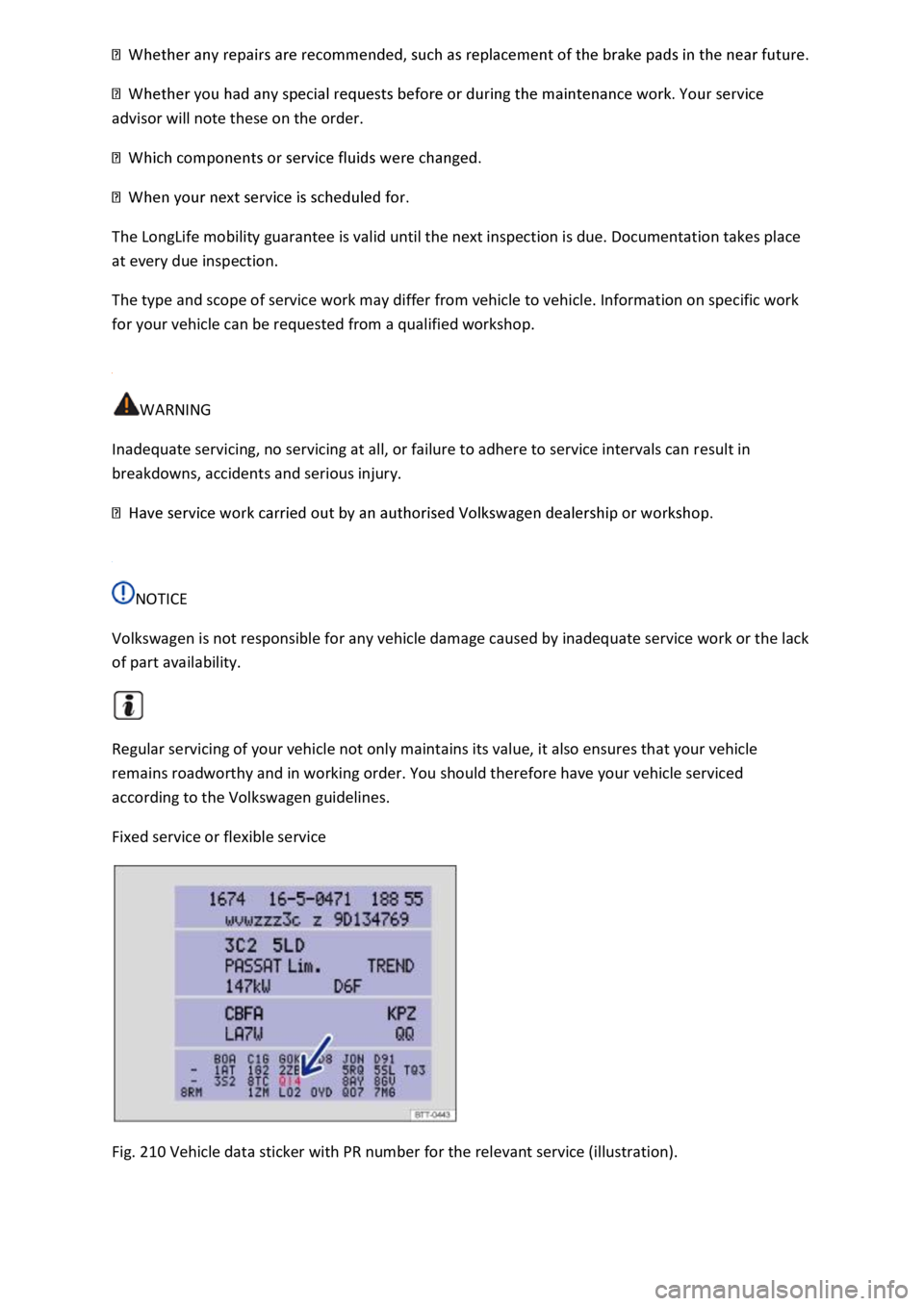
The vehicle data attached to the inside cover of this owner's manual help ensure that you can have
the correct Volkswagen Genuine Parts® installed in your vehicle whenever required. It also
determines which type of service applies to your vehicle.
The vehicle data sticker confirms when the vehicle was first registered or delivered, when the pre-
delivery inspection was carried out, and thus the date from which your vehicle is covered by our
warranty.
Storing the service operations performed (digital service schedule)
Each service record is stored by your Volkswagen dealership and qualified workshop in a central
system. This transparent documentation of the service history allows the service operations
performed to be reproduced at any time. Each time you have your vehicle serviced, Volkswagen
recommends asking for a printed service record, which contains all service work stored in the
system.
With every service, the printout of the previous service record is replaced by a current printout.
The digital service schedule is not available in some markets. In this case, your Volkswagen
dealership will inform you about the documentation process for service work.
Service work
The following information is documented in the digital service schedule by your Volkswagen
dealership or qualified workshop:
Page 432 of 502
advisor will note these on the order.
The LongLife mobility guarantee is valid until the next inspection is due. Documentation takes place
at every due inspection.
The type and scope of service work may differ from vehicle to vehicle. Information on specific work
for your vehicle can be requested from a qualified workshop.
WARNING
Inadequate servicing, no servicing at all, or failure to adhere to service intervals can result in
breakdowns, accidents and serious injury.
NOTICE
Volkswagen is not responsible for any vehicle damage caused by inadequate service work or the lack
of part availability.
Regular servicing of your vehicle not only maintains its value, it also ensures that your vehicle
remains roadworthy and in working order. You should therefore have your vehicle serviced
according to the Volkswagen guidelines.
Fixed service or flexible service
Fig. 210 Vehicle data sticker with PR number for the relevant service (illustration).
Page 434 of 502

Information on operating conditions
The specified service intervals and scope of service are always for vehicles used under normal
operating conditions.
If the vehicle is operated under severe conditions, some work will have to be performed before the
next service or at shorter intervals than those specified.
Severe operating conditions are, for example:
th high levels of dust,
This applies particularly to the following components (according to equipment):
Care allergen filter
The service advisor at your qualified workshop will be pleased to advise you on whether your vehicle
requires more frequent work between the normal service intervals due to the conditions under
which it is used.
WARNING
Inadequate servicing, no servicing at all, or failure to adhere to service intervals may result in
breakdowns, accidents or serious injury.
Have service work carried out by an authorised Volkswagen dealership or workshop.
NOTICE
Volkswagen is not responsible for any vehicle damage caused by inadequate service work or the lack
of part availability.
Page 437 of 502

Care allergen filter: change.
It is also possible to have servicing work carried out in between the scheduled service events
⇒ Fixed service or flexible service .
The scope of service is subject to change for technical reasons (continuous further development of
components). Your Volkswagen dealership or qualified workshop always has the latest information
about any changes.
Vehicle care
Notes on vehicle care
Regular, expert care helps to maintain your vehicle.
The longer contamination or dirt is left on the surface of vehicle components and upholstery fabrics,
the more difficult it can become to clean and treat them. Extended exposure may mean that it is no
longer possible to remove contamination or dirt.
Volkswagen recommend using Genuine care products that have been matched to your vehicle.1)
Consult a qualified workshop if you have any specific questions or if vehicle parts are not listed.
WARNING
Incorrect care and cleaning of vehicle components can impair the safety features of the vehicle and
cause serious injury.
be cleaned according to the manufacturer's instructions.
airbag modules.
ms against parts with sharp edges, e.g. when cleaning the insides of the
wheel housings.
WARNING
If the windows are covered in dirt, condensation, or ice, visibility will be reduced and the risk of
accidents and severe injuries will increase. This could impair the safety equipment of the vehicle.
-repellent window coating agents. In unfavourable
conditions, such coatings can cause increased dazzle.
Page 438 of 502

WARNING
Care products may be toxic and hazardous. Unsuitable care products and incorrect application of
care products can cause accidents, severe injuries, burns or poisoning.
facturer's instructions.
-ventilated rooms so that you do not breathe in any toxic
vapours.
e fluids for vehicle care.
These substances are toxic and highly inflammable.
NOTICE
Soiling with aggressive and solvent-based ingredients can cause irreparable damage to the vehicle
equipment, even if left for only a short time, e.g. on seat padding or trim parts.
1) Suitable accessories are available from your Volkswagen dealership. Follow the application
instructions on the packaging.
Washing the vehicle
Thoroughly wash the underside of the vehicle on a regular basis to remove road salt or sea water
residue.
Automatic car washes
Always observe all the car wash operator's specifications, particularly if your vehicle has add-on
parts ⇒ .
ar washes without brushes.
⇒ Information on
steering .
⇒ Operating the wiper lever and the rain/light sensor before using
the car wash.
High-pressure cleaner
Page 439 of 502

Follow the manufacturer’s instructions for the high-pressure cleaner. Never use rotating nozzles ⇒
.
-pressure cleaner.
cm away from the side windows and
other vehicle components.
yres,
rubber hoses, insulation materials or any other sensitive components, e.g. door locks.
brief periods of time.
Hand wash
As a rule, a hand wash is a gentle method to clean your vehicle. However, there are also some things
to note for this ⇒ .
g brush using only light pressure.
Start with the roof and work from the top to the bottom.
Use a shampoo for very stubborn dirt only.
Waxing
Waxing protects the paintwork. At the latest when water no longer clearly forms small drops and
runs off the paintwork when the vehicle is clean, reapply the protection to the vehicle using a quality
preservative wax.
Even if a preservative wax is applied regularly in the automatic car wash, Volkswagen recommends
protecting the vehicle paintwork at least twice a year using Volkswagen Genuine hard wax (-
000 096 317 -).
Polishing
Polishing is only necessary if the paint has lost its shine, and the gloss cannot be brought back by
applying wax.
Matt-painted vehicle parts must not be polished in order to avoid producing a shine ⇒ .
WARNING
Page 443 of 502

Volkswagen recommends using Volkswagen Genuine de-icing agent (- 000 096 322 -) for de-icing. Do
not use door lock de-icer containing grease solvents.
WARNING
The engine compartment of any motor vehicle is a hazardous area. All work in the engine
compartment carries the risk of injury, scalding, accidents and fire.
and safety precautions ⇒ Safety notes for working in the engine compartment .
NOTICE
Incorrect cleaning and care can cause vehicle damage.
tools.
NOTICE
The drainage channels for the plenum chamber may get blocked by leaves and dirt. Water that does
not drain away could get into the vehicle interior.
The durability and colourfastness of decorative and protective films can be affected by
environmental influences such as direct sunlight, moisture, air pollution, stone impact etc.
Decorative films may show signs of use or ageing after about one to three years, protective films
after about two to three years. In very hot climates, decorative films may start to fade within a year
and protective films within two years.
1) null
2) Mild soap solution: a maximum of two tablespoons neutral soap diluted in one litre of water.
Vehicle interior care and cleaning
The following overview contains recommendations for cleaning and care of individual vehicle
components ⇒ .
Windows:
Clean with a glass cleaning agent and then wipe dry using a clean chamois cloth or a lint-free cloth.