belt VOLKSWAGEN T-ROC 2021 Owner´s Manual
[x] Cancel search | Manufacturer: VOLKSWAGEN, Model Year: 2021, Model line: T-ROC, Model: VOLKSWAGEN T-ROC 2021Pages: 502, PDF Size: 9.42 MB
Page 83 of 502
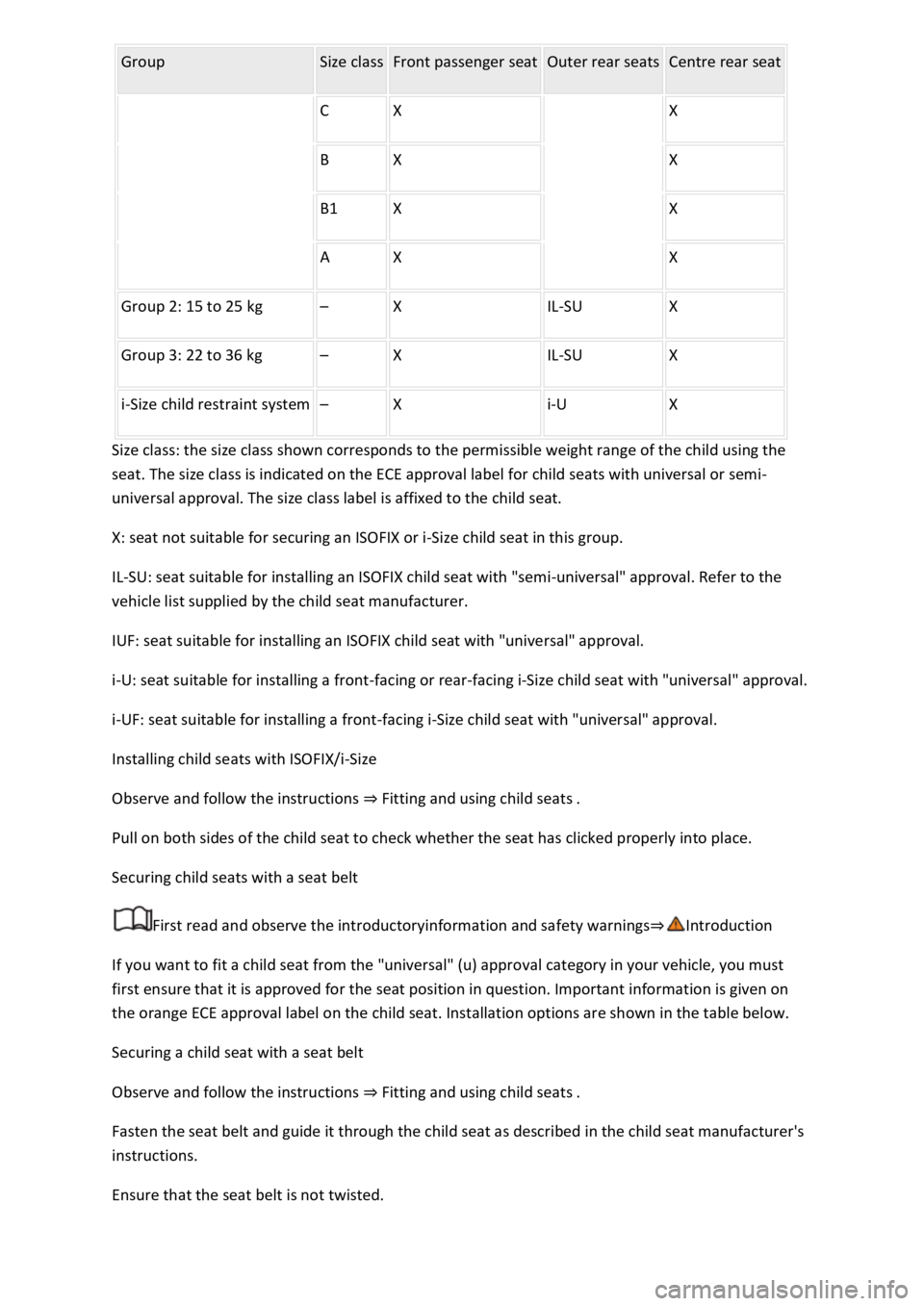
Group Size class Front passenger seat Outer rear seats Centre rear seat
C X X
B X X
B1 X X
A X X
Group 2: 15 to 25 kg – X IL-SU X
Group 3: 22 to 36 kg – X IL-SU X
i-Size child restraint system – X i-U X
Size class: the size class shown corresponds to the permissible weight range of the child using the
seat. The size class is indicated on the ECE approval label for child seats with universal or semi-
universal approval. The size class label is affixed to the child seat.
X: seat not suitable for securing an ISOFIX or i-Size child seat in this group.
IL-SU: seat suitable for installing an ISOFIX child seat with "semi-universal" approval. Refer to the
vehicle list supplied by the child seat manufacturer.
IUF: seat suitable for installing an ISOFIX child seat with "universal" approval.
i-U: seat suitable for installing a front-facing or rear-facing i-Size child seat with "universal" approval.
i-UF: seat suitable for installing a front-facing i-Size child seat with "universal" approval.
Installing child seats with ISOFIX/i-Size
Observe and follow the instructions ⇒ Fitting and using child seats .
Pull on both sides of the child seat to check whether the seat has clicked properly into place.
Securing child seats with a seat belt
First read and observe the introductoryinformation and safety warnings⇒Introduction
If you want to fit a child seat from the "universal" (u) approval category in your vehicle, you must
first ensure that it is approved for the seat position in question. Important information is given on
the orange ECE approval label on the child seat. Installation options are shown in the table below.
Securing a child seat with a seat belt
Observe and follow the instructions ⇒ Fitting and using child seats .
Fasten the seat belt and guide it through the child seat as described in the child seat manufacturer's
instructions.
Ensure that the seat belt is not twisted.
Page 118 of 502

⇒ Mechanically adjusting the front seat
⇒ Folding the front passenger seat backrest forwards
The following section describes the options for adjusting the front seats. Always ensure that you
adjust the correct sitting position ⇒ Sitting position .
WARNING
Always adjust the front seats to their correct position before any journey and ensure that all
passengers have fastened their seat belts.
Push the front passenger seat as far back as possible.
Adjust the driver seat so that there is at least 25 cm between your breastbone and the hub of the
steering wheel. Adjust the driver seat by moving it forwards or backwards so that you are able to
press the pedals to the floor with your knees still slightly angled and the distance to the dash panel
in the knee area is at least 10 cm. If your build makes it impossible to fulfil this requirement, you
must contact a qualified workshop so they can make any necessary modifications.
Never travel with the backrest tilted far back. The further back the backrest is tilted, the greater the
risk of injury caused by incorrect seat belt routing or an incorrect sitting position.
Never travel with the backrest tilted far forwards. When a front airbag is triggered, it could force the
seat backrest backwards and injure vehicle occupants on the rear seats.
Adopt and maintain the greatest possible distance from the steering wheel and dash panel.
You should always sit upright with your back against the seat backrest with the front seats properly
adjusted. Do not position any body part too close to where the airbags are fitted.
The risk of serious injury is increased for passengers on the rear seat if they are not sitting upright
because the seat belts are incorrectly positioned.
WARNING
Incorrect adjustment of the seats can cause accidents and serious injuries.
The seats must be adjusted only when the vehicle is stationary, or else the seat could change
position unexpectedly while the vehicle is in motion, leading to a loss of control of the vehicle.
Furthermore, an incorrect seating position is adopted while adjusting the seat.
Adjust the height and tilt of the seat or move it forwards and backwards only when the area around
the seat is clear.
The adjustment range of the seats must not be restricted by any items.
Adjust the tilt angle of the rear seats or move them forwards and backwards only when the area
around the seats is clear.
The adjustment and locking areas of the seats must not be soiled.
Page 119 of 502
WARNING
Cigarette lighters left in the vehicle can become damaged or may ignite unnoticed. This can cause
serious burns and vehicle damage.
Before adjusting the seats, always make sure that there is no lighter on or near the moveable parts
of the seat.
Before closing stowage areas or compartments, always make sure that there is no lighter in the way.
Never stow lighters in stowage areas, compartments or on other surfaces in the vehicle. Cigarette
lighters may self-ignite as a result of high surface temperatures, particularly in summer.
NOTICE
Sharp edges can damage the seats.
Do not touch the seats with sharp-edged objects. Sharp-edged objects such as zips, rivets on clothing
or belts can damage surfaces. Open Velcro fasteners can also cause damage.
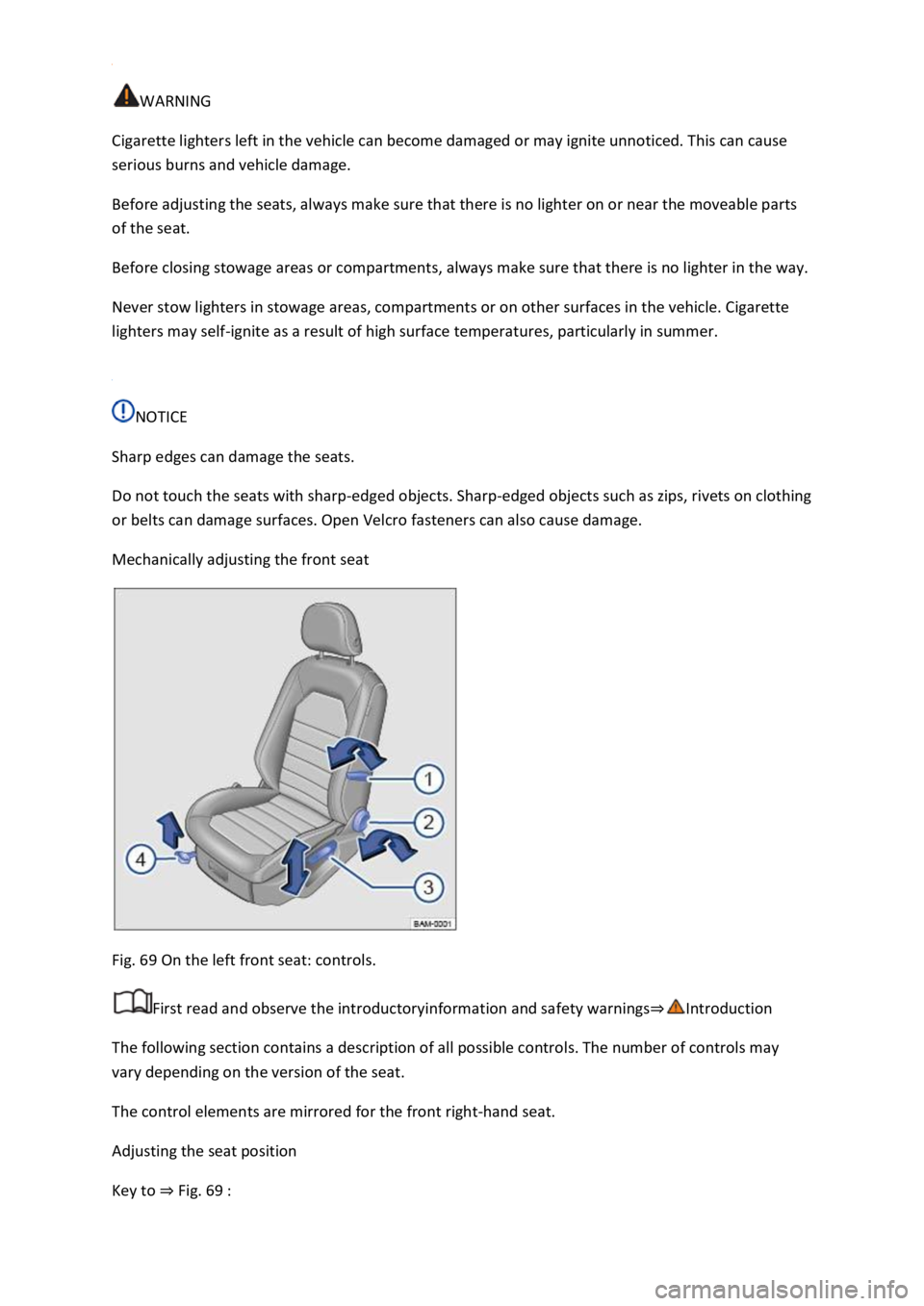
Mechanically adjusting the front seat
Fig. 69 On the left front seat: controls.
First read and observe the introductoryinformation and safety warnings⇒Introduction
The following section contains a description of all possible controls. The number of controls may
vary depending on the version of the seat.
The control elements are mirrored for the front right-hand seat.
Adjusting the seat position
Key to ⇒ Fig. 69 :
Page 123 of 502
Items in the luggage compartment could cause damage when pushing the rear seat forwards or
backwards.
When the rear seat is moved forwards, objects can get into the space between the seat and luggage
compartment floor. Remove any items or objects from this space before pushing the rear seat back.
NOTICE
Sharp edges can damage the seats.
Do not touch the seats with sharp-edged objects. Sharp-edged objects such as zips, rivets on clothing
or belts can damage surfaces. Open Velcro fasteners can also cause damage.
Folding the backrests on the rear bench seat forwards and backwards
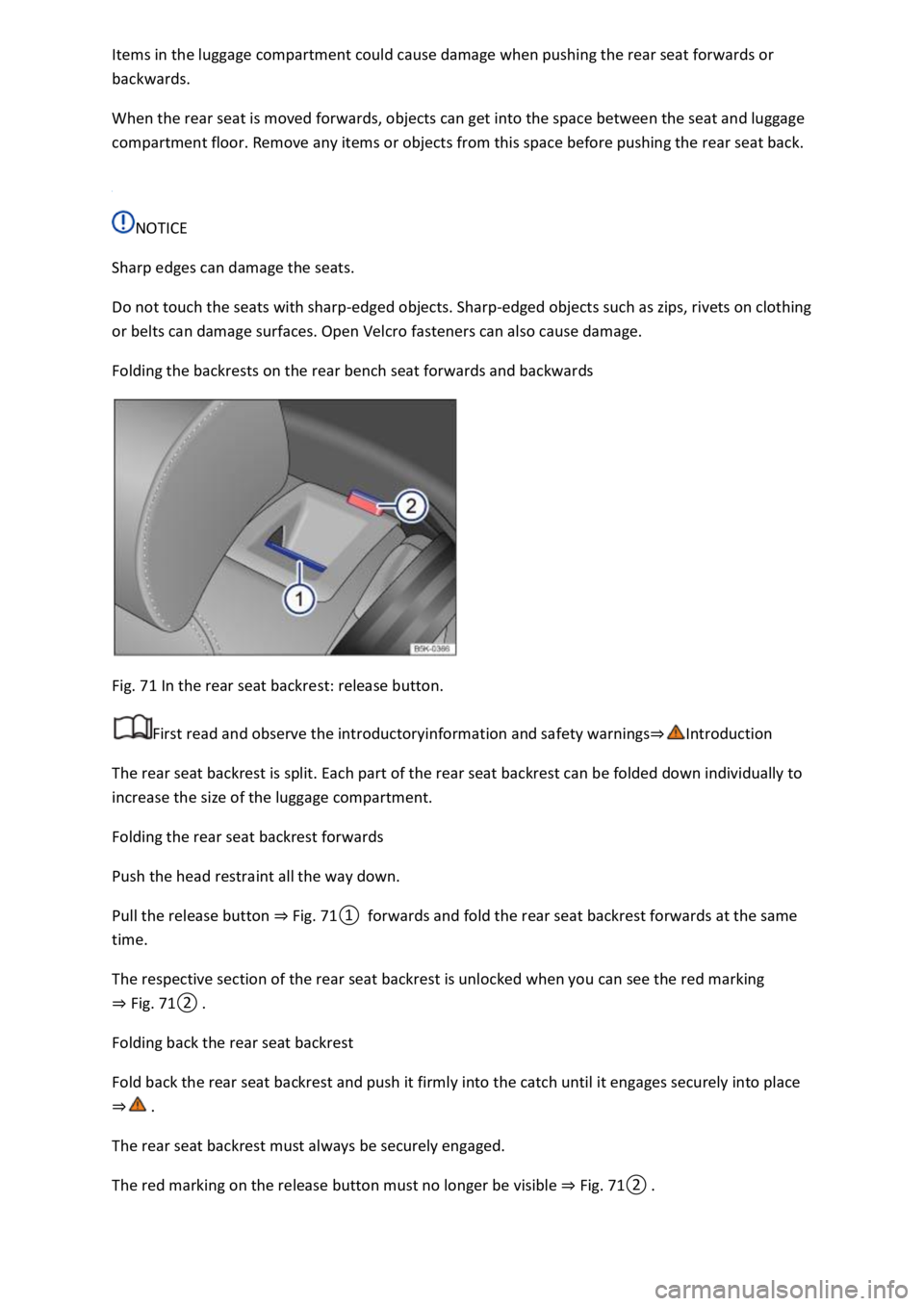
Fig. 71 In the rear seat backrest: release button.
First read and observe the introductoryinformation and safety warnings⇒Introduction
The rear seat backrest is split. Each part of the rear seat backrest can be folded down individually to
increase the size of the luggage compartment.
Folding the rear seat backrest forwards
Push the head restraint all the way down.
Pull the release button ⇒ Fig. 71① forwards and fold the rear seat backrest forwards at the same
time.
The respective section of the rear seat backrest is unlocked when you can see the red marking
⇒ Fig. 71② .
Folding back the rear seat backrest
Fold back the rear seat backrest and push it firmly into the catch until it engages securely into place
⇒ .
The rear seat backrest must always be securely engaged.
The red marking on the release button must no longer be visible ⇒ Fig. 71② .
Page 124 of 502

WARNING
Injuries can be caused if the rear seat backrests are folded forwards and backwards in an
uncontrolled way and without taking due care.
While folding the rear seat backrest forward, always make sure that no people or animals are in its
path.
Never fold the rear seat backrest forwards or backwards while the vehicle is in motion.
Ensure that the seat belt is not trapped or damaged when folding back the rear seat backrest.
Always keep hands, fingers, feet or other body parts away from the swivel area when folding the
rear seat backrest forwards and backwards.
Ensure that each rear seat backrest engages securely, otherwise the seat belts for the rear seats will
not offer maximum protection. This applies to the centre seat of the rear bench seat in particular. If
a seat is occupied and the corresponding rear seat backrest has not engaged securely into place, the
seat occupant and rear seat backrest may move forwards in the event of a sudden braking or driving
manoeuvre or during accidents.
Adults and children must not use seats if the corresponding backrest is folded forwards or is not
engaged securely into place.
NOTICE
Damage to the vehicle or to other objects could be caused if the rear bench seat backrest is folded
forwards and backwards in an uncontrolled way or without due care.
Before folding the rear seat backrests forwards, always adjust the front seats so that the rear head
restraints or rear seat cushions do impact the front seats.
Before folding down the rear seat backrest, always make sure that there are no objects located in its
path.
Head restraints
Introduction
This chapter contains information on the followingsubjects:
⇒ Adjusting the head restraints
⇒ Removing and installing head restraints
The following section describes the options for adjusting and removing the head restraints. Always
ensure that you adjust the correct sitting position ⇒ Sitting position .
Every seat is fitted with a head restraint. The centre head restraint at the rear is designed solely for
use with the centre rear bench seat. Therefore you should not install this head restraint in any of the
other positions.
Page 183 of 502
When all the following conditions are fulfilled at the same time, the vehicle ignition will be switched
off automatically when engine stop is active when the vehicle is stationary:
The driver seat belt has been unfastened.
No pedals are depressed.
The driver door is opened.
If the ignition is deactivated automatically while the dipped beam headlights are switched on,
the side lights remain switched on and lit for approximately 30 minutes.
The side lights can be switched off manually or will go off when the vehicle is locked.
Engine restart function
If no valid vehicle key is detected in the vehicle interior once the engine has been switched off, the
engine can be restarted within approximately five seconds. A corresponding message appears on the
instrument cluster display.
After this time, the engine cannot be re-started without a valid vehicle key in the vehicle interior.
WARNING
Unintentional vehicle movements can cause serious injury.
Do not depress the brake or clutch pedal when the ignition is switched on as the engine will start
immediately.
WARNING
Improper or unsupervised use of the vehicle keys can cause accidents or serious injuries.
Always take all vehicle keys with you every time you leave the vehicle. Children or unauthorised
persons could lock the vehicle, start the engine, switch on the ignition or operate electrical
equipment such as the electric windows.
Before leaving the vehicle, always switch off the ignition manually and observe any information
shown on the instrument cluster display.
Leaving the vehicle stationary for long periods with the ignition switched on can discharge the 12-
volt vehicle battery so that the engine can no longer be started.
Starting the engine
Page 187 of 502

The airbags and belt tensioners will not work if the ignition is switched off.
The brake servo will not work when the engine is switched off. More force is required on the brake
pedal to stop the vehicle.
If the vehicle key is removed from the ignition, the steering lock may activate and you will no longer
be able to steer the vehicle.
WARNING
The components of the exhaust system become very hot. This can cause fires and serious injuries.
Never park the vehicle so that parts of the exhaust system can come into contact with any
inflammable material underneath the vehicle, e.g. undergrowth, leaves, dry grass, spilt fuel etc.
Never apply additional underseal or anti-corrosion coatings to the exhaust pipes, catalytic
converters, heat shields or particulate filter.
NOTICE
If the vehicle has been driven at high load for a long period, the engine can overheat when it is
switched off. In order to avoid damage to the engine, allow the engine to run in neutral position for
approximately 2 minutes before switching it off.
After the engine is switched off, the radiator fan in the engine compartment may run on for some
minutes, even if the ignition is switched off or the vehicle key has been removed. The radiator fan
will switch itself off automatically.
Electronic immobiliser
The immobiliser helps to prevent the engine from being started and driven with an unauthorised
vehicle key.
There is a chip in the vehicle key. The immobiliser is automatically deactivated by this when a valid
vehicle key is inserted in the ignition lock.
The electronic immobiliser is automatically activated when the vehicle key is removed from the
ignition lock. In vehicles with Keyless Access, the vehicle key must be outside the vehicle.
The engine can be started only using a Volkswagen Genuine vehicle key with the correct code.
Coded vehicle keys are available from a Volkswagen dealership.
Problem-free operation of the vehicle is guaranteed only with Volkswagen Genuine vehicle keys.
Troubleshooting
Page 190 of 502
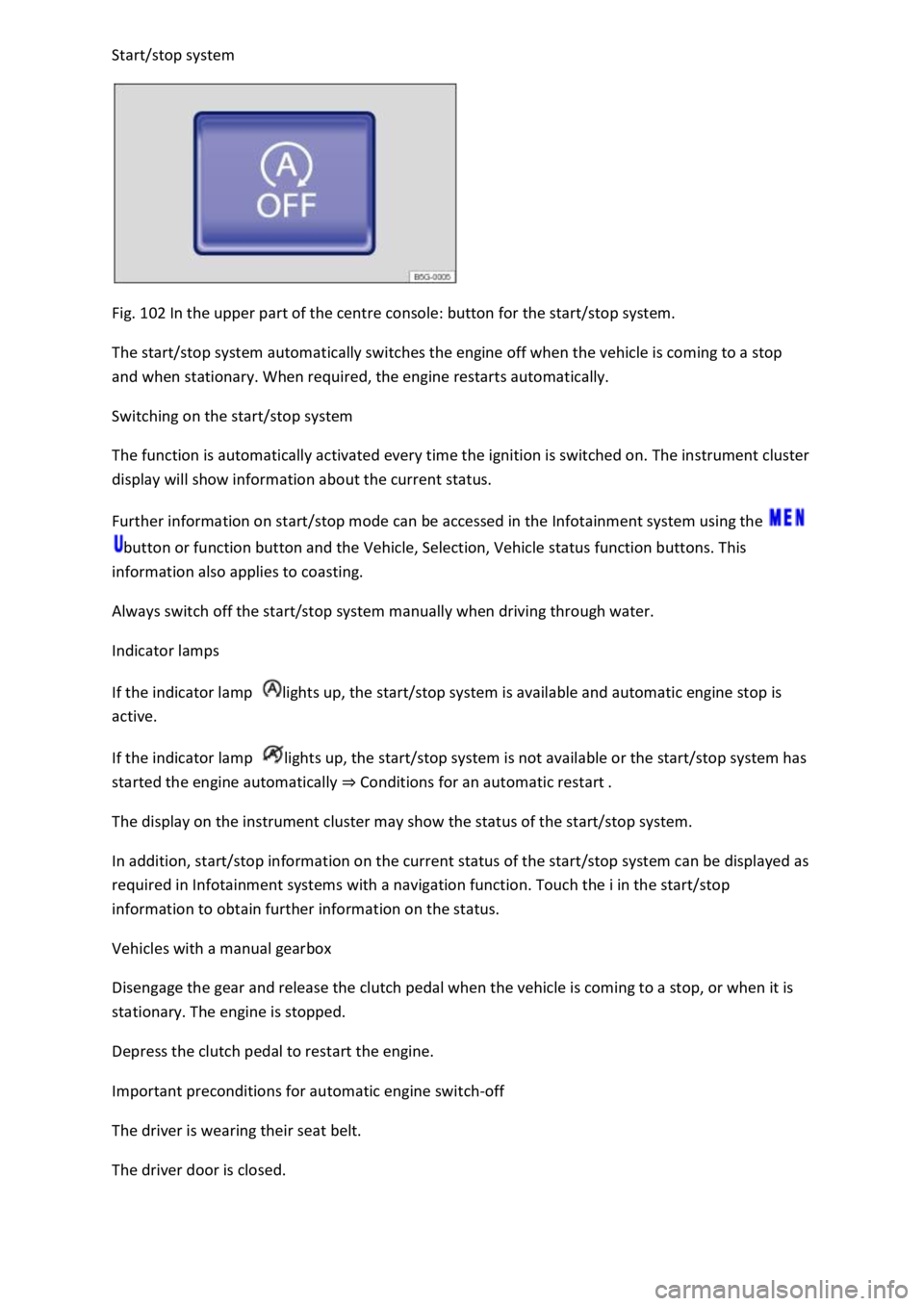
Start/stop system
Fig. 102 In the upper part of the centre console: button for the start/stop system.
The start/stop system automatically switches the engine off when the vehicle is coming to a stop
and when stationary. When required, the engine restarts automatically.
Switching on the start/stop system
The function is automatically activated every time the ignition is switched on. The instrument cluster
display will show information about the current status.
Further information on start/stop mode can be accessed in the Infotainment system using the
button or function button and the Vehicle, Selection, Vehicle status function buttons. This
information also applies to coasting.
Always switch off the start/stop system manually when driving through water.
Indicator lamps
If the indicator lamp lights up, the start/stop system is available and automatic engine stop is
active.
If the indicator lamp lights up, the start/stop system is not available or the start/stop system has
started the engine automatically ⇒ Conditions for an automatic restart .
The display on the instrument cluster may show the status of the start/stop system.
In addition, start/stop information on the current status of the start/stop system can be displayed as
required in Infotainment systems with a navigation function. Touch the i in the start/stop
information to obtain further information on the status.
Vehicles with a manual gearbox
Disengage the gear and release the clutch pedal when the vehicle is coming to a stop, or when it is
stationary. The engine is stopped.
Depress the clutch pedal to restart the engine.
Important preconditions for automatic engine switch-off
The driver is wearing their seat belt.
The driver door is closed.
Page 192 of 502

The instrument cluster shows the status of the start/stop system each time the button is pressed.
If the start/stop system has switched the engine off, it will start again as soon as the system is
deactivated manually with the button.
Always deactivate the start/stop system manually when driving through water.
Start/stop mode when Adaptive Cruise Control (ACC) is active
The engine will be switched off after the Adaptive Cruise Control (ACC) has brought the vehicle to a
standstill via an active braking intervention ⇒ Adaptive Cruise Control (ACC) .
The engine will be switched off after the Adaptive Cruise Control (ACC) has brought the vehicle to a
standstill via an active braking intervention ⇒ Adaptive Cruise Control (ACC) .
Vehicles with dual clutch gearbox DSG: when adaptive cruise control (ACC) is activated, the
dual clutch gearbox DSG® can switch to coasting mode.
Vehicles with dual clutch gearbox DSG: when adaptive cruise control (ACC) is activated, the
dual clutch gearbox DSG® can switch to coasting mode.
In the following instances, the engine will restart when the Adaptive Cruise Control (ACC) is active:
If the accelerator is depressed.
When the Adaptive Cruise Control (ACC) has resumed speed and distance control.
If the vehicle ahead has moved on.
WARNING
Never switch off the engine or the ignition while the vehicle is in motion. This can lead to a loss of
vehicle control, accidents and serious injuries.
The airbags and belt tensioners will not work if the ignition is switched off.
The brake servo will not work when the engine is switched off. That is why more pressure on the
brake pedal is needed to brake the vehicle when the engine is switched off.
The power steering will not work when the engine is not running. More power is needed to steer the
vehicle when the engine is switched off.
When the ignition is switched off, the steering lock may activate and you will no longer be able to
steer the vehicle.
The start/stop system must be deactivated if work is to be carried out in the engine compartment.
NOTICE
Page 216 of 502
The examples given in this chapter are an aid for safe offroad driving. However, we cannot predict
whether these guidelines will be valid for all situations that could occur.
The many different types of terrain and the associated risks and dangers make it impossible to
describe all possible driving situations. The examples are only general guidelines which are intended
to help you to drive offroad safely. It is crucial that you know what to expect when you drive into
offroad terrain you are unfamiliar with. This will enable you to assess potential dangers in advance.
The driver can use 4MOTION Active Control to activate a variety of vehicle settings in an all-wheel
drive vehicle as required ⇒ Setting a driving profile .
Checklist
Before driving offroad for the first time, take the following steps so you can operate and drive the
vehicle safely offroad:
Observe the basic safety notes Safety instructions for offroad driving.
Familiarise yourself with the vehicle controls.
Check and adjust the seat position Sitting position and fasten the seat belts Seat belts.
Check distance to steering wheel and adjust Steering wheel.
Always wear suitable, well-fitting shoes that provide good grip for your feet when operating the
pedals.
Safety instructions for offroad driving
First read and observe the introductoryinformation and safety warnings⇒Introduction
WARNING
The intelligent vehicle technology cannot overcome the laws of physics, and functions only within
the limits of the system. Despite ABS, instability through locked wheels can occur on adverse terrain
– e.g. if you brake hard when driving on a loose gravel road. The Electronic Stability Control will be
able to stabilise the vehicle only to a limited extent in these circumstances.
WARNING
Driving offroad can be dangerous and could cause accidents, serious injury, damage to the vehicle
and also a vehicle breakdown far from any assistance.
Never select a dangerous route and never take risks that could endanger you and your passengers. If
you cannot drive on or if you are in any doubt about the safety of the route, turn round and choose
another route.
Even terrain that looks harmless can be difficult and dangerous, and could get you and your
passengers into difficulties. We recommend inspecting the terrain on foot beforehand.