key start VOLKSWAGEN T-ROC 2021 Owner´s Manual
[x] Cancel search | Manufacturer: VOLKSWAGEN, Model Year: 2021, Model line: T-ROC, Model: VOLKSWAGEN T-ROC 2021Pages: 502, PDF Size: 9.42 MB
Page 258 of 502

Take all vehicle keys with you when you leave the vehicle.
Lock the vehicle.
Additional points to note on uphill and downhill gradients
Before switching off the engine, turn the steering wheel so that the front wheels will roll against the
kerb if the parked vehicle starts to move.
When facing downhill, turn the wheels so that they face the kerb.
When facing uphill, turn the wheels so that they face the centre of the road.
WARNING
The components of the exhaust system become very hot. This can cause fires and serious injuries.
Never park the vehicle where parts of the exhaust system can come into contact with inflammable
material underneath the vehicle, e.g. undergrowth, leaves, dry grass, spilt fuel, oil etc.
WARNING
The vehicle may roll away if you leave and park the vehicle incorrectly. This can cause accidents and
serious injuries.
Ensure that the electronic parking brake is switched on before you leave the vehicle and the
indicator lamp in the instrument cluster lights up red after you switch off the ignition.
Never remove the vehicle key from the ignition if the vehicle is in motion. The steering lock may be
activated and you will no longer be able to steer or control the vehicle.
Never leave children or people requiring assistance alone in the vehicle. They could switch off the
electronic parking brake, or move the selector lever or gearshift lever, and thus set the vehicle in
motion.
Always take all vehicle keys with you every time you leave the vehicle. The engine can be started and
electrical equipment such as the window controls can be operated. This can cause serious injury.
Never leave children or people requiring assistance alone in the vehicle. They could become trapped
in the vehicle in an emergency and may not be able to get themselves to safety. For example, locked
vehicles may be subjected to very high or very low temperatures depending on the season. This can
cause serious injuries and illness or fatalities, especially in the case of small children.
NOTICE
Objects that protrude from the ground can damage the bumper and other components when
parking the vehicle or driving out of a parking space. Always take care when driving into parking
spaces with high kerbs or fixed boundaries. Stop before the wheels touch the fixed boundaries or
kerbs.
Page 312 of 502

Release pin with coloured marking
The removable ball head is located with the vehicle toolkit in the luggage compartment.
Step 1: preparations
Remove the cap from the ball head mounting under the rear bumper ⇒ Rear view and stow in the
vehicle.
Starting from the bottom right side, swivel the trailer socket as far as possible to the top left. This
gives you access to the ball head mounting.
Check to ensure that the mounting, locking lever ⇒ Fig. 155 ⑥, shank ④ and the retaining balls
③ of the ball head are all clean and not damaged ⇒ . Clean if necessary.
Step 2: check whether the ball head is pre-tensioned
The ball head cannot be fitted properly unless it is pre-tensioned.
The following conditions must be fulfilled:
The lock cover ⇒ Fig. 155 ⑧ is open and the key ⑦ is inserted
The release pin ⑨ can be moved.
The locking lever ⑥ is in the bottom position.
All retaining balls ③ can be pressed fully into the shank ④.
If all these conditions are met, continue with Step 4.
If conditions are not met, continue with Step 3.
Step 3: pre-tensioning the ball head
If the ball head is not pre-tensioned, pre-tension the ball head as follows:
Remove the lock cover ⑧ from the lock and insert the key ⑦ into the lock.
Turn the key ⑦ anti-clockwise until the part of the key with the hole is at the top.
Press the release pin ⑨ and at the same time press the locking lever ⑥ down as far as it will go ⇒
. The locking lever remains locked in this position.
Step 4: attaching the pre-tensioned ball head to the vehicle
Do not touch the locking lever once the ball head has been pre-tensioned. When the ball head is
engaged, the locking lever will spring back to its original position and could cause injury ⇒ .
Guide the pre-tensioned removable ball head into the mounting tube from below.
Push the ball head firmly upwards until it engages. The centring devices ⇒ Fig. 155 ⑤ must engage
in the mounting points on the vehicle.
The locking lever ⑥ automatically turns up to its original position and the green section of the
release pin ⑨ is visible.
Page 340 of 502

First read and observe the introductoryinformation and safety warnings⇒Introduction
Checklist
Always carry out the following actions for changing a bulb in the given order ⇒ :
Park the vehicle on a firm and level surface at a safe distance from the flow of traffic.
Switch on the electronic parking brake Electronic parking brake.
Turn the light switch to position 0 Switching lights on and off.
Move the turn signal and main beam lever to neutral position Switching turn signals on and off.
Automatic gearbox: move the selector lever to position P DSG® dual clutch gearbox.
Stop the engine and remove the vehicle key from the ignition Starting the engine.
Manual gearbox: select a gear Manual gearbox: selecting a gear.
Allow the orientation lighting to go out Coming Home and Leaving Home function (orientation
lighting).
Leave the defective bulbs to cool down.
Check to see if a fuse has visibly blown Changing fuses.
Follow the instructions to change the affected bulb . Always replace bulbs with identical bulbs of the
same type. The designation is inscribed on the bulb, either on the glass part or on the base.
Page 343 of 502
Attach the rubber cover or hard plastic cover and turn it clockwise as far as it will go.
Close the bonnet ⇒ In the engine compartment .
Changing the bulbs in the headlights (lights with LED technology)
First read and observe the introductoryinformation and safety warnings⇒Introduction
These lamps use LED technology. The LEDs cannot be replaced by customers. If some LEDs fail, this
may be an indication that more elements are on the point of failure. In this case, have the lights
checked and renewed if necessary at a qualified workshop.
Changing the front turn signal bulbs
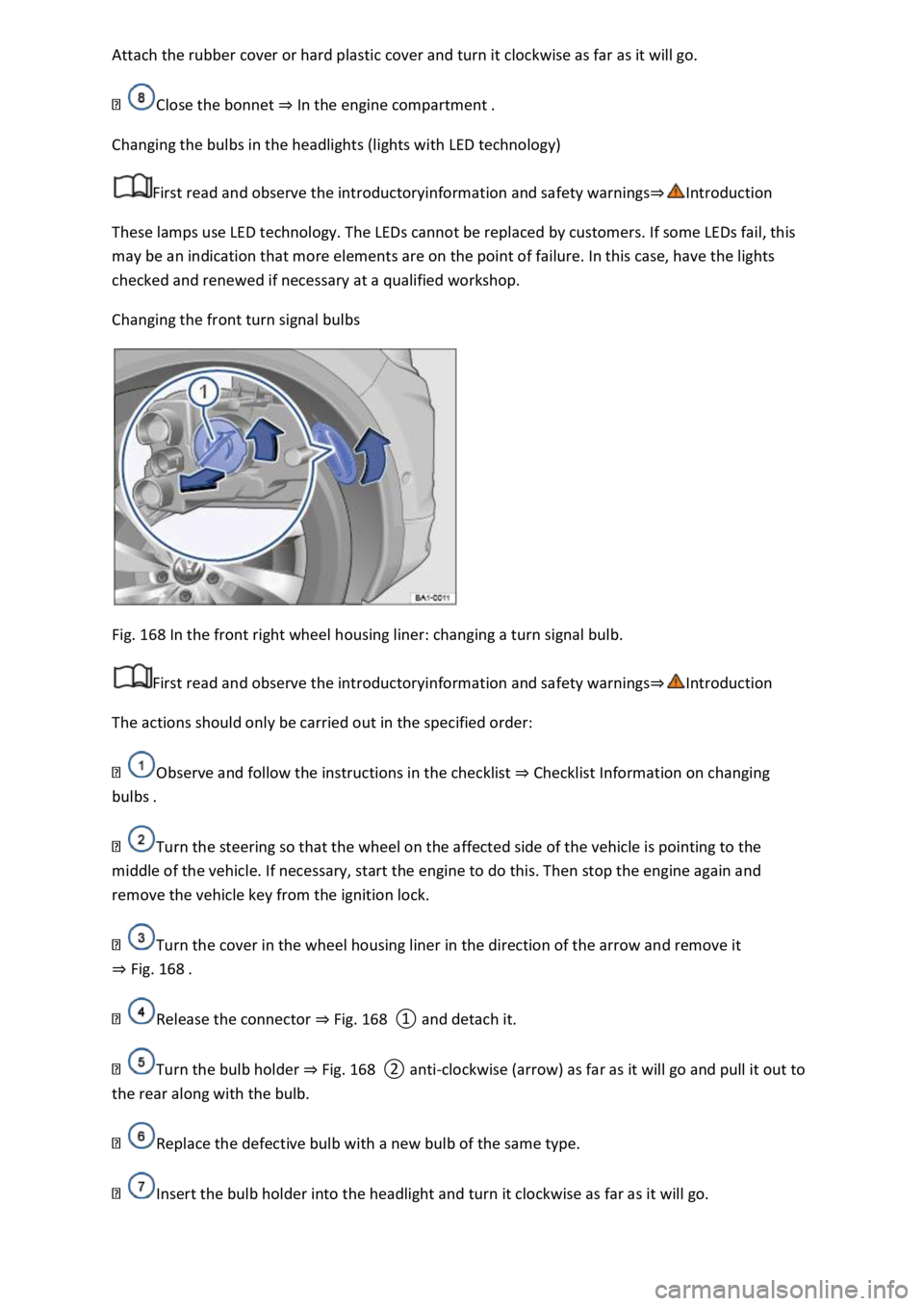
Fig. 168 In the front right wheel housing liner: changing a turn signal bulb.
First read and observe the introductoryinformation and safety warnings⇒Introduction
The actions should only be carried out in the specified order:
Observe and follow the instructions in the checklist ⇒ Checklist Information on changing
bulbs .
Turn the steering so that the wheel on the affected side of the vehicle is pointing to the
middle of the vehicle. If necessary, start the engine to do this. Then stop the engine again and
remove the vehicle key from the ignition lock.
Turn the cover in the wheel housing liner in the direction of the arrow and remove it
⇒ Fig. 168 .
Release the connector ⇒ Fig. 168 ① and detach it.
Turn the bulb holder ⇒ Fig. 168 ② anti-clockwise (arrow) as far as it will go and pull it out to
the rear along with the bulb.
Replace the defective bulb with a new bulb of the same type.
Insert the bulb holder into the headlight and turn it clockwise as far as it will go.
Page 353 of 502
les must not touch each other, as any contact could mean that electricity could flow as
soon as the positive terminals are connected.
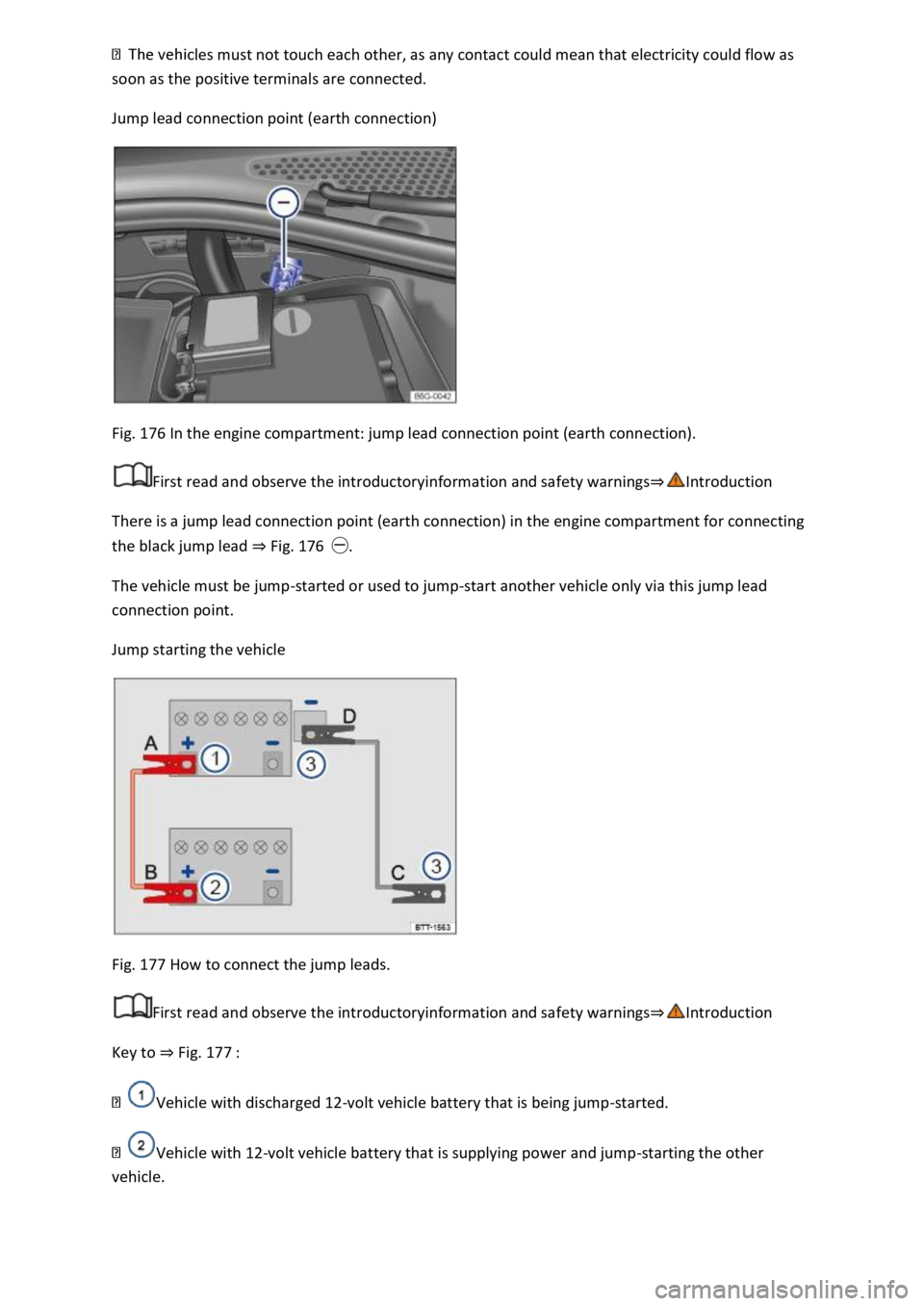
Jump lead connection point (earth connection)
Fig. 176 In the engine compartment: jump lead connection point (earth connection).
First read and observe the introductoryinformation and safety warnings⇒Introduction
There is a jump lead connection point (earth connection) in the engine compartment for connecting
the black jump lead ⇒ Fig. 176 ㊀.
The vehicle must be jump-started or used to jump-start another vehicle only via this jump lead
connection point.
Jump starting the vehicle
Fig. 177 How to connect the jump leads.
First read and observe the introductoryinformation and safety warnings⇒Introduction
Key to ⇒ Fig. 177 :
Vehicle with discharged 12-volt vehicle battery that is being jump-started.
Vehicle with 12-volt vehicle battery that is supplying power and jump-starting the other
vehicle.
Page 363 of 502

unattended.
expansion tank when the engine is hot. Coolant may spray out and cause serious burns and other
injuries.
-clockwise while exerting
gentle downward pressure on the cap.
face, hands and arms from hot coolant or steam with a large, thick cloth.
spilt service fluids can start a fire.
WARNING
High voltages in the electrical system can cause electric shocks, burns, serious injuries and death!
-volt battery could explode.
started, never touch the electrical cables in the ignition system.
WARNING
There are rotating components in the engine compartment that can cause serious injury.
rotor blades can result in serious injuries. The fan is temperature-controlled and can start
automatically, even when the ignition has been switched off or the vehicle key has been removed
from the ignition lock.
e engine is started or with the engine running, there is an
additional, potentially fatal safety risk from the rotating parts, such as the poly V-belt, alternator,
radiator fan, and from the high-voltage ignition system. Always be particularly careful.
Always ensure that no body parts, jewellery, ties, loose items of clothing or long hair can be
caught up in rotating engine components. Before starting work, remove any jewellery and ties, tie
up long hair and pull clothes in tightly to avoid them getting caught on engine parts.
could move, even if the electronic parking brake is applied.
s and tools, in the engine
compartment. Any forgotten items can cause malfunctions, engine damage and fires.
WARNING
Page 365 of 502

Depress and hold the brake pedal until you have switched off the ignition.
Switch on the electronic parking brake Electronic parking brake.
Move the gear lever to neutral position Manual gearbox: selecting a gear or move the selector lever
to position P DSG® dual clutch gearbox.
Switch off the ignition and remove the vehicle key from the ignition lock Starting and stopping the
engine.
Allow the engine to cool sufficiently.
Children and other people should be kept well away from the engine compartment.
Ensure that the vehicle cannot roll away unexpectedly.
WARNING
Ignoring any of the items on this important safety checklist can lead to severe injuries.
Opening and closing the bonnet
Page 381 of 502

Otherwise, the engine could be damaged. If you cannot see any coolant in the expansion tank do not
drive on. Seek professional assistance.
level remains stable.
⇒ Fig. 188 . Do not
fill up above the top edge of the marked area⇒ .
⇒ Coolant
specification , do not use any other coolant additive! Instead, initially refill with distilled water⇒
only. Then add the correct proportion of the specified coolant additive as soon as possible
⇒ Coolant specification .
WARNING
Hot steam and hot coolant can cause serious burns.
coolant coming out of the engine
compartment. Always wait until you can no longer see or hear escaping steam or coolant.
components can burn the skin.
wing points must be observed before opening the bonnet once it has cooled down:
P or move the gear
lever to the neutral position.
hicle key from the ignition lock.
unattended.
expansion tank when the engine is hot. Coolant may spray out and cause serious burns and other
injuries.
-clockwise while exerting gentle downward pressure on
the cap.
with a large, thick cloth.
spilt service fluids can start a fire. In certain circumstances, the ethylene glycol in the coolant can
catch fire.
NOTICE