flat tire VOLKSWAGEN TIGUAN 2007 Owner's Manual
[x] Cancel search | Manufacturer: VOLKSWAGEN, Model Year: 2007, Model line: TIGUAN, Model: VOLKSWAGEN TIGUAN 2007Pages: 435, PDF Size: 4.23 MB
Page 208 of 435

Each tire, including the spare (if provided), should be checked monthly when cold and inflated to the inflation pressure recommended by the vehicle manufacturer on the vehicle placard or tire inflation pressure label. (If your vehicle has tires of a different size than the size indicated on the vehicle placard or tire inflation pressure label, you should determine the proper tire inflation pressure for those tires.)
As an added safety feature, your vehicle has been equipped with a Tire Pressure Monitoring System (TPMS) that illuminates a low tire pressure telltale when one or more of your tires is significantly underinflated. Accordingly, when the low tire pressure telltale illuminates, you should stop and check your tires as soon as possible, and inflate them to the proper pressure. Driving on a significantly underinflated tire causes the tire to overheat and can lead to tire failure. Under inflation also reduces fuel efficiency and tire tread life, and may affect the vehicle's handling and stopping ability.
Please note that the TPMS is not a substitute for proper tire maintenance, and it is the driver's responsibility to maintain correct tire pressure, even if underinflation has not reached the level to trigger illumination of the TPMS low tire pressure telltale.
Your vehicle has also been equipped with a TPMS malfunction indicator to indicate when the system is not operating properly. The TPMS malfunction indicator is combined with the low tire pressure telltale. When the system detects a malfunction, the telltale will flash for approximately one minute and then remain continuously illuminated. This sequence will continue upon subsequent vehicle start-ups as long as the malfunction exists.
When the malfunction indicator is illuminated, the system may not be able to detect or signal low tire pressure as intended. TPMS malfunctions may occur for a variety of reasons, including the installation of replacement or alternate tires or wheels on the vehicle that prevent the TPMS from functioning properly. Always check the TPMS malfunction telltale after replacing one or more tires or wheels on your vehicle to ensure that the replacement or alternate tires and wheels allow the TPMS to continue to function properly.
Resetting and recalibrating the benchmark tire pressure
Resetting the tire pressures in the Multi-function Indicator (MFI) resets the benchmark tire pressure used by the TPMS to the current tire pressure in the tires based on the circumference of the tires.
To reset the reference tire pressure, switch on the ignition. In the MFI, navigate to the Settings menu and select Tire pressure. Store and confirm the new tire pressures.
The re-calibration must be performed each time the tire pressure in one or more tires has been adjusted or after one or more tires has been changed, exchanged, or repaired. The new tire pressures are stored in the system only after at least 20 minutes of normal driving.
If you have reset the benchmark tire pressure when your tires do not have the correct tire pressure, this will prevent the TPMS from working properly. It may then give false warnings or may not give any warning even if the tire pressure is too low.
For this reason, it is vital to make certain that all four tires are inflated to the correct pressure when they are cold, before calibrating the system. Cold tire tires are tires that have not been driven more than a couple of miles (kilometers) at low speed within the last 3 hours.
Recalibrate the system to reset the benchmark TPMS pressure in the following situations:
x After installing tires on your vehicle that have recommended cold tire inflation pressures that are different from the tires that were taken off.
x After any tire on your vehicle is removed and then remounted, even if the same tire and wheel rim that were taken off are reinstalled (for instance, after repair).
x After any tire on your vehicle is changed and replaced by another tire, even if the replacement tire is the same type and is inflated to the same pressure as the tire it replaced.
x After adjusting the tire pressure of any tire on the vehicle to its correct cold tire inflation pressure, either by putting air in one or more tires or by letting air out. Do this even though air was only added (or let out) to bring the tire to the inflation pressure it should have had all along.
x After rotating the front and rear wheels
x After mounting the compact spare wheel.
Page 209 of 435

WARNING
Incorrect calibration can cause the TPMS to give false warnings or to give no warning despite dangerously low tire pressures. Make certain the tire inflation pressure of all tires is correct before calibrating the system.
WARNING
Incorrect tire pressure can cause sudden tire failure, loss of vehicle control and serious personal injury.
x Always check and correct air pressure in all four tires, particularly after changing, exchanging, or repairing tires.
x After that, always make sure that all 4 tires are inflated to the correct tire pressure for the tires installed on the vehicle. Then recalibrate the system so that it can properly monitor the pressure in the tire.
x The Tire Pressure Monitoring System (TPMS) must be recalibrated using the MFI whenever you remove and remount or change any wheel or tire on the vehicle, even if the reinstalled or replacement wheels and tires are identical to those that were removed and even
if the tire pressure does not change ⇒ Resetting and recalibrating the benchmark tire pressure.
x See the tire pressure label ⇒ inflation pressure and the Owner's Literature for recommended cold tire inflation pressure and other important information.
x When replacing tires or wheel rims, always read and heed all of the information and
WARNINGS ⇒ Tires and wheels.
x The Tire Pressure Monitoring System (TPMS) must be recalibrated using the MFI whenever you remove and remount or change any wheel or tire on the vehicle, even if the reinstalled or replacement wheels and tires are identical to those that were removed and even if the tire pressure does not change.
The Tire Pressure Monitoring System (TPMS) stops working if there is an ESC/ABS malfunction.
⇒ Vehicle operation.
After a low tire pressure warning, the vehicle must stand and must not be driven for at least one minute before the new benchmark tire pressures can be stored.
Page 304 of 435

be lower on hard, firm surfaces if ideal conditions do not exist. As the driver, you are always
responsible for deciding whether your vehicle is able to handle a particular situation ⇒ .
Term Explanation Technical data
Ground clearance This is the vertical distance between the level ground and the lowest part on the vehicle.
Maximum 7.6 in (195 mm).
Fording depth in standing water Distance between the point on the ground that touches the tire and the engine air intake duct.
Maximum 6.9 inches (175 mm).
Gradient angle The number of feet (meters) in altitude gained when traveling 100 ft (30.48 m) is given as a percentage or in degrees
⇒ fig. 164 A. Information on the maximum slope the vehicle can climb unassisted (depends on road surface and engine power).
Maximum permissible 31 degrees (corresponds to 60 %).
Lateral angle (vehicle slope) The maximum angle the vehicle may be driven across terrain without the vehicle rolling over (depends on height of center of
gravity) ⇒ fig. 164 B.
Maximum permissible 27 degrees.
Breakover angle Maximum permitted angle given in degrees that a vehicle driven at low speed can clear a ramp without the underbody of the vehicle scraping the ramp.
Maximum 21.3 degrees.
Approach/departure angle Transition from horizontal plane to a slope, or from a slope to flat ground. Maximum angle in degrees the vehicle can be driven at low speed along an embankment without the bumper or underbody scraping.
Approach angle for off-road front end: Maximum 28 degrees.
Departure angle: Maximum 25 degrees.
Fall line This is the vertical drop route.
Articulation Articulation capability of the vehicle while driving on one side over an object.
WARNING
Never exceed the recommended maximum values in the above table. Exceeding these values will result in serious personal injury and/or damage to your vehicle.
x All values listed above are for ideal conditions and assume firm, even surfaces that are dry and not slippery.
x Off-road conditions will always be less than ideal. Always reduce the maximum values listed in the table above to allow an adequate margin of safety between the ideal maximum value and your vehicle's actual off-road situation.
Page 310 of 435

x After driving through water, have the vehicle drive train and electrical system thoroughly inspected for damage by an authorized Volkswagen dealer or an authorized Volkswagen Service Facility.
WARNING
Flowing water is very powerful and can sweep your vehicle away. This can lead create an extremely dangerous situation and cause an accident with serious personal injuries.
x Never take routes or risks that could put you or your passengers in danger. If you cannot go on or have doubts about the safety of your route, turn back and take a new route.
x Never stop in the water.
x If water gets into the engine, your vehicle can break down. You will lose control of a broken down vehicle, and it can be swept away.
x Soft surfaces, mud, underwater obstacles, and holes can cause accidents and can cause the vehicle to break down in the water. This can lead pose extreme danger.
x Rapidly flowing water can develop strong forces that can pull the vehicle downstream. This can cause accidents and fatal injuries.
x Drive through water only where the banks and bottom are firm enough and the water is shallower at all points than the maximum permissible fording depth for your vehicle.
NOTICE
x Vehicle components such as the engine, drive train, suspension or electrical system may be severely damaged by driving through water.
x Avoid stopping in deep water. This can let water get inside the vehicle.
x On soft ground, the tires dig into the surface. This reduces fording depth. Make sure that the ground is sufficiently firm.
x Avoid creating a bow wave in front of the vehicle while driving through water. A bow wave could force its way into the engine air intake duct and seriously damage the engine.
x If you even briefly exceed the maximum fording depth when driving through water, severe engine damage will result. This engine damage will lead to a vehicle breakdown. This can disable the vehicle in the water.
x Never drive over salt flats or through salt or salty water. Salt causes vehicle corrosion. Rinse all parts of the vehicle that were exposed to salt or salt water right away with fresh water.
Driving over snow-covered terrain
Page 404 of 435
WARNING
Improper use of your vehicle jack can cause the vehicle to fall off the jack leading to serious personal injury. To help reduce the risk of serious personal injury:
x Use only jacks approved by Volkswagen for the vehicle. Other jacks might slip, even those approved for other Volkswagen models, but not for your vehicle.
x Always set up the jack on firm and level ground. The vehicle may slip off the jack if the jack is resting on soft or sloping ground. If necessary place a sturdy board under the jack.
x On a hard, slippery surface (such as a tiled floor), use an anti-skid rubber mat or something similar to prevent the jack from slipping.
x Position the jack only at the described vehicle lift points. Before you raise your vehicle, always make sure the jack claw properly grips the vertical rib under the sill so that the jack
does not slip off when you are raising the vehicle ⇒ fig. 197.
x Never have any part of your body (such as your arm or leg) under the vehicle when it is supported by the jack. Never let other persons have any part of their body under the vehicle, either!
x If you must work under a vehicle raised on a floor jack, always make sure that the vehicle is safely supported on safety stands intended for that purpose that are strong enough to support the weight of the vehicle.
x Never lift the vehicle when it is tilted or inclined to one side or the engine is running.
x Never lift the vehicle when more than one tire is flat or damaged.
x Do not start the engine while the vehicle is supported by a jack. Engine vibrations may cause the vehicle to slip off the jack.
WARNING
Disregarding the safety-related checklist may lead to accidents and serious personal injuries.
x Always review and follow the checklist. Follow accepted safety practices and use common sense.
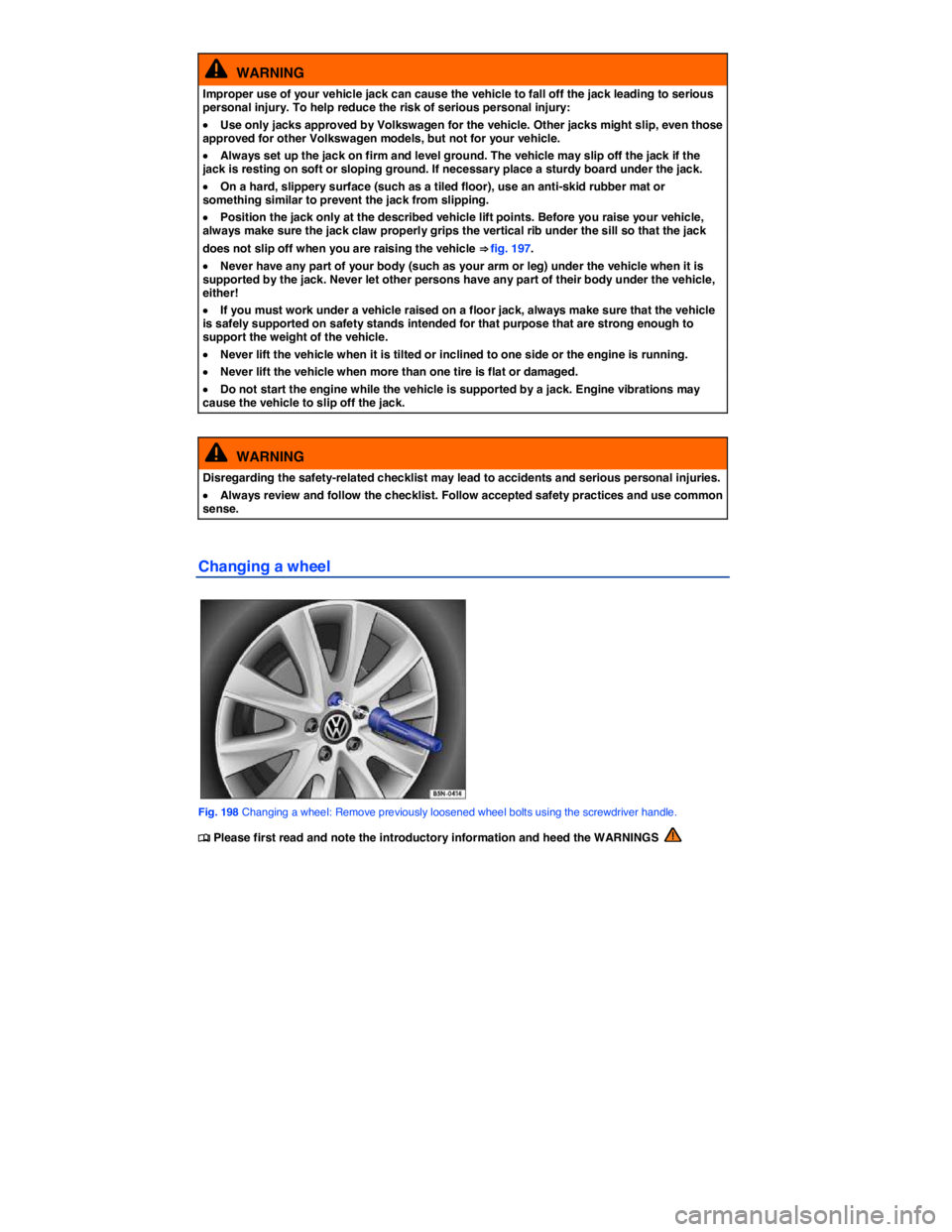
Changing a wheel
Fig. 198 Changing a wheel: Remove previously loosened wheel bolts using the screwdriver handle.