changing tire VOLKSWAGEN TIGUAN 2011 Owners Manual
[x] Cancel search | Manufacturer: VOLKSWAGEN, Model Year: 2011, Model line: TIGUAN, Model: VOLKSWAGEN TIGUAN 2011Pages: 435, PDF Size: 4.23 MB
Page 180 of 435

In most cases, you cannot use wheel bolts from a different vehicle. Even wheel rims from the same model may not fit properly.
Tires and wheel rims approved by Volkswagen have been matched precisely to your vehicle model and contribute considerably to good handling and safe vehicle performance.
Tightening Torque
Wheel bolts must always be installed with the correct tightening torque ⇒ Changing a wheel. The required tightening torque for your vehicle's wheel bolts is 103 ft lbs (140 Nm) for front-wheel drive vehicles and 88 ft lbs (120 Nm) for vehicles with four-wheel drive (4MOTION). After changing a wheel, the bolt torque must be checked as soon as possible with an accurate torque wrench. See an authorized Volkswagen dealer or authorized Volkswagen Service Facility.
Wheel rims with bolted rim rings
Wheel rims with bolted rim rings have several parts. The parts are bolted together with special screws in a special process. This helps to ensure that they will work properly, prevent leaks, run true and safely. Damaged wheel rims must be replaced, and you must never take them apart or try to repair them yourself. Have an authorized Volkswagen dealer or an authorized Volkswagen Service Facility
repair them for you ⇒ .
Wheel rims with bolted decorative covers
Light-alloy wheels may have interchangeable decorative covers attached to the rim with self-locking screws. If you want to replace damaged wheel covers, contact your authorized Volkswagen dealer or
authorized Volkswagen Service Facility ⇒ .
WARNING
Using improper or damaged wheel rims can affect driving safety, cause accidents and severe personal injuries.
x Use only wheel rims approved for the vehicle.
x Regularly check wheel rims for damage and replace them if necessary.
WARNING
Improper loosening and tightening of the bolts on wheel rims with bolted rim rings can cause accidents and severe personal injury.
x Never loosen bolted connections on wheel rims with bolted rim rings.
x Have all work on wheel rims with bolted rim rings performed by an authorized Volkswagen dealer or authorized Volkswagen Service Facility.
New and replacement tires
Page 209 of 435

WARNING
Incorrect calibration can cause the TPMS to give false warnings or to give no warning despite dangerously low tire pressures. Make certain the tire inflation pressure of all tires is correct before calibrating the system.
WARNING
Incorrect tire pressure can cause sudden tire failure, loss of vehicle control and serious personal injury.
x Always check and correct air pressure in all four tires, particularly after changing, exchanging, or repairing tires.
x After that, always make sure that all 4 tires are inflated to the correct tire pressure for the tires installed on the vehicle. Then recalibrate the system so that it can properly monitor the pressure in the tire.
x The Tire Pressure Monitoring System (TPMS) must be recalibrated using the MFI whenever you remove and remount or change any wheel or tire on the vehicle, even if the reinstalled or replacement wheels and tires are identical to those that were removed and even
if the tire pressure does not change ⇒ Resetting and recalibrating the benchmark tire pressure.
x See the tire pressure label ⇒ inflation pressure and the Owner's Literature for recommended cold tire inflation pressure and other important information.
x When replacing tires or wheel rims, always read and heed all of the information and
WARNINGS ⇒ Tires and wheels.
x The Tire Pressure Monitoring System (TPMS) must be recalibrated using the MFI whenever you remove and remount or change any wheel or tire on the vehicle, even if the reinstalled or replacement wheels and tires are identical to those that were removed and even if the tire pressure does not change.
The Tire Pressure Monitoring System (TPMS) stops working if there is an ESC/ABS malfunction.
⇒ Vehicle operation.
After a low tire pressure warning, the vehicle must stand and must not be driven for at least one minute before the new benchmark tire pressures can be stored.
Page 258 of 435

automatically switches off to keep the brake from overheating. As soon as the brake has cooled down, EDL automatically switches on again.
WARNING
Driving fast on icy, slippery, or wet roads can lead to a loss of control and result in serious personal injury for you and your passengers.
x Always adjust your speed and driving style to road, traffic, weather, and visibility conditions. Never let the additional safety that ESC, ABS, BAS, ASR, and EDL can provide tempt you into taking extra risks.
x Braking assistance systems cannot overcome the laws of physics and always prevent loss of vehicle control. Slippery and wet roads are still dangerous even with ESC and the other systems!
x Driving too fast on wet roads can cause the wheels to lose contact with the road and “hydroplane.” A vehicle that has lost road contact cannot be braked, steered, or controlled.
x These systems cannot reduce the risk of accident, for example if you drive too fast for conditions or if you do not keep your distance from the vehicle in front of you.
x Although these systems are very effective and can help you control the vehicle in many difficult situations, always remember that your vehicle handling control is limited by tire traction.
x When accelerating on a slippery surface, for example on ice and snow, depress the accelerator carefully. Even with these systems, the wheels may start to spin, leading to a loss of vehicle control.
WARNING
The effectiveness of ESC can be significantly reduced if other components and systems that affect vehicle dynamics, including but not limited to brakes, tires, and other systems mentioned above, are not properly maintained or functioning.
x Always remember that vehicle alterations or modifications can affect the functioning of the ABS, BAS, ASR, EDL and ESC systems.
x Changing the vehicle suspension or using an unapproved tire/wheel combination can change the way the ABS, BAS, ASR, EDL and ESC systems work and reduce their effectiveness.
x The effectiveness of ESC is also determined by the tires fitted ⇒ Tires and wheels.
All 4 wheels must be equipped with identical tires in order for ESC and ASR to work properly. Differences in the tread circumference of the tires can cause the system to reduce the engine power when it is not expected.
If ABS is not working, ESC, ASR, and EDL will also not work.
You may hear noises when these systems are active.
Page 369 of 435

Changing the vehicle's suspension system can change the way that the airbag system works in a crash. For example, using tire-rim combinations not approved by Volkswagen, lowering the vehicle, changing the stiffness of the suspension, including the springs, suspension struts, shock absorbers etc. can change the forces that are measured by the airbag sensors and sent to the electronic control unit. Some suspension changes can, for example, increase the force levels measured by the airbag sensors and sent to the electronic control unit and make the airbag system deploy in crashes in which it would not deploy if the changes had not been made. Other kinds of changes may reduce the force levels measured by the sensors and prevent the airbag from deploying when it should.
Never install leather upholstery on a vehicle that originally had cloth upholstery. Never install cloth upholstery on a vehicle that originally had leather upholstery. The weight-sensing mat for the Advanced Airbag system will not work properly if different upholstery is installed on the passenger seat than the upholstery originally installed on the vehicle when it was originally manufactured.
WARNING
Changing the vehicle's suspension including use of unapproved tire-rim combinations can change airbag performance and increase the risk of serious personal injury in a crash.
x Never install suspension components that do not have the same performance characteristics as the components originally installed on your vehicle.
x Never use tire-rim combinations that have not been approved by Volkswagen.
WARNING
Leaving the optional safety belt extender attached to the safety belt buckle on the front passenger seat when the safety belt is not being used will prevent the Advanced Airbag System from working properly and can increase the risk of serious personal injury in a collision.
x Leaving the extender attached to the safety belt buckle when the front seat is occupied and the safety belt is not being used will signal to the airbag control unit that the front passenger seat is occupied and that the safety belt is being used. The electronic control unit for the airbag system will then receive incorrect information that will
– cause the safety belt pretensioner to deploy unnecessarily in collisions and
– cause the front passenger airbag to deploy later in collisions in which the front airbag would otherwise be triggered earlier to help protect an unrestrained front seat passenger.
x Always remove the safety belt extender when it is not needed and stow it safely.
x Never use the safety belt extender to secure a child restraint.
WARNING
Items stored between the safety belt buckle and the center console can cause safety belt buckle to send the wrong information to the airbag control unit and prevent the Advanced Airbag System from working properly.
x Always make sure that nothing can interfere with the safety belt buckles and that they are not obstructed.
Page 400 of 435

WARNING
Changing a wheel, especially on the side of the road, can be dangerous. To help reduce the risk of serious personal injury:
x Always stop the vehicle as soon as it is safe to do so. Move the vehicle a safe distance off the road where it is safe to change the wheel.
x Always make sure that all passengers, especially children, are in a safe place outside the vehicle and away from the vehicle and traffic (such as behind a guard rail).
x Turn on the emergency flashers and set up another warning device about 25 yards (25 meters) behind the vehicle to warn approaching traffic.
x Change a wheel by yourself only if you are familiar with the necessary steps. Otherwise, get expert assistance.
x Always switch the engine off, apply the electronic parking brake, and shift the transmission into Park (P) (automatic transmission) or any gear (manual only) to help prevent the vehicle from moving suddenly and slipping off the jack.
x Always make sure that the ground is level and firm. If necessary, place the jack on a large and sturdy board or on a similar ground support.
x Always block the wheel diagonally opposite the wheel being changed with chocks or similar things.
x If you are towing a trailer, always unhitch it from your vehicle before starting to change the wheel. Always apply the trailer brakes firmly and make sure the trailer cannot move unintentionally.
x Always use proper and undamaged tools when changing a wheel.
x Once a wheel is lifted off the ground, having the transmission in Park (P) or in gear will not prevent sudden vehicle movement.
x Always use a jack that has been approved by the manufacturer for your vehicle. Never use other jacks, even if they have been approved for use on other Volkswagen models.
x To reduce the risk of losing control, crashes, and serious personal injuries, never loosen the screws on rims with threaded rim rings.
x After changing a wheel, have the wheel bolt tightening torque checked with an accurate torque wrench.
x After changing a wheel or tire, reset the Tire Pressure Monitoring System (TPMS) ⇒ Tire Pressure Monitoring System (TPMS).
Preparations for changing a wheel
Page 404 of 435
WARNING
Improper use of your vehicle jack can cause the vehicle to fall off the jack leading to serious personal injury. To help reduce the risk of serious personal injury:
x Use only jacks approved by Volkswagen for the vehicle. Other jacks might slip, even those approved for other Volkswagen models, but not for your vehicle.
x Always set up the jack on firm and level ground. The vehicle may slip off the jack if the jack is resting on soft or sloping ground. If necessary place a sturdy board under the jack.
x On a hard, slippery surface (such as a tiled floor), use an anti-skid rubber mat or something similar to prevent the jack from slipping.
x Position the jack only at the described vehicle lift points. Before you raise your vehicle, always make sure the jack claw properly grips the vertical rib under the sill so that the jack
does not slip off when you are raising the vehicle ⇒ fig. 197.
x Never have any part of your body (such as your arm or leg) under the vehicle when it is supported by the jack. Never let other persons have any part of their body under the vehicle, either!
x If you must work under a vehicle raised on a floor jack, always make sure that the vehicle is safely supported on safety stands intended for that purpose that are strong enough to support the weight of the vehicle.
x Never lift the vehicle when it is tilted or inclined to one side or the engine is running.
x Never lift the vehicle when more than one tire is flat or damaged.
x Do not start the engine while the vehicle is supported by a jack. Engine vibrations may cause the vehicle to slip off the jack.
WARNING
Disregarding the safety-related checklist may lead to accidents and serious personal injuries.
x Always review and follow the checklist. Follow accepted safety practices and use common sense.
Changing a wheel
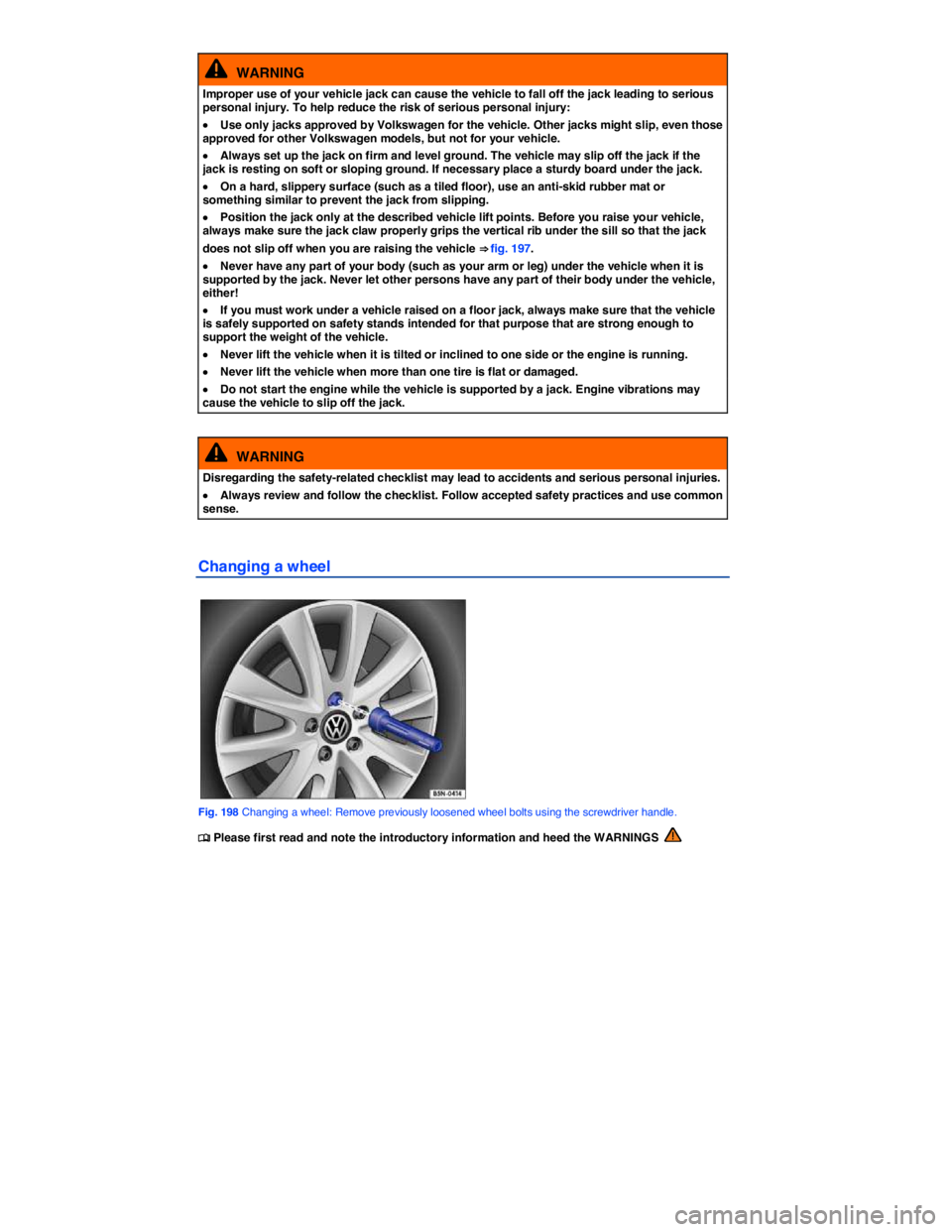
Fig. 198 Changing a wheel: Remove previously loosened wheel bolts using the screwdriver handle.
Page 405 of 435

Removing the wheel
x Review the checklist ⇒ Preparations for changing a wheel.
x Loosen the wheel bolts ⇒ Wheel bolts.
x Lift the vehicle ⇒ Lifting the vehicle with the vehicle jack.
x Completely unscrew and remove the previously loosened wheel bolts using the hexagonal socket
in the screwdriver handle ⇒ fig. 198. Place the wheel bolts on a clean surface.
x Remove the wheel.
Installing a spare tire or a compact spare wheel
If the tire is a unidirectional tire, be sure to install it in the proper rolling direction ⇒ Unidirectional tires.
x Place the spare tire or compact spare into place on the vehicle.
x Screw in all wheel bolts clockwise and tighten them slightly using the hexagonal socket in the screwdriver handle.
x Lower the vehicle with the jack.
x Use the lug wrench to firmly tighten all wheel bolts (turn clockwise) ⇒ . Do not tighten them in sequence! Tighten any wheel bolt to begin, then tighten the wheel bolt diagonally opposite the first bolt, and so forth.
x Install the wheel bolt caps, center wheel hubcap, or wheel cover, if any ⇒ Wheel trim.
WARNING
Wheel bolts that are tightened or installed improperly can come loose, causing loss of vehicle control, a crash, and serious personal injury.
x Always keep wheel bolts and threads in the wheel hub clean and free of oil and grease. The wheel bolts must turn easily and must be tightened with the right torque.
x Use the hexagonal socket in the screwdriver handle only to turn the wheel bolts when they are loose, never to loosen them or tighten them firmly.
WARNING
Improper use of a compact spare wheel can cause loss of vehicle control, a crash or other accident, and serious personal injury.
x Never use a compact spare tire if it is damaged or worn down to the wear indicators.
x Never drive faster than 50 mph (80 km/h) with a compact spare wheel. Avoid full-throttle acceleration, heavy braking, and fast cornering!
x Never drive more than 125 miles (200 km) with a compact spare wheel that is installed on the front axle (drive axle).
x Replace the compact spare with a normal wheel and tire as soon as possible. compact spare wheels are designed for brief use only.
After changing a wheel