display VOLKSWAGEN TIGUAN 2013 1.G User Guide
[x] Cancel search | Manufacturer: VOLKSWAGEN, Model Year: 2013, Model line: TIGUAN, Model: VOLKSWAGEN TIGUAN 2013 1.GPages: 356, PDF Size: 5.65 MB
Page 167 of 356
If the ignition is on but the engine is not running, the vehicle battery will be drained by any device that
is plugged in and turned on. For this reason, never use the electrical sockets unless the engine is
running.
To help prevent damage from voltage fluctuations, switch off all electrical devices connected to a 12
Volt socket before switching the ignition on or off or starting the engine.
The vehicle may have 12 Volt sockets at the following places:
x In the storage compartment or in the front center console.
x In the storage compartment in the front center armrest.
x In the rear center console.
x In the luggage compartment.
Volt socket
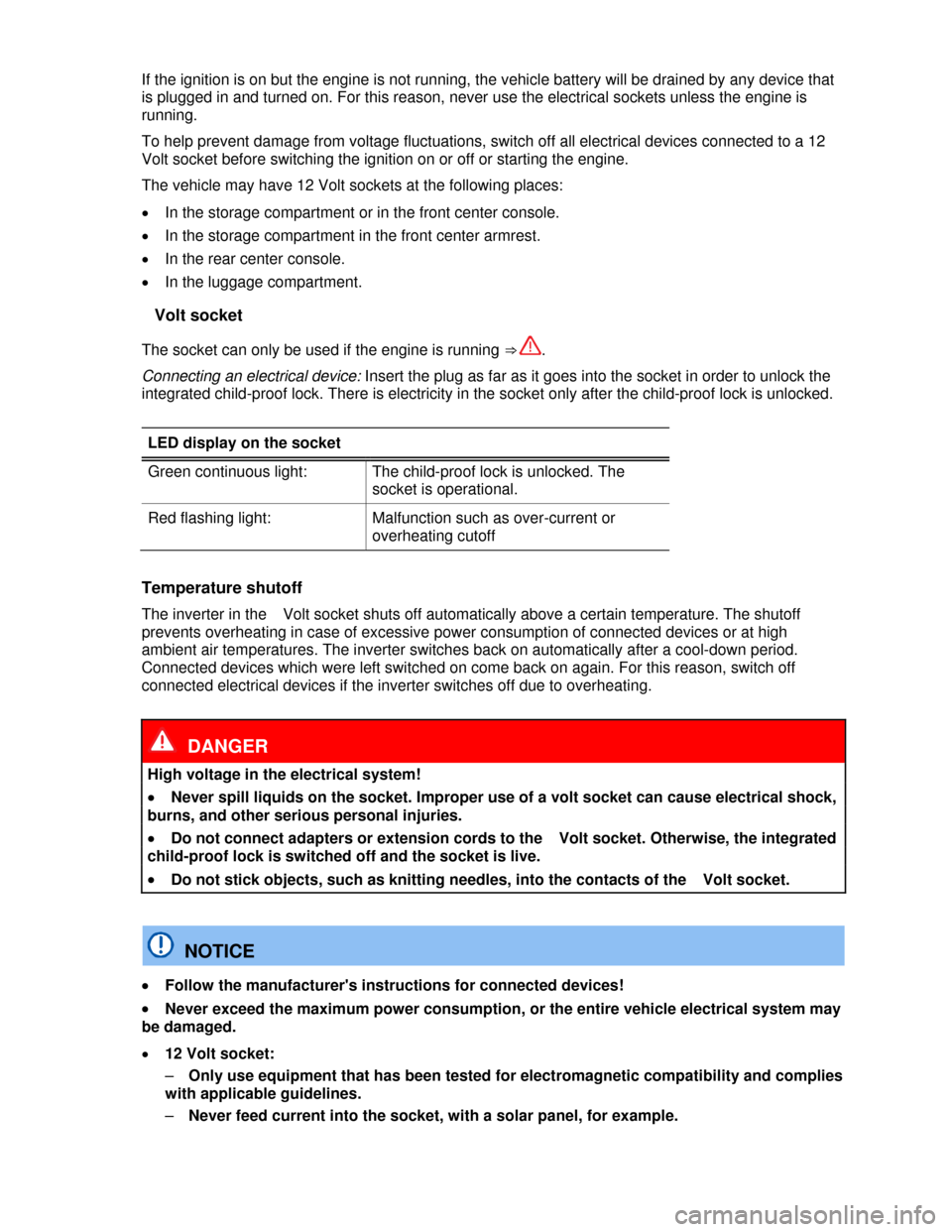
The socket can only be used if the engine is running ⇒ .
Connecting an electrical device: Insert the plug as far as it goes into the socket in order to unlock the
integrated child-proof lock. There is electricity in the socket only after the child-proof lock is unlocked.
LED display on the socket
Green continuous light: The child-proof lock is unlocked. The
socket is operational.
Red flashing light: Malfunction such as over-current or
overheating cutoff
Temperature shutoff
The inverter in the Volt socket shuts off automatically above a certain temperature. The shutoff
prevents overheating in case of excessive power consumption of connected devices or at high
ambient air temperatures. The inverter switches back on automatically after a cool-down period.
Connected devices which were left switched on come back on again. For this reason, switch off
connected electrical devices if the inverter switches off due to overheating.
DANGER
High voltage in the electrical system!
x Never spill liquids on the socket. Improper use of a volt socket can cause electrical shock,
burns, and other serious personal injuries.
x Do not connect adapters or extension cords to the Volt socket. Otherwise, the integrated
child-proof lock is switched off and the socket is live.
x Do not stick objects, such as knitting needles, into the contacts of the Volt socket.
NOTICE
x Follow the manufacturer's instructions for connected devices!
x Never exceed the maximum power consumption, or the entire vehicle electrical system may
be damaged.
x 12 Volt socket:
– Only use equipment that has been tested for electromagnetic compatibility and complies
with applicable guidelines.
– Never feed current into the socket, with a solar panel, for example.
Page 196 of 356
Brakes coated with road salt also react slower and need longer stopping distances. If there is salt on
the roads and you are not braking regularly, brake carefully and gently from time to time to remove any
salt coating from the brake disks and pads ⇒ .
Brake disc corrosion (rust) and dirt buildup on the brake pads are more likely to occur if the vehicle is
not driven much or is driven only for short distances with little braking. If the brakes have not been
used and there is some rust on the discs, clean the brake discs and pads once in a while by carefully
braking a couple of times while driving at relatively high speed to help clean the brake discs and pads.
Make sure nobody is behind you and that you do not endanger yourself or others ⇒ .
Brake system malfunction
If you brake and find that vehicle doesn't brake nearly as well as it used to (sudden increase in
stopping distance), a brake circuit may have failed. The brake warning light BRAKE or h will come on
and a message may appear in the instrument cluster display. If you believe the vehicle is safe to drive,
immediately take it to the nearest authorized Volkswagen dealer or authorized Volkswagen Service
Facility for repair. Drive slowly and very carefully, allow for the longer stopping distance, and be ready
to push longer and harder on the brake pedal to slow the vehicle down.
Brake booster
The brake booster works only when the engine is running. It increases the force on the brakes above
and beyond the pressure put on the brake pedal by the driver.
If the brake booster is not working, or if the vehicle has to be towed, you will have to push the brake
pedal harder to make up for the lack of booster assistance and the resulting longer stopping distance
⇒ .
WARNING
New brake pads do not provide maximum braking performance.
x New brake pads do not have the best stopping power for the first miles ( km) and must
be “broken in”. You can compensate for the slightly reduced braking force by putting more
pressure on the brake pedal.
x Drive with extra care while the new brake pads are being broken in. This reduces the risk
of collisions and serious personal injuries due to a loss of control over the vehicle.
x Never follow other vehicles too closely or put yourself into other situations that might
require sudden, hard braking, especially when the brake pads have not been broken in.
WARNING
Overheated brakes will reduce the vehicle's stopping power and increase stopping distances
considerably.
x When driving downhill, the brakes have to work especially hard and heat up quickly.
x Before driving downhill, especially on hills that are long or steep, always reduce speed
and shift into lower gear (manual or automatic transmission). This will let the vehicle use
engine braking and reduce the load on the brakes. Otherwise, the brake system could
overheat and possibly fail. Only use the brakes when you need them to slow the vehicle down
more or to stop.
x A damaged front spoiler or a nonstandard spoiler can reduce airflow to the brakes and
make them overheat.
Page 216 of 356
WARNING
Rear Assist technology cannot overcome the laws of physics and the limits of the system.
Careless or unintentional use of Rear Assist may result in accidents and severe injuries.
x Always adjust your speed and driving style to road, traffic, weather, and visibility
conditions.
x Always keep an eye on the parking direction and the vehicle surroundings. The front of
the vehicle swings out more than the rear of the vehicle.
x Never pay so much attention to the graphics shown on the screen that you fail to notice
what is going on around you.
x Always watch for people, especially small children, animals and objects, because the
camera may not always be able to detect them.
x The system may not be able to clearly show everything behind the vehicle.
x Use Rear Assist only when the rear hatch is completely closed.
NOTICE
x The camera shows only two-dimensional images on the screen. Due to the lack of depth of
field, it may be difficult or impossible to identify protruding objects or recesses in the road, for
example.
x Things like thin rods, fences, posts and trees may not be detected by the camera and could
damage the vehicle.
Operation
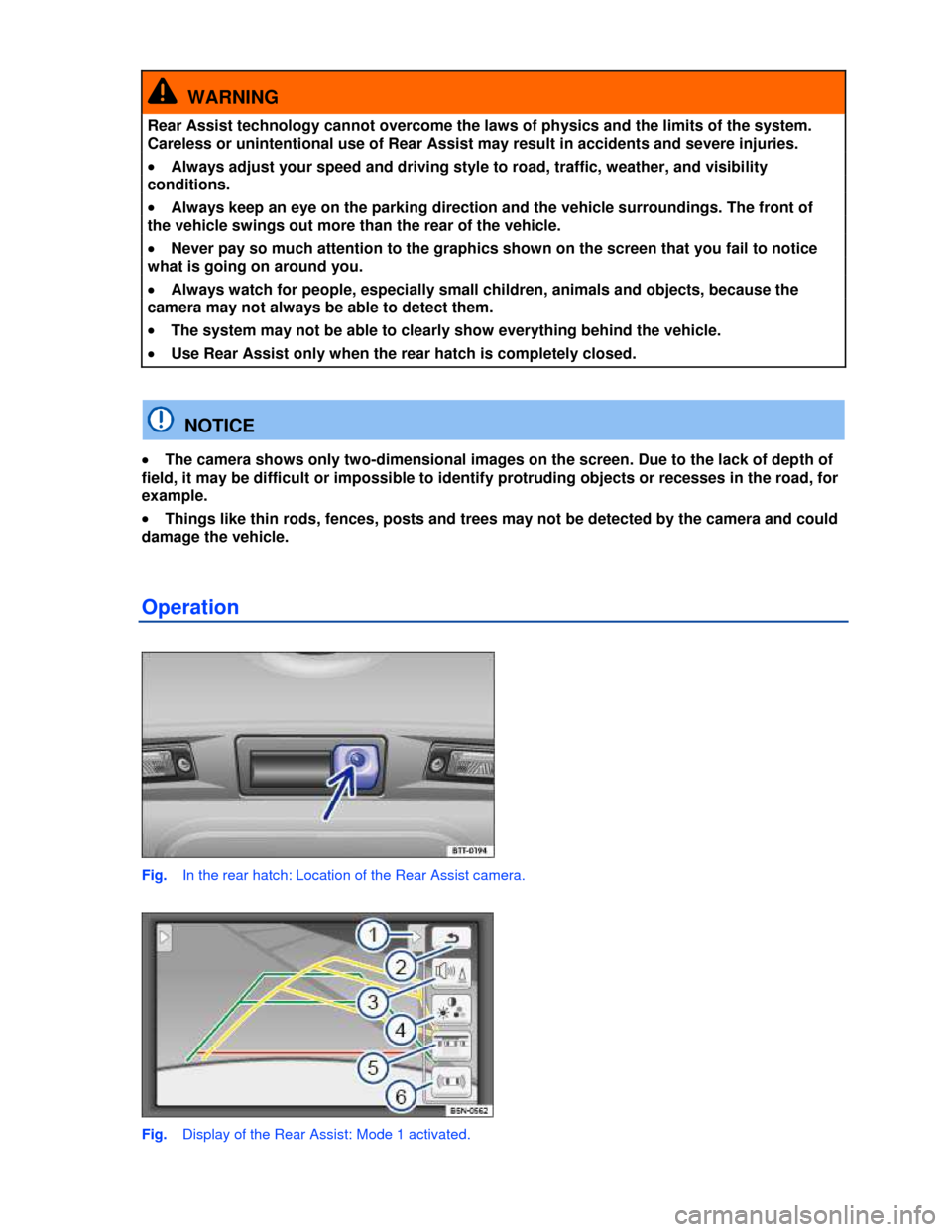
Fig. In the rear hatch: Location of the Rear Assist camera.
Fig. Display of the Rear Assist: Mode 1 activated.
Page 220 of 356

Orientation lines overview
Meaning of the orientation lines and areas projected on screen ⇒ fig. . All distances of the orientation
lines refer to a vehicle on a level surface.
(1) Safety distance: Area up to about 16 inches (40 cm) behind the vehicle on the road.
(2) Vehicle's width limits.
(3) Point to change steering angle.
When the yellow line touches the curb or any other parking space boundary, the steering wheel
must be turned in the opposite direction (close-up view).
(4) The parking area parallel to the vehicle which is needed for parking. The area shown must fit
completely into the parking space.
(5) Parked vehicle at the curb.
Parking
x Position the vehicle about 3 feet (1 meter) away from and parallel to the parking space and shift
into reverse.
x On the screen of the navigation system, activate Mode 2 for parallel parking.
x Back up slowly and steer the vehicle so that the yellow surface on the screen is flush with the side
boundary of the parking space (such as the curb) and stops short of any obstacle (5), such as another
vehicle.
x Turn the steering wheel as far as it will go into the direction of the parking space and slowly back
up.
x Once the yellow line (3) touches the side boundary of the parking space, such as a painted line or
a curb (close-up view), turn the steering wheel as far as it will go in the opposite direction.
x Continue backing up until the vehicles is positioned in the parking space parallel to the roadway. If
necessary, correct the parking position.
It may take up to 5 seconds for the area detected by the sensors to be displayed on the factory-
installed radio or navigation system screen.
Page 223 of 356
Display
Different cruise control versions are available. The stored speed is shown in the instrument cluster
display on some equipment versions.
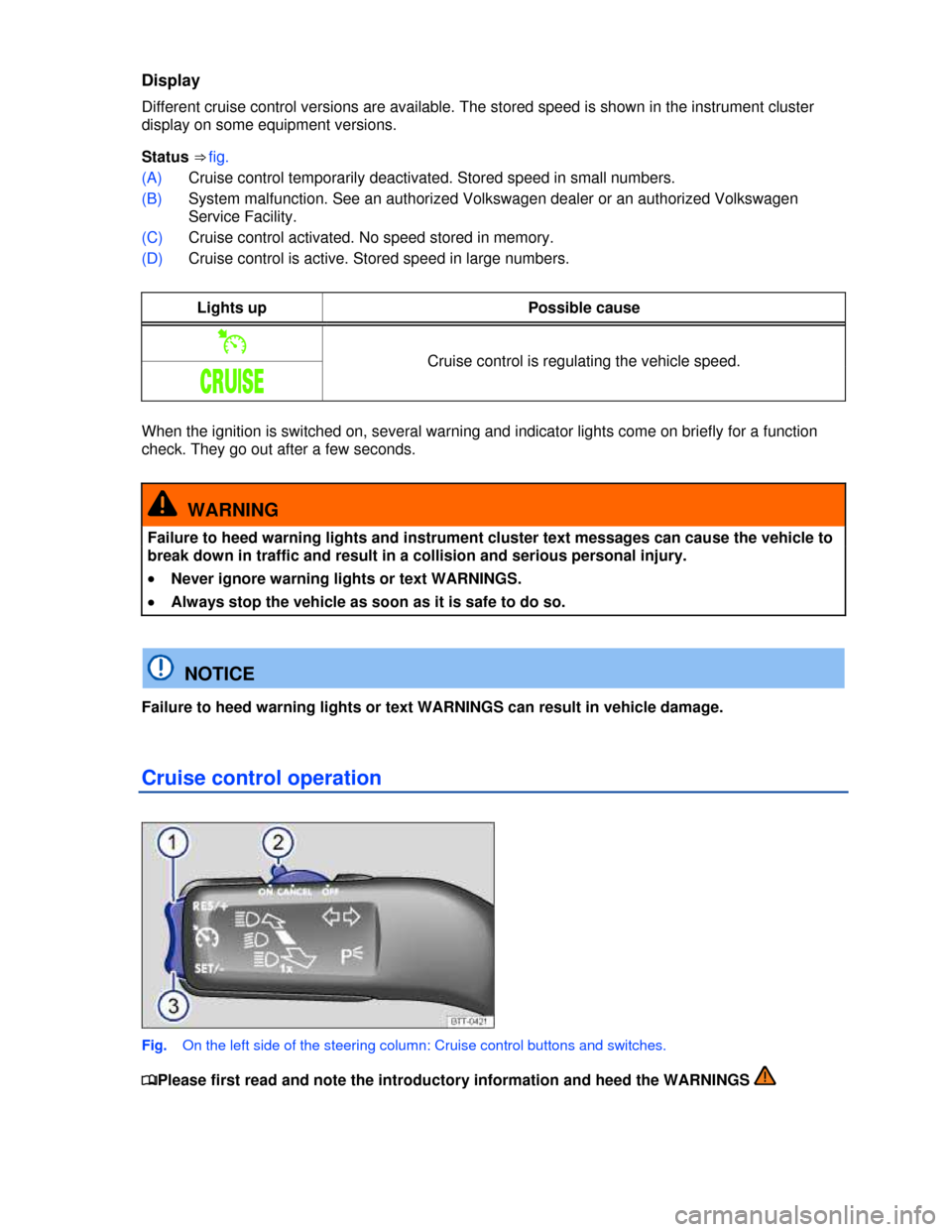
Status ⇒ fig.
(A) Cruise control temporarily deactivated. Stored speed in small numbers.
(B) System malfunction. See an authorized Volkswagen dealer or an authorized Volkswagen
Service Facility.
(C) Cruise control activated. No speed stored in memory.
(D) Cruise control is active. Stored speed in large numbers.
Lights up Possible cause
% Cruise control is regulating the vehicle speed.
#25)3%
When the ignition is switched on, several warning and indicator lights come on briefly for a function
check. They go out after a few seconds.
WARNING
Failure to heed warning lights and instrument cluster text messages can cause the vehicle to
break down in traffic and result in a collision and serious personal injury.
x Never ignore warning lights or text WARNINGS.
x Always stop the vehicle as soon as it is safe to do so.
NOTICE
Failure to heed warning lights or text WARNINGS can result in vehicle damage.
Cruise control operation
Fig. On the left side of the steering column: Cruise control buttons and switches.
Page 237 of 356

Climatronic: Changing the temperature unit on the factory-installed Radio or Radio &
Navigation system display
For vehicles with a Premium instrument cluster: The inside and outside temperatures can be displayed
in either Fahrenheit (F) or Centigrade (C). Select Units
Press the !