maximum VOLKSWAGEN TIGUAN 2013 1.G Owner's Manual
[x] Cancel search | Manufacturer: VOLKSWAGEN, Model Year: 2013, Model line: TIGUAN, Model: VOLKSWAGEN TIGUAN 2013 1.GPages: 356, PDF Size: 5.65 MB
Page 300 of 356

Tire labeling (example) Meaning
E4 ... Labeling according to international regulations (E) including
number of the approving country. The multi-digit approval number
is listed next.
DOT BT RA TY5 9 Tire identification number (TIN6 – in some cases only on one side
of the tire – and the manufacturing date:
DOT The tire complies with the requirements of the United
States Department of Transportation, responsible for
issuing safety standards.
BT Identification letter of the manufacturing site.
RA Manufacturer information regarding tire dimensions.
TY5 Tire characteristics provided by the manufacturer.
9 Manufacturing date: 17th week in 9.
TWI Marks the position of the tread wear indicator
Made in Germany Country of manufacture.
MAX LOAD KG ( 6 LBS) United States maximum load rating per wheel.
MAX INFLATION KPA (51 PSI) United States maximum permissible inflation pressure.
SIDEWALL 1 PLY RAYON Tire ply composition and materials used:
1 layer of rayon.
TREAD 4 PLIES
1 RAYON + 2 STEEL +
1 NYLON
Tire tread composition and materials used:
In this example there are 4 layers under the tread: 1 layer of
rayon, 2 layers of steel belt and 1 layer of nylon.
Consumer information regarding comparison to specified base tires (standardized test
procedure) 313:
TREADWEAR Relative service life expectancy of the tire referenced to a US-
specific standard test.
TRACTION AA Traction rating under wet conditions (AA, A, B or C).
TEMPERATURE A Temperature stability of the tire at increased test bench speeds
(A, B or C).
Additional numbers found on the tire could either be tire manufacturer internal labels or
country-specific labels (e.g. for Brazil and China).
Unidirectional tires
Unidirectional tires are designed to rotate only in one direction. Unidirectional tires have arrows on the
sidewalls that show the direction of rotation. Make sure you mount the tire so that it rotates in the
proper direction. The tire's performance with regard to hydroplaning, traction, noise, and wear is worse
if it is not mounted in the proper direction of rotation.
If you have to mount a tire opposite to its proper direction of rotation, you must drive more carefully,
since the tire is no longer being used as designed. This is particularly important on wet roads. You
must replace or remount the tire as soon as possible in order to restore the correct direction of
rotation.
Load rating code
The load index indicates the maximum permissible load per individual tire in pounds (kilograms).
6 TIN represents the serial number of the tire.
Page 301 of 356

91 6 lbs ( kg)
93 3 lbs ( kg)
95 1 lbs ( kg)
97 9 lbs ( kg)
98 3 lbs ( kg)
99 9 lbs ( kg)
100 3 lbs ( kg)
101 9 Ibs ( kg)
102 4 lbs ( kg)
103 9 lbs ( kg)
104 4 lbs ( kg)
110 7 lbs ( 0 kg)
Speed rating code letter
The speed rating code letter indicates the maximum permissible road speed of the tires.
P up to 93 mph ( km/h)
Q up to 99 mph ( km/h)
R up to mph ( km/h)
S up to mph ( km/h)
T up to mph ( km/h)
U up to mph ( km/h)
H up to mph ( km/h)
V up to mph ( km/h)
Z over mph ( km/h)
W up to mph ( km/h)
Y up to mph ( km/h)
Some tire manufacturers label tires with a maximum permissible road speed above mph ( km/h)
with the letter combination “ZR”.
WARNING
Using incorrect or unmatched tires and/or wheels or improper tire and wheel combinations
can lead to loss of control, collision and serious personal injury.
x Always use tires, wheels and wheel bolts that meet the specifications of the original
factory-installed tires or other combinations that have been specifically approved by the
vehicle manufacturer.
x All 4 wheels must be fitted with radial tires of the same type, the same size (tread
circumference), and the same tread pattern. Driving with different tires reduces vehicle
handling and can lead to a loss of control.
x Never drive faster than the maximum speed for which the tires installed on your vehicle
are rated because tires that are driven faster than their rated speed can fail suddenly.
x Overloading tires can cause heat buildup, sudden tire failure, including a blowout and
sudden deflation and loss of control.
x Temperature grades apply to tires that are properly inflated and not over- or underinflated.
Page 305 of 356

Cracking
Any parting within the tread, sidewall, or inner liner of the tire extending to cord material.
Cold tire inflation pressure
The tire pressure recommended by the vehicle manufacturer for a tire of a specified size that has not
been driven for more than a couple of miles (kilometers) at low speeds in the 3 hour period before the
tire pressure is measured or adjusted.
Curb weight
The weight of a motor vehicle with standard equipment including the maximum capacity of fuel, oil,
and coolant, air conditioner, and additional weight of optional equipment.
Extra load tire
A tire designed to operate at higher loads and at higher inflation pressures than the corresponding
standard tire.
Gross Axle Weight Rating (GAWR)
The load-carrying capacity of a single axle system, measured where the tire contacts the ground.
Gross Vehicle Weight Rating (GVWR)
The maximum loaded weight of the vehicle.
Groove
The space between 2 adjacent tread ribs.
Load rating (code)
The maximum load that a tire is rated to carry for a given inflation pressure. You may not find this
information on all tires because it is not required by law.
Maximum load rating
The load rating for a tire at the maximum permissible inflation pressure for that tire.
Maximum loaded vehicle weight
The total of:
x Curb weight.
x Accessory weight.
x Vehicle capacity weight.
x Production options weight.
Maximum (permissible) inflation pressure
The maximum cold inflation pressure to which a tire may be inflated. Also called “maximum inflation
pressure.”
Normal occupant weight
Means lbs (68 kilograms) times the number of occupants seated in the vehicle up to the total seating
capacity of your vehicle.
Occupant distribution
The placement of passengers in a vehicle.
Outer diameter
The diameter of a new, properly inflated tire.
Page 307 of 356

Section width
The linear distance between the exteriors of the sidewalls of an inflated tire, excluding elevations due
to labeling decoration, or protective bands.
Sidewall
The portion of a tire between the bead and the tread.
Sidewall separation
The parting of the rubber compound from the cord material in the sidewall.
Speed rating (letter code)
A standardized letter code indicating the maximum speed at which a tire is designed to be driven for
extended periods of time. The ratings range from 93 mph or km/h (“P”) to mph or ( km/h) “Y”.
The speed rating letter code, where applicable, is molded on the tire sidewall 297, Speed rating
code letter. You may not find this information on all tires because it is not required by law.
Tire Pressure Monitoring System
A system that detects when at least one of a vehicle's tires is underinflated and illuminates a low tire-
pressure warning light.
Tread
The portion of a tire that normally touches the road.
Tread rib
A tread section running circumferentially around a tire.
Tread separation
Tire failure caused by the tread pulling away from the tire carcass.
Tread wear indicators (TWI)
Raised areas within the main tread grooves that show, visually, when tires are worn and near the end
of their useful life, Tread depth and tread wear indicators.
Uniform Tire Quality Grading (UTQG)
A tire information system developed by the U.S. National Highway Traffic Safety Administration
(NHTSA) that is designed to help buyers compare tires. UTQG is not a safety rating, nor is it a
guarantee that a tire will last for a certain number of miles or perform a certain way. It gives tire buyers
more information to compare with factors such as price, brand loyalty and dealer recommendations.
Under UTQG, tires are graded by the tire manufacturers in 3 areas: tread wear, traction and
temperature resistance. UTQG information is molded into the tire sidewalls.
U.S. DOT Tire Identification Number (TIN)
A tire's serial number. It begins with the letters “DOT” (“Department of Transportation”) and indicates
that the tire meets all federal standards. The next 2 numbers or letters indicate the plant where the tire
was manufactured. The last 4 numbers represent the week and year of manufacture.
For example, the numbers 1 mean that the tire was produced in the 18th week of 1. Any other
numbers are marketing codes used by the tire manufacturer. This information is used to help identify
affected consumers if a tire defect requires a recall.
Vehicle capacity weight
The total rated cargo, luggage and passenger load. Passenger load is lbs (68 kilograms) times the
vehicle's total seating capacity (as listed on the label inside the driver door).
Page 308 of 356
Vehicle maximum load on the tire
The load on an individual tire that is determined by taking each axle's share of the maximum loaded
vehicle weight (GAWR) and dividing by 2.
Vehicle normal load on the tire
The load on an individual tire that is determined by taking each axle's share of the curb weight,
accessory weight, and normal occupant weight (distributed according to the table below) and dividing
by 2.
Wheel size designation
Wheel rim diameter and width.
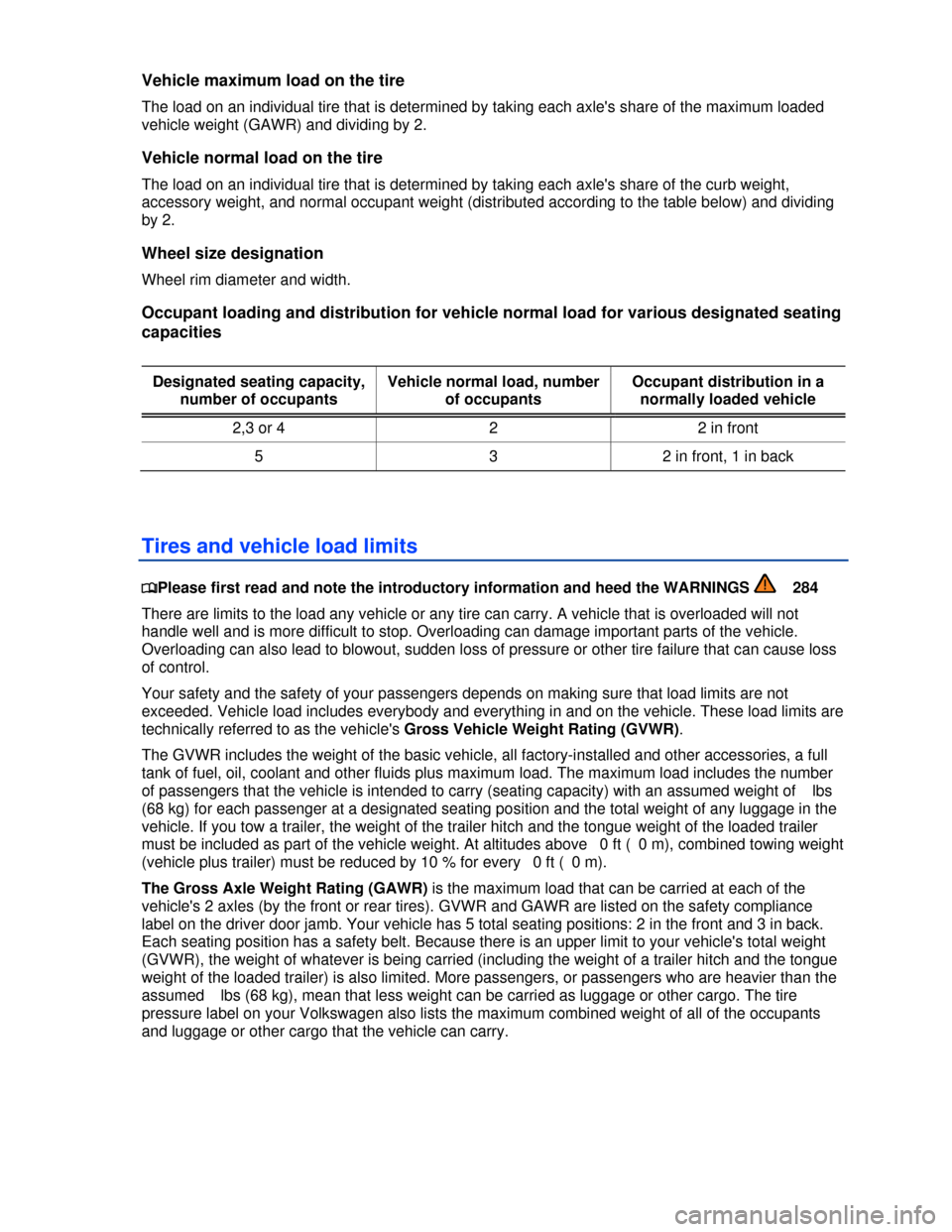
Occupant loading and distribution for vehicle normal load for various designated seating
capacities
Designated seating capacity,
number of occupants
Vehicle normal load, number
of occupants
Occupant distribution in a
normally loaded vehicle
2,3 or 4 2 2 in front
5 3 2 in front, 1 in back
Tires and vehicle load limits