handle VOLKSWAGEN TIGUAN 2014 1.G User Guide
[x] Cancel search | Manufacturer: VOLKSWAGEN, Model Year: 2014, Model line: TIGUAN, Model: VOLKSWAGEN TIGUAN 2014 1.GPages: 418, PDF Size: 6.1 MB
Page 131 of 418

WARNING
Heavy loads will influence the way your vehicle handles and increase stopping distances. Heavy loads that are not properly stowed or secured can cause loss of control and serious injury.
x Secure the load properly to keep it from shifting.
x Always remember when transporting heavy objects that a change in the center of gravity also changes the way your vehicle handles:
– Always distribute the load as evenly as possible.
– Secure heavy objects properly as far forward in the luggage compartment as possible.
– Always tie down heavy items securely with suitable straps using the tie-downs in the luggage compartment.
– Securely latch the rear seat backrest in the upright position.
x Never exceed the Gross Axle Weight Rating or the Gross Vehicle Weight Rating on the safety compliance sticker on the left door jamb. Exceeding permissible weight can cause the vehicle to skid and handle differently.
x Always adapt your speed and driving to the heavier load and the weight distribution in the vehicle. Take road, weather, traffic, and visibility conditions into account as well.
x Always accelerate gently and avoid sudden braking and driving maneuvers.
x Always brake earlier than you would if you were not driving a loaded vehicle.
Stowing luggage
Page 144 of 418
WARNING
Elastic straps have to be stretched when being attached to the tie-downs in the luggage compartment Hooks on elastic straps can cause serious personal injury if not handled properly and attached securely.
x Always protect eyes and face from injury from the hooks when attaching them to the vehicle and do not let them snap back and hit you.
x Always hold the hooks on elastic straps firmly when attaching to the vehicle and do not let them snap back and hit you.
x First attach hooks on the straps to the tie-downs at the rear seat backrest in the luggage compartment and then to the tie-downs near the loading edge of the luggage compartment. This way, if one of the hooks on the elastic straps snaps back, it will move away from you, decreasing the risk of personal injury.
The maximum load for the tie-downs is about 785 lbs. (356 kg).
For suitable ratchet straps and luggage stowage systems, please see an authorized Volkswagen dealer or authorized Volkswagen Service Facility.
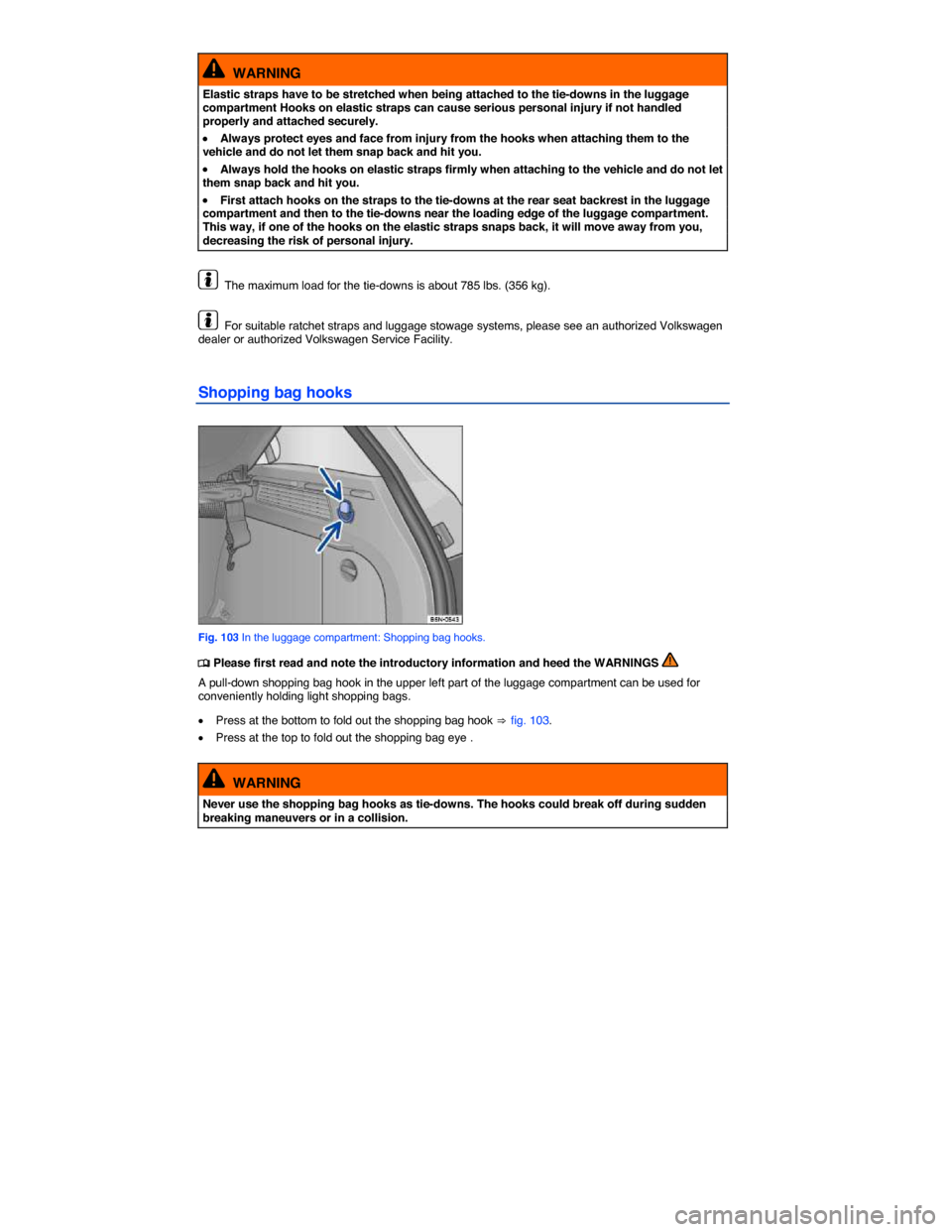
Shopping bag hooks
Fig. 103 In the luggage compartment: Shopping bag hooks.
Page 146 of 418
WARNING
The elastic luggage net has to be stretched when being attached to the tie-downs in the luggage compartment. The hooks can cause serious personal injury if not handled properly and attached securely.
x Always hold the hooks on the luggage net bag firmly when attaching to the vehicle and do not let them spring back and hit you.
x Always protect eyes and face from injury from the metal hooks when attaching them to the tie-downs in the luggage compartment.
x First attach the luggage net bag hooks to the tie-downs on the rear seat backrest or on the shopping bag hooks in the luggage compartment and then to the tie-downs near the loading edge of the luggage compartment. If one of the hooks on the luggage bag net snaps back, it will move away from you and not towards you, increasing the risk of injury.
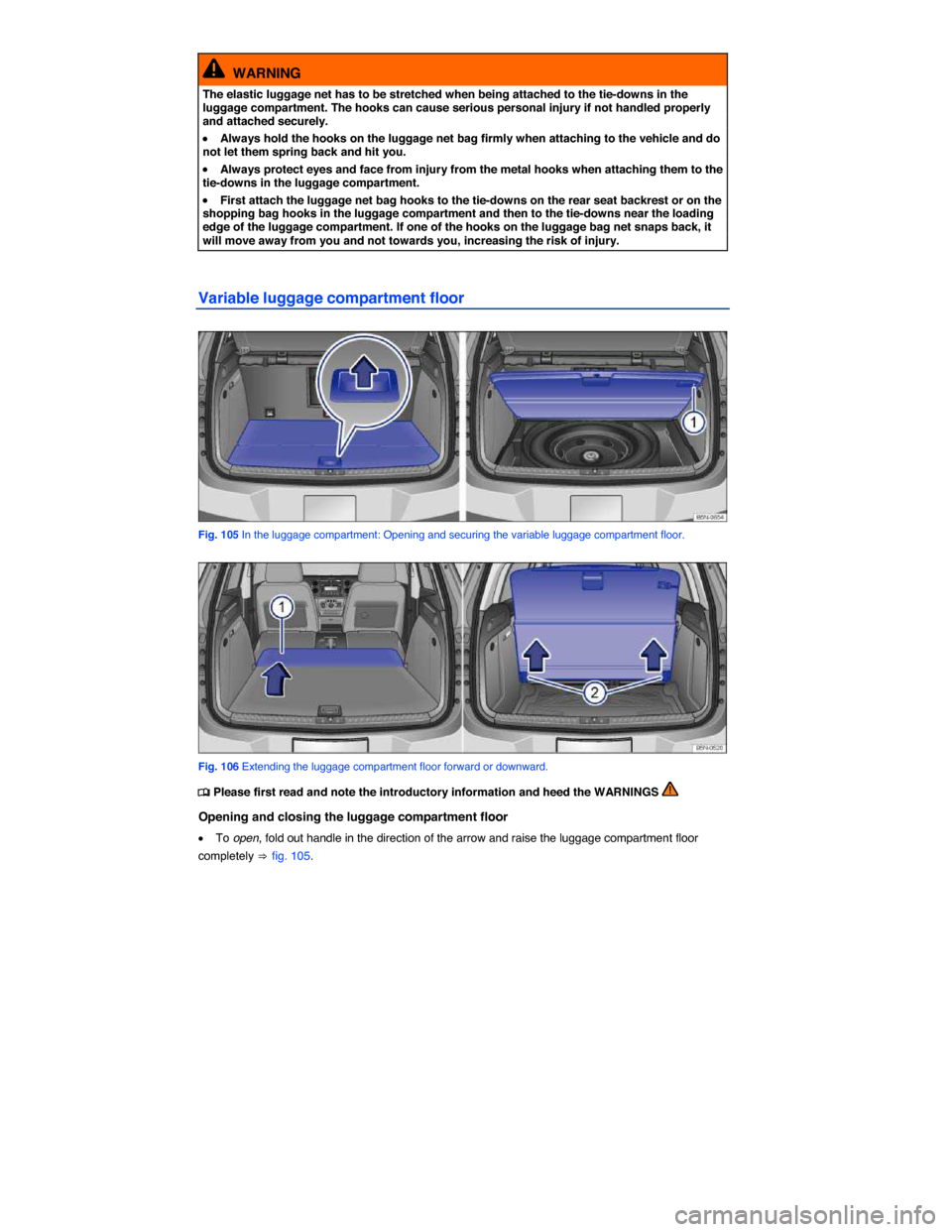
Variable luggage compartment floor
Fig. 105 In the luggage compartment: Opening and securing the variable luggage compartment floor.
Fig. 106 Extending the luggage compartment floor forward or downward.
Page 153 of 418

WARNING
Improper use of the trailer hitch can cause accidents and injuries. An improperly installed, incorrect, or damaged trailer hitch can cause the trailer to separate from the towing vehicle and cause serious personal injuries.
x Only use an undamaged, properly mounted trailer hitch.
x Never repair or modify the trailer hitch.
x To reduce the risk of injury in rear-end collisions, and the risk to pedestrians and cyclists when the vehicle is parked, always remove the ball mount when you are not towing a trailer.
x Never install a “weight distributing” or “load equalizing” trailer hitch on your vehicle. The vehicle was not designed for these kinds of trailer hitches. The trailer hitch attachment can fail, causing the trailer to tear loose from the vehicle.
WARNING
Improper trailer towing can cause loss of vehicle control and serious personal injury.
x Driving with a trailer and carrying heavy or large things can change the way the vehicle handles, increase the distance it needs to stop safely, and cause accidents.
x Always secure the load properly with suitable and undamaged straps so that the load will not shift.
x Always adapt your speed and driving to the heavier load and the weight distribution in the vehicle. Take road, weather, traffic, and visibility conditions into account as well.
x Reduce your speed even more than you otherwise would when going downhill and under unfavorable load, weather, or wind conditions.
x Trailers with a high center of gravity tip more easily than trailers with a low center of gravity.
x Always avoid sudden maneuvers and hard braking.
x Be especially careful when passing other vehicles.
x Reduce speed immediately if the trailer shows the slightest sign of swaying.
x Never try to stop the swaying by accelerating.
x Always obey speed limits. In some areas, the speed limits for vehicles towing trailers are lower than for vehicles without trailers. Never drive faster than 50 mph (80 km/h; under exceptional circumstances 60 mph - 100 km/h) when towing a trailer. This applies even if the local speed limit is higher.
If you are driving a new vehicle or a vehicle with a new or rebuilt engine, do not tow a trailer during the break-in period, about 600 miles (1000 km)
If you tow a trailer, your vehicle may need maintenance more often because of the extra load it has to move.
When you are not towing, remove the trailer hitch ball. This helps keep the trailer hitch from causing damage to your vehicle and to others if your vehicle is hit from behind.
Some models need a trailer hitch to tow or tow-start other vehicles. You may want to always carry the ball mount in the vehicle after it has been removed. Be sure to stow it securely.
Page 157 of 418

This vehicle has not been designed to tow a Class II trailer and must never be retrofitted to tow a Class II trailer. Always make sure that your vehicle has been designed to tow the trailer you want to use and that it is legal to tow the trailer where you will be driving.
Loading the trailer
The weight distribution in the vehicle and trailer must be balanced. Use the maximum permissible tongue weight and make sure that the load in the trailer is evenly distributed and that it is not front-heavy or tail-heavy:
x Distribute the load in the trailer so that heavy objects are directly above the axle or as close as possible to the axle.
x Secure loads properly on the trailer.
Tire pressure
Always follow the trailer manufacturer's tire pressure recommendations for the trailer tires.
When towing, inflate the towing vehicle's tires to the maximum permissible pressure listed on the tire
pressure label ⇒ Tires and wheels.
WARNING
Exceeding the gross weight ratings for axle, tongue, vehicle, trailer or combined weight can cause accidents and serious personal injury.
x Never exceed the specified values.
x Never let the actual weights at the front and rear axles exceed the Gross Axle Weight Rating. Never let the combined front and rear weights exceed the Gross Vehicle Weight Rating.
WARNING
Trailer loads that are not properly secured can shift when the vehicle is moving or braking and suddenly change the way the vehicle handles, causing accidents and severe injuries.
x Always load the trailer properly.
x Always secure the load properly with suitable, undamaged straps that can be tightened so that the load cannot shift.
Driving with a trailer
Page 158 of 418

x Before driving downhill, especially on hills that are long or steep, shift into a lower gear (manual or automatic transmission) so that the engine helps to brake the vehicle. Otherwise, the brake system could overheat and might fail.
x The vehicle's center of gravity and, in turn, the vehicle's handling, will change because of the trailer load and the increased combined towing weight of the vehicle and trailer.
x Weight distribution is especially bad if the towing vehicle is empty and the trailer is loaded. If you absolutely must drive with this combination, drive with extra care and at a reduced speed.
Starting off with a trailer on hills
Depending on how steep the hill is and the combined towing weight, a parked vehicle with trailer can roll backwards when you first start moving.
When starting off with a trailer on a hill:
x Depress and hold the brake pedal (and depress and hold the clutch - manual transmission).
x Shift into first gear or drive position (D) ⇒ Braking and parking.
x Press the G button once to deactivate the electronic parking brake ⇒ Braking and parking.
x Pull and hold the G button to hold the vehicle and trailer with the electronic parking brake
⇒ Braking and parking.
x At the same time, release the brake pedal and gradually depress the accelerator and, for manual transmission, let out the clutch until you can feel the car moving forward. Do not release the G button until the engine starts to move the vehicle forward. If your vehicle has an automatic transmission, you can also depress and hold the brake pedal for added braking and then let up on the brake pedal when you feel that the vehicle “wants” to move forward.
x Drive ahead slowly.
WARNING
Improper trailer towing can cause loss of vehicle control and serious personal injury.
x Driving with a trailer and carrying heavy or bulky items changes the way the vehicle handles and increases the distance it needs to stop safely.
x Always watch what is happening up ahead and around you. Brake earlier than you would if you were not towing a trailer.
x Always adapt your speed and driving to the heavier load and the weight distribution in the vehicle. Take road, weather, traffic, and visibility conditions into account as well.
x Reduce your speed even more than you otherwise would when going downhill and under unfavorable load, weather, or wind conditions.
x Drive especially carefully and accelerate gently. Always avoid sudden maneuvers and hard braking.
x Be especially careful when passing other vehicles.
x Reduce speed immediately if the trailer shows even the slightest sign of swaying.
x Never try to stop the swaying by accelerating.
x Always obey speed limits. In some areas speed limits for vehicles towing trailers are lower than for vehicles without trailers.
Page 171 of 418

WARNING
Incorrect tire pressure can cause a sudden tire failure or blowout, loss of control, collision, serious personal injury, and even death.
x Always inflate tires to the recommended and correct cold tire pressure before driving off.
x Low tire pressure can cause tires to get too hot, resulting in tread separation, sudden loss of pressure, and blowouts. Tires with excessively low pressure flex (bend) more, which can cause the tire to overheat and fail suddenly without warning.
x Excessive speed and/or overloading can cause heat buildup, sudden tire failure including a blowout and sudden deflation and loss of control.
x If the tire pressure is too low or too high, the tires will wear prematurely and the vehicle will not handle well.
x Regularly check tire inflation pressure, at least once a month, and also especially before a long trip.
x Check the pressure in all four tires when the tires are still cold. Never reduce air pressure in warm tires to match cold tire inflation pressure.
NOTICE
x Make sure not to jam the tire pressure gauge into the valve stem. Otherwise you can damage the tire valves.
x Driving without valve caps, with the wrong valve caps, or with valve caps that are not properly screwed on can damage the tire valves and the sensors on the Tire Pressure Monitoring System. To help prevent damage, always use valve stem caps like those originally installed at the factory. The caps must be screwed on tightly. Do not use metal valve caps or “comfort” valve stem caps.
Underinflation increases fuel consumption.
Pressures measured with a gauge when inflating the tires may be different from the pressures read by the tire pressure sensors. The electronic TPMS is more accurate.
When the TPMS warns that the pressure in at least one tire is too low, check the tire pressure in all 4 tires with an accurate tire pressure gauge. Low tire pressure usually cannot be spotted by looking
at the tire. This is especially true for low-profile tires. When checking the tire pressures, refer to ⇒ Tire Pressure Monitoring System (TPMS).
Tire inflation pressure in cold tires
Page 192 of 418

WARNING
Incorrect tire pressures and/or underinflation can cause sudden tire failure, loss of control, collision, serious personal injury or even death.
x When the warning symbol appears in the instrument cluster, stop and inspect the tires.
x Incorrect tire pressure and/or underinflation can cause increased tire wear and can affect the handling of the vehicle and stopping ability.
x Incorrect tire pressures and/or underinflation can also lead to sudden tire failure, including a blowout and sudden deflation, causing loss of vehicle control.
x The driver is responsible for the correct tire pressures for all tires on the vehicle. The recommended tire pressure values are listed on a sticker inside the driver door 170.
x The TPMS can only work correctly when all tires on the vehicle are filled to the correct cold tire inflation pressure.
x Using incorrect tire pressure values can cause accidents or other damage. Always inflate the tires to the correct specified cold tire pressure values for the tires installed on the vehicle.
x Always maintain correct cold tire inflation pressure so that TPMS can do its job.
x Always inflate tires to the recommended and correct tire pressure before driving off.
x Driving with underinflated tires causes them to flex (bend) more, letting them get too hot, resulting in tread separation, sudden tire failure, and loss of control.
x Excessive speed and/overloading can cause heat buildup, sudden tire failure and loss of control.
x If the tire pressure is too low or too high, the tires will wear prematurely and the vehicle will not handle well.
x If the tire is not “flat” and you do not have to change a wheel immediately, drive carefully and at reduced speed to the nearest service station to check the tire pressure and add air as required.
x When replacing tires or wheel rims on vehicles equipped with TPMS always read and heed the information and all WARNINGS regarding Tires and wheels
x The Tire Pressure Monitoring System must be recalibrated using the MFI whenever you remove and remount or change any wheel or tire on the vehicle, even if the reinstalled or replacement wheels and tires are identical to those that were removed and even if the tire pressure does not change
WARNING
Improper use of the MFI reset function can cause the TPMS to give false warnings or to give no warning despite dangerously low tire pressure
Underinflation increases fuel consumption and tire wear.
Do not rely solely on the Tire Pressure Monitoring System. Check your tires regularly to make sure they are properly inflated and have no signs of damage, such as punctures, cuts, cracks, and blisters. Remove any objects that become embedded in the tire tread but have not penetrated into the body of tire itself.
When you take delivery of the vehicle, the Tire Pressure Monitoring System is calibrated for the factory-recommended cold tire inflation pressure for the tires on your vehicle, as shown on the label inside the driver door
x The system must be recalibrated in the appropriate menu in the MFI whenever you remove and remount or change any wheel or tire on the vehicle, even if the reinstalled or replacement wheels and
Page 285 of 418

d Check the vehicle tool kit. Add tools and other gear based on the special requirements of the trip you will be taking
d Stow luggage as low and flat as possible in the vehicle. Safely secure all loose objects.
Before driving off-road the first time
Before you drive your vehicle off-road, we urge you to take an appropriate off-road driving course. Taking a course is especially important if you have little or no experience driving off-road. Even more experienced off-roaders can benefit from an off-road driving course.
A good course can show you how to handle the vehicle in a wide range of off-road situations and how to more safely deal with difficult terrain Driving off-road demands a different attitude and very different skills compared with highway driving. Your safety and that of your passengers will depend on your
knowledge, skill, and caution as a driver ⇒ .
WARNING
Disregarding the safety-related checklist may lead to accidents and serious personal injuries.
x Always review and follow the checklist above. Follow commonly accepted safety practices and use common sense.
x All occupants must sit properly and wear safety belts whenever the vehicle is moving.
General rules and good driving practices
Page 287 of 418

be lower on hard, firm surfaces if ideal conditions do not exist. As the driver, you are always
responsible for deciding whether your vehicle is able to handle a particular situation ⇒ .
Term Explanation Technical data
Ground clearance This is the vertical distance between the level ground and the lowest part on the vehicle.
Maximum 7.6 in (195 mm).
Gradient angle The number of feet (meters) in altitude gained when traveling 100 ft (30.48 m) is given as a percentage or in degrees
⇒ fig. 159 A. Information on the maximum slope the vehicle can climb unassisted (depends on road surface and engine power).
Maximum permissible 31 degrees (corresponds to 60 %).
Lateral angle (vehicle slope) The maximum angle the vehicle may be driven across terrain without the vehicle rolling over (depends on height of center of gravity) B.
Maximum permissible 27 degrees.
Breakover angle Maximum permitted angle given in degrees that a vehicle driven at low speed can clear a ramp without the underbody of the vehicle scraping the ramp.
Maximum 21.3 degrees.
Approach/departure angle Transition from horizontal plane to a slope, or from a slope to flat ground. Maximum angle in degrees the vehicle can be driven at low speed along an embankment without the bumper or underbody scraping.
Approach angle for off-road front end: Maximum 28 degrees.
Departure angle: Maximum 25 degrees.
Fall line This is the vertical drop route.
Articulation Articulation capability of the vehicle while driving on one side over an object.
WARNING
Never exceed the recommended maximum values in the above table. Exceeding these values will result in serious personal injury and/or damage to your vehicle.
x All values listed above are for ideal conditions and assume firm, even surfaces that are dry and not slippery.
x Off-road conditions will always be less than ideal. Always reduce the maximum values listed in the table above to allow an adequate margin of safety between the ideal maximum value and your vehicle's actual off-road situation.