TPMS VOLKSWAGEN TIGUAN 2015 Owner´s Manual
[x] Cancel search | Manufacturer: VOLKSWAGEN, Model Year: 2015, Model line: TIGUAN, Model: VOLKSWAGEN TIGUAN 2015Pages: 435, PDF Size: 6.19 MB
Page 208 of 435

Each tire, including the spare (if provided), should be checked monthly when cold and inflated to the inflation pressure recommended by the vehicle manufacturer on the vehicle placard or tire inflation pressure label. (If your vehicle has tires of a different size than the size indicated on the vehicle placard or tire inflation pressure label, you should determine the proper tire inflation pressure for those tires.)
As an added safety feature, your vehicle has been equipped with a Tire Pressure Monitoring System (TPMS) that illuminates a low tire pressure telltale when one or more of your tires is significantly underinflated. Accordingly, when the low tire pressure telltale illuminates, you should stop and check your tires as soon as possible, and inflate them to the proper pressure. Driving on a significantly underinflated tire causes the tire to overheat and can lead to tire failure. Under inflation also reduces fuel efficiency and tire tread life, and may affect the vehicle's handling and stopping ability.
Please note that the TPMS is not a substitute for proper tire maintenance, and it is the driver's responsibility to maintain correct tire pressure, even if underinflation has not reached the level to trigger illumination of the TPMS low tire pressure telltale.
Your vehicle has also been equipped with a TPMS malfunction indicator to indicate when the system is not operating properly. The TPMS malfunction indicator is combined with the low tire pressure telltale. When the system detects a malfunction, the telltale will flash for approximately one minute and then remain continuously illuminated. This sequence will continue upon subsequent vehicle start-ups as long as the malfunction exists.
When the malfunction indicator is illuminated, the system may not be able to detect or signal low tire pressure as intended. TPMS malfunctions may occur for a variety of reasons, including the installation of replacement or alternate tires or wheels on the vehicle that prevent the TPMS from functioning properly. Always check the TPMS malfunction telltale after replacing one or more tires or wheels on your vehicle to ensure that the replacement or alternate tires and wheels allow the TPMS to continue to function properly.
Resetting and recalibrating the benchmark tire pressure
Resetting the tire pressures in the Multi-function Indicator (MFI) resets the benchmark tire pressure used by the TPMS to the current tire pressure in the tires based on the circumference of the tires.
To reset the reference tire pressure, switch on the ignition. In the MFI, navigate to the Settings menu and select Tire pressure. Store and confirm the new tire pressures.
The re-calibration must be performed each time the tire pressure in one or more tires has been adjusted or after one or more tires has been changed, exchanged, or repaired. The new tire pressures are stored in the system only after at least 20 minutes of normal driving.
If you have reset the benchmark tire pressure when your tires do not have the correct tire pressure, this will prevent the TPMS from working properly. It may then give false warnings or may not give any warning even if the tire pressure is too low.
For this reason, it is vital to make certain that all four tires are inflated to the correct pressure when they are cold, before calibrating the system. Cold tire tires are tires that have not been driven more than a couple of miles (kilometers) at low speed within the last 3 hours.
Recalibrate the system to reset the benchmark TPMS pressure in the following situations:
x After installing tires on your vehicle that have recommended cold tire inflation pressures that are different from the tires that were taken off.
x After any tire on your vehicle is removed and then remounted, even if the same tire and wheel rim that were taken off are reinstalled (for instance, after repair).
x After any tire on your vehicle is changed and replaced by another tire, even if the replacement tire is the same type and is inflated to the same pressure as the tire it replaced.
x After adjusting the tire pressure of any tire on the vehicle to its correct cold tire inflation pressure, either by putting air in one or more tires or by letting air out. Do this even though air was only added (or let out) to bring the tire to the inflation pressure it should have had all along.
x After rotating the front and rear wheels
x After mounting the compact spare wheel.
Page 209 of 435

WARNING
Incorrect calibration can cause the TPMS to give false warnings or to give no warning despite dangerously low tire pressures. Make certain the tire inflation pressure of all tires is correct before calibrating the system.
WARNING
Incorrect tire pressure can cause sudden tire failure, loss of vehicle control and serious personal injury.
x Always check and correct air pressure in all four tires, particularly after changing, exchanging, or repairing tires.
x After that, always make sure that all 4 tires are inflated to the correct tire pressure for the tires installed on the vehicle. Then recalibrate the system so that it can properly monitor the pressure in the tire.
x The Tire Pressure Monitoring System (TPMS) must be recalibrated using the MFI whenever you remove and remount or change any wheel or tire on the vehicle, even if the reinstalled or replacement wheels and tires are identical to those that were removed and even
if the tire pressure does not change ⇒ Resetting and recalibrating the benchmark tire pressure.
x See the tire pressure label ⇒ inflation pressure and the Owner's Literature for recommended cold tire inflation pressure and other important information.
x When replacing tires or wheel rims, always read and heed all of the information and
WARNINGS ⇒ Tires and wheels.
x The Tire Pressure Monitoring System (TPMS) must be recalibrated using the MFI whenever you remove and remount or change any wheel or tire on the vehicle, even if the reinstalled or replacement wheels and tires are identical to those that were removed and even if the tire pressure does not change.
The Tire Pressure Monitoring System (TPMS) stops working if there is an ESC/ABS malfunction.
⇒ Vehicle operation.
After a low tire pressure warning, the vehicle must stand and must not be driven for at least one minute before the new benchmark tire pressures can be stored.
Page 400 of 435

WARNING
Changing a wheel, especially on the side of the road, can be dangerous. To help reduce the risk of serious personal injury:
x Always stop the vehicle as soon as it is safe to do so. Move the vehicle a safe distance off the road where it is safe to change the wheel.
x Always make sure that all passengers, especially children, are in a safe place outside the vehicle and away from the vehicle and traffic (such as behind a guard rail).
x Turn on the emergency flashers and set up another warning device about 25 yards (25 meters) behind the vehicle to warn approaching traffic.
x Change a wheel by yourself only if you are familiar with the necessary steps. Otherwise, get expert assistance.
x Always switch the engine off, apply the electronic parking brake, and shift the transmission into Park (P) (automatic transmission) or any gear (manual only) to help prevent the vehicle from moving suddenly and slipping off the jack.
x Always make sure that the ground is level and firm. If necessary, place the jack on a large and sturdy board or on a similar ground support.
x Always block the wheel diagonally opposite the wheel being changed with chocks or similar things.
x If you are towing a trailer, always unhitch it from your vehicle before starting to change the wheel. Always apply the trailer brakes firmly and make sure the trailer cannot move unintentionally.
x Always use proper and undamaged tools when changing a wheel.
x Once a wheel is lifted off the ground, having the transmission in Park (P) or in gear will not prevent sudden vehicle movement.
x Always use a jack that has been approved by the manufacturer for your vehicle. Never use other jacks, even if they have been approved for use on other Volkswagen models.
x To reduce the risk of losing control, crashes, and serious personal injuries, never loosen the screws on rims with threaded rim rings.
x After changing a wheel, have the wheel bolt tightening torque checked with an accurate torque wrench.
x After changing a wheel or tire, reset the Tire Pressure Monitoring System (TPMS) ⇒ Tire Pressure Monitoring System (TPMS).
Preparations for changing a wheel
Page 406 of 435
x Securely store the compact spare wheel or the wheel you took off the vehicle in the luggage compartment.
x Have the wheel bolt tightening torque immediately checked with a torque wrench ⇒ Wheel bolts.
x Have the damaged wheel replaced as soon as possible.
The Tire Pressure Monitoring System (TPMS) must be “recalibrated” after each tire change ⇒ Tire Pressure Monitoring System (TPMS).
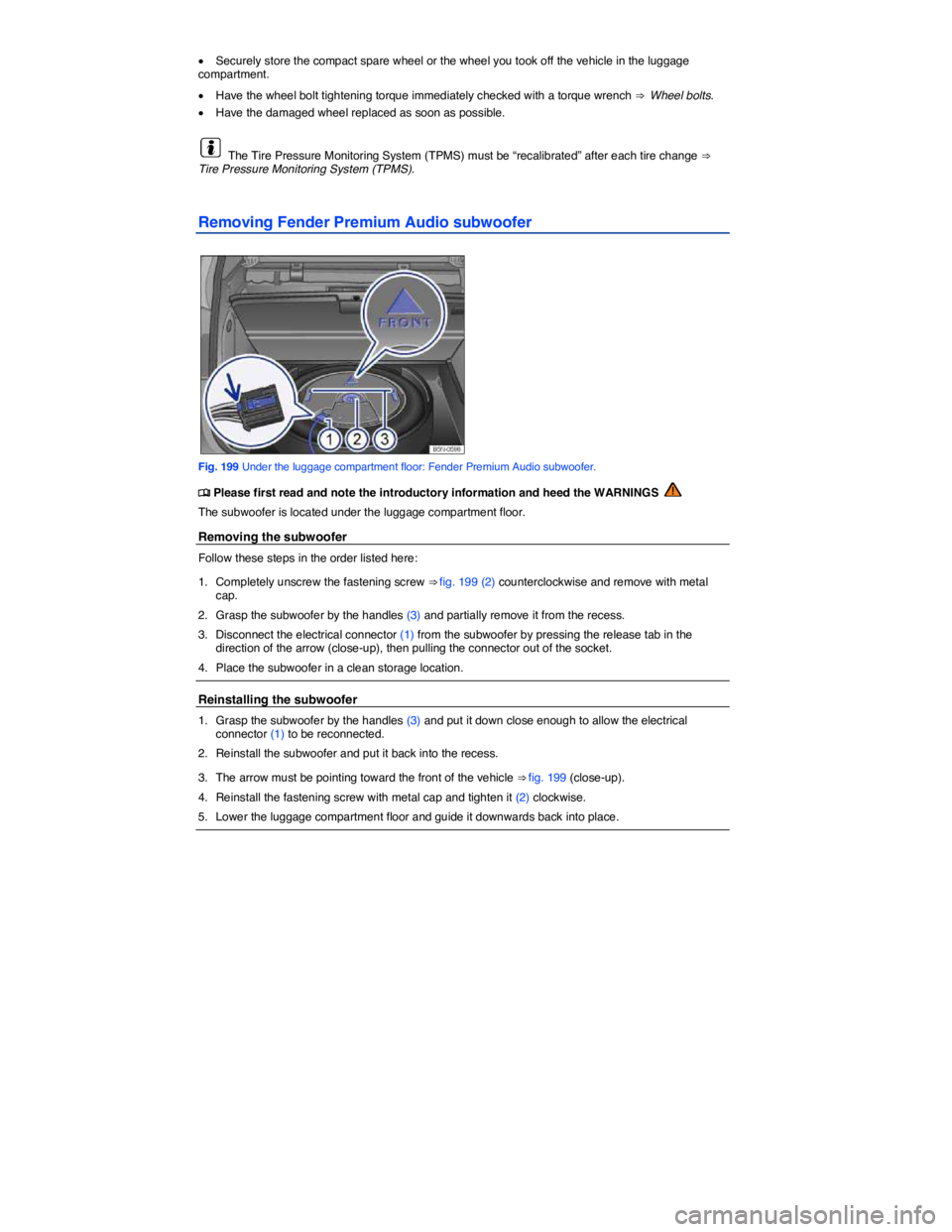
Removing Fender Premium Audio subwoofer
Fig. 199 Under the luggage compartment floor: Fender Premium Audio subwoofer.