Media VOLKSWAGEN TIGUAN 2015 Owner´s Manual
[x] Cancel search | Manufacturer: VOLKSWAGEN, Model Year: 2015, Model line: TIGUAN, Model: VOLKSWAGEN TIGUAN 2015Pages: 435, PDF Size: 6.19 MB
Page 314 of 435
WARNING
Never try to drive crosswise on a slope, especially one that is too steep for your vehicle. The vehicle could slide sideways and tumble down the slope. To reduce the risk of accidents and serious injuries:
x Never underestimate the difficulties and dangers of driving crosswise on a slope. Never take routes or risks that could put you or your passengers in danger. If you cannot go on or have doubts about the safety of your route, turn back and take a different route.
x When driving crosswise on a hill, the vehicle can lose its hold, slide sideways, tip or turn over and roll down the hill.
x Make certain that the wheels on the downhill side of the vehicle do not run over holes or depressions. Make certain that the wheels on the high side of the vehicle do not run over rocks, tree stumps, or protruding objects.
x Before driving crosswise on a hill, check whether it is possible to steer into the fall line along the selected route. If this is not possible, select a different route. If the vehicle
threatens to tip, immediately steer downhill into the fall line and gently accelerate ⇒ fig. 165.
x If the vehicle is stopped a hillside and is laterally tilted, avoid sudden and uncontrolled movement in the vehicle The vehicle can lose its hold, slide sideways, tip, or turn over and roll down the hill.
x If the vehicle is stopped at while pointed crosswise on a steep slope, make certain that no one exits the vehicle through a door on the downhill side. This can shift the vehicle center of gravity to the downhill side. The can tilt or roll over and roll down the hill. To help minimize
this risk, always exit the vehicle through the doors that are facing uphill ⇒ fig. 166.
x When getting out, make certain that doors opened on the uphill side are not closed carelessly and do not swing shut due to their own weight and injure anybody.
Avoiding deep ruts and depressions
Page 334 of 435
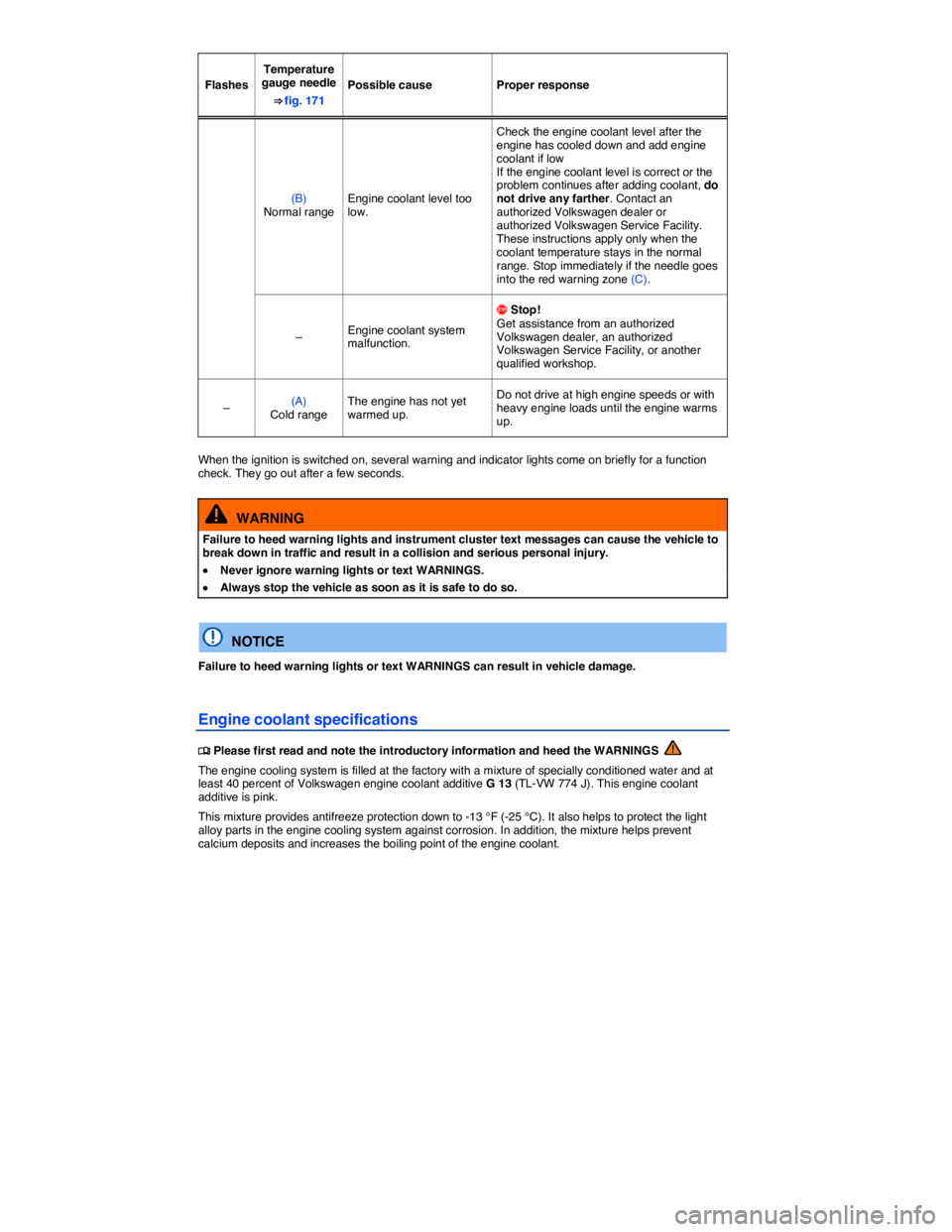
Flashes
Temperature gauge needle
⇒ fig. 171
Possible cause Proper response
(B) Normal range Engine coolant level too low.
Check the engine coolant level after the engine has cooled down and add engine coolant if low If the engine coolant level is correct or the problem continues after adding coolant, do not drive any farther. Contact an authorized Volkswagen dealer or authorized Volkswagen Service Facility. These instructions apply only when the coolant temperature stays in the normal range. Stop immediately if the needle goes into the red warning zone (C).
– Engine coolant system malfunction.
Page 335 of 435

To protect the engine, the mixture must always contain at least 40% coolant additive even in warm weather or climates where antifreeze protection is not needed.
If more antifreeze protection is needed for climate conditions, the percentage of coolant additive can be increased. However, the coolant additive percentage must never be more than 60%; otherwise, antifreeze protection is reduced and the ability of the mixture to cool the engine is also reduced.
When adding engine coolant, use a mixture of distilled water and at least 40% coolant additive G 13
or G 12 plus-plus (TL-VW 774 G) for optimum corrosion protection ⇒ .
Do not mix G 13 with G 12 plus or G 11. Mixing these coolant additives together significantly reduces
corrosion protection ⇒ and can lead to engine damage that is not covered by any Volkswagen Limited Warranty.
WARNING
Too little antifreeze protection in the engine cooling system can cause engine failure and severe injuries.
x Always make sure there is enough of the correct coolant additive to provide proper antifreeze protection at the coldest temperatures that can be expected where the vehicle will be used.
x At extremely cold temperatures, the coolant could freeze, causing the vehicle to break down. The heater would also not work, and vehicle occupants could be without protection at subfreezing temperatures.
NOTICE
Never mix original Volkswagen engine coolant additives with other additives not approved by Volkswagen. Mixing Volkswagen coolant additives with coolant additives made by other manufacturers can seriously damage the engine and the engine cooling system.
x If the fluid in the engine coolant reservoir is any color but pink, then G 13 was mixed with a different engine coolant. If this is the case, the engine coolant must be replaced immediately. Otherwise serious malfunctions or engine damage can occur!
Engine coolant and engine coolant additives can pollute the environment. Collect leaking operating fluids and dispose of them properly in accordance with applicable environmental laws and regulations.
Page 337 of 435
Adding engine coolant
x Always protect face, hands and arms from hot escaping coolant or steam by covering the cap with a large, thick rag.
x Carefully unscrew the cap ⇒ .
x Add only new engine coolant according to Volkswagen specifications (⇒ Engine coolant
specifications) ⇒ .
x The engine coolant level must be inside the marks on the side of the reservoir ⇒ fig. 172. Do not
fill above the top edge of the filling range! ⇒
x Screw the lid tightly.
x Even in an emergency, do not use any other kind of coolant additive if engine coolant meeting
Volkswagen specifications (⇒ Engine coolant specifications) is unavailable! Instead, add distilled
water only ⇒ . As soon as possible, have the correct coolant ratio restored using engine coolant
that meets Volkswagen specifications ⇒ Engine coolant specifications.
WARNING
Hot steam and hot engine coolant can cause serious burns.
x Never open the hood if you see steam or coolant escaping from the engine compartment. Always wait until you no longer see or hear steam or coolant escaping from the engine.
x Always let the engine cool down completely before carefully opening the hood. Hot components will burn skin on contact.
x When the engine has cooled down and you are ready to open the hood:
– Apply the electronic parking brake and shift the transmission into Park (P) (automatic) or Neutral (manual only).
– Take the vehicle key out of the ignition.
– On vehicles with Keyless Access, make sure that the remote control vehicle key is out of range of the vehicle and that the vehicle cannot be started by depressing the starter button
– Always keep children and others away from the engine compartment and never leave them unsupervised.
x The engine coolant system is under pressure when the engine is hot. Never unscrew the coolant expansion tank cap when the engine is hot. Hot coolant can spray out and cause severe burns and other serious injuries.
– Turn the cap slowly and very carefully in a counterclockwise direction while applying light downward pressure on the top of the cap.
– Always protect your face, hands, and arms from hot escaping coolant or steam by covering the cap with a large, thick rag.
x Never spill fluids on the engine or exhaust system when refilling. Spilling fluids onto hot parts of the engine or exhaust system can cause a fire. Under some conditions, the ethylene glycol in engine coolant can catch fire.
NOTICE
x Use distilled water only when adding coolant! All other types of water contain chemical compounds that can cause extensive corrosion damage to the engine. This can even lead to engine failure. If you have added non-distilled water, take the vehicle immediately to an authorized Volkswagen dealer or an authorized Volkswagen Service Facility to have the coolant system drained, flushed, and refilled completely with the proper coolant.
Page 338 of 435

x Refill engine coolant only up to the top edge of the marked fill range ⇒ fig. 172. Excess engine coolant may forced out of the engine cooling system when it gets hot and cause damage.
x In the case of significant engine coolant loss, refill engine coolant only when the engine is completely cooled down. Significant engine coolant loss is a sign of leaks in the cooling system. Have the engine cooling system checked immediately by an authorized Volkswagen dealer or an authorized Volkswagen Service Facility. Otherwise the engine may be damaged!
x When changing or topping off operating fluids, make sure that you pour the fluids into the correct reservoirs. Serious malfunctions and engine damage can result if you pour operating fluids into the wrong reservoir.
Page 340 of 435
WARNING
Working on the batteries or the electrical system in your vehicle can cause serious acid burns, fires, explosions, or electrical shocks. Always read and heed the following WARNINGS and safety precautions before working on the batteries or the electrical system.
x Before working on the electrical system, always switch off the ignition and all electrical consumers and disconnect the negative (–) cable from the standard 12 Volt battery.
x When you change a light bulb, always switch off the light first.
x Always keep children away from battery acid and vehicle batteries in general.
x Always wear eye protection. Never let battery acid or lead particles come into contact with your eyes, skin, or clothing.
x Sulfuric battery acid is very corrosive. It can burn unprotected skin and cause blindness. Always wear protective gloves and eye protection. To reduce your risk of injury, never tilt the batteries, as this could spill acid through the vents and burn you.
x If you get battery acid in your eyes or on your skin, immediately rinse with cold water for several minutes and then get immediate medical attention. If you swallow any battery acid, get medical attention immediately.
x When disconnecting the batteries from the vehicle electrical system, always disconnect the negative cable (–) first and then the positive cable (+).
x Always switch off all electrical consumers before reconnecting 12 Volt batteries. Reconnect the plus cable (+) first and then the negative cable (–). Never reverse the polarity of the connections. This could cause a fire.
x A highly explosive mixture of gases is given off when the battery is being charged.
x Do not smoke and avoid fires, sparks, and open flames when working. Never create sparks or electrostatic charges when handling cables and electrical equipment. Never short circuit the battery terminals. High-energy sparks can cause serious personal injury.
x Never use or attempt to charge a damaged or frozen battery, or a battery that was frozen but has thawed. Charging a frozen or thawed battery could cause explosions and chemical burns! Replace damaged or frozen vehicle batteries immediately. A dead battery can freeze at temperatures around +32 °F (0 °C).
x If the battery has a vent line or tube, make sure that it is properly connected to the battery.
x Always make sure that the vent line is securely attached to a vehicle battery that is located in the luggage compartment.
WARNING
California Proposition 65 Warning
x Battery posts, terminals, and related accessories contain lead and lead components, chemicals known to the State of California to cause cancer and reproductive harm. Wash your hands after handling.
NOTICE
x Do not expose the vehicle battery to direct sunlight for an extended period of time as ultraviolet rays may damage the battery housing.
x If the vehicle is left standing in the cold for a long time, protect the vehicle battery from freezing. A battery will be permanently damaged by freezing.
Emergency starting and starting the engine with a very weak vehicle battery or after the vehicle battery has been replaced may change or delete system settings (including time, date, personal
Page 343 of 435
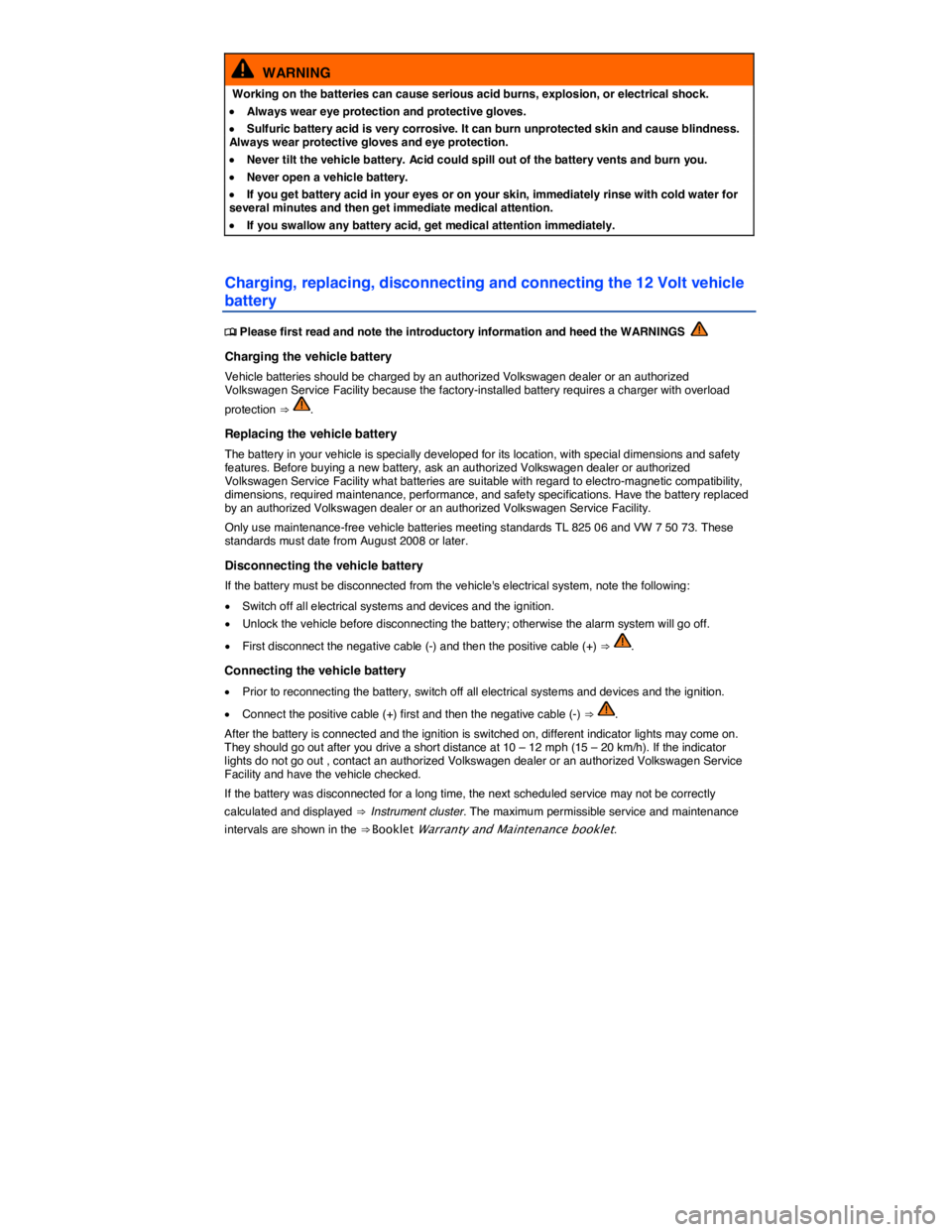
WARNING
Working on the batteries can cause serious acid burns, explosion, or electrical shock.
x Always wear eye protection and protective gloves.
x Sulfuric battery acid is very corrosive. It can burn unprotected skin and cause blindness. Always wear protective gloves and eye protection.
x Never tilt the vehicle battery. Acid could spill out of the battery vents and burn you.
x Never open a vehicle battery.
x If you get battery acid in your eyes or on your skin, immediately rinse with cold water for several minutes and then get immediate medical attention.
x If you swallow any battery acid, get medical attention immediately.
Charging, replacing, disconnecting and connecting the 12 Volt vehicle
battery
Page 360 of 435
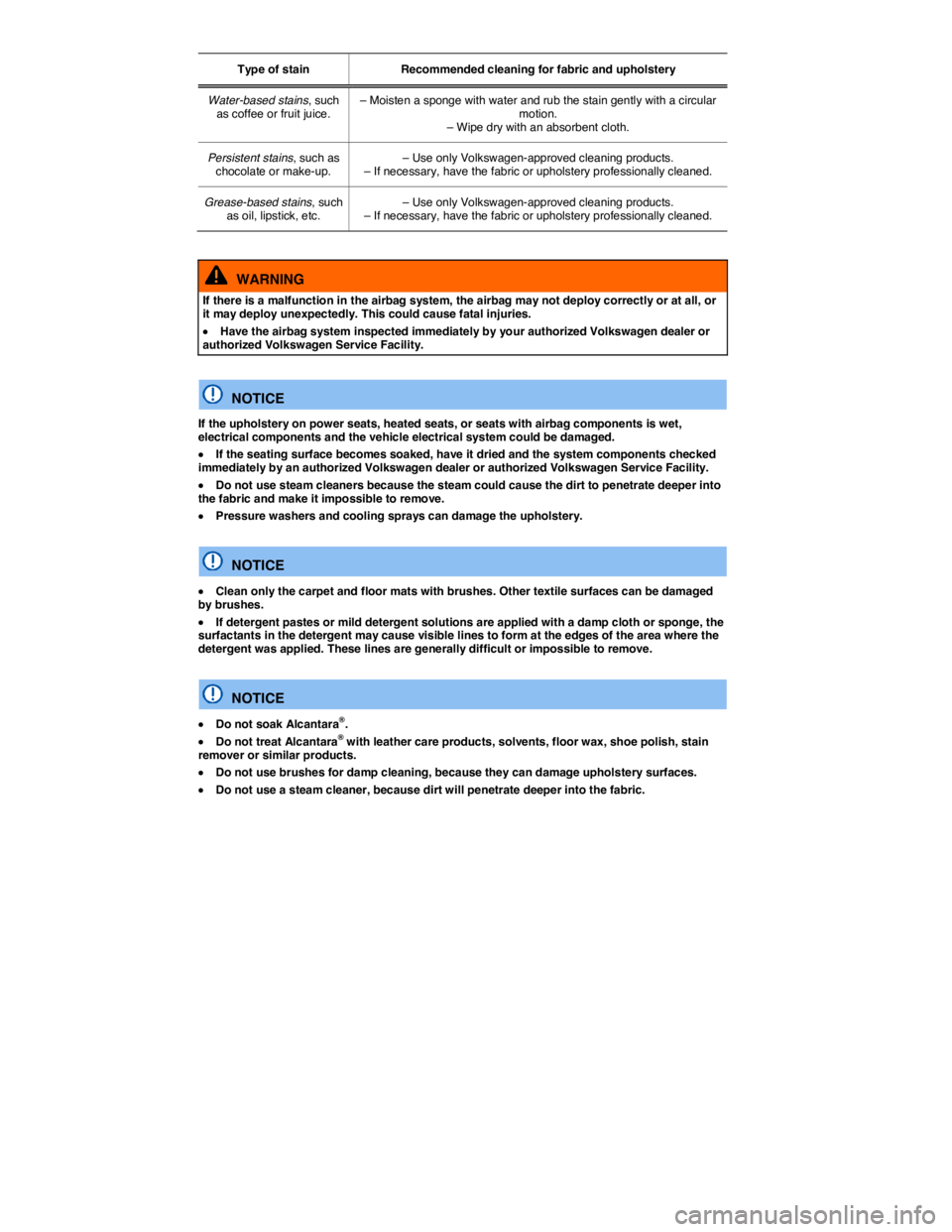
Type of stain Recommended cleaning for fabric and upholstery
Water-based stains, such as coffee or fruit juice. – Moisten a sponge with water and rub the stain gently with a circular motion. – Wipe dry with an absorbent cloth.
Persistent stains, such as chocolate or make-up. – Use only Volkswagen-approved cleaning products. – If necessary, have the fabric or upholstery professionally cleaned.
Grease-based stains, such as oil, lipstick, etc. – Use only Volkswagen-approved cleaning products. – If necessary, have the fabric or upholstery professionally cleaned.
WARNING
If there is a malfunction in the airbag system, the airbag may not deploy correctly or at all, or it may deploy unexpectedly. This could cause fatal injuries.
x Have the airbag system inspected immediately by your authorized Volkswagen dealer or authorized Volkswagen Service Facility.
NOTICE
If the upholstery on power seats, heated seats, or seats with airbag components is wet, electrical components and the vehicle electrical system could be damaged.
x If the seating surface becomes soaked, have it dried and the system components checked immediately by an authorized Volkswagen dealer or authorized Volkswagen Service Facility.
x Do not use steam cleaners because the steam could cause the dirt to penetrate deeper into the fabric and make it impossible to remove.
x Pressure washers and cooling sprays can damage the upholstery.
NOTICE
x Clean only the carpet and floor mats with brushes. Other textile surfaces can be damaged by brushes.
x If detergent pastes or mild detergent solutions are applied with a damp cloth or sponge, the surfactants in the detergent may cause visible lines to form at the edges of the area where the detergent was applied. These lines are generally difficult or impossible to remove.
NOTICE
x Do not soak Alcantara®.
x Do not treat Alcantara® with leather care products, solvents, floor wax, shoe polish, stain remover or similar products.
x Do not use brushes for damp cleaning, because they can damage upholstery surfaces.
x Do not use a steam cleaner, because dirt will penetrate deeper into the fabric.
Page 362 of 435
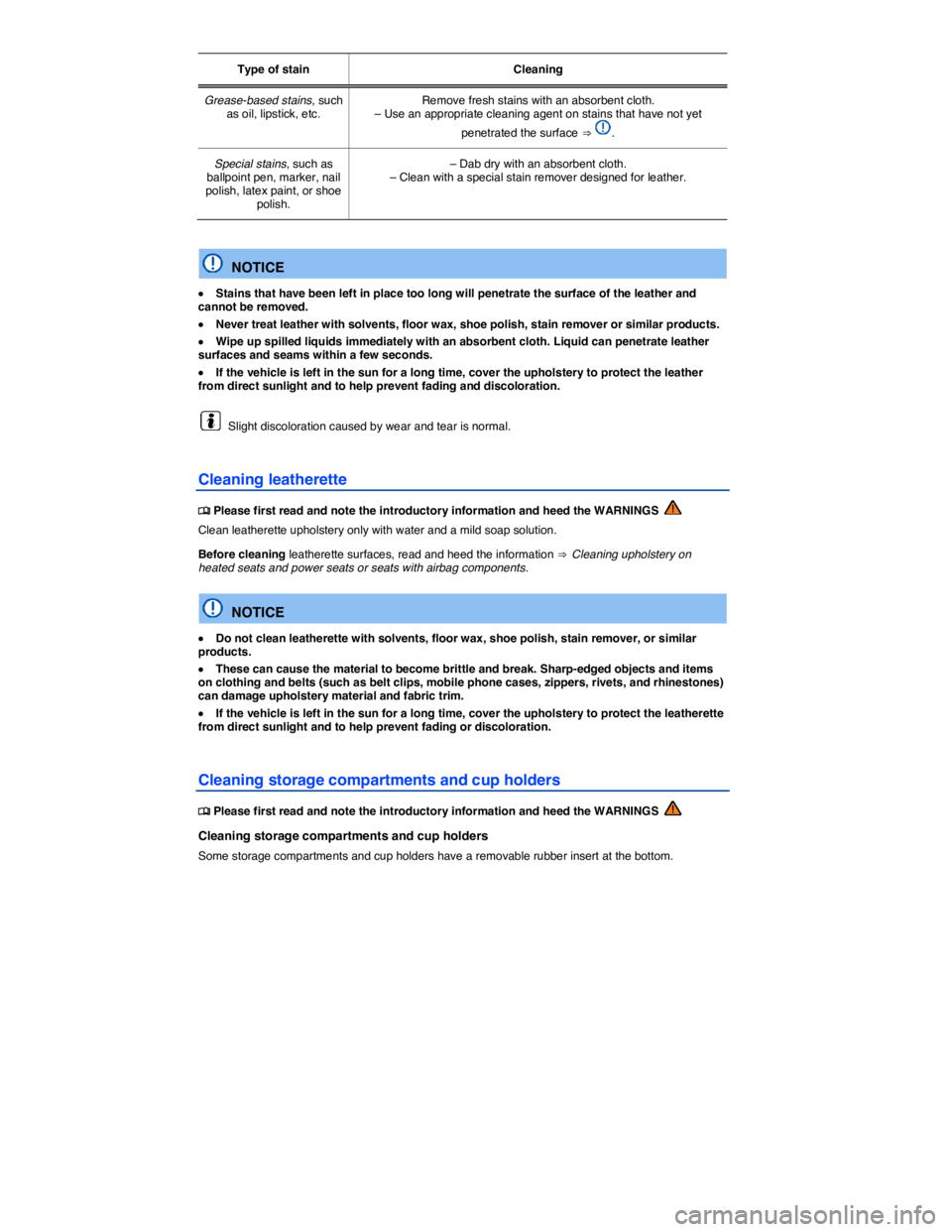
Type of stain Cleaning
Grease-based stains, such as oil, lipstick, etc. Remove fresh stains with an absorbent cloth. – Use an appropriate cleaning agent on stains that have not yet
penetrated the surface ⇒ .
Special stains, such as ballpoint pen, marker, nail polish, latex paint, or shoe polish.
– Dab dry with an absorbent cloth. – Clean with a special stain remover designed for leather.
NOTICE
x Stains that have been left in place too long will penetrate the surface of the leather and cannot be removed.
x Never treat leather with solvents, floor wax, shoe polish, stain remover or similar products.
x Wipe up spilled liquids immediately with an absorbent cloth. Liquid can penetrate leather surfaces and seams within a few seconds.
x If the vehicle is left in the sun for a long time, cover the upholstery to protect the leather from direct sunlight and to help prevent fading and discoloration.
Slight discoloration caused by wear and tear is normal.
Cleaning leatherette
Page 364 of 435

WARNING
Damage to safety belts reduces their overall effectiveness and increases the risk of serious personal injury and death whenever the vehicle is being used.
x Check the condition of all safety belts regularly. If you notice that the safety belt webbing, hardware, retractor, buckle, or any other part of the safety belts is damaged, immediately have an authorized Volkswagen dealer or authorized Volkswagen Service Facility replace the safety belt with the correct replacement belt for your vehicle model and model year.
x Never use chemical cleaning agents, solvents, or any substance that may damage or weaken the safety belt webbing or any other parts of the safety belt. Never let the belts come into contact with corrosive fluids or sharp objects. Otherwise, the safety belt webbing will be significantly weakened.
x After cleaning, always give the safety belts time to dry completely before letting them retract. The moisture can damage the retractor and keep it from working properly.
x Never let foreign objects or liquids get into the safety belt latch. This could prevent the belt buckles and safety belts from working properly.
x Damaged safety belts must be replaced; they cannot be repaired.
x Never try to repair a damaged safety belt yourself. Never remove or modify the safety belts in any way.
x Safety belts that were subject to stress in an accident and stretched must be replaced with a correct, new safety belt, preferably by an authorized Volkswagen dealer or authorized Volkswagen Service Facility.
x Replacement after a crash may be necessary even if a safety belt shows no visible damage. Anchorages that have been loaded must also be inspected.