shifting VOLKSWAGEN TIGUAN 2015 Owner´s Manual
[x] Cancel search | Manufacturer: VOLKSWAGEN, Model Year: 2015, Model line: TIGUAN, Model: VOLKSWAGEN TIGUAN 2015Pages: 435, PDF Size: 6.19 MB
Page 110 of 435

Expectant mothers must always wear the lap portion of the safety belt as low as possible across the pelvis and below the rounding of the abdomen – throughout the pregnancy. The safety belt must lie
flat against the body to avoid pressure against the abdomen ⇒ fig. 68.
Adjusting safety belt height
The safety belt position can be adjusted using the following features:
x Safety belt height adjusters for the front seats.
x Front seats with height adjustment.
WARNING
Improperly positioned safety belts can cause serious personal injury in an accident or a sudden braking maneuver.
x Always make sure that all vehicle occupants are correctly restrained and stay in a correct seating position whenever the vehicle is being used.
x Safety belts offer optimum protection only when the seat backrest is upright and belts are correctly positioned on the body.
x A loose-fitting safety belt can cause serious injuries by shifting its position on your body from the strong bones to more vulnerable soft tissue and cause serious injury.
x The shoulder belt portion of the safety belt must be positioned over the middle of the occupant's shoulder and never across the neck or throat.
x The safety belt must lie flat and snug on the occupant's upper body.
x Never wear the shoulder part of the safety belt under your arm or otherwise out of position.
x The lap portion of the safety belt must be positioned as low as possible across the pelvis and never over the abdomen. Make sure the belt lies flat and snug against the pelvis. Pull on the safety belt to tighten if necessary.
x Expectant mothers must always wear the lap portion of the safety belt as low as possible across the pelvis and below the rounding of the abdomen.
x Do not twist the belt when attaching it. If you cannot untwist a twisted safety belt, wear it anyway, but make sure the twisted part is not in contact with your body. Have the problem corrected right away by an authorized Volkswagen dealer or authorized Volkswagen Service Facility.
x Never hold the safety belt away from your body with your hand.
x Never wear belts over rigid or breakable objects, such as eye glasses, pens or keys.
x Never modify the position of the belt using comfort clips, loops or similar devices.
x If you have a physical impairment or condition that prevents you from sitting properly on the seat with the safety belt properly fastened, special modifications to your vehicle may be necessary.
x Contact your authorized Volkswagen dealer or authorized Volkswagen Service Facility or call the Volkswagen Customer CARE Center at 1-800-822-8987 for information about possible modifications to your vehicle.
Page 142 of 435

WARNING
Heavy loads will influence the way your vehicle handles and increase stopping distances. Heavy loads that are not properly stowed or secured can cause loss of control and serious injury.
x Secure the load properly to keep it from shifting.
x Always remember when transporting heavy objects that a change in the center of gravity also changes the way your vehicle handles:
– Always distribute the load as evenly as possible.
– Secure heavy objects properly as far forward in the luggage compartment as possible.
– Always tie down heavy items securely with suitable straps using the tie-downs in the luggage compartment.
– Securely latch the rear seat backrest in the upright position.
x Never exceed the Gross Axle Weight Rating or the Gross Vehicle Weight Rating on the safety compliance sticker on the left door jamb. Exceeding permissible weight can cause the vehicle to skid and handle differently.
x Always adapt your speed and driving to the heavier load and the weight distribution in the vehicle. Take road, weather, traffic, and visibility conditions into account as well.
x Always accelerate gently and avoid sudden braking and driving maneuvers.
x Always brake earlier than you would if you were not driving a loaded vehicle.
Stowing luggage
Page 147 of 435

WARNING
Unsecured or incorrectly stowed items can fly through the vehicle, causing serious personal injury during hard braking or sharp steering or in an accident. Loose items can also be struck and thrown through the passenger compartment by the front airbags if they inflate. To help reduce the risk of serious personal injury:
x Always stow all objects securely in the vehicle. Always put luggage and heavy items in the luggage compartment.
x Always secure objects in the passenger compartment properly with suitable straps so that they cannot move into the deployment zone of a side or front airbag during a sudden braking, in a sudden maneuver, or in a collision.
x Always keep storage compartments closed while driving.
x Never stow hard, heavy, or sharp objects in the vehicle's open storage compartments, on the shelf behind the rear seat bench, or on the top of the instrument panel.
x Always remove hard, heavy, or sharp objects from clothing and bags in the vehicle interior and stow them securely in the luggage compartment.
WARNING
Transporting heavy objects causes the handling characteristics of the vehicle to change and increases braking distances. Heavy loads which are not properly stowed or secured in the vehicle can lead to a loss of vehicle control and cause serious person injury.
x Transporting heavy items causes the handling characteristics of the vehicle to change by shifting the vehicle's center of gravity.
x Always distribute luggage evenly and as low as possible within the vehicle. The vehicle capacity weight figures apply when the load is distributed evenly in the vehicle (passengers and luggage).
x Always stow luggage and heavy items in the luggage compartment as far forward of the rear axle as possible and secure them with appropriate straps to the tie-downs provided.
x Never exceed the vehicle's Gross Vehicle Weight Rating or Gross Axle Weight Ratings, which are printed on the Safety Compliance Certification Label located on the door jamb of the driver door. Exceeding the permissible weight can cause the vehicle to skid and behave differently.
x Always adapt your speed and driving style to accommodate your payload and its weight distribution within your vehicle.
x Be especially cautious and gentle when stepping on the accelerator pedal and avoid sudden braking and other maneuvers.
x Brake earlier than you would if you were not driving a loaded vehicle.
NOTICE
x The defroster heating wires or antenna in the rear window can be damaged by objects that rub against them.
The ventilation slots between the rear window and the luggage compartment cover must not be blocked so that stale air can escape from the vehicle.
Page 234 of 435

Shifting
Page 238 of 435

WARNING
When the engine is running and a gear is engaged, the vehicle will start to move as soon as the clutch pedal is released, even when the parking brake is applied. This also applies when the parking brake is engaged.
x Never shift into reverse when the vehicle is moving.
NOTICE
Shifting down to a gear that is too low when driving at fast speeds or high engine rpms can cause extensive damage to the clutch and transmission. That is true even if the clutch pedal is pressed so that the clutch is not engaged.
NOTICE
To help prevent damage and premature wear:
x Do not rest your hand on the gearshift lever while driving. Over time, the pressure will cause premature wear in the transmission.
x Make sure that the vehicle has come to a complete stop before shifting into reverse.
x Always depress the clutch pedal all the way when changing gears.
x Do not hold the vehicle on a hill using engine power with the clutch pedal partially engaged and the engine running.
Automatic transmission: Selector lever
Fig. 141 Automatic transmission selector lever with shift lever release button (arrow).
Page 239 of 435

Selector lever position
Designation Meaning ⇒
0 Park The drive wheels are mechanically locked. Select only when the vehicle is not moving. To change the selector lever position, switch on the ignition (if it is off) and then press the selector lever release button while holding down the brake pedal.
2 Reverse The Reverse (R) gear is engaged. Shift into Reverse (R) only when the vehicle is not moving.
. Neutral Transmission is in Neutral (N) position. No power is transmitted to the wheels and no engine braking effect is available.
$ Drive (standard driving position) All forward gears shift up and down automatically. The transmission shifts as needed depending on engine load, individual driving style, and vehicle speed.
3 Sport Drive (Sport driving position) All forward gears automatically upshift later and downshift earlier than in the Drive (D) position, to take full advantage of the engine's power reserves. The transmission shifts as needed depending on engine load, individual driving style, and vehicle speed.
Automatic Shift Lock (ASL)
The Automatic Shift Lock (ASL) in Park (P) and Neutral (N) prevents drive positions from being engaged inadvertently, which would cause the vehicle to move.
To release the ASL, depress and hold the brake pedal with the ignition switched on. Press the release button on the selector lever at the same time.
The ASL is not engaged if the selector lever is moved quickly through Neutral (N) (e.g., when shifting from Reverse (R) to Drive (D)). This makes it possible to “rock” the vehicle backwards and forwards if it is stuck in snow or mud. The ASL engages automatically if the brake pedal is not depressed and the lever is in Neutral (N) for more than about 1 second and the vehicle is traveling no faster than about 3 mph (5 km/h).
x Depress and then release the brake pedal.
WARNING
Moving the selector lever to the wrong position can cause loss of vehicle control, a collision, and serious personal injury.
x Never accelerate when moving the selector lever.
x When the engine is running and a drive position is engaged, the vehicle will start to move as soon as the brake pedal is released.
x Never shift into Reverse (R) or Park (P) when the vehicle is moving.
Page 240 of 435

WARNING
Unintended vehicle movement can cause serious personal injury.
x Never get out of the driver's seat while the engine is running, especially when the transmission is in a drive gear. If you must leave your vehicle while the engine is running, always set the parking brake and shift the transmission into Park (P).
x Never leave the vehicle in Neutral (N). It will roll down hills, whether the engine is running or not.
x When the engine is running and a drive gear - Drive (D), Sport Drive (S), or Reverse (R) - has been selected, press and hold the brake pedal to keep the vehicle from moving. The vehicle may “creep” and move forward or backward even if the engine is idling slowly.
x Never shift into Reverse (R) or Park (P) when the vehicle is moving.
NOTICE
Even though the transmission is in Park (P), the vehicle may move a couple of inches (a few centimeters) forwards or backwards if you take your foot off the brake pedal after stopping the vehicle without first applying the electronic parking brake.
If the selector lever is moved into Neutral (N) by mistake when the vehicle is moving, take your foot off the accelerator pedal. Wait until the engine speed has dropped to idle speed before moving the selector lever into a drive gear.
Leaving the selector lever for a long period of time in any position other than Park (P) when the ignition is switched off can drain the vehicle battery.
Shifting with Tiptronic®
Fig. 142 Selector lever in Tiptronic position.
Page 242 of 435

Driving on hills
The steeper the grade, the lower the gear that must be selected. Lower gears increase the braking effect of the engine. Never coast downhill in Neutral (N).
x Reduce speed.
x Switch to Tiptronic mode by moving the selector lever from Drive (D) to the right into the Tiptronic
position ⇒ Shifting with Tiptronic®.
x Downshift by pulling the selector lever back briefly (-).
Stopping and starting on hills: If you stop on a hill with the vehicle in gear, you must depress the brake pedal or engage the electronic parking brake to keep the vehicle from rolling. Do not release the
brake pedal or the parking brake until the vehicle has started to move forwards ⇒ .
Kick-down acceleration
The kick-down feature permits maximum acceleration when the selector lever is in the Drive (D), Sport Drive (S) or Tiptronic mode.
If you push the accelerator all the way down, the vehicle will automatically downshift, depending on vehicle speed and engine speed (rpm). This feature lets you take advantage of the full acceleration
capacity of the vehicle ⇒ .
With kick-down actuated, the transmission will stay in the current gear longer and not upshift until the engine reaches maximum rpm.
WARNING
Rapid acceleration can cause skidding and loss of traction, especially on slippery roads, resulting in a loss of vehicle control, collisions, and serious personal injury.
x Only use the kick-down feature or fast acceleration if visibility, weather, road, and traffic conditions allow it and other drivers will not be endangered by your driving and the vehicle's acceleration.
x Always adapt your driving to the traffic flow.
x Note that the drive wheels can spin and the vehicle can swerve when ASR is switched off, especially when the road is slippery.
x Once you have accelerated, switch ASR back on again.
NOTICE
x When stopping on hills with the transmission in a drive gear, do not use the accelerator to help prevent the vehicle from rolling backwards. This can cause the automatic transmission to overheat and be damaged.
x Never let the vehicle coast or roll down a hill in Neutral (N), especially when the engine is not running. The transmission will not be lubricated and will be damaged.
Automatic transmission malfunction
Page 271 of 435
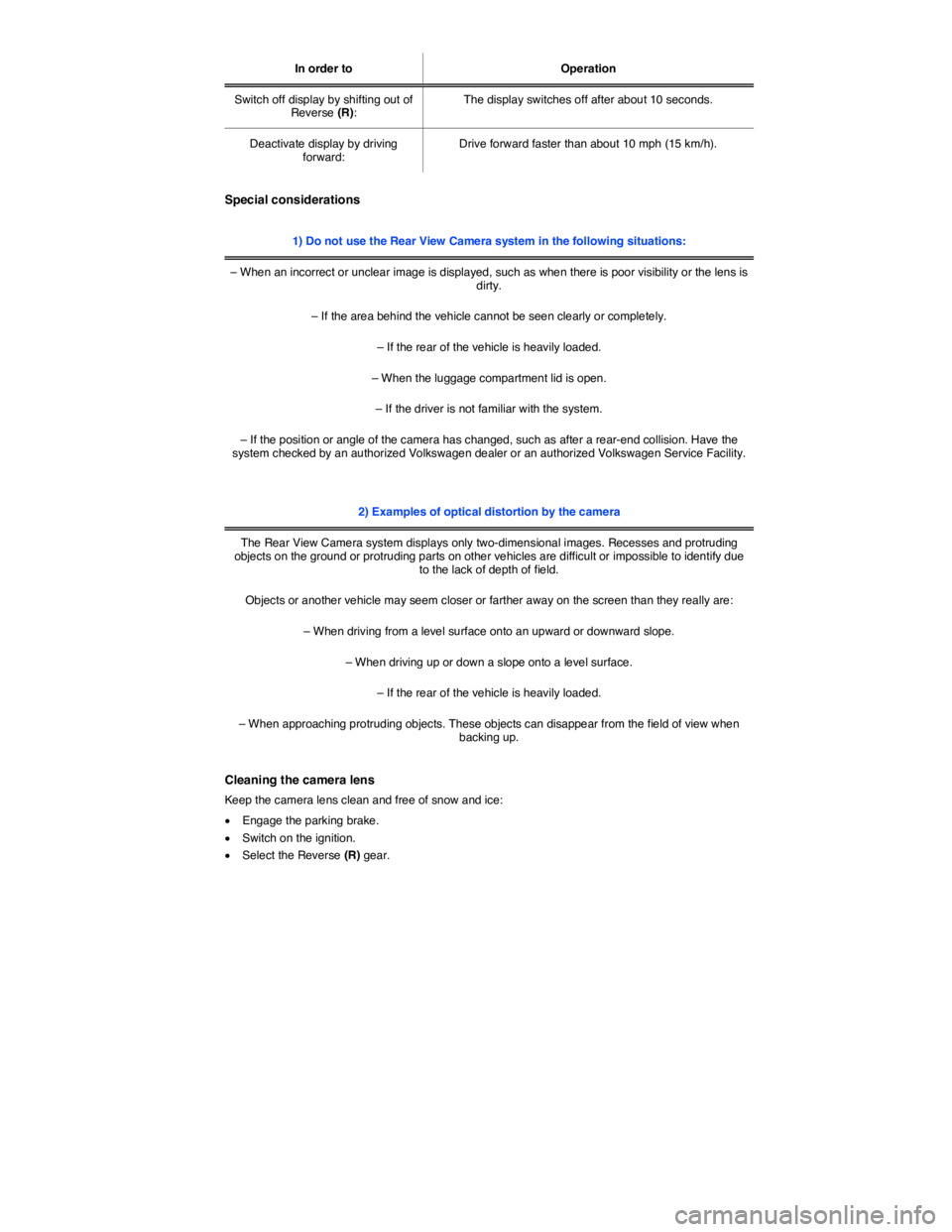
In order to Operation
Switch off display by shifting out of Reverse (R): The display switches off after about 10 seconds.
Deactivate display by driving forward: Drive forward faster than about 10 mph (15 km/h).
Special considerations
1) Do not use the Rear View Camera system in the following situations:
– When an incorrect or unclear image is displayed, such as when there is poor visibility or the lens is dirty.
– If the area behind the vehicle cannot be seen clearly or completely.
– If the rear of the vehicle is heavily loaded.
– When the luggage compartment lid is open.
– If the driver is not familiar with the system.
– If the position or angle of the camera has changed, such as after a rear-end collision. Have the system checked by an authorized Volkswagen dealer or an authorized Volkswagen Service Facility.
2) Examples of optical distortion by the camera
The Rear View Camera system displays only two-dimensional images. Recesses and protruding objects on the ground or protruding parts on other vehicles are difficult or impossible to identify due to the lack of depth of field.
Objects or another vehicle may seem closer or farther away on the screen than they really are:
– When driving from a level surface onto an upward or downward slope.
– When driving up or down a slope onto a level surface.
– If the rear of the vehicle is heavily loaded.
– When approaching protruding objects. These objects can disappear from the field of view when backing up.
Cleaning the camera lens
Keep the camera lens clean and free of snow and ice:
x Engage the parking brake.
x Switch on the ignition.
x Select the Reverse (R) gear.