tow VOLKSWAGEN TIGUAN 2017 Owner´s Manual
[x] Cancel search | Manufacturer: VOLKSWAGEN, Model Year: 2017, Model line: TIGUAN, Model: VOLKSWAGEN TIGUAN 2017Pages: 341, PDF Size: 9.14 MB
Page 259 of 341
This chapter does not refer to all the fuses in the vehicle. These should be changed only by
a qualified workshop.
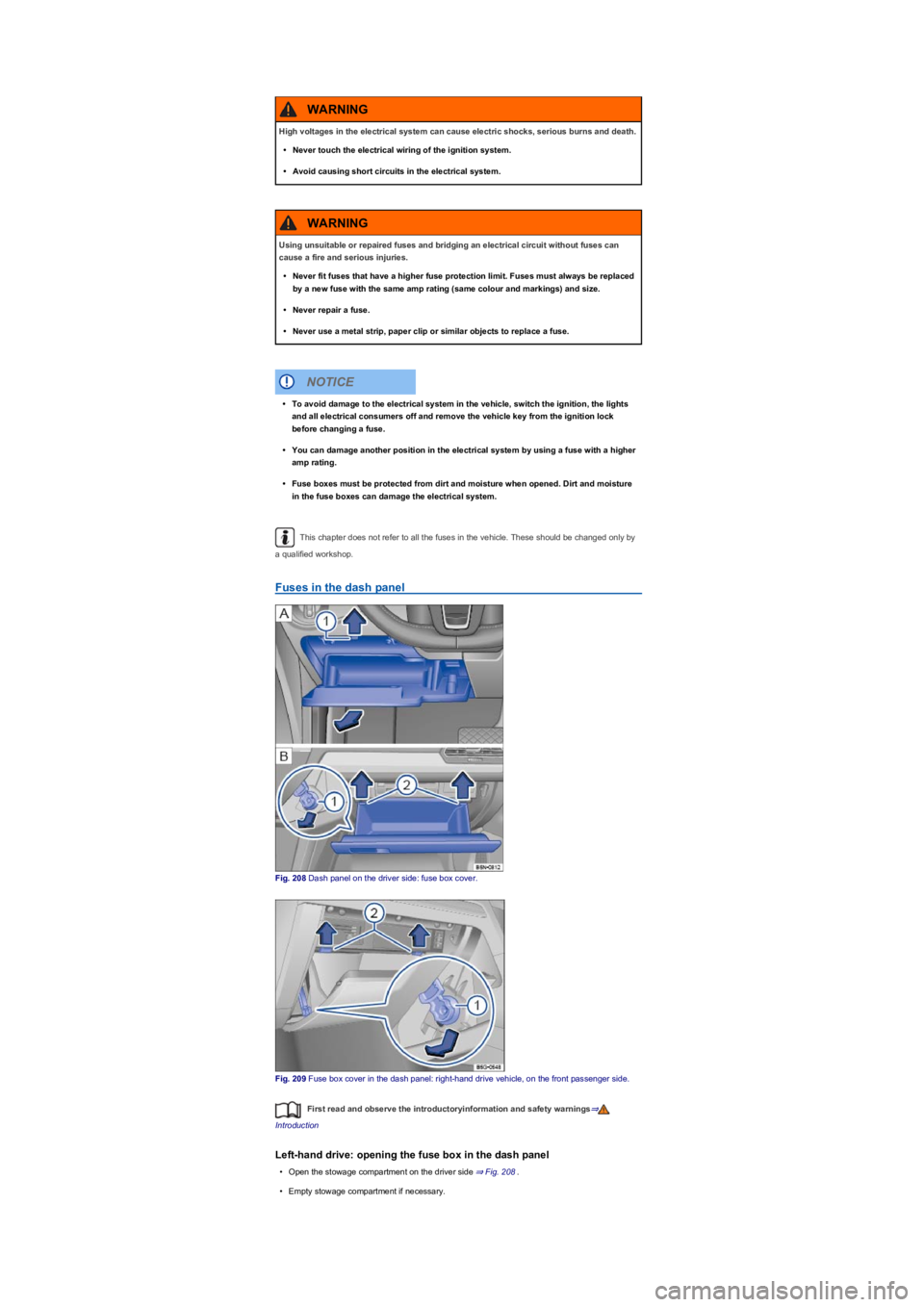
Fuses in the dash panel
Fig. 208 Dash panel on the driver side: fuse box cover.
Fig. 209 Fuse box cover in the dash panel: right-hand drive vehicle, on the front passenger side.
First read and observe the introductoryinformation and safety warnings⇒
Introduction
Left-hand drive: opening the fuse box in the dash panel
•Open the stowage compartment on the driver side ⇒ Fig. 208.
•Empty stowage compartment if necessary.
High voltages in the electrical system can cause electric shocks, serious burns and death.
•Never touch the electrical wiring of the ignition system.
•Avoid causing short circuits in the electrical system.
WARNING
Using unsuitable or repaired fuses and bridging an electrical circuit without fuses can
cause a fire and serious injuries.
•Never fit fuses that have a higher fuse protection limit. Fuses must always be replaced
by a new fuse with the same amp rating (same colour and markings) and size.
•Never repair a fuse.
•Never use a metal strip, paper clip or similar objects to replace a fuse.
WARNING
•To avoid damage to the electrical system in the vehicle, switch the ignition, the lights
and all electrical consumers off and remove the vehicle key from the ignition lock
before changing a fuse.
•You can damage another position in the electrical system by using a fuse with a higher
amp rating.
•Fuse boxes must be protected from dirt and moisture when opened. Dirt and moisture
in the fuse boxes can damage the electrical system.
NOTICE
Page 260 of 341
•Push the retaining lugs ⇒ Fig. 208① upwards in the direction of the arrow whilst opening the
stowage compartment until the fuse carrier can be accessed.
•To install, press the stowage compartment into the mounts on the dash panel until it audibly
clicks into place on both sides and then close the compartment.
Right-hand drive: opening the fuse box in the dash panel
•Open the stowage compartment on the front passenger side and remove the contents if
necessary ⇒ Fig. 209.
•Slide the braking element ⇒ Fig. 209① downwards into the opening in the holder and pull it
out sideways.
•Push catches ⇒ Fig. 209② upwards in the direction of the arrow whilst opening the stowage
compartment further.
•To install: bring storage compartment into position. Insert the brake element in the holder
opening and push upwards until it audibly engages. Carefully push the stowage compartment
forwards beyond the resistance of the catches ⇒ Fig. 209②.
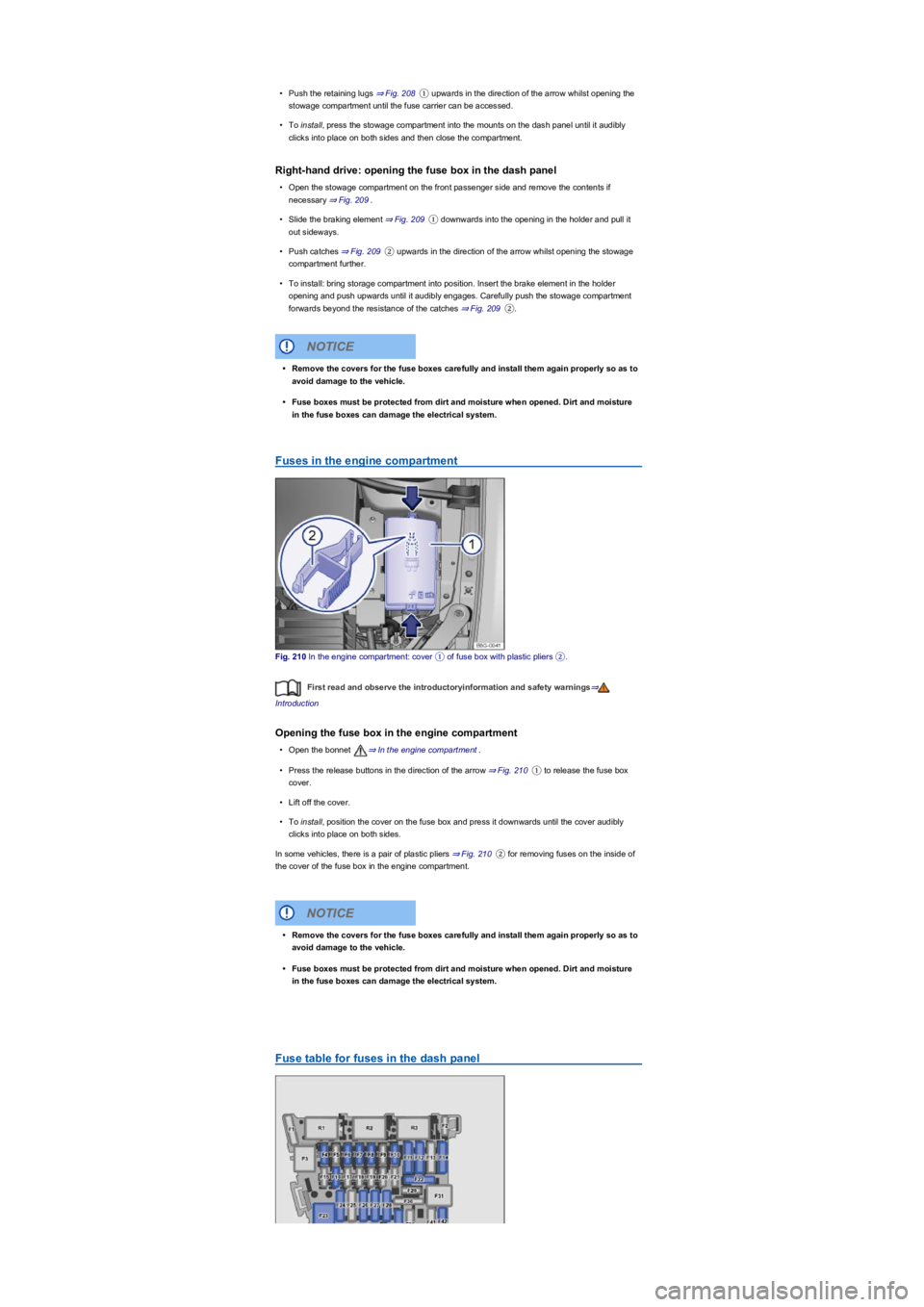
Fuses in the engine compartment
Fig. 210 In the engine compartment: cover ① of fuse box with plastic pliers ②.
First read and observe the introductoryinformation and safety warnings⇒
Introduction
Opening the fuse box in the engine compartment
•Open the bonnet ⇒ In the engine compartment.
•Press the release buttons in the direction of the arrow ⇒ Fig. 210① to release the fuse box
cover.
•Lift off the cover.
•To install, position the cover on the fuse box and press it downwards until the cover audibly
clicks into place on both sides.
In some vehicles, there is a pair of plastic pliers ⇒ Fig. 210② for removing fuses on the inside of
the cover of the fuse box in the engine compartment.
Fuse table for fuses in the dash panel
•Remove the covers for the fuse boxes carefully and install them again properly so as to
avoid damage to the vehicle.
•Fuse boxes must be protected from dirt and moisture when opened. Dirt and moisture
in the fuse boxes can damage the electrical system.
NOTICE
•Remove the covers for the fuse boxes carefully and install them again properly so as to
avoid damage to the vehicle.
•Fuse boxes must be protected from dirt and moisture when opened. Dirt and moisture
in the fuse boxes can damage the electrical system.
NOTICE
Page 267 of 341
Tow-starting or towing
Introduction
This chapter contains information on the followingsubjects:
⇒ Notes on tow-starting and towing
⇒ Fitting the rear towing eye
⇒ Fitting the front towing eye
⇒ Fitting the front towing eye (R-Line)
⇒ Driving notes when towing
Tow-starting is where a vehicle is started from it being set in motion by a vehicle that is hitched up
to it.
Towing is where a vehicle that cannot be driven is pulled away with the aid of another vehicle.
Observe any legal requirements when towing or tow-starting.
For technical reasons, vehicles with a discharged 12-volt battery must not be towed.⇒ Jump
starting
Vehicles with Keyless Access must only be towed with the ignition switched on.
Towing a vehicle when the engine is switched off and the ignition is switched on discharges the 12-
volt vehicle battery. Depending on the charge level of the 12-volt vehicle battery, the drop in voltage
can be large enough after just a few minutes that electrical consumers in the vehicle will no longer
function, e.g. the hazard warning lights.
Jump starting the vehicle incorrectly can cause the 12-volt vehicle battery to explode,
which can lead to serious injuries. Please observe the following in order to reduce the risk
of the 12-volt vehicle battery exploding:
•All work on the 12-volt vehicle battery and the electrical system can cause serious
chemical burns, fire or electric shocks. Always read the warnings and safety
information before carrying out any kind of work on the 12-volt vehicle battery ⇒ 12-
volt vehicle battery.
•Always wear suitable eye protection and gloves and never lean over the 12-volt vehicle
battery.
•Attach the connector cables in the correct order – the positive cable first, followed by
the negative.
•Never connect the negative cable to parts of the fuel system or to the brake lines.
•The non-insulated parts of the battery clamps must not be allowed to touch. The jump
lead attached to the positive terminal on the 12-volt vehicle battery must not touch
electrically conductive parts of the vehicle.
•m/k/a995MK Vehicles with battery in the engine compartment: check the battery
window on the 12-volt vehicle battery. Use a torch for this if necessary. If the display is
light yellow or colourless, do not jump start the vehicle. Seek expert assistance.
•Avoid electrostatic discharge in the vicinity of the 12-volt vehicle battery. The explosive
gas emitted from the 12-volt vehicle battery could be ignited by sparks.
•Do not carry out jump starting if the 12-volt vehicle battery is damaged or if it is or has
ever been frozen.
WARNING
Once the vehicle has been successfully jump-started, go to a qualified workshop and have
the 12-volt vehicle battery checked.
NOTICE
Page 268 of 341
Notes on tow-starting and towing
First read and observe the introductoryinformation and safety warnings⇒
Introduction
Tow rope, tow bar
It is easier and safer to tow a vehicle with a tow bar. Only use a tow rope if you do not have a tow
bar.
The tow rope should be slightly elastic to reduce the strain on both vehicles. It is advisable to use a
tow rope made of synthetic fibre or similarly elastic material.
Only attach the tow rope or tow bar to the specially provided towing eyes or to the towing bracket.
Vehicles with a factory-fitted towing bracket must only use tow bars that are specially designed
to fit a ball head ⇒ Trailer towing.
Tow-starting
Vehicles should not be tow-started wherever possible. Instead have the vehicle jump-started
⇒ Jump starting or collected by a recovery vehicle.
However, if the vehicle still has to be tow-started:
•Engage second or third gear.
•Keep the clutch pressed down.
•Switch on the ignition and the hazard warning lights.
•Once both vehicles are in motion, release the clutch.
•As soon as the engine starts, press the clutch and put the gear into neutral. This helps to
prevent driving into the towing vehicle.
When should your vehicle not be towed?
•The vehicle gearbox is damaged or does not contain any lubricant.
•The 12-volt vehicle battery is discharged. The steering system is still locked and the electronic
parking brake and electronic steering column lock, if applied, cannot be released.
•The distance to be towed is further than 50 km.
Never tow a vehicle that has no power supply.
•Never remove the vehicle key from the ignition or switch off the ignition using the
starter button during towing. This could cause the mechanical steering column lock
(steering lock) or the electronic steering column lock to engage suddenly. You will no
longer be able to steer the vehicle. This can lead to a loss of control of the vehicle,
accidents and serious injuries.
•If the power supply to the towed vehicle is disconnected, stop towing immediately and
seek expert assistance.
WARNING
If a vehicle is being towed, the vehicle handling and braking effect will change
significantly. Please note the following in order to reduce the risk of an accident or serious
injuries:
•Notes for the driver of the towed vehicle:
- You will need to depress the brake pedal more vigorously than normal as the
brake servo is not working. Always be careful not to drive into the vehicle that is
pulling your vehicle.
- You will need to turn the steering wheel more vigorously as the power-assisted
steering function is not working.
•Notes for the driver of the towing vehicle
- Accelerate carefully and gently.
- Avoid sudden braking and driving manoeuvres.
- Brake earlier than normal by pressing lightly on the brake pedal.
WARNING
•Remove and install the cover and the towing eye carefully so as to avoid damage to the
vehicle, e.g. the paintwork.
•Unburnt fuel can enter the catalytic converter and damage it while the vehicle is being
towed.
NOTICE
Page 269 of 341
•The steering function or the operating clearance of the wheels cannot be ensured after an
accident.
If your own vehicle has to be towed:
•Switch on the ignition.
•Select the neutral position or move the selector lever to N⇒ DSG dual clutch gearbox.
•Do not allow the vehicle to be towed at speeds faster than 50 km/h (30 mph).
•Do not allow the vehicle to be towed further than 50 km.
•Vehicles with a DSG dual clutch gearbox may only be towed by the breakdown truck with the
front wheels raised.
Towing vehicles with four-wheel drive (4MOTION)
Vehicles with four-wheel drive (4MOTION) may be towed with a tow bar or tow rope. If the vehicle
is towed with the rear or front axle raised, the engine must be switched off otherwise the drive train
could be damaged.
Please comply with the following when towing another vehicle:
•Comply with legal regulations.
•Comply with the information on towing contained in the owner's manual for the other vehicle.
The vehicle can only be towed when the electronic parking brake is switched off and, if
applicable, when the electronic steering column lock is released. If the power supply fails or if there
are faults in the electrical system, you may need to use jump leads to start the engine to release the
electronic parking brake and the electronic steering column lock.
Fitting the rear towing eye
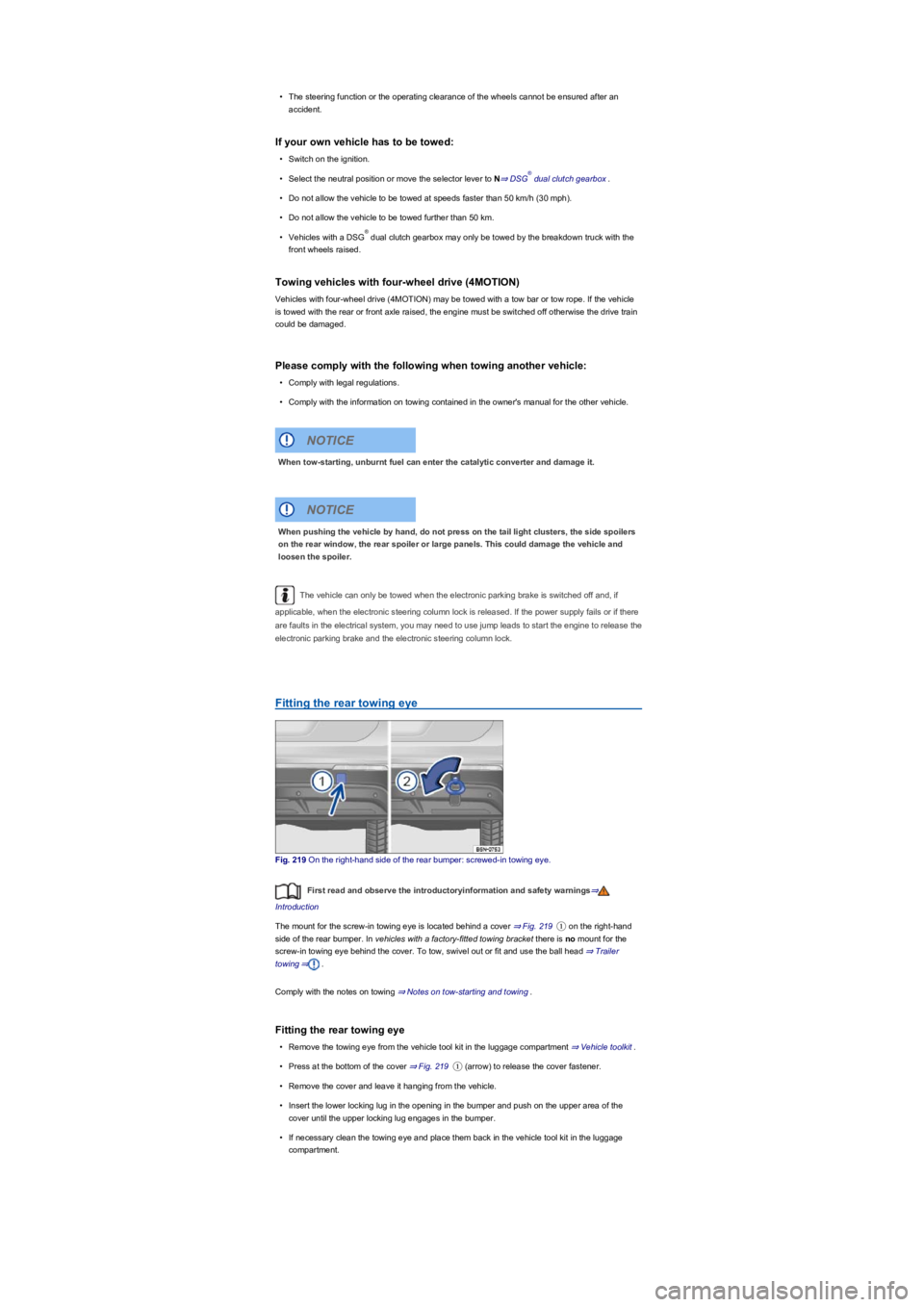
Fig. 219 On the right-hand side of the rear bumper: screwed-in towing eye.
First read and observe the introductoryinformation and safety warnings⇒
Introduction
The mount for the screw-in towing eye is located behind a cover ⇒ Fig. 219① on the right-hand
side of the rear bumper. In vehicles with a factory-fitted towing bracket there is no mount for the
screw-in towing eye behind the cover. To tow, swivel out or fit and use the ball head ⇒ Trailer
towing⇒.
Comply with the notes on towing ⇒ Notes on tow-starting and towing.
Fitting the rear towing eye
•Remove the towing eye from the vehicle tool kit in the luggage compartment ⇒ Vehicle toolkit.
•Press at the bottom of the cover ⇒ Fig. 219① (arrow) to release the cover fastener.
•Remove the cover and leave it hanging from the vehicle.
•Insert the lower locking lug in the opening in the bumper and push on the upper area of the
cover until the upper locking lug engages in the bumper.
•If necessary clean the towing eye and place them back in the vehicle tool kit in the luggage
compartment.
®
®
When tow-starting, unburnt fuel can enter the catalytic converter and damage it.
NOTICE
When pushing the vehicle by hand, do not press on the tail light clusters, the side spoilers
on the rear window, the rear spoiler or large panels. This could damage the vehicle and
loosen the spoiler.
NOTICE
Page 270 of 341
Fitting the front towing eye
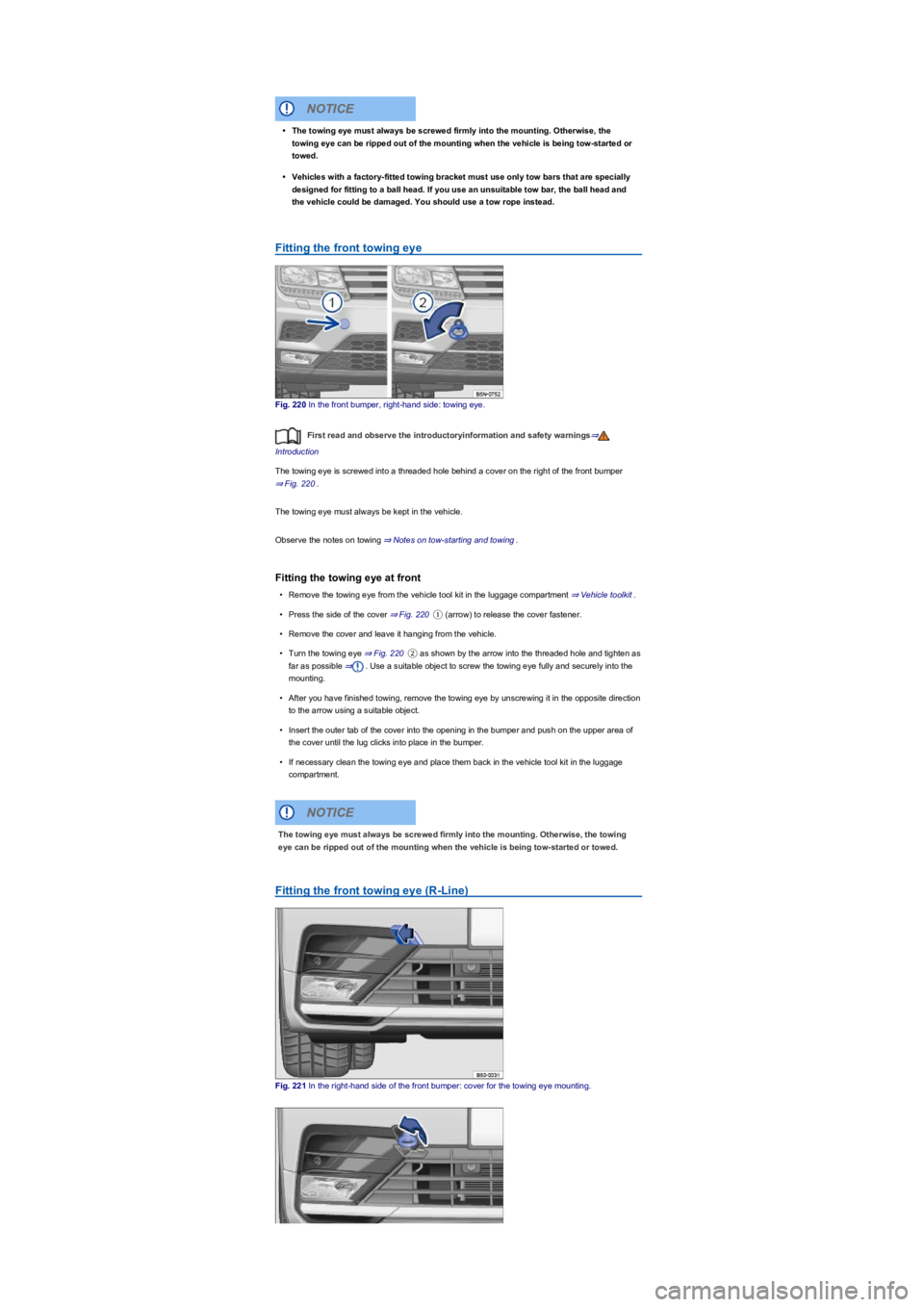
Fig. 220 In the front bumper, right-hand side: towing eye.
First read and observe the introductoryinformation and safety warnings⇒
Introduction
The towing eye is screwed into a threaded hole behind a cover on the right of the front bumper
⇒ Fig. 220.
The towing eye must always be kept in the vehicle.
Observe the notes on towing ⇒ Notes on tow-starting and towing.
Fitting the towing eye at front
•Remove the towing eye from the vehicle tool kit in the luggage compartment ⇒ Vehicle toolkit.
•Press the side of the cover ⇒ Fig. 220① (arrow) to release the cover fastener.
•Remove the cover and leave it hanging from the vehicle.
•Turn the towing eye ⇒ Fig. 220② as shown by the arrow into the threaded hole and tighten as
far as possible ⇒. Use a suitable object to screw the towing eye fully and securely into the
mounting.
•After you have finished towing, remove the towing eye by unscrewing it in the opposite direction
to the arrow using a suitable object.
•Insert the outer tab of the cover into the opening in the bumper and push on the upper area of
the cover until the lug clicks into place in the bumper.
•If necessary clean the towing eye and place them back in the vehicle tool kit in the luggage
compartment.
Fitting the front towing eye (R-Line)
Fig. 221 In the right-hand side of the front bumper: cover for the towing eye mounting.
•The towing eye must always be screwed firmly into the mounting. Otherwise, the
towing eye can be ripped out of the mounting when the vehicle is being tow-started or
towed.
•Vehicles with a factory-fitted towing bracket must use only tow bars that are specially
designed for fitting to a ball head. If you use an unsuitable tow bar, the ball head and
the vehicle could be damaged. You should use a tow rope instead.
NOTICE
The towing eye must always be screwed firmly into the mounting. Otherwise, the towing
eye can be ripped out of the mounting when the vehicle is being tow-started or towed.
NOTICE
Page 271 of 341
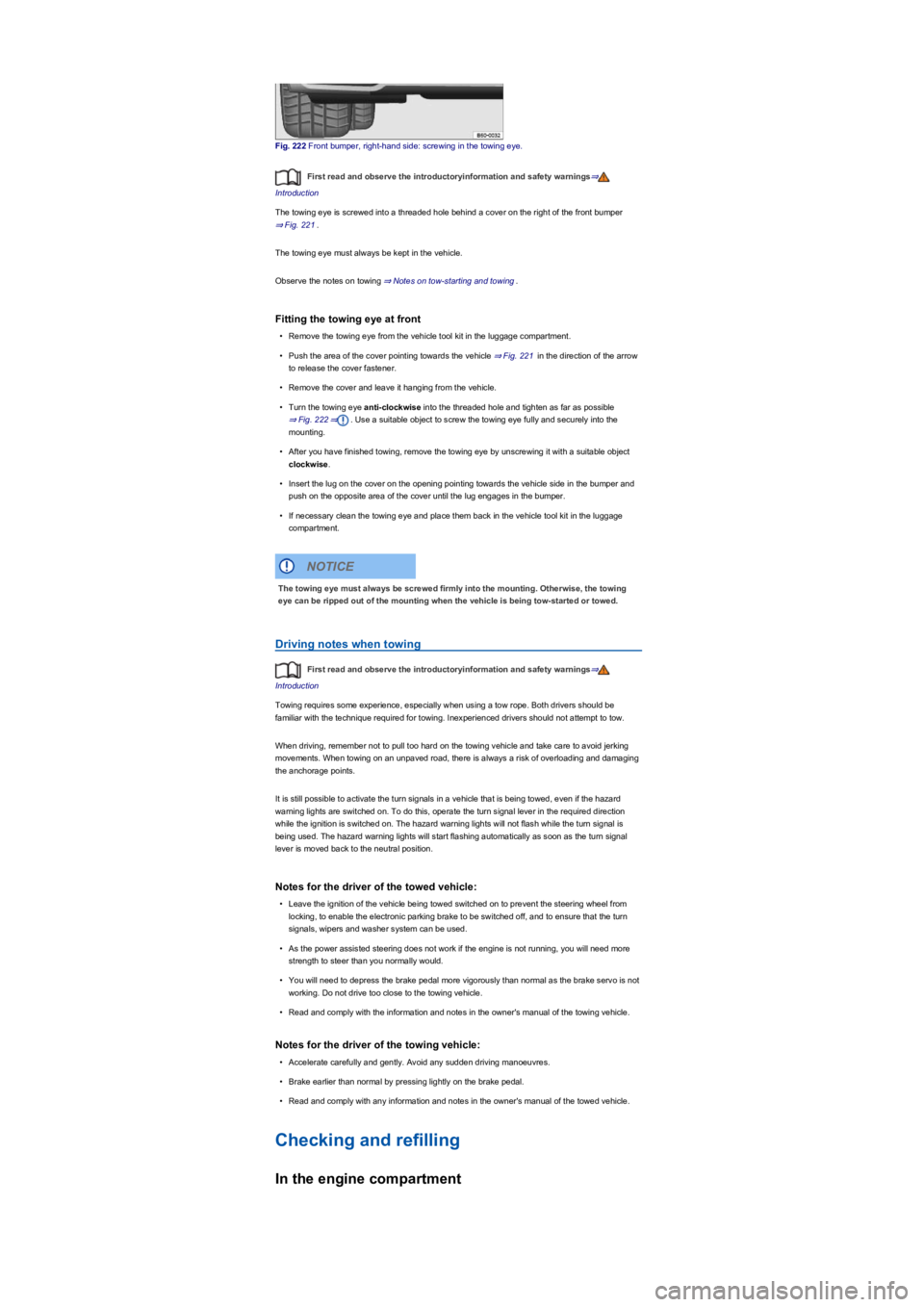
Fig. 222 Front bumper, right-hand side: screwing in the towing eye.
First read and observe the introductoryinformation and safety warnings⇒
Introduction
The towing eye is screwed into a threaded hole behind a cover on the right of the front bumper
⇒ Fig. 221.
The towing eye must always be kept in the vehicle.
Observe the notes on towing ⇒ Notes on tow-starting and towing.
Fitting the towing eye at front
•Remove the towing eye from the vehicle tool kit in the luggage compartment.
•Push the area of the cover pointing towards the vehicle ⇒ Fig. 221 in the direction of the arrow
to release the cover fastener.
•Remove the cover and leave it hanging from the vehicle.
•Turn the towing eye anti-clockwise into the threaded hole and tighten as far as possible
⇒ Fig. 222⇒. Use a suitable object to screw the towing eye fully and securely into the
mounting.
•After you have finished towing, remove the towing eye by unscrewing it with a suitable object
clockwise.
•Insert the lug on the cover on the opening pointing towards the vehicle side in the bumper and
push on the opposite area of the cover until the lug engages in the bumper.
•If necessary clean the towing eye and place them back in the vehicle tool kit in the luggage
compartment.
Driving notes when towing
First read and observe the introductoryinformation and safety warnings⇒
Introduction
Towing requires some experience, especially when using a tow rope. Both drivers should be
familiar with the technique required for towing. Inexperienced drivers should not attempt to tow.
When driving, remember not to pull too hard on the towing vehicle and take care to avoid jerking
movements. When towing on an unpaved road, there is always a risk of overloading and damaging
the anchorage points.
It is still possible to activate the turn signals in a vehicle that is being towed, even if the hazard
warning lights are switched on. To do this, operate the turn signal lever in the required direction
while the ignition is switched on. The hazard warning lights will not flash while the turn signal is
being used. The hazard warning lights will start flashing automatically as soon as the turn signal
lever is moved back to the neutral position.
Notes for the driver of the towed vehicle:
•Leave the ignition of the vehicle being towed switched on to prevent the steering wheel from
locking, to enable the electronic parking brake to be switched off, and to ensure that the turn
signals, wipers and washer system can be used.
•As the power assisted steering does not work if the engine is not running, you will need more
strength to steer than you normally would.
•You will need to depress the brake pedal more vigorously than normal as the brake servo is not
working. Do not drive too close to the towing vehicle.
•Read and comply with the information and notes in the owner's manual of the towing vehicle.
Notes for the driver of the towing vehicle:
•Accelerate carefully and gently. Avoid any sudden driving manoeuvres.
•Brake earlier than normal by pressing lightly on the brake pedal.
•Read and comply with any information and notes in the owner's manual of the towed vehicle.
Checking and refilling
In the engine compartment
The towing eye must always be screwed firmly into the mounting. Otherwise, the towing
eye can be ripped out of the mounting when the vehicle is being tow-started or towed.
NOTICE
Page 279 of 341
Before changing the engine oil, first find out where old oil can be disposed of properly near
you.
Used oil must be disposed of in accordance with regulations governing the protection of the
environment. Never dispose of old oil in locations such as gardens, woods, sewerage systems, on
streets and roads, or in rivers and waterways.
Engine oil consumption
First read and observe the introductoryinformation and safety warnings⇒
Introduction
Engine oil consumption can vary from engine to engine and can change during the working life of
an engine.
The vehicle may consume up to 1.0 litre of engine oil per 2,000 km, depending on how you drive
and the conditions in which the car is used. In new vehicles, consumption is likely to be higher for
the first 5,000 km. The engine oil level must therefore be checked at regular intervals, preferably
when refuelling and before long journeys.
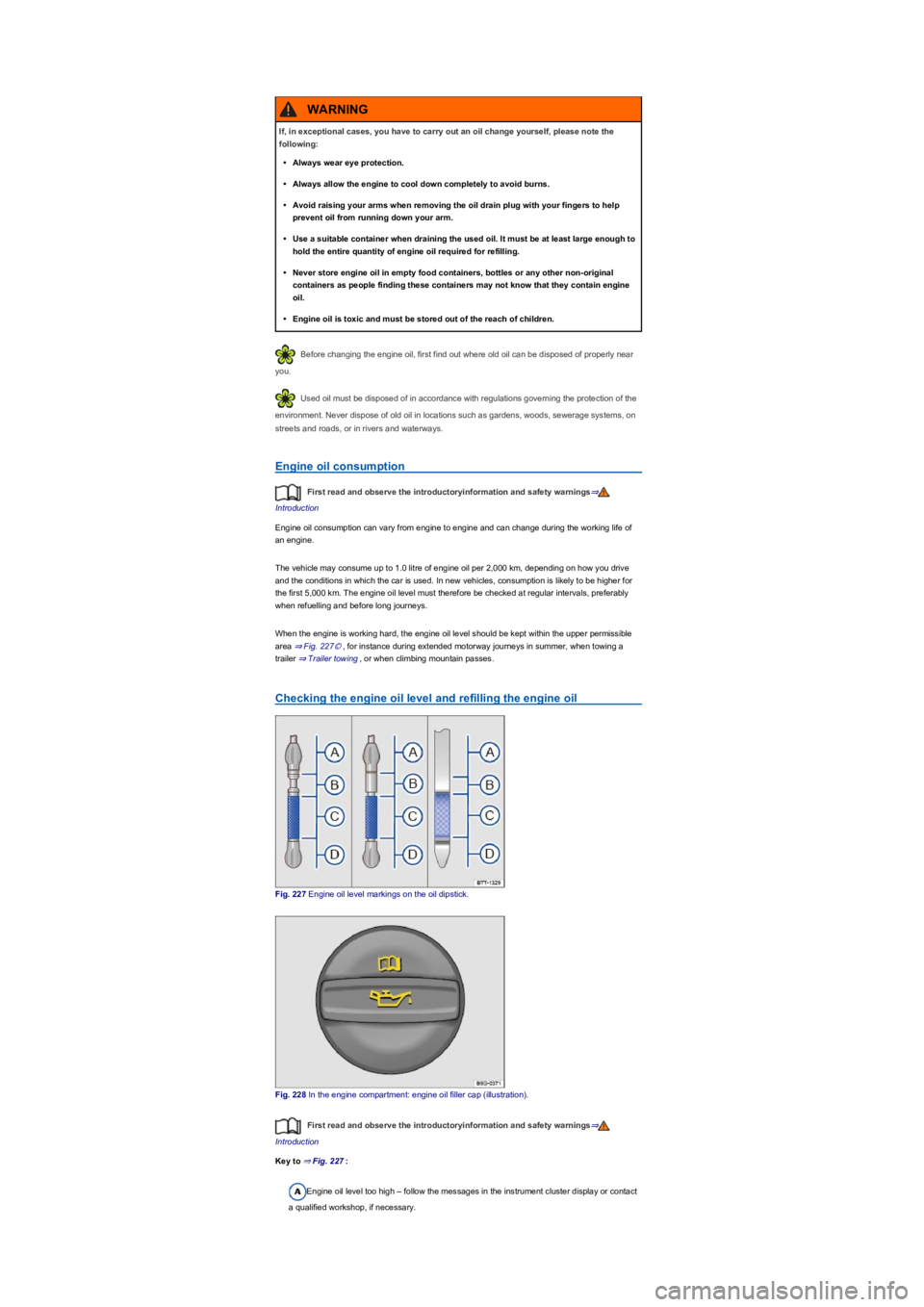
When the engine is working hard, the engine oil level should be kept within the upper permissible
area ⇒ Fig. 227Ⓒ, for instance during extended motorway journeys in summer, when towing a
trailer ⇒ Trailer towing, or when climbing mountain passes.
Checking the engine oil level and refilling the engine oil
Fig. 227 Engine oil level markings on the oil dipstick.
Fig. 228 In the engine compartment: engine oil filler cap (illustration).
First read and observe the introductoryinformation and safety warnings⇒
Introduction
Key to ⇒ Fig. 227:
Engine oil level too high – follow the messages in the instrument cluster display or contact
a qualified workshop, if necessary.
If, in exceptional cases, you have to carry out an oil change yourself, please note the
following:
•Always wear eye protection.
•Always allow the engine to cool down completely to avoid burns.
•Avoid raising your arms when removing the oil drain plug with your fingers to help
prevent oil from running down your arm.
•Use a suitable container when draining the used oil. It must be at least large enough to
hold the entire quantity of engine oil required for refilling.
•Never store engine oil in empty food containers, bottles or any other non-original
containers as people finding these containers may not know that they contain engine
oil.
•Engine oil is toxic and must be stored out of the reach of children.
WARNING
Page 301 of 341
Removing the spare wheel
•Open the boot lid.
•Raise or fold forward the luggage compartment floor ⇒ Boot lid.
•Pull the wedge of the locating element ⇒ Fig. 239① upwards and out.
•Unscrew the handwheel in the middle of the spare wheel ② anticlockwise fully and remove the
spare wheel.
Storing the removed wheel
•Open the boot lid and raise the luggage compartment floor or fold it forwards.
•Place the removed wheel into the spare wheel well with the rim facing downwards so that the
central hole in the rim positioned exactly above the threaded pin.
•Screw the handwheel ⇒ Fig. 239② clockwise onto the threaded pin until the replaced wheel is
firmly secured.
•Insert the locating element wedge ① into the slot of the threaded pin so that the handwheel can
no longer be turned.
If the spare wheel tyre is not the same as the tyres that are mounted on
the vehicle
If the spare wheel tyre differs from the other tyres on the vehicle, the spare wheel must be used
only in the event of a tyre failure and for a short time ⇒.
Follow these guidelines:
•Do not drive faster than 80 km/h (50 mph).
•Avoid full acceleration, sudden braking and fast driving through bends in the road.
•Do not use snow chains on the temporary spare wheel ⇒ Snow chains.
•The tyre pressure must be checked as soon as possible after fitting the spare wheel or
temporary spare wheel ⇒ Tyre pressure.
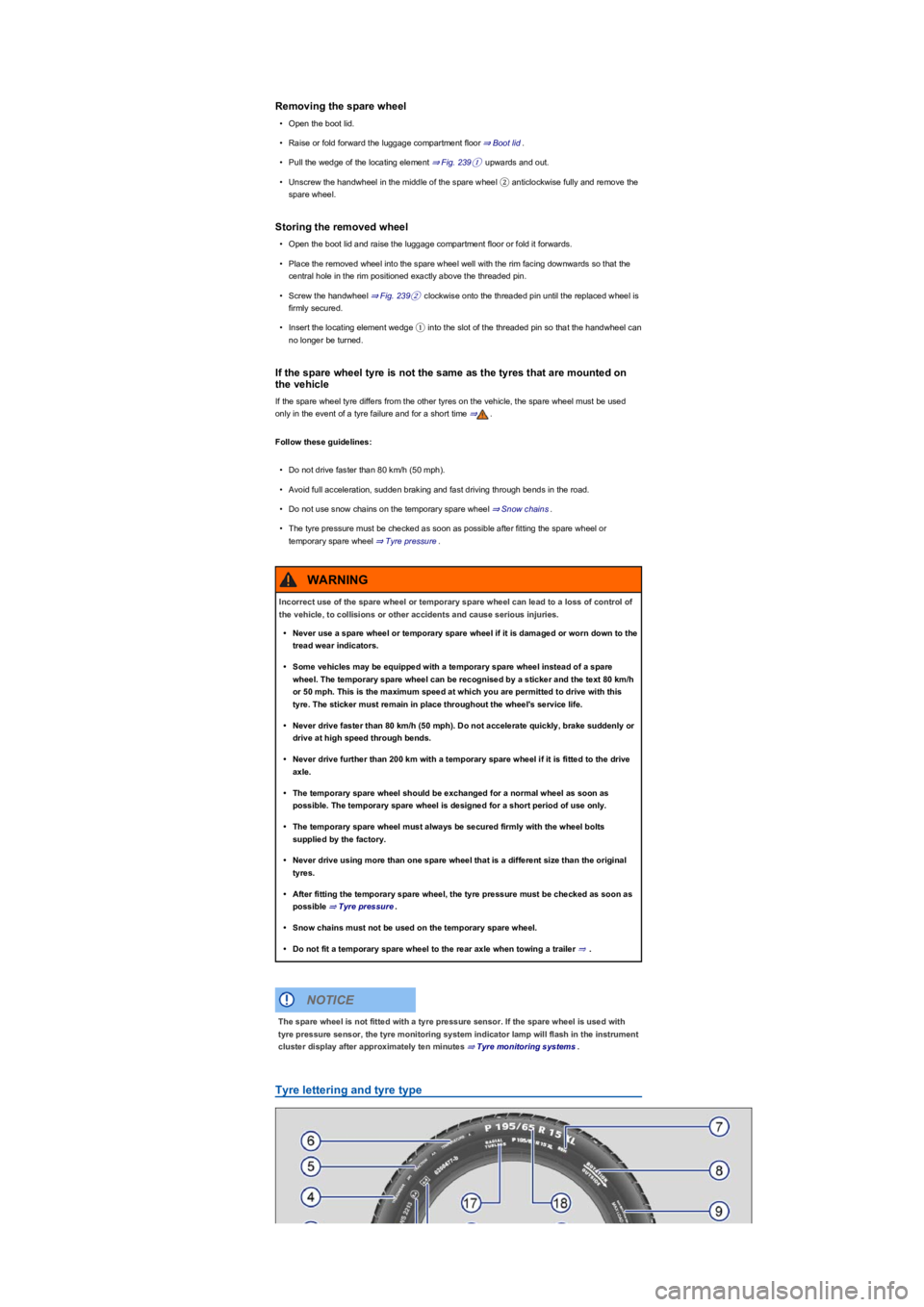
Tyre lettering and tyre type
Incorrect use of the spare wheel or temporary spare wheel can lead to a loss of control of
the vehicle, to collisions or other accidents and cause serious injuries.
•Never use a spare wheel or temporary spare wheel if it is damaged or worn down to the
tread wear indicators.
•Some vehicles may be equipped with a temporary spare wheel instead of a spare
wheel. The temporary spare wheel can be recognised by a sticker and the text 80 km/h
or 50 mph. This is the maximum speed at which you are permitted to drive with this
tyre. The sticker must remain in place throughout the wheel's service life.
•Never drive faster than 80 km/h (50 mph). Do not accelerate quickly, brake suddenly or
drive at high speed through bends.
•Never drive further than 200 km with a temporary spare wheel if it is fitted to the drive
axle.
•The temporary spare wheel should be exchanged for a normal wheel as soon as
possible. The temporary spare wheel is designed for a short period of use only.
•The temporary spare wheel must always be secured firmly with the wheel bolts
supplied by the factory.
•Never drive using more than one spare wheel that is a different size than the original
tyres.
•After fitting the temporary spare wheel, the tyre pressure must be checked as soon as
possible ⇒ Tyre pressure.
•Snow chains must not be used on the temporary spare wheel.
•Do not fit a temporary spare wheel to the rear axle when towing a trailer ⇒.
WARNING
The spare wheel is not fitted with a tyre pressure sensor. If the spare wheel is used with
tyre pressure sensor, the tyre monitoring system indicator lamp will flash in the instrument
cluster display after approximately ten minutes ⇒ Tyre monitoring systems.
NOTICE
Page 308 of 341
Ask all vehicle occupants to leave the vehicle and stand at a safe distance away from moving
traffic.
Chock the wheel diagonally opposite the wheel being worked on with a stone, collapsible
chocks or another suitable object.
When towing a trailer: unhitch the trailer from the vehicle and park it properly .
Remove any items of luggage from the luggage compartment.
Remove the spare wheel or temporary spare wheel and the vehicle tool kit from the
luggage compartment.
Remove the hubcaps Hubcaps.
Wheel bolts
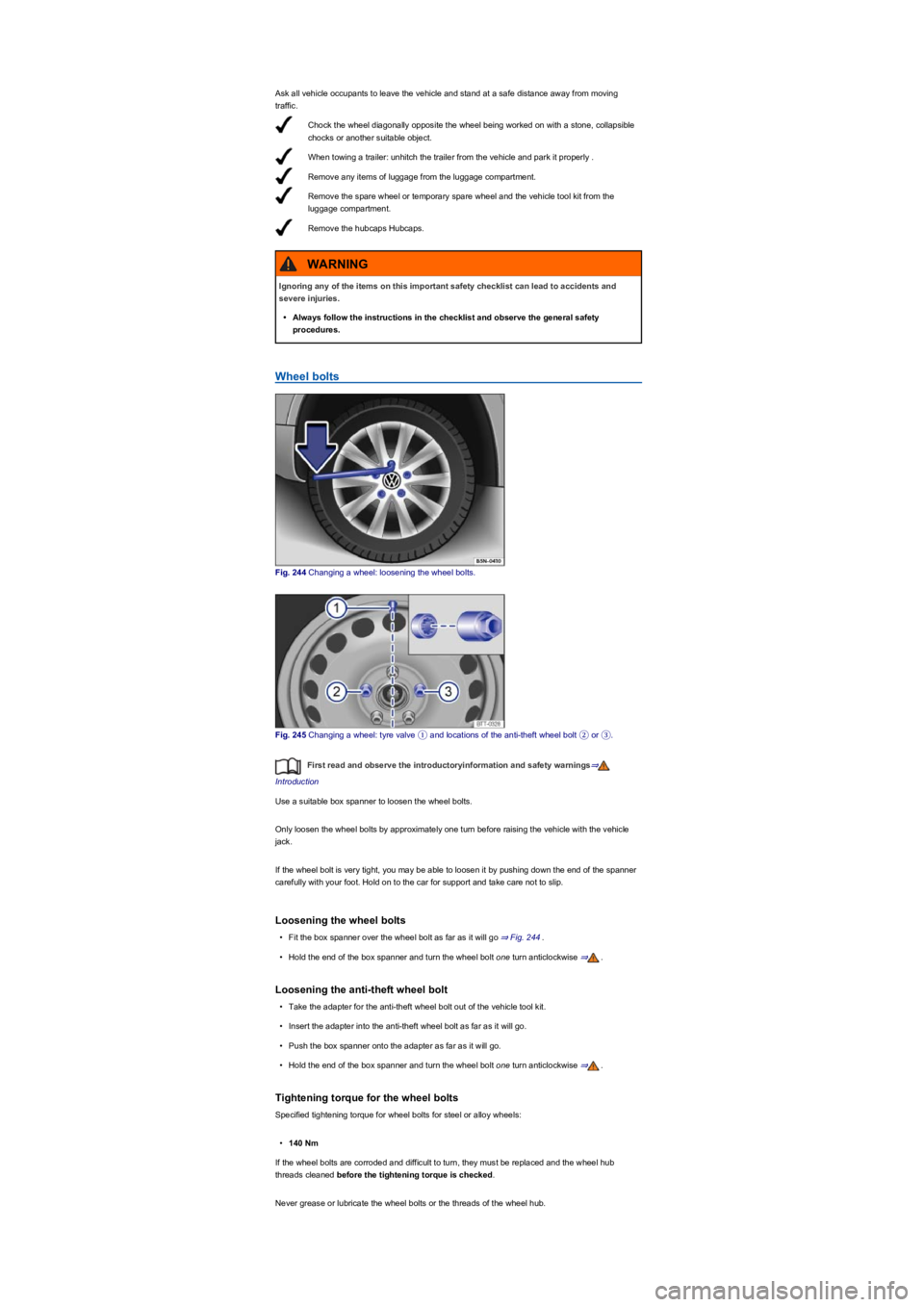
Fig. 244 Changing a wheel: loosening the wheel bolts.
Fig. 245 Changing a wheel: tyre valve ① and locations of the anti-theft wheel bolt ② or ③.
First read and observe the introductoryinformation and safety warnings⇒
Introduction
Use a suitable box spanner to loosen the wheel bolts.
Only loosen the wheel bolts by approximately one turn before raising the vehicle with the vehicle
jack.
If the wheel bolt is very tight, you may be able to loosen it by pushing down the end of the spanner
carefully with your foot. Hold on to the car for support and take care not to slip.
Loosening the wheel bolts
•Fit the box spanner over the wheel bolt as far as it will go ⇒ Fig. 244.
•Hold the end of the box spanner and turn the wheel bolt one turn anticlockwise ⇒.
Loosening the anti-theft wheel bolt
•Take the adapter for the anti-theft wheel bolt out of the vehicle tool kit.
•Insert the adapter into the anti-theft wheel bolt as far as it will go.
•Push the box spanner onto the adapter as far as it will go.
•Hold the end of the box spanner and turn the wheel bolt one turn anticlockwise ⇒.
Tightening torque for the wheel bolts
Specified tightening torque for wheel bolts for steel or alloy wheels:
•140 Nm
If the wheel bolts are corroded and difficult to turn, they must be replaced and the wheel hub
threads cleaned before the tightening torque is checked.
Never grease or lubricate the wheel bolts or the threads of the wheel hub.
Ignoring any of the items on this important safety checklist can lead to accidents and
severe injuries.
•Always follow the instructions in the checklist and observe the general safety
procedures.
WARNING