engine oil VOLKSWAGEN TIGUAN 2017 Owner´s Manual
[x] Cancel search | Manufacturer: VOLKSWAGEN, Model Year: 2017, Model line: TIGUAN, Model: VOLKSWAGEN TIGUAN 2017Pages: 341, PDF Size: 9.14 MB
Page 153 of 341
Steering
Information on steering
The steering should be locked every time you leave the vehicle to make it more difficult for the
vehicle to be stolen.
Steering
The power steering is not hydraulic. It is an electromechanical system. The advantage of this
steering system is that no hydraulic hoses, hydraulic oil, pumps, filter or other parts are required.
The electromechanical system reduces fuel consumption. A hydraulic system requires constant oil
pressure in the system, whereas an electromechanical steering system only needs an energy
supply while steering.
In vehicles with driving profile selection, the selected driving profile can affect the behaviour of the
power steering ⇒ Driving profile selection and 4MOTION Active Control.
Electronic steering column lock in vehicles with starter button
The steering column will be locked if the driver door is opened and the ignition is switched off. For
this, the vehicle should be stationary and, if necessary, the gear selector lever should be in position
P.
If the ignition is not switched off until after the driver door is opened, the electronic steering column
will only be locked when the vehicle is locked using the vehicle key or the sensor in the door
handle.
Mechanical steering column lock (steering lock) in vehicles with an
ignition lock
The steering column is locked if the vehicle key is removed from the ignition lock when the vehicle
is stationary. Turn the steering wheel slightly until the steering lock clicks into place.
Insert the vehicle key into the ignition lock to unlock the steering lock. Turn the steering wheel
slightly to take the load off the steering lock mechanism. Hold the steering wheel in this position and
turn the ignition on.
Electromechanical steering
The power steering provided by the electromechanical steering system automatically adjusts to the
vehicle speed, steering wheel torque and steering wheel angle. The electromechanical steering
only functions when the engine is running.
You will need considerably more strength than normal to steer the vehicle if the power steering is
reduced or has failed completely.
Counter steering assistance
Counter steering assistance provides the driver with power steering in critical driving situations.
Additional steering power helps the driver when counter steering ⇒.
The intelligent Hill Descent Control technology cannot overcome the laws of physics, and
functions only within the limits of the system. Never allow the extra convenience afforded
by pull-away assist systems to tempt you into taking any risks when driving.
•Unintentional vehicle movements can cause serious injury.
•The Hill Descent Control cannot replace the full concentration of the driver.
•Always adapt your speed and driving style to suit visibility, weather, road and traffic
conditions.
•A Hill Descent Control System may not be able to always hold the vehicle on uphill
gradients or brake it sufficiently on all slopes going downhill (e.g. if the ground is
slippery or icy).
WARNING
Always be prepared to brake the vehicle. Accidents and injuries could occur if this is not
ensured.
•The Hill Descent Control system is only a support function and may not be able to
brake the vehicle sufficiently in all situations when driving downhill.
•The vehicle may accelerate despite the Hill Descent Control system.
WARNING
Page 158 of 341
•Press the button in the Infotainment system.
•Touch the Vehicle function button.
•Touch the Selection function button.
•Touch the Off-road function button.
Selecting instruments and setting units
The display shows various instruments ⇒ Fig. 130.
To change instruments, swipe vertically over the display.
The units can be adjusted for some instruments in the Infotainment system ⇒ Operation and
display in the Infotainment system.
Instruments in the off-road display (depends on the vehicle's equipment):
•Altitude: The altitude function shows the current height above sea level.
•Steering angle display: the steering angle of the vehicle is displayed in the range between -
49° and 49°. The value is positive for a left steering angle and negative for a right steering
angle.
•Compass: the compass shows the current driving direction.
•Coolant temperature display: the display corresponds to the temperature display on the
instrument cluster ⇒ Coolant temperature display. At high engine loads and with high outside
temperatures, the needle will move clockwise. This is no cause for concern unless the
indicator lamp in the instrument cluster is lit up or flashing.
•Oil temperature display: the needle is in the middle when the engine has reached operating
temperature. If the needle is in the bottom left area, this means that the engine has not yet
reached its operating temperature. At high engine loads and with high outside temperatures, the
needle will move clockwise. This is no cause for concern unless the indicator lamp in
the instrument cluster is lit up or flashing ⇒ Engine oil.
Adapting the display areas to the driving situation
The displayed instruments can be selected depending on the driving situation, the ambient
conditions and the off-road conditions:
•Sandy terrain: oil, steering angle and coolant temperature display
•Inclines: steering angle and coolant temperature display, altimeter
•Alpine terrain: steering angle display, altimeter, compass
Off-road driving situations
Introduction
This chapter contains information on the followingsubjects:
⇒ Safety notes for driving off-road
⇒ Explanation of some technical terms
⇒ Checklist: Before driving off-road
⇒ General rules and driving tips
⇒ Useful accessories for off-road driving
⇒ Changing gear
⇒ Up hill and down dale
⇒ Driving through water
⇒ Off-road driving in snow
⇒ Driving in sand and mud
⇒ Driving in steep terrain
⇒ Traversing a slope
⇒ Driving through ditches
⇒ If your vehicle gets stuck
⇒ After off-road driving
You can also drive four-wheel drive vehicles off-road in addition to normal roads. It is very important
to read the contents of this section before driving off-road.
The vehicle is not built for expeditions.
The examples given in this chapter are an aid for safe off-road driving. However, we cannot predict
whether these guidelines will be valid for all situations that could occur.
The large variety of landscapes and the associated risks and dangers make it impossible to
describe all possible driving situations. The examples are only general guidelines designed to help
you drive off-road safely. It is crucial that you know what to expect when you drive into off-road
terrain you are unfamiliar with. This will enable you to assess potential danger in advance.
Accidents and injuries can occur if the driver is distracted. Operating the Infotainment
system can distract you from the road.
•Always drive carefully and responsibly.
WARNING
Page 161 of 341
Obtain sufficient information before driving into off-road terrain with the vehicle.
Do not plan day tours that are too long. Take increased fuel requirements for off-road
driving into account.
Refill tank completely. Fuel consumption is considerably higher off-road.
Check that your tyres are suitable for the off-road journey you have planned.
Recommendation for difficult off-road terrain: always have off-road tyres fitted to your
vehicle.
Check the tyre pressure on all tyres and correct them if necessary. This includes the
temporary spare wheel, if fitted.
Check engine oil level and refill engine oil as necessary. The engine will only be supplied
with engine oil when it is driven on or across a steep slope if the engine oil level is
sufficient.
Completely refill the washer fluid reservoir with water and washer fluid.
Fit the towing eye at the front and rear. It is not always possible to fit a towing eye when
the vehicle is stuck.
Check the vehicle tool kit and add tools according to individual requirements Useful
accessories for off-road driving.
Pack luggage in the vehicle as evenly and as low as possible. Secure all loose items.
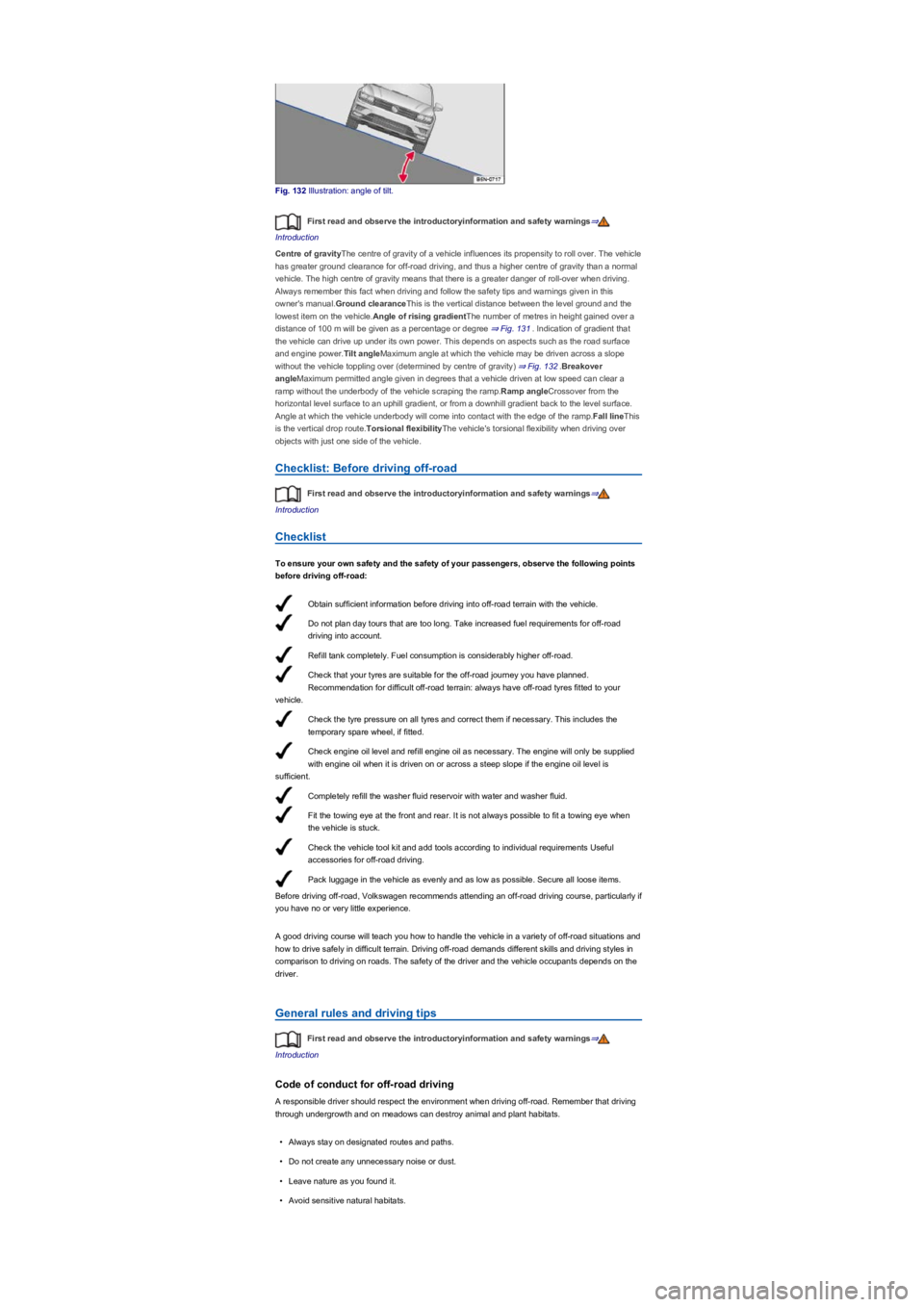
Fig. 132 Illustration: angle of tilt.
First read and observe the introductoryinformation and safety warnings⇒
Introduction
Centre of gravityThe centre of gravity of a vehicle influences its propensity to roll over. The vehicle
has greater ground clearance for off-road driving, and thus a higher centre of gravity than a normal
vehicle. The high centre of gravity means that there is a greater danger of roll-over when driving.
Always remember this fact when driving and follow the safety tips and warnings given in this
owner's manual.Ground clearanceThis is the vertical distance between the level ground and the
lowest item on the vehicle.Angle of rising gradientThe number of metres in height gained over a
distance of 100 m will be given as a percentage or degree ⇒ Fig. 131. Indication of gradient that
the vehicle can drive up under its own power. This depends on aspects such as the road surface
and engine power.Tilt angleMaximum angle at which the vehicle may be driven across a slope
without the vehicle toppling over (determined by centre of gravity) ⇒ Fig. 132.Breakover
angleMaximum permitted angle given in degrees that a vehicle driven at low speed can clear a
ramp without the underbody of the vehicle scraping the ramp.Ramp angleCrossover from the
horizontal level surface to an uphill gradient, or from a downhill gradient back to the level surface.
Angle at which the vehicle underbody will come into contact with the edge of the ramp.Fall lineThis
is the vertical drop route.Torsional flexibilityThe vehicle's torsional flexibility when driving over
objects with just one side of the vehicle.
Checklist: Before driving off-road
First read and observe the introductoryinformation and safety warnings⇒
Introduction
Checklist
To ensure your own safety and the safety of your passengers, observe the following points
before driving off-road:
Before driving off-road, Volkswagen recommends attending an off-road driving course, particularly if
you have no or very little experience.
A good driving course will teach you how to handle the vehicle in a variety of off-road situations and
how to drive safely in difficult terrain. Driving off-road demands different skills and driving styles in
comparison to driving on roads. The safety of the driver and the vehicle occupants depends on the
driver.
General rules and driving tips
First read and observe the introductoryinformation and safety warnings⇒
Introduction
Code of conduct for off-road driving
A responsible driver should respect the environment when driving off-road. Remember that driving
through undergrowth and on meadows can destroy animal and plant habitats.
•Always stay on designated routes and paths.
•Do not create any unnecessary noise or dust.
•Leave nature as you found it.
•Avoid sensitive natural habitats.
Page 163 of 341
•Use the Off-road display ⇒ Off-road display.
Up hill and down dale
First read and observe the introductoryinformation and safety warnings⇒
Introduction
Use off-road mode ⇒ Selecting a driving profile (4MOTION Action Control).
You should drive through rocky terrain at walking pace.
If you are not able to drive around a stone, drive carefully onto the stone with one front wheel and
drive over it slowly ⇒.
Escaping engine oil and brake fluid can pollute the environment. Spilt service fluids must be
collected and then disposed of properly and in an environmentally responsible way.
Driving through water
First read and observe the introductoryinformation and safety warnings⇒
Introduction
Driving through flooded terrain could damage the vehicle ⇒ Checklist: Before driving off-road.
You can drive the vehicle carefully through water with a depth reaching to the bottom edge of the
body, for example puddles or shallow water. Never stop in the water, do not drive in reverse, and
never switch off the engine.
Off-road driving in snow
First read and observe the introductoryinformation and safety warnings⇒
Introduction
Fit snow chains to the front wheels only before driving on snow-covered terrain.
Terrain might look harmless, but there could be hidden dangers. This is particularly true of sections
where there are no tyre tracks.
•You should never drive straight over large obstacles, e.g. boulders or tree stumps, or
drive over such obstacles with one side of the vehicle. Obstacles which require more
ground clearance than is available could damage vehicle components when you drive
over them and thus cause the vehicle to break down.
•Even obstacles that are smaller than the ground clearance selected could come into
contact with the vehicle underbody and thus cause damage which could lead to a
vehicle breakdown. This applies in particular if there is a ditch or soft ground either in
front of or behind the obstacle. This also applies in cases when you drive too quickly
over the obstacle causing the vehicle to bounce.
NOTICE
Strong flowing water can develop enormous power and sweep the vehicle away. This can
lead to very dangerous situations which can cause accidents and serious or even fatal
accidents.
•Never allow the vehicle to stand still in water.
•Water in the engine compartment can cause the vehicle to breakdown in the water.
•Soft ground surface, underwater obstacles and shallows can cause accidents and can
cause the vehicle to breakdown in the water. This could lead to critical situations.
WARNING
If you drive through water, parts of the vehicle, such as the engine, drive train, running
gear and vehicle electrics, could sustain severe damage.
•When driving through water, always select a section where the ground is solid and
where the depth of the water does not exceed the maximum permitted wading depth of
the vehicle.
•Never drive through salt, salty surfaces or salt water as salt can cause corrosion. Rinse
all components that have been exposed to salt or salt water thoroughly with fresh
water.
NOTICE
Page 167 of 341
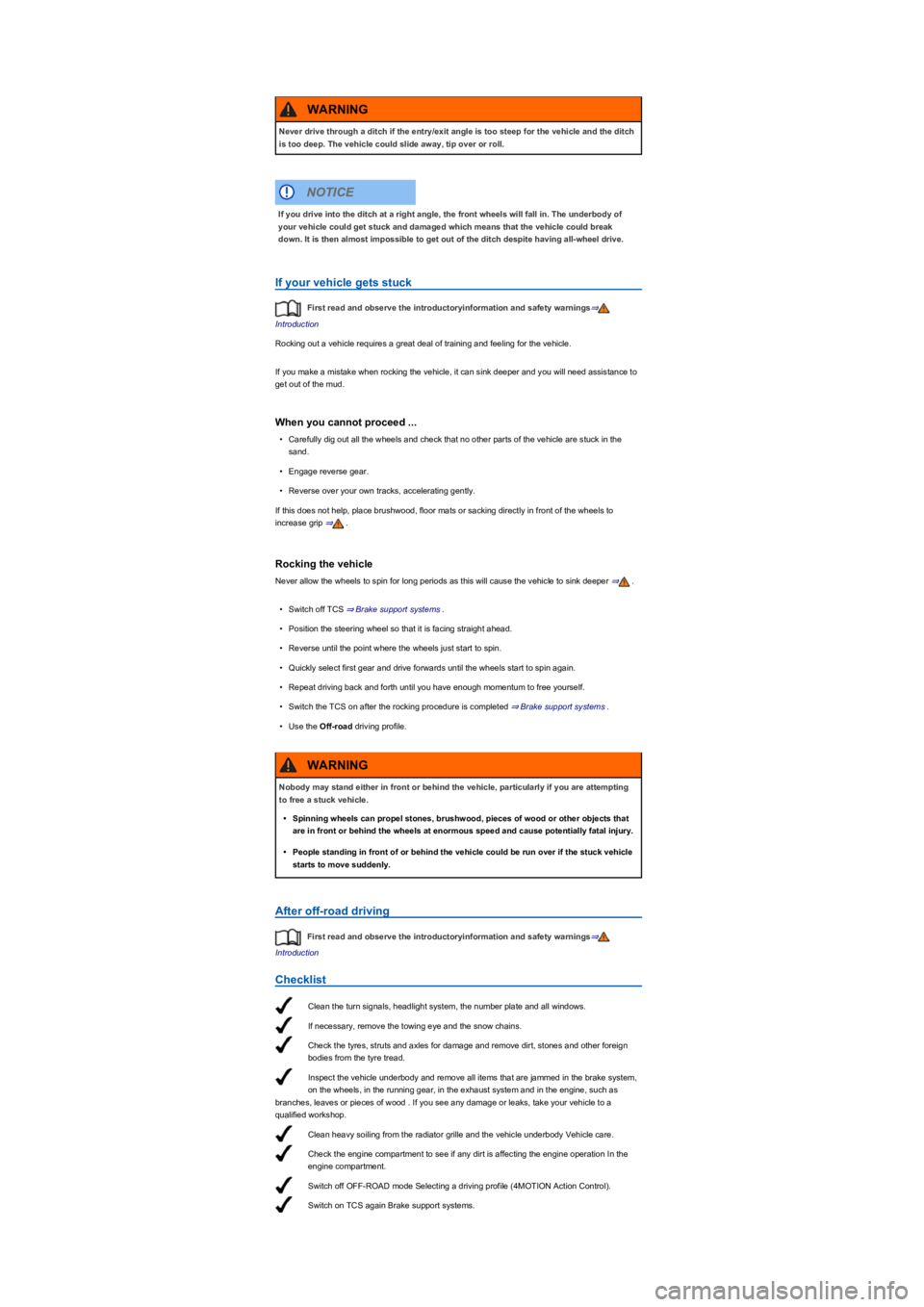
Clean the turn signals, headlight system, the number plate and all windows.
If necessary, remove the towing eye and the snow chains.
Check the tyres, struts and axles for damage and remove dirt, stones and other foreign
bodies from the tyre tread.
Inspect the vehicle underbody and remove all items that are jammed in the brake system,
on the wheels, in the running gear, in the exhaust system and in the engine, such as
branches, leaves or pieces of wood . If you see any damage or leaks, take your vehicle to a
qualified workshop.
Clean heavy soiling from the radiator grille and the vehicle underbody Vehicle care.
Check the engine compartment to see if any dirt is affecting the engine operation In the
engine compartment.
Switch off OFF-ROAD mode Selecting a driving profile (4MOTION Action Control).
Switch on TCS again Brake support systems.
If your vehicle gets stuck
First read and observe the introductoryinformation and safety warnings⇒
Introduction
Rocking out a vehicle requires a great deal of training and feeling for the vehicle.
If you make a mistake when rocking the vehicle, it can sink deeper and you will need assistance to
get out of the mud.
When you cannot proceed ...
•Carefully dig out all the wheels and check that no other parts of the vehicle are stuck in the
sand.
•Engage reverse gear.
•Reverse over your own tracks, accelerating gently.
If this does not help, place brushwood, floor mats or sacking directly in front of the wheels to
increase grip ⇒.
Rocking the vehicle
Never allow the wheels to spin for long periods as this will cause the vehicle to sink deeper ⇒.
•Switch off TCS ⇒ Brake support systems.
•Position the steering wheel so that it is facing straight ahead.
•Reverse until the point where the wheels just start to spin.
•Quickly select first gear and drive forwards until the wheels start to spin again.
•Repeat driving back and forth until you have enough momentum to free yourself.
•Switch the TCS on after the rocking procedure is completed ⇒ Brake support systems.
•Use the Off-road driving profile.
After off-road driving
First read and observe the introductoryinformation and safety warnings⇒
Introduction
Checklist
Never drive through a ditch if the entry/exit angle is too steep for the vehicle and the ditch
is too deep. The vehicle could slide away, tip over or roll.
WARNING
If you drive into the ditch at a right angle, the front wheels will fall in. The underbody of
your vehicle could get stuck and damaged which means that the vehicle could break
down. It is then almost impossible to get out of the ditch despite having all-wheel drive.
NOTICE
Nobody may stand either in front or behind the vehicle, particularly if you are attempting
to free a stuck vehicle.
•Spinning wheels can propel stones, brushwood, pieces of wood or other objects that
are in front or behind the wheels at enormous speed and cause potentially fatal injury.
•People standing in front of or behind the vehicle could be run over if the stuck vehicle
starts to move suddenly.
WARNING
Page 190 of 341
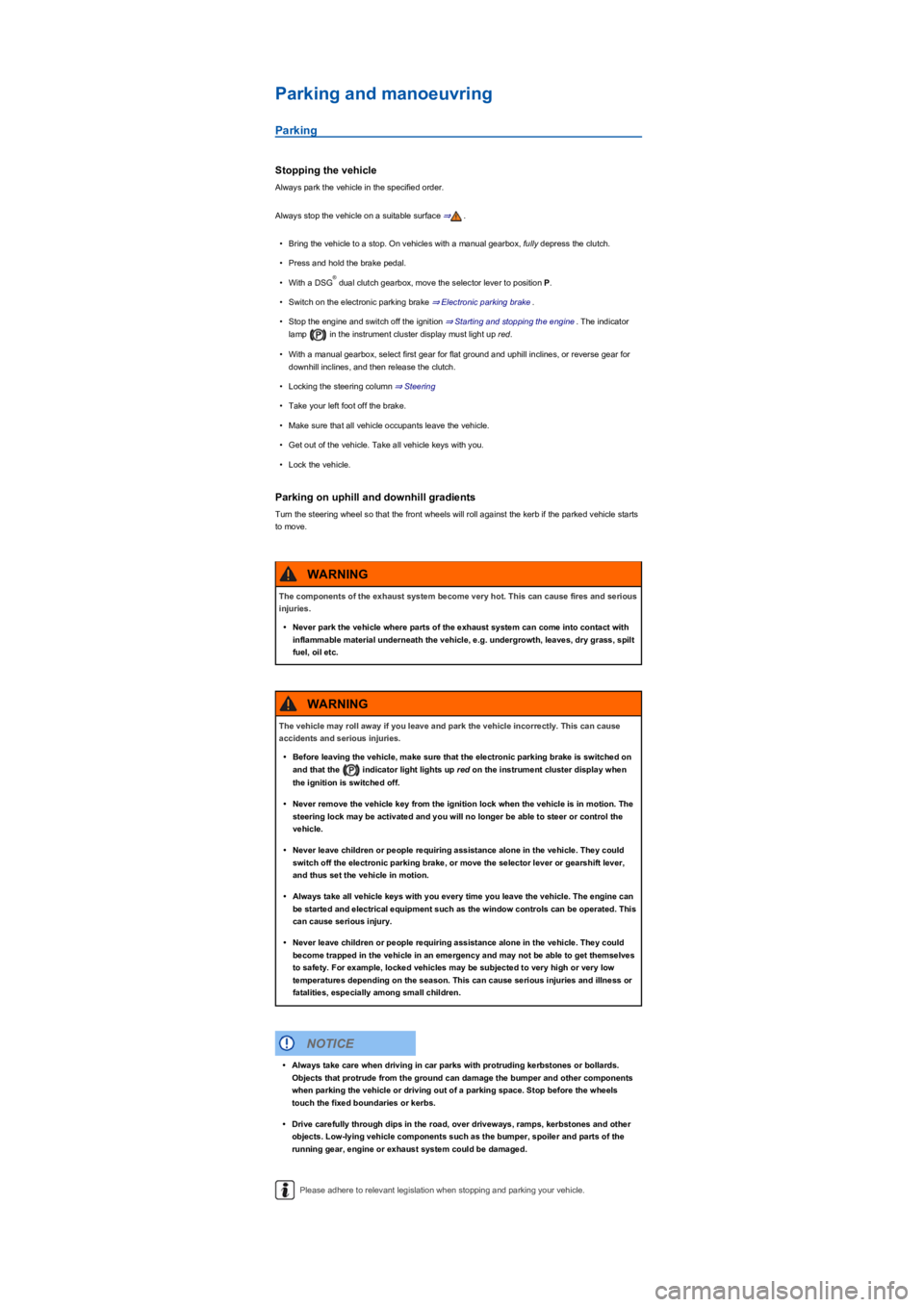
Parking and manoeuvring
Parking
Stopping the vehicle
Always park the vehicle in the specified order.
Always stop the vehicle on a suitable surface ⇒.
•Bring the vehicle to a stop. On vehicles with a manual gearbox, fully depress the clutch.
•Press and hold the brake pedal.
•With a DSG dual clutch gearbox, move the selector lever to position P.
•Switch on the electronic parking brake ⇒ Electronic parking brake.
•Stop the engine and switch off the ignition ⇒ Starting and stopping the engine. The indicator
lamp in the instrument cluster display must light up red.
•With a manual gearbox, select first gear for flat ground and uphill inclines, or reverse gear for
downhill inclines, and then release the clutch.
•Locking the steering column ⇒ Steering
•Take your left foot off the brake.
•Make sure that all vehicle occupants leave the vehicle.
•Get out of the vehicle. Take all vehicle keys with you.
•Lock the vehicle.
Parking on uphill and downhill gradients
Turn the steering wheel so that the front wheels will roll against the kerb if the parked vehicle starts
to move.
Please adhere to relevant legislation when stopping and parking your vehicle.
®
The components of the exhaust system become very hot. This can cause fires and serious
injuries.
•Never park the vehicle where parts of the exhaust system can come into contact with
inflammable material underneath the vehicle, e.g. undergrowth, leaves, dry grass, spilt
fuel, oil etc.
WARNING
The vehicle may roll away if you leave and park the vehicle incorrectly. This can cause
accidents and serious injuries.
•Before leaving the vehicle, make sure that the electronic parking brake is switched on
and that the indicator light lights up red on the instrument cluster display when
the ignition is switched off.
•Never remove the vehicle key from the ignition lock when the vehicle is in motion. The
steering lock may be activated and you will no longer be able to steer or control the
vehicle.
•Never leave children or people requiring assistance alone in the vehicle. They could
switch off the electronic parking brake, or move the selector lever or gearshift lever,
and thus set the vehicle in motion.
•Always take all vehicle keys with you every time you leave the vehicle. The engine can
be started and electrical equipment such as the window controls can be operated. This
can cause serious injury.
•Never leave children or people requiring assistance alone in the vehicle. They could
become trapped in the vehicle in an emergency and may not be able to get themselves
to safety. For example, locked vehicles may be subjected to very high or very low
temperatures depending on the season. This can cause serious injuries and illness or
fatalities, especially among small children.
WARNING
•Always take care when driving in car parks with protruding kerbstones or bollards.
Objects that protrude from the ground can damage the bumper and other components
when parking the vehicle or driving out of a parking space. Stop before the wheels
touch the fixed boundaries or kerbs.
•Drive carefully through dips in the road, over driveways, ramps, kerbstones and other
objects. Low-lying vehicle components such as the bumper, spoiler and parts of the
running gear, engine or exhaust system could be damaged.
NOTICE
Page 244 of 341
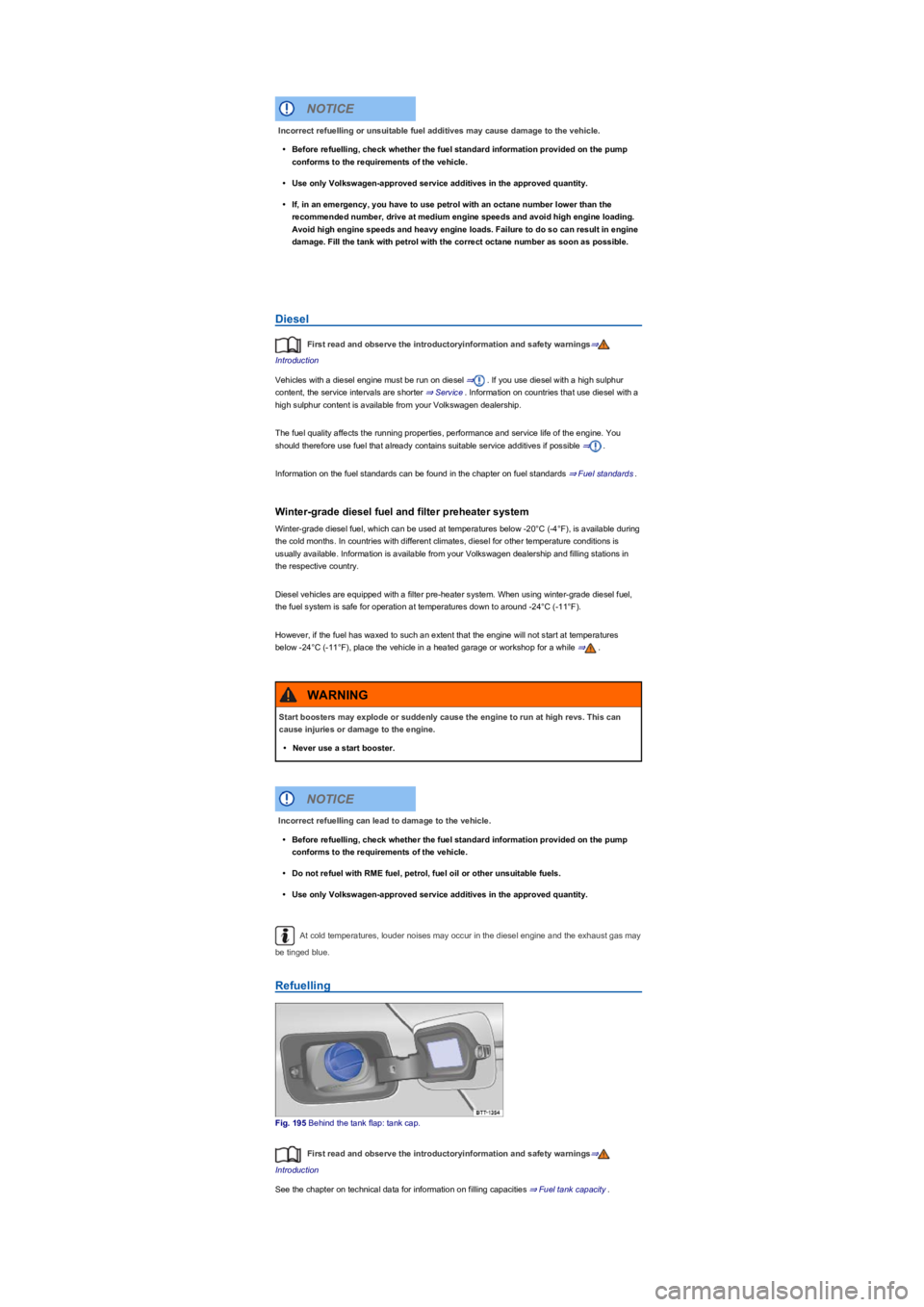
Diesel
First read and observe the introductoryinformation and safety warnings⇒
Introduction
Vehicles with a diesel engine must be run on diesel ⇒. If you use diesel with a high sulphur
content, the service intervals are shorter ⇒ Service. Information on countries that use diesel with a
high sulphur content is available from your Volkswagen dealership.
The fuel quality affects the running properties, performance and service life of the engine. You
should therefore use fuel that already contains suitable service additives if possible ⇒.
Information on the fuel standards can be found in the chapter on fuel standards ⇒ Fuel standards.
Winter-grade diesel fuel and filter preheater system
Winter-grade diesel fuel, which can be used at temperatures below -20°C (-4°F), is available during
the cold months. In countries with different climates, diesel for other temperature conditions is
usually available. Information is available from your Volkswagen dealership and filling stations in
the respective country.
Diesel vehicles are equipped with a filter pre-heater system. When using winter-grade diesel fuel,
the fuel system is safe for operation at temperatures down to around -24°C (-11°F).
However, if the fuel has waxed to such an extent that the engine will not start at temperatures
below -24°C (-11°F), place the vehicle in a heated garage or workshop for a while ⇒.
At cold temperatures, louder noises may occur in the diesel engine and the exhaust gas may
be tinged blue.
Refuelling
Fig. 195 Behind the tank flap: tank cap.
First read and observe the introductoryinformation and safety warnings⇒
Introduction
See the chapter on technical data for information on filling capacities ⇒ Fuel tank capacity.
Incorrect refuelling or unsuitable fuel additives may cause damage to the vehicle.
•Before refuelling, check whether the fuel standard information provided on the pump
conforms to the requirements of the vehicle.
•Use only Volkswagen-approved service additives in the approved quantity.
•If, in an emergency, you have to use petrol with an octane number lower than the
recommended number, drive at medium engine speeds and avoid high engine loading.
Avoid high engine speeds and heavy engine loads. Failure to do so can result in engine
damage. Fill the tank with petrol with the correct octane number as soon as possible.
NOTICE
Start boosters may explode or suddenly cause the engine to run at high revs. This can
cause injuries or damage to the engine.
•Never use a start booster.
WARNING
Incorrect refuelling can lead to damage to the vehicle.
•Before refuelling, check whether the fuel standard information provided on the pump
conforms to the requirements of the vehicle.
•Do not refuel with RME fuel, petrol, fuel oil or other unsuitable fuels.
•Use only Volkswagen-approved service additives in the approved quantity.
NOTICE
Page 248 of 341
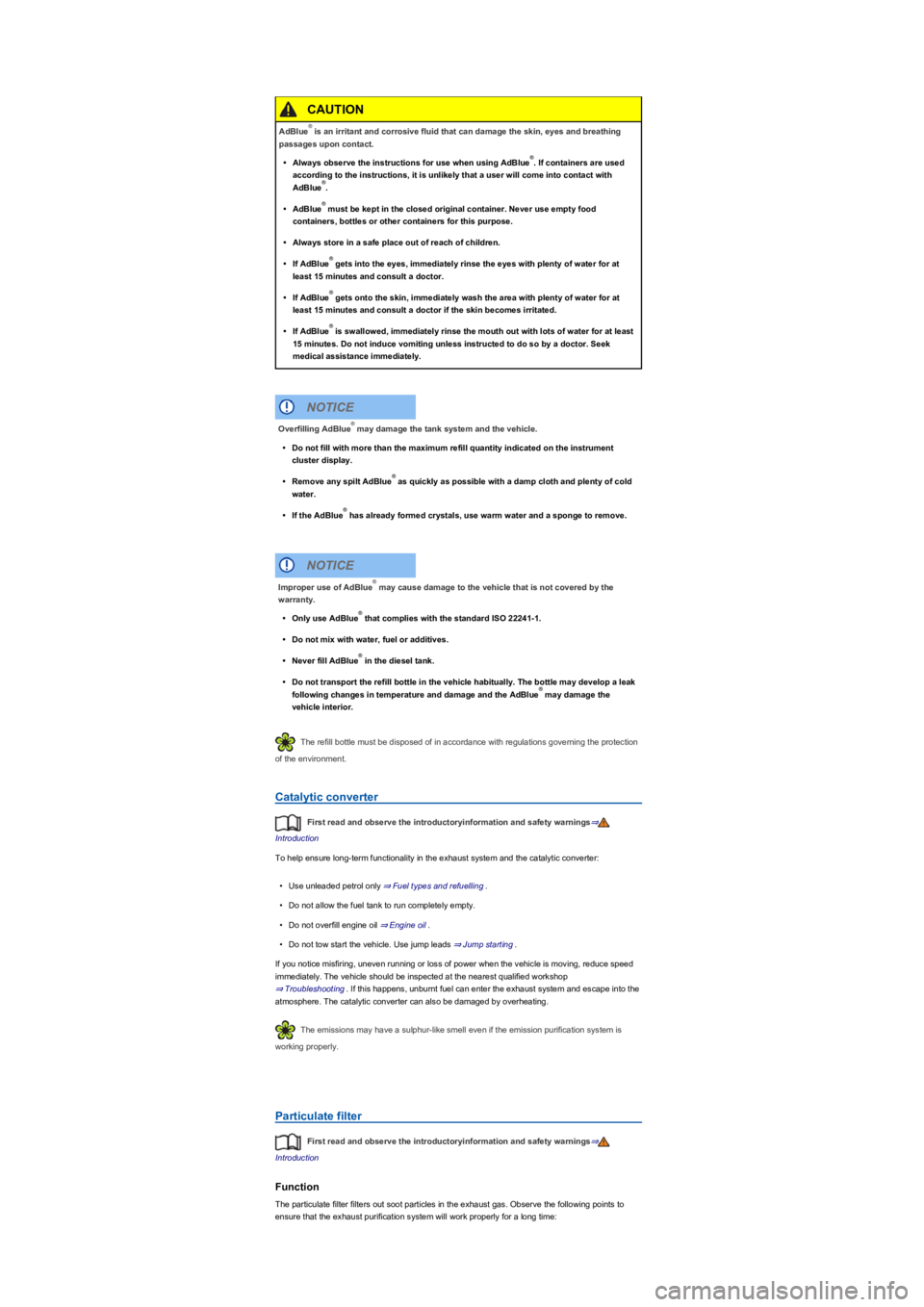
The refill bottle must be disposed of in accordance with regulations governing the protection
of the environment.
Catalytic converter
First read and observe the introductoryinformation and safety warnings⇒
Introduction
To help ensure long-term functionality in the exhaust system and the catalytic converter:
•Use unleaded petrol only ⇒ Fuel types and refuelling.
•Do not allow the fuel tank to run completely empty.
•Do not overfill engine oil ⇒ Engine oil.
•Do not tow start the vehicle. Use jump leads ⇒ Jump starting.
If you notice misfiring, uneven running or loss of power when the vehicle is moving, reduce speed
immediately. The vehicle should be inspected at the nearest qualified workshop
⇒ Troubleshooting. If this happens, unburnt fuel can enter the exhaust system and escape into the
atmosphere. The catalytic converter can also be damaged by overheating.
The emissions may have a sulphur-like smell even if the emission purification system is
working properly.
Particulate filter
First read and observe the introductoryinformation and safety warnings⇒
Introduction
Function
The particulate filter filters out soot particles in the exhaust gas. Observe the following points to
ensure that the exhaust purification system will work properly for a long time:
AdBlue is an irritant and corrosive fluid that can damage the skin, eyes and breathing
passages upon contact.
•Always observe the instructions for use when using AdBlue. If containers are used
according to the instructions, it is unlikely that a user will come into contact with
AdBlue.
•AdBlue must be kept in the closed original container. Never use empty food
containers, bottles or other containers for this purpose.
•Always store in a safe place out of reach of children.
•If AdBlue gets into the eyes, immediately rinse the eyes with plenty of water for at
least 15 minutes and consult a doctor.
•If AdBlue gets onto the skin, immediately wash the area with plenty of water for at
least 15 minutes and consult a doctor if the skin becomes irritated.
•If AdBlue is swallowed, immediately rinse the mouth out with lots of water for at least
15 minutes. Do not induce vomiting unless instructed to do so by a doctor. Seek
medical assistance immediately.
CAUTION
®
®
®
®
®
®
®
Overfilling AdBlue may damage the tank system and the vehicle.
•Do not fill with more than the maximum refill quantity indicated on the instrument
cluster display.
•Remove any spilt AdBlue as quickly as possible with a damp cloth and plenty of cold
water.
•If the AdBlue has already formed crystals, use warm water and a sponge to remove.
NOTICE
®
®
®
Improper use of AdBlue may cause damage to the vehicle that is not covered by the
warranty.
•Only use AdBlue that complies with the standard ISO 22241-1.
•Do not mix with water, fuel or additives.
•Never fill AdBlue in the diesel tank.
•Do not transport the refill bottle in the vehicle habitually. The bottle may develop a leak
following changes in temperature and damage and the AdBlue may damage the
vehicle interior.
NOTICE
®
®
®
®
Page 249 of 341
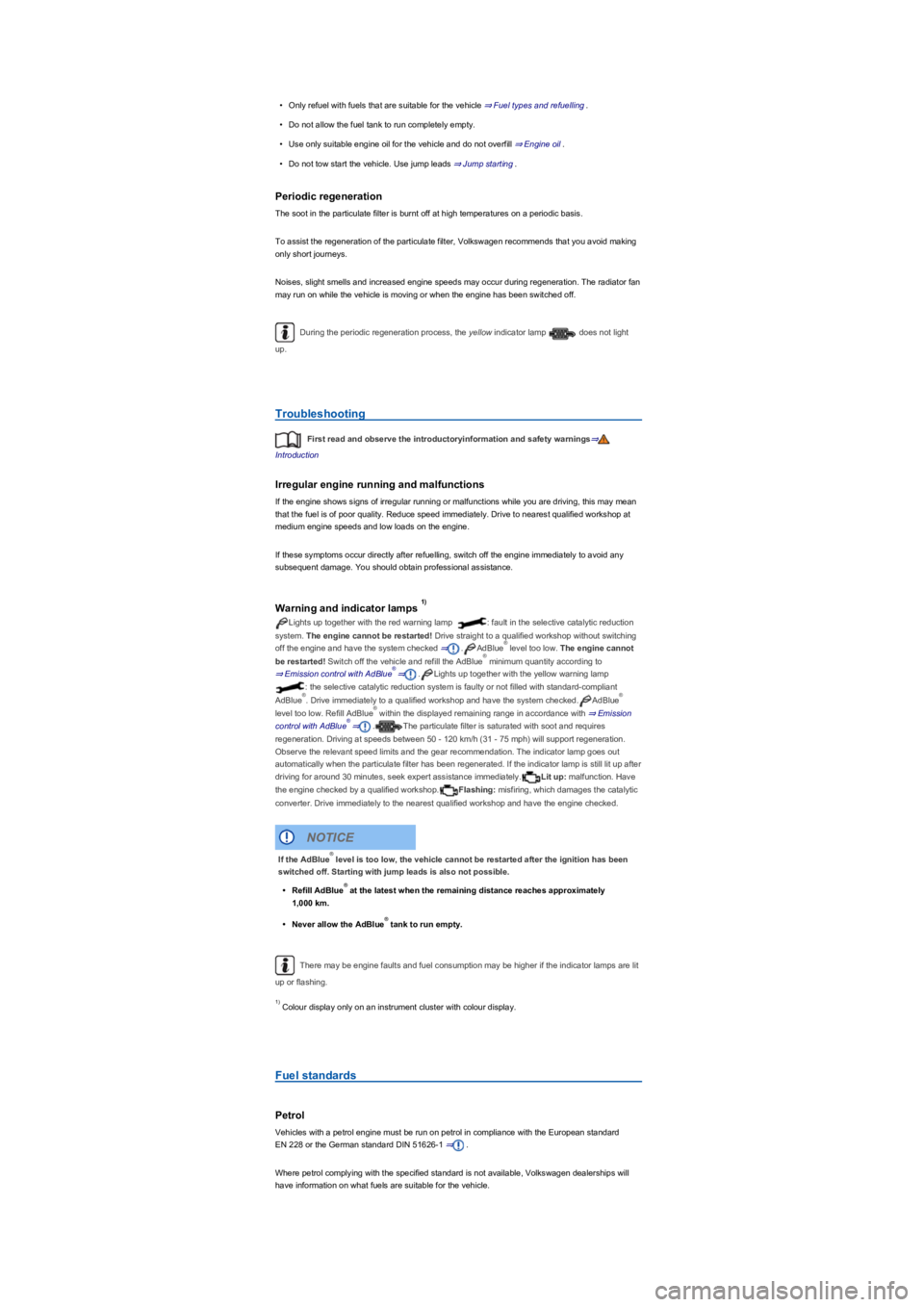
•Only refuel with fuels that are suitable for the vehicle ⇒ Fuel types and refuelling.
•Do not allow the fuel tank to run completely empty.
•Use only suitable engine oil for the vehicle and do not overfill ⇒ Engine oil.
•Do not tow start the vehicle. Use jump leads ⇒ Jump starting.
Periodic regeneration
The soot in the particulate filter is burnt off at high temperatures on a periodic basis.
To assist the regeneration of the particulate filter, Volkswagen recommends that you avoid making
only short journeys.
Noises, slight smells and increased engine speeds may occur during regeneration. The radiator fan
may run on while the vehicle is moving or when the engine has been switched off.
During the periodic regeneration process, the yellow indicator lamp does not light
up.
Troubleshooting
First read and observe the introductoryinformation and safety warnings⇒
Introduction
Irregular engine running and malfunctions
If the engine shows signs of irregular running or malfunctions while you are driving, this may mean
that the fuel is of poor quality. Reduce speed immediately. Drive to nearest qualified workshop at
medium engine speeds and low loads on the engine.
If these symptoms occur directly after refuelling, switch off the engine immediately to avoid any
subsequent damage. You should obtain professional assistance.
Warning and indicator lamps
Lights up together with the red warning lamp : fault in the selective catalytic reduction
system. The engine cannot be restarted! Drive straight to a qualified workshop without switching
off the engine and have the system checked ⇒.AdBlue level too low. The engine cannot
be restarted! Switch off the vehicle and refill the AdBlue minimum quantity according to
⇒ Emission control with AdBlue⇒.Lights up together with the yellow warning lamp
: the selective catalytic reduction system is faulty or not filled with standard-compliant
AdBlue. Drive immediately to a qualified workshop and have the system checked.AdBlue
level too low. Refill AdBlue within the displayed remaining range in accordance with ⇒ Emission
control with AdBlue⇒.The particulate filter is saturated with soot and requires
regeneration. Driving at speeds between 50 - 120 km/h (31 - 75 mph) will support regeneration.
Observe the relevant speed limits and the gear recommendation. The indicator lamp goes out
automatically when the particulate filter has been regenerated. If the indicator lamp is still lit up after
driving for around 30 minutes, seek expert assistance immediately.Lit up: malfunction. Have
the engine checked by a qualified workshop.Flashing: misfiring, which damages the catalytic
converter. Drive immediately to the nearest qualified workshop and have the engine checked.
There may be engine faults and fuel consumption may be higher if the indicator lamps are lit
up or flashing.
Colour display only on an instrument cluster with colour display.
Fuel standards
Petrol
Vehicles with a petrol engine must be run on petrol in compliance with the European standard
EN 228 or the German standard DIN 51626-1 ⇒.
Where petrol complying with the specified standard is not available, Volkswagen dealerships will
have information on what fuels are suitable for the vehicle.
1)
®
®
®
®®
®
®
If the AdBlue level is too low, the vehicle cannot be restarted after the ignition has been
switched off. Starting with jump leads is also not possible.
•Refill AdBlue at the latest when the remaining distance reaches approximately
1,000 km.
•Never allow the AdBlue tank to run empty.
NOTICE
®
®
®
1)
Page 269 of 341
•The steering function or the operating clearance of the wheels cannot be ensured after an
accident.
If your own vehicle has to be towed:
•Switch on the ignition.
•Select the neutral position or move the selector lever to N⇒ DSG dual clutch gearbox.
•Do not allow the vehicle to be towed at speeds faster than 50 km/h (30 mph).
•Do not allow the vehicle to be towed further than 50 km.
•Vehicles with a DSG dual clutch gearbox may only be towed by the breakdown truck with the
front wheels raised.
Towing vehicles with four-wheel drive (4MOTION)
Vehicles with four-wheel drive (4MOTION) may be towed with a tow bar or tow rope. If the vehicle
is towed with the rear or front axle raised, the engine must be switched off otherwise the drive train
could be damaged.
Please comply with the following when towing another vehicle:
•Comply with legal regulations.
•Comply with the information on towing contained in the owner's manual for the other vehicle.
The vehicle can only be towed when the electronic parking brake is switched off and, if
applicable, when the electronic steering column lock is released. If the power supply fails or if there
are faults in the electrical system, you may need to use jump leads to start the engine to release the
electronic parking brake and the electronic steering column lock.
Fitting the rear towing eye
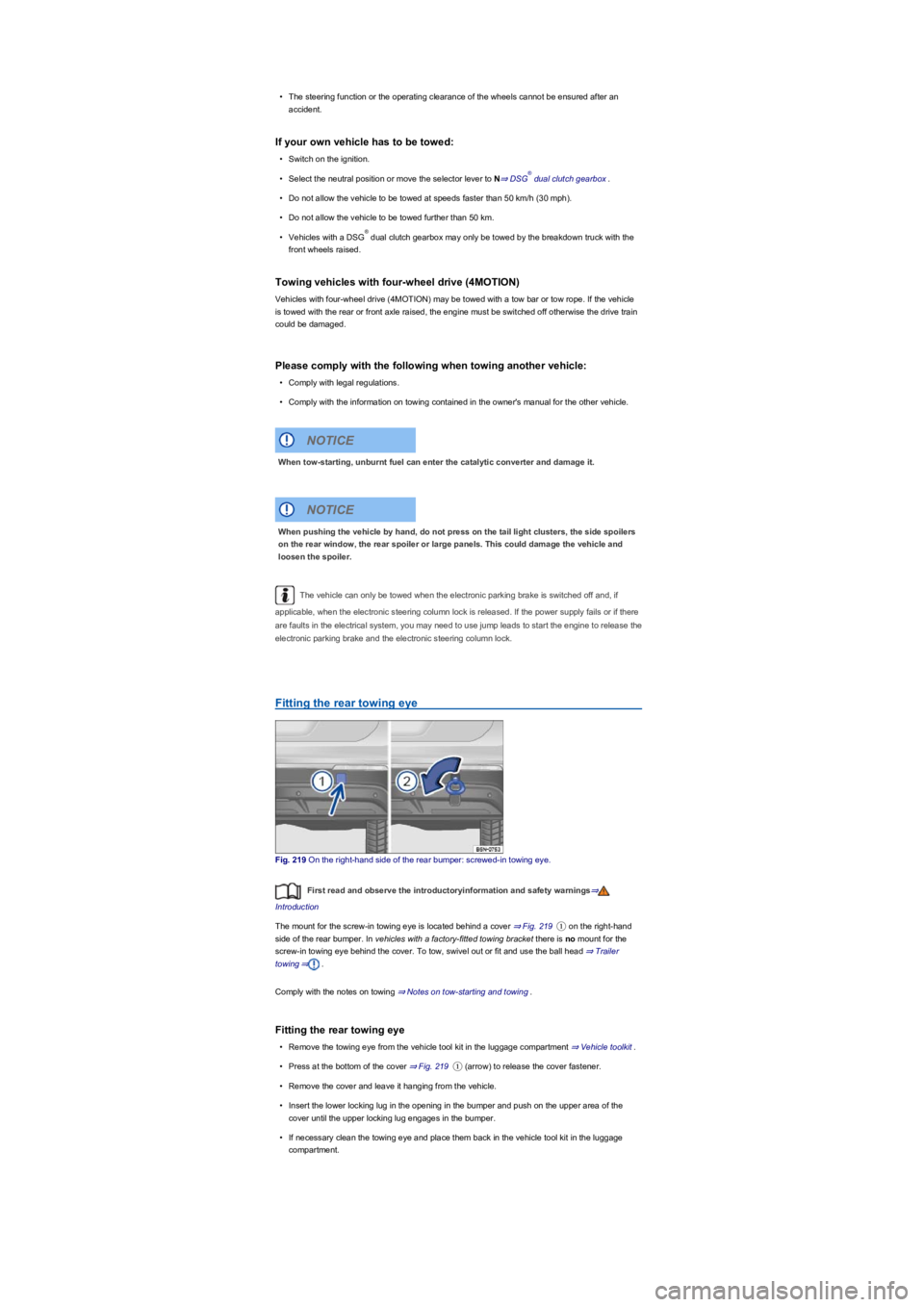
Fig. 219 On the right-hand side of the rear bumper: screwed-in towing eye.
First read and observe the introductoryinformation and safety warnings⇒
Introduction
The mount for the screw-in towing eye is located behind a cover ⇒ Fig. 219① on the right-hand
side of the rear bumper. In vehicles with a factory-fitted towing bracket there is no mount for the
screw-in towing eye behind the cover. To tow, swivel out or fit and use the ball head ⇒ Trailer
towing⇒.
Comply with the notes on towing ⇒ Notes on tow-starting and towing.
Fitting the rear towing eye
•Remove the towing eye from the vehicle tool kit in the luggage compartment ⇒ Vehicle toolkit.
•Press at the bottom of the cover ⇒ Fig. 219① (arrow) to release the cover fastener.
•Remove the cover and leave it hanging from the vehicle.
•Insert the lower locking lug in the opening in the bumper and push on the upper area of the
cover until the upper locking lug engages in the bumper.
•If necessary clean the towing eye and place them back in the vehicle tool kit in the luggage
compartment.
®
®
When tow-starting, unburnt fuel can enter the catalytic converter and damage it.
NOTICE
When pushing the vehicle by hand, do not press on the tail light clusters, the side spoilers
on the rear window, the rear spoiler or large panels. This could damage the vehicle and
loosen the spoiler.
NOTICE