heater VOLKSWAGEN TIGUAN 2017 Owner´s Manual
[x] Cancel search | Manufacturer: VOLKSWAGEN, Model Year: 2017, Model line: TIGUAN, Model: VOLKSWAGEN TIGUAN 2017Pages: 341, PDF Size: 9.14 MB
Page 139 of 341
•m/k/a995MKVehicles with ignition lock: Turn the vehicle key to position ⇒ Fig. 118② –
do not depress the accelerator. Release the vehicle key once the engine has started.
•m/k/a995MKVehicles with a starter button: Press the starter button once ⇒ Starter
button – do not depress the accelerator. There must be a valid vehicle key in the vehicle before
the engine can be started. Release the starter button once the engine has started.
•If the engine does not start, stop the start procedure and repeat it after approximately one
minute.
•m/k/a995MK Vehicles with starter button: Jump start the vehicle if necessary
⇒ Emergency start function.
•Switch off the electronic parking brake if you wish to pull away.
Do not warm up the engine by running it while the vehicle is stationary. Instead, pull off as
soon as there is good visibility through the windows. This helps the engine to reach operating
temperature more quickly and reduces emissions.
Components with a high power consumption are switched off temporarily when the engine is
started.
The engine cannot, for example, be started with the starter button if the cell battery in the
vehicle key is weak or flat. In this case, use the emergency start function ⇒ Emergency start
function.
When starting from cold, the engine may be a little noisy for the first few seconds. This is
quite normal, and no cause for concern.
At outside temperatures of less than +5°C (+41°F), fumes may be detected under a vehicle
with a diesel engine if the fuel-powered supplementary heater is switched on.
Stopping the engine
First read and observe the introductoryinformation and safety warnings⇒
Introduction
•Bring the vehicle to a standstill ⇒.
•Park the vehicle ⇒ Parking.
•m/k/a995MKVehicles with ignition lock: Turn the vehicle key to position ⇒ Fig. 118⓪ in
the ignition lock.
Never leave the engine running if you leave the vehicle unattended, particularly not if a
gear or position has been selected. The vehicle could move suddenly or something
unexpected may happen that may cause damage, fire or serious injuries.
WARNING
Start boosters may explode or suddenly cause the engine to run at high revs.
•Never use a start booster.
WARNING
•The starter and the engine can be damaged if you attempt to start the engine while the
vehicle is in motion or if the engine is started again immediately after it has been
switched off.
•When the engine is cold, avoid high engine speeds, driving at full throttle and
overloading the engine.
•Do not push-start or tow-start the vehicle. Unburnt fuel can damage the catalytic
converter.
NOTICE
If the engine does not start, never use the starter with a gear selected and the vehicle key
in the ignition lock in position ⇒ Fig. 118② for driving or tow-starting, e.g. when the fuel
tank is empty. This could cause damage to the starter.
•Fill up fuel if necessary ⇒ Fuel types and refuelling or jump start the vehicle ⇒ Jump
starting.
•If the engine does not start, seek expert assistance.
NOTICE
Page 243 of 341
Safety instructions for handling fuel
Fuels can pollute the environment. Any spilt service fluids must be cleaned up and disposed
of properly.
The tank flap cannot be opened manually. Seek expert assistance.
Fuel types and refuelling
Introduction
This chapter contains information on the followingsubjects:
⇒ Petrol
⇒ Diesel
⇒ Refuelling
⇒ Misfuelling prevention device
The tank flap is located at the rear right-hand side of the vehicle ⇒ Side view.
Different engines require different fuels. The factory-fitted sticker on the inside of the tank flap
indicates the required fuel type for your vehicle.
Information on indicator and warning lamps can be found in the troubleshooting section at the end
of the chapter ⇒ Troubleshooting.
Petrol
First read and observe the introductoryinformation and safety warnings⇒
Introduction
Vehicles with a petrol engine must be run on unleaded petrol. Fuels with a maximum ethanol
content of 10% (E10) can be used for refuelling ⇒.
The petrol grades differ with respect to the octane number. The vehicle may be filled with petrol that
has a higher octane number than the engine requires. However, this does not provide any
advantage in terms of fuel consumption or engine output.
The fuel quality affects the running properties, performance and service life of the engine. You
should therefore use fuel that already contains suitable service additives if possible ⇒.
Information on the fuel standards can be found in the chapter on fuel standards ⇒ Fuel standards.
Incorrect handling of fuel can cause explosions, fire, serious burns and other injuries.
•Switch off the auxiliary heater⇒ Auxiliary heater and ventilation, the engine, the
ignition, your mobile phone and other wireless equipment while refuelling.
•Do not get into the vehicle to avoid electrostatic discharge.
•Make sure that the tank cap is closed properly and no fuel can escape.
•Comply with any relevant safety information and legislation concerning the handling of
fuels.
WARNING
Fuel may run out of the fuel canister. This could cause fire and injuries.
•Do not carry fuel canisters in the vehicle.
CAUTION
Incorrect refuelling can lead to damage to the vehicle.
•Only use fuels that have been approved for the vehicle.
•Do not use fuels containing metals and only use approved additives.
•Spilt fuel should be removed from all vehicle components immediately.
NOTICE
Page 244 of 341
Diesel
First read and observe the introductoryinformation and safety warnings⇒
Introduction
Vehicles with a diesel engine must be run on diesel ⇒. If you use diesel with a high sulphur
content, the service intervals are shorter ⇒ Service. Information on countries that use diesel with a
high sulphur content is available from your Volkswagen dealership.
The fuel quality affects the running properties, performance and service life of the engine. You
should therefore use fuel that already contains suitable service additives if possible ⇒.
Information on the fuel standards can be found in the chapter on fuel standards ⇒ Fuel standards.
Winter-grade diesel fuel and filter preheater system
Winter-grade diesel fuel, which can be used at temperatures below -20°C (-4°F), is available during
the cold months. In countries with different climates, diesel for other temperature conditions is
usually available. Information is available from your Volkswagen dealership and filling stations in
the respective country.
Diesel vehicles are equipped with a filter pre-heater system. When using winter-grade diesel fuel,
the fuel system is safe for operation at temperatures down to around -24°C (-11°F).
However, if the fuel has waxed to such an extent that the engine will not start at temperatures
below -24°C (-11°F), place the vehicle in a heated garage or workshop for a while ⇒.
At cold temperatures, louder noises may occur in the diesel engine and the exhaust gas may
be tinged blue.
Refuelling
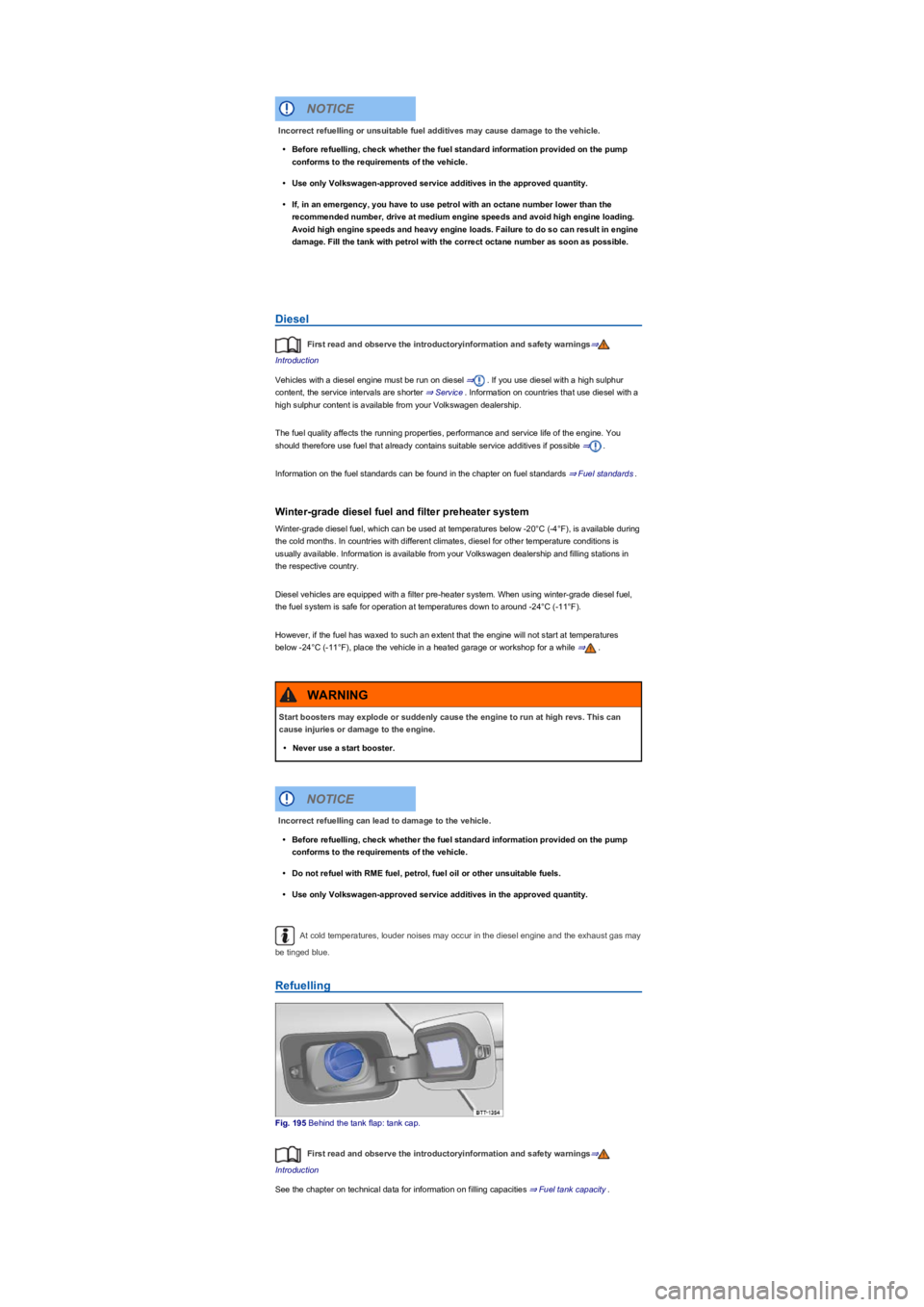
Fig. 195 Behind the tank flap: tank cap.
First read and observe the introductoryinformation and safety warnings⇒
Introduction
See the chapter on technical data for information on filling capacities ⇒ Fuel tank capacity.
Incorrect refuelling or unsuitable fuel additives may cause damage to the vehicle.
•Before refuelling, check whether the fuel standard information provided on the pump
conforms to the requirements of the vehicle.
•Use only Volkswagen-approved service additives in the approved quantity.
•If, in an emergency, you have to use petrol with an octane number lower than the
recommended number, drive at medium engine speeds and avoid high engine loading.
Avoid high engine speeds and heavy engine loads. Failure to do so can result in engine
damage. Fill the tank with petrol with the correct octane number as soon as possible.
NOTICE
Start boosters may explode or suddenly cause the engine to run at high revs. This can
cause injuries or damage to the engine.
•Never use a start booster.
WARNING
Incorrect refuelling can lead to damage to the vehicle.
•Before refuelling, check whether the fuel standard information provided on the pump
conforms to the requirements of the vehicle.
•Do not refuel with RME fuel, petrol, fuel oil or other unsuitable fuels.
•Use only Volkswagen-approved service additives in the approved quantity.
NOTICE
Page 262 of 341
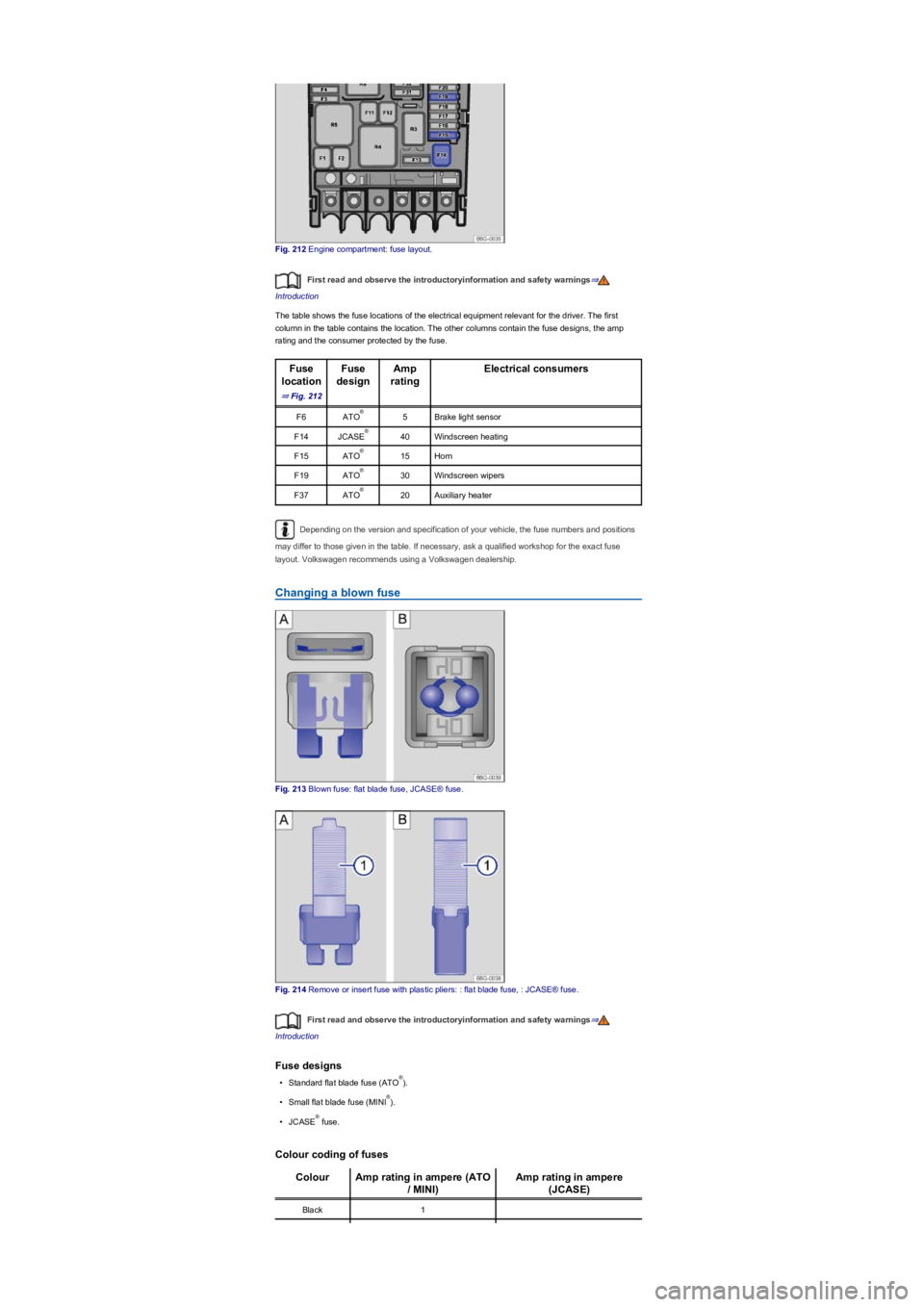
Fig. 212 Engine compartment: fuse layout.
First read and observe the introductoryinformation and safety warnings⇒
Introduction
The table shows the fuse locations of the electrical equipment relevant for the driver. The first
column in the table contains the location. The other columns contain the fuse designs, the amp
rating and the consumer protected by the fuse.
Fuse
location
⇒ Fig. 212
Fuse
design
Amp
rating
Electrical consumers
F6ATO5Brake light sensor
F14JCASE40Windscreen heating
F15ATO15Horn
F19ATO30Windscreen wipers
F37ATO20Auxiliary heater
Depending on the version and specification of your vehicle, the fuse numbers and positions
may differ to those given in the table. If necessary, ask a qualified workshop for the exact fuse
layout. Volkswagen recommends using a Volkswagen dealership.
Changing a blown fuse
Fig. 213 Blown fuse: flat blade fuse, JCASE® fuse.
Fig. 214 Remove or insert fuse with plastic pliers: : flat blade fuse, : JCASE® fuse.
First read and observe the introductoryinformation and safety warnings⇒
Introduction
Fuse designs
•Standard flat blade fuse (ATO).
•Small flat blade fuse (MINI).
•JCASE fuse.
Colour coding of fuses
ColourAmp rating in ampere (ATO
/ MINI)
Amp rating in ampere
(JCASE)
Black1
®
®
®
®
®
®
®
®
Page 273 of 341
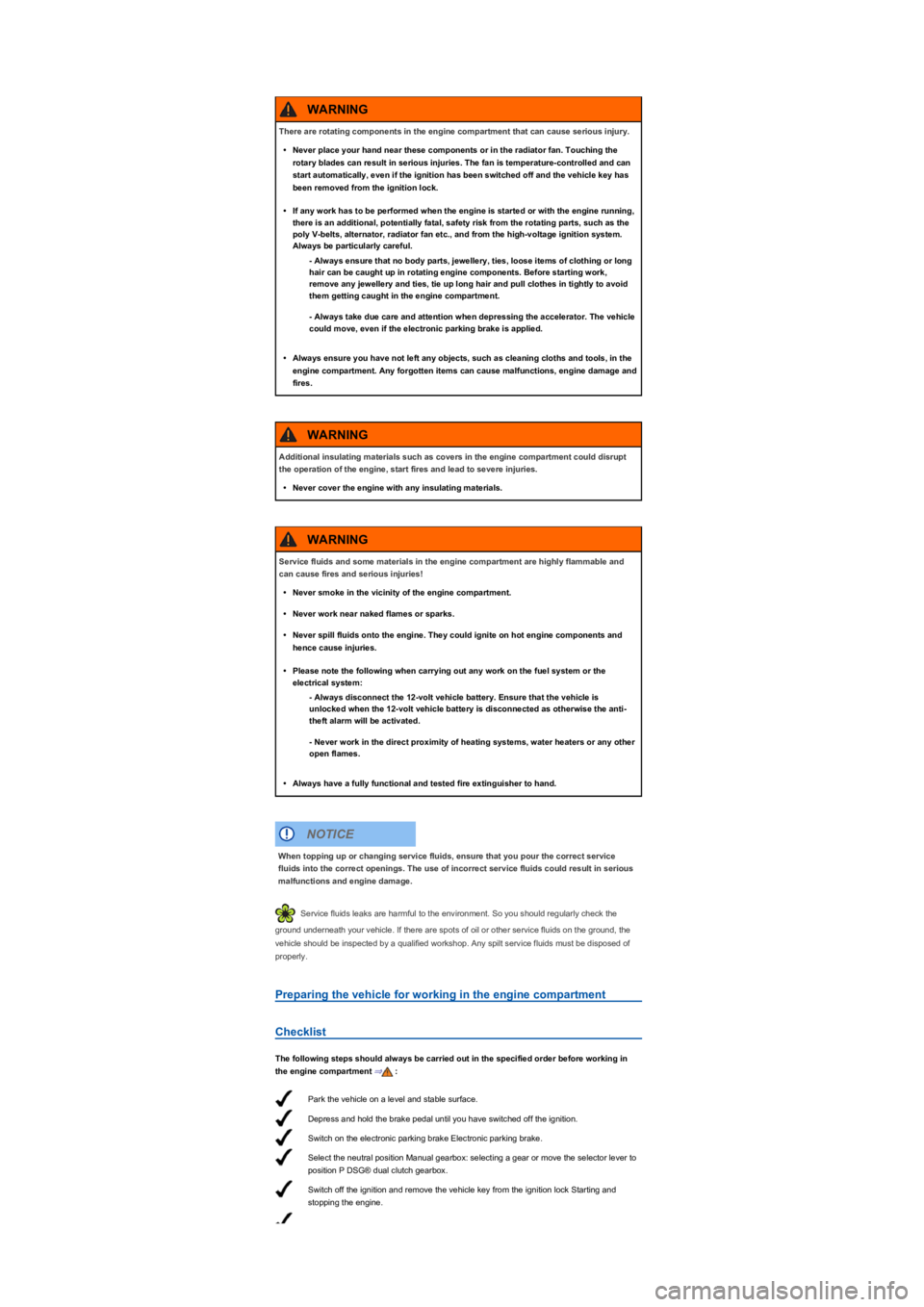
Park the vehicle on a level and stable surface.
Depress and hold the brake pedal until you have switched off the ignition.
Switch on the electronic parking brake Electronic parking brake.
Select the neutral position Manual gearbox: selecting a gear or move the selector lever to
position P DSG® dual clutch gearbox.
Switch off the ignition and remove the vehicle key from the ignition lock Starting and
stopping the engine.
Service fluids leaks are harmful to the environment. So you should regularly check the
ground underneath your vehicle. If there are spots of oil or other service fluids on the ground, the
vehicle should be inspected by a qualified workshop. Any spilt service fluids must be disposed of
properly.
Preparing the vehicle for working in the engine compartment
Checklist
The following steps should always be carried out in the specified order before working in
the engine compartment ⇒:
There are rotating components in the engine compartment that can cause serious injury.
•Never place your hand near these components or in the radiator fan. Touching the
rotary blades can result in serious injuries. The fan is temperature-controlled and can
start automatically, even if the ignition has been switched off and the vehicle key has
been removed from the ignition lock.
•If any work has to be performed when the engine is started or with the engine running,
there is an additional, potentially fatal, safety risk from the rotating parts, such as the
poly V-belts, alternator, radiator fan etc., and from the high-voltage ignition system.
Always be particularly careful.
- Always ensure that no body parts, jewellery, ties, loose items of clothing or long
hair can be caught up in rotating engine components. Before starting work,
remove any jewellery and ties, tie up long hair and pull clothes in tightly to avoid
them getting caught in the engine compartment.
- Always take due care and attention when depressing the accelerator. The vehicle
could move, even if the electronic parking brake is applied.
•Always ensure you have not left any objects, such as cleaning cloths and tools, in the
engine compartment. Any forgotten items can cause malfunctions, engine damage and
fires.
WARNING
Additional insulating materials such as covers in the engine compartment could disrupt
the operation of the engine, start fires and lead to severe injuries.
•Never cover the engine with any insulating materials.
WARNING
Service fluids and some materials in the engine compartment are highly flammable and
can cause fires and serious injuries!
•Never smoke in the vicinity of the engine compartment.
•Never work near naked flames or sparks.
•Never spill fluids onto the engine. They could ignite on hot engine components and
hence cause injuries.
•Please note the following when carrying out any work on the fuel system or the
electrical system:
- Always disconnect the 12-volt vehicle battery. Ensure that the vehicle is
unlocked when the 12-volt vehicle battery is disconnected as otherwise the anti-
theft alarm will be activated.
- Never work in the direct proximity of heating systems, water heaters or any other
open flames.
•Always have a fully functional and tested fire extinguisher to hand.
WARNING
When topping up or changing service fluids, ensure that you pour the correct service
fluids into the correct openings. The use of incorrect service fluids could result in serious
malfunctions and engine damage.
NOTICE
Page 287 of 341
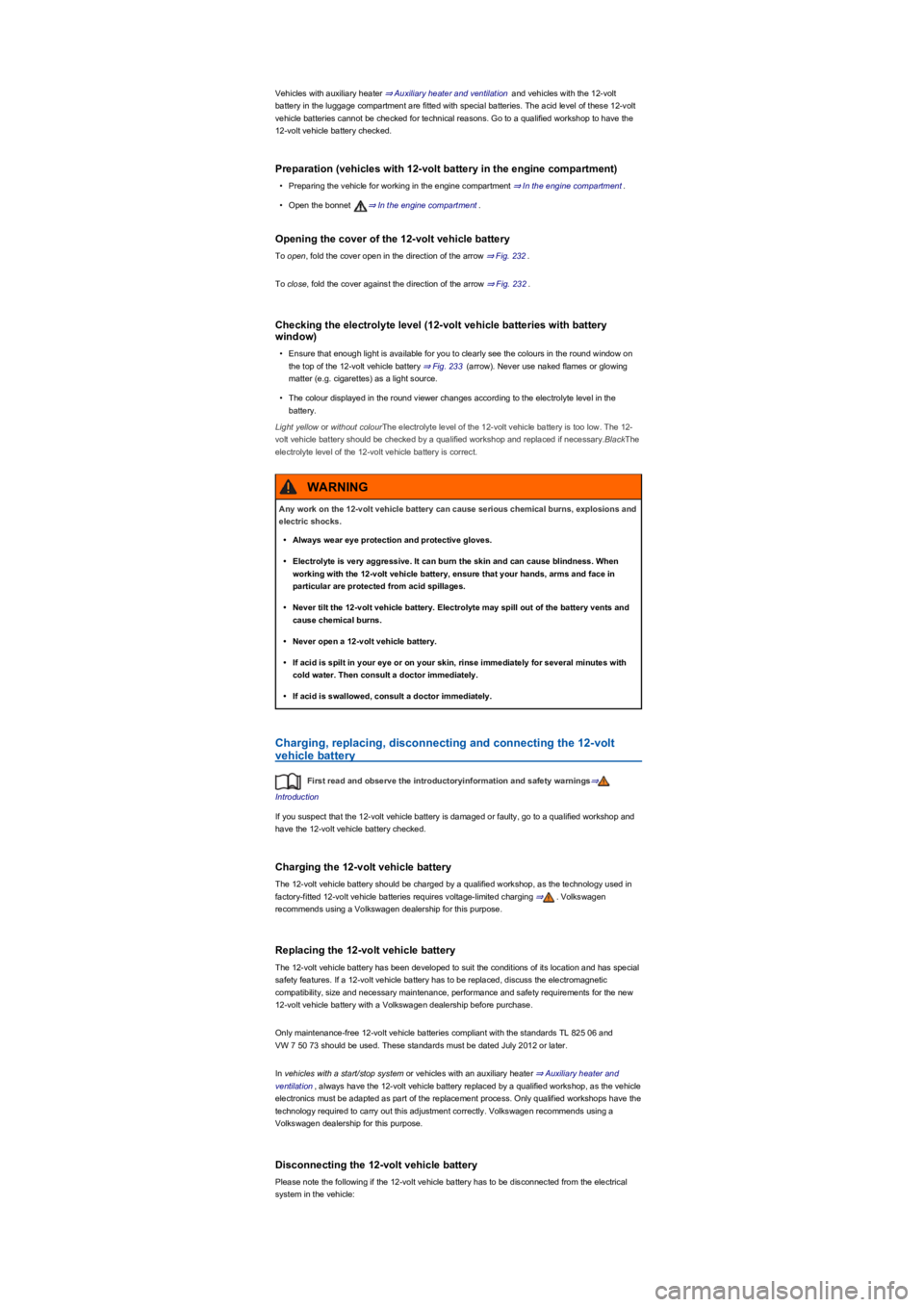
Vehicles with auxiliary heater ⇒ Auxiliary heater and ventilation and vehicles with the 12-volt
battery in the luggage compartment are fitted with special batteries. The acid level of these 12-volt
vehicle batteries cannot be checked for technical reasons. Go to a qualified workshop to have the
12-volt vehicle battery checked.
Preparation (vehicles with 12-volt battery in the engine compartment)
•Preparing the vehicle for working in the engine compartment ⇒ In the engine compartment.
•Open the bonnet ⇒ In the engine compartment.
Opening the cover of the 12-volt vehicle battery
To open, fold the cover open in the direction of the arrow ⇒ Fig. 232.
To close, fold the cover against the direction of the arrow ⇒ Fig. 232.
Checking the electrolyte level (12-volt vehicle batteries with battery
window)
•Ensure that enough light is available for you to clearly see the colours in the round window on
the top of the 12-volt vehicle battery ⇒ Fig. 233 (arrow). Never use naked flames or glowing
matter (e.g. cigarettes) as a light source.
•The colour displayed in the round viewer changes according to the electrolyte level in the
battery.
Light yellow or without colourThe electrolyte level of the 12-volt vehicle battery is too low. The 12-
volt vehicle battery should be checked by a qualified workshop and replaced if necessary.BlackThe
electrolyte level of the 12-volt vehicle battery is correct.
Charging, replacing, disconnecting and connecting the 12-volt
vehicle battery
First read and observe the introductoryinformation and safety warnings⇒
Introduction
If you suspect that the 12-volt vehicle battery is damaged or faulty, go to a qualified workshop and
have the 12-volt vehicle battery checked.
Charging the 12-volt vehicle battery
The 12-volt vehicle battery should be charged by a qualified workshop, as the technology used in
factory-fitted 12-volt vehicle batteries requires voltage-limited charging ⇒. Volkswagen
recommends using a Volkswagen dealership for this purpose.
Replacing the 12-volt vehicle battery
The 12-volt vehicle battery has been developed to suit the conditions of its location and has special
safety features. If a 12-volt vehicle battery has to be replaced, discuss the electromagnetic
compatibility, size and necessary maintenance, performance and safety requirements for the new
12-volt vehicle battery with a Volkswagen dealership before purchase.
Only maintenance-free 12-volt vehicle batteries compliant with the standards TL 825 06 and
VW 7 50 73 should be used. These standards must be dated July 2012 or later.
In vehicles with a start/stop system or vehicles with an auxiliary heater ⇒ Auxiliary heater and
ventilation, always have the 12-volt vehicle battery replaced by a qualified workshop, as the vehicle
electronics must be adapted as part of the replacement process. Only qualified workshops have the
technology required to carry out this adjustment correctly. Volkswagen recommends using a
Volkswagen dealership for this purpose.
Disconnecting the 12-volt vehicle battery
Please note the following if the 12-volt vehicle battery has to be disconnected from the electrical
system in the vehicle:
Any work on the 12-volt vehicle battery can cause serious chemical burns, explosions and
electric shocks.
•Always wear eye protection and protective gloves.
•Electrolyte is very aggressive. It can burn the skin and can cause blindness. When
working with the 12-volt vehicle battery, ensure that your hands, arms and face in
particular are protected from acid spillages.
•Never tilt the 12-volt vehicle battery. Electrolyte may spill out of the battery vents and
cause chemical burns.
•Never open a 12-volt vehicle battery.
•If acid is spilt in your eye or on your skin, rinse immediately for several minutes with
cold water. Then consult a doctor immediately.
•If acid is swallowed, consult a doctor immediately.
WARNING
Page 288 of 341
•Switch off all electrical consumers and the ignition.
•Unlock the vehicle before disconnecting the battery in order to avoid triggering the anti-theft
alarm.
•First disconnect the negative cable and then the positive cable ⇒.
Connecting the 12-volt vehicle battery
•Switch off all electrical consumers and the ignition before reconnecting the 12-volt vehicle
battery.
•First reconnect the positive cable and then the negative cable ⇒.
Various indicator lamps may light up after the 12-volt vehicle battery has been connected and the
ignition is switched on. They will go out if you drive a short distance at a speed of approximately
15 – 20 km/h (10 – 12 mph). If the indicator lamps remain lit up, the vehicle should be checked by a
qualified workshop.
If the 12-volt vehicle battery was disconnected for an extended period, the system may not able to
calculate or correctly display the time when the next service is due ⇒ Instrument cluster. Observe
the maximum permissible service intervals ⇒ Service.
Vehicles with Keyless Access:⇒ Central locking system: if the ignition cannot be switched on after
connecting the 12-volt vehicle battery, lock and unlock the vehicle from the outside. Then try to start
the ignition again. Please contact an expert if the ignition cannot be switched on.
Automatic switch-off for electrical consumers
The intelligent vehicle electrical system management automatically implements a range of
measures to prevent the 12-volt battery from discharging under high loads:
•The idling speed is increased so that the alternator provides more electricity.
•The performance of large electrical consumers may be reduced or they may be switched off
completely.
•The power supply to the 12-volt socket and the cigarette lighter is interrupted temporarily while
the engine is being started.
The vehicle electrical system management function cannot always prevent the 12-volt vehicle
battery from discharging. For example when the ignition is switched on for an extended period with
the engine off, or when the side or parking lights are on when the vehicle is parked for an extended
period.
Battery switch-off in an accident in which the airbag is triggered
In vehicles with 12-volt vehicle battery in the luggage compartment, the electrical connection to the
12-volt vehicle battery is disconnected pyrotechnically in the event of an accident in which the
airbags are triggered. This prevents short-circuiting.
What can cause the 12-volt vehicle battery to discharge?
•Long periods at a standstill in which the engine is not running, especially if the ignition is
switched on.
•The use of electrical consumers when the engine is switched off.
•When the auxiliary heater is being used ⇒ Auxiliary heater and ventilation.
Page 332 of 341
Information in accordance with the EU Chemicals Regulation
REACH
In accordance with the European regulations on chemicals, known as REACH, Volkswagen would
like to inform you about the substances that may be found in your vehicle.
You can access this information online using your vehicle identification number ⇒ Technical data:
https://reachinfo.volkswagen.com
Declaration of conformity
The individual manufacturer declares herewith that the following products conform, at the time of
vehicle production, with the basic requirements and other relevant laws and regulations, including
FCC Part 15.19, FCC Part 15.21 and RSS-Gen Issue 1:
Radio-based equipment
•Electronic immobiliser.
•Vehicle key.
•Keyless Access locking and starting system.
•Adaptive Cruise Control (ACC).
•Area monitoring system (Front Assist) including City Emergency Brake.
•Lane change system (Side Assist)
•Remote control for the auxiliary heater ⇒ Auxiliary heater and ventilation.
•Trailer manoeuvring system (Trailer Assist) ⇒ Trailer Assist
Electrical equipment
•12-volt socket.
•230-volt Euro socket, 115-volt socket, 100-volt socket.
Recycling and scrapping end-of-life vehicles
Recycling end-of-life vehicles
Volkswagen has already made provision for you to recycle your vehicle in an environmentally
responsible manner. The recycling system operating in many European countries will take back
your vehicle at the end of its useful life. Once the vehicle has been recycled, a certificate of
destruction will be issued to show that the vehicle has been disposed of correctly.
End-of-life vehicles are recycled free of charge, provided that national legislation is complied with.
Further information on the recycling of end-of-life vehicles can be found at a Volkswagen
dealership.
Scrapping
The relevant safety requirements must be observed when the vehicle or components of the airbag
and the belt tensioners are scrapped. Qualified workshops are familiar with these requirements.
Information about vehicles with N1 approval (light commercial
vehicle)
Please observe the following information for vehicles used to transport goods with a maximum
permitted weight of up to 3.5 t (N1 approval in Europe):
Variants and number of seats
N1 vehicles based on a Volkswagen passenger car models are available in different versions. The
number of seats may be restricted to two or four.
Vehicles with two seats: there is no floor covering in the rear of the vehicle interior because there is
no rear bench seat ⇒.
Vehicles with four seats: the centre seat on the rear bench seat cannot be used⇒.
Safe transport of children
Like in vehicles with passenger car approval (M1), approved child restraint systems can be used on
the seats ⇒ Safe transport of children.
Towing a trailer
If the vehicle is approved for towing a trailer, observe any local regulations for driving with a trailer
and using a towing bracket.