key VOLKSWAGEN TIGUAN 2017 Owner´s Manual
[x] Cancel search | Manufacturer: VOLKSWAGEN, Model Year: 2017, Model line: TIGUAN, Model: VOLKSWAGEN TIGUAN 2017Pages: 341, PDF Size: 9.14 MB
Page 32 of 341
Adapting the display areas to the driving situation
Choose the three possible instruments corresponding to your individual driving style and the driving
situation.
Due to the principle of performance determination available in the vehicle, the physical
accuracy of the displayed values is not guaranteed.
Lap timer
First read and observe the introductoryinformation and safety warnings⇒
Introduction
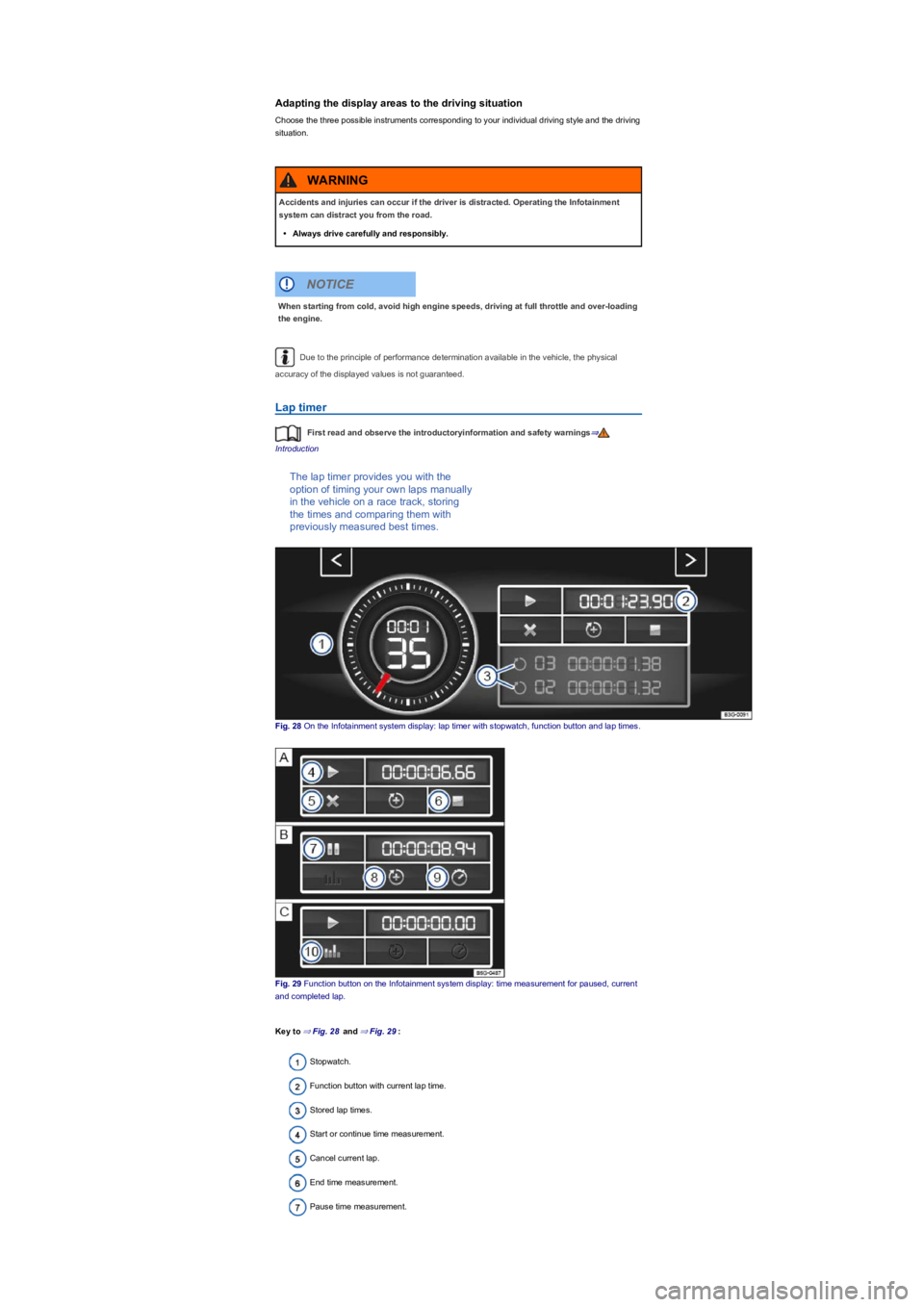
The lap timer provides you with the
option of timing your own laps manually
in the vehicle on a race track, storing
the times and comparing them with
previously measured best times.
Fig. 28 On the Infotainment system display: lap timer with stopwatch, function button and lap times.
Fig. 29 Function button on the Infotainment system display: time measurement for paused, current
and completed lap.
Key to ⇒ Fig. 28 and ⇒ Fig. 29:
Stopwatch.
Function button with current lap time.
Stored lap times.
Start or continue time measurement.
Cancel current lap.
End time measurement.
Pause time measurement.
Accidents and injuries can occur if the driver is distracted. Operating the Infotainment
system can distract you from the road.
•Always drive carefully and responsibly.
WARNING
When starting from cold, avoid high engine speeds, driving at full throttle and over-loading
the engine.
NOTICE
Page 34 of 341
Personalisation
First read and observe the introductoryinformation and safety warnings⇒
Introduction
The personalisation function allows personalised vehicle settings, such as air conditioning system,
instrument cluster or lighting settings, to be saved in a user account. You have four user accounts
available. Users are identified using the vehicle key upon unlocking the vehicle. One user account
is assigned to each vehicle key.
Changes to the setup will be assigned to the active user account and saved upon locking the
vehicle or changing the user account.
Welcome and user account selection
When personalisation is activated, the name of the current user account appears on the instrument
cluster display for approximately ten seconds after you switch on the ignition.
During this time, you can select a user account using the buttons on the wiper lever or multifunction
steering wheel ⇒ Operation and display in the Infotainment system.
When you select a user account, the saved vehicle settings are activated.
User management and setup
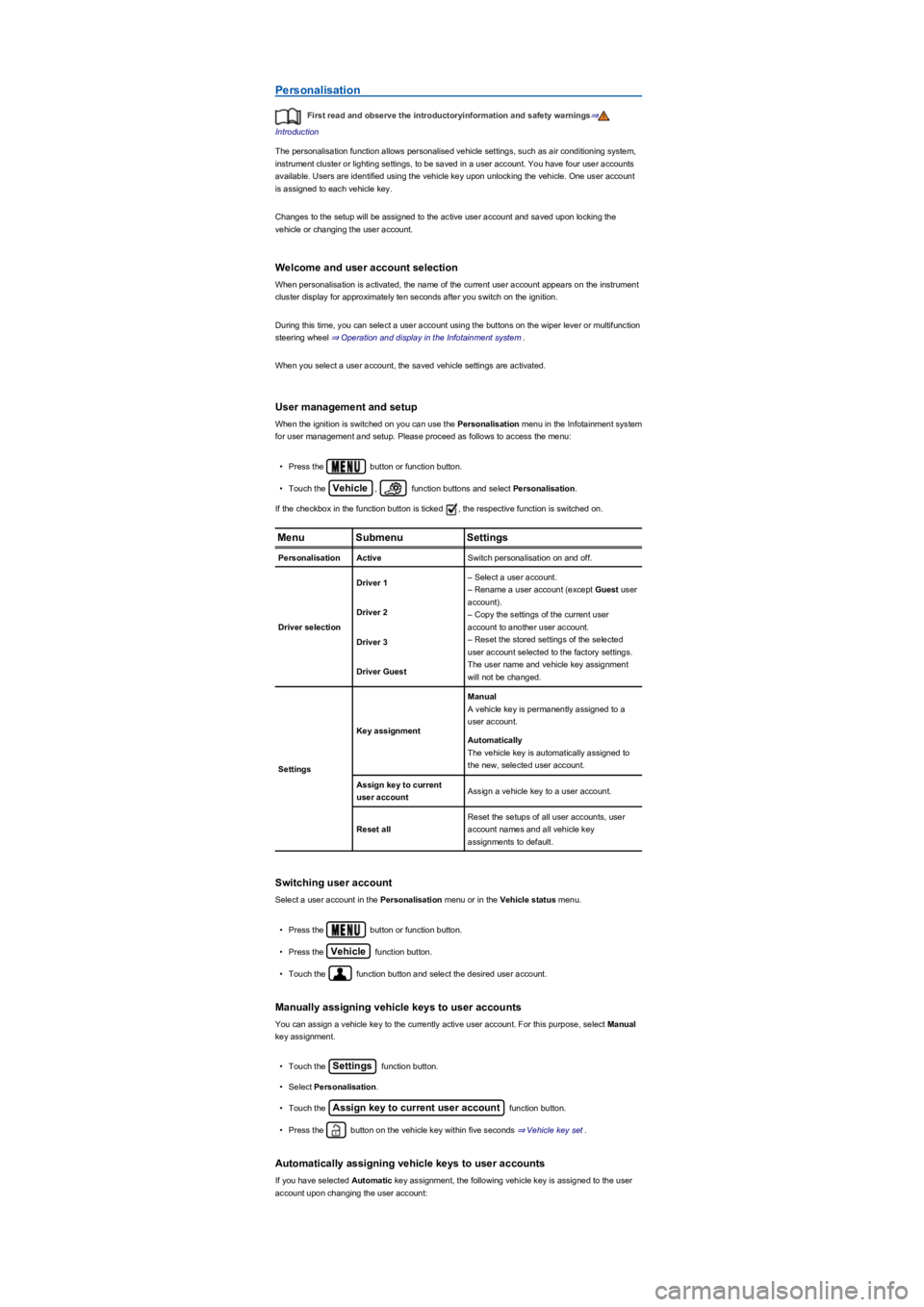
When the ignition is switched on you can use the Personalisation menu in the Infotainment system
for user management and setup. Please proceed as follows to access the menu:
•Press the button or function button.
•Touch the Vehicle, function buttons and select Personalisation.
If the checkbox in the function button is ticked , the respective function is switched on.
MenuSubmenuSettings
PersonalisationActiveSwitch personalisation on and off.
Driver selection
Driver 1– Select a user account.
– Rename a user account (except Guest user
account).
– Copy the settings of the current user
account to another user account.
– Reset the stored settings of the selected
user account selected to the factory settings.
The user name and vehicle key assignment
will not be changed.
Driver 2
Driver 3
Driver Guest
Settings
Key assignment
Manual
A vehicle key is permanently assigned to a
user account.
Automatically
The vehicle key is automatically assigned to
the new, selected user account.
Assign key to current
user accountAssign a vehicle key to a user account.
Reset all
Reset the setups of all user accounts, user
account names and all vehicle key
assignments to default.
Switching user account
Select a user account in the Personalisation menu or in the Vehicle status menu.
•Press the button or function button.
•Press the Vehicle function button.
•Touch the function button and select the desired user account.
Manually assigning vehicle keys to user accounts
You can assign a vehicle key to the currently active user account. For this purpose, select Manual
key assignment.
•Touch the Settings function button.
•Select Personalisation.
•Touch the Assign key to current user account function button.
•Press the button on the vehicle key within five seconds ⇒ Vehicle key set.
Automatically assigning vehicle keys to user accounts
If you have selected Automatic key assignment, the following vehicle key is assigned to the user
account upon changing the user account:
Page 35 of 341
Check that all lights and turn signals are working properly.
Check the tyre pressure and fuel level Wheels and tyres, Fuel types and refuelling.
Ensure that you have a good, clear view through all of the windows.
Air intake to the engine must not be obstructed, and the engine must not be covered with
any kind of insulating materials In the engine compartment.
Secure any objects and luggage in the stowage compartments, the luggage compartment
or on the roof Transporting.
Ensure that you are able to operate the pedals freely at all times.
Secure any children travelling in the vehicle in a restraint system suitable for their weight
and size Safe transport of children.
Adjust the front seats, head restraints and mirrors properly in accordance with the size of
the occupants Sitting position, Mirrors.
Wear shoes that provide good grip for your feet when using the pedals.
The floor mat in the footwell on the driver side must leave the pedal area free and must be
securely fastened.
Assume a correct sitting position before setting off and maintain this position while driving.
This also applies to all passengers Sitting position.
Fasten your seat belt correctly before setting off and keep it properly fastened throughout
the journey. This also applies to all passengers Seat belts.
Each vehicle occupant must sit in a seat of their own and must have their own seat belt.
Never drive if your driving ability is impaired, e.g. by medication, alcohol or drugs.
Do not allow yourself to be distracted from the traffic, e.g. by passengers, telephone calls,
opening menus and making adjustments to settings.
Always adapt your speed and driving style to suit visibility, weather, road and traffic
conditions.
Observe traffic regulations and speed limits.
Take regular breaks when travelling long distances – at least every two hours.
Secure animals in the vehicle using a system that is suitable for their weight and size.
Does the vehicle need any technical modifications for driving abroad, e.g. masking or
switching the headlights over?
Are the necessary tools, diagnostic equipment and spare parts available for service and
repair work?
Are there any Volkswagen dealerships in the destination country?
•Vehicles without Keyless Access: vehicle key used to unlock the vehicle.
•Vehicles with Keyless Access: vehicle key that is identified first by the personalisation function
upon opening the driver door.
Personalised vehicle setup
The vehicle equipment and functions that can be personalised include the following:
•Open and close (single door unlocking, window convenience opening etc.)
•Light and vision (daytime running lights, cornering light, convenience turn signal etc.)
•Air conditioning system (temperature settings, ventilation etc.)
•Assistance systems (Park Distance Control, ACC, Dynamic Road Sign Display etc.)
•Driver profile selection (driver profiles etc.)
•Multifunction display and instrument cluster (selection of displays)
•Infotainment system (brightness and saved stations)
•Seat setup (seat position)
A new vehicle key will be assigned to the current user account. To assign the vehicle key to
a different user account, select the user account you want and manually assign it to the vehicle key.
Safety
General notes
Checklist
Observe the following information both before and during every journey to ensure your own
safety, and the safety of all passengers and other road users ⇒:
Checklist
In some countries, special safety standards and emissions-related regulations apply that the
vehicle may not comply with. Volkswagen recommends that you visit your Volkswagen
dealership before travelling abroad to find out about any legal requirements and the
following issues at your destination:
Page 44 of 341
Assuming an incorrect sitting position can cause severe or fatal injuries ⇒ Sitting position.
Correct seat belt routing
•The shoulder part of the seat belt must always lie on the centre of the shoulder, never across
the neck, over or under the arm or behind the back.
•The lap part of the seat belt must always lie across the pelvis, never across the stomach.
•The seat belt must always lie flat and snugly on the body. Tighten the belt if necessary.
For pregnant women the seat belt must be positioned evenly over the chest and as low as
possible over the pelvis. It must lie flat so that no pressure is exerted on the lower body – this
applies in every stage of pregnancy ⇒ Fig. 41.
Correct seat belt routing according to height
The following equipment can be used to adjust the seat belt routing:
•Seat belt height adjuster for the front seats ⇒ Seat belt height adjuster.
•Height-adjustable front seats ⇒ Sitting position.
If a person's physical build prevents them from routing the seat belt properly, contact a
qualified workshop to find out about any special modifications so that the seat belts and airbags can
provide the optimum level of protection. Volkswagen recommends using a Volkswagen dealership
for this purpose.
Seat belt height adjuster
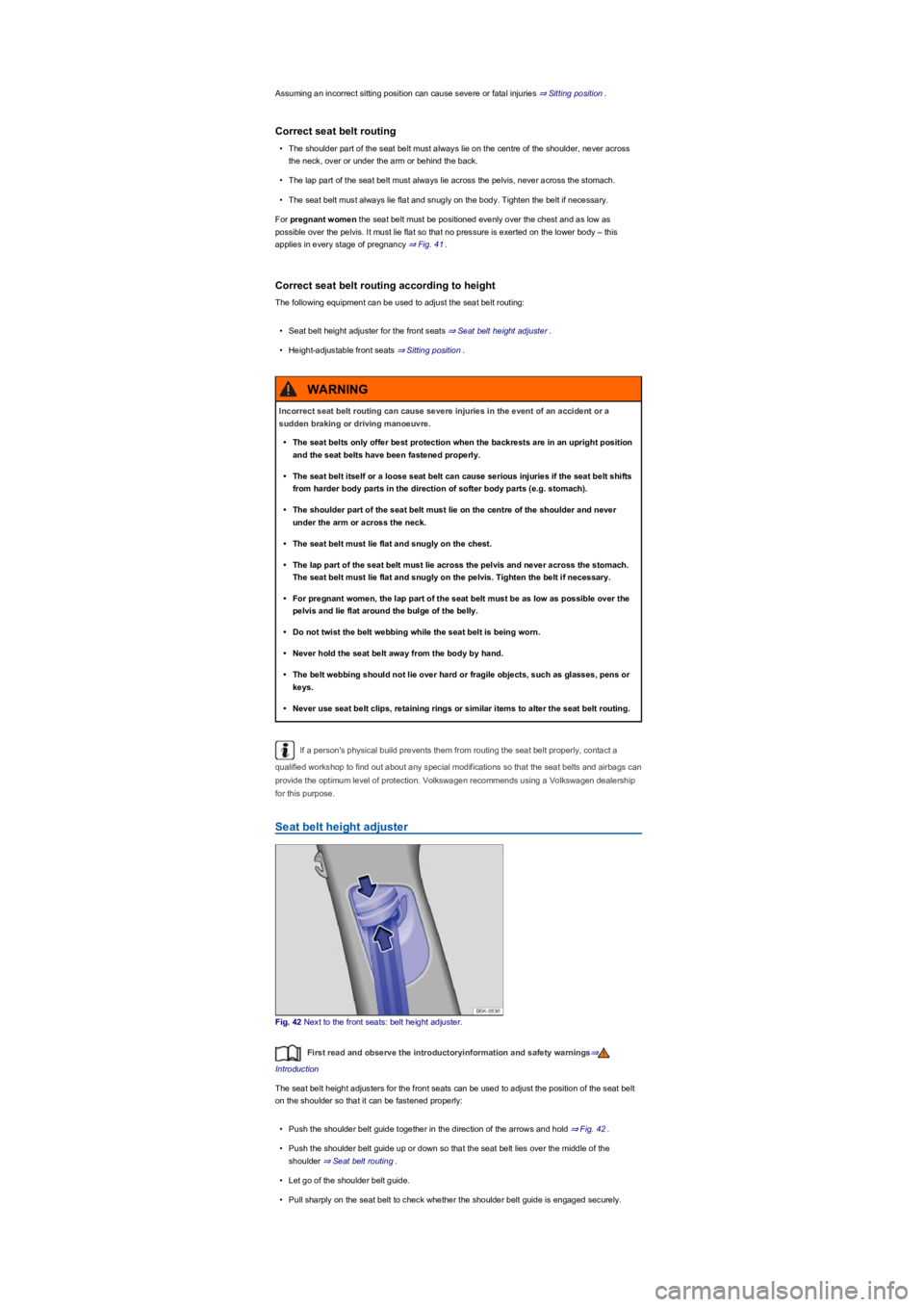
Fig. 42 Next to the front seats: belt height adjuster.
First read and observe the introductoryinformation and safety warnings⇒
Introduction
The seat belt height adjusters for the front seats can be used to adjust the position of the seat belt
on the shoulder so that it can be fastened properly:
•Push the shoulder belt guide together in the direction of the arrows and hold ⇒ Fig. 42.
•Push the shoulder belt guide up or down so that the seat belt lies over the middle of the
shoulder ⇒ Seat belt routing.
•Let go of the shoulder belt guide.
•Pull sharply on the seat belt to check whether the shoulder belt guide is engaged securely.
Incorrect seat belt routing can cause severe injuries in the event of an accident or a
sudden braking or driving manoeuvre.
•The seat belts only offer best protection when the backrests are in an upright position
and the seat belts have been fastened properly.
•The seat belt itself or a loose seat belt can cause serious injuries if the seat belt shifts
from harder body parts in the direction of softer body parts (e.g. stomach).
•The shoulder part of the seat belt must lie on the centre of the shoulder and never
under the arm or across the neck.
•The seat belt must lie flat and snugly on the chest.
•The lap part of the seat belt must lie across the pelvis and never across the stomach.
The seat belt must lie flat and snugly on the pelvis. Tighten the belt if necessary.
•For pregnant women, the lap part of the seat belt must be as low as possible over the
pelvis and lie flat around the bulge of the belly.
•Do not twist the belt webbing while the seat belt is being worn.
•Never hold the seat belt away from the body by hand.
•The belt webbing should not lie over hard or fragile objects, such as glasses, pens or
keys.
•Never use seat belt clips, retaining rings or similar items to alter the seat belt routing.
WARNING
Page 49 of 341
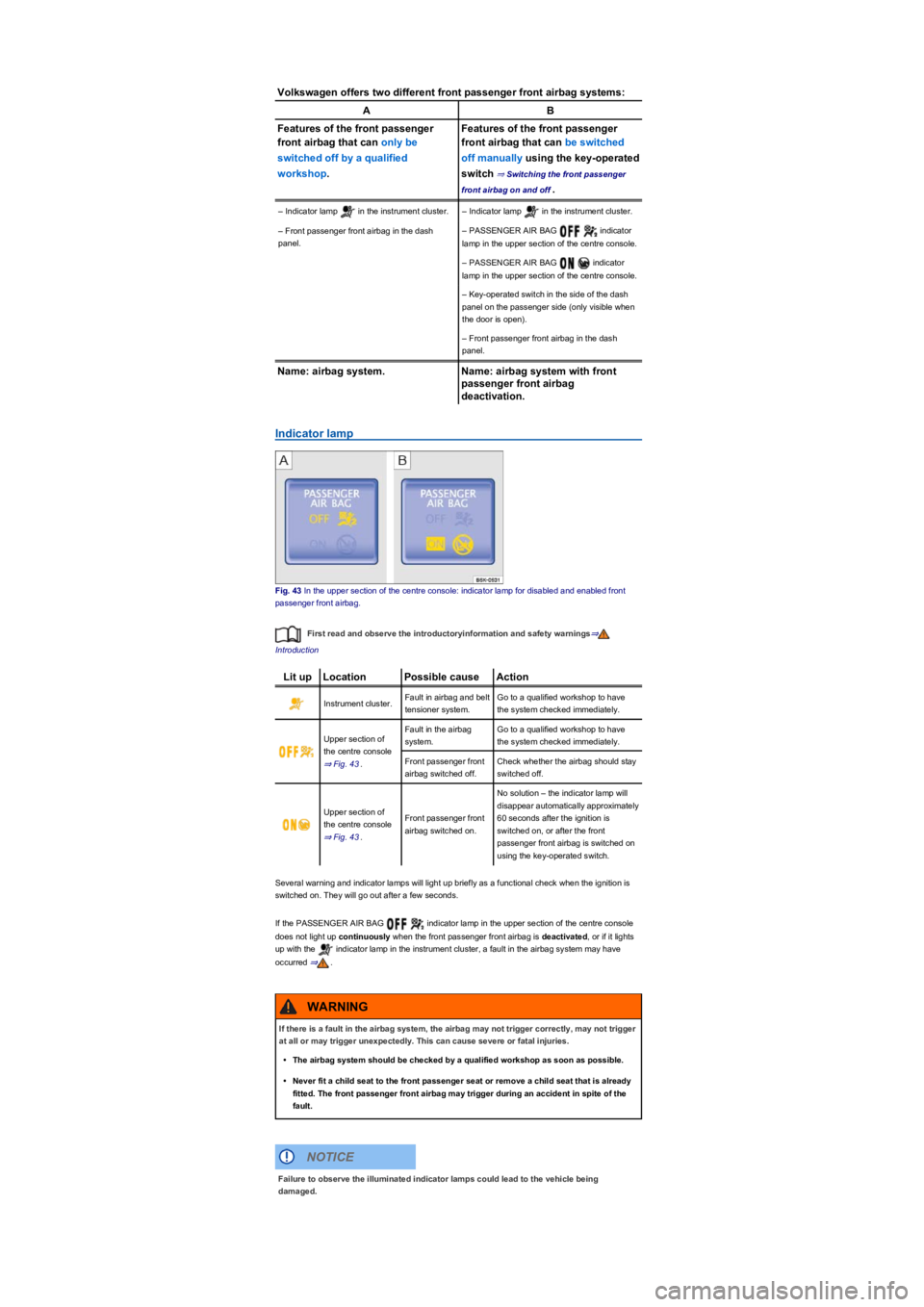
Volkswagen offers two different front passenger front airbag systems:
AB
Features of the front passenger
front airbag that can only be
switched off by a qualified
workshop.
Features of the front passenger
front airbag that can be switched
off manually using the key-operated
switch ⇒ Switching the front passenger
front airbag on and off.
– Indicator lamp in the instrument cluster.– Indicator lamp in the instrument cluster.
– Front passenger front airbag in the dash
panel.
– PASSENGER AIR BAG indicator
lamp in the upper section of the centre console.
– PASSENGER AIR BAG indicator
lamp in the upper section of the centre console.
– Key-operated switch in the side of the dash
panel on the passenger side (only visible when
the door is open).
– Front passenger front airbag in the dash
panel.
Name: airbag system.Name: airbag system with front
passenger front airbag
deactivation.
Indicator lamp
Fig. 43 In the upper section of the centre console: indicator lamp for disabled and enabled front
passenger front airbag.
First read and observe the introductoryinformation and safety warnings⇒
Introduction
Lit upLocationPossible causeAction
Instrument cluster.Fault in airbag and belt
tensioner system.
Go to a qualified workshop to have
the system checked immediately.
Upper section of
the centre console
⇒ Fig. 43.
Fault in the airbag
system.
Go to a qualified workshop to have
the system checked immediately.
Front passenger front
airbag switched off.
Check whether the airbag should stay
switched off.
Upper section of
the centre console
⇒ Fig. 43.
Front passenger front
airbag switched on.
No solution – the indicator lamp will
disappear automatically approximately
60 seconds after the ignition is
switched on, or after the front
passenger front airbag is switched on
using the key-operated switch.
Several warning and indicator lamps will light up briefly as a functional check when the ignition is
switched on. They will go out after a few seconds.
If the PASSENGER AIR BAG indicator lamp in the upper section of the centre console
does not light up continuously when the front passenger front airbag is deactivated, or if it lights
up with the indicator lamp in the instrument cluster, a fault in the airbag system may have
occurred ⇒.
If there is a fault in the airbag system, the airbag may not trigger correctly, may not trigger
at all or may trigger unexpectedly. This can cause severe or fatal injuries.
•The airbag system should be checked by a qualified workshop as soon as possible.
•Never fit a child seat to the front passenger seat or remove a child seat that is already
fitted. The front passenger front airbag may trigger during an accident in spite of the
fault.
WARNING
Failure to observe the illuminated indicator lamps could lead to the vehicle being
damaged.
NOTICE
Page 52 of 341
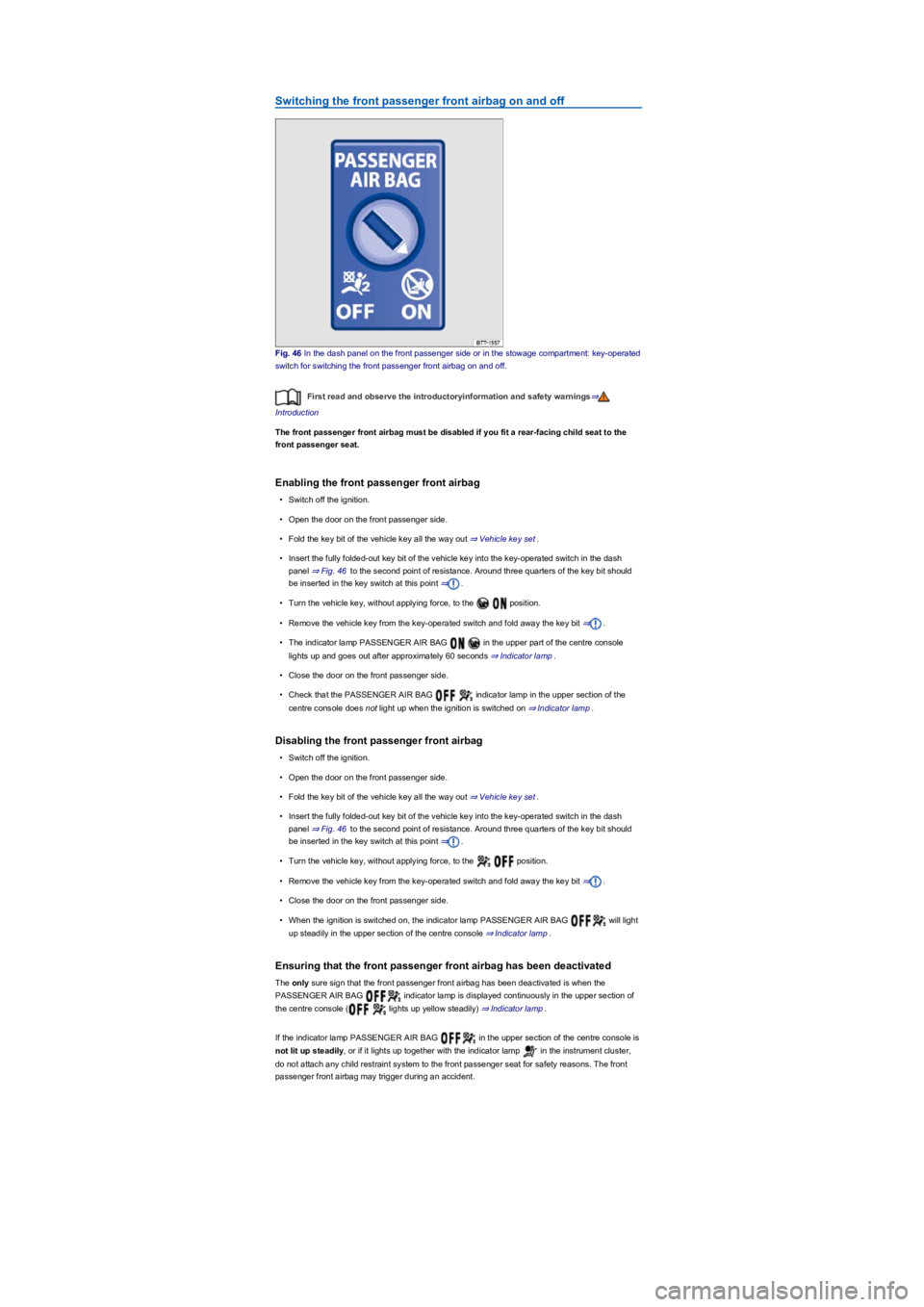
Switching the front passenger front airbag on and off
Fig. 46 In the dash panel on the front passenger side or in the stowage compartment: key-operated
switch for switching the front passenger front airbag on and off.
First read and observe the introductoryinformation and safety warnings⇒
Introduction
The front passenger front airbag must be disabled if you fit a rear-facing child seat to the
front passenger seat.
Enabling the front passenger front airbag
•Switch off the ignition.
•Open the door on the front passenger side.
•Fold the key bit of the vehicle key all the way out ⇒ Vehicle key set.
•Insert the fully folded-out key bit of the vehicle key into the key-operated switch in the dash
panel ⇒ Fig. 46 to the second point of resistance. Around three quarters of the key bit should
be inserted in the key switch at this point ⇒.
•Turn the vehicle key, without applying force, to the position.
•Remove the vehicle key from the key-operated switch and fold away the key bit ⇒.
•The indicator lamp PASSENGER AIR BAG in the upper part of the centre console
lights up and goes out after approximately 60 seconds ⇒ Indicator lamp.
•Close the door on the front passenger side.
•Check that the PASSENGER AIR BAG indicator lamp in the upper section of the
centre console does not light up when the ignition is switched on ⇒ Indicator lamp.
Disabling the front passenger front airbag
•Switch off the ignition.
•Open the door on the front passenger side.
•Fold the key bit of the vehicle key all the way out ⇒ Vehicle key set.
•Insert the fully folded-out key bit of the vehicle key into the key-operated switch in the dash
panel ⇒ Fig. 46 to the second point of resistance. Around three quarters of the key bit should
be inserted in the key switch at this point ⇒.
•Turn the vehicle key, without applying force, to the position.
•Remove the vehicle key from the key-operated switch and fold away the key bit ⇒.
•Close the door on the front passenger side.
•When the ignition is switched on, the indicator lamp PASSENGER AIR BAG will light
up steadily in the upper section of the centre console ⇒ Indicator lamp.
Ensuring that the front passenger front airbag has been deactivated
The only sure sign that the front passenger front airbag has been deactivated is when the
PASSENGER AIR BAG indicator lamp is displayed continuously in the upper section of
the centre console ( lights up yellow steadily) ⇒ Indicator lamp.
If the indicator lamp PASSENGER AIR BAG in the upper section of the centre console is
not lit up steadily, or if it lights up together with the indicator lamp in the instrument cluster,
do not attach any child restraint system to the front passenger seat for safety reasons. The front
passenger front airbag may trigger during an accident.
Page 53 of 341
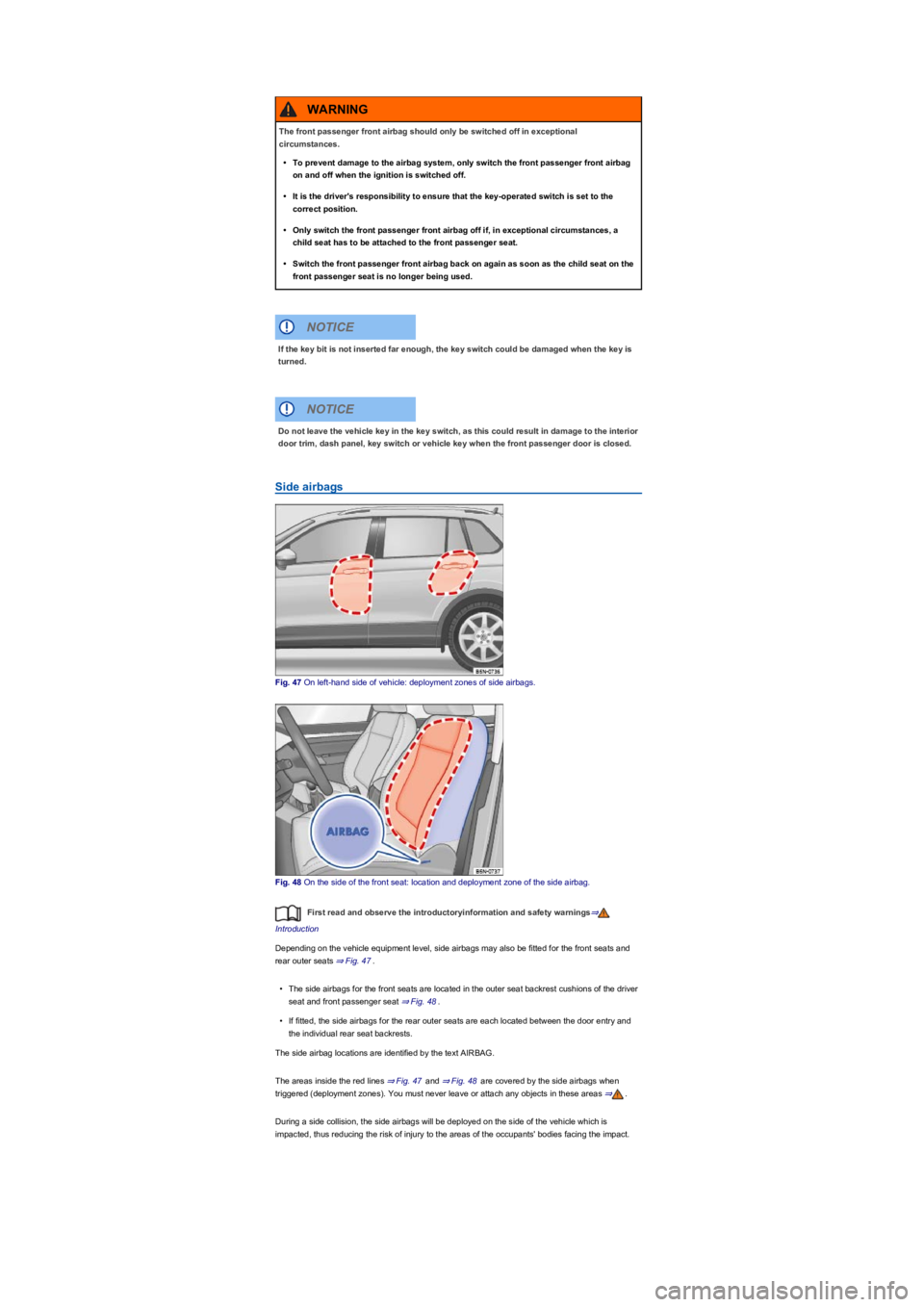
Side airbags
Fig. 47 On left-hand side of vehicle: deployment zones of side airbags.
Fig. 48 On the side of the front seat: location and deployment zone of the side airbag.
First read and observe the introductoryinformation and safety warnings⇒
Introduction
Depending on the vehicle equipment level, side airbags may also be fitted for the front seats and
rear outer seats ⇒ Fig. 47.
•The side airbags for the front seats are located in the outer seat backrest cushions of the driver
seat and front passenger seat ⇒ Fig. 48.
•If fitted, the side airbags for the rear outer seats are each located between the door entry and
the individual rear seat backrests.
The side airbag locations are identified by the text AIRBAG.
The areas inside the red lines ⇒ Fig. 47 and ⇒ Fig. 48 are covered by the side airbags when
triggered (deployment zones). You must never leave or attach any objects in these areas ⇒.
During a side collision, the side airbags will be deployed on the side of the vehicle which is
impacted, thus reducing the risk of injury to the areas of the occupants' bodies facing the impact.
The front passenger front airbag should only be switched off in exceptional
circumstances.
•To prevent damage to the airbag system, only switch the front passenger front airbag
on and off when the ignition is switched off.
•It is the driver's responsibility to ensure that the key-operated switch is set to the
correct position.
•Only switch the front passenger front airbag off if, in exceptional circumstances, a
child seat has to be attached to the front passenger seat.
•Switch the front passenger front airbag back on again as soon as the child seat on the
front passenger seat is no longer being used.
WARNING
If the key bit is not inserted far enough, the key switch could be damaged when the key is
turned.
NOTICE
Do not leave the vehicle key in the key switch, as this could result in damage to the interior
door trim, dash panel, key switch or vehicle key when the front passenger door is closed.
NOTICE
Page 55 of 341
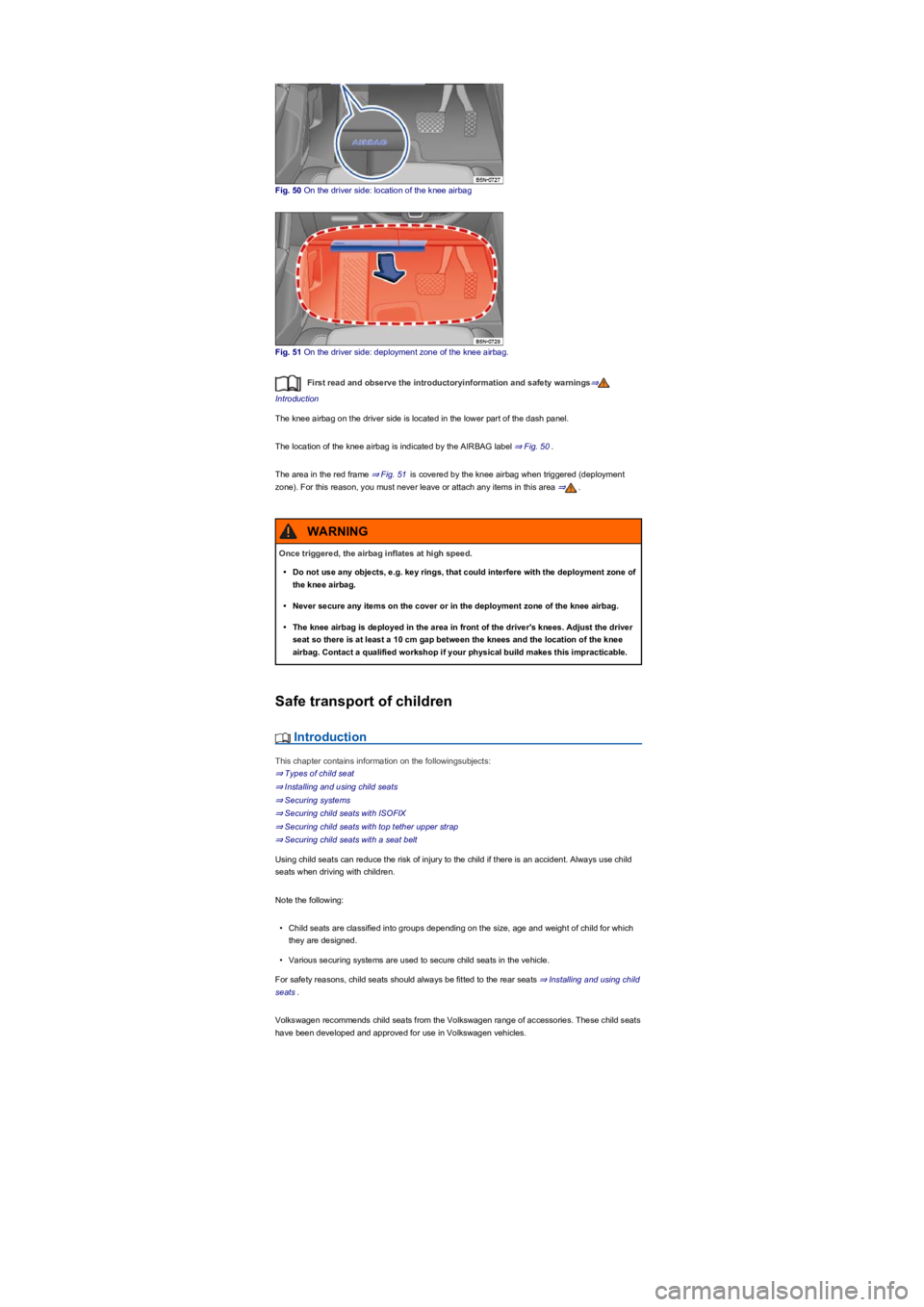
Fig. 50 On the driver side: location of the knee airbag
Fig. 51 On the driver side: deployment zone of the knee airbag.
First read and observe the introductoryinformation and safety warnings⇒
Introduction
The knee airbag on the driver side is located in the lower part of the dash panel.
The location of the knee airbag is indicated by the AIRBAG label ⇒ Fig. 50.
The area in the red frame ⇒ Fig. 51 is covered by the knee airbag when triggered (deployment
zone). For this reason, you must never leave or attach any items in this area ⇒.
Safe transport of children
Introduction
This chapter contains information on the followingsubjects:
⇒ Types of child seat
⇒ Installing and using child seats
⇒ Securing systems
⇒ Securing child seats with ISOFIX
⇒ Securing child seats with top tether upper strap
⇒ Securing child seats with a seat belt
Using child seats can reduce the risk of injury to the child if there is an accident. Always use child
seats when driving with children.
Note the following:
•Child seats are classified into groups depending on the size, age and weight of child for which
they are designed.
•Various securing systems are used to secure child seats in the vehicle.
For safety reasons, child seats should always be fitted to the rear seats ⇒ Installing and using child
seats.
Volkswagen recommends child seats from the Volkswagen range of accessories. These child seats
have been developed and approved for use in Volkswagen vehicles.
Once triggered, the airbag inflates at high speed.
•Do not use any objects, e.g. key rings, that could interfere with the deployment zone of
the knee airbag.
•Never secure any items on the cover or in the deployment zone of the knee airbag.
•The knee airbag is deployed in the area in front of the driver's knees. Adjust the driver
seat so there is at least a 10 cm gap between the knees and the location of the knee
airbag. Contact a qualified workshop if your physical build makes this impracticable.
WARNING
Page 58 of 341
•Deactivate the front passenger front airbag if fitting a rear-facing child seat on the front
passenger seat.
•When fitting on the front passenger seat, push the front passenger seat back fully and adjust
the seat to the highest position. Adjust the backrest to an upright position ⇒ Sitting position.
•When using child seats from groups 0 or 1 on the rear bench seat, push the rear bench seat
backwards as far as possible ⇒ Sitting position.
•When using child seats from groups 2 or 3 on the rear bench seat, push the rear bench seat
into a central position ⇒ Sitting position.
•Always ensure that there is enough space around the child seat. If necessary, adjust the
position of the seat in front. When doing so, ensure that the driver or front passenger can still
maintain a correct sitting position ⇒ Sitting position.
•The backrest of the child seat must lay as flat as possible against the vehicle seat backrest.
Adjust the seat backrest angle if necessary so that the child seat lies flush against the backrest.
If the child seat, once fitted, touches the vehicle head restraint so that it cannot lie flat against
the backrest, push the vehicle head restraint up as far as it will go or remove it and stow it away
safely in the vehicle ⇒ Sitting position.
Airbag sticker
The vehicle may be provided with stickers giving key information about the front passenger front
airbag. The information on these stickers may vary from country to country. The stickers may be
found:
•On the driver and/or front passenger sun visor ⇒ Fig. 53.
•On the B-pillar on the passenger side ⇒ Fig. 54.
It is essential to note the warning information shown on these stickers before installing a rear-facing
child seat ⇒.
Risks involved in carrying children on the front passenger seat
If you are using a rear-facing child seat, the front passenger front airbag can cause critical or
potentially fatal injuries when it inflates ⇒.
Rear-facing child seat may only be used on the front passenger seat if the front passenger front
airbag has been deactivated. A deactivated front passenger front airbag is indicated by means of
the permanently lit PASSENGER AIR BAG indicator lamp in the driver's field of vision.
Switching off the front passenger front airbag ⇒ Airbag system, PASSENGER AIR BAG
indicator lamp ⇒ Indicator lamp.
If using a front-facing child seat, do not deactivate the front passenger front airbag. When fitting
the child seat ensure ensure that it is as far away as possible from the front passenger front airbag.
The front passenger front airbag can cause severe injuries when it inflates ⇒.
Some child seats are not suitable for use on the front passenger seat. The child seat must be
specially authorised by the manufacturer for use on the front passenger seat in vehicles with front
and side airbags. Volkswagen dealerships keep an up-to-date list of authorised child seats.
If you use a rear-facing child seat on the front passenger seat, the child in it is at
increased risk of sustaining critical or fatal injuries in the event of an accident.
•Deactivate the front passenger front airbag. If the front passenger front airbag cannot
be deactivated no rear-facing child seat may be used.
•Move the front passenger seat as far back and as high as possible in order to create
the largest possible distance between the child seat and the front passenger front
airbag.
•Move the backrest to the upright position.
•Move the seat belt height adjuster to the highest position.
•Use only child seats that have been approved by the child seat manufacturer for use on
a front passenger seat with front and side airbags.
DANGER
Child seats present a risk of injury if incorrectly installed.
•Always read and follow the installation instructions and warning information provided
by the child seat manufacturer.
WARNING
Page 59 of 341
Securing systems
First read and observe the introductoryinformation and safety warnings⇒
Introduction
Different countries use different securing systems for safely fitting child seats in the vehicle.
Key terms for securing systems
•ISOFIX: ISOFIX is a standardised securing system for fitting child seats in the vehicle quickly
and safely. The ISOFIX attachment system creates a rigid connection between the child seat
and the car body.
Compatible child seats have two rigid attachment arms that click into ISOFIX attachment points at
the bottom of the backrest (on the outer rear seats). The ISOFIX securing system as described
here is specific to Europe ⇒ Securing child seats with ISOFIX. An upper strap (top tether) and/or
support foot may sometimes have to be used in addition to the ISOFIX anchor points described
above.
•Three-point automatic seat belt. It is better to secure child seats using the ISOFIX system, if
available, rather than with a three-point automatic seat belt ⇒ Securing child seats with a seat
belt.
Additional securing points:
•Top tether: the strap at the top of the child seat is routed over the vehicle seat backrest and
hooked to an anchor ring on the back of the rear seats ⇒ Securing child seats with top tether
upper strap. Top tether anchor points are marked with an anchor symbol.
•Support foot: some child seats are propped up with a support foot resting on the floor of the
vehicle. This support foot helps prevent the child seat tipping forward in a crash. Child seats
with a support foot can be used only on the front passenger seat and the outer rear seats ⇒.
Recommended child seat securing systems
Volkswagen recommends that child seats are secured as follows:
•Infant carrier or rear-facing child seat: ISOFIX and support foot.
•Front-facing child seat: ISOFIX and top tether and possibly support foot also.
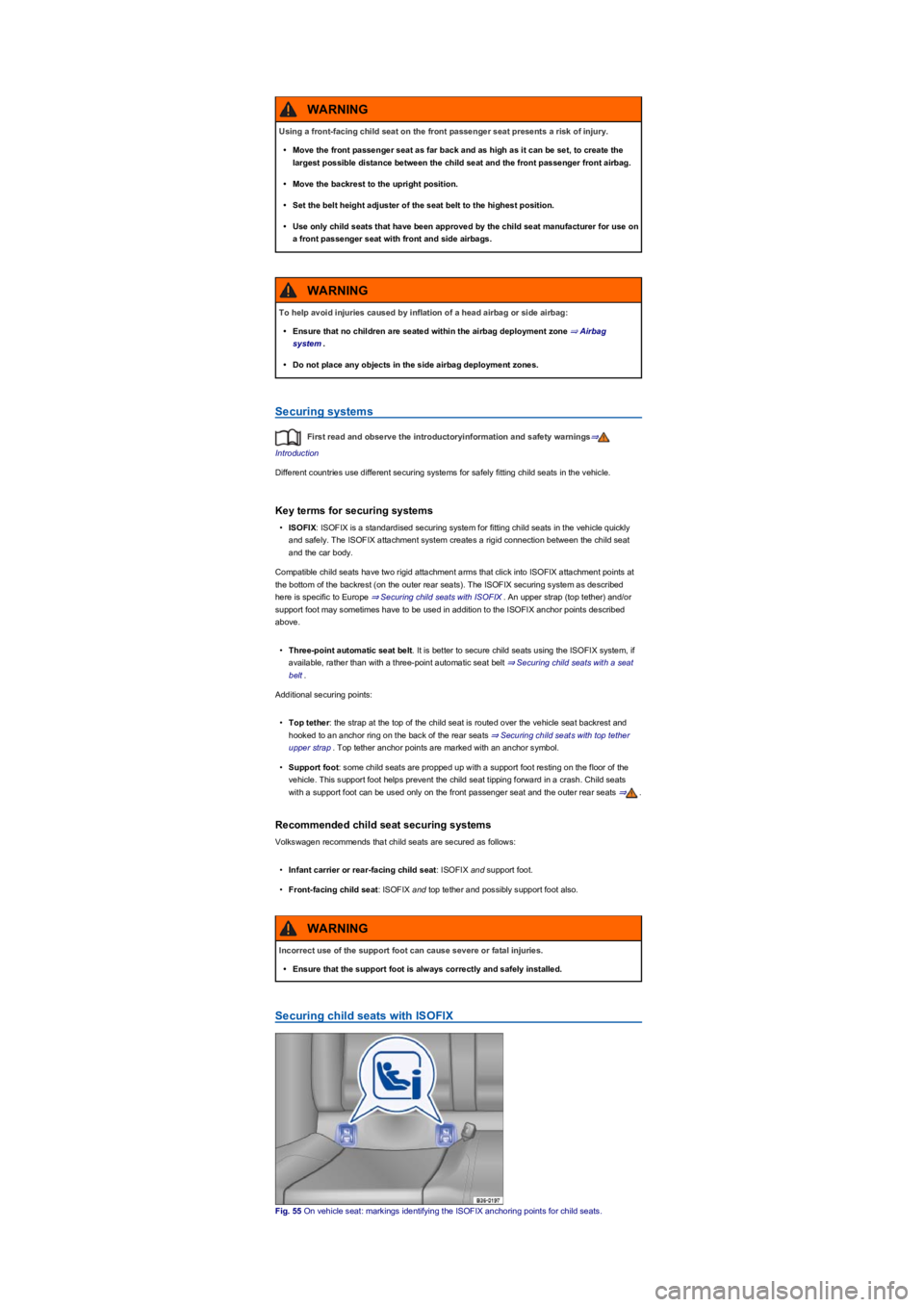
Securing child seats with ISOFIX
Fig. 55 On vehicle seat: markings identifying the ISOFIX anchoring points for child seats.
Using a front-facing child seat on the front passenger seat presents a risk of injury.
•Move the front passenger seat as far back and as high as it can be set, to create the
largest possible distance between the child seat and the front passenger front airbag.
•Move the backrest to the upright position.
•Set the belt height adjuster of the seat belt to the highest position.
•Use only child seats that have been approved by the child seat manufacturer for use on
a front passenger seat with front and side airbags.
WARNING
To help avoid injuries caused by inflation of a head airbag or side airbag:
•Ensure that no children are seated within the airbag deployment zone ⇒ Airbag
system.
•Do not place any objects in the side airbag deployment zones.
WARNING
Incorrect use of the support foot can cause severe or fatal injuries.
•Ensure that the support foot is always correctly and safely installed.
WARNING