phone VOLKSWAGEN TIGUAN 2017 Owner´s Manual
[x] Cancel search | Manufacturer: VOLKSWAGEN, Model Year: 2017, Model line: TIGUAN, Model: VOLKSWAGEN TIGUAN 2017Pages: 341, PDF Size: 9.14 MB
Page 75 of 341
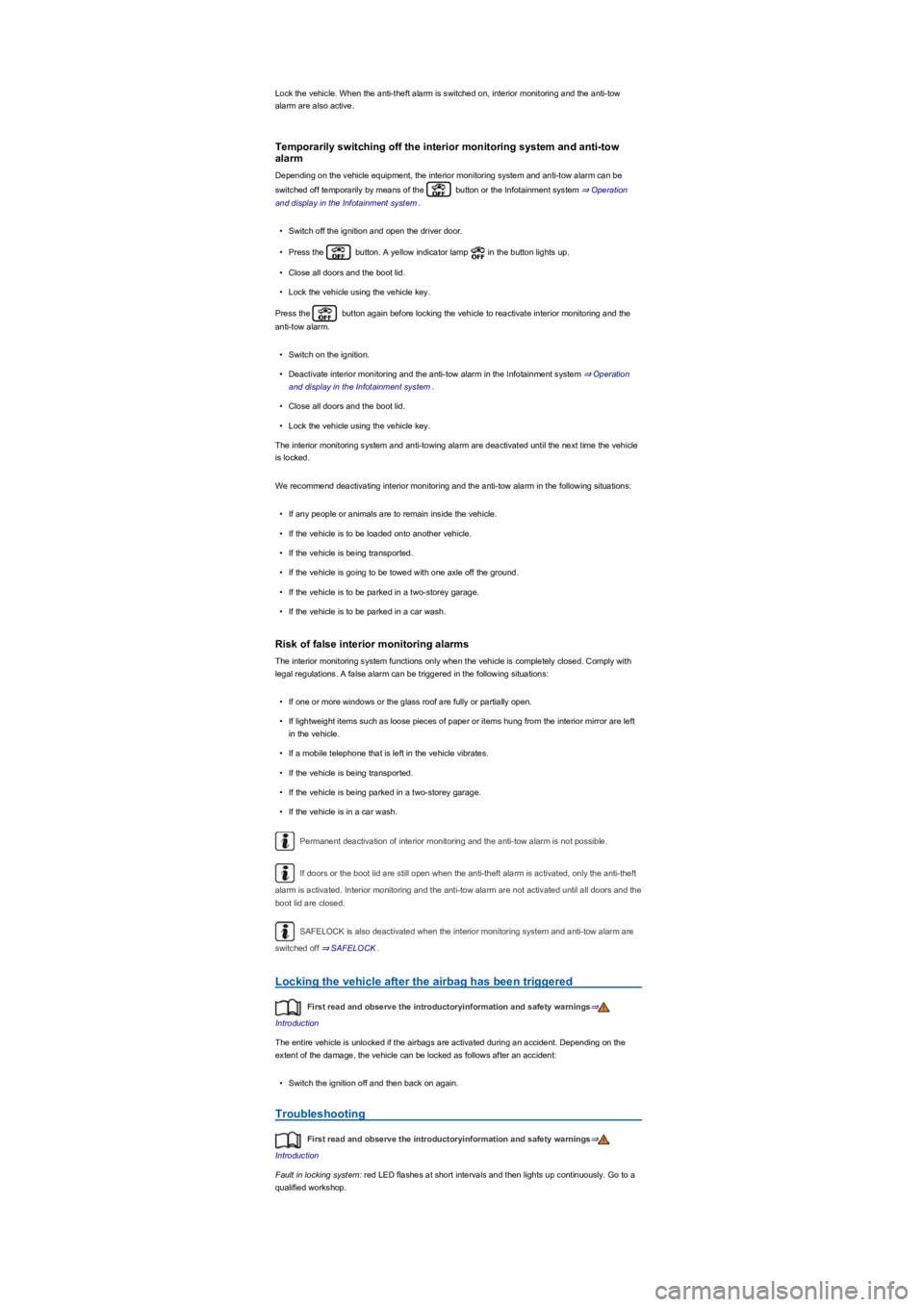
Lock the vehicle. When the anti-theft alarm is switched on, interior monitoring and the anti-tow
alarm are also active.
Temporarily switching off the interior monitoring system and anti-tow
alarm
Depending on the vehicle equipment, the interior monitoring system and anti-tow alarm can be
switched off temporarily by means of the button or the Infotainment system ⇒ Operation
and display in the Infotainment system.
•Switch off the ignition and open the driver door.
•Press the button. A yellow indicator lamp in the button lights up.
•Close all doors and the boot lid.
•Lock the vehicle using the vehicle key.
Press the button again before locking the vehicle to reactivate interior monitoring and the
anti-tow alarm.
•Switch on the ignition.
•Deactivate interior monitoring and the anti-tow alarm in the Infotainment system ⇒ Operation
and display in the Infotainment system.
•Close all doors and the boot lid.
•Lock the vehicle using the vehicle key.
The interior monitoring system and anti-towing alarm are deactivated until the next time the vehicle
is locked.
We recommend deactivating interior monitoring and the anti-tow alarm in the following situations:
•If any people or animals are to remain inside the vehicle.
•If the vehicle is to be loaded onto another vehicle.
•If the vehicle is being transported.
•If the vehicle is going to be towed with one axle off the ground.
•If the vehicle is to be parked in a two-storey garage.
•If the vehicle is to be parked in a car wash.
Risk of false interior monitoring alarms
The interior monitoring system functions only when the vehicle is completely closed. Comply with
legal regulations. A false alarm can be triggered in the following situations:
•If one or more windows or the glass roof are fully or partially open.
•If lightweight items such as loose pieces of paper or items hung from the interior mirror are left
in the vehicle.
•If a mobile telephone that is left in the vehicle vibrates.
•If the vehicle is being transported.
•If the vehicle is being parked in a two-storey garage.
•If the vehicle is in a car wash.
Permanent deactivation of interior monitoring and the anti-tow alarm is not possible.
If doors or the boot lid are still open when the anti-theft alarm is activated, only the anti-theft
alarm is activated. Interior monitoring and the anti-tow alarm are not activated until all doors and the
boot lid are closed.
SAFELOCK is also deactivated when the interior monitoring system and anti-tow alarm are
switched off ⇒ SAFELOCK.
Locking the vehicle after the airbag has been triggered
First read and observe the introductoryinformation and safety warnings⇒
Introduction
The entire vehicle is unlocked if the airbags are activated during an accident. Depending on the
extent of the damage, the vehicle can be locked as follows after an accident:
•Switch the ignition off and then back on again.
Troubleshooting
First read and observe the introductoryinformation and safety warnings⇒
Introduction
Fault in locking system: red LED flashes at short intervals and then lights up continuously. Go to a
qualified workshop.
Page 76 of 341
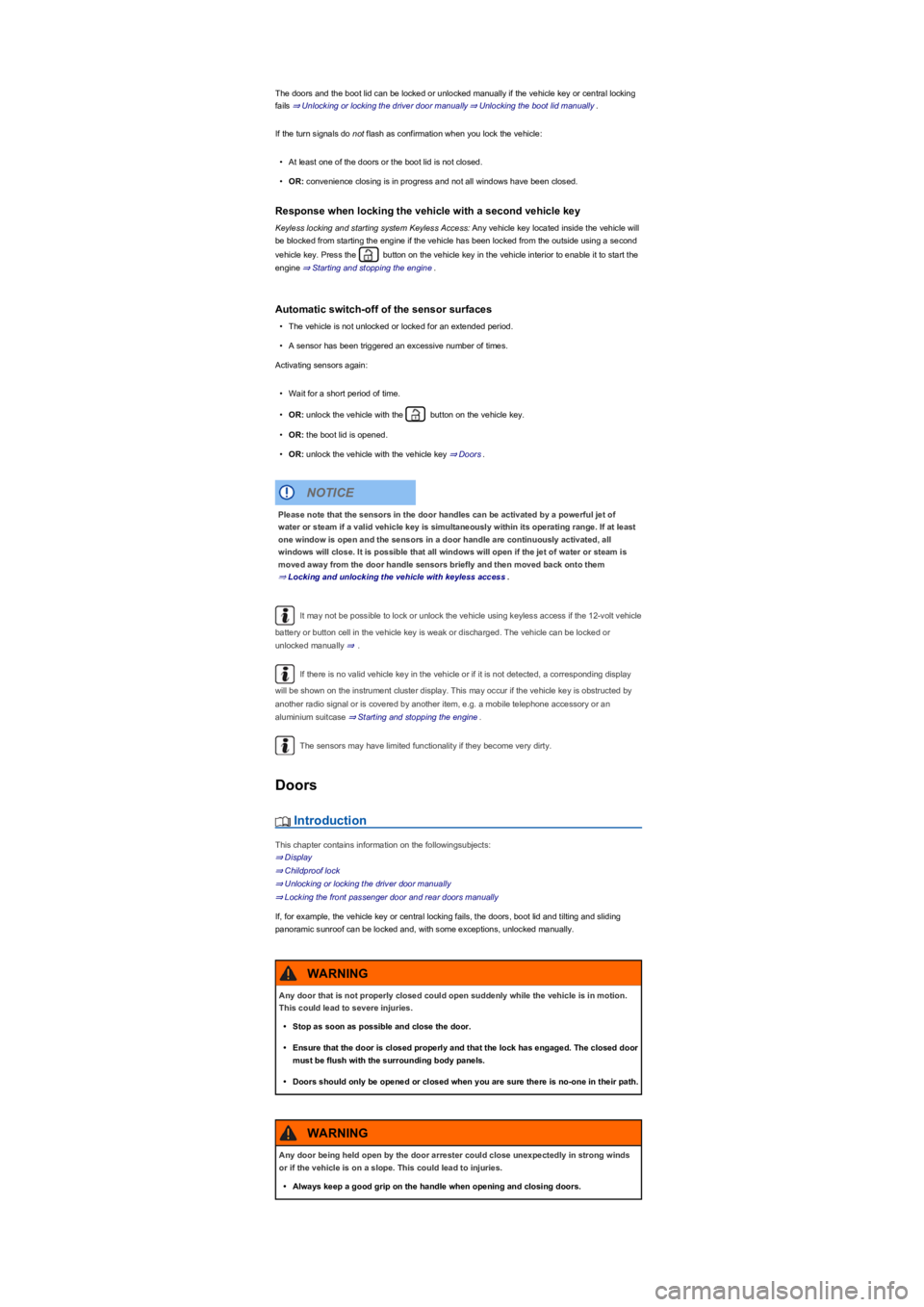
The doors and the boot lid can be locked or unlocked manually if the vehicle key or central locking
fails ⇒ Unlocking or locking the driver door manually⇒ Unlocking the boot lid manually.
If the turn signals do not flash as confirmation when you lock the vehicle:
•At least one of the doors or the boot lid is not closed.
•OR: convenience closing is in progress and not all windows have been closed.
Response when locking the vehicle with a second vehicle key
Keyless locking and starting system Keyless Access: Any vehicle key located inside the vehicle will
be blocked from starting the engine if the vehicle has been locked from the outside using a second
vehicle key. Press the button on the vehicle key in the vehicle interior to enable it to start the
engine ⇒ Starting and stopping the engine.
Automatic switch-off of the sensor surfaces
•The vehicle is not unlocked or locked for an extended period.
•A sensor has been triggered an excessive number of times.
Activating sensors again:
•Wait for a short period of time.
•OR: unlock the vehicle with the button on the vehicle key.
•OR: the boot lid is opened.
•OR: unlock the vehicle with the vehicle key ⇒ Doors.
It may not be possible to lock or unlock the vehicle using keyless access if the 12-volt vehicle
battery or button cell in the vehicle key is weak or discharged. The vehicle can be locked or
unlocked manually ⇒.
If there is no valid vehicle key in the vehicle or if it is not detected, a corresponding display
will be shown on the instrument cluster display. This may occur if the vehicle key is obstructed by
another radio signal or is covered by another item, e.g. a mobile telephone accessory or an
aluminium suitcase ⇒ Starting and stopping the engine.
The sensors may have limited functionality if they become very dirty.
Doors
Introduction
This chapter contains information on the followingsubjects:
⇒ Display
⇒ Childproof lock
⇒ Unlocking or locking the driver door manually
⇒ Locking the front passenger door and rear doors manually
If, for example, the vehicle key or central locking fails, the doors, boot lid and tilting and sliding
panoramic sunroof can be locked and, with some exceptions, unlocked manually.
Please note that the sensors in the door handles can be activated by a powerful jet of
water or steam if a valid vehicle key is simultaneously within its operating range. If at least
one window is open and the sensors in a door handle are continuously activated, all
windows will close. It is possible that all windows will open if the jet of water or steam is
moved away from the door handle sensors briefly and then moved back onto them
⇒ Locking and unlocking the vehicle with keyless access.
NOTICE
Any door that is not properly closed could open suddenly while the vehicle is in motion.
This could lead to severe injuries.
•Stop as soon as possible and close the door.
•Ensure that the door is closed properly and that the lock has engaged. The closed door
must be flush with the surrounding body panels.
•Doors should only be opened or closed when you are sure there is no-one in their path.
WARNING
Any door being held open by the door arrester could close unexpectedly in strong winds
or if the vehicle is on a slope. This could lead to injuries.
•Always keep a good grip on the handle when opening and closing doors.
WARNING
Page 162 of 341
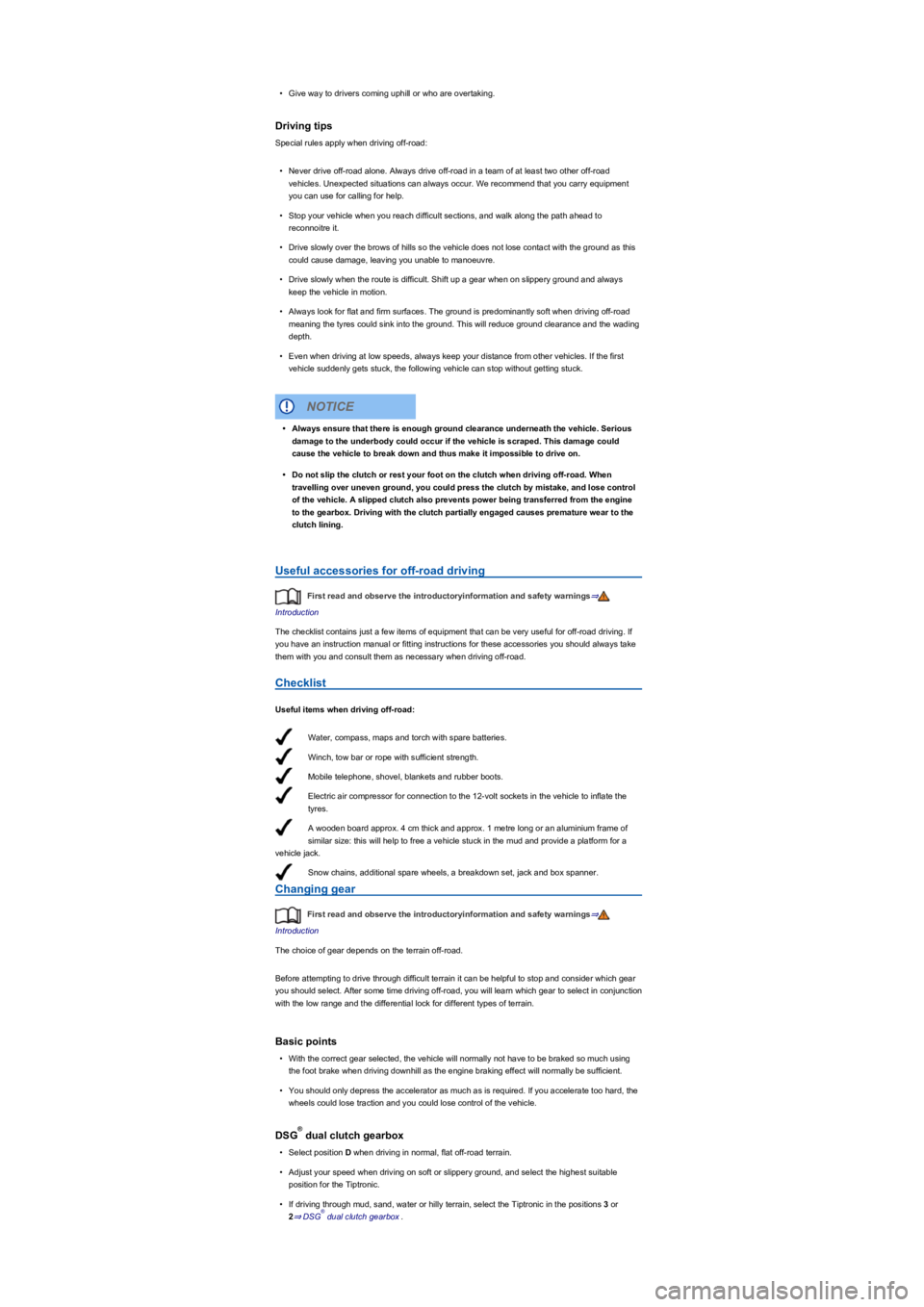
Water, compass, maps and torch with spare batteries.
Winch, tow bar or rope with sufficient strength.
Mobile telephone, shovel, blankets and rubber boots.
Electric air compressor for connection to the 12-volt sockets in the vehicle to inflate the
tyres.
A wooden board approx. 4 cm thick and approx. 1 metre long or an aluminium frame of
similar size: this will help to free a vehicle stuck in the mud and provide a platform for a
vehicle jack.
Snow chains, additional spare wheels, a breakdown set, jack and box spanner.
•Give way to drivers coming uphill or who are overtaking.
Driving tips
Special rules apply when driving off-road:
•Never drive off-road alone. Always drive off-road in a team of at least two other off-road
vehicles. Unexpected situations can always occur. We recommend that you carry equipment
you can use for calling for help.
•Stop your vehicle when you reach difficult sections, and walk along the path ahead to
reconnoitre it.
•Drive slowly over the brows of hills so the vehicle does not lose contact with the ground as this
could cause damage, leaving you unable to manoeuvre.
•Drive slowly when the route is difficult. Shift up a gear when on slippery ground and always
keep the vehicle in motion.
•Always look for flat and firm surfaces. The ground is predominantly soft when driving off-road
meaning the tyres could sink into the ground. This will reduce ground clearance and the wading
depth.
•Even when driving at low speeds, always keep your distance from other vehicles. If the first
vehicle suddenly gets stuck, the following vehicle can stop without getting stuck.
Useful accessories for off-road driving
First read and observe the introductoryinformation and safety warnings⇒
Introduction
The checklist contains just a few items of equipment that can be very useful for off-road driving. If
you have an instruction manual or fitting instructions for these accessories you should always take
them with you and consult them as necessary when driving off-road.
Checklist
Useful items when driving off-road:
Changing gear
First read and observe the introductoryinformation and safety warnings⇒
Introduction
The choice of gear depends on the terrain off-road.
Before attempting to drive through difficult terrain it can be helpful to stop and consider which gear
you should select. After some time driving off-road, you will learn which gear to select in conjunction
with the low range and the differential lock for different types of terrain.
Basic points
•With the correct gear selected, the vehicle will normally not have to be braked so much using
the foot brake when driving downhill as the engine braking effect will normally be sufficient.
•You should only depress the accelerator as much as is required. If you accelerate too hard, the
wheels could lose traction and you could lose control of the vehicle.
DSG dual clutch gearbox
•Select position D when driving in normal, flat off-road terrain.
•Adjust your speed when driving on soft or slippery ground, and select the highest suitable
position for the Tiptronic.
•If driving through mud, sand, water or hilly terrain, select the Tiptronic in the positions 3 or
2⇒ DSG dual clutch gearbox.
•Always ensure that there is enough ground clearance underneath the vehicle. Serious
damage to the underbody could occur if the vehicle is scraped. This damage could
cause the vehicle to break down and thus make it impossible to drive on.
•Do not slip the clutch or rest your foot on the clutch when driving off-road. When
travelling over uneven ground, you could press the clutch by mistake, and lose control
of the vehicle. A slipped clutch also prevents power being transferred from the engine
to the gearbox. Driving with the clutch partially engaged causes premature wear to the
clutch lining.
NOTICE
®
®
Page 222 of 341
Legal requirements
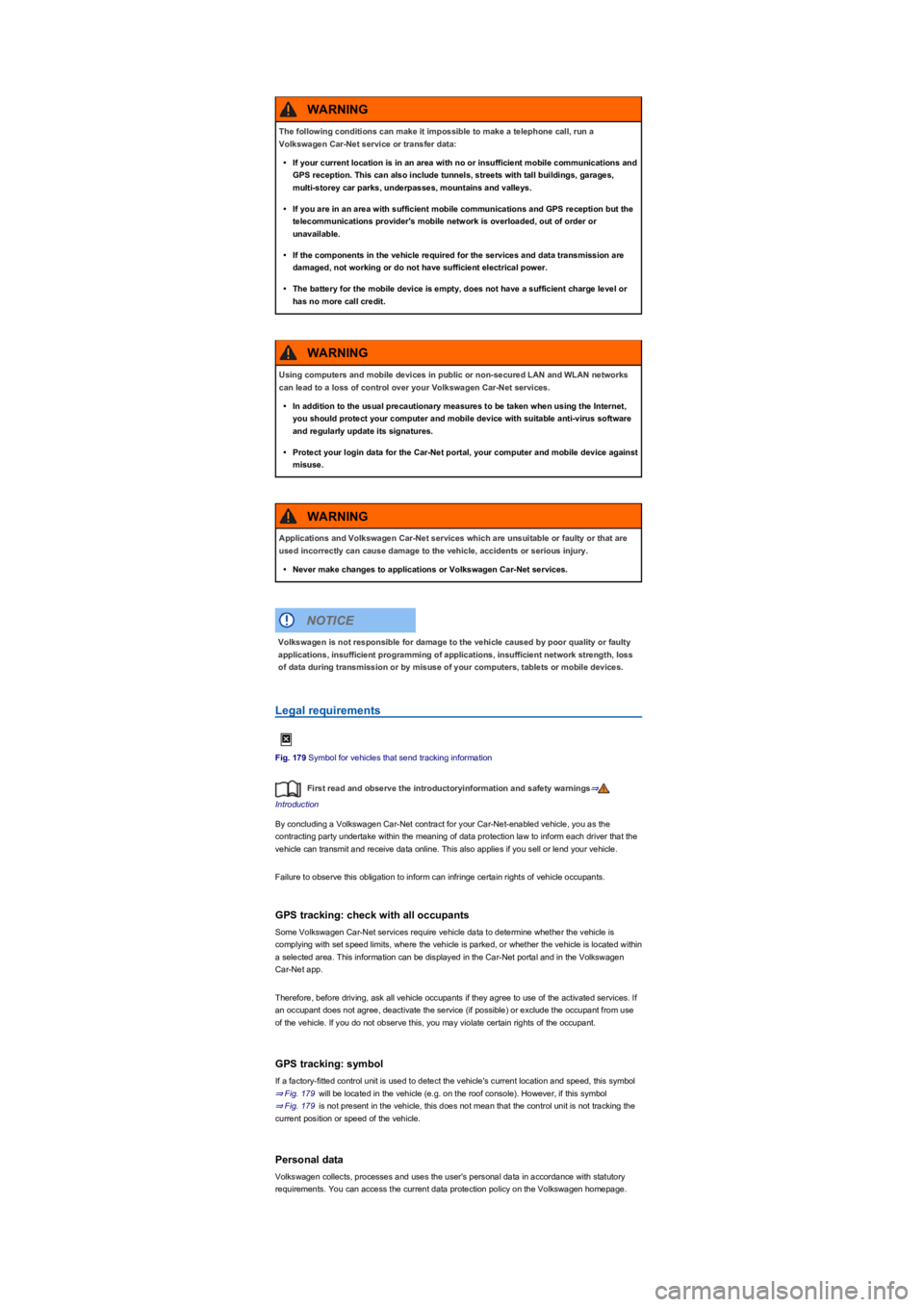
Fig. 179 Symbol for vehicles that send tracking information
First read and observe the introductoryinformation and safety warnings⇒
Introduction
By concluding a Volkswagen Car-Net contract for your Car-Net-enabled vehicle, you as the
contracting party undertake within the meaning of data protection law to inform each driver that the
vehicle can transmit and receive data online. This also applies if you sell or lend your vehicle.
Failure to observe this obligation to inform can infringe certain rights of vehicle occupants.
GPS tracking: check with all occupants
Some Volkswagen Car-Net services require vehicle data to determine whether the vehicle is
complying with set speed limits, where the vehicle is parked, or whether the vehicle is located within
a selected area. This information can be displayed in the Car-Net portal and in the Volkswagen
Car-Net app.
Therefore, before driving, ask all vehicle occupants if they agree to use of the activated services. If
an occupant does not agree, deactivate the service (if possible) or exclude the occupant from use
of the vehicle. If you do not observe this, you may violate certain rights of the occupant.
GPS tracking: symbol
If a factory-fitted control unit is used to detect the vehicle's current location and speed, this symbol
⇒ Fig. 179 will be located in the vehicle (e.g. on the roof console). However, if this symbol
⇒ Fig. 179 is not present in the vehicle, this does not mean that the control unit is not tracking the
current position or speed of the vehicle.
Personal data
Volkswagen collects, processes and uses the user's personal data in accordance with statutory
requirements. You can access the current data protection policy on the Volkswagen homepage.
The following conditions can make it impossible to make a telephone call, run a
Volkswagen Car-Net service or transfer data:
•If your current location is in an area with no or insufficient mobile communications and
GPS reception. This can also include tunnels, streets with tall buildings, garages,
multi-storey car parks, underpasses, mountains and valleys.
•If you are in an area with sufficient mobile communications and GPS reception but the
telecommunications provider's mobile network is overloaded, out of order or
unavailable.
•If the components in the vehicle required for the services and data transmission are
damaged, not working or do not have sufficient electrical power.
•The battery for the mobile device is empty, does not have a sufficient charge level or
has no more call credit.
WARNING
Using computers and mobile devices in public or non-secured LAN and WLAN networks
can lead to a loss of control over your Volkswagen Car-Net services.
•In addition to the usual precautionary measures to be taken when using the Internet,
you should protect your computer and mobile device with suitable anti-virus software
and regularly update its signatures.
•Protect your login data for the Car-Net portal, your computer and mobile device against
misuse.
WARNING
Applications and Volkswagen Car-Net services which are unsuitable or faulty or that are
used incorrectly can cause damage to the vehicle, accidents or serious injury.
•Never make changes to applications or Volkswagen Car-Net services.
WARNING
Volkswagen is not responsible for damage to the vehicle caused by poor quality or faulty
applications, insufficient programming of applications, insufficient network strength, loss
of data during transmission or by misuse of your computers, tablets or mobile devices.
NOTICE
Page 224 of 341
Volkswagen Car-Net services can be subject to regional restrictions. Availability also depends on
the mobile network coverage in each country.
Exchanging your system
If the factory-fitted Infotainment system or control unit is damaged or must be exchanged in a
vehicle with Volkswagen Car-Net services installed, go to a qualified workshop. This may require
registering or activating again.
Registration for user account on Car-Net portal
If you wish to use the Volkswagen Car-Net e-Remote, Guide & Inform or Security & Service
services in a Car-Net-compatible vehicle, you must create a user account at
www.volkswagen.com/car-net and activate Volkswagen Car-Net.
Service description
The portfolios for the e-Remote, Guide & Inform and Security & Service services are all explained in
a separate service description. This service descriptions and additional important information about
all services and Car-Net-capable vehicles are available online at www.volkswagen.com/car-net and
on the Car-Net portal once a user account has been set up.
All service descriptions are updated at irregular intervals and are available on the Car-Net portal.
Always use the latest edition of the relevant service description.
Volkswagen Car-Net services is a system based on a mobile network. If a fault arises
despite the fact that all requirements have been fulfilled, please try using the services again at a
later time.
The use of Volkswagen Car-Net and the necessary mobile network connection may be
subject to a fee. Due to the potentially high volume of data in use, Volkswagen recommends using
a mobile phone tariff which includes a data flat rate. For more information contact your mobile
telephone provider.
Data transfer via the factory-fitted SIM card reader (if possible).
Apps
First read and observe the introductoryinformation and safety warnings⇒
Introduction
•The Volkswagen Car-Net app that executes Volkswagen Car-Net services in the vehicle and
that can provide information.
•Volkswagen App-Connect allows content from Volkswagen apps and third party apps on mobile
devices to be shown on the Infotainment system screen.
There may be problems with compatibility with third party apps.
Applications, their use and the necessary mobile network connection may be subject to charges.
A wide range of applications may be available and they can be vehicle-specific and country-specific
⇒. Content, range and provider of applications can vary. Some applications also depend on
availability of services offered by third parties.
We are unable to guarantee that the available apps can be run on all mobile devices and all
operating systems.
Applications offered by Volkswagen can be changed, set, deactivated, reactivated and expanded
without prior notice.
Transporting
Stowing luggage and loads
Cargo and luggage can be transported in the vehicle, on a trailer ⇒ Technical requirements and on
the roof ⇒ Roof carrier. Always observe the legal regulations.
Stowing luggage safely in the vehicle
•Always distribute any loads in the vehicle as evenly as possible.
•Always stow luggage and heavy objects in the luggage compartment ⇒.
•Place heavy objects as far forward in the luggage compartment as possible.
•Observe gross axle weight ratings and the gross vehicle weight rating ⇒ Information on
technical data.
•Secure luggage in the luggage compartment to the fastening rings using suitable fixing and
securing straps ⇒ Luggage compartment equipment.
•Also stow small objects safely.
1)
Page 243 of 341
Safety instructions for handling fuel
Fuels can pollute the environment. Any spilt service fluids must be cleaned up and disposed
of properly.
The tank flap cannot be opened manually. Seek expert assistance.
Fuel types and refuelling
Introduction
This chapter contains information on the followingsubjects:
⇒ Petrol
⇒ Diesel
⇒ Refuelling
⇒ Misfuelling prevention device
The tank flap is located at the rear right-hand side of the vehicle ⇒ Side view.
Different engines require different fuels. The factory-fitted sticker on the inside of the tank flap
indicates the required fuel type for your vehicle.
Information on indicator and warning lamps can be found in the troubleshooting section at the end
of the chapter ⇒ Troubleshooting.
Petrol
First read and observe the introductoryinformation and safety warnings⇒
Introduction
Vehicles with a petrol engine must be run on unleaded petrol. Fuels with a maximum ethanol
content of 10% (E10) can be used for refuelling ⇒.
The petrol grades differ with respect to the octane number. The vehicle may be filled with petrol that
has a higher octane number than the engine requires. However, this does not provide any
advantage in terms of fuel consumption or engine output.
The fuel quality affects the running properties, performance and service life of the engine. You
should therefore use fuel that already contains suitable service additives if possible ⇒.
Information on the fuel standards can be found in the chapter on fuel standards ⇒ Fuel standards.
Incorrect handling of fuel can cause explosions, fire, serious burns and other injuries.
•Switch off the auxiliary heater⇒ Auxiliary heater and ventilation, the engine, the
ignition, your mobile phone and other wireless equipment while refuelling.
•Do not get into the vehicle to avoid electrostatic discharge.
•Make sure that the tank cap is closed properly and no fuel can escape.
•Comply with any relevant safety information and legislation concerning the handling of
fuels.
WARNING
Fuel may run out of the fuel canister. This could cause fire and injuries.
•Do not carry fuel canisters in the vehicle.
CAUTION
Incorrect refuelling can lead to damage to the vehicle.
•Only use fuels that have been approved for the vehicle.
•Do not use fuels containing metals and only use approved additives.
•Spilt fuel should be removed from all vehicle components immediately.
NOTICE
Page 261 of 341
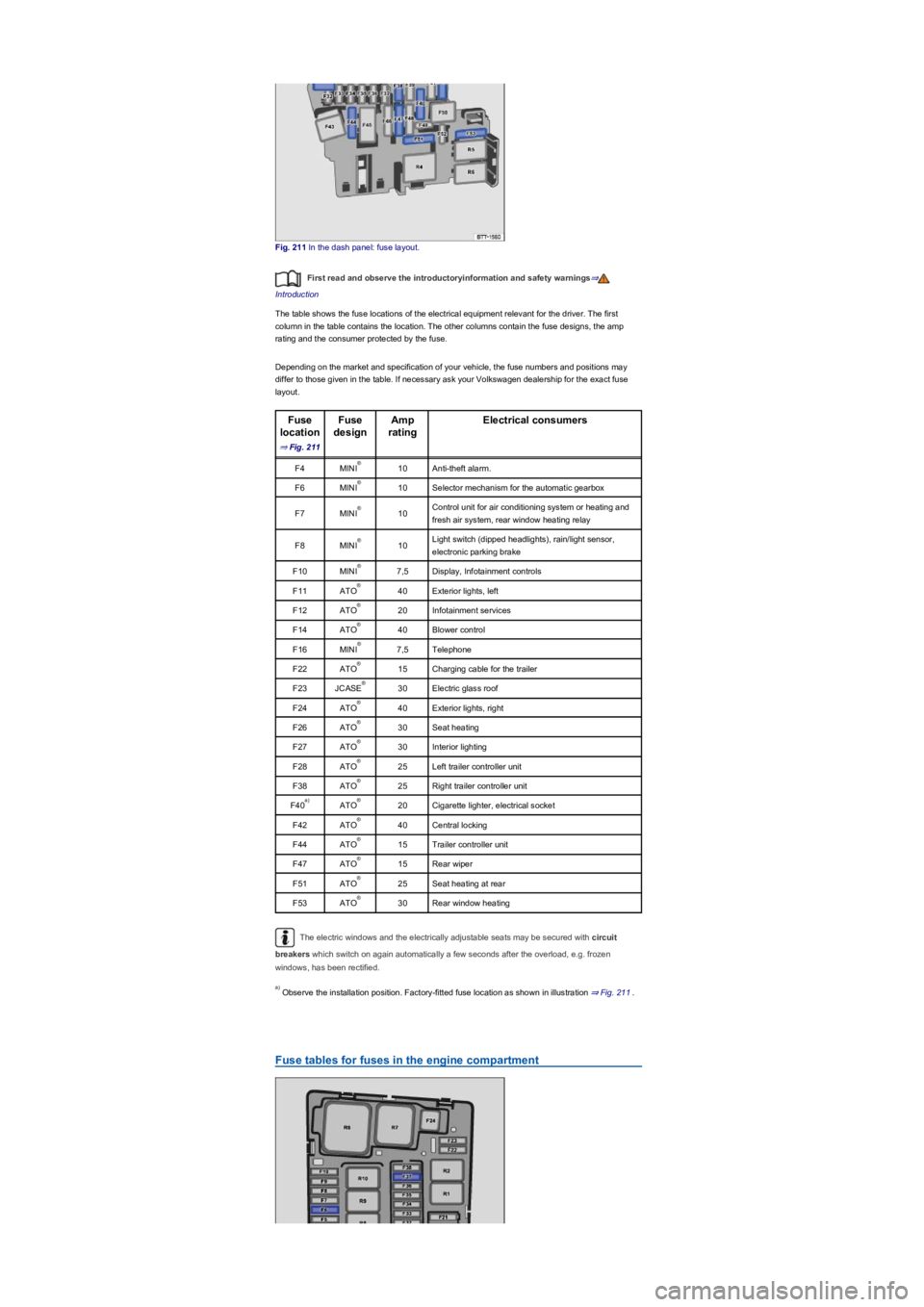
Fig. 211 In the dash panel: fuse layout.
First read and observe the introductoryinformation and safety warnings⇒
Introduction
The table shows the fuse locations of the electrical equipment relevant for the driver. The first
column in the table contains the location. The other columns contain the fuse designs, the amp
rating and the consumer protected by the fuse.
Depending on the market and specification of your vehicle, the fuse numbers and positions may
differ to those given in the table. If necessary ask your Volkswagen dealership for the exact fuse
layout.
Fuse
location
⇒ Fig. 211
Fuse
design
Amp
rating
Electrical consumers
F4MINI10Anti-theft alarm.
F6MINI10Selector mechanism for the automatic gearbox
F7MINI10Control unit for air conditioning system or heating and
fresh air system, rear window heating relay
F8MINI10Light switch (dipped headlights), rain/light sensor,
electronic parking brake
F10MINI7,5Display, Infotainment controls
F11ATO40Exterior lights, left
F12ATO20Infotainment services
F14ATO40Blower control
F16MINI7,5Telephone
F22ATO15Charging cable for the trailer
F23JCASE30Electric glass roof
F24ATO40Exterior lights, right
F26ATO30Seat heating
F27ATO30Interior lighting
F28ATO25Left trailer controller unit
F38ATO25Right trailer controller unit
F40ATO20Cigarette lighter, electrical socket
F42ATO40Central locking
F44ATO15Trailer controller unit
F47ATO15Rear wiper
F51ATO25Seat heating at rear
F53ATO30Rear window heating
The electric windows and the electrically adjustable seats may be secured with circuit
breakers which switch on again automatically a few seconds after the overload, e.g. frozen
windows, has been rectified.
Observe the installation position. Factory-fitted fuse location as shown in illustration ⇒ Fig. 211.
Fuse tables for fuses in the engine compartment
®
®
®
®
®
®
®
®
®
®
®
®
®
®
®
®
a)®
®
®
®
®
®
a)
Page 264 of 341
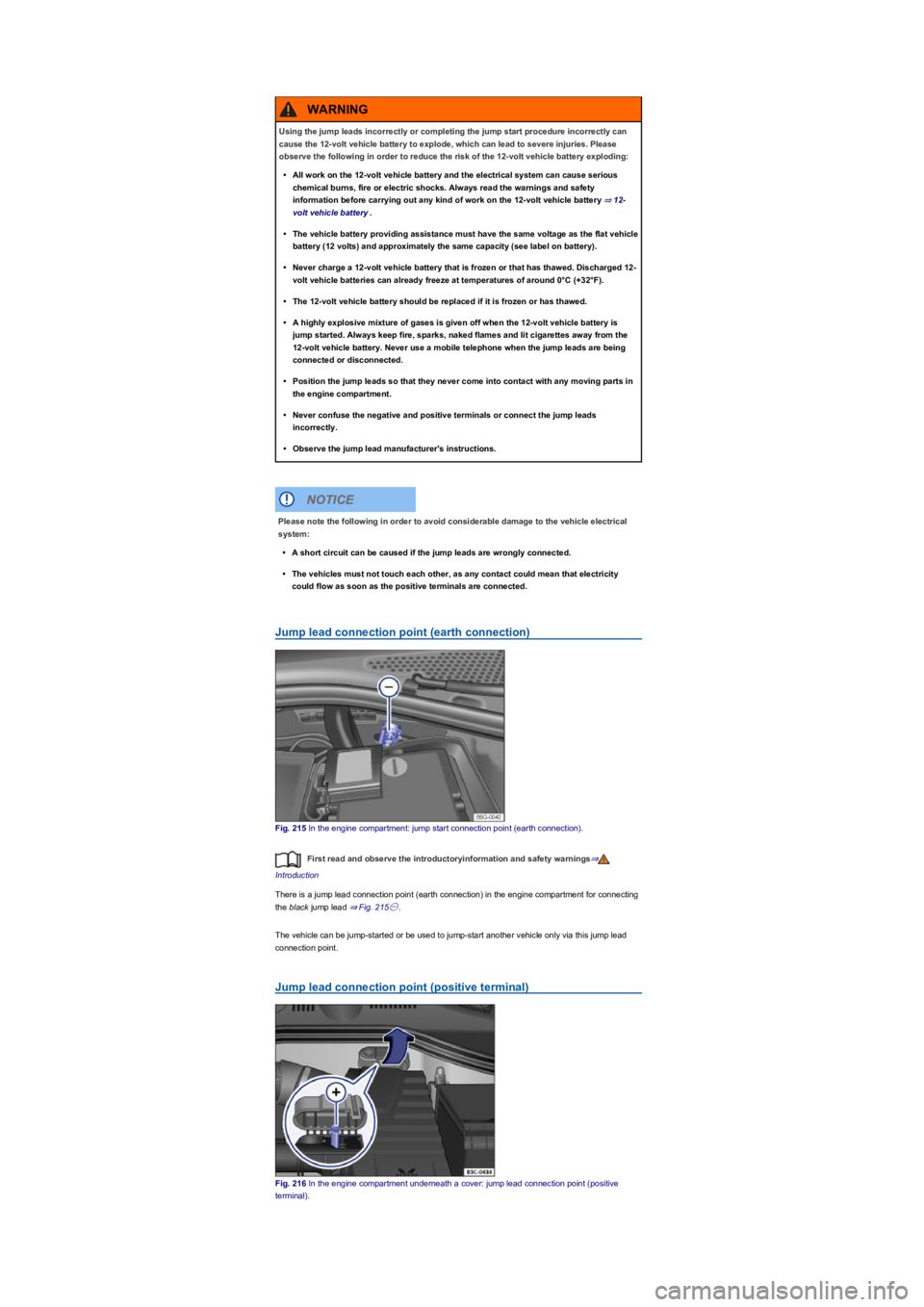
Jump lead connection point (earth connection)
Fig. 215 In the engine compartment: jump start connection point (earth connection).
First read and observe the introductoryinformation and safety warnings⇒
Introduction
There is a jump lead connection point (earth connection) in the engine compartment for connecting
the black jump lead ⇒ Fig. 215㊀.
The vehicle can be jump-started or be used to jump-start another vehicle only via this jump lead
connection point.
Jump lead connection point (positive terminal)
Fig. 216 In the engine compartment underneath a cover: jump lead connection point (positive
terminal).
Using the jump leads incorrectly or completing the jump start procedure incorrectly can
cause the 12-volt vehicle battery to explode, which can lead to severe injuries. Please
observe the following in order to reduce the risk of the 12-volt vehicle battery exploding:
•All work on the 12-volt vehicle battery and the electrical system can cause serious
chemical burns, fire or electric shocks. Always read the warnings and safety
information before carrying out any kind of work on the 12-volt vehicle battery ⇒ 12-
volt vehicle battery.
•The vehicle battery providing assistance must have the same voltage as the flat vehicle
battery (12 volts) and approximately the same capacity (see label on battery).
•Never charge a 12-volt vehicle battery that is frozen or that has thawed. Discharged 12-
volt vehicle batteries can already freeze at temperatures of around 0°C (+32°F).
•The 12-volt vehicle battery should be replaced if it is frozen or has thawed.
•A highly explosive mixture of gases is given off when the 12-volt vehicle battery is
jump started. Always keep fire, sparks, naked flames and lit cigarettes away from the
12-volt vehicle battery. Never use a mobile telephone when the jump leads are being
connected or disconnected.
•Position the jump leads so that they never come into contact with any moving parts in
the engine compartment.
•Never confuse the negative and positive terminals or connect the jump leads
incorrectly.
•Observe the jump lead manufacturer's instructions.
WARNING
Please note the following in order to avoid considerable damage to the vehicle electrical
system:
•A short circuit can be caused if the jump leads are wrongly connected.
•The vehicles must not touch each other, as any contact could mean that electricity
could flow as soon as the positive terminals are connected.
NOTICE
Page 324 of 341
authorization symbol). These devices include cruise control systems or an electronically controlled
suspension.
Any additional electrical components fitted that do not serve to control the vehicle itself must
bear the mark (manufacturer conformity declaration in the European Union). Such devices
include refrigerator boxes, laptops and ventilator fans.
Repairs and technical modifications
Repairs and technical modifications must always be carried out according to Volkswagen
specifications⇒.
Unauthorised modifications to the electronic components or software in the vehicle may cause
malfunctions. As the electronic components are linked together in networks, these faults may
indirectly affect the working of other systems. This can seriously impair safety, lead to excessive
wear of components, and also invalidate the type approval for the vehicle.
The Volkswagen dealership cannot be held liable for any damage caused by technical
modifications and/or work performed incorrectly.
The Volkswagen dealership is not responsible for damage caused by technical modifications and/or
work performed incorrectly. Such damage is not covered by the Volkswagen guarantee.
Volkswagen recommends that all repairs and technical modifications be performed by an
authorised Volkswagen workshop using Volkswagen Genuine Parts.
Volkswagen repair information
Volkswagen Service information and official Volkswagen repair information can be purchased for a
fee.
Customers in Europe, Asia, Australia, Africa, Central and South America: please contact a
Volkswagen dealership or qualified workshop or register on the online portal erWin (electronic
repair and workshop information):
https://erwin.volkswagen.de
erWin is available in numerous languages.
Vehicles with special auxiliary equipment or body parts
The manufacturer of these components must ensure that these parts (fittings) adhere to the
stipulated environmental laws and regulations, particularly the EU directive 2000/53/EC concerning
end-of-life vehicles and EU directive 2003/11/EC concerning the restriction on the marketing and
use of certain dangerous substances and preparations.
The vehicle owner should keep all assembly documentation for these auxiliary fittings, and pass it
on to any scrapping company later engaged. This is to facilitate environmentally responsible
disposal for all vehicles, including refitted vehicles.
Windscreen repairs
To function properly, some items of equipment require an electrical or electronic module, which is
located on the inside of the windscreen near the interior mirror. If the windscreen has been
damaged in the viewing field of the electrical or electronic module, e.g. by stone impact, the
windscreen must be replaced. Repairing the crack can lead to malfunctions or functional faults in
the equipment.
After changing the windscreen, the camera and sensors must be set up and calibrated by a
qualified workshop.
Impairment or damage to sensors and cameras
Incorrect repairs, retrofit structural modifications to the vehicle, e.g. lowering the body, add-on parts
on the vehicle or trailer ⇒ Trailer towing, or changes to the trim may lead to the sensors or
cameras being disrupted or damaged. This can also be caused by collisions, e.g. when parking.
Failure to observe this may impair important functions (driver assist systems) and damage the
vehicle.
The area in front of and around the sensors and cameras must not be covered by stickers,
additional headlights, trim frames for number plates or similar.
Incorrectly performed repairs or modifications to your vehicle can impair the effectiveness
of the airbags, cause malfunctions, accidents and fatal injury.
•Never secure or mount objects such as drink holders or telephone holders either on or
next to the airbag covers or within the deployment zones of the airbag modules.
•Objects either on or next to the airbag module covers or are in the deployment zone of
the airbags can cause serious or even fatal injuries should the airbags be activated.
WARNING
®
Page 325 of 341
Repairs and structural modifications should be carried out by a qualified workshop. Volkswagen
recommends using a Volkswagen dealership for this purpose.
•Repainting and paint touch-ups in the area around the sensors may impair the function of the
system in question.
•As the Volkswagen badge influences the view of the radar sensor in the front area, drive the
vehicle only with the original Volkswagen badge.
Engine and transmission guard
An engine and transmission guard can reduce the risk of damage to the underside of the vehicle
and to the engine oil sump.
Depending on where the vehicle is used, it may be a good idea to have an engine and transmission
guard installed, e.g. if the vehicle will be driven over kerbs, on driveways or on unsurfaced roads. If
you wish to have one fitted, Volkswagen recommends contacting your Volkswagen dealership.
Repairs and faults in the airbag system
Repairs and technical modifications must always be carried out according to Volkswagen
specifications⇒.
Modifications and repairs to the front bumper, the doors, the front seats, the headliner, or the
bodywork should be carried out by a qualified workshop. System components and airbag system
sensors might be fitted on these vehicle components.
If you work on the airbag system or remove and install parts of the system when performing other
repair work, parts of the airbag system may be damaged. The consequence may be that, in the
event of an accident, the airbag inflates incorrectly or does not inflate at all.
Regulations must be observed to ensure that the effectiveness of the airbags is not reduced and
that removed parts do not cause any injuries or environmental pollution. Qualified workshops are
familiar with these requirements.
Any modifications to the vehicle's suspension could prevent the airbag system from working
properly during a collision. For example, using tyre/rim combinations that have not been approved
by Volkswagen, lowering the vehicle, making modifications to the suspension rate including work on
the springs, struts and shock absorbers could change the forces that are measured by the airbag
sensors and sent to the electronic control unit. Some changes to the suspension could cause the
forces measured by the sensors to increase, for example. This can lead to the airbag system being
triggered in collision scenarios where it normally would not be triggered if modifications to the
suspension had not been made. Other modifications can cause the forces measured by the
sensors to decrease, therefore preventing the airbag system from being triggered when it should
have been.
Incorrect repairs and modifications can cause malfunctions and damage to the vehicle
and impair the effectiveness of the driver assist systems. This can result in accidents and
severe injuries.
•Repairs and modifications to your vehicle should be carried out only by a qualified
workshop.
WARNING
Unsuitable spare parts and accessories, incorrectly carried out work, modifications and
repairs can lead to damage to the vehicle and cause accidents and serious injuries.
•Volkswagen strongly recommends you use only approved Volkswagen accessories
and Volkswagen Genuine Parts. These parts and accessories have been specially
tested by Volkswagen for suitability, reliability and safety.
•Repairs and modifications to your vehicle should only be carried out by a qualified
workshop. Qualified workshops have the necessary tools, diagnostic equipment, repair
information and qualified personnel.
•Never fit parts to your vehicle that are in any way different from the factory-fitted parts.
•Never secure or mount objects such as drink holders or telephone holders either on or
next to the airbag covers or within the deployment zones of the airbag modules.
•Only use rim/tyre combinations which have been approved by Volkswagen for your
vehicle type.
WARNING
®