stop start VOLKSWAGEN TIGUAN 2017 Owner´s Manual
[x] Cancel search | Manufacturer: VOLKSWAGEN, Model Year: 2017, Model line: TIGUAN, Model: VOLKSWAGEN TIGUAN 2017Pages: 341, PDF Size: 9.14 MB
Page 76 of 341
The doors and the boot lid can be locked or unlocked manually if the vehicle key or central locking
fails ⇒ Unlocking or locking the driver door manually⇒ Unlocking the boot lid manually.
If the turn signals do not flash as confirmation when you lock the vehicle:
•At least one of the doors or the boot lid is not closed.
•OR: convenience closing is in progress and not all windows have been closed.
Response when locking the vehicle with a second vehicle key
Keyless locking and starting system Keyless Access: Any vehicle key located inside the vehicle will
be blocked from starting the engine if the vehicle has been locked from the outside using a second
vehicle key. Press the button on the vehicle key in the vehicle interior to enable it to start the
engine ⇒ Starting and stopping the engine.
Automatic switch-off of the sensor surfaces
•The vehicle is not unlocked or locked for an extended period.
•A sensor has been triggered an excessive number of times.
Activating sensors again:
•Wait for a short period of time.
•OR: unlock the vehicle with the button on the vehicle key.
•OR: the boot lid is opened.
•OR: unlock the vehicle with the vehicle key ⇒ Doors.
It may not be possible to lock or unlock the vehicle using keyless access if the 12-volt vehicle
battery or button cell in the vehicle key is weak or discharged. The vehicle can be locked or
unlocked manually ⇒.
If there is no valid vehicle key in the vehicle or if it is not detected, a corresponding display
will be shown on the instrument cluster display. This may occur if the vehicle key is obstructed by
another radio signal or is covered by another item, e.g. a mobile telephone accessory or an
aluminium suitcase ⇒ Starting and stopping the engine.
The sensors may have limited functionality if they become very dirty.
Doors
Introduction
This chapter contains information on the followingsubjects:
⇒ Display
⇒ Childproof lock
⇒ Unlocking or locking the driver door manually
⇒ Locking the front passenger door and rear doors manually
If, for example, the vehicle key or central locking fails, the doors, boot lid and tilting and sliding
panoramic sunroof can be locked and, with some exceptions, unlocked manually.
Please note that the sensors in the door handles can be activated by a powerful jet of
water or steam if a valid vehicle key is simultaneously within its operating range. If at least
one window is open and the sensors in a door handle are continuously activated, all
windows will close. It is possible that all windows will open if the jet of water or steam is
moved away from the door handle sensors briefly and then moved back onto them
⇒ Locking and unlocking the vehicle with keyless access.
NOTICE
Any door that is not properly closed could open suddenly while the vehicle is in motion.
This could lead to severe injuries.
•Stop as soon as possible and close the door.
•Ensure that the door is closed properly and that the lock has engaged. The closed door
must be flush with the surrounding body panels.
•Doors should only be opened or closed when you are sure there is no-one in their path.
WARNING
Any door being held open by the door arrester could close unexpectedly in strong winds
or if the vehicle is on a slope. This could lead to injuries.
•Always keep a good grip on the handle when opening and closing doors.
WARNING
Page 78 of 341
Switching the child lock on and off
•Unlock the vehicle and open the appropriate rear door.
•Move the slot to the corresponding position.
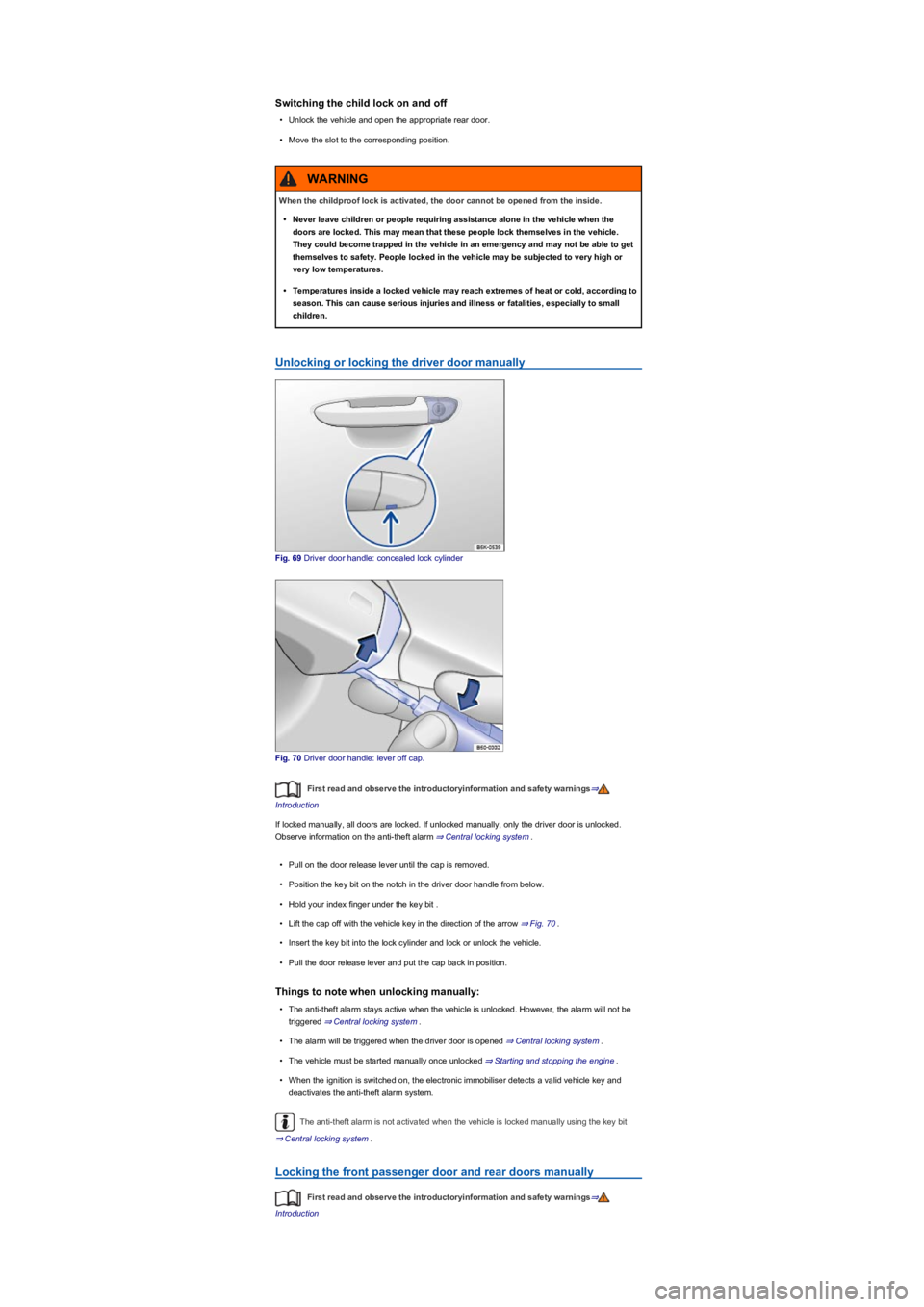
Unlocking or locking the driver door manually
Fig. 69 Driver door handle: concealed lock cylinder
Fig. 70 Driver door handle: lever off cap.
First read and observe the introductoryinformation and safety warnings⇒
Introduction
If locked manually, all doors are locked. If unlocked manually, only the driver door is unlocked.
Observe information on the anti-theft alarm ⇒ Central locking system.
•Pull on the door release lever until the cap is removed.
•Position the key bit on the notch in the driver door handle from below.
•Hold your index finger under the key bit .
•Lift the cap off with the vehicle key in the direction of the arrow ⇒ Fig. 70.
•Insert the key bit into the lock cylinder and lock or unlock the vehicle.
•Pull the door release lever and put the cap back in position.
Things to note when unlocking manually:
•The anti-theft alarm stays active when the vehicle is unlocked. However, the alarm will not be
triggered ⇒ Central locking system.
•The alarm will be triggered when the driver door is opened ⇒ Central locking system.
•The vehicle must be started manually once unlocked ⇒ Starting and stopping the engine.
•When the ignition is switched on, the electronic immobiliser detects a valid vehicle key and
deactivates the anti-theft alarm system.
The anti-theft alarm is not activated when the vehicle is locked manually using the key bit
⇒ Central locking system.
Locking the front passenger door and rear doors manually
First read and observe the introductoryinformation and safety warnings⇒
Introduction
When the childproof lock is activated, the door cannot be opened from the inside.
•Never leave children or people requiring assistance alone in the vehicle when the
doors are locked. This may mean that these people lock themselves in the vehicle.
They could become trapped in the vehicle in an emergency and may not be able to get
themselves to safety. People locked in the vehicle may be subjected to very high or
very low temperatures.
•Temperatures inside a locked vehicle may reach extremes of heat or cold, according to
season. This can cause serious injuries and illness or fatalities, especially to small
children.
WARNING
Page 81 of 341
•Briefly press and hold the button on the vehicle key to unlock the boot lid.
•OR: pull the button in the driver door upwards ⇒ Fig. 71.
•OR: press the button in the boot lid ⇒ Fig. 72.
The boot lid will then open.
Closing the boot lid electrically
•Press the button in the open boot lid.
•OR: pull the button in the driver door upwards.
•OR: briefly press and hold the button on the vehicle key.
•OR: close the boot lid by moving it manually until the boot lid closes by itself.
The boot lid is closed.
Interrupting the opening or closing procedure
•Press one of the buttons during the opening or closing procedure.
The boot lid can now be moved by hand. You will need to use increased force to do this.
Pressing the button again moves the boot lid back into the starting position.
Signal tones
If the boot lid is opened or closed from the vehicle interior or using the vehicle key, signal tones will
sound.
Changing and storing the opening angle
If the area behind or above the vehicle is smaller than the path of the boot lid, the opening angle of
the boot lid can be changed.
•Stop the opening procedure at the desired open position (at least half open).
•In the opened boot lid, press and hold the button until the hazard warning lights
flash.
The changed opening angle will be stored.
The hazard warning lights flash and an acoustic signal sounds to confirm that the changed opening
angle has been stored.
Resetting and storing the opening angle
To reset the opening angle so that the boot lid opens fully again, press the open boot lid upwards
with your hand up to the limit position. You will need to use increased force to do this.
In the opened boot lid, press and hold the button until the hazard warning lights flash.
The opening angle will be reset.
The hazard warning lights flash and an acoustic signal sounds to confirm that the opening angle
has been reset.
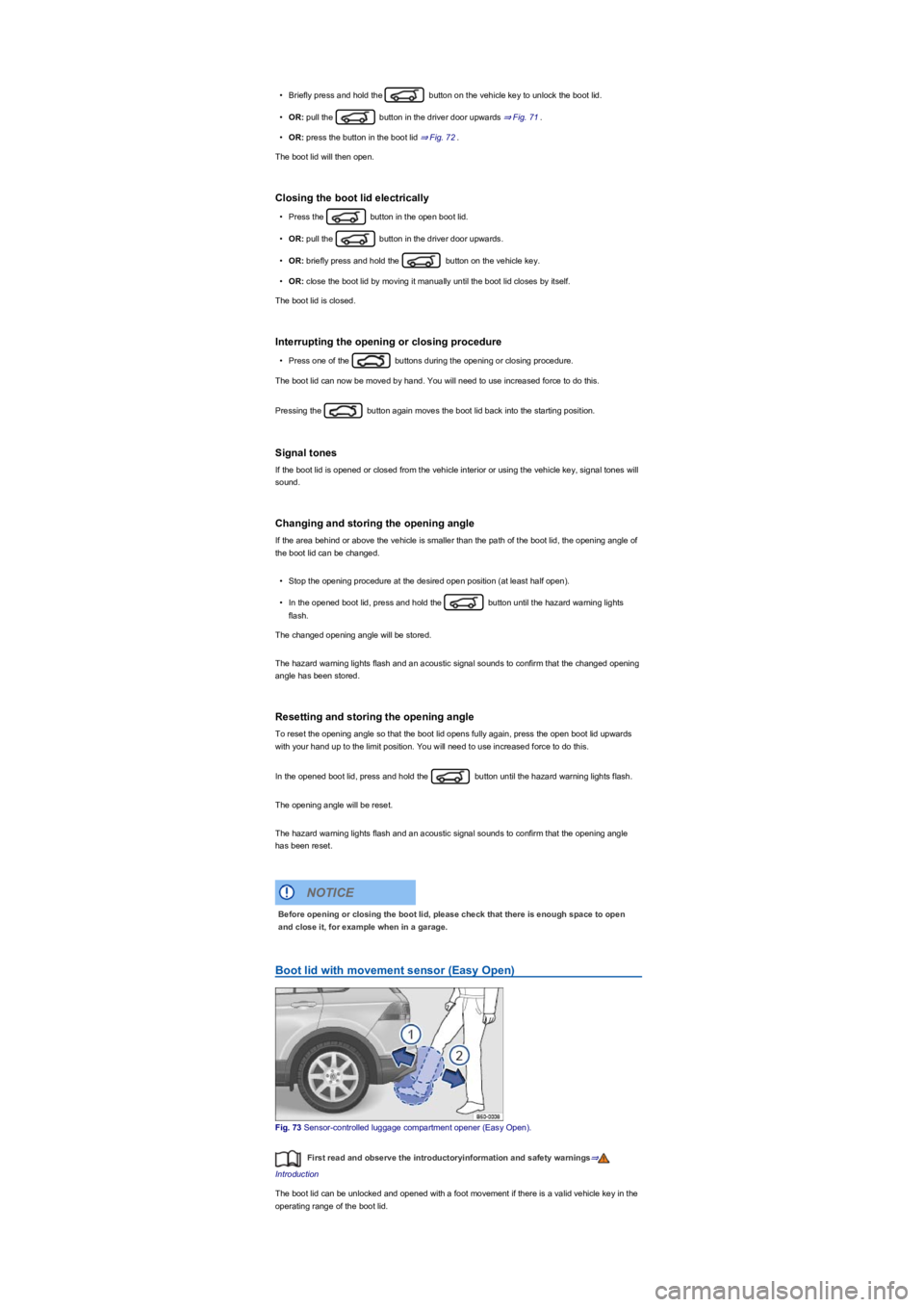
Boot lid with movement sensor (Easy Open)
Fig. 73 Sensor-controlled luggage compartment opener (Easy Open).
First read and observe the introductoryinformation and safety warnings⇒
Introduction
The boot lid can be unlocked and opened with a foot movement if there is a valid vehicle key in the
operating range of the boot lid.
Before opening or closing the boot lid, please check that there is enough space to open
and close it, for example when in a garage.
NOTICE
Page 84 of 341
One-touch opening and closing
One-touch opening and closing makes it possible to fully open and close the windows. The
individual buttons do not have to be held down to do this.
One-touch closing: pull the button for the appropriate window up briefly into the second position.
One-touch opening: press the button for the appropriate window down briefly into the second
position.
Stopping the one-touch function: press or pull the button for the appropriate window again.
Convenience opening and closing
The windows can be opened and closed from outside the vehicle using the vehicle key when the
ignition is switched off:
•Press and hold the locking or unlocking button on the vehicle key.
•Vehicles with the keyless locking and starting system Keyless Access: place your finger on the
locking sensor in the door handle for a few seconds until the windows are closed ⇒ Central
locking system. The vehicle key must also be within the operating range.
•To interrupt the function, release the unlocking or locking button OR take your finger off the
sensor surface.
A valid vehicle key must be located in the operating range. All turn signals will flash once as
confirmation that all the windows have been closed.
Adjust the settings for convenience opening using the Infotainment system ⇒ Operation and display
in the Infotainment system.
One-touch opening and closing and the roll-back function will not work if there is a
malfunction in the electric windows. Go to a qualified workshop.
Convenience opening and closing works only when one-touch opening and closing is
activated for all electric windows.
Electric window roll-back function
First read and observe the introductoryinformation and safety warnings⇒
Introduction
The roll-back function for the electric windows can reduce the risk of crush injuries when the
windows are closing.
If the window is not able to close because it is stiff or because of an obstruction, the window will
immediately open again ⇒.
•Check to see why the window has not closed.
•Try to close the window again.
•If the window closing process is interrupted again, the roll-back function will be disabled for a
few seconds.
•If the window still cannot be closed, it will stop at the corresponding position. To close the
window without the roll-back function, press the button again within a few seconds ⇒.
Careless or unsupervised use of the electric windows can cause serious injuries.
•The electric windows should be opened or closed only when you are sure that nobody
is in their operating area.
•Never leave children or people requiring assistance alone in the vehicle when the
vehicle is locked. The windows can no longer be opened in an emergency.
•Always take all vehicle keys with you every time you leave the vehicle. The windows
can still be operated using the buttons in the doors for a short time after the ignition
has been switched off, provided that the driver door and front passenger door are not
opened.
•When transporting children on the rear bench seat, the rear electric windows should
always be deactivated using the safety button so that they cannot be opened or closed.
WARNING
Page 86 of 341
Remove leaves and other loose items from the glass roof guide rails at regular intervals
using a vacuum cleaner, or by hand.
The roll-back function will not work properly if there is a malfunction with the glass roof. Go to
a qualified workshop.
Opening and closing the glass roof
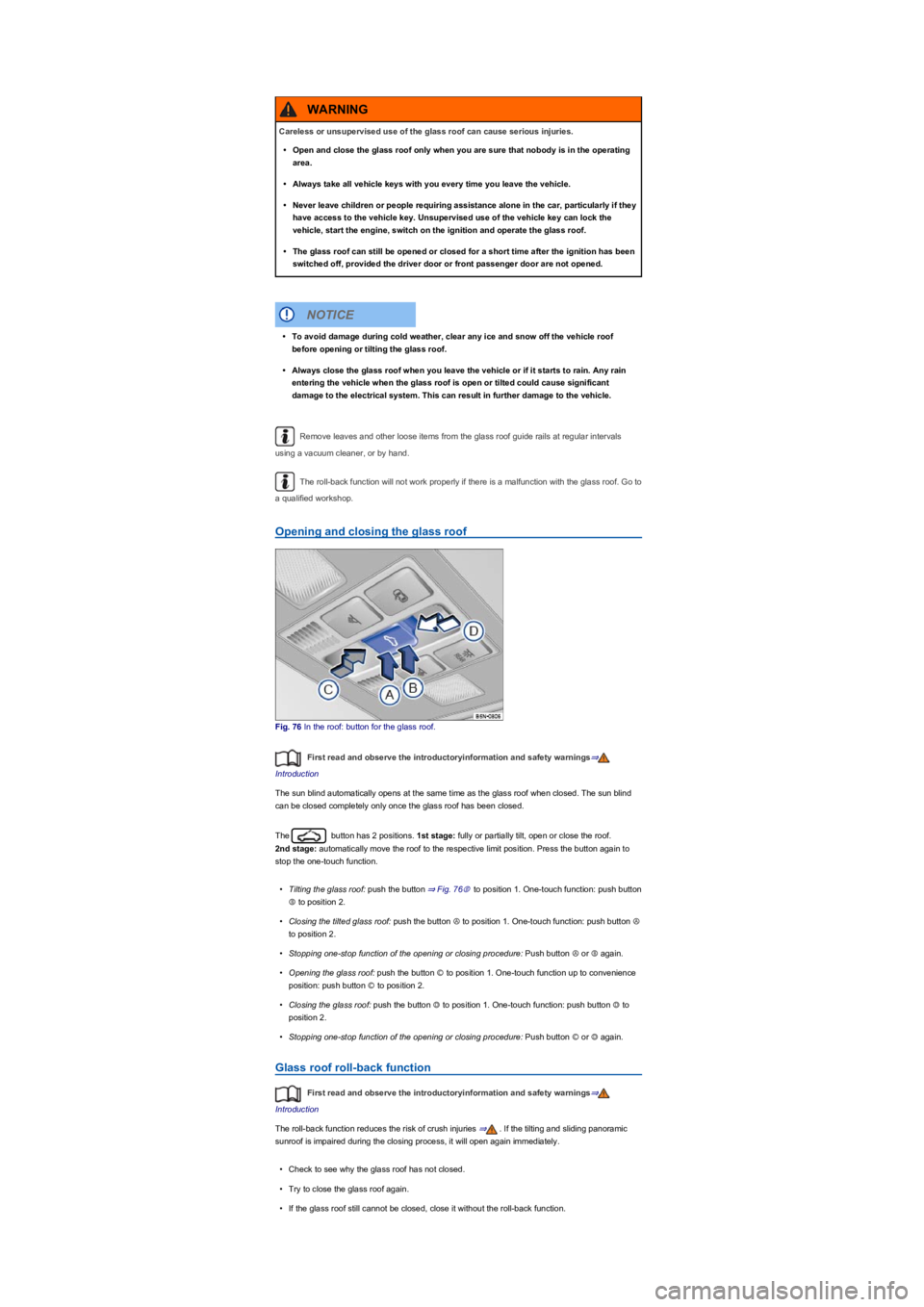
Fig. 76 In the roof: button for the glass roof.
First read and observe the introductoryinformation and safety warnings⇒
Introduction
The sun blind automatically opens at the same time as the glass roof when closed. The sun blind
can be closed completely only once the glass roof has been closed.
The button has 2 positions. 1st stage: fully or partially tilt, open or close the roof.
2nd stage: automatically move the roof to the respective limit position. Press the button again to
stop the one-touch function.
•Tilting the glass roof: push the button ⇒ Fig. 76Ⓑ to position 1. One-touch function: push button
Ⓑ to position 2.
•Closing the tilted glass roof: push the button Ⓐ to position 1. One-touch function: push button Ⓐ
to position 2.
•Stopping one-stop function of the opening or closing procedure: Push button Ⓐ or Ⓑ again.
•Opening the glass roof: push the button Ⓒ to position 1. One-touch function up to convenience
position: push button Ⓒ to position 2.
•Closing the glass roof: push the button Ⓓ to position 1. One-touch function: push button Ⓓ to
position 2.
•Stopping one-stop function of the opening or closing procedure: Push button Ⓒ or Ⓓ again.
Glass roof roll-back function
First read and observe the introductoryinformation and safety warnings⇒
Introduction
The roll-back function reduces the risk of crush injuries ⇒. If the tilting and sliding panoramic
sunroof is impaired during the closing process, it will open again immediately.
•Check to see why the glass roof has not closed.
•Try to close the glass roof again.
•If the glass roof still cannot be closed, close it without the roll-back function.
Careless or unsupervised use of the glass roof can cause serious injuries.
•Open and close the glass roof only when you are sure that nobody is in the operating
area.
•Always take all vehicle keys with you every time you leave the vehicle.
•Never leave children or people requiring assistance alone in the car, particularly if they
have access to the vehicle key. Unsupervised use of the vehicle key can lock the
vehicle, start the engine, switch on the ignition and operate the glass roof.
•The glass roof can still be opened or closed for a short time after the ignition has been
switched off, provided the driver door or front passenger door are not opened.
WARNING
•To avoid damage during cold weather, clear any ice and snow off the vehicle roof
before opening or tilting the glass roof.
•Always close the glass roof when you leave the vehicle or if it starts to rain. Any rain
entering the vehicle when the glass roof is open or tilted could cause significant
damage to the electrical system. This can result in further damage to the vehicle.
NOTICE
Page 91 of 341
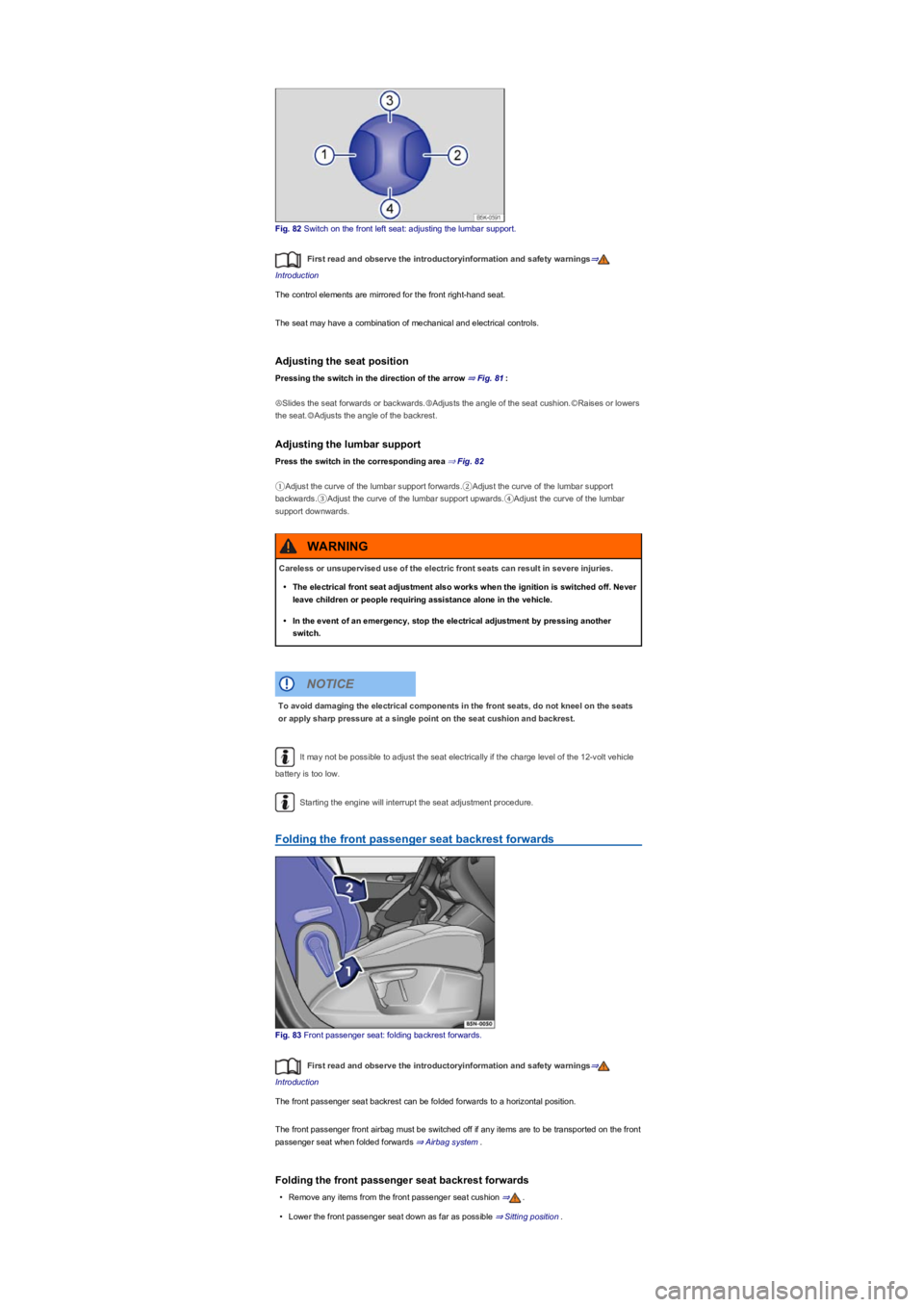
Fig. 82 Switch on the front left seat: adjusting the lumbar support.
First read and observe the introductoryinformation and safety warnings⇒
Introduction
The control elements are mirrored for the front right-hand seat.
The seat may have a combination of mechanical and electrical controls.
Adjusting the seat position
Pressing the switch in the direction of the arrow ⇒ Fig. 81:
ⒶSlides the seat forwards or backwards.ⒷAdjusts the angle of the seat cushion.ⒸRaises or lowers
the seat.ⒹAdjusts the angle of the backrest.
Adjusting the lumbar support
Press the switch in the corresponding area ⇒ Fig. 82
①Adjust the curve of the lumbar support forwards.②Adjust the curve of the lumbar support
backwards.③Adjust the curve of the lumbar support upwards.④Adjust the curve of the lumbar
support downwards.
It may not be possible to adjust the seat electrically if the charge level of the 12-volt vehicle
battery is too low.
Starting the engine will interrupt the seat adjustment procedure.
Folding the front passenger seat backrest forwards
Fig. 83 Front passenger seat: folding backrest forwards.
First read and observe the introductoryinformation and safety warnings⇒
Introduction
The front passenger seat backrest can be folded forwards to a horizontal position.
The front passenger front airbag must be switched off if any items are to be transported on the front
passenger seat when folded forwards ⇒ Airbag system.
Folding the front passenger seat backrest forwards
•Remove any items from the front passenger seat cushion ⇒.
•Lower the front passenger seat down as far as possible ⇒ Sitting position.
Careless or unsupervised use of the electric front seats can result in severe injuries.
•The electrical front seat adjustment also works when the ignition is switched off. Never
leave children or people requiring assistance alone in the vehicle.
•In the event of an emergency, stop the electrical adjustment by pressing another
switch.
WARNING
To avoid damaging the electrical components in the front seats, do not kneel on the seats
or apply sharp pressure at a single point on the seat cushion and backrest.
NOTICE
Page 111 of 341
Troubleshooting
Washer fluid level too low. Fill up the washer fluid reservoir as soon as possible ⇒ Washer
fluid.Fault in the rain/light sensor. Switch the ignition on and off. If the indicator lamp still lights
up permanently after you switch the ignition back on, seek expert assistance.Fault in
windscreen wipers. Switch the ignition on and off. If the indicator lamp still lights up permanently
after you switch the ignition back on, seek expert assistance.
Changes in the response of the rain/light sensor
Possible causes for faults and misinterpretations relating to the sensitive surface of the rain/light
sensor ⇒ Vehicle overviews include:
•Damaged wiper blades: a film of water or smears caused by damaged wiper blades can
increase the time the wipers are switched on, can shorten the length of the intervals between
wipes or cause the wipers to run quickly and continuously.
•Insects: insects hitting the windscreen surface can cause the wipers to be activated.
•Salt deposits: in winter, salt deposits on the windscreen can cause the wipers to continue to
wipe the windscreen when it is almost dry.
•Soiling: dry dust, wax, windscreen coatings (lotus effect), or detergent deposits (from an
automatic car wash) can cause the rain/light sensor to become less sensitive and react too
slowly, or prevent it from reacting at all. Clean the sensitive surface of the rain/light sensor
⇒ Caring for and cleaning the vehicle exterior at regular intervals and inspect the wiper blades
for damage.
•Crack in the windscreen: a wipe cycle will be triggered if the rain/light sensor is on when the
windscreen is impacted by a stone. The rain/light sensor will then register the reduction in
sensitivity of the surfaces and adjust accordingly. The size of the crack can affect the way in
which the rain/light sensor activates the wipers.
We recommend that you use an alcohol-based glass cleaner to remove wax and polish.
The wipers will try to wipe away any obstacles that are on the windscreen. The wipers will
stop moving if the obstacle blocks their path. Remove the obstacle and switch the wipers back on
again.
Mirrors
Introduction
This chapter contains information on the followingsubjects:
⇒ Interior mirror
⇒ Exterior mirrors
You can use the exterior mirrors and the interior mirror to observe traffic behind you and adjust
driving style accordingly.
For safety reasons it is important that the driver positions the exterior and interior mirrors correctly
before starting a journey ⇒.
Looking in the exterior mirrors and the interior mirror does not allow the driver to see the entire side
and rear area of the vehicle. The area that cannot be seen is known as the blind spot. There may
be objects and other road users in the blind spot.
Adjusting the exterior and interior mirrors while driving may cause the driver to become
distracted. This can lead to accidents and serious injuries.
•Exterior and interior mirrors should only be adjusted when the vehicle is stationary.
•When parking, changing lane, or performing an overtaking or turning manoeuvre,
always pay careful attention to the area around the vehicle as objects and other road
users may be located in the blind spot.
•Always ensure that the mirrors are positioned correctly and that the rear view is not
restricted by ice, snow, condensation or any other objects.
WARNING
If you estimate the distance from traffic behind you incorrectly, you can cause accidents
and serious injuries.
•Curved mirrors (convex or aspheric) enlarge the field of vision and can make objects in
the mirror seem smaller and further away than they actually are.
•Using curved mirrors to estimate the distance from other vehicles behind you when
changing lanes can provide inaccurate results and can lead to accidents and severe
injuries.
•Whenever possible, use the interior mirror to check the exact distance between your
vehicle and following traffic or other objects.
•Ensure that you have a good view to the rear of the vehicle.
WARNING
Page 130 of 341
m/k/a995MK Vehicles with manual gearbox: change from first to second gear immediately
after setting off. Change to higher gears rapidly.
m/k/a995MK Vehicles with DSG dual clutch gearbox: accelerate slowly and avoid using the
kickdown function.
Gear-change indicator ⇒ Gear-change indicator.
Eco driving profile ⇒ Driving profile selection and 4MOTION Active Control.
Avoid full throttle
Never fully use the maximum speed of the vehicle. Driving at excessive speeds, e.g. above 130
km/h on the motorway, will increase air resistance and thus the amount of force needed to move
the vehicle.
Reduce idling
Drive off immediately with low revs. If you are stopped for a long period, do not allow the engine to
idle but switch it off, e.g. when in a traffic jam or at a railway crossing.
In vehicles with an activated start/stop system, the engine will switch off automatically when the
vehicle is stopping and when the vehicle is stationary ⇒ Start/stop system .
Refuel with moderation
A full fuel tank increases the weight of the vehicle. A fuel tank that is half to three quarters full is
sufficient for urban journeys in particular.
Avoid short journeys
A cold engine has a very high fuel consumption. The optimum operating temperature is reached
only after driving a few miles. The fuel consumption is above average at very low ambient
temperatures, e.g. in winter ⇒ Fig. 116. Plan journeys economically and combine short distances.
Carry out regular maintenance
Regular maintenance is an essential prerequisite for economical driving and increases the service
life of the vehicle.
Observe the correct tyre pressures
An inadequate tyre pressure does not just mean greater wear, but also increases the rolling
resistance of the tyres and thus the fuel consumption. Use optimised rolling resistance tyres.
Adjust the tyre pressure according to the vehicle load. Observe the information on the tyre pressure
sticker ⇒ Useful information about wheels and tyres
Tyre Pressure Loss Indicator or Tyre Pressure Monitoring System ⇒ Tyre monitoring systems.
Use low viscosity engine oil
Fully synthetic engine oils with a low viscosity decrease frictional resistance in the engine and
spread better and more quickly, especially for cold starts.
Do not drive with unnecessary loads in the vehicle
You can reduce fuel consumption by clearing out the luggage compartment before setting off, for
example by removing empty drink crates or unused child seats.
In order to keep the drag coefficient of the vehicle as low as possible, remove attachments and
add-on parts such as ski, bicycle or roof carriers after use.
Save electrical energy
The alternator is driven by the engine and generates power for convenience consumers such as the
air conditioning system, window heating and ventilation. Saving electrical energy is easy, e.g.:
•At high ambient temperatures, ventilate the car before starting a journey and drive a short
distance with open window. Only then switch on the air conditioning system.
•Switch off convenience systems as soon as they have served their purpose.
Adapt your speed and distance from the vehicles ahead to suit visibility, weather, road
and traffic conditions.
WARNING
Page 134 of 341
Driving through water on roads
First read and observe the introductoryinformation and safety warnings⇒
Introduction
Please follow these rules to help prevent damage to your vehicle when driving through water, for
example if the road is flooded:
•Check the depth of the water before driving through it. The water level must be no higher than
the lower edge of the vehicle body ⇒.
•Do not drive faster than walking speed.
•Never stop the vehicle, reverse or switch off the engine while in water.
•Oncoming vehicles will create waves that could increase the water level for your vehicle to such
an extent that it is not safe to drive through the water.
•Always deactivate the start/stop system manually when driving through water ⇒ Start/stop
system .
Driving with an unlocked or open boot lid can cause serious injuries.
•Always drive with the boot lid closed.
•Always stow all items in the luggage compartment securely. Loose objects can fall out
of the luggage compartment and injure other road users.
•Always drive carefully and ensure that you think ahead.
•Avoid any abrupt or sudden driving and braking manoeuvres as this could cause the
open boot lid to move unpredictably.
•Any objects protruding from the luggage compartment must be marked to ensure that
they are visible to other road users. Comply with legal regulations.
•If items protrude out of the luggage compartment, never use the boot lid to wedge
them into place or hold them in position.
•If you drive with the boot lid open, you must remove any racks and luggage from the
boot lid.
WARNING
Poisonous exhaust fumes could enter the vehicle interior if the boot lid is open. This could
result in loss of consciousness, carbon monoxide poisoning, serious injury and
accidents.
•You should always drive with the boot lid closed in order to prevent poisonous gases
from entering the vehicle.
•If exceptional circumstances require you to drive with an open boot lid, you must do
the following to reduce the amount of poisonous exhaust fumes that could enter into
the vehicle:
- Close all windows and the glass roof.
- Switch off the air recirculation mode of the heating and fresh air system or
switch off the air conditioning system.
- Open all vents in the dash panel.
- Switch the blowers for the heating and fresh air system, or for the air
conditioning system, to the highest setting.
WARNING
The vehicle height, and possibly the length, are different when the boot lid is open.
NOTICE
Page 136 of 341
Warning lights and text messages are shown on the instrument cluster display. These warnings
may be accompanied by acoustic signals.
Front brake pads worn. Go to a qualified workshop immediately. All brake pads should be
checked and renewed as necessary.
Malfunction in the brake system
A brake circuit may have failed if you have to reduce speed and the vehicle does not brake as
normal (sudden increase in braking distance). This is indicated by the warning lamp and in
some cases by a text message. Go to the nearest qualified workshop immediately to have the fault
corrected. Drive at low speed when doing this and anticipate much longer braking distances and an
increase in the pressure required on the pedal.
Starting and stopping the engine
Introduction
This chapter contains information on the followingsubjects:
⇒ Ignition lock
⇒ Starter button
⇒ Starting the engine
⇒ Stopping the engine
⇒ Electronic immobiliser
⇒ Troubleshooting
Push-starting or tow-starting
For technical reasons, your vehicle must not be push-started or tow-started. Use jump leads to
start the engine instead ⇒ Jump starting.
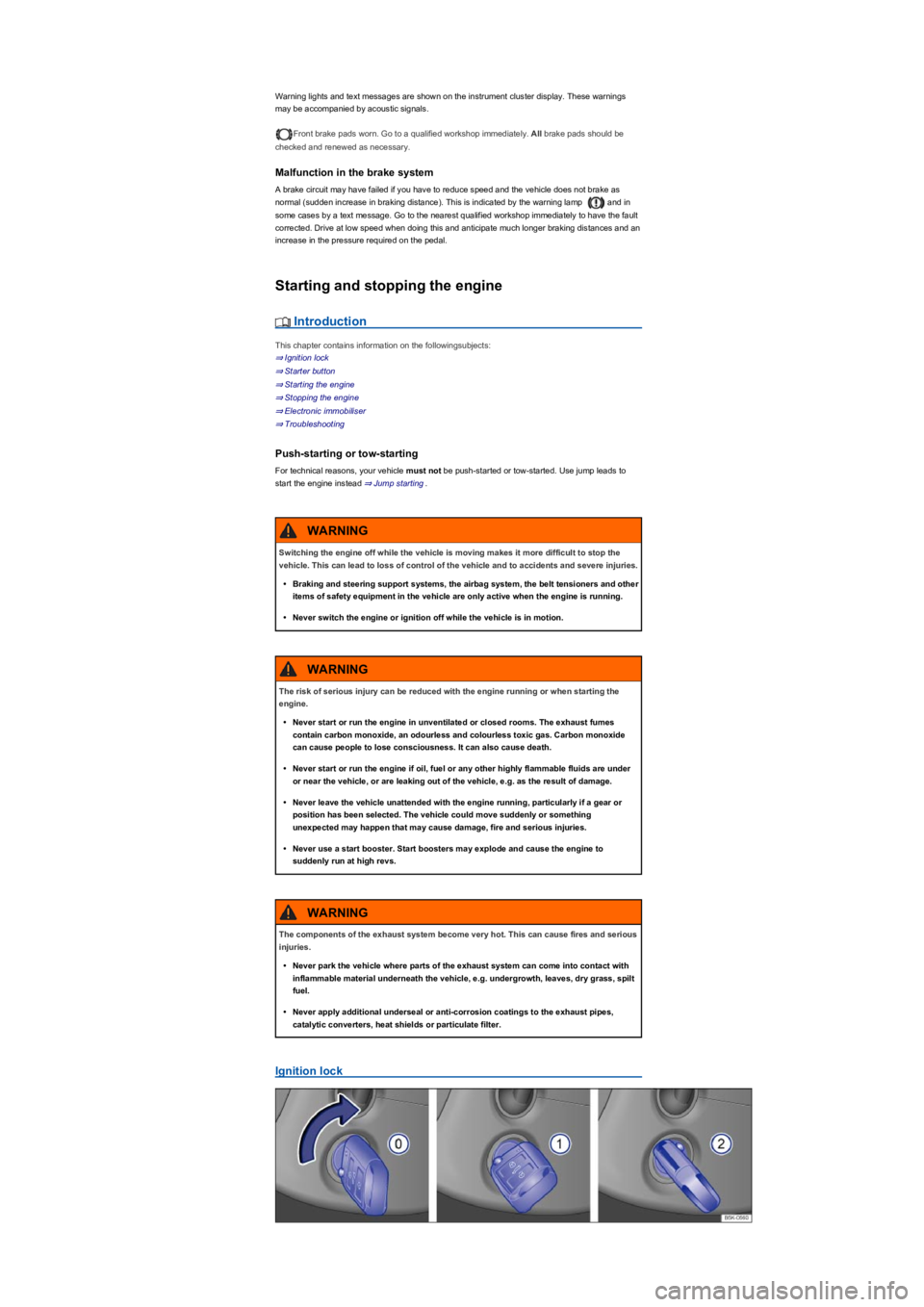
Ignition lock
Switching the engine off while the vehicle is moving makes it more difficult to stop the
vehicle. This can lead to loss of control of the vehicle and to accidents and severe injuries.
•Braking and steering support systems, the airbag system, the belt tensioners and other
items of safety equipment in the vehicle are only active when the engine is running.
•Never switch the engine or ignition off while the vehicle is in motion.
WARNING
The risk of serious injury can be reduced with the engine running or when starting the
engine.
•Never start or run the engine in unventilated or closed rooms. The exhaust fumes
contain carbon monoxide, an odourless and colourless toxic gas. Carbon monoxide
can cause people to lose consciousness. It can also cause death.
•Never start or run the engine if oil, fuel or any other highly flammable fluids are under
or near the vehicle, or are leaking out of the vehicle, e.g. as the result of damage.
•Never leave the vehicle unattended with the engine running, particularly if a gear or
position has been selected. The vehicle could move suddenly or something
unexpected may happen that may cause damage, fire and serious injuries.
•Never use a start booster. Start boosters may explode and cause the engine to
suddenly run at high revs.
WARNING
The components of the exhaust system become very hot. This can cause fires and serious
injuries.
•Never park the vehicle where parts of the exhaust system can come into contact with
inflammable material underneath the vehicle, e.g. undergrowth, leaves, dry grass, spilt
fuel.
•Never apply additional underseal or anti-corrosion coatings to the exhaust pipes,
catalytic converters, heat shields or particulate filter.
WARNING