heating VOLKSWAGEN TIGUAN 2017 Owner´s Manual
[x] Cancel search | Manufacturer: VOLKSWAGEN, Model Year: 2017, Model line: TIGUAN, Model: VOLKSWAGEN TIGUAN 2017Pages: 341, PDF Size: 9.14 MB
Page 123 of 341
Why does the cooling system switch off automatically or cannot be
switched on?
•The engine is not running.
•The blower is switched off.
•The air conditioning system fuse has blown.
•The ambient temperature is lower than approximately +3°C (+38°F).
•The air conditioning compressor of the cooling system has been temporarily switched off
because the engine coolant temperature is too high.
•There is a vehicle fault. The air conditioning system should be checked by a qualified workshop.
Settings for optimal road visibility
•Keep the air intake in front of the windscreen free from ice, snow or leaves to improve the
heating and cooling performance and prevent condensation on the windows ⇒ Vehicle care.
•Do not cover the air vents in the rear of the luggage compartment to allow air to flow through
the vehicle from the front to the rear.
•The maximum heating output and the fastest window defrosting results are achieved when the
coolant has reached its operating temperature.
Recommended settings for the heating and fresh air system or manual air
conditioning system
•Switch off air recirculation mode.
•Set blower to setting or .
•Set the temperature selector to the middle position.
•Open and position all vents on the dash panel.
•Turn the air distribution regulator to the desired position.
•Manual air conditioning system: press the button on the control panel to switch the
cooling system on.
Recommended Climatronic setup
•Press the button.
•Set the temperature to +22°C (+72°F).
•Open and position the vents on the dash panel.
Air Care Climatronic
The allergen filter of Air Care Climatronic can additionally reduce the amount of pollutants and also
allergens that enter the vehicle interior.
The filters must be changed regularly to avoid impairing the performance of the air conditioning
system. If the vehicle is frequently used in severely polluted air, the filter must be replaced between
service events.
•Press the button on the control panel.
•Touch the Air Care function button.
•Touch the Active function button to switch the Air Care function on or off.
Dust and pollen filter
The dust and pollen filter must be replaced regularly to prevent impaired performance of the manual
air conditioning system. If the vehicle is frequently used in severely polluted air, the filter must be
replaced between service events.
Water under the vehicle
If the humidity and temperature outside the vehicle are high, condensation can drip off the
evaporator in the cooling system and form a pool underneath the vehicle. This is normal and does
not indicate a leak.
If the outside humidity is high and the outside temperature low, condensation may evaporate when
the auxiliary heater is running ⇒ Auxiliary heater and ventilation. If this is the case, steam may
appear underneath the vehicle. This is not a sign that the vehicle is damaged.
Auxiliary heater and ventilation
Introduction
This chapter contains information on the followingsubjects:
⇒ Switching the auxiliary heater and auxiliary ventilation on and off
⇒ Programming the auxiliary heater and auxiliary ventilation
⇒ Remote control
Page 124 of 341
The auxiliary heater and ventilation
system allows the vehicle interior to be
heated in winter and ventilated in
summer. Operation of the system
allows ice, condensation and a thin
covering of snow to be cleared from the
windscreen. The auxiliary heater is
supplied with fuel from the vehicle fuel
tank and can be operated when the
vehicle is stationary with the ignition
switched off. The auxiliary ventilation
system is supplied with power by the
12-volt vehicle battery.
Auxiliary heater exhaust system
The emissions produced by the auxiliary heater are removed via an exhaust pipe fitted underneath
the vehicle. The exhaust pipe must not be blocked by snow, mud or other objects.
Switching the auxiliary heater and auxiliary ventilation on and off
First read and observe the introductoryinformation and safety warnings⇒
Introduction
The auxiliary heating can be operated only when the ignition is switched off. If the ignition is
switched on while the auxiliary heater is working, the auxiliary heater continues to run to provide
additional heat.
Switching on the auxiliary heater
•Press the immediate heat button on the control panel ⇒ Front controls.
•Press the button on the remote control ⇒ Remote control.
•Program a departure time ⇒ Programming the auxiliary heater and auxiliary ventilation.
The auxiliary heater heats up the vehicle interior to a temperature of at least 22°C.
The auxiliary heater will not switch on if the 12-volt vehicle battery has a low charge level or the fuel
tank is empty.
Switching off the auxiliary heater manually
•Press the immediate heat button on the control panel ⇒ Front controls.
•Press the button on the remote control ⇒ Remote control.
•Touch the function button in the Infotainment system ⇒ Programming the auxiliary heater
and auxiliary ventilation.
Auxiliary heater switches off automatically
•When the programmed departure time is reached, or after the programmed operating period
has elapsed ⇒ Programming the auxiliary heater and auxiliary ventilation.
•If the indicator lamp or lights up (fuel gauge) ⇒ Fuel gauge.
•If the charge level of the 12-volt vehicle battery is too low ⇒ 12-volt vehicle battery.
The fumes from the auxiliary heater contain among other things carbon monoxide, which
is an odourless and colourless poisonous gas. Carbon monoxide can cause people to
lose consciousness. It can also cause death.
•Never start or run the auxiliary heater in unventilated or closed rooms.
•Never programme the auxiliary heater so that it is switched on and run in unventilated
or enclosed spaces.
WARNING
Parts of the auxiliary heater exhaust system become very hot. This can cause fires.
•Park the vehicle so that no part of the exhaust system can come into contact with any
inflammable material underneath the vehicle, e.g. dry grass.
WARNING
Do not place any food, medicine or any other temperature-sensitive items in front of the
vents. Heat-sensitive food, medicine and other items could be either damaged or rendered
useless.
NOTICE
Page 125 of 341
The auxiliary heater runs on for a short time after it is switched off manually or automatically so that
the remaining fuel in the system can be burnt off.
When the vehicle is at a standstill, the auxiliary heater can be activated up to three times in
succession for the maximum operating duration.
Operating noises can be heard if the auxiliary heater is switched on.
The 12-volt battery will discharge if the auxiliary heater or ventilation is run several times
over an extended period. Drive the vehicle for an appropriate distance in order to recharge the 12-
volt vehicle battery.
When parked on an incline, the fuel gauge indication (just above the reserve quantity) may
be inaccurate and lead to functional restrictions of the auxiliary heater.
The auxiliary heater may switch on automatically as a supplementary heating measure when
the engine is started at temperatures below +5°C (+41°F). The supplementary heating function is
switched off again automatically after a short time.
Programming the auxiliary heater and auxiliary ventilation
First read and observe the introductoryinformation and safety warnings⇒
Introduction
Opening the Auxiliary heater menu
The auxiliary heater is programmed in the Infotainment system.
m/k/a997MK Manual air conditioning system
•Press the button on the Infotainment system.
•Touch the Vehicle and function buttons.
m/k/a997MK Climatronic
•Press the button on the control panel.
•Touch the function button.
Changing the operating mode
•Open the Auxiliary heater menu.
•Touch the Heating or Ventilation function buttons to change the operating mode.
At high outside temperatures, the auxiliary ventilation function supplies fresh air to the vehicle
interior and helps prevent a build-up of heat.
Programming the auxiliary heater
Activation is always for one heating or ventilation period only. The departure time must be activated
for every start.
•Before programming, check that the date and time set in the vehicle are correct ⇒ Vehicle
settings menu.
•Open the Auxiliary heater menu.
•Press the Adjust button.
•Choose one of the memory locations for a Departure time.
•Touch the Activate function button.
m/k/a995MKManual air conditioning system: the programmed departure time determines
the time at which the auxiliary heater or ventilation should switch off. The point at which the heating
or ventilation process starts is determined depending on the programmed operating period.
m/k/a995MK Climatronic: on the basis of the programmed departure time, the vehicle
automatically calculates the start time for heating or ventilation to the currently set temperature
depending on the outside temperature.
•Touch the Running time function button under Adjust to set the auxiliary heater
running time after the heater is switched on with the immediate heat button or using the
remote control.
Page 126 of 341
Programming check
If a departure time has been activated, the LED in the immediate heat button will light up on
the Climatronic control panel for approximately ten seconds after the ignition is switched off.
Remote control
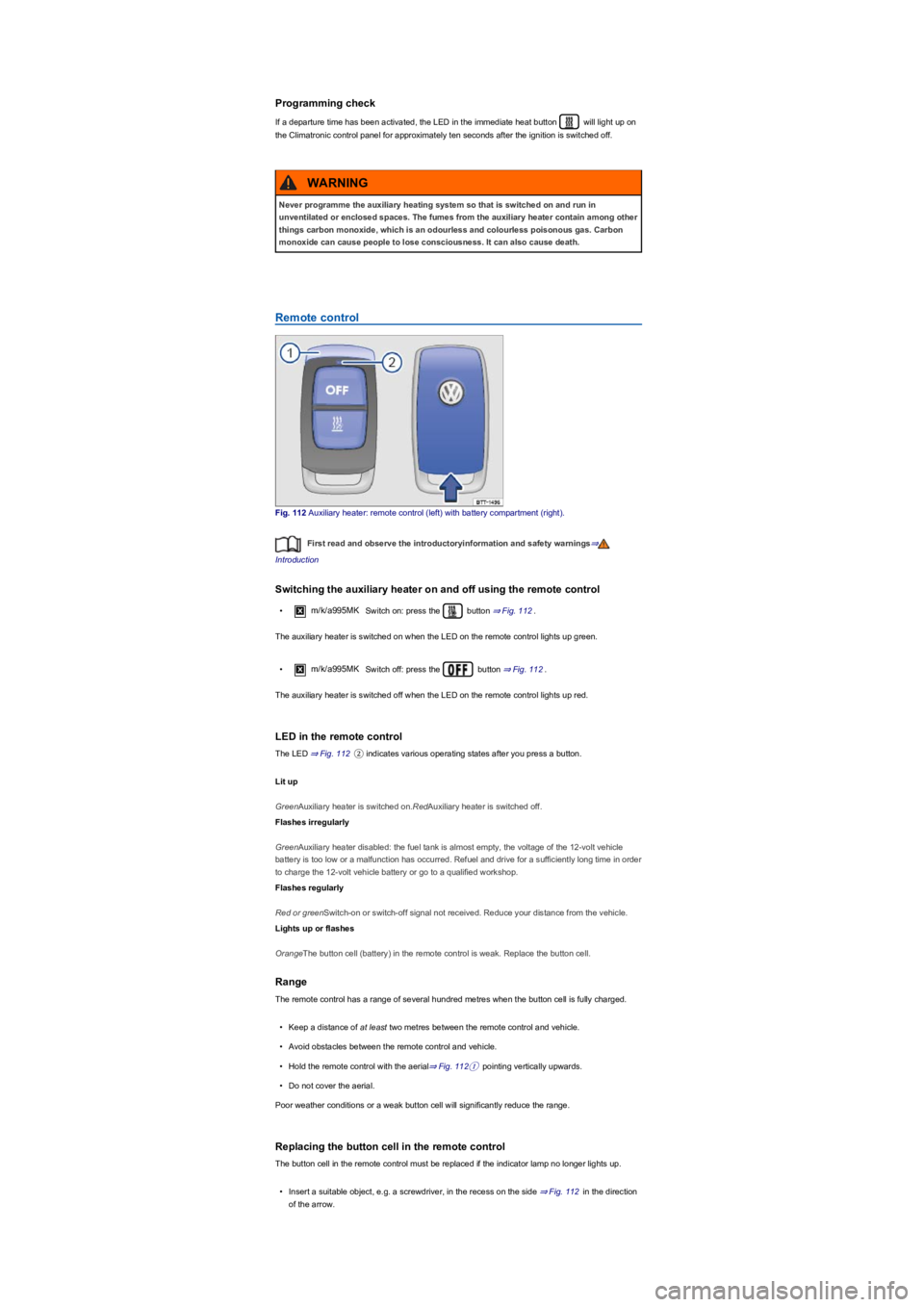
Fig. 112 Auxiliary heater: remote control (left) with battery compartment (right).
First read and observe the introductoryinformation and safety warnings⇒
Introduction
Switching the auxiliary heater on and off using the remote control
•m/k/a995MK Switch on: press the button ⇒ Fig. 112.
The auxiliary heater is switched on when the LED on the remote control lights up green.
•m/k/a995MKSwitch off: press the button ⇒ Fig. 112.
The auxiliary heater is switched off when the LED on the remote control lights up red.
LED in the remote control
The LED ⇒ Fig. 112② indicates various operating states after you press a button.
Lit up
GreenAuxiliary heater is switched on.RedAuxiliary heater is switched off.
Flashes irregularly
GreenAuxiliary heater disabled: the fuel tank is almost empty, the voltage of the 12-volt vehicle
battery is too low or a malfunction has occurred. Refuel and drive for a sufficiently long time in order
to charge the 12-volt vehicle battery or go to a qualified workshop.
Flashes regularly
Red or greenSwitch-on or switch-off signal not received. Reduce your distance from the vehicle.
Lights up or flashes
OrangeThe button cell (battery) in the remote control is weak. Replace the button cell.
Range
The remote control has a range of several hundred metres when the button cell is fully charged.
•Keep a distance of at least two metres between the remote control and vehicle.
•Avoid obstacles between the remote control and vehicle.
•Hold the remote control with the aerial⇒ Fig. 112① pointing vertically upwards.
•Do not cover the aerial.
Poor weather conditions or a weak button cell will significantly reduce the range.
Replacing the button cell in the remote control
The button cell in the remote control must be replaced if the indicator lamp no longer lights up.
•Insert a suitable object, e.g. a screwdriver, in the recess on the side ⇒ Fig. 112 in the direction
of the arrow.
Never programme the auxiliary heating system so that is switched on and run in
unventilated or enclosed spaces. The fumes from the auxiliary heater contain among other
things carbon monoxide, which is an odourless and colourless poisonous gas. Carbon
monoxide can cause people to lose consciousness. It can also cause death.
WARNING
Page 130 of 341
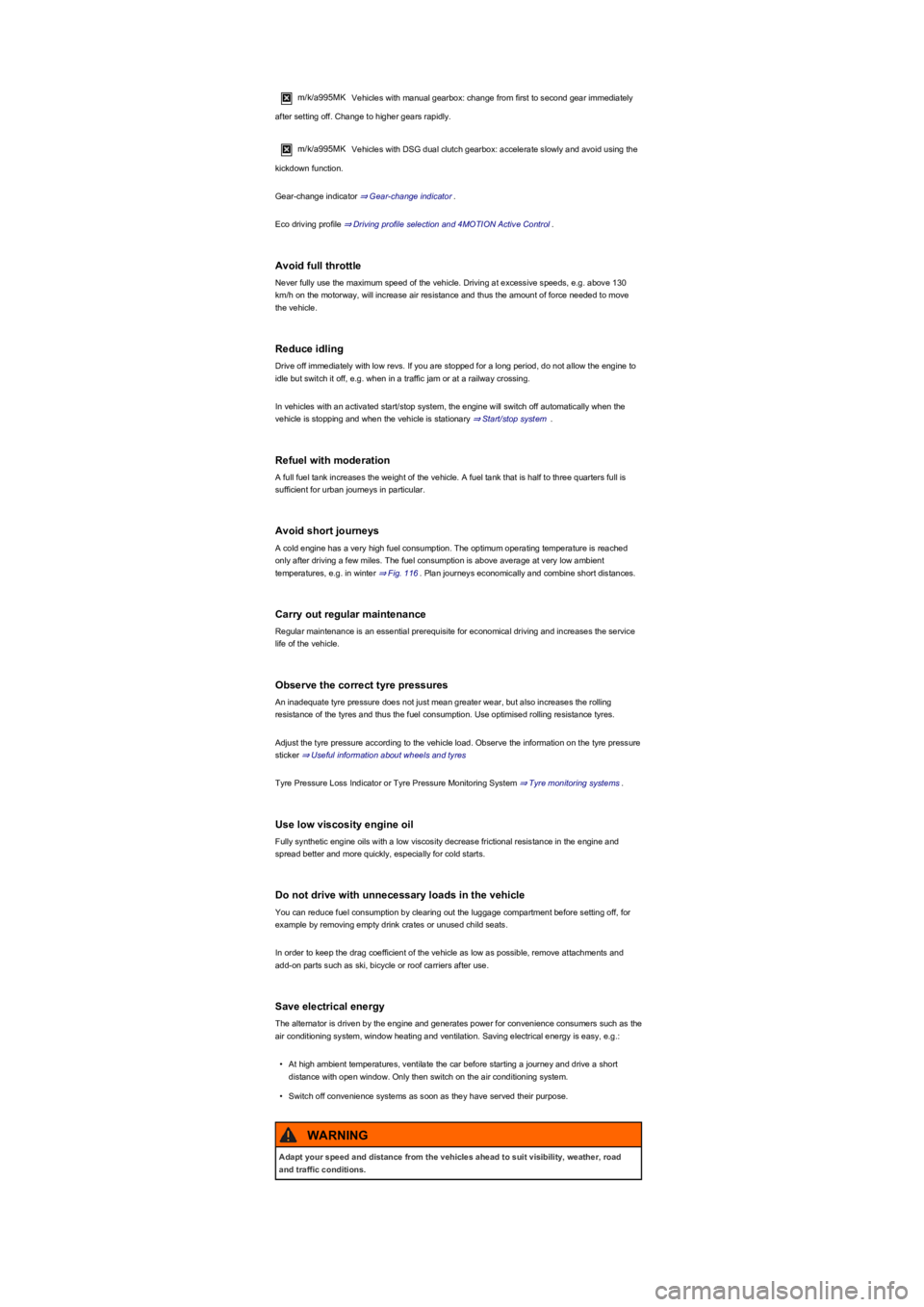
m/k/a995MK Vehicles with manual gearbox: change from first to second gear immediately
after setting off. Change to higher gears rapidly.
m/k/a995MK Vehicles with DSG dual clutch gearbox: accelerate slowly and avoid using the
kickdown function.
Gear-change indicator ⇒ Gear-change indicator.
Eco driving profile ⇒ Driving profile selection and 4MOTION Active Control.
Avoid full throttle
Never fully use the maximum speed of the vehicle. Driving at excessive speeds, e.g. above 130
km/h on the motorway, will increase air resistance and thus the amount of force needed to move
the vehicle.
Reduce idling
Drive off immediately with low revs. If you are stopped for a long period, do not allow the engine to
idle but switch it off, e.g. when in a traffic jam or at a railway crossing.
In vehicles with an activated start/stop system, the engine will switch off automatically when the
vehicle is stopping and when the vehicle is stationary ⇒ Start/stop system .
Refuel with moderation
A full fuel tank increases the weight of the vehicle. A fuel tank that is half to three quarters full is
sufficient for urban journeys in particular.
Avoid short journeys
A cold engine has a very high fuel consumption. The optimum operating temperature is reached
only after driving a few miles. The fuel consumption is above average at very low ambient
temperatures, e.g. in winter ⇒ Fig. 116. Plan journeys economically and combine short distances.
Carry out regular maintenance
Regular maintenance is an essential prerequisite for economical driving and increases the service
life of the vehicle.
Observe the correct tyre pressures
An inadequate tyre pressure does not just mean greater wear, but also increases the rolling
resistance of the tyres and thus the fuel consumption. Use optimised rolling resistance tyres.
Adjust the tyre pressure according to the vehicle load. Observe the information on the tyre pressure
sticker ⇒ Useful information about wheels and tyres
Tyre Pressure Loss Indicator or Tyre Pressure Monitoring System ⇒ Tyre monitoring systems.
Use low viscosity engine oil
Fully synthetic engine oils with a low viscosity decrease frictional resistance in the engine and
spread better and more quickly, especially for cold starts.
Do not drive with unnecessary loads in the vehicle
You can reduce fuel consumption by clearing out the luggage compartment before setting off, for
example by removing empty drink crates or unused child seats.
In order to keep the drag coefficient of the vehicle as low as possible, remove attachments and
add-on parts such as ski, bicycle or roof carriers after use.
Save electrical energy
The alternator is driven by the engine and generates power for convenience consumers such as the
air conditioning system, window heating and ventilation. Saving electrical energy is easy, e.g.:
•At high ambient temperatures, ventilate the car before starting a journey and drive a short
distance with open window. Only then switch on the air conditioning system.
•Switch off convenience systems as soon as they have served their purpose.
Adapt your speed and distance from the vehicles ahead to suit visibility, weather, road
and traffic conditions.
WARNING
Page 134 of 341
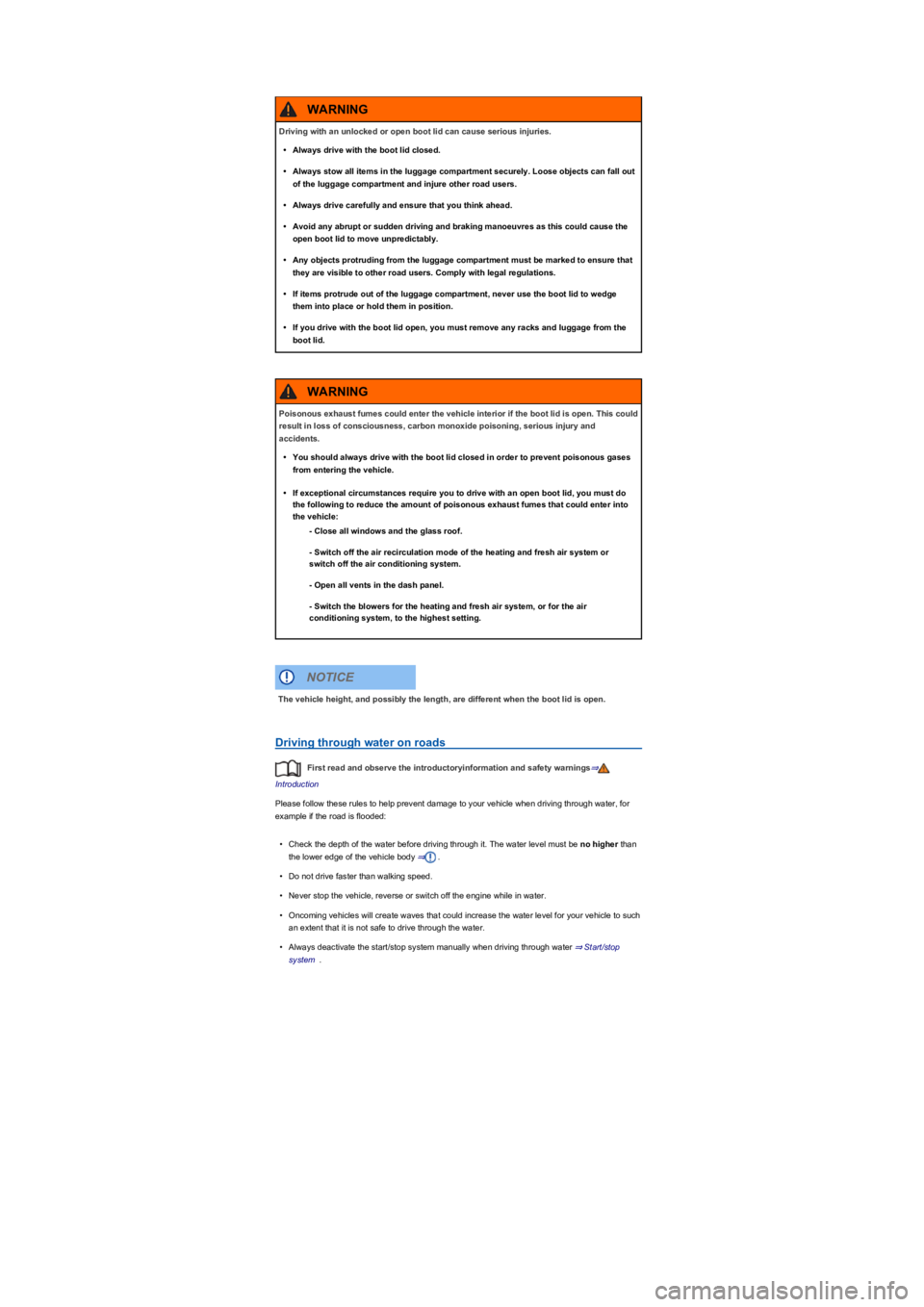
Driving through water on roads
First read and observe the introductoryinformation and safety warnings⇒
Introduction
Please follow these rules to help prevent damage to your vehicle when driving through water, for
example if the road is flooded:
•Check the depth of the water before driving through it. The water level must be no higher than
the lower edge of the vehicle body ⇒.
•Do not drive faster than walking speed.
•Never stop the vehicle, reverse or switch off the engine while in water.
•Oncoming vehicles will create waves that could increase the water level for your vehicle to such
an extent that it is not safe to drive through the water.
•Always deactivate the start/stop system manually when driving through water ⇒ Start/stop
system .
Driving with an unlocked or open boot lid can cause serious injuries.
•Always drive with the boot lid closed.
•Always stow all items in the luggage compartment securely. Loose objects can fall out
of the luggage compartment and injure other road users.
•Always drive carefully and ensure that you think ahead.
•Avoid any abrupt or sudden driving and braking manoeuvres as this could cause the
open boot lid to move unpredictably.
•Any objects protruding from the luggage compartment must be marked to ensure that
they are visible to other road users. Comply with legal regulations.
•If items protrude out of the luggage compartment, never use the boot lid to wedge
them into place or hold them in position.
•If you drive with the boot lid open, you must remove any racks and luggage from the
boot lid.
WARNING
Poisonous exhaust fumes could enter the vehicle interior if the boot lid is open. This could
result in loss of consciousness, carbon monoxide poisoning, serious injury and
accidents.
•You should always drive with the boot lid closed in order to prevent poisonous gases
from entering the vehicle.
•If exceptional circumstances require you to drive with an open boot lid, you must do
the following to reduce the amount of poisonous exhaust fumes that could enter into
the vehicle:
- Close all windows and the glass roof.
- Switch off the air recirculation mode of the heating and fresh air system or
switch off the air conditioning system.
- Open all vents in the dash panel.
- Switch the blowers for the heating and fresh air system, or for the air
conditioning system, to the highest setting.
WARNING
The vehicle height, and possibly the length, are different when the boot lid is open.
NOTICE
Page 138 of 341
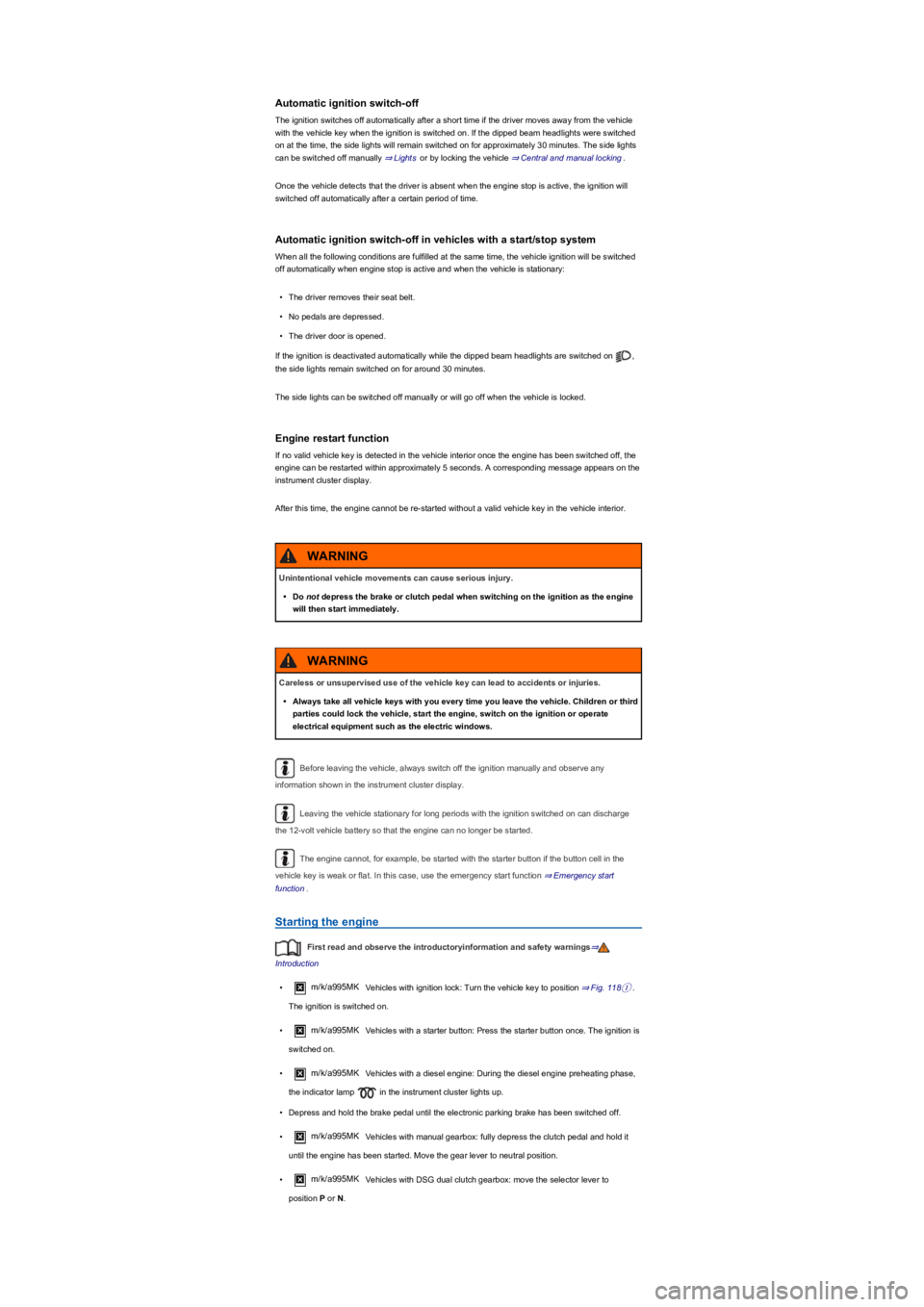
Automatic ignition switch-off
The ignition switches off automatically after a short time if the driver moves away from the vehicle
with the vehicle key when the ignition is switched on. If the dipped beam headlights were switched
on at the time, the side lights will remain switched on for approximately 30 minutes. The side lights
can be switched off manually ⇒ Lights or by locking the vehicle ⇒ Central and manual locking.
Once the vehicle detects that the driver is absent when the engine stop is active, the ignition will
switched off automatically after a certain period of time.
Automatic ignition switch-off in vehicles with a start/stop system
When all the following conditions are fulfilled at the same time, the vehicle ignition will be switched
off automatically when engine stop is active and when the vehicle is stationary:
•The driver removes their seat belt.
•No pedals are depressed.
•The driver door is opened.
If the ignition is deactivated automatically while the dipped beam headlights are switched on ,
the side lights remain switched on for around 30 minutes.
The side lights can be switched off manually or will go off when the vehicle is locked.
Engine restart function
If no valid vehicle key is detected in the vehicle interior once the engine has been switched off, the
engine can be restarted within approximately 5 seconds. A corresponding message appears on the
instrument cluster display.
After this time, the engine cannot be re-started without a valid vehicle key in the vehicle interior.
Before leaving the vehicle, always switch off the ignition manually and observe any
information shown in the instrument cluster display.
Leaving the vehicle stationary for long periods with the ignition switched on can discharge
the 12-volt vehicle battery so that the engine can no longer be started.
The engine cannot, for example, be started with the starter button if the button cell in the
vehicle key is weak or flat. In this case, use the emergency start function ⇒ Emergency start
function.
Starting the engine
First read and observe the introductoryinformation and safety warnings⇒
Introduction
•m/k/a995MKVehicles with ignition lock: Turn the vehicle key to position ⇒ Fig. 118①.
The ignition is switched on.
•m/k/a995MKVehicles with a starter button: Press the starter button once. The ignition is
switched on.
•m/k/a995MK Vehicles with a diesel engine: During the diesel engine preheating phase,
the indicator lamp in the instrument cluster lights up.
•Depress and hold the brake pedal until the electronic parking brake has been switched off.
•m/k/a995MKVehicles with manual gearbox: fully depress the clutch pedal and hold it
until the engine has been started. Move the gear lever to neutral position.
•m/k/a995MKVehicles with DSG dual clutch gearbox: move the selector lever to
position P or N.
Unintentional vehicle movements can cause serious injury.
•Do not depress the brake or clutch pedal when switching on the ignition as the engine
will then start immediately.
WARNING
Careless or unsupervised use of the vehicle key can lead to accidents or injuries.
•Always take all vehicle keys with you every time you leave the vehicle. Children or third
parties could lock the vehicle, start the engine, switch on the ignition or operate
electrical equipment such as the electric windows.
WARNING
Page 141 of 341
First read and observe the introductoryinformation and safety warnings⇒
Introduction
Warning and indicator lamps in the instrument cluster
Warning and indicator lamps light up
Fault in engine management system. The engine should be checked by a qualified workshop
as soon as possible.Risk of engine overheating. The engine speed will be automatically
restricted. The engine speed is shown on the instrument cluster display. The engine speed control
is lifted when the engine is no longer in a critical temperature range and the foot is taken off the
accelerator. and Engine speed limitation is initiated due to a fault in the engine
management system. Make sure that you do not exceed the displayed engine speed. The engine
should be checked by a qualified workshop as soon as possible.Exhaust system fault. Have
the engine checked by a qualified workshop.Particulate filter has become saturated with
soot. Drive in fourth gear (manual gearbox) or in selector lever position D (DSG dual clutch
gearbox) at a speed of at least 70 km/h (44 mph) for approximately 15 minutes. Observe the valid
speed limits. Go to the nearest qualified workshop if the indicator lamp still does not go out.
m/k/a997MKVehicles with diesel engine
Indicator lamps flash.
Fault in engine management system. The engine should be checked by a qualified workshop
as soon as possible.Engine management system has detected misfiring, which damages the
catalytic converter. Reduce speed immediately and drive carefully to the nearest qualified
workshop. Have the engine checked.
Unauthorised vehicle keys
If a non-authorised vehicle key has been inserted in the ignition lock it can be removed as follows:
•m/k/a995MKVehicles with a DSG dual clutch gearbox: press the lock button in the
selector lever and release. Pull the vehicle key out of the ignition lock.
•m/k/a995MKVehicles with a manual gearbox: remove the vehicle key from the ignition
lock.
Emergency start function
Use the emergency start function if no valid vehicle key is detected in the vehicle interior. A
corresponding display will appear in the instrument cluster. This could be the case, for example, if
the button cell in the vehicle key is weak or discharged:
•Depress and hold the brake pedal.
•Hold the vehicle key to the right of the steering column trim directly after pressing the starter
button ⇒ Fig. 120.
•The ignition is switched on automatically, and in some cases the engine is started.
Emergency deactivation
If the engine cannot be switched off by pressing the starter button briefly, an emergency switch-off
procedure is required:
•Press the starter button twice within a few seconds or press and hold once.
•The engine switches off automatically ⇒.
Immobiliser malfunction
A message will be displayed in the instrument cluster if an unauthorised vehicle key is used or there
is a fault in the system. The engine cannot be started. Use an authorised vehicle key or seek expert
assistance.
Start/stop system
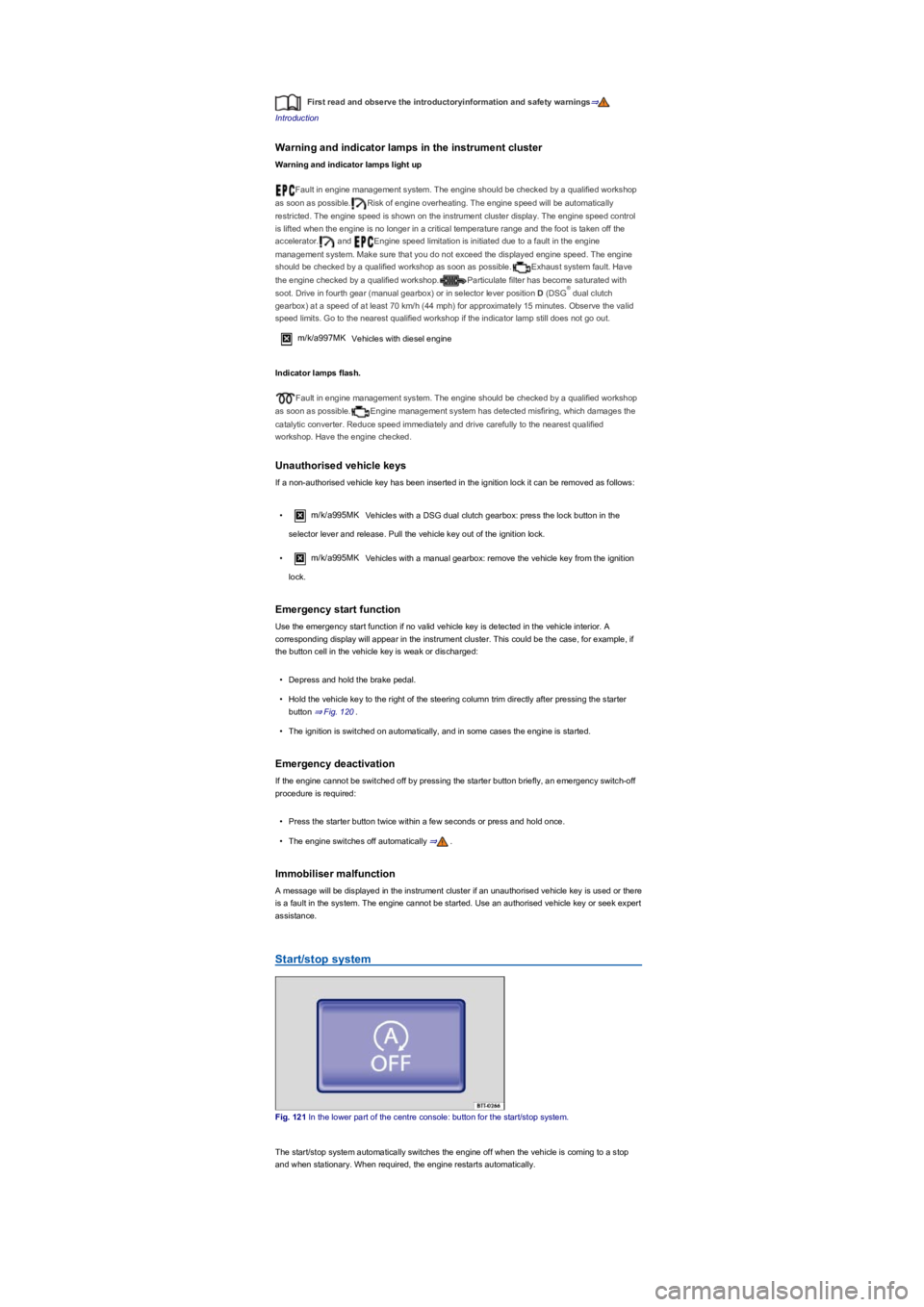
Fig. 121 In the lower part of the centre console: button for the start/stop system.
The start/stop system automatically switches the engine off when the vehicle is coming to a stop
and when stationary. When required, the engine restarts automatically.
®
Page 142 of 341
Switching on start/stop
The function is automatically activated every time the ignition is switched on. The instrument cluster
display will show information about the current status.
Vehicles with DSG dual clutch gearbox may be equipped with a start/stop system with engine-off
coasting function. The engine-off coasting function is deactivated and activated together with the
start/stop system.
Further information regarding start/stop mode is available in the Infotainment system ⇒ Operation
and display in the Infotainment system. This information also applies to coasting.
Indicator lamps
If the indicator lamp is lit, the start/stop system is available and automatic engine stop is active.
If the indicator lamp is lit, the start/stop system is not available or the start/stop system has
started the engine automatically. Check whether all technical requirements have been fulfilled. If
not, ensure that all technical requirements are met ⇒ Important preconditions for automatic engine
switch-off.
The display on the instrument cluster may show the status of the start/stop system.
In addition, start/stop information on the current status of the start/stop system can be displayed as
required in Infotainment systems with a navigation function. Touch the i in the start/stop
information to obtain further information on the status.
Vehicles with a manual gearbox
•Disengage the gear and release the clutch pedal when the vehicle is coming to a stop, or when
it is stationary. The engine is stopped.
•Depress the clutch pedal to restart the engine.
Vehicles with DSG dual clutch gearbox
•To stop, press and hold the brake pedal. The engine switches off shortly before the vehicle
reaches a complete standstill or when the vehicle is stationary.
•Take your foot off the brake pedal, or depress the accelerator, to restart the engine.
Important preconditions for automatic engine switch-off
•The driver is wearing their seat belt.
•The driver door is closed.
•The bonnet is closed.
•A minimum engine temperature has been reached.
•m/k/a995MKVehicles with Climatronic: the temperature of the vehicle interior is within
the preset temperature range, and the humidity level is not too high.
•The defrost function of the air conditioning system is not switched on.
•The charge level of the 12-volt vehicle battery is sufficient.
•The temperature of the 12-volt vehicle battery is not too low or too high.
•The vehicle is not on a steep incline.
•The windscreen heating is not switched on.
•m/k/a995MKVehicles with DSG dual clutch gearbox: the steering wheel is not turned
too sharply.
•Reverse gear is not engaged.
•The Park Assist system is not active.
•The Off-road or Off-road Individual driving profile is activated.
When the conditions for automatic engine switch-off are only fulfilled when the vehicle is stationary,
the engine can also switch off subsequently, e.g. by switching off the defrost function.
Conditions for an automatic restart
The engine can start automatically under the following conditions:
•If the temperature inside the vehicle substantially increases or decreases.
•If the vehicle rolls on.
•If the electric voltage of the 12-volt vehicle battery drops.
•If the steering wheel is moved.
As a general rule, the engine always starts again automatically when required by the detected
situation and the vehicle.
®
®
Page 144 of 341
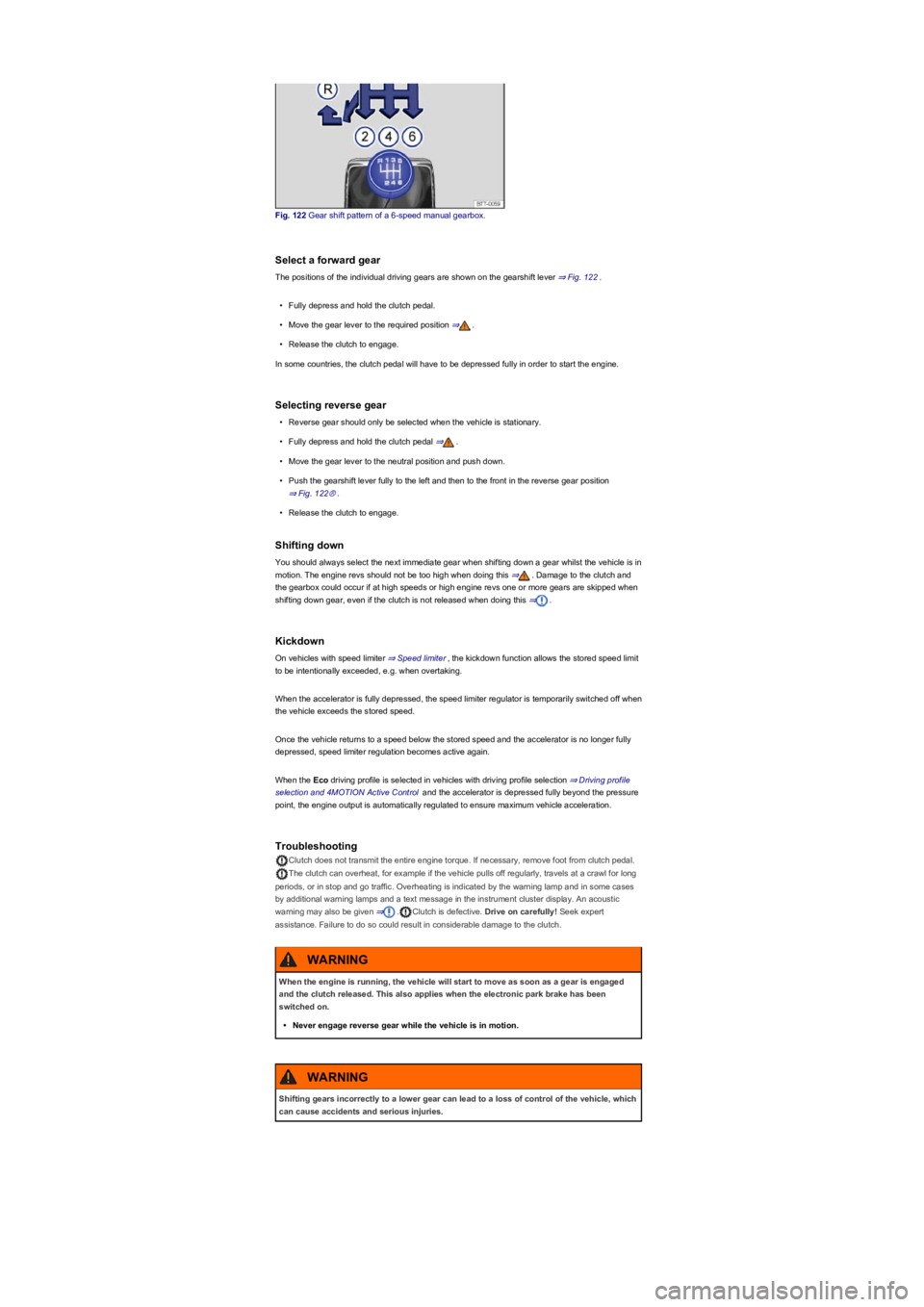
Fig. 122 Gear shift pattern of a 6-speed manual gearbox.
Select a forward gear
The positions of the individual driving gears are shown on the gearshift lever ⇒ Fig. 122.
•Fully depress and hold the clutch pedal.
•Move the gear lever to the required position ⇒.
•Release the clutch to engage.
In some countries, the clutch pedal will have to be depressed fully in order to start the engine.
Selecting reverse gear
•Reverse gear should only be selected when the vehicle is stationary.
•Fully depress and hold the clutch pedal ⇒.
•Move the gear lever to the neutral position and push down.
•Push the gearshift lever fully to the left and then to the front in the reverse gear position
⇒ Fig. 122Ⓡ.
•Release the clutch to engage.
Shifting down
You should always select the next immediate gear when shifting down a gear whilst the vehicle is in
motion. The engine revs should not be too high when doing this ⇒. Damage to the clutch and
the gearbox could occur if at high speeds or high engine revs one or more gears are skipped when
shifting down gear, even if the clutch is not released when doing this ⇒.
Kickdown
On vehicles with speed limiter ⇒ Speed limiter, the kickdown function allows the stored speed limit
to be intentionally exceeded, e.g. when overtaking.
When the accelerator is fully depressed, the speed limiter regulator is temporarily switched off when
the vehicle exceeds the stored speed.
Once the vehicle returns to a speed below the stored speed and the accelerator is no longer fully
depressed, speed limiter regulation becomes active again.
When the Eco driving profile is selected in vehicles with driving profile selection ⇒ Driving profile
selection and 4MOTION Active Control and the accelerator is depressed fully beyond the pressure
point, the engine output is automatically regulated to ensure maximum vehicle acceleration.
Troubleshooting
Clutch does not transmit the entire engine torque. If necessary, remove foot from clutch pedal.
The clutch can overheat, for example if the vehicle pulls off regularly, travels at a crawl for long
periods, or in stop and go traffic. Overheating is indicated by the warning lamp and in some cases
by additional warning lamps and a text message in the instrument cluster display. An acoustic
warning may also be given ⇒.Clutch is defective. Drive on carefully! Seek expert
assistance. Failure to do so could result in considerable damage to the clutch.
When the engine is running, the vehicle will start to move as soon as a gear is engaged
and the clutch released. This also applies when the electronic park brake has been
switched on.
•Never engage reverse gear while the vehicle is in motion.
WARNING
Shifting gears incorrectly to a lower gear can lead to a loss of control of the vehicle, which
can cause accidents and serious injuries.
WARNING