warning lights VOLKSWAGEN TIGUAN 2017 Owner´s Manual
[x] Cancel search | Manufacturer: VOLKSWAGEN, Model Year: 2017, Model line: TIGUAN, Model: VOLKSWAGEN TIGUAN 2017Pages: 341, PDF Size: 9.14 MB
Page 225 of 341
•If necessary, fold back the rear seat backrest and allow it to engage securely.
•If necessary, adjust the headlight range ⇒ Headlights.
•Adjust the tyre pressure according to the vehicle load. Observe the tyre pressure sticker ⇒ Tyre
pressure.
•In vehicles with a tyre monitoring system, set the new vehicle load level as necessary ⇒ Tyre
monitoring systems.
Do not cover the ventilation openings in the area around the rear window as this prevents
stale air escaping from the vehicle.
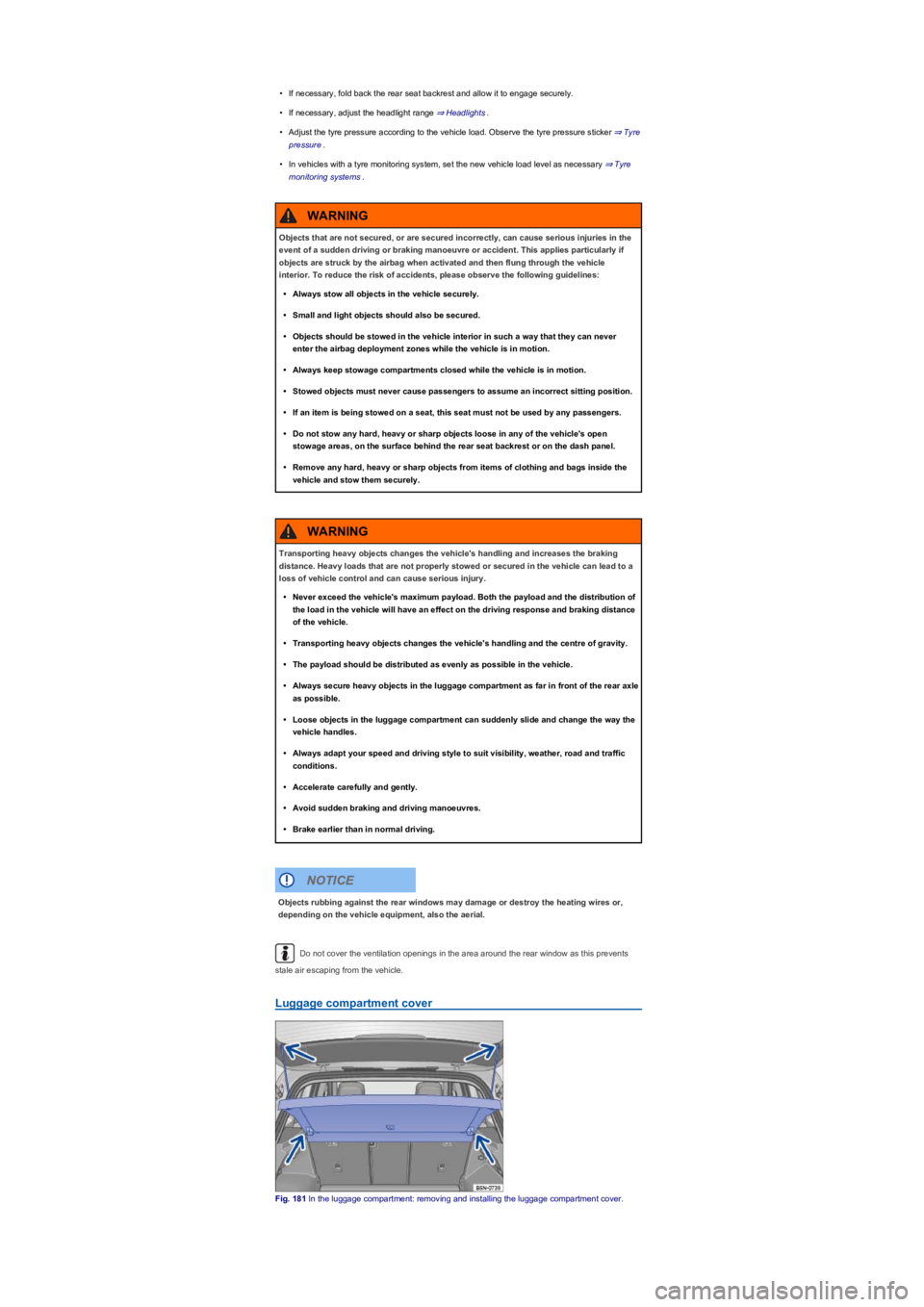
Luggage compartment cover
Fig. 181 In the luggage compartment: removing and installing the luggage compartment cover.
Objects that are not secured, or are secured incorrectly, can cause serious injuries in the
event of a sudden driving or braking manoeuvre or accident. This applies particularly if
objects are struck by the airbag when activated and then flung through the vehicle
interior. To reduce the risk of accidents, please observe the following guidelines:
•Always stow all objects in the vehicle securely.
•Small and light objects should also be secured.
•Objects should be stowed in the vehicle interior in such a way that they can never
enter the airbag deployment zones while the vehicle is in motion.
•Always keep stowage compartments closed while the vehicle is in motion.
•Stowed objects must never cause passengers to assume an incorrect sitting position.
•If an item is being stowed on a seat, this seat must not be used by any passengers.
•Do not stow any hard, heavy or sharp objects loose in any of the vehicle's open
stowage areas, on the surface behind the rear seat backrest or on the dash panel.
•Remove any hard, heavy or sharp objects from items of clothing and bags inside the
vehicle and stow them securely.
WARNING
Transporting heavy objects changes the vehicle's handling and increases the braking
distance. Heavy loads that are not properly stowed or secured in the vehicle can lead to a
loss of vehicle control and can cause serious injury.
•Never exceed the vehicle's maximum payload. Both the payload and the distribution of
the load in the vehicle will have an effect on the driving response and braking distance
of the vehicle.
•Transporting heavy objects changes the vehicle's handling and the centre of gravity.
•The payload should be distributed as evenly as possible in the vehicle.
•Always secure heavy objects in the luggage compartment as far in front of the rear axle
as possible.
•Loose objects in the luggage compartment can suddenly slide and change the way the
vehicle handles.
•Always adapt your speed and driving style to suit visibility, weather, road and traffic
conditions.
•Accelerate carefully and gently.
•Avoid sudden braking and driving manoeuvres.
•Brake earlier than in normal driving.
WARNING
Objects rubbing against the rear windows may damage or destroy the heating wires or,
depending on the vehicle equipment, also the aerial.
NOTICE
Page 230 of 341
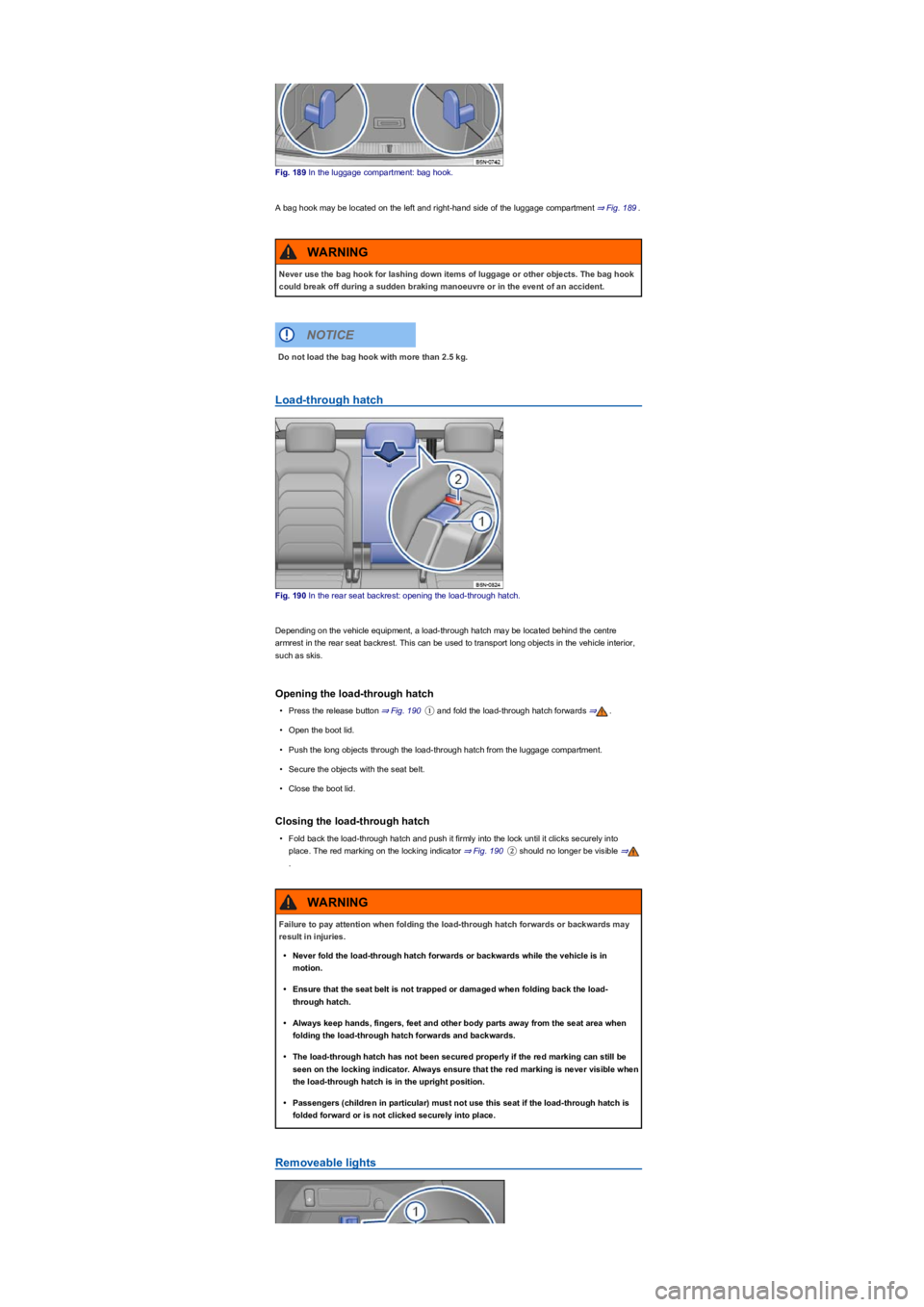
Fig. 189 In the luggage compartment: bag hook.
A bag hook may be located on the left and right-hand side of the luggage compartment ⇒ Fig. 189.
Load-through hatch
Fig. 190 In the rear seat backrest: opening the load-through hatch.
Depending on the vehicle equipment, a load-through hatch may be located behind the centre
armrest in the rear seat backrest. This can be used to transport long objects in the vehicle interior,
such as skis.
Opening the load-through hatch
•Press the release button ⇒ Fig. 190① and fold the load-through hatch forwards ⇒.
•Open the boot lid.
•Push the long objects through the load-through hatch from the luggage compartment.
•Secure the objects with the seat belt.
•Close the boot lid.
Closing the load-through hatch
•Fold back the load-through hatch and push it firmly into the lock until it clicks securely into
place. The red marking on the locking indicator ⇒ Fig. 190② should no longer be visible ⇒
.
Removeable lights
Never use the bag hook for lashing down items of luggage or other objects. The bag hook
could break off during a sudden braking manoeuvre or in the event of an accident.
WARNING
Do not load the bag hook with more than 2.5 kg.
NOTICE
Failure to pay attention when folding the load-through hatch forwards or backwards may
result in injuries.
•Never fold the load-through hatch forwards or backwards while the vehicle is in
motion.
•Ensure that the seat belt is not trapped or damaged when folding back the load-
through hatch.
•Always keep hands, fingers, feet and other body parts away from the seat area when
folding the load-through hatch forwards and backwards.
•The load-through hatch has not been secured properly if the red marking can still be
seen on the locking indicator. Always ensure that the red marking is never visible when
the load-through hatch is in the upright position.
•Passengers (children in particular) must not use this seat if the load-through hatch is
folded forward or is not clicked securely into place.
WARNING
Page 235 of 341
Technical requirements
First read and observe the introductoryinformation and safety warnings⇒
Introduction
Engine cooling system
There is an increased load on the engine and the engine cooling system when trailer towing. The
engine cooling system must contain sufficient engine coolant and be able to cope with the extra
load added by the trailer.
Trailer brake
If the trailer is equipped with its own brake system, comply with the relevant regulations.
Trailer tail light clusters
The trailer tail light clusters must work correctly and meet legal requirements. Do not exceed the
maximum power consumption for the trailer.
Exterior mirrors
If you are unable to see the traffic behind the trailer in the vehicle's standard exterior mirrors,
additional exterior mirrors should be fitted in accordance with any country-specific regulations.
Before setting off, adjust the mirrors so that you have a sufficient view of the rear.
Retrofitting a towing bracket
Only use a towing bracket which has been approved by Volkswagen for your vehicle type. Always
check and follow the data provided by the towing bracket manufacturer.
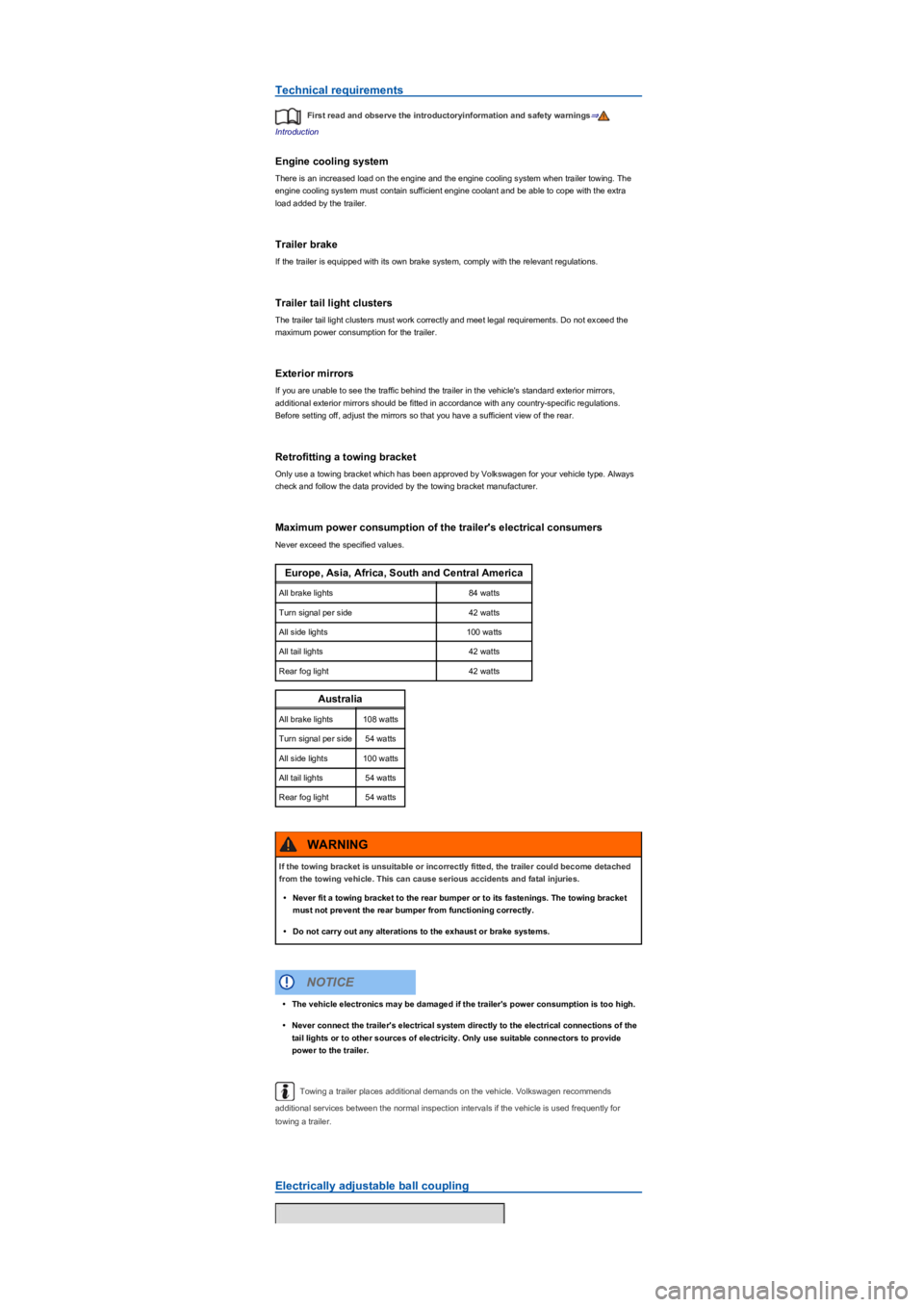
Maximum power consumption of the trailer's electrical consumers
Never exceed the specified values.
Europe, Asia, Africa, South and Central America
All brake lights84 watts
Turn signal per side42 watts
All side lights100 watts
All tail lights42 watts
Rear fog light42 watts
Australia
All brake lights108 watts
Turn signal per side54 watts
All side lights100 watts
All tail lights54 watts
Rear fog light54 watts
Towing a trailer places additional demands on the vehicle. Volkswagen recommends
additional services between the normal inspection intervals if the vehicle is used frequently for
towing a trailer.
Electrically adjustable ball coupling
If the towing bracket is unsuitable or incorrectly fitted, the trailer could become detached
from the towing vehicle. This can cause serious accidents and fatal injuries.
•Never fit a towing bracket to the rear bumper or to its fastenings. The towing bracket
must not prevent the rear bumper from functioning correctly.
•Do not carry out any alterations to the exhaust or brake systems.
WARNING
•The vehicle electronics may be damaged if the trailer's power consumption is too high.
•Never connect the trailer's electrical system directly to the electrical connections of the
tail lights or to other sources of electricity. Only use suitable connectors to provide
power to the trailer.
NOTICE
Page 236 of 341
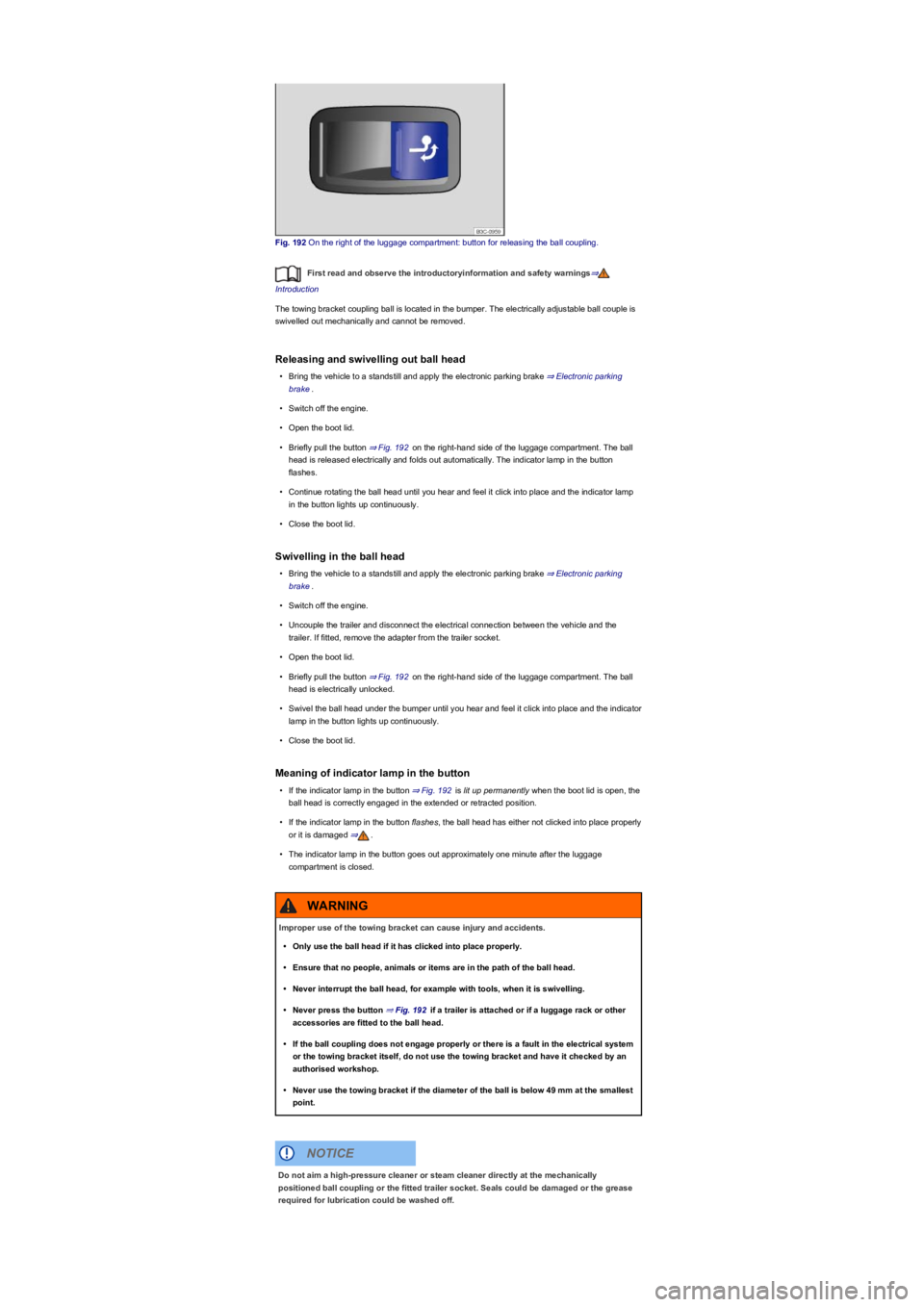
Fig. 192 On the right of the luggage compartment: button for releasing the ball coupling.
First read and observe the introductoryinformation and safety warnings⇒
Introduction
The towing bracket coupling ball is located in the bumper. The electrically adjustable ball couple is
swivelled out mechanically and cannot be removed.
Releasing and swivelling out ball head
•Bring the vehicle to a standstill and apply the electronic parking brake ⇒ Electronic parking
brake.
•Switch off the engine.
•Open the boot lid.
•Briefly pull the button ⇒ Fig. 192 on the right-hand side of the luggage compartment. The ball
head is released electrically and folds out automatically. The indicator lamp in the button
flashes.
•Continue rotating the ball head until you hear and feel it click into place and the indicator lamp
in the button lights up continuously.
•Close the boot lid.
Swivelling in the ball head
•Bring the vehicle to a standstill and apply the electronic parking brake ⇒ Electronic parking
brake.
•Switch off the engine.
•Uncouple the trailer and disconnect the electrical connection between the vehicle and the
trailer. If fitted, remove the adapter from the trailer socket.
•Open the boot lid.
•Briefly pull the button ⇒ Fig. 192 on the right-hand side of the luggage compartment. The ball
head is electrically unlocked.
•Swivel the ball head under the bumper until you hear and feel it click into place and the indicator
lamp in the button lights up continuously.
•Close the boot lid.
Meaning of indicator lamp in the button
•If the indicator lamp in the button ⇒ Fig. 192 is lit up permanently when the boot lid is open, the
ball head is correctly engaged in the extended or retracted position.
•If the indicator lamp in the button flashes, the ball head has either not clicked into place properly
or it is damaged ⇒.
•The indicator lamp in the button goes out approximately one minute after the luggage
compartment is closed.
Improper use of the towing bracket can cause injury and accidents.
•Only use the ball head if it has clicked into place properly.
•Ensure that no people, animals or items are in the path of the ball head.
•Never interrupt the ball head, for example with tools, when it is swivelling.
•Never press the button ⇒ Fig. 192 if a trailer is attached or if a luggage rack or other
accessories are fitted to the ball head.
•If the ball coupling does not engage properly or there is a fault in the electrical system
or the towing bracket itself, do not use the towing bracket and have it checked by an
authorised workshop.
•Never use the towing bracket if the diameter of the ball is below 49 mm at the smallest
point.
WARNING
Do not aim a high-pressure cleaner or steam cleaner directly at the mechanically
positioned ball coupling or the fitted trailer socket. Seals could be damaged or the grease
required for lubrication could be washed off.
NOTICE
Page 238 of 341
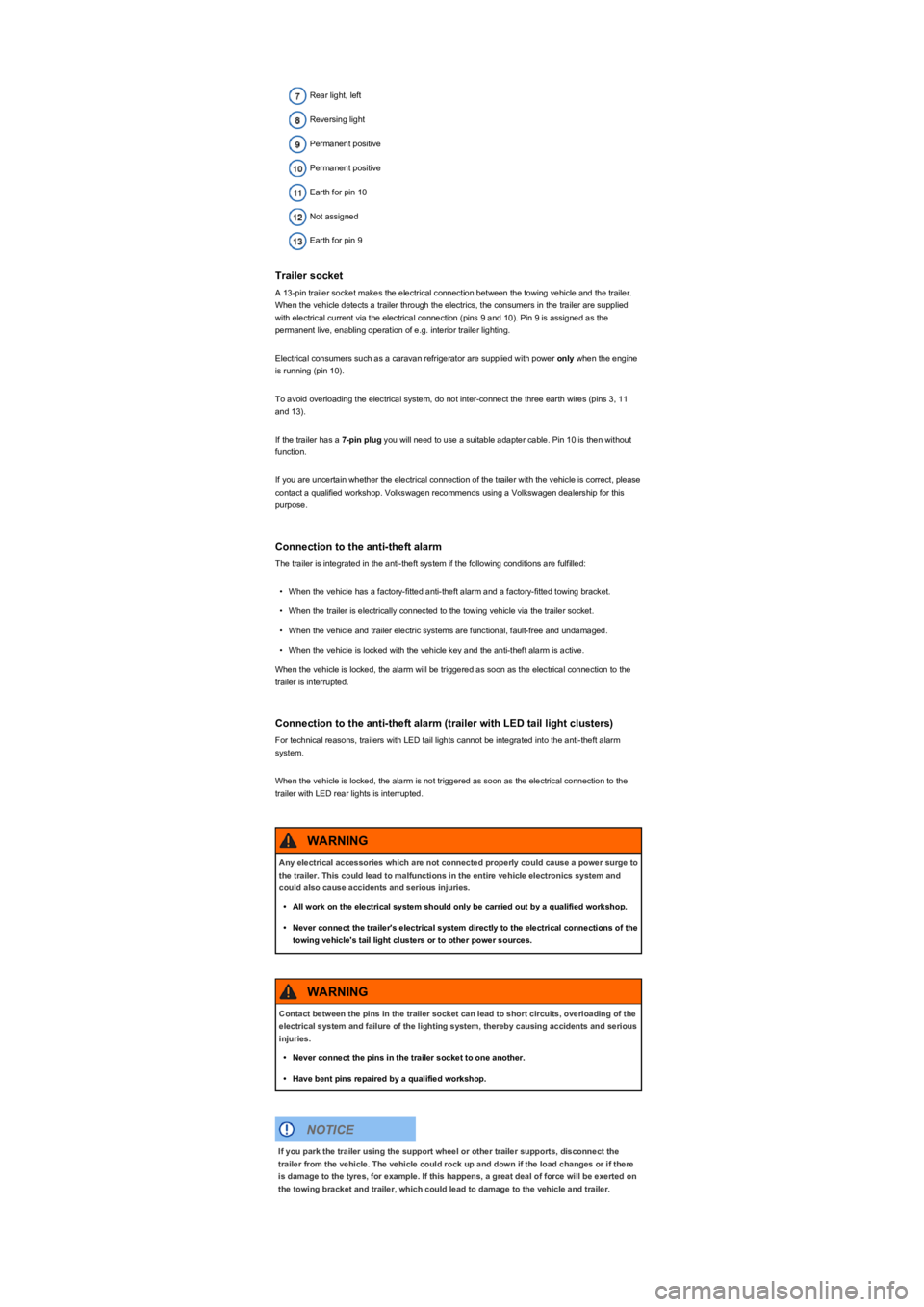
Rear light, left
Reversing light
Permanent positive
Permanent positive
Earth for pin 10
Not assigned
Earth for pin 9
Trailer socket
A 13-pin trailer socket makes the electrical connection between the towing vehicle and the trailer.
When the vehicle detects a trailer through the electrics, the consumers in the trailer are supplied
with electrical current via the electrical connection (pins 9 and 10). Pin 9 is assigned as the
permanent live, enabling operation of e.g. interior trailer lighting.
Electrical consumers such as a caravan refrigerator are supplied with power only when the engine
is running (pin 10).
To avoid overloading the electrical system, do not inter-connect the three earth wires (pins 3, 11
and 13).
If the trailer has a 7-pin plug you will need to use a suitable adapter cable. Pin 10 is then without
function.
If you are uncertain whether the electrical connection of the trailer with the vehicle is correct, please
contact a qualified workshop. Volkswagen recommends using a Volkswagen dealership for this
purpose.
Connection to the anti-theft alarm
The trailer is integrated in the anti-theft system if the following conditions are fulfilled:
•When the vehicle has a factory-fitted anti-theft alarm and a factory-fitted towing bracket.
•When the trailer is electrically connected to the towing vehicle via the trailer socket.
•When the vehicle and trailer electric systems are functional, fault-free and undamaged.
•When the vehicle is locked with the vehicle key and the anti-theft alarm is active.
When the vehicle is locked, the alarm will be triggered as soon as the electrical connection to the
trailer is interrupted.
Connection to the anti-theft alarm (trailer with LED tail light clusters)
For technical reasons, trailers with LED tail lights cannot be integrated into the anti-theft alarm
system.
When the vehicle is locked, the alarm is not triggered as soon as the electrical connection to the
trailer with LED rear lights is interrupted.
Any electrical accessories which are not connected properly could cause a power surge to
the trailer. This could lead to malfunctions in the entire vehicle electronics system and
could also cause accidents and serious injuries.
•All work on the electrical system should only be carried out by a qualified workshop.
•Never connect the trailer's electrical system directly to the electrical connections of the
towing vehicle's tail light clusters or to other power sources.
WARNING
Contact between the pins in the trailer socket can lead to short circuits, overloading of the
electrical system and failure of the lighting system, thereby causing accidents and serious
injuries.
•Never connect the pins in the trailer socket to one another.
•Have bent pins repaired by a qualified workshop.
WARNING
If you park the trailer using the support wheel or other trailer supports, disconnect the
trailer from the vehicle. The vehicle could rock up and down if the load changes or if there
is damage to the tyres, for example. If this happens, a great deal of force will be exerted on
the towing bracket and trailer, which could lead to damage to the vehicle and trailer.
NOTICE
Page 242 of 341
Volkswagen recommends having the towing bracket retrofitted by a qualified workshop. The cooling
system may need to be modified or heat shields may need to be fitted. Volkswagen recommends
using a Volkswagen dealership for this purpose.
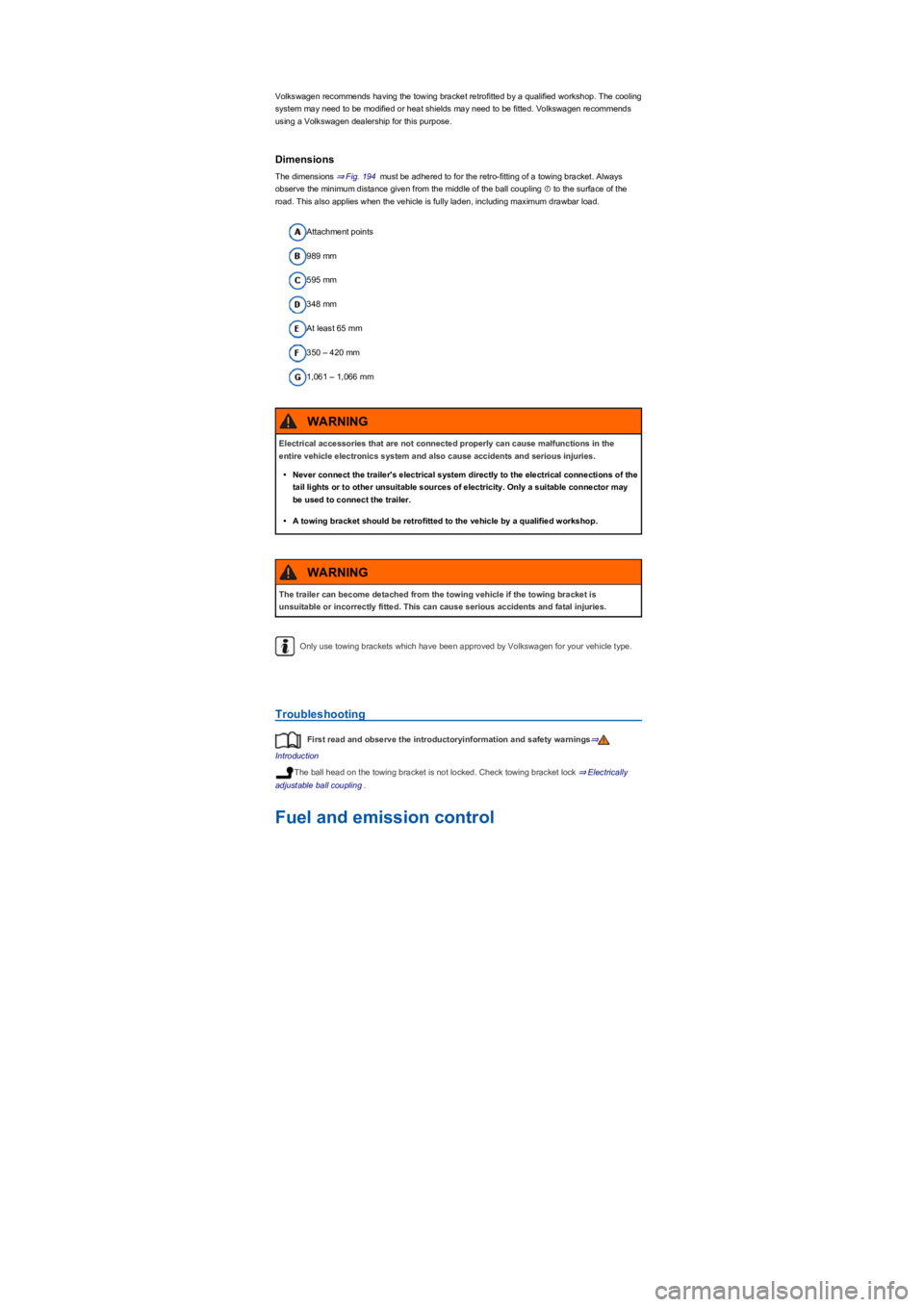
Dimensions
The dimensions ⇒ Fig. 194 must be adhered to for the retro-fitting of a towing bracket. Always
observe the minimum distance given from the middle of the ball coupling Ⓕ to the surface of the
road. This also applies when the vehicle is fully laden, including maximum drawbar load.
Attachment points
989 mm
595 mm
348 mm
At least 65 mm
350 – 420 mm
1,061 – 1,066 mm
Only use towing brackets which have been approved by Volkswagen for your vehicle type.
Troubleshooting
First read and observe the introductoryinformation and safety warnings⇒
Introduction
The ball head on the towing bracket is not locked. Check towing bracket lock ⇒ Electrically
adjustable ball coupling.
Fuel and emission control
Electrical accessories that are not connected properly can cause malfunctions in the
entire vehicle electronics system and also cause accidents and serious injuries.
•Never connect the trailer's electrical system directly to the electrical connections of the
tail lights or to other unsuitable sources of electricity. Only a suitable connector may
be used to connect the trailer.
•A towing bracket should be retrofitted to the vehicle by a qualified workshop.
WARNING
The trailer can become detached from the towing vehicle if the towing bracket is
unsuitable or incorrectly fitted. This can cause serious accidents and fatal injuries.
WARNING
Page 249 of 341
•Only refuel with fuels that are suitable for the vehicle ⇒ Fuel types and refuelling.
•Do not allow the fuel tank to run completely empty.
•Use only suitable engine oil for the vehicle and do not overfill ⇒ Engine oil.
•Do not tow start the vehicle. Use jump leads ⇒ Jump starting.
Periodic regeneration
The soot in the particulate filter is burnt off at high temperatures on a periodic basis.
To assist the regeneration of the particulate filter, Volkswagen recommends that you avoid making
only short journeys.
Noises, slight smells and increased engine speeds may occur during regeneration. The radiator fan
may run on while the vehicle is moving or when the engine has been switched off.
During the periodic regeneration process, the yellow indicator lamp does not light
up.
Troubleshooting
First read and observe the introductoryinformation and safety warnings⇒
Introduction
Irregular engine running and malfunctions
If the engine shows signs of irregular running or malfunctions while you are driving, this may mean
that the fuel is of poor quality. Reduce speed immediately. Drive to nearest qualified workshop at
medium engine speeds and low loads on the engine.
If these symptoms occur directly after refuelling, switch off the engine immediately to avoid any
subsequent damage. You should obtain professional assistance.
Warning and indicator lamps
Lights up together with the red warning lamp : fault in the selective catalytic reduction
system. The engine cannot be restarted! Drive straight to a qualified workshop without switching
off the engine and have the system checked ⇒.AdBlue level too low. The engine cannot
be restarted! Switch off the vehicle and refill the AdBlue minimum quantity according to
⇒ Emission control with AdBlue⇒.Lights up together with the yellow warning lamp
: the selective catalytic reduction system is faulty or not filled with standard-compliant
AdBlue. Drive immediately to a qualified workshop and have the system checked.AdBlue
level too low. Refill AdBlue within the displayed remaining range in accordance with ⇒ Emission
control with AdBlue⇒.The particulate filter is saturated with soot and requires
regeneration. Driving at speeds between 50 - 120 km/h (31 - 75 mph) will support regeneration.
Observe the relevant speed limits and the gear recommendation. The indicator lamp goes out
automatically when the particulate filter has been regenerated. If the indicator lamp is still lit up after
driving for around 30 minutes, seek expert assistance immediately.Lit up: malfunction. Have
the engine checked by a qualified workshop.Flashing: misfiring, which damages the catalytic
converter. Drive immediately to the nearest qualified workshop and have the engine checked.
There may be engine faults and fuel consumption may be higher if the indicator lamps are lit
up or flashing.
Colour display only on an instrument cluster with colour display.
Fuel standards
Petrol
Vehicles with a petrol engine must be run on petrol in compliance with the European standard
EN 228 or the German standard DIN 51626-1 ⇒.
Where petrol complying with the specified standard is not available, Volkswagen dealerships will
have information on what fuels are suitable for the vehicle.
1)
®
®
®
®®
®
®
If the AdBlue level is too low, the vehicle cannot be restarted after the ignition has been
switched off. Starting with jump leads is also not possible.
•Refill AdBlue at the latest when the remaining distance reaches approximately
1,000 km.
•Never allow the AdBlue tank to run empty.
NOTICE
®
®
®
1)
Page 253 of 341
Cleaning windscreen wiper blades
Note for the windscreen wipers: move the wiper arms to the service position before lifting them
⇒ Wipers.
•When lifting the wiper arm hold it only by the wiper blade mounting.
•Clean the wiper blades carefully using a damp sponge ⇒.
•Carefully place the wiper arms on the windscreen.
Changing the windscreen wiper blades
•Move the wiper arms to the service position before lifting ⇒ Wipers.
•When lifting the wiper arm hold it only by the wiper blade mounting.
•Press and hold the release button ⇒ Fig. 202① and simultaneously pull off the wiper blade in
the direction of the arrow.
•Insert a new wiper blade with the same length and design onto the wiper arm. Push it on until
it engages.
•Carefully place the wiper arms on the windscreen.
Changing the wiper blade for the rear window
•When lifting the wiper arm hold it only by the wiper blade mounting.
•Lift and fold back the wiper arm.
•Press and hold the release button ⇒ Fig. 203①.
•Tilt the wiper blade in the direction of the wiper arm ⇒ Fig. 203 (arrow Ⓐ) and pull it off in the
direction of the arrow Ⓑ at the same time. You may need to use some force to do this.
•Insert a new wiper blade with the same length and design onto the wiper arm in the opposite
direction of the arrow. Push it on until it engages ⇒ Fig. 203Ⓑ. The wiper blade must be in the
folded back position ⇒ Fig. 203 (arrow Ⓐ).
•Carefully place the wiper arm back onto the rear window.
Wax deposits on the windscreen and rear window could cause the wiper blades to rub.
Remove wax residue using a special cleaning product or cleaning cloths.
Changing bulbs
Introduction
This chapter contains information on the followingsubjects:
⇒ Checklist
⇒ Changing bulbs in the headlights (halogen bulbs)
⇒ Changing bulbs in the front bumper
⇒ Changing bulbs in the front bumper (R-Line)
⇒ Changing the bulbs in the tail light cluster in the body
⇒ Troubleshooting
Changing the vehicle bulbs requires considerable technical skill. Volkswagen therefore
recommends having bulbs replaced by a qualified workshop if you are uncertain. The work must
always be performed by an expert if other vehicle parts around the affected bulbs need to be
removed. Volkswagen recommends having bulbs replaced by a Volkswagen dealership.
You should keep a box with spare light bulbs for the lights that ensure the vehicle is roadworthy in
the vehicle at all times. Spare bulbs are available from Volkswagen dealerships. In some countries
it is a legal requirement to have these spare bulbs in the vehicle.
It may be illegal to drive with a defective bulb in the exterior lighting.
Worn or dirty windscreen wiper blades reduce visibility and increase the risk of accidents
and severe injuries.
•Always change wiper blades if they are damaged or worn and no longer clean the
window properly.
WARNING
Damaged or dirty windscreen wipers can scratch the windscreen.
•Do not use any cleaning agents containing solvents, hard sponges and other sharp
objects, as they can damage the graphite coating of the wiper blades during cleaning.
•Do not use fuel, nail varnish remover, paint thinner or similar products to clean the
windows.
NOTICE
Page 254 of 341
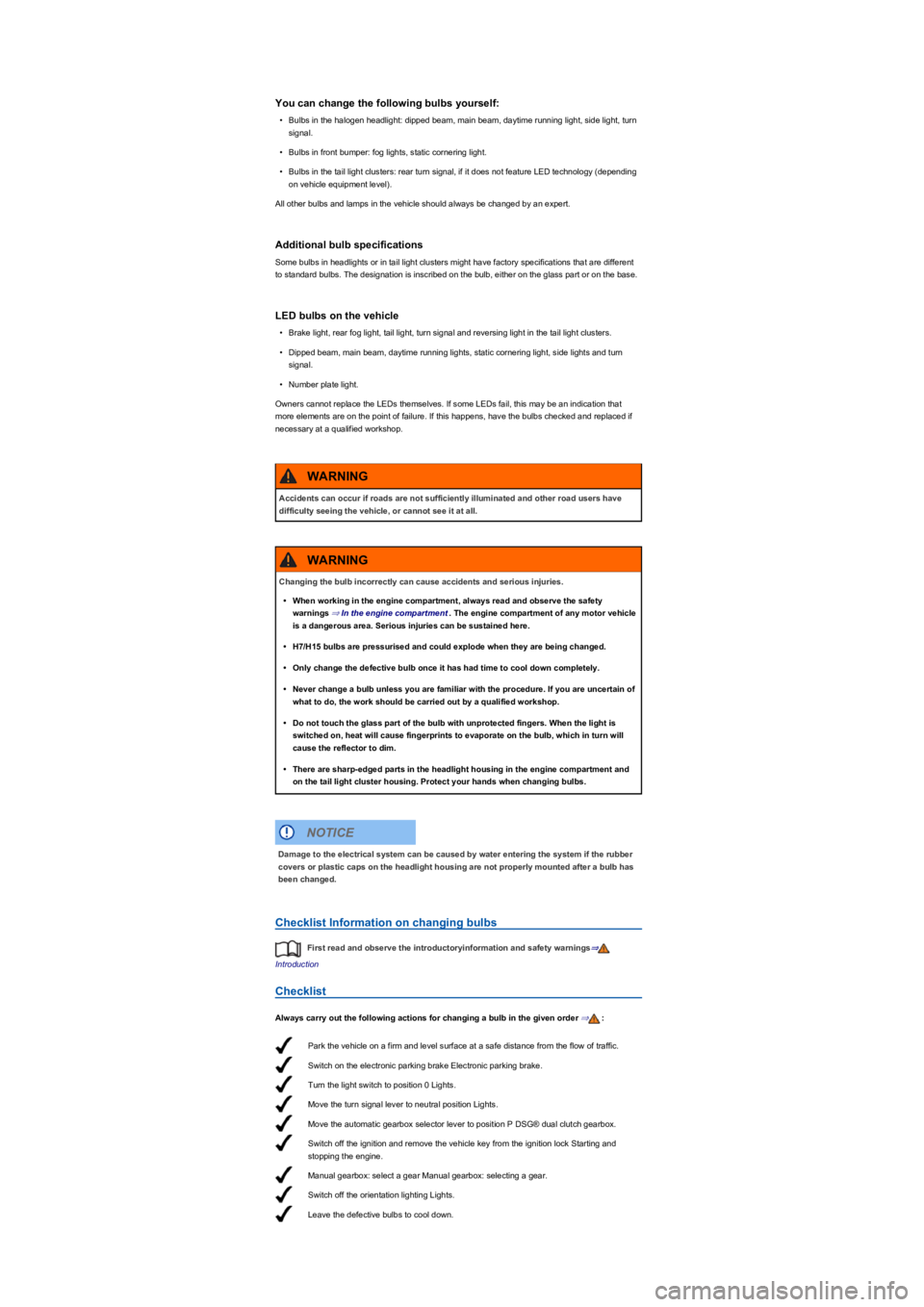
Park the vehicle on a firm and level surface at a safe distance from the flow of traffic.
Switch on the electronic parking brake Electronic parking brake.
Turn the light switch to position 0 Lights.
Move the turn signal lever to neutral position Lights.
Move the automatic gearbox selector lever to position P DSG® dual clutch gearbox.
Switch off the ignition and remove the vehicle key from the ignition lock Starting and
stopping the engine.
Manual gearbox: select a gear Manual gearbox: selecting a gear.
Switch off the orientation lighting Lights.
Leave the defective bulbs to cool down.
You can change the following bulbs yourself:
•Bulbs in the halogen headlight: dipped beam, main beam, daytime running light, side light, turn
signal.
•Bulbs in front bumper: fog lights, static cornering light.
•Bulbs in the tail light clusters: rear turn signal, if it does not feature LED technology (depending
on vehicle equipment level).
All other bulbs and lamps in the vehicle should always be changed by an expert.
Additional bulb specifications
Some bulbs in headlights or in tail light clusters might have factory specifications that are different
to standard bulbs. The designation is inscribed on the bulb, either on the glass part or on the base.
LED bulbs on the vehicle
•Brake light, rear fog light, tail light, turn signal and reversing light in the tail light clusters.
•Dipped beam, main beam, daytime running lights, static cornering light, side lights and turn
signal.
•Number plate light.
Owners cannot replace the LEDs themselves. If some LEDs fail, this may be an indication that
more elements are on the point of failure. If this happens, have the bulbs checked and replaced if
necessary at a qualified workshop.
Checklist Information on changing bulbs
First read and observe the introductoryinformation and safety warnings⇒
Introduction
Checklist
Always carry out the following actions for changing a bulb in the given order ⇒:
Accidents can occur if roads are not sufficiently illuminated and other road users have
difficulty seeing the vehicle, or cannot see it at all.
WARNING
Changing the bulb incorrectly can cause accidents and serious injuries.
•When working in the engine compartment, always read and observe the safety
warnings ⇒ In the engine compartment. The engine compartment of any motor vehicle
is a dangerous area. Serious injuries can be sustained here.
•H7/H15 bulbs are pressurised and could explode when they are being changed.
•Only change the defective bulb once it has had time to cool down completely.
•Never change a bulb unless you are familiar with the procedure. If you are uncertain of
what to do, the work should be carried out by a qualified workshop.
•Do not touch the glass part of the bulb with unprotected fingers. When the light is
switched on, heat will cause fingerprints to evaporate on the bulb, which in turn will
cause the reflector to dim.
•There are sharp-edged parts in the headlight housing in the engine compartment and
on the tail light cluster housing. Protect your hands when changing bulbs.
WARNING
Damage to the electrical system can be caused by water entering the system if the rubber
covers or plastic caps on the headlight housing are not properly mounted after a bulb has
been changed.
NOTICE
Page 255 of 341
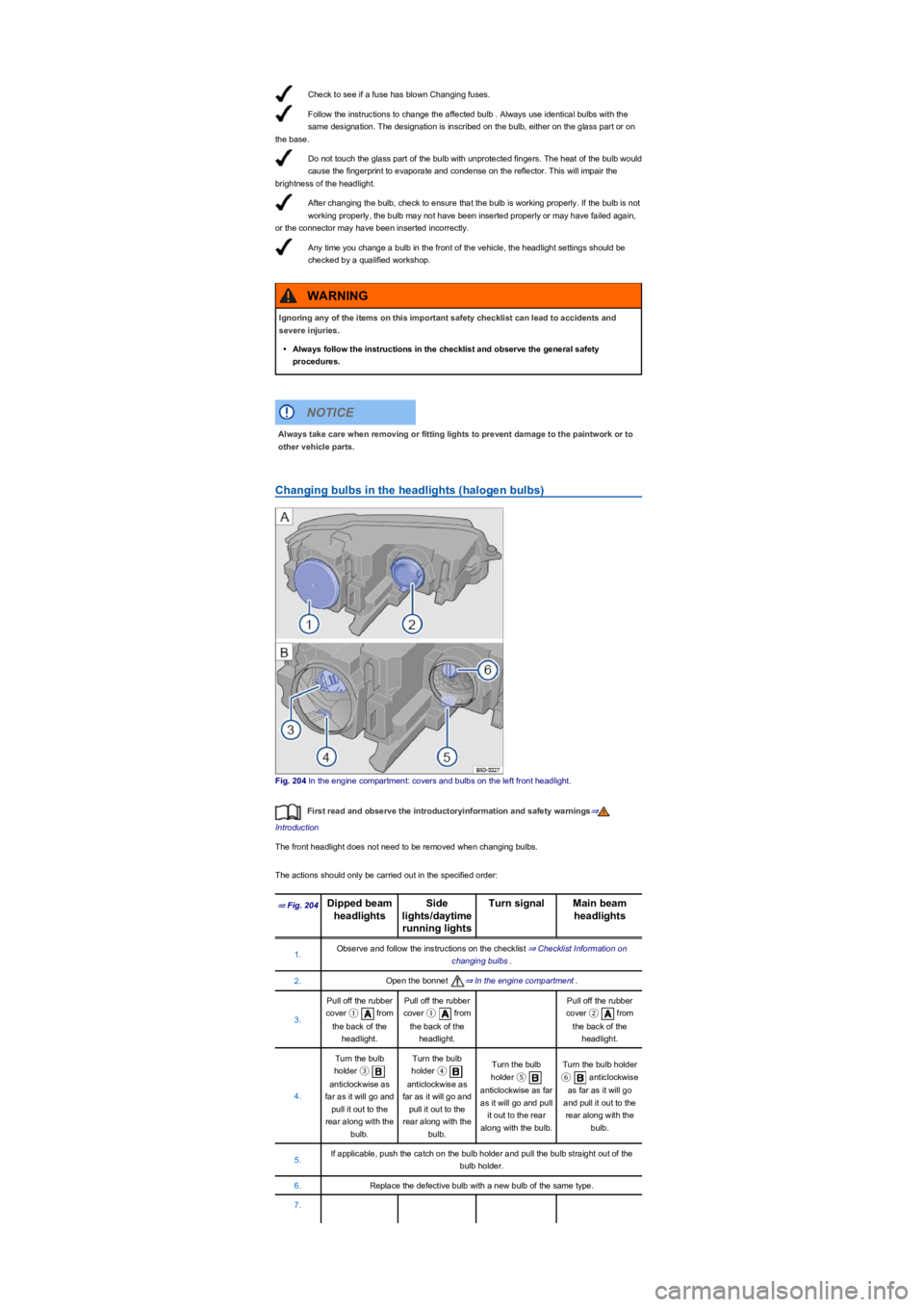
Check to see if a fuse has blown Changing fuses.
Follow the instructions to change the affected bulb . Always use identical bulbs with the
same designation. The designation is inscribed on the bulb, either on the glass part or on
the base.
Do not touch the glass part of the bulb with unprotected fingers. The heat of the bulb would
cause the fingerprint to evaporate and condense on the reflector. This will impair the
brightness of the headlight.
After changing the bulb, check to ensure that the bulb is working properly. If the bulb is not
working properly, the bulb may not have been inserted properly or may have failed again,
or the connector may have been inserted incorrectly.
Any time you change a bulb in the front of the vehicle, the headlight settings should be
checked by a qualified workshop.
Changing bulbs in the headlights (halogen bulbs)
Fig. 204 In the engine compartment: covers and bulbs on the left front headlight.
First read and observe the introductoryinformation and safety warnings⇒
Introduction
The front headlight does not need to be removed when changing bulbs.
The actions should only be carried out in the specified order:
⇒ Fig. 204Dipped beam
headlights
Side
lights/daytime
running lights
Turn signalMain beam
headlights
1.Observe and follow the instructions on the checklist ⇒ Checklist Information on
changing bulbs.
2.Open the bonnet ⇒ In the engine compartment.
3.
Pull off the rubber
cover ① from
the back of the
headlight.
Pull off the rubber
cover ① from
the back of the
headlight.
Pull off the rubber
cover ② from
the back of the
headlight.
4.
Turn the bulb
holder ③
anticlockwise as
far as it will go and
pull it out to the
rear along with the
bulb.
Turn the bulb
holder ④
anticlockwise as
far as it will go and
pull it out to the
rear along with the
bulb.
Turn the bulb
holder ⑤
anticlockwise as far
as it will go and pull
it out to the rear
along with the bulb.
Turn the bulb holder
⑥ anticlockwise
as far as it will go
and pull it out to the
rear along with the
bulb.
5.If applicable, push the catch on the bulb holder and pull the bulb straight out of the
bulb holder.
6.Replace the defective bulb with a new bulb of the same type.
7.
Ignoring any of the items on this important safety checklist can lead to accidents and
severe injuries.
•Always follow the instructions in the checklist and observe the general safety
procedures.
WARNING
Always take care when removing or fitting lights to prevent damage to the paintwork or to
other vehicle parts.
NOTICE