Snow VOLKSWAGEN TIGUAN 2018 User Guide
[x] Cancel search | Manufacturer: VOLKSWAGEN, Model Year: 2018, Model line: TIGUAN, Model: VOLKSWAGEN TIGUAN 2018Pages: 341, PDF Size: 6.11 MB
Page 116 of 341
The following systems may be installed in the vehicle
The heating and fresh air system warms up and supplies fresh air to the vehicle interior. The
heating and fresh air system does not cool down the vehicle interior.
The manual air conditioning system or Climatronic cools down and dehumidifies the air. It
works most effectively when the windows and the glass roof are closed. If heat has built up in the
vehicle interior, opening the doors and windows can speed up the cooling process.
How the vehicle displays active functions
Lit up LEDs on rotary knobs and buttons indicate that a function has been switched on.
Some settings can be stored in the user accounts of the personalisation function and
therefore change when the user account changes ⇒ Personalisation.
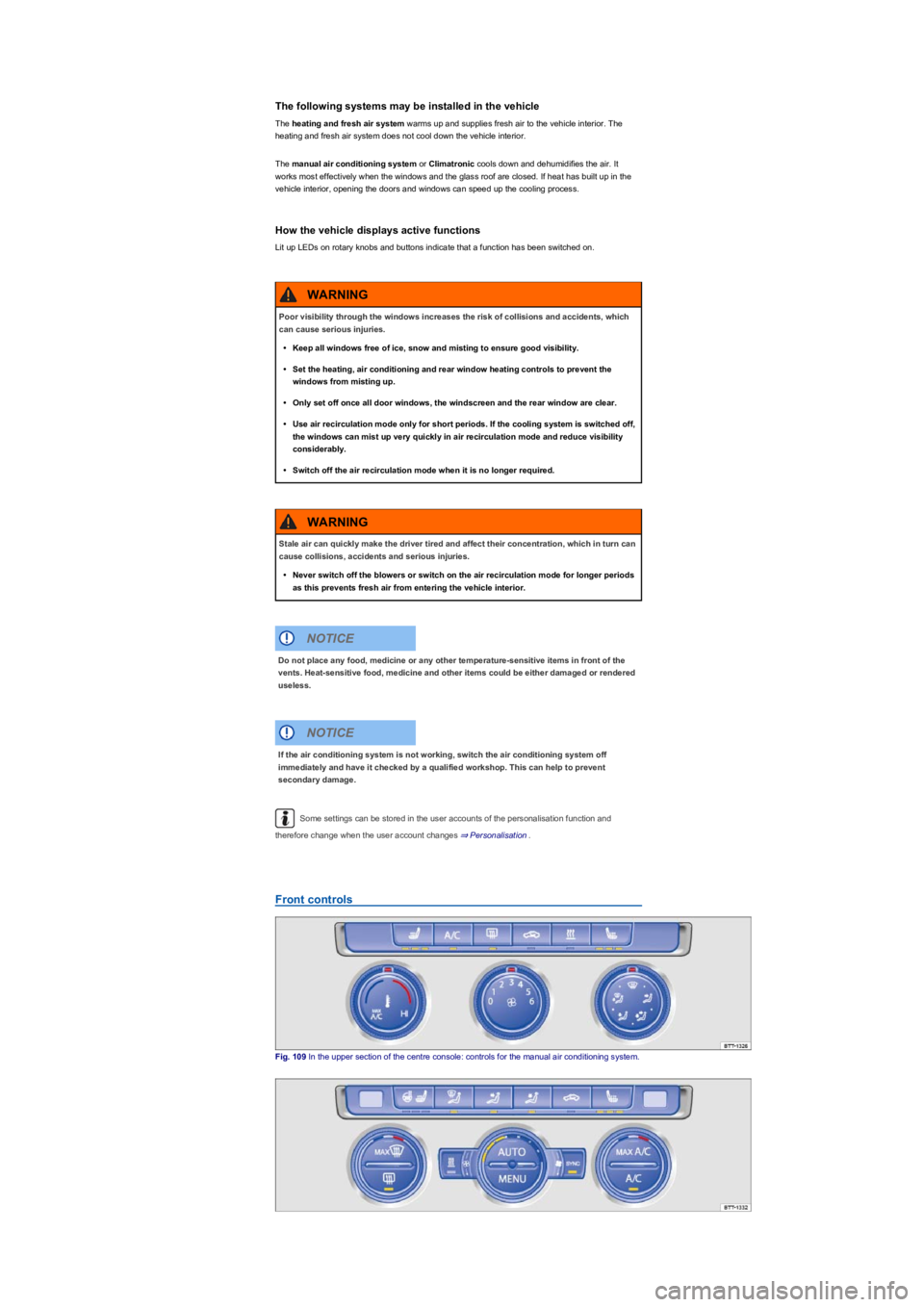
Front controls
Fig. 109 In the upper section of the centre console: controls for the manual air conditioning system.
Poor visibility through the windows increases the risk of collisions and accidents, which
can cause serious injuries.
•Keep all windows free of ice, snow and misting to ensure good visibility.
•Set the heating, air conditioning and rear window heating controls to prevent the
windows from misting up.
•Only set off once all door windows, the windscreen and the rear window are clear.
•Use air recirculation mode only for short periods. If the cooling system is switched off,
the windows can mist up very quickly in air recirculation mode and reduce visibility
considerably.
•Switch off the air recirculation mode when it is no longer required.
WARNING
Stale air can quickly make the driver tired and affect their concentration, which in turn can
cause collisions, accidents and serious injuries.
•Never switch off the blowers or switch on the air recirculation mode for longer periods
as this prevents fresh air from entering the vehicle interior.
WARNING
Do not place any food, medicine or any other temperature-sensitive items in front of the
vents. Heat-sensitive food, medicine and other items could be either damaged or rendered
useless.
NOTICE
If the air conditioning system is not working, switch the air conditioning system off
immediately and have it checked by a qualified workshop. This can help to prevent
secondary damage.
NOTICE
Page 123 of 341
Why does the cooling system switch off automatically or cannot be
switched on?
•The engine is not running.
•The blower is switched off.
•The air conditioning system fuse has blown.
•The ambient temperature is lower than approximately +3°C (+38°Fyf.
•The air conditioning compressor of the cooling system has been temporarily switched off
because the engine coolant temperature is too high.
•There is a vehicle fault. The air conditioning system should be checked by a qualified workshop.
Settings for optimal road visibility
•Keep the air intake in front of the windscreen free from ice, snow or leaves to improve the
heating and cooling performance and prevent condensation on the windows ⇒ Vehicle care.
•Do not cover the air vents in the rear of the luggage compartment to allow air to flow through
the vehicle from the front to the rear.
•The maximum heating output and the fastest window defrosting results are achieved when the
coolant has reached its operating temperature.
Recommended settings for the heating and fresh air system or manual air
conditioning system
•Switch off air recirculation mode.
•Set blower to setting or .
•Set the temperature selector to the middle position.
•Open and position all vents on the dash panel.
•Turn the air distribution regulator to the desired position.
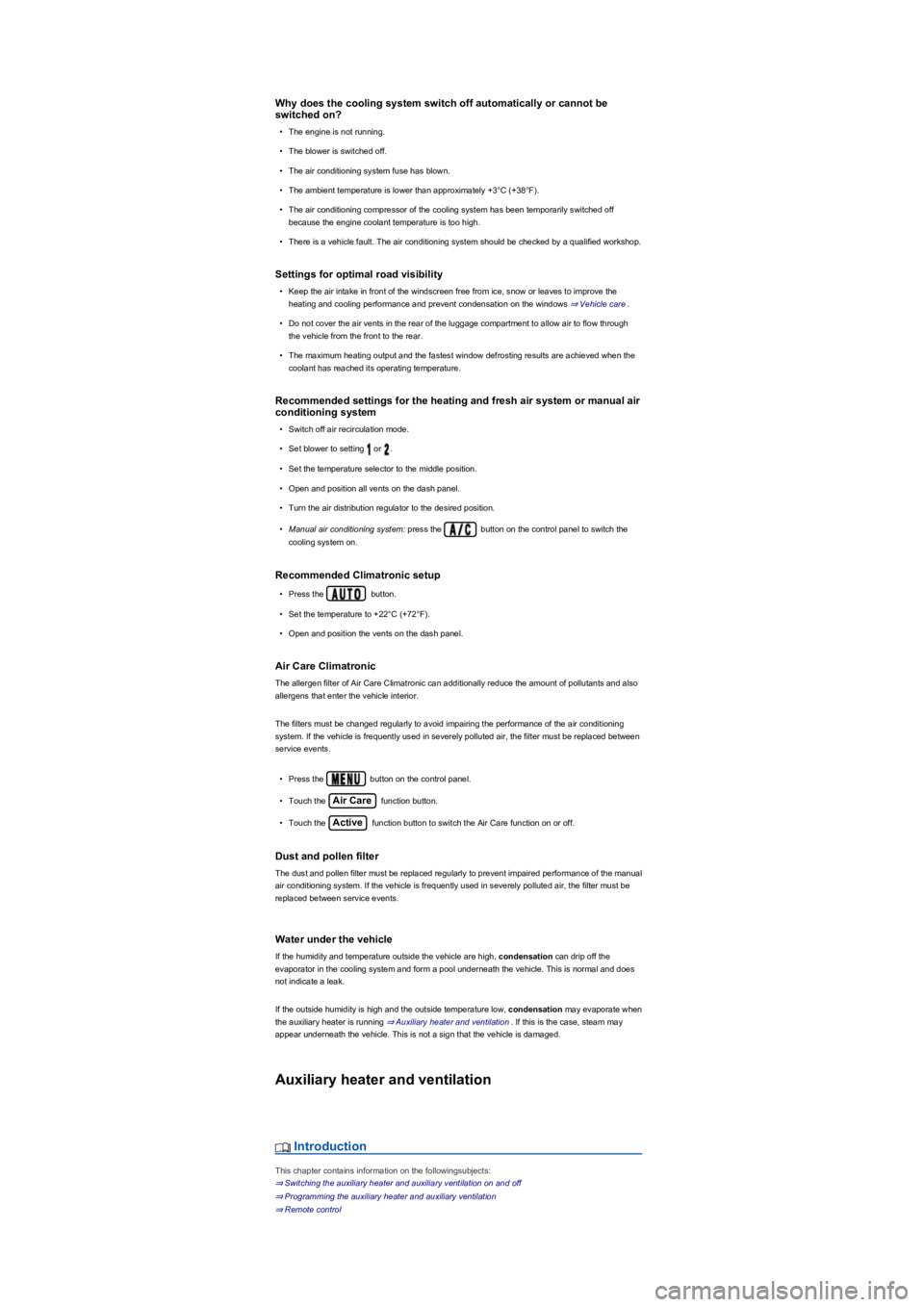
•Manual air conditioning system: press the button on the control panel to switch the
cooling system on.
Recommended Climatronic setup
•Press the button.
•Set the temperature to +22°C (+72°Fyf.
•Open and position the vents on the dash panel.
Air Care Climatronic
The allergen filter of Air Care Climatronic can additionally reduce the amount of pollutants and also
allergens that enter the vehicle interior.
The filters must be changed regularly to avoid impairing the performance of the air conditioning
system. If the vehicle is frequently used in severely polluted air, the filter must be replaced between
service events.
•Press the button on the control panel.
•Touch the Air Care function button.
•Touch the Active function button to switch the Air Care function on or off.
Dust and pollen filter
The dust and pollen filter must be replaced regularly to prevent impaired performance of the manual
air conditioning system. If the vehicle is frequently used in severely polluted air, the filter must be
replaced between service events.
Water under the vehicle
If the humidity and temperature outside the vehicle are high, condensation can drip off the
evaporator in the cooling system and form a pool underneath the vehicle. This is normal and does
not indicate a leak.
If the outside humidity is high and the outside temperature low, condensation may evaporate when
the auxiliary heater is running ⇒ Auxiliary heater and ventilation. If this is the case, steam may
appear underneath the vehicle. This is not a sign that the vehicle is damaged.
Auxiliary heater and ventilation
Introduction
This chapter contains information on the followingsubjects:
⇒ Switching the auxiliary heater and auxiliary ventilation on and off
⇒ Programming the auxiliary heater and auxiliary ventilation
⇒ Remote control
Page 124 of 341
The auxiliary heater and ventilation
system allows the vehicle interior to be
heated in winter and ventilated in
summer. Operation of the system
allows ice, condensation and a thin
covering of snow to be cleared from the
windscreen. The auxiliary heater is
supplied with fuel from the vehicle fuel
tank and can be operated when the
vehicle is stationary with the ignition
switched off. The auxiliary ventilation
system is supplied with power by the
12-volt vehicle battery.
Auxiliary heater exhaust system
The emissions produced by the auxiliary heater are removed via an exhaust pipe fitted underneath
the vehicle. The exhaust pipe must not be blocked by snow, mud or other objects.
Switching the auxiliary heater and auxiliary ventilation on and off
First read and observe the introductoryinformation and safety warnings⇒
Introduction
The auxiliary heating can be operated only when the ignition is switched off. If the ignition is
switched on while the auxiliary heater is working, the auxiliary heater continues to run to provide
additional heat.
Switching on the auxiliary heater
•Press the immediate heat button on the control panel ⇒ Front controls.
•Press the button on the remote control ⇒ Remote control.
•Program a departure time ⇒ Programming the auxiliary heater and auxiliary ventilation.
The auxiliary heater heats up the vehicle interior to a temperature of at least 22°C.
The auxiliary heater will not switch on if the 12-volt vehicle battery has a low charge level or the fuel
tank is empty.
Switching off the auxiliary heater manually
•Press the immediate heat button on the control panel ⇒ Front controls.
•Press the button on the remote control ⇒ Remote control.
•Touch the function button in the Infotainment system ⇒ Programming the auxiliary heater
and auxiliary ventilation.
Auxiliary heater switches off automatically
•When the programmed departure time is reached, or after the programmed operating period
has elapsed ⇒ Programming the auxiliary heater and auxiliary ventilation.
•If the indicator lamp or lights up (fuel gaugeyf ⇒ Fuel gauge.
•If the charge level of the 12-volt vehicle battery is too low ⇒ 12-volt vehicle battery.
The fumes from the auxiliary heater contain among other things carbon monoxide, which
is an odourless and colourless poisonous gas. Carbon monoxide can cause people to
lose consciousness. It can also cause death.
•Never start or run the auxiliary heater in unventilated or closed rooms.
•Never programme the auxiliary heater so that it is switched on and run in unventilated
or enclosed spaces.
WARNING
Parts of the auxiliary heater exhaust system become very hot. This can cause fires.
•Park the vehicle so that no part of the exhaust system can come into contact with any
inflammable material underneath the vehicle, e.g. dry grass.
WARNING
Do not place any food, medicine or any other temperature-sensitive items in front of the
vents. Heat-sensitive food, medicine and other items could be either damaged or rendered
useless.
NOTICE
Page 146 of 341
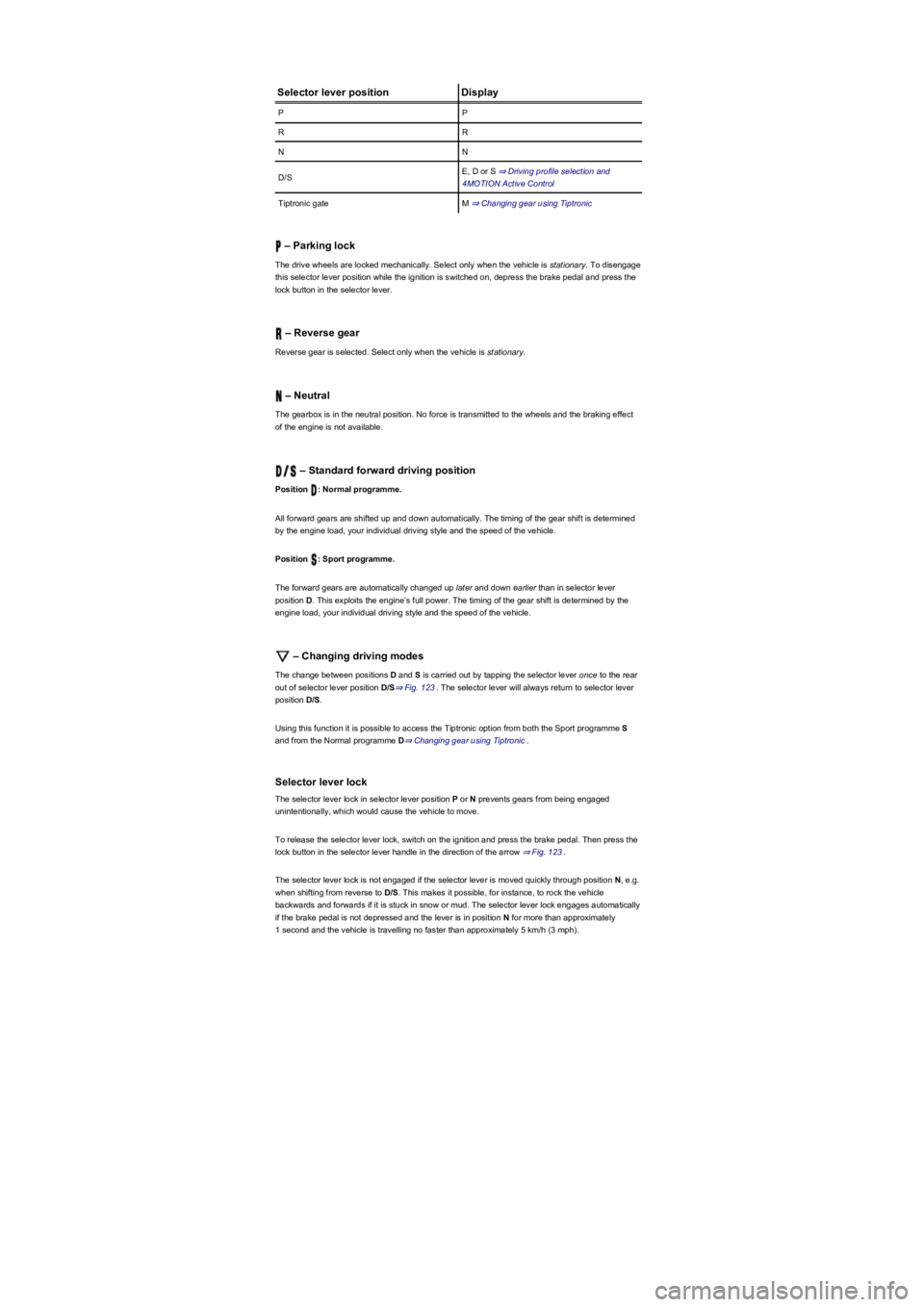
Selector lever positionDisplay
PP
RR
NN
D/SE, D or S ⇒ Driving profile selection and
4MOTION Active Control
Tiptronic gateM ⇒ Changing gear using Tiptronic
– Parking lock
The drive wheels are locked mechanically. Select only when the vehicle is stationary. To disengage
this selector lever position while the ignition is switched on, depress the brake pedal and press the
lock button in the selector lever.
– Reverse gear
Reverse gear is selected. Select only when the vehicle is stationary.
– Neutral
The gearbox is in the neutral position. No force is transmitted to the wheels and the braking effect
of the engine is not available.
– Standard forward driving position
Position : Normal programme.
All forward gears are shifted up and down automatically. The timing of the gear shift is determined
by the engine load, your individual driving style and the speed of the vehicle.
Position : Sport programme.
The forward gears are automatically changed up later and down earlier than in selector lever
position D. This exploits the engine’s full power. The timing of the gear shift is determined by the
engine load, your individual driving style and the speed of the vehicle.
– Changing driving modes
The change between positions D and S is carried out by tapping the selector lever once to the rear
out of selector lever position D/S⇒ Fig. 123. The selector lever will always return to selector lever
position D/S.
Using this function it is possible to access the Tiptronic option from both the Sport programme S
and from the Normal programme D⇒ Changing gear using Tiptronic.
Selector lever lock
The selector lever lock in selector lever position P or N prevents gears from being engaged
unintentionally, which would cause the vehicle to move.
To release the selector lever lock, switch on the ignition and press the brake pedal. Then press the
lock button in the selector lever handle in the direction of the arrow ⇒ Fig. 123.
The selector lever lock is not engaged if the selector lever is moved quickly through position N, e.g.
when shifting from reverse to D/S. This makes it possible, for instance, to rock the vehicle
backwards and forwards if it is stuck in snow or mud. The selector lever lock engages automatically
if the brake pedal is not depressed and the lever is in position N for more than approximately
1 second and the vehicle is travelling no faster than approximately 5 km/h (3 mphyf.
Page 156 of 341
•Proactive occupant protection system
In vehicles with a DSG dual clutch gearbox, the system automatically changes to gear
position S when the Sport driving profile is selected. The system automatically switches to gear
position D when the Eco driving profile is selected. Since coasting is active in the Eco driving
profile, the gearbox programme E is additionally displayed on the instrument cluster display.
The driver can adjust certain vehicle functions irrespective of the selected driving profile. For
example, the driver can switch to gear position S when the Eco driving profile is selected.
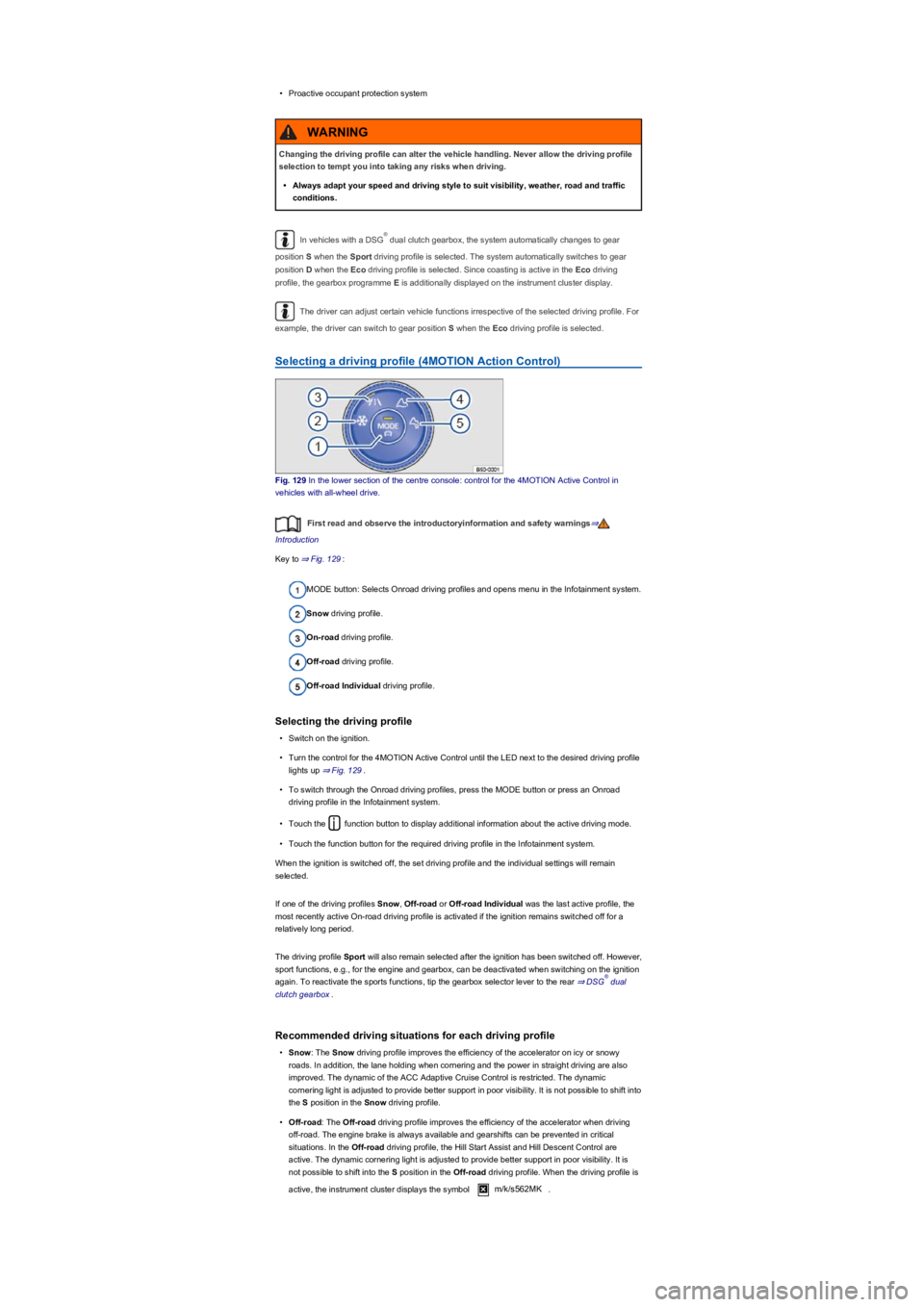
Selecting a driving profile (4MOTION Action Controlyf
Fig. 129 In the lower section of the centre console: control for the 4MOTION Active Control in
vehicles with all-wheel drive.
First read and observe the introductoryinformation and safety warnings⇒
Introduction
Key to ⇒ Fig. 129:
MODE button: Selects Onroad driving profiles and opens menu in the Infotainment system.
Snow driving profile.
On-road driving profile.
Off-road driving profile.
Off-road Individual driving profile.
Selecting the driving profile
•Switch on the ignition.
•Turn the control for the 4MOTION Active Control until the LED next to the desired driving profile
lights up ⇒ Fig. 129.
•To switch through the Onroad driving profiles, press the MODE button or press an Onroad
driving profile in the Infotainment system.
•Touch the function button to display additional information about the active driving mode.
•Touch the function button for the required driving profile in the Infotainment system.
When the ignition is switched off, the set driving profile and the individual settings will remain
selected.
If one of the driving profiles Snow, Off-road or Off-road Individual was the last active profile, the
most recently active On-road driving profile is activated if the ignition remains switched off for a
relatively long period.
The driving profile Sport will also remain selected after the ignition has been switched off. However,
sport functions, e.g., for the engine and gearbox, can be deactivated when switching on the ignition
again. To reactivate the sports functions, tip the gearbox selector lever to the rear ⇒ DSG dual
clutch gearbox.
Recommended driving situations for each driving profile
•Snow: The Snow driving profile improves the efficiency of the accelerator on icy or snowy
roads. In addition, the lane holding when cornering and the power in straight driving are also
improved. The dynamic of the ACC Adaptive Cruise Control is restricted. The dynamic
cornering light is adjusted to provide better support in poor visibility. It is not possible to shift into
the S position in the Snow driving profile.
•Off-road: The Off-road driving profile improves the efficiency of the accelerator when driving
off-road. The engine brake is always available and gearshifts can be prevented in critical
situations. In the Off-road driving profile, the Hill Start Assist and Hill Descent Control are
active. The dynamic cornering light is adjusted to provide better support in poor visibility. It is
not possible to shift into the S position in the Off-road driving profile. When the driving profile is
active, the instrument cluster displays the symbol m/k/s562MK.
Changing the driving profile can alter the vehicle handling. Never allow the driving profile
selection to tempt you into taking any risks when driving.
•Always adapt your speed and driving style to suit visibility, weather, road and traffic
conditions.
WARNING
®
®
Page 158 of 341
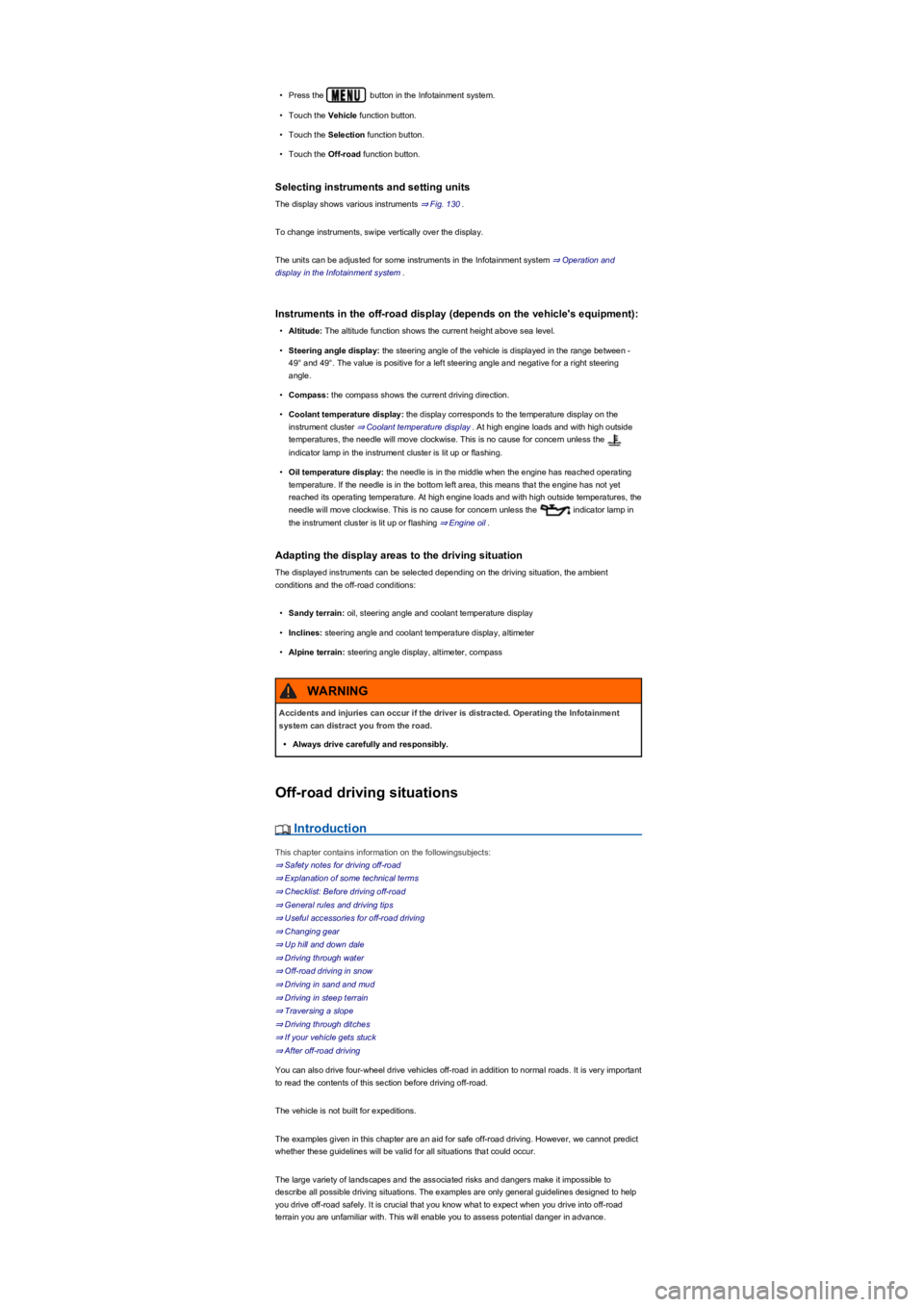
•Press the button in the Infotainment system.
•Touch the Vehicle function button.
•Touch the Selection function button.
•Touch the Off-road function button.
Selecting instruments and setting units
The display shows various instruments ⇒ Fig. 130.
To change instruments, swipe vertically over the display.
The units can be adjusted for some instruments in the Infotainment system ⇒ Operation and
display in the Infotainment system.
Instruments in the off-road display (depends on the vehicle's equipmentyf:
•Altitude: The altitude function shows the current height above sea level.
•Steering angle display: the steering angle of the vehicle is displayed in the range between -
49° and 49°. The value is positive for a left steering angle and negative for a right steering
angle.
•Compass: the compass shows the current driving direction.
•Coolant temperature display: the display corresponds to the temperature display on the
instrument cluster ⇒ Coolant temperature display. At high engine loads and with high outside
temperatures, the needle will move clockwise. This is no cause for concern unless the
indicator lamp in the instrument cluster is lit up or flashing.
•Oil temperature display: the needle is in the middle when the engine has reached operating
temperature. If the needle is in the bottom left area, this means that the engine has not yet
reached its operating temperature. At high engine loads and with high outside temperatures, the
needle will move clockwise. This is no cause for concern unless the indicator lamp in
the instrument cluster is lit up or flashing ⇒ Engine oil.
Adapting the display areas to the driving situation
The displayed instruments can be selected depending on the driving situation, the ambient
conditions and the off-road conditions:
•Sandy terrain: oil, steering angle and coolant temperature display
•Inclines: steering angle and coolant temperature display, altimeter
•Alpine terrain: steering angle display, altimeter, compass
Off-road driving situations
Introduction
This chapter contains information on the followingsubjects:
⇒ Safety notes for driving off-road
⇒ Explanation of some technical terms
⇒ Checklist: Before driving off-road
⇒ General rules and driving tips
⇒ Useful accessories for off-road driving
⇒ Changing gear
⇒ Up hill and down dale
⇒ Driving through water
⇒ Off-road driving in snow
⇒ Driving in sand and mud
⇒ Driving in steep terrain
⇒ Traversing a slope
⇒ Driving through ditches
⇒ If your vehicle gets stuck
⇒ After off-road driving
You can also drive four-wheel drive vehicles off-road in addition to normal roads. It is very important
to read the contents of this section before driving off-road.
The vehicle is not built for expeditions.
The examples given in this chapter are an aid for safe off-road driving. However, we cannot predict
whether these guidelines will be valid for all situations that could occur.
The large variety of landscapes and the associated risks and dangers make it impossible to
describe all possible driving situations. The examples are only general guidelines designed to help
you drive off-road safely. It is crucial that you know what to expect when you drive into off-road
terrain you are unfamiliar with. This will enable you to assess potential danger in advance.
Accidents and injuries can occur if the driver is distracted. Operating the Infotainment
system can distract you from the road.
•Always drive carefully and responsibly.
WARNING
Page 162 of 341
Water, compass, maps and torch with spare batteries.
Winch, tow bar or rope with sufficient strength.
Mobile telephone, shovel, blankets and rubber boots.
Electric air compressor for connection to the 12-volt sockets in the vehicle to inflate the
tyres.
A wooden board approx. 4 cm thick and approx. 1 metre long or an aluminium frame of
similar size: this will help to free a vehicle stuck in the mud and provide a platform for a
vehicle jack.
Snow chains, additional spare wheels, a breakdown set, jack and box spanner.
•Give way to drivers coming uphill or who are overtaking.
Driving tips
Special rules apply when driving off-road:
•Never drive off-road alone. Always drive off-road in a team of at least two other off-road
vehicles. Unexpected situations can always occur. We recommend that you carry equipment
you can use for calling for help.
•Stop your vehicle when you reach difficult sections, and walk along the path ahead to
reconnoitre it.
•Drive slowly over the brows of hills so the vehicle does not lose contact with the ground as this
could cause damage, leaving you unable to manoeuvre.
•Drive slowly when the route is difficult. Shift up a gear when on slippery ground and always
keep the vehicle in motion.
•Always look for flat and firm surfaces. The ground is predominantly soft when driving off-road
meaning the tyres could sink into the ground. This will reduce ground clearance and the wading
depth.
•Even when driving at low speeds, always keep your distance from other vehicles. If the first
vehicle suddenly gets stuck, the following vehicle can stop without getting stuck.
Useful accessories for off-road driving
First read and observe the introductoryinformation and safety warnings⇒
Introduction
The checklist contains just a few items of equipment that can be very useful for off-road driving. If
you have an instruction manual or fitting instructions for these accessories you should always take
them with you and consult them as necessary when driving off-road.
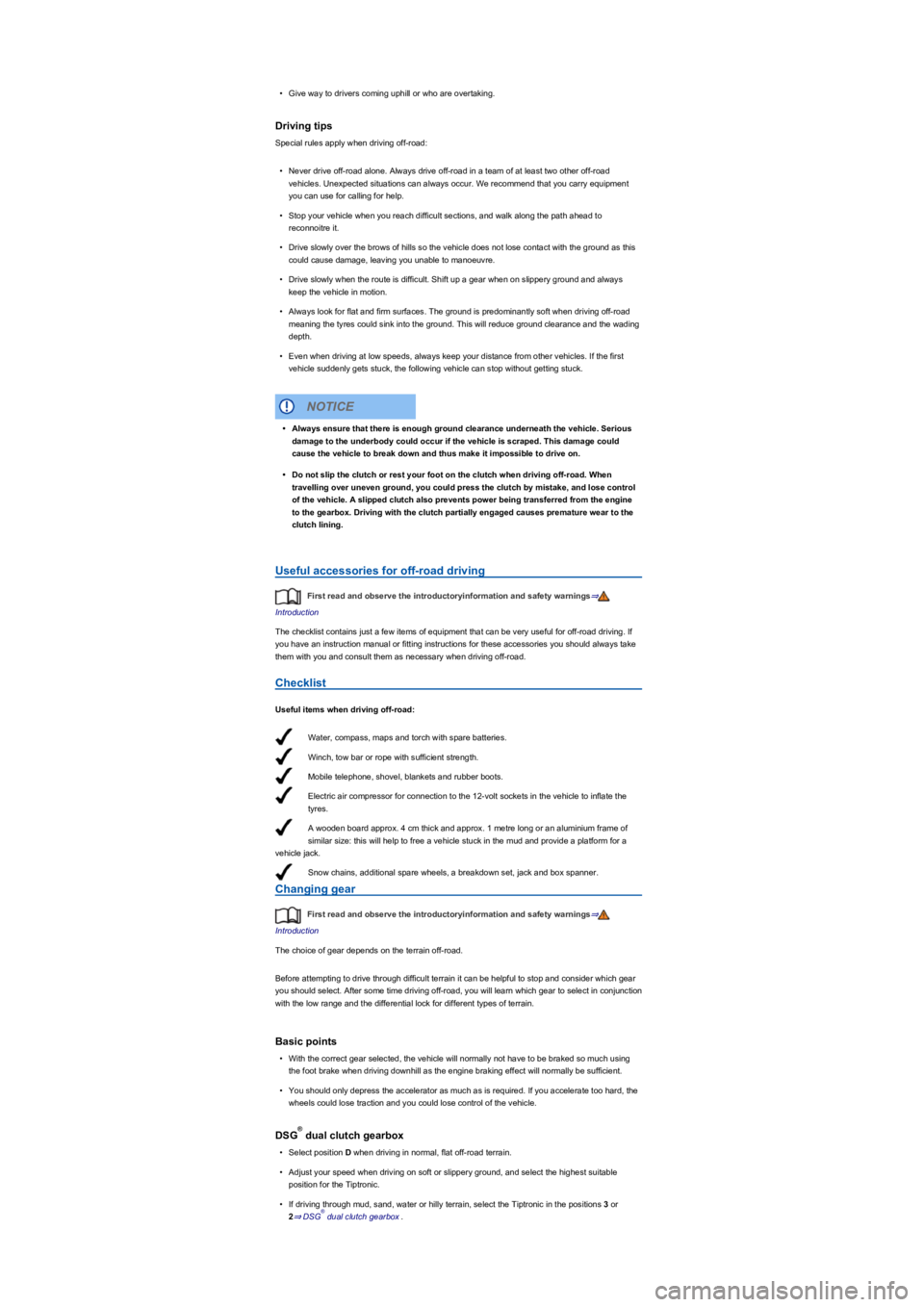
Checklist
Useful items when driving off-road:
Changing gear
First read and observe the introductoryinformation and safety warnings⇒
Introduction
The choice of gear depends on the terrain off-road.
Before attempting to drive through difficult terrain it can be helpful to stop and consider which gear
you should select. After some time driving off-road, you will learn which gear to select in conjunction
with the low range and the differential lock for different types of terrain.
Basic points
•With the correct gear selected, the vehicle will normally not have to be braked so much using
the foot brake when driving downhill as the engine braking effect will normally be sufficient.
•You should only depress the accelerator as much as is required. If you accelerate too hard, the
wheels could lose traction and you could lose control of the vehicle.
DSG dual clutch gearbox
•Select position D when driving in normal, flat off-road terrain.
•Adjust your speed when driving on soft or slippery ground, and select the highest suitable
position for the Tiptronic.
•If driving through mud, sand, water or hilly terrain, select the Tiptronic in the positions 3 or
2⇒ DSG dual clutch gearbox.
•Always ensure that there is enough ground clearance underneath the vehicle. Serious
damage to the underbody could occur if the vehicle is scraped. This damage could
cause the vehicle to break down and thus make it impossible to drive on.
•Do not slip the clutch or rest your foot on the clutch when driving off-road. When
travelling over uneven ground, you could press the clutch by mistake, and lose control
of the vehicle. A slipped clutch also prevents power being transferred from the engine
to the gearbox. Driving with the clutch partially engaged causes premature wear to the
clutch lining.
NOTICE
®
®
Page 163 of 341
•Use the Off-road display ⇒ Off-road display.
Up hill and down dale
First read and observe the introductoryinformation and safety warnings⇒
Introduction
Use off-road mode ⇒ Selecting a driving profile (4MOTION Action Controlyf.
You should drive through rocky terrain at walking pace.
If you are not able to drive around a stone, drive carefully onto the stone with one front wheel and
drive over it slowly ⇒.
Escaping engine oil and brake fluid can pollute the environment. Spilt service fluids must be
collected and then disposed of properly and in an environmentally responsible way.
Driving through water
First read and observe the introductoryinformation and safety warnings⇒
Introduction
Driving through flooded terrain could damage the vehicle ⇒ Checklist: Before driving off-road.
You can drive the vehicle carefully through water with a depth reaching to the bottom edge of the
body, for example puddles or shallow water. Never stop in the water, do not drive in reverse, and
never switch off the engine.
Off-road driving in snow
First read and observe the introductoryinformation and safety warnings⇒
Introduction
Fit snow chains to the front wheels only before driving on snow-covered terrain.
Terrain might look harmless, but there could be hidden dangers. This is particularly true of sections
where there are no tyre tracks.
•You should never drive straight over large obstacles, e.g. boulders or tree stumps, or
drive over such obstacles with one side of the vehicle. Obstacles which require more
ground clearance than is available could damage vehicle components when you drive
over them and thus cause the vehicle to break down.
•Even obstacles that are smaller than the ground clearance selected could come into
contact with the vehicle underbody and thus cause damage which could lead to a
vehicle breakdown. This applies in particular if there is a ditch or soft ground either in
front of or behind the obstacle. This also applies in cases when you drive too quickly
over the obstacle causing the vehicle to bounce.
NOTICE
Strong flowing water can develop enormous power and sweep the vehicle away. This can
lead to very dangerous situations which can cause accidents and serious or even fatal
accidents.
•Never allow the vehicle to stand still in water.
•Water in the engine compartment can cause the vehicle to breakdown in the water.
•Soft ground surface, underwater obstacles and shallows can cause accidents and can
cause the vehicle to breakdown in the water. This could lead to critical situations.
WARNING
If you drive through water, parts of the vehicle, such as the engine, drive train, running
gear and vehicle electrics, could sustain severe damage.
•When driving through water, always select a section where the ground is solid and
where the depth of the water does not exceed the maximum permitted wading depth of
the vehicle.
•Never drive through salt, salty surfaces or salt water as salt can cause corrosion. Rinse
all components that have been exposed to salt or salt water thoroughly with fresh
water.
NOTICE
Page 164 of 341
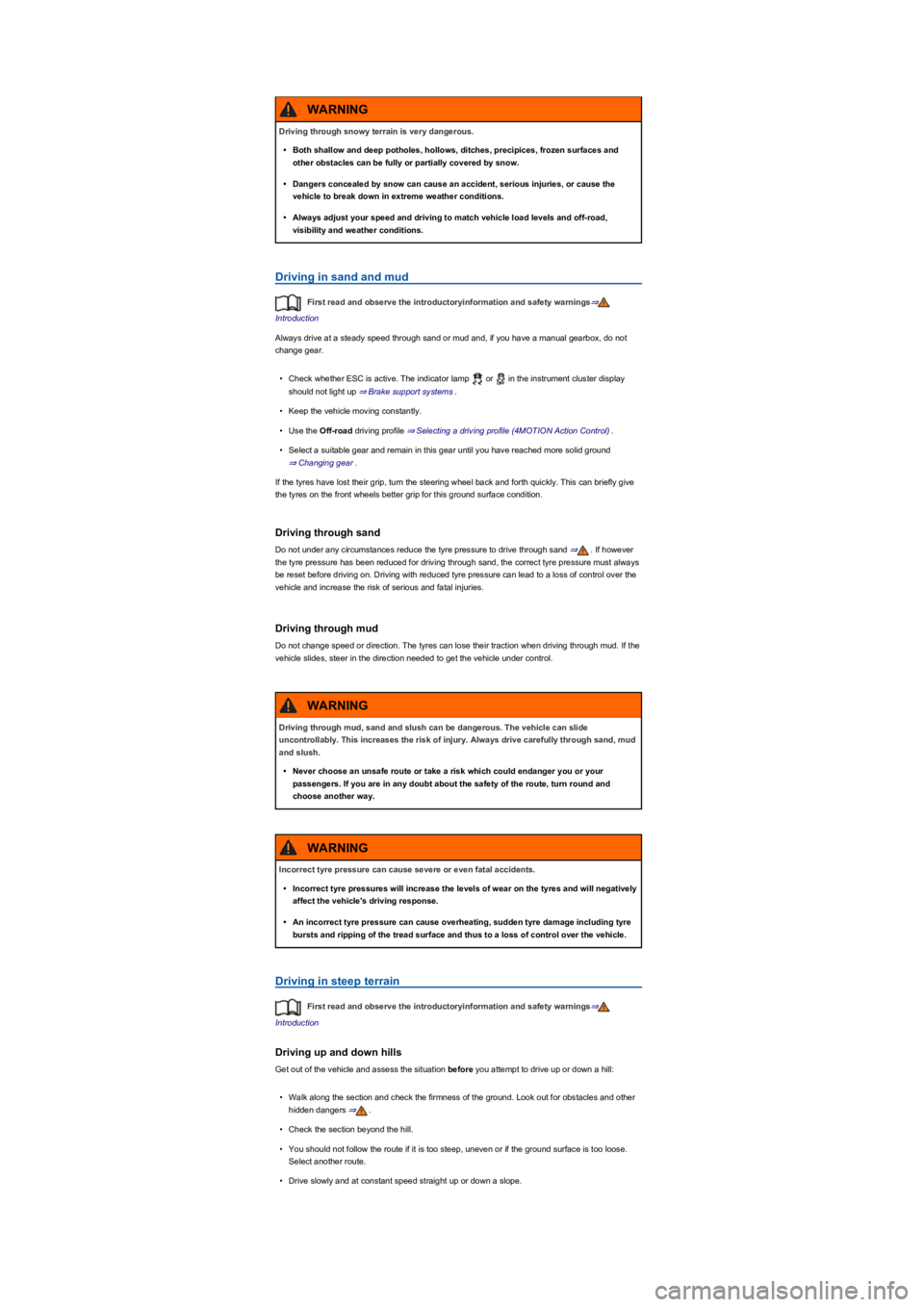
Driving in sand and mud
First read and observe the introductoryinformation and safety warnings⇒
Introduction
Always drive at a steady speed through sand or mud and, if you have a manual gearbox, do not
change gear.
•Check whether ESC is active. The indicator lamp or in the instrument cluster display
should not light up ⇒ Brake support systems.
•Keep the vehicle moving constantly.
•Use the Off-road driving profile ⇒ Selecting a driving profile (4MOTION Action Controlyf.
•Select a suitable gear and remain in this gear until you have reached more solid ground
⇒ Changing gear.
If the tyres have lost their grip, turn the steering wheel back and forth quickly. This can briefly give
the tyres on the front wheels better grip for this ground surface condition.
Driving through sand
Do not under any circumstances reduce the tyre pressure to drive through sand ⇒. If however
the tyre pressure has been reduced for driving through sand, the correct tyre pressure must always
be reset before driving on. Driving with reduced tyre pressure can lead to a loss of control over the
vehicle and increase the risk of serious and fatal injuries.
Driving through mud
Do not change speed or direction. The tyres can lose their traction when driving through mud. If the
vehicle slides, steer in the direction needed to get the vehicle under control.
Driving in steep terrain
First read and observe the introductoryinformation and safety warnings⇒
Introduction
Driving up and down hills
Get out of the vehicle and assess the situation before you attempt to drive up or down a hill:
•Walk along the section and check the firmness of the ground. Look out for obstacles and other
hidden dangers ⇒.
•Check the section beyond the hill.
•You should not follow the route if it is too steep, uneven or if the ground surface is too loose.
Select another route.
•Drive slowly and at constant speed straight up or down a slope.
Driving through snowy terrain is very dangerous.
•Both shallow and deep potholes, hollows, ditches, precipices, frozen surfaces and
other obstacles can be fully or partially covered by snow.
•Dangers concealed by snow can cause an accident, serious injuries, or cause the
vehicle to break down in extreme weather conditions.
•Always adjust your speed and driving to match vehicle load levels and off-road,
visibility and weather conditions.
WARNING
Driving through mud, sand and slush can be dangerous. The vehicle can slide
uncontrollably. This increases the risk of injury. Always drive carefully through sand, mud
and slush.
•Never choose an unsafe route or take a risk which could endanger you or your
passengers. If you are in any doubt about the safety of the route, turn round and
choose another way.
WARNING
Incorrect tyre pressure can cause severe or even fatal accidents.
•Incorrect tyre pressures will increase the levels of wear on the tyres and will negatively
affect the vehicle's driving response.
•An incorrect tyre pressure can cause overheating, sudden tyre damage including tyre
bursts and ripping of the tread surface and thus to a loss of control over the vehicle.
WARNING
Page 167 of 341
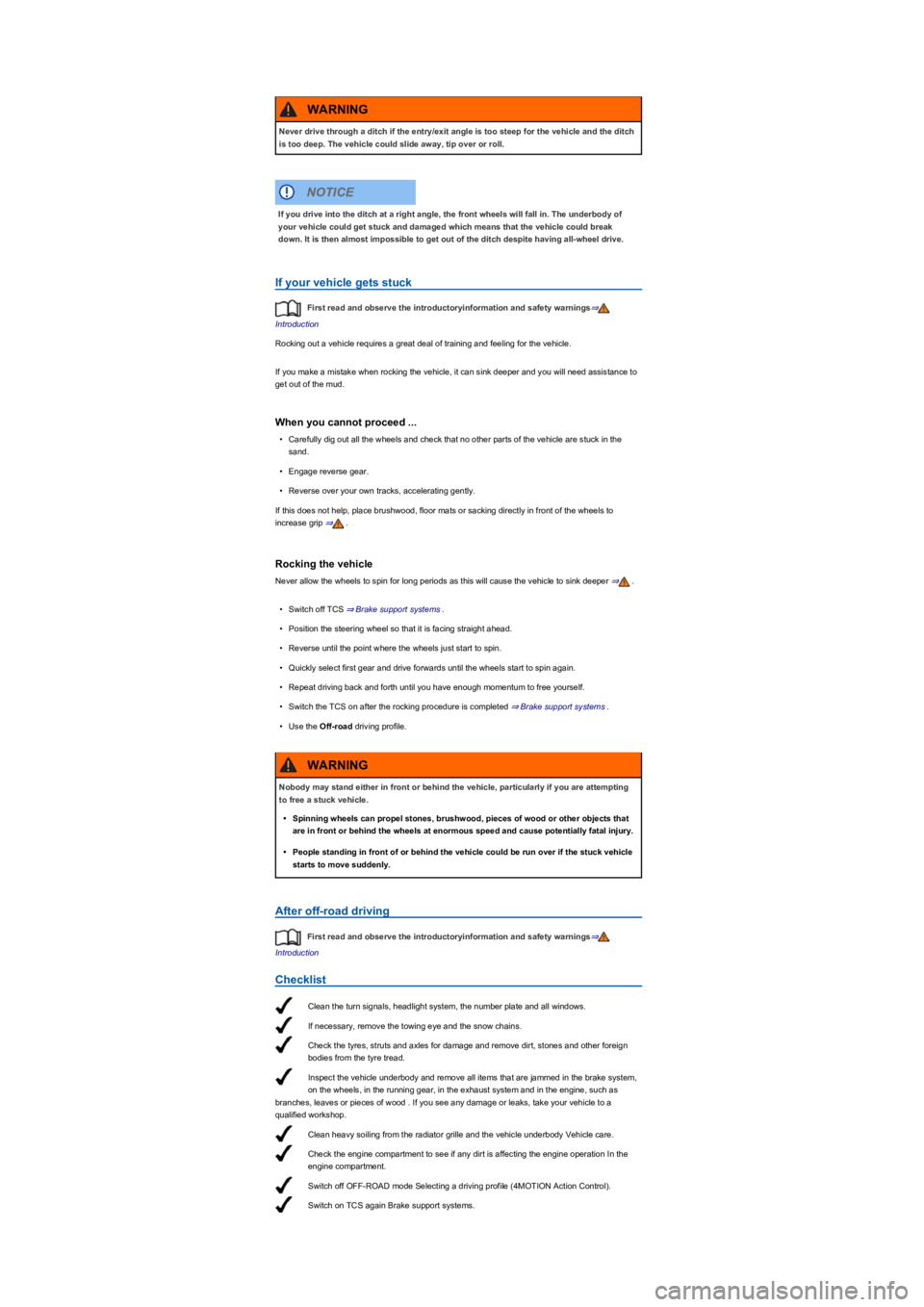
Clean the turn signals, headlight system, the number plate and all windows.
If necessary, remove the towing eye and the snow chains.
Check the tyres, struts and axles for damage and remove dirt, stones and other foreign
bodies from the tyre tread.
Inspect the vehicle underbody and remove all items that are jammed in the brake system,
on the wheels, in the running gear, in the exhaust system and in the engine, such as
branches, leaves or pieces of wood . If you see any damage or leaks, take your vehicle to a
qualified workshop.
Clean heavy soiling from the radiator grille and the vehicle underbody Vehicle care.
Check the engine compartment to see if any dirt is affecting the engine operation In the
engine compartment.
Switch off OFF-ROAD mode Selecting a driving profile (4MOTION Action Controlyf.
Switch on TCS again Brake support systems.
If your vehicle gets stuck
First read and observe the introductoryinformation and safety warnings⇒
Introduction
Rocking out a vehicle requires a great deal of training and feeling for the vehicle.
If you make a mistake when rocking the vehicle, it can sink deeper and you will need assistance to
get out of the mud.
When you cannot proceed ...
•Carefully dig out all the wheels and check that no other parts of the vehicle are stuck in the
sand.
•Engage reverse gear.
•Reverse over your own tracks, accelerating gently.
If this does not help, place brushwood, floor mats or sacking directly in front of the wheels to
increase grip ⇒.
Rocking the vehicle
Never allow the wheels to spin for long periods as this will cause the vehicle to sink deeper ⇒.
•Switch off TCS ⇒ Brake support systems.
•Position the steering wheel so that it is facing straight ahead.
•Reverse until the point where the wheels just start to spin.
•Quickly select first gear and drive forwards until the wheels start to spin again.
•Repeat driving back and forth until you have enough momentum to free yourself.
•Switch the TCS on after the rocking procedure is completed ⇒ Brake support systems.
•Use the Off-road driving profile.
After off-road driving
First read and observe the introductoryinformation and safety warnings⇒
Introduction
Checklist
Never drive through a ditch if the entry/exit angle is too steep for the vehicle and the ditch
is too deep. The vehicle could slide away, tip over or roll.
WARNING
If you drive into the ditch at a right angle, the front wheels will fall in. The underbody of
your vehicle could get stuck and damaged which means that the vehicle could break
down. It is then almost impossible to get out of the ditch despite having all-wheel drive.
NOTICE
Nobody may stand either in front or behind the vehicle, particularly if you are attempting
to free a stuck vehicle.
•Spinning wheels can propel stones, brushwood, pieces of wood or other objects that
are in front or behind the wheels at enormous speed and cause potentially fatal injury.
•People standing in front of or behind the vehicle could be run over if the stuck vehicle
starts to move suddenly.
WARNING