ECU VOLKSWAGEN TOUAREG 2012 Owner's Manual
[x] Cancel search | Manufacturer: VOLKSWAGEN, Model Year: 2012, Model line: TOUAREG, Model: VOLKSWAGEN TOUAREG 2012Pages: 684, PDF Size: 6.36 MB
Page 439 of 684

Driving situa-
tions
Requirements and
conditions Vehicle behavior
Braking energy
regeneration
(Recuperation).
– Early and even brak-
ing with short brake
pedal travel.
The vehicle is braked by the
electric motor. Most of the
kinetic energy is then won
back and can be stored in the
form of electrical energy in the
high-voltage battery.
Driving in city
traffic.
– Selection of a moder-
ate speed.
Driving in fully electric mode at
this level is possible only with
a speed of up to approximately
50 km/h (31 mph).
– Avoid full acceleration.
The fuel consumption is re-
duced with moderate accelera-
tion due to higher efficiency of
the combustion engine and
driving in fully electric mode is
possible.
– Careful use of %
Page 443 of 684

This depends on vehicle conditions of the hybrid drive system is normal and is designed to save fuel. The power steering and the braking assistance systems remain active. In certain situations it may be necessary for the system to start the combustion engine even when the vehicle is not moving. With prolonged driving in traffic jams, the combustion engine will be switched on and off to charge the high-voltage battery for the following start-stop phase.
Sailing
If the accelerator is not depressed and the lever is in Drive (D), the internal combustion engine is switched off even at higher speeds. The vehicle then decelerates slower than conventional vehicles.
This feature can be used to help reduce fuel consumption when you keep traffic conditions in mind and can anticipate the vehicles power requirements. Even in this case, the rev counter in the instru-ment cluster displays zero engine speed (0 engine revolutions). The instrument cluster powermeter shows zero.
Brake energy regeneration (Recuperation/charge)
When the vehicle brakes, the electrical energy is generated by the electric motor, which works as an alternator and charges the high-voltage battery. The same thing occurs while the vehicle is coasting to a stop or driving downhill.
Energy regeneration is shown in the instrument cluster display or on the Infotainment System screen. The combustion engine may be switched off automatically in this situation. The instrument cluster powermeter registers below zero.
When the high voltage battery is fully charged, there is no brake energy recuperation, and therefore no engine braking. Recuperation and engine braking are also automatically reduced if the vehicle detects that the road conditions do not permit sufficient contact between the wheels and the road surface.
Automatic starting - combustion engine
The combustion engine is started automatically in a number of situations.
x Engine temperature is too low.
x Catalytic converter temperature is too low.
x High-voltage battery being charged at high rate when decelerating. The high-voltage battery can-not absorb any more energy and for this reason the electric motor cannot brake the vehicle. The combustion engine comes on to help slow the vehicle down (engine brake).
x Engine hood is open.
x Leaving the vehicle when the electric motor is still “live”. The status of the electric motor is not always obvious, particularly when the combustion engine is not running. The combustion engine will therefore start if the driver's safety belt is unlatched or the driver's door is opened when the transmis-
sion is in Park (P) or Neutral (N) ⇒ Warning when leaving the vehicle.
Page 445 of 684
Color Infotainment System screen
Blue Energy flow from the high-voltage battery (electrical motor drive).
Energy flow to the high-voltage battery (battery charge).
Green Energy regeneration through deceleration or braking (recupera-
tion).
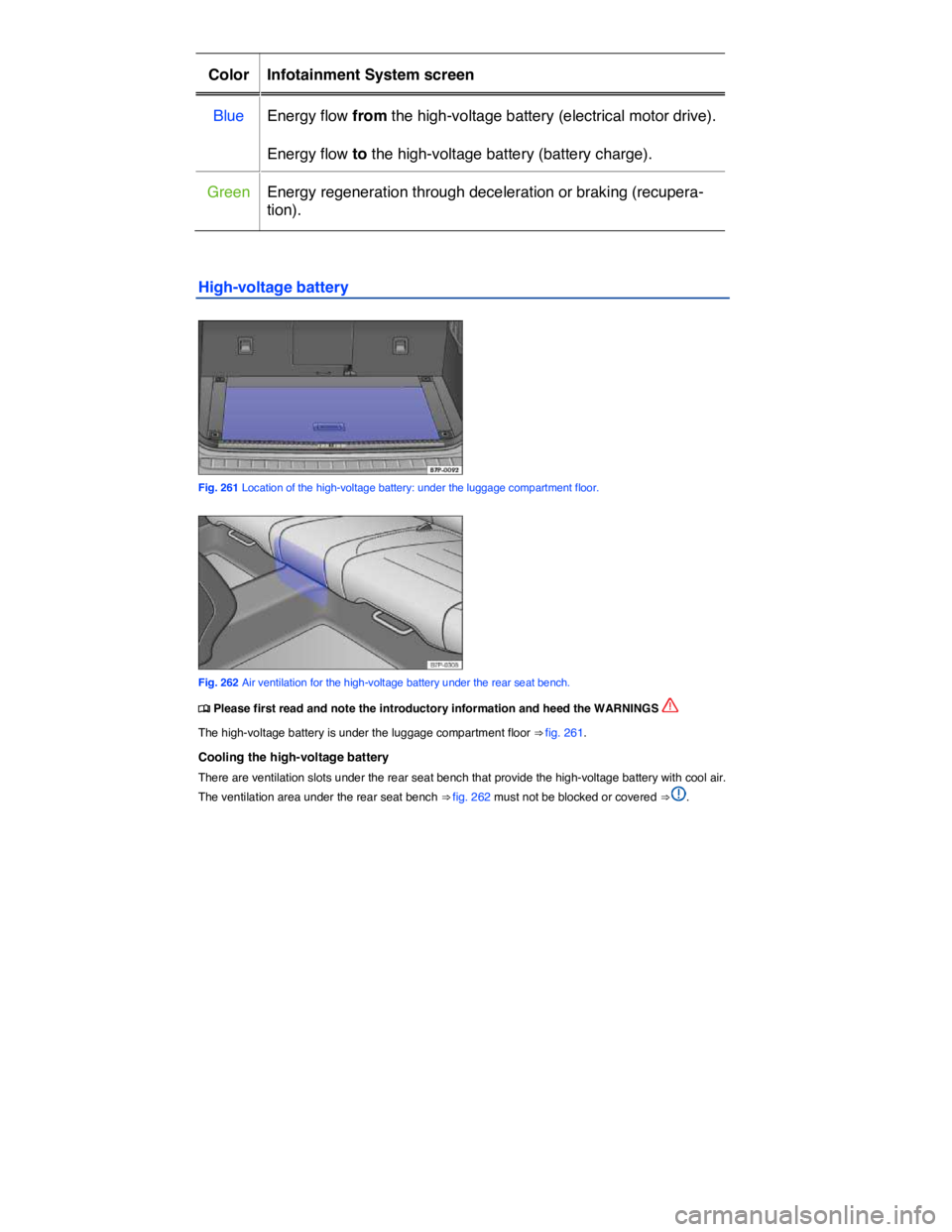
High-voltage battery
Fig. 261 Location of the high-voltage battery: under the luggage compartment floor.
Fig. 262 Air ventilation for the high-voltage battery under the rear seat bench.
Page 541 of 684

x Fold up the luggage compartment floor panel ⇒ fig. 308 (1) and hook it open or, if you have a reversible luggage compartment floor panel, take this out
x Take out the collapsible spare tire (2)- Unscrew the fastening screw (3) with washer counterclock-wise and take out the collapsible spare tire.
x Pull off the plug (4) in the spare tire well.
x Unscrew the tank filler neck cap ⇒ fig. 309 (5) counterclockwise and remove.
Refilling AdBlue
Only use Volkswagen-approved AdBlue or any Diesel Exhaust Fluid that expressly conforms to International Organization for Standardization specification ISO 22241-1. Using a DEF that does not meet the requirements of ISO 22241-1 can seriously damage your vehicle’s engine. Only use fluid in original, unopened packaging.
x Read and heed the information provided by the AdBlue refill manufacturer ⇒ .
x Note the expiration date.
x Unscrew the cap of the refill container.
x Vertically insert the neck of the refill container (6) into the tank filler neck and turn clockwise to hand-tighten.
x Press the refill container down into the tank filler neck and hold it there.
x Add at least 1.5 gallons (5.7 liters) of AdBlue which is 3 refill bottles. Adding a smaller amount is not sufficient.
x Wait until the contents of the refill container has flowed into the AdBlue tank. Do not squeeze or damage the refill container!
x Unscrew the refill container counterclockwise and lift it out carefully ⇒ .
x AdBlue stops flowing from the refill bottle when the AdBlue tank is completely full.
Closing the fuel filler neck
x Screw in the fuel filler neck cap (5) clockwise until the cap locks into place.
x Put the plug ⇒ fig. 308 (4) back in the spare wheel recess and make certain it is properly placed and secure.
x Put the collapsible spare tire (2) back in the spare wheel recess and secure it with the fastening screw (3) and washer.
x Unhook the luggage compartment floor panel (1) and fold down or, if you have a reversible lug-
gage compartment floor panel, put this back in ⇒ Luggage compartment.
Things to do before driving again
x After refilling, switch on only the ignition.
x Leave the ignition switched on for at least 30 seconds so that system can detect the refill.
x Do not start the engine for 30 seconds!
WARNING
Store AdBlue only in its closed original container and in a safe place.
x To reduce the risk of poisoning, never keep AdBlue in empty food or beverage containers that might mislead someone into drinking from them.
x Always store AdBlue outside the reach of children.
Page 546 of 684

d Check the vehicle tool kit. Add tools and other gear based on the special requirements of the trip
you will be taking ⇒ Useful off-road driving equipment.
d Stow luggage as low and flat as possible in the vehicle. Safely secure all loose objects.
Before driving off-road the first time
Before you drive your vehicle off-road, we urge you to take an appropriate off-road driving course. Taking a course is especially important if you have little or no experience driving off-road. Even more experienced off-roaders can benefit from an off-road driving course.
A good course can show you how to handle the vehicle in a wide range of off-road situations and how to more safely deal with difficult terrain Driving off-road demands a different attitude and very different skills compared with highway driving. Your safety and that of your passengers will depend on your
knowledge, skill, and caution as a driver ⇒ .
WARNING
Disregarding the safety-related checklist may lead to accidents and serious personal injuries.
x Always review and follow the checklist above. Follow commonly accepted safety practices and use common sense.
x All occupants must sit properly and wear safety belts whenever the vehicle is moving.
General rules and good driving practices
Page 564 of 684

DANGER
The vehicle's high-voltage electrical system and high-voltage battery are dangerous and can cause burns, other serious personal injuries, electrocution, and death.
x Always assume that high-voltage battery and parts of the high-voltage system are fully charged and energized.
x Never touch or let jewelry or other metal objects contact high-voltage cables or the high-voltage battery and battery poles, especially if the cables, battery, and battery poles have been damaged in any way.
x Never do any work yourself on the high-voltage electrical system, the orange-colored high-voltage wiring, or on the high-voltage battery.
x Never open, service, repair, or disconnect any part of the hybrid electrical system.
x Never damage the orange-colored high-voltage cables. Never remove them and never disconnect them from the high-voltage electrical system.
x Never open or remove the orange-colored cover on the high-voltage battery.
x Always have work on the hybrid electrical system and systems that could be indirectly affected by it done by qualified, trained technicians who have the know-how, experience, documentation, and tools to do the work safely.
x All work on the high-voltage electrical system and the high-voltage battery must be done in compliance with Volkswagen standards and guidelines.
x Vehicle keys must be safely stored a safe distance from vehicle so that the ignition cannot be switched on and energize the electrical system.
x Gases vented or released from the high-voltage battery vapors are potentially poisonous and can burn.
x Physical damage to the vehicle or the high-voltage battery can result in immediate or de-layed release of poisonous gases that can also cause a fire.
x Always avoid contact with leaking fluids and gases escaping from the battery, particularly one that has been damaged.
x Always tell emergency responders that the vehicle has a high-voltage battery.
WARNING
Unintended vehicle movement during maintenance work can cause serious personal injuries.
x Never work under the vehicle unless you have safely secured the vehicle from moving. If you must work under the vehicle with the wheels on the ground, always make sure that the vehicle is on level ground, that all 4 wheels are chocked to keep them from moving, and that the key is not in the ignition.
x If you must work under a vehicle raised on a floor jack, always make sure that the vehicle is safely supported on safety stands intended for that purpose that are strong enough to support the weight of the vehicle. The jack supplied with the vehicle is not strong enough for this purpose and can collapse causing serious personal injury.
Page 569 of 684

x Open the driver door and pull the inside hood release lever in the direction of the arrow ⇒ fig. 314.
x The engine hood is released from its latch by a spring ⇒ .
x Push the outside hood release lever ⇒ fig. 315 (arrow) and lift the hood all the way up. A gas-filled strut will hold the hood up.
Closing the engine hood
x Pull the hood down to overcome the resistance of the gas-pressure strut ⇒ .
x Let the engine hood drop into the hood latch – do not press it afterwards!
If the hood does not close completely, open it again and close it properly.
When the hood is properly closed, you can see that it fits flush with the other body parts. The indicator light in the instrument cluster will go out
WARNING
If the hood is not closed properly, it could fly up and block your view while you are driving. This can lead to a crash and serious personal injuries.
x After closing the engine hood, check that the hood release lever is properly latched into the hood latch. The engine hood must be flush with the surrounding auto body parts.
x If you ever notice that the hood latch is not properly secured when the vehicle is moving, stop at once and close it.
x Never let anyone get in the way of the hood when closing it.
NOTICE
x Make sure the windshield wipers are switched off and the windshield wiper arms are resting on the windshield before you open the hood. Otherwise, the windshield wipers and the hood may be damaged.
x Always put the windshield wiper arms down against the windshield before driving the vehi-cle.
NOTICE
Before opening or closing the engine hood, make sure there is enough room to do so, for example when the vehicle is in a garage.
Page 587 of 684

x Interior care and cleaning
x Parts, accessories, repairs and modifications
WARNING
Working on the batteries or the electrical system in your vehicle can cause serious acid burns, fires, explosions, or electrical shocks. Always read and heed the following WARNINGS and safety precautions before working on the batteries or the electrical system.
x Before working on the electrical system, always switch off the ignition and all electrical consumers and disconnect the negative cable (–) from the standard 12 Volt vehicle battery.
x When you change a light bulb, always switch off the light first.
x Always keep children away from battery acid and vehicle batteries in general.
x Always wear eye protection. Never let battery acid or lead particles come into contact with your eyes, skin, or clothing.
x Sulfuric battery acid is very corrosive. It can burn unprotected skin and cause blindness. Always wear protective gloves and eye protection. To reduce your risk of injury, never tilt the batteries, as this could spill acid through the vents and burn you.
x If you get battery acid in your eyes or on your skin, immediately rinse with cold water for several minutes and then get immediate medical attention. If you swallow any battery acid, get medical attention immediately.
x When disconnecting the batteries from the vehicle electrical system, always disconnect the negative cable (–) first and then the positive cable (+).
x Always switch off all electrical consumers before reconnecting 12 Volt vehicle batteries. Reconnect the plus cable (+) first and then the negative cable (–). Never reverse the polarity of the connections. This could cause a fire.
x A highly explosive mixture of gases is given off when the battery is being charged.
x Do not smoke and avoid fires, sparks, and open flames when working. Never create sparks or electrostatic charges when handling cables and electrical equipment. Never short circuit the battery terminals. High-energy sparks can cause serious personal injury.
x Never use or attempt to charge a damaged or frozen battery, or a battery that was frozen but has thawed. Charging a frozen or thawed battery could cause explosions and chemical burns! Replace damaged or frozen vehicle batteries immediately. A dead battery can freeze at temperatures around +32 °F (0 °C).
x If the battery has a vent line or tube, make sure that this it is properly connected to the battery.
x Always make sure that the vent line is securely attached to a vehicle battery that is located in the luggage compartment.
WARNING
California Proposition 65 Warning
x Battery posts, terminals, and related accessories contain lead and lead components, chemicals known to the State of California to cause cancer and reproductive harm. Wash your hands after handling.
NOTICE
x Do not expose the vehicle battery to direct sunlight for an extended period of time as ultra-violet rays may damage the battery housing.
x If the vehicle is left standing in the cold for a long time, protect the vehicle battery from freezing. A battery will be permanently damaged by freezing.
Page 615 of 684

unit. Some suspension changes can, for example, increase the force levels measured by the airbag sensors and send to the electronic control unit and make the airbag system deploy in crashes in which it would not deploy if the changes had not been made. Other kinds of changes may reduce the force levels measured by the sensors and prevent the airbag from deploying when it should.
Never install leather upholstery on a vehicle that originally had cloth upholstery. Never install cloth upholstery on a vehicle that originally had leather upholstery. The weight-sensing mat for the Ad-vanced Airbag system will not work properly if different upholstery is installed on the passenger seat than the upholstery originally installed on the vehicle when it was originally manufactured.
WARNING
Changing the vehicle's suspension including use of unapproved tire-rim combinations can change airbag performance and increase the risk of serious personal injury in a crash.
x Never install suspension components that do not have the same performance characteris-tics as the components originally installed on your vehicle.
x Never use tire-rim combinations that have not been approved by Volkswagen.
WARNING
Leaving the optional safety belt extender attached to the safety belt buckle on the front pas-senger seat when the safety belt is not being used will prevent the Advanced Airbag System from working properly and can increase the risk of serious personal injury in a collision.
x Leaving the extender attached to the safety belt buckle when the front seat is occupied and the safety belt is not being used will signal to the airbag control unit that the front pas-senger seat is occupied and that the safety belt is being used. The electronic control unit for the airbag system will then receive incorrect information that will
– cause the safety belt pretensioner to deploy unnecessarily in collisions and
– cause the front passenger airbag to deploy later in collisions in which the front airbag would otherwise be triggered earlier to help protect an unrestrained front seat passenger.
x Always remove the safety belt extender when it is not needed and stow it safely.
x Never use the safety belt extender to secure a child restraint.
WARNING
Items stored between the safety belt buckle and the center console can cause safety belt buckle to send the wrong information to the airbag control unit and prevent the Advanced Airbag System from working properly.
x Always make sure that nothing can interfere with the safety belt buckles and that they are not obstructed.
Page 658 of 684

2. Switch off the engine, shift the transmission into Park (P) ⇒ Shifting. Then apply the parking brake
to help prevent the vehicle from moving ⇒ Braking and parking.
3. If towing a trailer: Unhitch the trailer from the vehicle and park the trailer properly.
4. Straighten the steering wheel so that the front wheels point straight forward.
5. Block the diagonally opposite wheel with chocks or other suitable things.
6. Loosen the wheel bolts of the wheel to be changed ⇒ Wheel bolts.
7. Remove the scissors jack and tools from the vehicle.
8. Inset the extension ⇒ fig. 340 (A) into the scissors jack (B) Attach the crank (C) to the extension (A).
9. Find the jack lift point ⇒ fig. 340 on the vehicle frame that is closest to the wheel to be changed.
10. Crank up the jack so that it still just fits underneath the lift point.
11. Position the jack so that its base is directly underneath the lift point ⇒ fig. 341, making sure that the entire base of the jack rests securely on the ground.
12. Align the jack and wind up the jack claw at the same time, until the claw cradles the rib underneath
the vehicle ⇒ fig. 341 A or B.
13. Continue cranking up the jack until the wheel is just a little off the ground.
WARNING
Using the wrong jack to raise a vehicle with side steps, extended door sills, additional deco-rative trim or other enhancements in the area of the lower side sills can cause the vehicle to fall off the jack and result in serious personal injury.
x Never use the standard jack supplied with unmodified vehicles to raise the vehicle. The side step can interfere with the jack when raising the vehicle.
x Always use the scissor vehicle jack supplied with the authorized side step package when the vehicle must be jacked up, for example, to change a tire.