belt VOLKSWAGEN TOUAREG 2017 Owner´s Manual
[x] Cancel search | Manufacturer: VOLKSWAGEN, Model Year: 2017, Model line: TOUAREG, Model: VOLKSWAGEN TOUAREG 2017Pages: 684, PDF Size: 9.34 MB
Page 180 of 684
WARNING
Tires must have the required clearance. Tires that do not have enough clearance can rub against parts of the vehicle body, suspension, and brake system, causing brake system fail-ure, tread delamination, and sudden blow outs.
x Always make sure that new tires are not larger than the tires approved for your vehicle and that the new tires do not rub against parts of the vehicle.
NOTICE
x When switching to different tires, make certain the valves and sensors are not damaged.
x Never drive without valve stem caps. The valves and sensors could be damaged.
x If the sensor on the Tire Pressure Monitoring System (TPMS) must be replaced, the valve must be replaced at the same time.
Always dispose of old tires in accordance with legal requirements.
TPMS wheel sensors are classified as Perchlorate Material – Special handling may apply. Obey all legal requirements regarding handling and disposal of these components – See http://www.dtsc.ca.gov/hazardouswaste/perchlorate. Obey all applicable legal requirements regarding handling and disposal of the vehicle or parts of its restraint system, including airbag modules and safety belts with pretensioners. Authorized Volkswagen dealers and authorized Volkswagen Service Facilities are familiar with the requirements, and we recommend that you have them perform this service for you.
If the replacement wheel is different from the tires that you have mounted on your vehicle (for example winter tires or wider, low-profile tires, , or a compact spare), then use the replacement wheel for a short time only, and drive cautiously.
x Replace it with a tire matching the others on your vehicle as soon as possible.
Although tire size specifications can be the same, the actual dimensions may differ from those nominal values for different tire makes, or the tire contours may be significantly different.
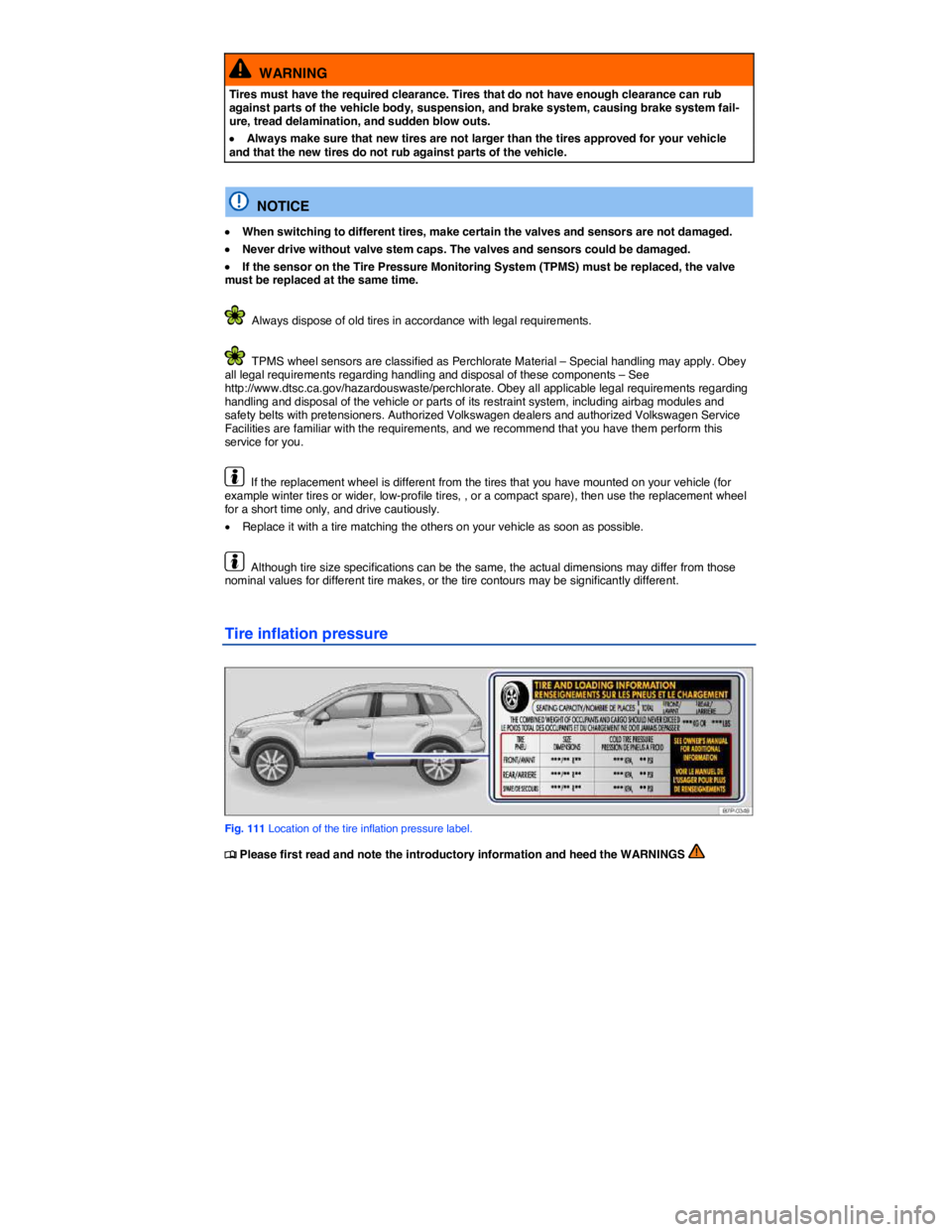
Tire inflation pressure
Fig. 111 Location of the tire inflation pressure label.
Page 190 of 684

Tire labeling (exam-
ple)
Meaning
R Tire belt design letter code for radial.
18 Rim diameter (in inches)
109 H Load rating code and speed rating code ⇒ Tire
labeling.
XL Indicates “reinforced” tire (heavy-duty)
M+S or M/S Indicates Mud and Snow capability (also M/S)
RADIAL TUBELESS Tubeless radial tire.
E4 … Labeling according to international regulations
(E) including number of the approving country.
The multi-digit approval number is listed next.
DOT BT RA TY5 1709 Tire identification number (TIN3 - In some cases
the manufacturing date is only on one side of the
tire:
DOT The tire complies with the requirements of
the United States Department of Trans-
portation, responsible for issuing safety
standards.
BT Identification letter of the manufacturing
site.
RA Manufacturer information regarding tire
dimensions.
TY5 Tire characteristics provided by the
manufacturer.
1709 Manufacturing date: 17th week in 2009.
3 TIN represents the serial number of the tire.
Page 191 of 684

Tire labeling (exam-
ple)
Meaning
TWI Marks the position of the treadwear indicator
Made in Germany Country of manufacture.
MAX LOAD 615 KG
(1356 LBS)
United States maximum load rating per wheel.
MAX INFLATION
350 KPA (51 PSI)
United States maximum permissible inflation
pressure.
ROTATION Rotation direction (unidirectional tires)
SIDEWALL 1 PLY
RAYON
Tire ply composition and materials used:
1 layer of rayon.
TREAD 4 PLIES
1 RAYON + 2 STEEL +
1 NYLON
Tire tread composition and materials used:
In this example there are 4 layers under the
tread: 1 layer of rayon, 2 layers of steel belt and
1 layer of nylon.
Consumer information regarding comparison to specified base tires
(standardized test procedure):
TREADWEAR 220 Relative service life expectancy of the tire refer-
enced to a US-specific standard test.
TRACTION A Traction rating under wet conditions (AA, A, B or
C).
TEMPERATURE A Temperature stability of the tire at increased test
bench speeds (A, B or C).
Additional numbers found on the tire could either be tire manufactur-
er internal labels or country-specific labels (such as for Brazil and
China).
Unidirectional tires
Unidirectional tires are designed to rotate only in one direction. Unidirectional tires have arrows on the sidewalls that show the direction of rotation. Make sure you mount the tire so that it rotates in the
Page 399 of 684

WARNING
Never stop the engine before the vehicle has come to a complete stop. You can lose control of the vehicle, crash, and be seriously injured.
x The airbags and safety belt pretensioners will not work when the ignition is switched off.
x The brake booster does not work when the engine is not running. More brake pedal pres-sure will be needed to stop the vehicle.
x The power steering system does not work when the engine is not running, and you will need more force to steer the vehicle.
x When the key is removed from the ignition switch, the steering will lock and you will not be able to steer the vehicle.
NOTICE
If the vehicle has been driven hard for a long time, the engine could overheat when it is stopped. To reduce the risk of engine damage, let the engine idle in Neutral for about 2 minutes before you switch off the ignition.
If the ignition is switched on or the engine is running and the driver door is opened, a chime sounds. The chime is also a reminder to switch off the engine and turn off the ignition before leaving and locking the vehicle from the outside.
The vehicle key can be removed from the ignition only when the transmission is in Park (P).
After the engine has been switched off, the radiator fan in the engine compartment may keep running for several minutes, or may start running after the vehicle has been parked for a while, even if the ignition is switched off and the vehicle key has been removed. The radiator fan shuts off automati-cally when the engine has cooled down enough.
Electronic immobilizer
Page 437 of 684

Lights
up
Warnings in the in-
strument cluster dis-
play
Proper response
Electric driving is cur-
rently not possible.
Never leave the vehicle parked in the
ready position. Remove the remote
control vehicle key out of the ignition
or for vehicle with Keyless Access
press the starter button.
Request to start the
engine.
Start the engine with the ignition
switch or starter button.
Warning when leaving the vehicle
Switch off the ignition before leaving the vehicle unattended ⇒ Starting and stopping the engine. In certain situations, a message Ignition on appears in the instrument cluster display as you are leaving the vehicle. This message warns you that the vehicle's electric drive is still enabled and that the combustion engine might start automatically.
Always switch the engine off, remove the key, and take it with you when leaving the vehicle ⇒ . As a reminder to do so, the combustion engine may start automatically under the following conditions:
x The ignition is switched ON.
x AND: Electrical drive is functional (Ready).
x AND: The transmission is in Park (P) or Neutral (N).
x AND: The driver safety belt is not fastened. OR The driver door is open.
The message in the instrument cluster display also reminds you to switch the ignition off. In addition, always be sure to apply the parking brake, remove the key, and take it with you when leaving the vehicle.
WARNING
A parked vehicle that is not properly parked can roll away and cause accidents or severe injuries. When leaving the vehicle, always move the selector lever into Park (P) and engage the electronic parking brake.
WARNING
Failure to heed warning lights and instrument cluster text messages can cause the vehicle to break down in traffic and result in a collision and serious personal injury.
x Never ignore warning lights or text WARNINGS.
x Always stop the vehicle as soon as it is safe to do so.
NOTICE
Failure to heed warning lights or text WARNINGS can result in vehicle damage.
Page 443 of 684

This depends on vehicle conditions of the hybrid drive system is normal and is designed to save fuel. The power steering and the braking assistance systems remain active. In certain situations it may be necessary for the system to start the combustion engine even when the vehicle is not moving. With prolonged driving in traffic jams, the combustion engine will be switched on and off to charge the high-voltage battery for the following start-stop phase.
Sailing
If the accelerator is not depressed and the lever is in Drive (D), the internal combustion engine is switched off even at higher speeds. The vehicle then decelerates slower than conventional vehicles.
This feature can be used to help reduce fuel consumption when you keep traffic conditions in mind and can anticipate the vehicles power requirements. Even in this case, the rev counter in the instru-ment cluster displays zero engine speed (0 engine revolutions). The instrument cluster powermeter shows zero.
Brake energy regeneration (Recuperation/charge)
When the vehicle brakes, the electrical energy is generated by the electric motor, which works as an alternator and charges the high-voltage battery. The same thing occurs while the vehicle is coasting to a stop or driving downhill.
Energy regeneration is shown in the instrument cluster display or on the Infotainment System screen. The combustion engine may be switched off automatically in this situation. The instrument cluster powermeter registers below zero.
When the high voltage battery is fully charged, there is no brake energy recuperation, and therefore no engine braking. Recuperation and engine braking are also automatically reduced if the vehicle detects that the road conditions do not permit sufficient contact between the wheels and the road surface.
Automatic starting - combustion engine
The combustion engine is started automatically in a number of situations.
x Engine temperature is too low.
x Catalytic converter temperature is too low.
x High-voltage battery being charged at high rate when decelerating. The high-voltage battery can-not absorb any more energy and for this reason the electric motor cannot brake the vehicle. The combustion engine comes on to help slow the vehicle down (engine brake).
x Engine hood is open.
x Leaving the vehicle when the electric motor is still “live”. The status of the electric motor is not always obvious, particularly when the combustion engine is not running. The combustion engine will therefore start if the driver's safety belt is unlatched or the driver's door is opened when the transmis-
sion is in Park (P) or Neutral (N) ⇒ Warning when leaving the vehicle.
Page 546 of 684

d Check the vehicle tool kit. Add tools and other gear based on the special requirements of the trip
you will be taking ⇒ Useful off-road driving equipment.
d Stow luggage as low and flat as possible in the vehicle. Safely secure all loose objects.
Before driving off-road the first time
Before you drive your vehicle off-road, we urge you to take an appropriate off-road driving course. Taking a course is especially important if you have little or no experience driving off-road. Even more experienced off-roaders can benefit from an off-road driving course.
A good course can show you how to handle the vehicle in a wide range of off-road situations and how to more safely deal with difficult terrain Driving off-road demands a different attitude and very different skills compared with highway driving. Your safety and that of your passengers will depend on your
knowledge, skill, and caution as a driver ⇒ .
WARNING
Disregarding the safety-related checklist may lead to accidents and serious personal injuries.
x Always review and follow the checklist above. Follow commonly accepted safety practices and use common sense.
x All occupants must sit properly and wear safety belts whenever the vehicle is moving.
General rules and good driving practices
Page 566 of 684

WARNING
High voltage systems in the engine compartment can cause electrical shocks or even elec-trocution, severe burns, other serious injuries, and even death!
x Never short-circuit the electrical system. Be especially careful when using jumper cables. The vehicle's battery could explode!
x To reduce the risk of electrical shock and personal injury while the engine is running or being started:
– Never touch ignition cables. Never touch other components of the high-voltage elec-tronic ignition system.
– Never touch the wiring of the HID – High Intensity Discharge (Xenon) headlights.
x Read and heed the important information and warnings on cleaning the engine compart-
ment ⇒ Cleaning the engine compartment.
WARNING
Moving parts in the engine compartment can cause serious personal injury on contact.
x Never reach into the area around or touch the radiator fan. Contact with the blades can cause serious personal injury. Always remember that the radiator fan is temperature-controlled and can come on suddenly even when the engine has been switched off for a while and the key has been removed from the ignition.
x If you have to perform a check or repair when the engine is running, there are more risks from the rotating parts, such as the drive belts, alternator, radiator fan, etc., and from the high-voltage ignition system. Always use extreme care.
– Always make sure that jewelry, loose clothing and long hair do not get caught in rotat-ing engine parts. Before starting any work remove your jewelry, take off your necktie, tie back and cover your hair, and do not wear clothing that can hang down and get caught in moving engine parts.
– Always use extreme caution if the accelerator pedal has to be depressed to perform a check. The vehicle will start to move even if the parking brake is on.
x Never leave any objects in the engine compartment, for example cleaning rags and tools. Objects left behind can cause malfunctions, engine damage, and even fires.
WARNING
Operating fluids and some materials in the engine compartment can catch fire easily, causing burns and other serious personal injuries!
x Do not smoke.
x Never work next to open flames or sparks.
x Never pour or spill operating fluids or other flammable liquids on the engine. These fluids can ignite on hot engine parts and cause injuries.
x If work on the fuel system or the electrical system is necessary:
– Always disconnect the 12 Volt vehicle battery. Make sure the vehicle is unlocked when you disconnect the battery, or the alarm will go off. Never touch the electrical wiring of the ignition system.
– Never work near heaters, water heaters, or other open flames.
x Always have a functional, approved fire extinguisher nearby.
Page 609 of 684
NOTICE
x Do not clean leatherette with solvents, floor wax, shoe polish, stain remover, or similar products.
x These can cause the material to become brittle and break. Sharp-edged objects and items on clothing and belts (such as belt clips, mobile phone cases, zippers, rivets, and rhinestones) can damage upholstery material and fabric trim.
x If the vehicle is left in the sun for a long time, cover the upholstery to protect the leatherette from direct sunlight and to help prevent fading or discoloration.
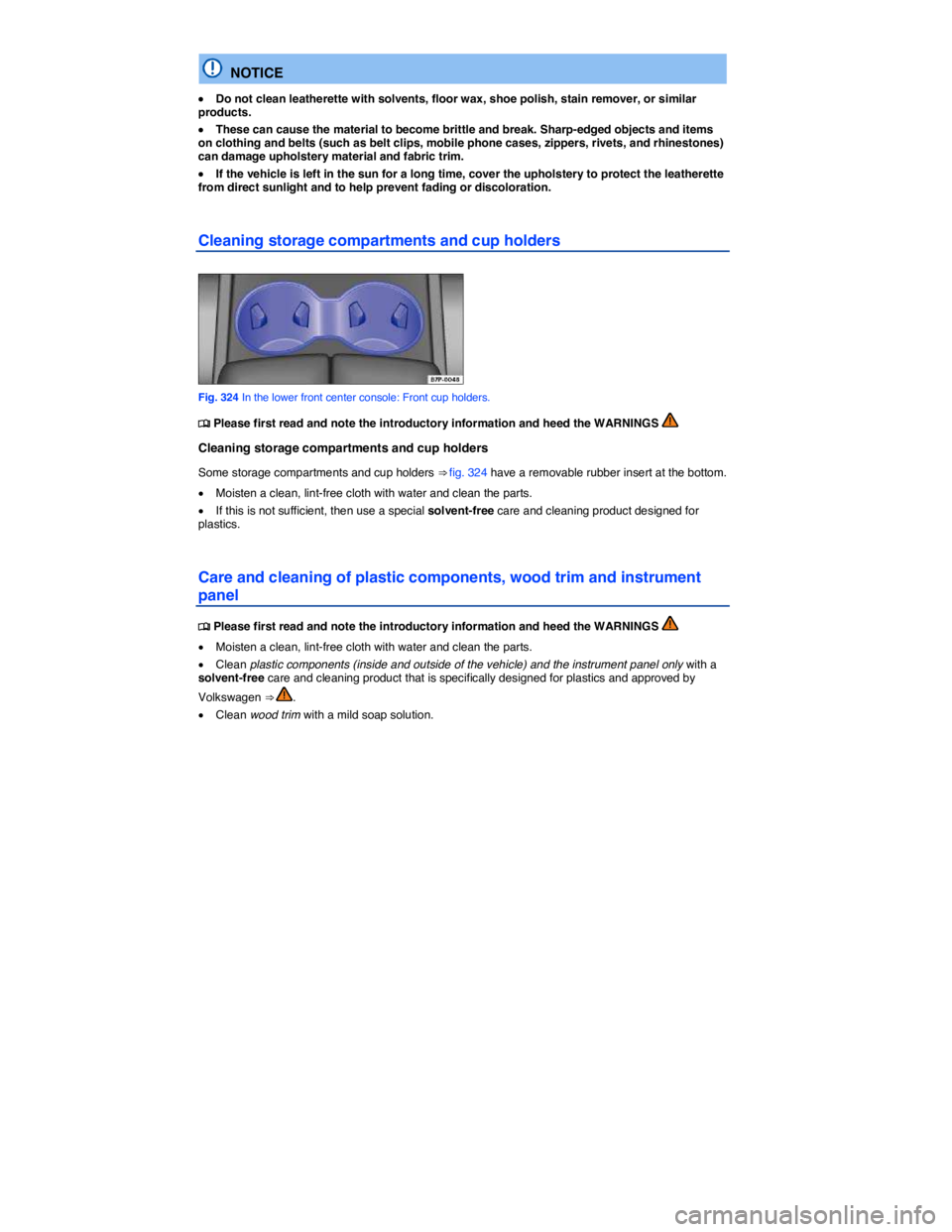
Cleaning storage compartments and cup holders
Fig. 324 In the lower front center console: Front cup holders.
Page 610 of 684

WARNING
Using solvents or other improper cleaning products on surfaces where airbags are located can change the way airbags deploy in a crash.
x Products containing solvents will change the properties of the plastics and may cause plastic parts to break and fly around when the airbag deploys in a crash, causing injury.
x Never use solvents or cleaners on the steering wheel horn pad or on the instrument panel because they can damage the airbag cover or change the stiffness or strength of the material so that the airbag cannot deploy and protect properly.
x When cleaning the horn pad and instrument panel, use only a soft, dry cloth or a cloth moistened with plain water.
Cleaning the safety belts