light VOLKSWAGEN TOUAREG 2017 Owner´s Manual
[x] Cancel search | Manufacturer: VOLKSWAGEN, Model Year: 2017, Model line: TOUAREG, Model: VOLKSWAGEN TOUAREG 2017Pages: 684, PDF Size: 9.34 MB
Page 423 of 684

mance, increases stopping distances and can even cause total brake failure. Your safety and the
safety of others depends on brakes that are working properly at all times ⇒ .
Brake fluid specifications
Volkswagen has developed a special brake fluid that is optimized for the brake system in your Volkswagen. Volkswagen recommends that you expressly use brake fluid that conforms to quality standard VW Standard 501 14 for optimum performance of the brake system. Check the information on the container for the brake fluid you want to use to make sure it meets the requirements for your vehicle.
Brake fluid that complies with VW Standard 501 14 can be purchased from your authorized Volkswagen dealer or authorized Volkswagen Service Facility.
If this special brake fluid is not available you may – under these circumstances – use another high-quality brake fluid that complies with U.S. Federal Motor Vehicle Safety Standard (FMVSS) 116 DOT 4
⇒ .
Please note, however, that not all brake fluids that comply with U.S. Federal Motor Vehicle Safety Standard FMVSS 116 DOT 4 have the same chemical composition. Some of these brake fluids can contain chemicals that could, over time, degrade or damage internal parts of the vehicle’s brake sys-tem.
Volkswagen therefore recommends that you use brake fluid that expressly complies with VW Stand-ard 501 14 for optimum brake system performance over the long term.
Brake fluid level
The fluid level in the transparent brake fluid reservoir must always be between the MIN and MAX
marking ⇒ .
On some vehicles, engine components block the view of the brake fluid reservoir and make it impossi-ble to see the brake fluid level. If you cannot clearly see the brake fluid level in the brake fluid reser-voir, please see an authorized Volkswagen dealer or authorized Volkswagen Service Facility.
The brake fluid level drops slightly when the vehicle is being used as the brake pads wear and the brakes are automatically adjusted.
Changing brake fluid
Brake fluid must be changed according to the service schedule in your ⇒ Booklet Warranty and
Maintenance. Have the brake fluid checked by an authorized Volkswagen dealer or an authorized Volkswagen Service Facility. Refill only with new brake fluid that meets the standards listed above.
WARNING
Brake failure and reduced brake performance can be caused by not having enough brake fluid in the reservoir or by old or incorrect brake fluid.
x Check the brake system and brake fluid level regularly.
x Always change the brake fluid according to the service schedule in your
⇒ Booklet Warranty and Maintenance.
x Hard braking with old brake fluid may cause vapor lock. Vapor lock reduces braking per-formance, increases stopping distances and can even cause total brake failure.
x Always make sure that only the correct brake fluid is used. Only use brake fluid that ex-pressly conforms to VW Standard 501 14 or, if it is not available, only use a high-quality brake fluid that conforms to U.S. Standard FMVSS 116 DOT 4 requirements.
x Using another brake fluid, or one that is not of high quality, can impair the function of the brake system and reduce its effectiveness. If the container does not say that the brake fluid complies with VW Standard 501 14, or U.S. Standard FMVSS 116 DOT 4, do not use it.
x The brake fluid must be new.
Page 428 of 684

Adjust the tire pressure
The proper tire pressure helps reduce rolling resistance as well as fuel consumption.
When purchasing new tires, always make sure that the tires are optimized for lower rolling resistance.
Use low viscosity engine oil
Fully “synthetic,” low viscosity engine oils that expressly comply with Volkswagen oil quality standards reduce fuel consumption. Low viscosity engine oils reduce the frictional resistance on the engine and are distributed more evenly and quickly, particularly when cold-starting the engine. The effect is partic-ularly apparent in vehicles that frequently travel short distances.
Always ensure the right engine oil level is maintained and keep to the scheduled service intervals (engine oil changes).
Make sure the engine oil that you purchase expressly complies with Volkswagen oil quality standards and is the oil approved by Volkswagen for your vehicle.
Avoid unnecessary weight
The lighter the vehicle, the more economical and eco-friendly it will be. For example, an extra 220 lbs (100 kg) of weight increases fuel consumption by up to 1 pint per 60 miles (0.3 l/100 km).
Remove all unnecessary items and unnecessary dead weight from the vehicle.
Remove unnecessary aftermarket components
The more aerodynamic the vehicle, the less fuel it will consume. Aftermarket components such as bicycle racks reduce its aerodynamic performance.
Therefore, remove unnecessary structures and unused rack systems, particularly if planning to drive at higher speeds.
See additional tips on using your hybrid drive to help reduce fuel consumption.
Page 430 of 684
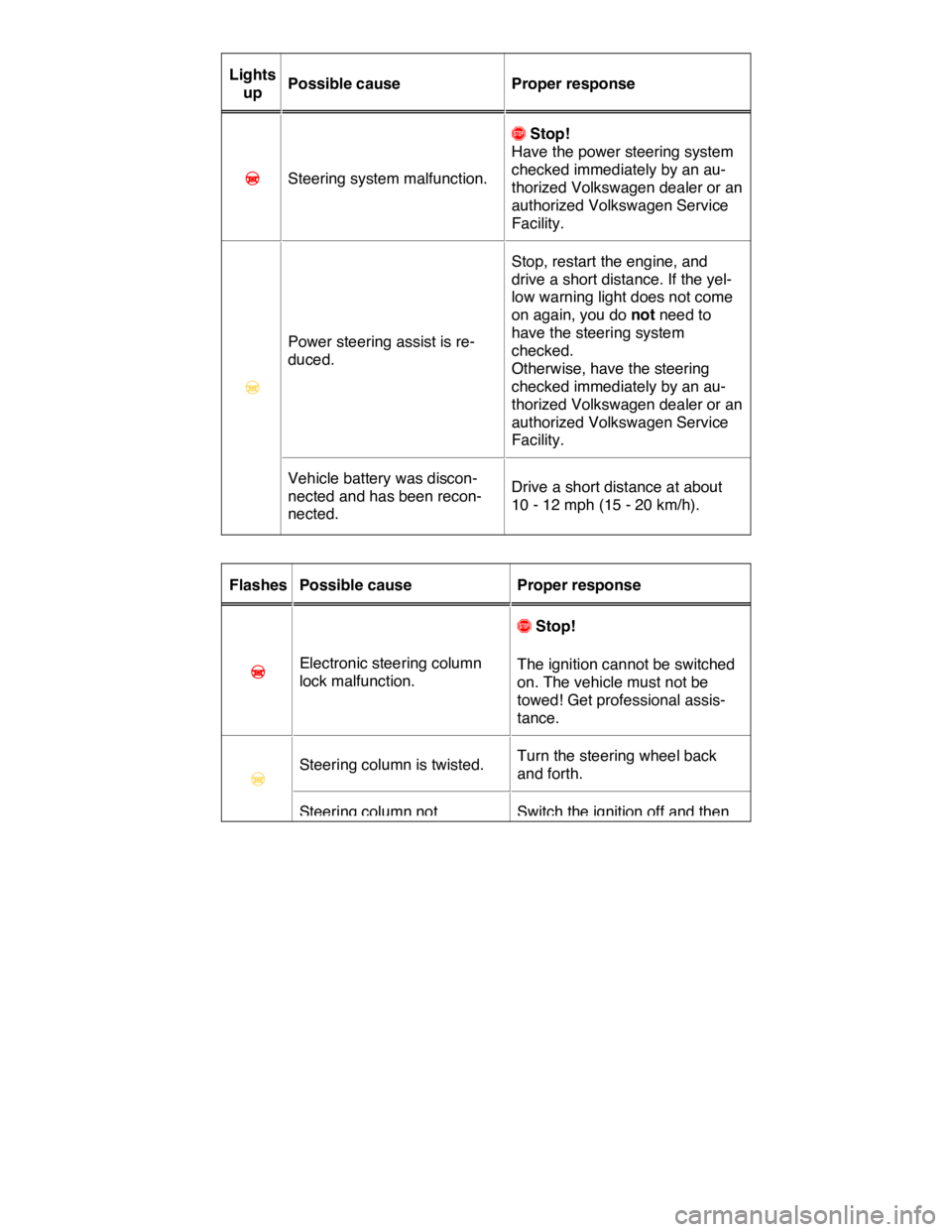
Lights
up Possible cause Proper response
D Steering system malfunction.
Page 431 of 684
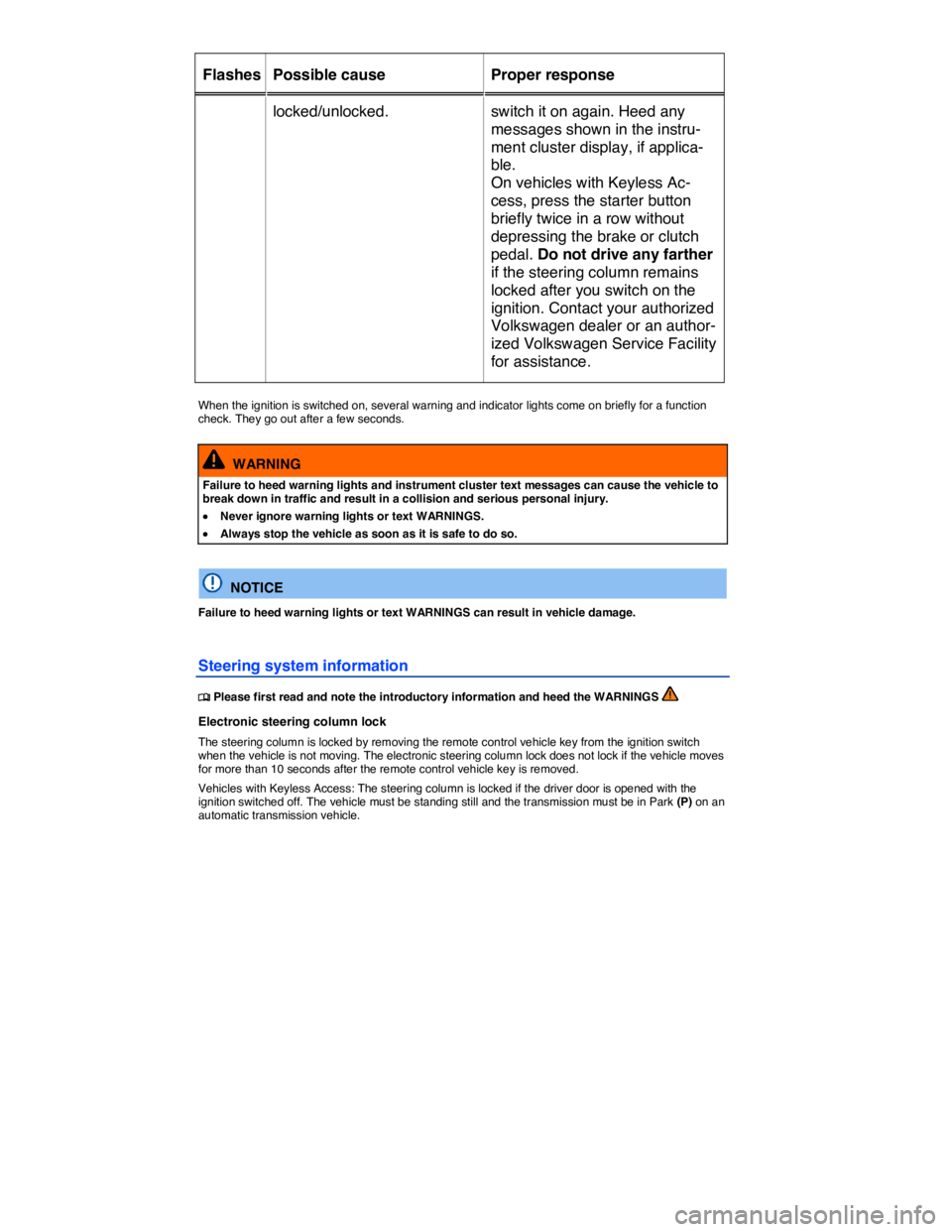
Flashes Possible cause Proper response
locked/unlocked. switch it on again. Heed any
messages shown in the instru-
ment cluster display, if applica-
ble.
On vehicles with Keyless Ac-
cess, press the starter button
briefly twice in a row without
depressing the brake or clutch
pedal. Do not drive any farther
if the steering column remains
locked after you switch on the
ignition. Contact your authorized
Volkswagen dealer or an author-
ized Volkswagen Service Facility
for assistance.
When the ignition is switched on, several warning and indicator lights come on briefly for a function check. They go out after a few seconds.
WARNING
Failure to heed warning lights and instrument cluster text messages can cause the vehicle to break down in traffic and result in a collision and serious personal injury.
x Never ignore warning lights or text WARNINGS.
x Always stop the vehicle as soon as it is safe to do so.
NOTICE
Failure to heed warning lights or text WARNINGS can result in vehicle damage.
Steering system information
Page 435 of 684
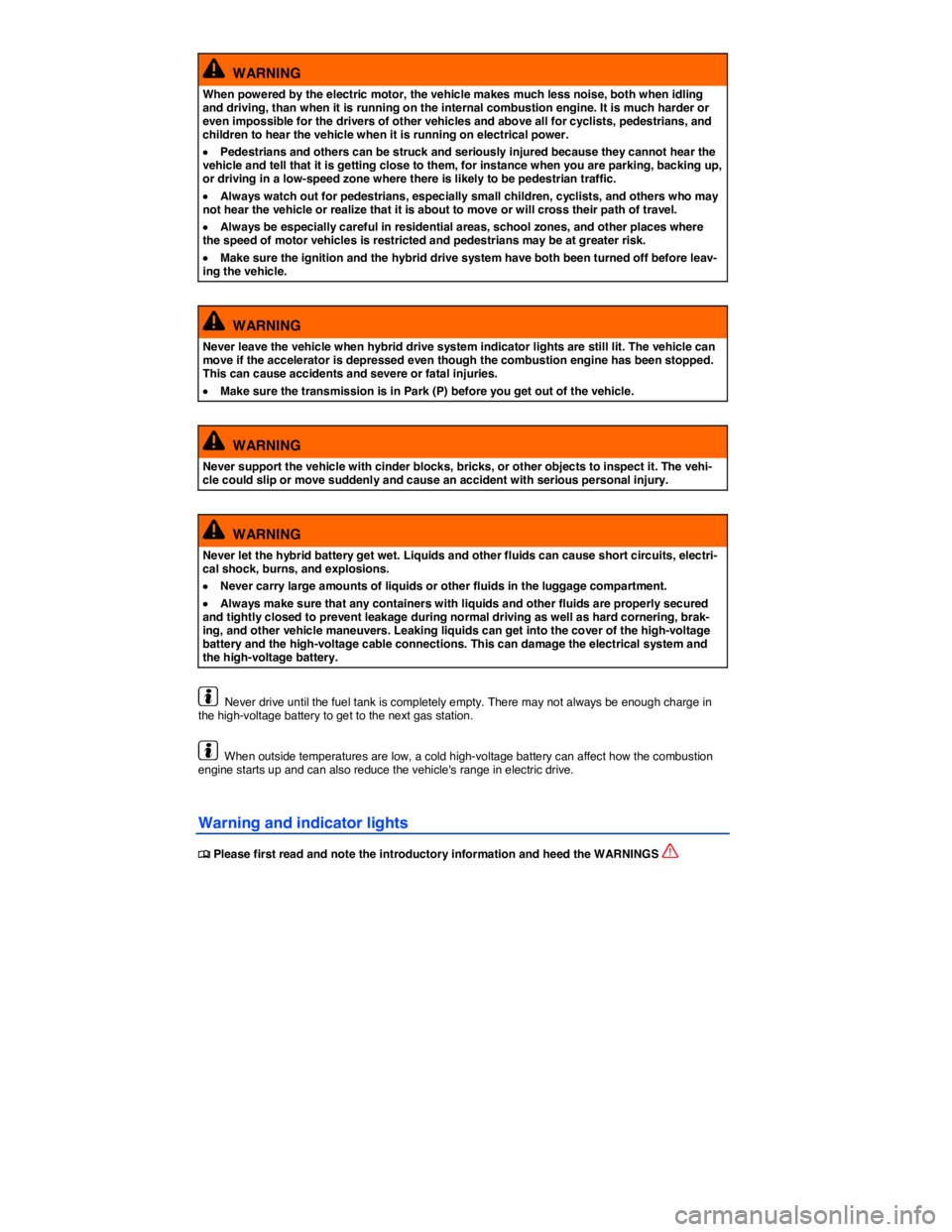
WARNING
When powered by the electric motor, the vehicle makes much less noise, both when idling and driving, than when it is running on the internal combustion engine. It is much harder or even impossible for the drivers of other vehicles and above all for cyclists, pedestrians, and children to hear the vehicle when it is running on electrical power.
x Pedestrians and others can be struck and seriously injured because they cannot hear the vehicle and tell that it is getting close to them, for instance when you are parking, backing up, or driving in a low-speed zone where there is likely to be pedestrian traffic.
x Always watch out for pedestrians, especially small children, cyclists, and others who may not hear the vehicle or realize that it is about to move or will cross their path of travel.
x Always be especially careful in residential areas, school zones, and other places where the speed of motor vehicles is restricted and pedestrians may be at greater risk.
x Make sure the ignition and the hybrid drive system have both been turned off before leav-ing the vehicle.
WARNING
Never leave the vehicle when hybrid drive system indicator lights are still lit. The vehicle can move if the accelerator is depressed even though the combustion engine has been stopped. This can cause accidents and severe or fatal injuries.
x Make sure the transmission is in Park (P) before you get out of the vehicle.
WARNING
Never support the vehicle with cinder blocks, bricks, or other objects to inspect it. The vehi-cle could slip or move suddenly and cause an accident with serious personal injury.
WARNING
Never let the hybrid battery get wet. Liquids and other fluids can cause short circuits, electri-cal shock, burns, and explosions.
x Never carry large amounts of liquids or other fluids in the luggage compartment.
x Always make sure that any containers with liquids and other fluids are properly secured and tightly closed to prevent leakage during normal driving as well as hard cornering, brak-ing, and other vehicle maneuvers. Leaking liquids can get into the cover of the high-voltage battery and the high-voltage cable connections. This can damage the electrical system and the high-voltage battery.
Never drive until the fuel tank is completely empty. There may not always be enough charge in the high-voltage battery to get to the next gas station.
When outside temperatures are low, a cold high-voltage battery can affect how the combustion engine starts up and can also reduce the vehicle's range in electric drive.
Warning and indicator lights
Page 436 of 684

Warning messages
When the ignition is switched on, several warning and indicator lights come on briefly for a function check. They go out after a few seconds.
Warning lights and text messages are shown in the instrument cluster display. Acoustic warnings may also sound at the same time.
Lights
up
Warnings in the in-
strument cluster dis-
play
Proper response
∋
Fault in the hybrid sys-
tem: stop the vehicle at
a safe location!
Stop the vehicle in a safe place as
soon as it is safe to do so.
∋
Fault in the hybrid sys-
tem: Workshop!
See an authorized Volkswagen dealer
or an authorized Volkswagen Service
Facility.
Hybrid battery is charg-
ing, leave engine run-
ning.
While this message appears, do not
stop the engine.
2%!$9 Electric drive is
READY.
Never leave the vehicle parked in the
ready position. Remove the remote
control vehicle key out of the ignition
or for vehicle with Keyless Access
press the starter button ⇒ page 395.
When leaving the vehicle always take
the remote control vehicle key with
you.
%
Page 437 of 684
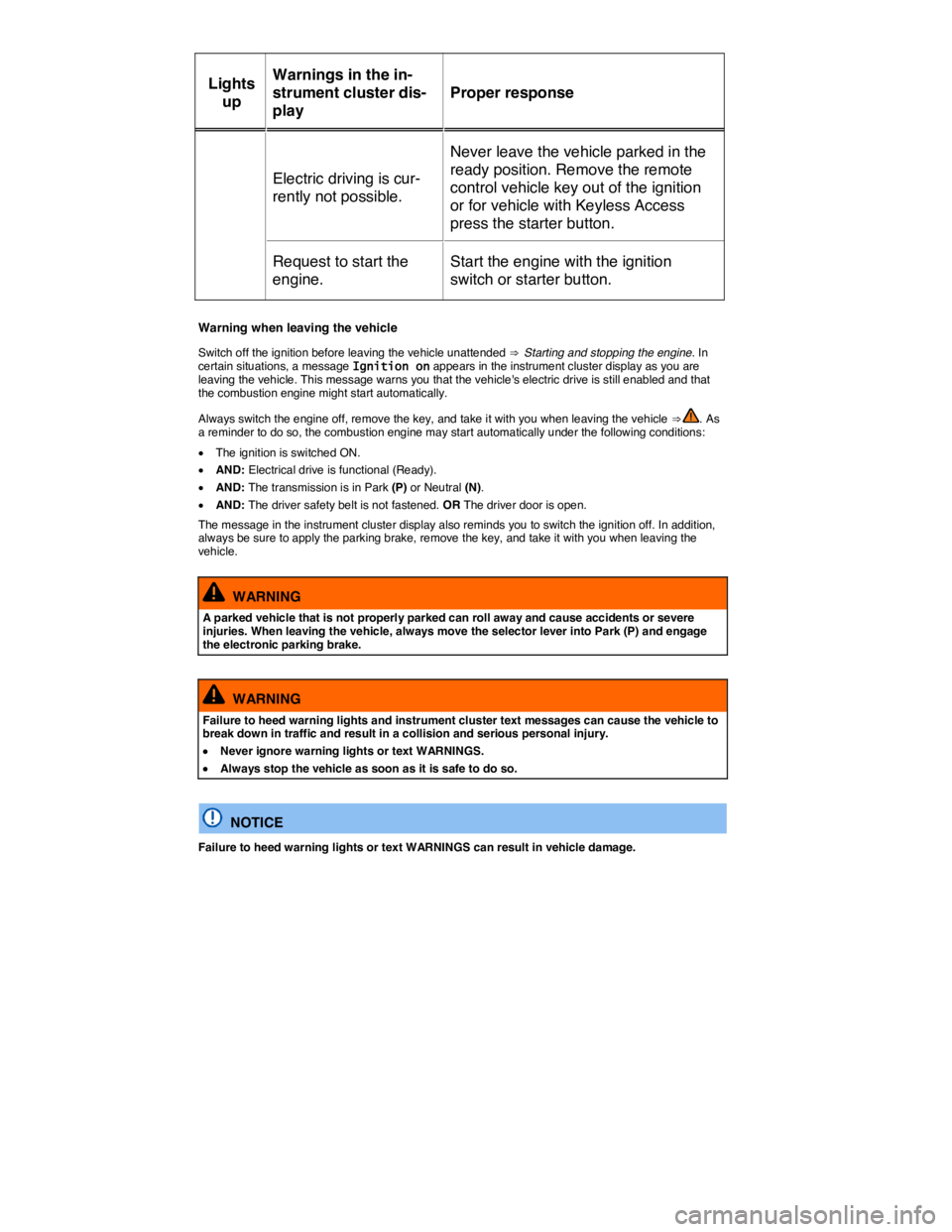
Lights
up
Warnings in the in-
strument cluster dis-
play
Proper response
Electric driving is cur-
rently not possible.
Never leave the vehicle parked in the
ready position. Remove the remote
control vehicle key out of the ignition
or for vehicle with Keyless Access
press the starter button.
Request to start the
engine.
Start the engine with the ignition
switch or starter button.
Warning when leaving the vehicle
Switch off the ignition before leaving the vehicle unattended ⇒ Starting and stopping the engine. In certain situations, a message Ignition on appears in the instrument cluster display as you are leaving the vehicle. This message warns you that the vehicle's electric drive is still enabled and that the combustion engine might start automatically.
Always switch the engine off, remove the key, and take it with you when leaving the vehicle ⇒ . As a reminder to do so, the combustion engine may start automatically under the following conditions:
x The ignition is switched ON.
x AND: Electrical drive is functional (Ready).
x AND: The transmission is in Park (P) or Neutral (N).
x AND: The driver safety belt is not fastened. OR The driver door is open.
The message in the instrument cluster display also reminds you to switch the ignition off. In addition, always be sure to apply the parking brake, remove the key, and take it with you when leaving the vehicle.
WARNING
A parked vehicle that is not properly parked can roll away and cause accidents or severe injuries. When leaving the vehicle, always move the selector lever into Park (P) and engage the electronic parking brake.
WARNING
Failure to heed warning lights and instrument cluster text messages can cause the vehicle to break down in traffic and result in a collision and serious personal injury.
x Never ignore warning lights or text WARNINGS.
x Always stop the vehicle as soon as it is safe to do so.
NOTICE
Failure to heed warning lights or text WARNINGS can result in vehicle damage.
Page 446 of 684
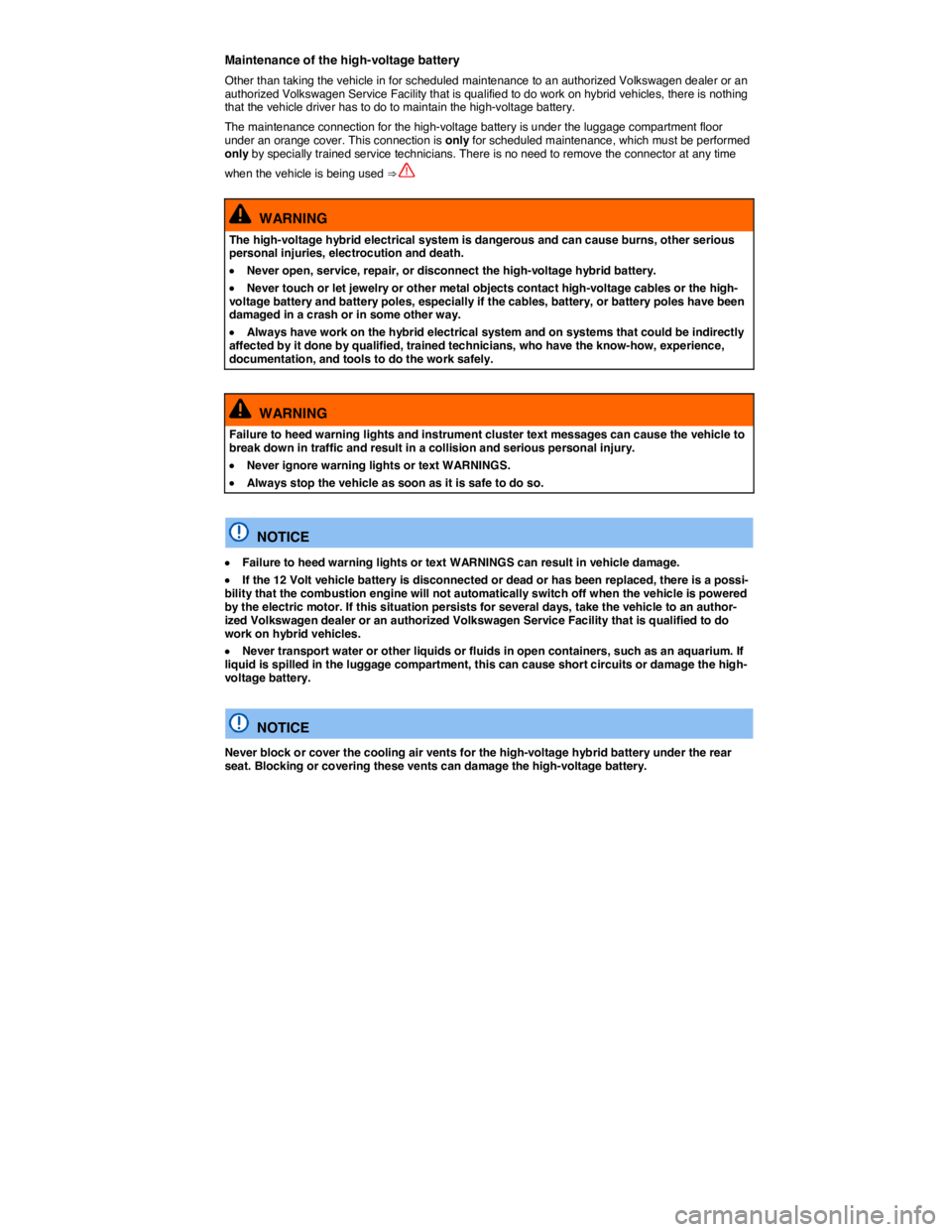
Maintenance of the high-voltage battery
Other than taking the vehicle in for scheduled maintenance to an authorized Volkswagen dealer or an authorized Volkswagen Service Facility that is qualified to do work on hybrid vehicles, there is nothing that the vehicle driver has to do to maintain the high-voltage battery.
The maintenance connection for the high-voltage battery is under the luggage compartment floor under an orange cover. This connection is only for scheduled maintenance, which must be performed only by specially trained service technicians. There is no need to remove the connector at any time
when the vehicle is being used ⇒
WARNING
The high-voltage hybrid electrical system is dangerous and can cause burns, other serious personal injuries, electrocution and death.
x Never open, service, repair, or disconnect the high-voltage hybrid battery.
x Never touch or let jewelry or other metal objects contact high-voltage cables or the high-voltage battery and battery poles, especially if the cables, battery, or battery poles have been damaged in a crash or in some other way.
x Always have work on the hybrid electrical system and on systems that could be indirectly affected by it done by qualified, trained technicians, who have the know-how, experience, documentation, and tools to do the work safely.
WARNING
Failure to heed warning lights and instrument cluster text messages can cause the vehicle to break down in traffic and result in a collision and serious personal injury.
x Never ignore warning lights or text WARNINGS.
x Always stop the vehicle as soon as it is safe to do so.
NOTICE
x Failure to heed warning lights or text WARNINGS can result in vehicle damage.
x If the 12 Volt vehicle battery is disconnected or dead or has been replaced, there is a possi-bility that the combustion engine will not automatically switch off when the vehicle is powered by the electric motor. If this situation persists for several days, take the vehicle to an author-ized Volkswagen dealer or an authorized Volkswagen Service Facility that is qualified to do work on hybrid vehicles.
x Never transport water or other liquids or fluids in open containers, such as an aquarium. If liquid is spilled in the luggage compartment, this can cause short circuits or damage the high-voltage battery.
NOTICE
Never block or cover the cooling air vents for the high-voltage hybrid battery under the rear seat. Blocking or covering these vents can damage the high-voltage battery.
Page 448 of 684
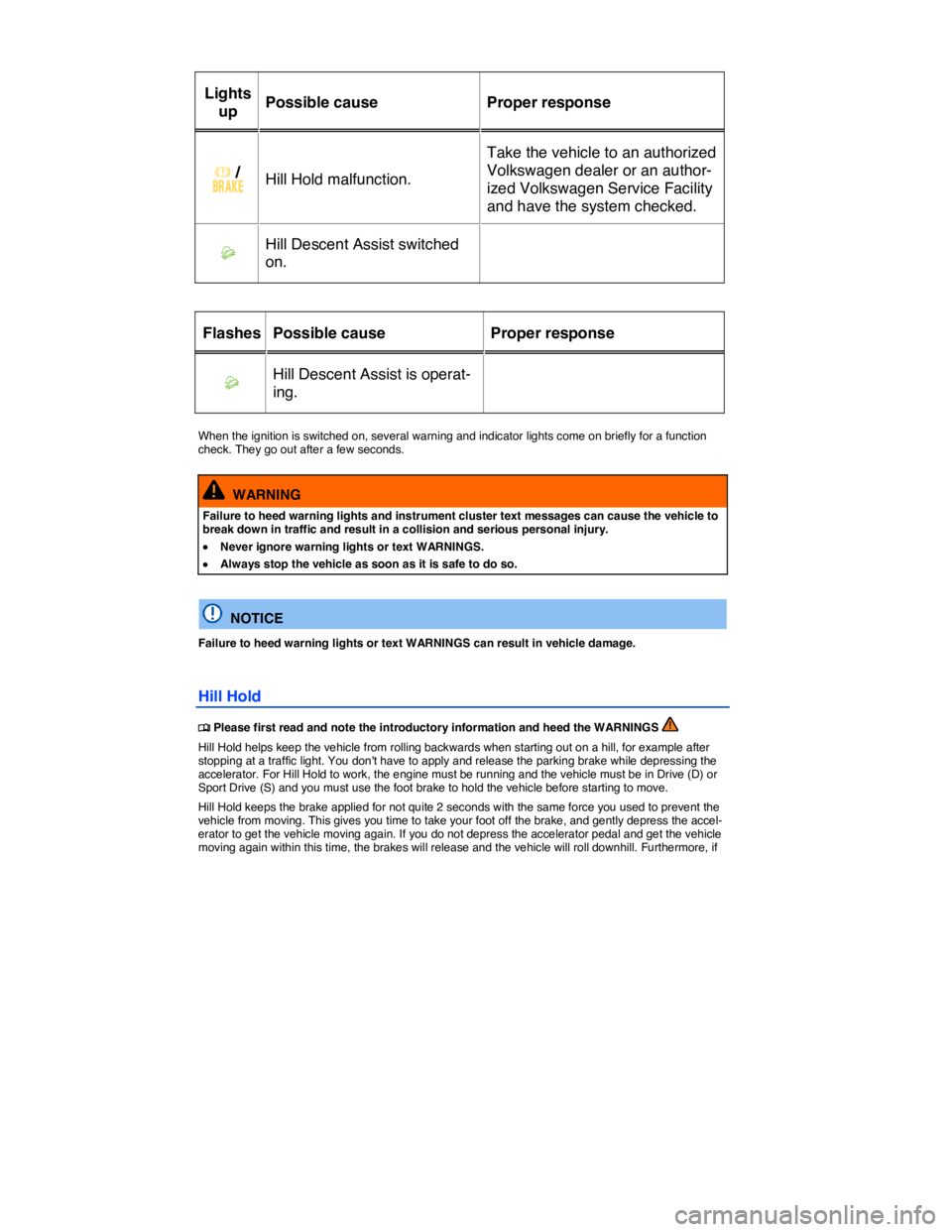
Lights
up Possible cause Proper response
H
Page 449 of 684
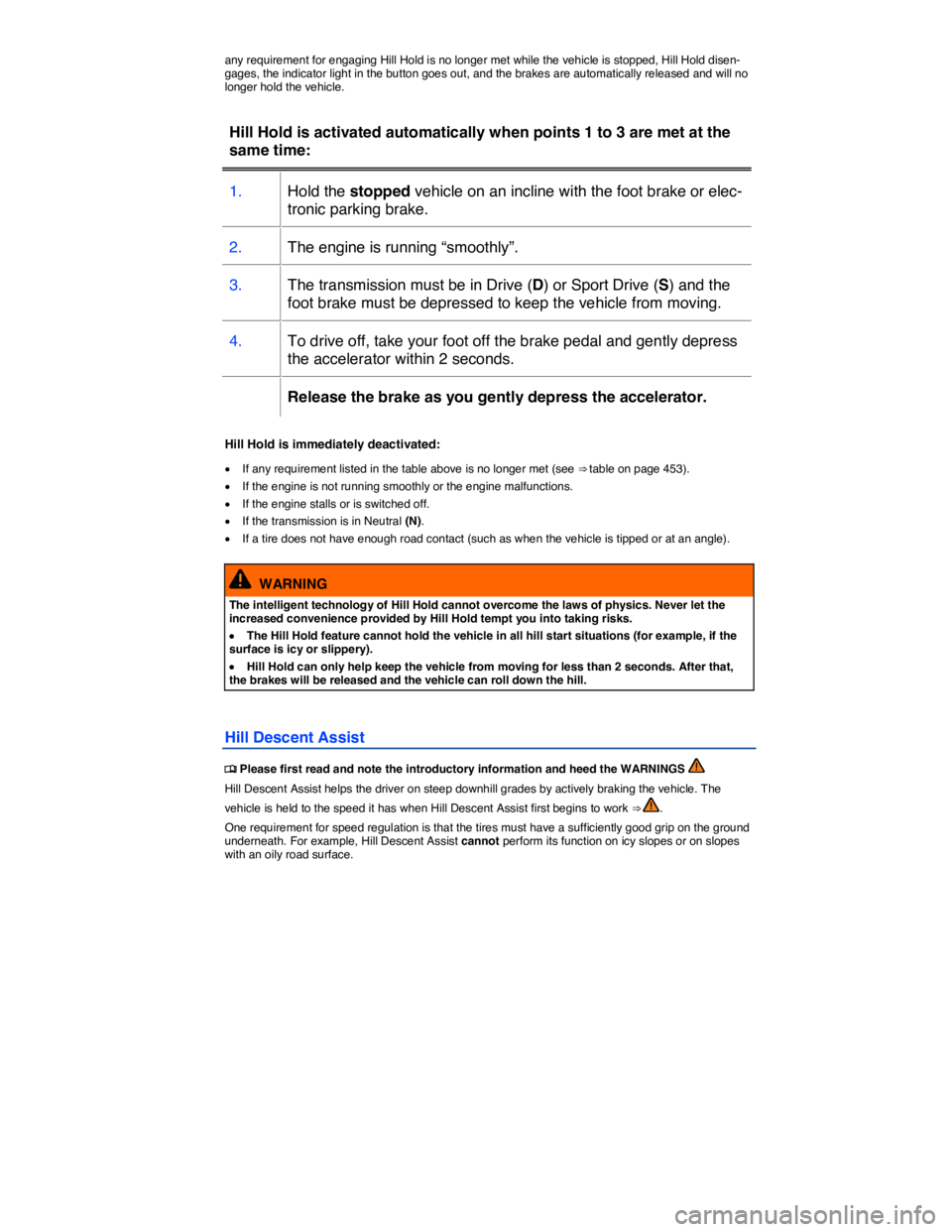
any requirement for engaging Hill Hold is no longer met while the vehicle is stopped, Hill Hold disen-gages, the indicator light in the button goes out, and the brakes are automatically released and will no longer hold the vehicle.
Hill Hold is activated automatically when points 1 to 3 are met at the
same time:
1. Hold the stopped vehicle on an incline with the foot brake or elec-
tronic parking brake.
2. The engine is running “smoothly”.
3. The transmission must be in Drive (D) or Sport Drive (S) and the
foot brake must be depressed to keep the vehicle from moving.
4. To drive off, take your foot off the brake pedal and gently depress
the accelerator within 2 seconds.
Release the brake as you gently depress the accelerator.
Hill Hold is immediately deactivated:
x If any requirement listed in the table above is no longer met (see ⇒ table on page 453).
x If the engine is not running smoothly or the engine malfunctions.
x If the engine stalls or is switched off.
x If the transmission is in Neutral (N).
x If a tire does not have enough road contact (such as when the vehicle is tipped or at an angle).
WARNING
The intelligent technology of Hill Hold cannot overcome the laws of physics. Never let the increased convenience provided by Hill Hold tempt you into taking risks.
x The Hill Hold feature cannot hold the vehicle in all hill start situations (for example, if the surface is icy or slippery).
x Hill Hold can only help keep the vehicle from moving for less than 2 seconds. After that, the brakes will be released and the vehicle can roll down the hill.
Hill Descent Assist