battery VOLKSWAGEN TRANSPORTER 1990 T4 / 4.G User Guide
[x] Cancel search | Manufacturer: VOLKSWAGEN, Model Year: 1990, Model line: TRANSPORTER, Model: VOLKSWAGEN TRANSPORTER 1990 T4 / 4.GPages: 165, PDF Size: 24.87 MB
Page 71 of 165
Downloaded from www.Manualslib.com manuals search engine
VEHICLE OPERATION
OPERATE
YOUR VEHICLE SAFELY
A
lot has gone
into
the manufacture of your Volkswagen, including advanced engineering techniques, rigid quality
control and demanding inspections.
These
engineering and safety features will be enhanced by you, the safe driver,
• who knows the vehicle and all controls
• who maintains the vehicle properly
• who uses driving skills wisely.
For
your own safety as well as
that
of
those around you - be a responsible
driver. If you
drink,
do not
drive.
The use
of alcohol, drugs and certain medications
will seriously impair perception, reactions and driving ability, substantially increasing
the risk of an accident and personal
injury.
Do not
drive
if you are
tired,
ill or
under
emotional
stress.
The
following
points
are also
important
for
your
safety,
please
observe
them
all.
First
things
first...
• Turn the engine off before performing
any checks or repairs on the vehicle.
• Be sure tires are inflated correctly.
Check
for damage and
tire
wear.
• See
that
wheel bolts or nuts are pro
perly tightened and not loose or missing.
• Check engine oil level, add if neces
sary.
Make it a habit to have engine oil
checked
with
every fuel filling.
• Check coolant level to assure sufficient
engine cooling.
• Be sure you have a well charged
battery.
• Check brake fluid level. If too low, have
brake system checked.
• Replenish windshield washer fluid.
• Replace worn or cracked wiper blades.
• See
that
all windows are clear and un
obstructed.
• Check whether all
light
lenses are
clean.
• Be sure all lights are working and head
lights are aimed correctly.
• Check under vehicle for leaks.
• Make sure the movement of either
brake,
clutch or accelerator pedal is not hampered in any way.
• Be sure all luggage is stored securely.
You'll
find helpful hints on how to perform most of these checks in this manual. If in
doubt, have these checks performed by
your dealer or any other qualified
mechanic.
Emergency
equipment
It is good practice to carry emergency
equipment in your vehicle. Some of the
things you should have are: emergency
light,
first-aid kit, small shovel, and for the
winter
season,
an ice scraper, snow brush,
a
container or bag of sand or salt, etc.
70
www.westfaliaT3.info - a useful website for owners and enthusiasts of VW Westfalia T25 / T3 Campervans
Page 73 of 165
Downloaded from www.Manualslib.com manuals search engine
VEHICLE OPERATION
OPERATE
YOUR VEHICLE ECONOMICALLY AND
MINIMIZE
POLLUTION
Your
personal
style
of
driving
determines your operating costs,
exhaust
emissions and noise levels. To obtain the best
possi
ble fuel economy,
minimize
pollution
and
save
wear and tear on the engine, brakes
and tires, observe the following points:
• Keep a
light
foot
on the accelerator.
• Drive smoothly, avoid abrupt changes
in speed as much as possible.
• Avoid jack rabbit starts and sudden
stops.
• Avoid unnecessary idling. Turn the
engine off.
• "Warm up" idling wastes gas. Start the
engine
just
before you are ready to drive.
Accelerate
slowly and smoothly.
• Do not drive longer than necessary in
the lower gears. By upshifting early you
can
economize on fuel consumption. • Organize your trips to include in several
errands.
• Any additional weight carried in the
vehicle reduces fuel economy. Always keep cargo to a minimum and remove all
unnecessary
items.
• Remove roof and ski racks when not in
use.
• All electrical consumers contribute to
increased
fuel consumption. Therefore,
use
fan, rear window defogger, etc., only
when needed.
• Check your vehicle's fuel consumption
regularly. Keep a
written
tally sheet or use
the
trip
odometer. Fuel consumption will
vary
with
traffic, road and weather condi
tions.
• Have your vehicle serviced by an
Volkswagen
dealer at the specified inter
vals
(see page 95 and your Maintenance brochure). • Air cleaner should be inspected to
assure
proper engine "breathing".
• Battery should be fully charged.
• Wheels should be properly aligned.
• Tires should be inflated to correct pres
sures.
Check
tire
pressures regularly - at least once a month.
• The published ENVIRONMENTAL-
PROTECTION AGENCY (EPA) and Trans
port
Canada
mileage
estimates
may not
agree
with
your
actual
highway
mileage
which
will
vary,
depending
upon
vehicle
load
and speed,
road
and
weather
condi
tions,
trip
length,
etc.
• Have the engine oil level checked
with
every fuel filling. Engine oil consumption
is
normal but tends to be higher when the
engine is new. The use of quality engine oil
and a correct engine oil level are essential
for vehicle performance and economical operation at all times.
72
www.westfaliaT3.info - a useful website for owners and enthusiasts of VW Westfalia T25 / T3 Campervans
Page 102 of 165
Downloaded from www.Manualslib.com manuals search engine
VEHICLE
CARE
ENGINE
COMPARTMENT LID
mu
have access to the engine compart-
•Mit
lid from inside the luggage compart- -ent.
"lb
open the
lid,
roll the floor covering out of
~9
way and
turn
both lock handles to the
Tb close the lid, reverse the above proce- ;jre.
ENGINE
COMPARTMENT
Always exercise extreme caution when
working on the engine. WARNING
•
Before you check anything in the en
gine compartment, stop the engine,
fully set the parking brake and remove
the ignition key.
•
Do not work on
your
car if you are
tired or ill, under emotional stress or under influence of drugs, medication
or alcohol.
•
Always let the engine cool down. Hot
components will burn skin on contact.
•
Do not spill engine oil, ATF, brake
fluid,
antifreeze and washer solvent on hot engine components, especially not
on the exhaust system.
These
fluids
are
flammable.
•
Always disconnect the battery
ground strap if you must work on the
fuel
system or the electrical system.
Never
smoke or work near heaters or
other fire hazards if you must work
around
fuel.
Always keep an approved
fire extinguisher immediately
avail
able.
Be
especially careful if engine is run
ning:
•
If work must be done with the engine
running, always fully set the parking
brake,
and make sure the shift lever is
in Neutral (Manual transmission) or
Park
(Automatic transmission).
•
Always be alert and extremely
cau
tious around the engine at
all
times par
ticularly when the engine is running.
•
Always exercise extreme caution to
prevent
neckties,
jewelry,
long hair or
loose clothing from getting caught in
the fan blades, the V-belts, or any other
moving
engine parts.
•
To avoid electrical shock and per
sonal
injury
never
touch ignition ca
bles
or components of the high voltage
electronic ignition system while the en
gine is running or even when starter is
cranked.
97
www.westfaliaT3.info - a useful website for owners and enthusiasts of VW Westfalia T25 / T3 Campervans
Page 114 of 165
Downloaded from www.Manualslib.com manuals search engine
VEHICLE CARE
3ATTERY
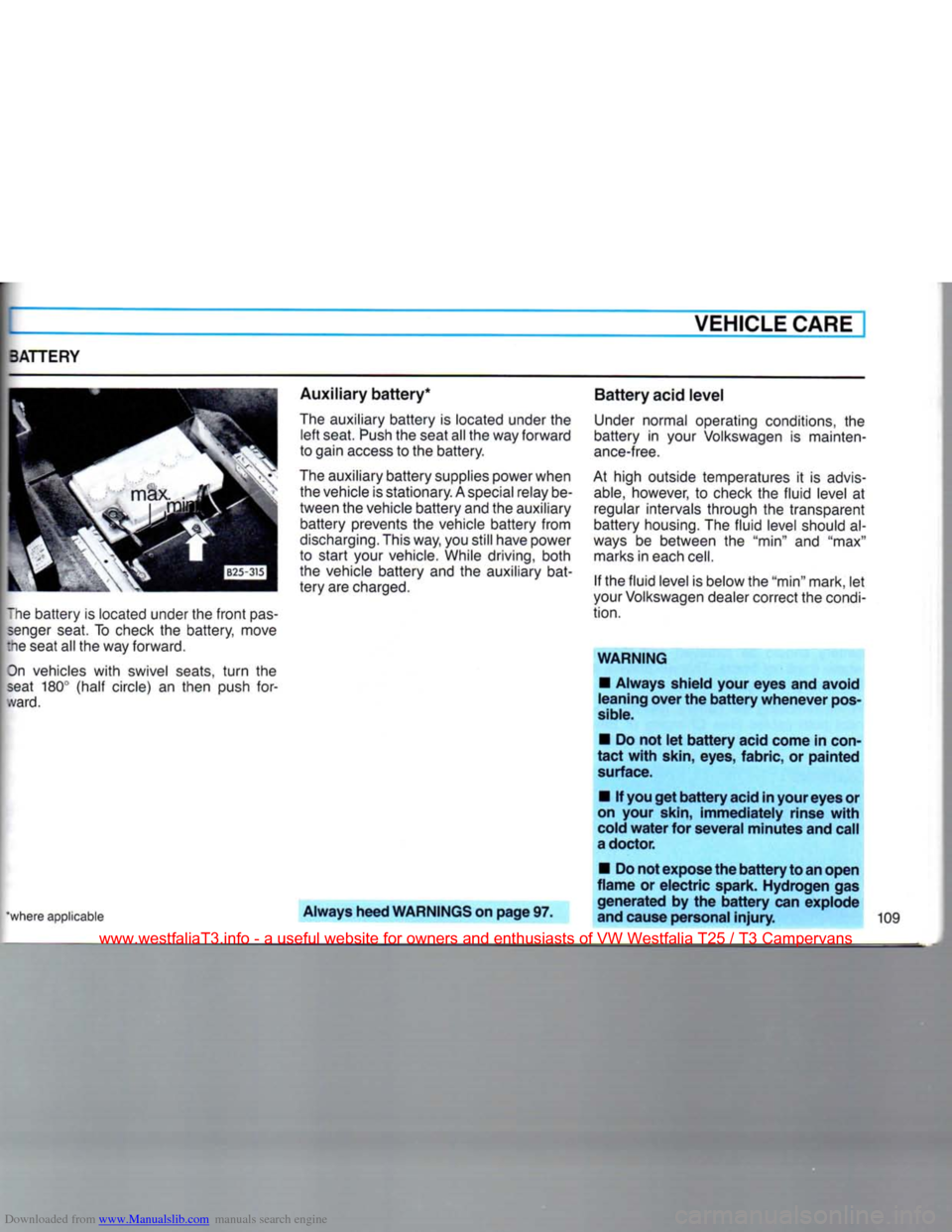
~he battery
is
located under the
front
pas
senger
seat.
To
check
the
battery, move
lie
seat all the way forward.
On
vehicles
with
swivel seats,
turn
the
seat
180°
(half circle)
an
then push
for
ward.
Auxiliary
battery*
The
auxiliary battery
is
located under
the
left
seat.
Push
the
seat all the way forward
to gain
access
to
the battery.
The
auxiliary battery supplies power when the vehicle is stationary.
A
special relay be
tween the vehicle battery and
the
auxiliary battery prevents
the
vehicle battery from
discharging.
This way, you still have power
to start your vehicle. While driving, both
the vehicle battery
and the
auxiliary bat
tery are charged.
'where applicable
Always heed WARNINGS on page 97. Battery acid level
Under
normal operating conditions,
the
battery
in
your Volkswagen
is
mainten
ance-free.
At high outside temperatures
it is
advis
able,
however,
to
check
the
fluid level
at
regular intervals through
the
transparent
battery housing. The fluid level should
al
ways
be
between
the "min" and "max"
marks
in
each
cell.
If
the fluid level
is
below the "min" mark,
let
your Volkswagen dealer correct
the
condi
tion.
WARNING
•
Always shield your eyes and avoid
leaning over the
battery
whenever
pos
sible.
•
Do not let
battery
acid come in
con
tact
with
skin,
eyes, fabric, or painted
surface.
•
If
you
get
battery
acid
in
your eyes or
on
your
skin,
immediately rinse
with
cold
water
for several minutes and call a doctor.
•
Do not expose the
battery
to an open
flame
or electric spark. Hydrogen gas generated by the
battery
can explode
and cause personal injury.
109
www.westfaliaT3.info - a useful website for owners and enthusiasts of VW Westfalia T25 / T3 Campervans
Page 115 of 165

Downloaded from www.Manualslib.com manuals search engine
VEHICLE
CARE
Winter operation During the winter months, battery capacity
tends to decrease as temperatures drop.
Additionally, more power is consumed while starting, and the headlights, heater, rear window defogger, etc., are used more
frequently. Curtail unnecessary power
consumption,
particularly in city traffic or
when travelling short distances only. Let
your
Volkswagen dealer test the battery's
capacity before winter sets in. A well
charged battery will not only prevent
starting
problems but will also live longer.
If
your
vehicle is left standing for several
weeks
at extremely low temperatures, the battery should be removed and stored
where it will not freeze.
This
will prevent it
from being damaged.
When removing the battery, first discon nect both cables (see Charging of Bat
tery),
then unscrew the battery mounting.
WARNING
Always keep the battery well out of the reach of children.
Always heed WARNINGS on page
97.
Charging of battery
WARNING
•
Always shield
your
eyes and avoid
leaning
over
the battery whenever pos
sible.
•
Charge battery in a well ventilated
area.
Keep away from open flame or
electrical
spark. Do not
smoke.
Hydro gen gas generated by the battery is explosive.
•
Battery acid that may spill during
charging should be washed off with a solution of warm water and baking
soda
to neutralize the
acid.
•
If you get battery
acid
in
your
eyes or
on
your
skin,
immediately rinse with
cold
water for several minutes and
call
a
doctor.
•
Never charge
a
frozen battery. It may
explode because of gas trapped in the
ice.
Allow a frozen battery to thaw out
first.
•
Never use a fast charger as a boo
ster to start the engine.
This
will
seri
ously damage sensitive electronic
components,
such as relays, radio,
etc.,
as well as the battery charger.
•
Fast charging
a
battery
is
dangerous
and should only be attempted by a
competent mechanic with the proper
equipment.
Slow battery charging WARNING
•
Heed all WARNINGS and follow in
structions that come with
your
battery
•
It is not necessary to remove the bat
tery
from the engine compartment, and it
is
also not necessary to disconnect the
cables.
•
Make sure the electrolyte level in each
cell
is between the "min" and "max" marks. If the fluid level is below the "min" mark, le:
your
Volkswagen dealer correct the condi
tion.
•
Connect charger cables.
Charger cables must be connected
POSITIVE
(+) to
POSITIVE
(+) and
NEGATIVE
(-) to
NEGATIVE
(-).
Do not connect or disconnect charger
cables
while charger is operating to re
duce the danger of exploding.
www.westfaliaT3.info - a useful website for owners and enthusiasts of VW Westfalia T25 / T3 Campervans
Page 116 of 165

Downloaded from www.Manualslib.com manuals search engine VEHICLE CARE
• Switch on charger.
• Charging
rate
not over 6 Amp.
Vormally,
a battery should be charged at
rc more than 10 percent of its rated
capa
city.
For
example, a charging current of 4.5
Amp.
would be used on a battery having
• Ah. Rated capacity of the battery in .our vehicle is listed on the battery
"Dusing.
• After charging,
turn
off charger and dis-
ronnect charger
cables.
To
remove
battery
from
vehicle • Disconnect negative ground cable.
• Disconnect positive cable.
• Unscrew bolt of holding plate with open
end
wrench.
To
reinstall
battery
in vehicle •
Place
battery in vehicle and tighten bolt
of holding plate.
• Reconnect positive cable. • Reconnect negative ground cable.
WARNING
Do not
reverse
polarity.
Cleaning
terminals
and
connections
WARNING
• Before
work
is done on the
electrical
system, disconnect the
negative
ground cable.
•
When
working
on the
battery,
be
sure not to short circuit the
terminals
with
tools or
other
metal
objects. This
would
cause the
battery
to
heat
up
very
quickly,
which
could
lead
to
damage
or
explosion and personal
injury.
The
terminals and connections should be kept clean and greased with silicone spray
or
petroleum jelly. Make sure the ground
connection
to the body is
tight
and free of
corrosion.
With
a disconnected
battery
the
engine
must
not run because the
electrical
sys
tem
will
be damaged. Replacing
battery
A
replacement battery must have the
same
specifications and dimensions as
the original equipment battery.
Specifica
tions are listed on the battery housing.
Make
sure the replacement battery is in
stalled
correctly and securely. See "Re moving and reinstalling battery".
Always heed
WARNINGS
on
page
97.
www.westfaliaT3.info - a useful website for owners and enthusiasts of VW Westfalia T25 / T3 Campervans
Page 126 of 165

Downloaded from www.Manualslib.com manuals search engine
t'/INTER
DRIVING
VEHICLE CARE
Remember
the following points when
criving in the
winter:
• Winter weather is particularly hard on
ne battery. We recommend having the cattery
checked,
preferably by a
Volks
wagen dealer, before the cold weather starts - see page 110.
If the vehicle is
left
standing for several
iveeks
at extremely low temperatures, the
rattery
should be removed - see page 111
=or
further
details. • Have the antifreeze concentration in
the cooling system checked before the cold weather starts - see page 107.
• The engine oil must have the correct
viscosity grade for the outside tempera
tures to be expected - see page 98.
• The best way to protect the bodywork is
to wash and wax it frequently, especially in
winter - see page 90.
• Always use a windshield washer
fluid
with
antifreeze for the windshield and rear
window washer system in winter - see page 112. • Use a scraper to remove snow and ice
from
the windows - see page 91.
• On winter roads the use of winter tires
or all-weather tires
will
improve handling;
this also applies to vehicles
with
all-wheel
drive - see pages 78 and 118.
• When driving in the mountains in winter
it is best to take along a set of snow chains.
Snow
chains may be compulsory for some
mountain roads, and this restriction also
applies
to vehicles
with
all-wheel drive -
see
pages 78 and 119.
121
www.westfaliaT3.info - a useful website for owners and enthusiasts of VW Westfalia T25 / T3 Campervans
Page 141 of 165

Downloaded from www.Manualslib.com manuals search engine
DO-IT-YOURSELF-SERVICE
EMERGENCY
STARTING
Starting by
pushing
or towing
Vehicles
with
Automatic Transmission
cannot
be started by
pushing
or
towing.
Vehicles
with
Manual
Transmission
must
not
be started by
pushing
or
towing.
Damage to the catalytic converter and/or
other parts of the vehicle may result. Starting
with
jumper
cables
WARNING
•
Always shield your eyes and avoid
leaning over the battery whenever
pos
sible.
•
Do not allow battery acid to contact
eyes
or
skin.
Flush any contacted area
with
water
immediately.
•
Improper use of booster battery to
start a vehicle may
cause
an
explosion.
•
Vehicles batteries generate explo
sive
gases.
Keep sparks, flame and lighted cigarettes away from batteries.
•
Do not charge a frozen battery; allow
it to thaw out first. Gas trapped
in the ice may cause an explosion.
•
Do not try to jump start any vehicle
with
a low electrolyte level in the bat tery.
•
The voltage of the booster battery
must also have a 12-volt rating. The
capacity
(Ah) of the booster battery
should
not be lower than
that
of the
dis
charged
battery. Use of batteries of dif
ferent voltage or substantially different
Ah
rating may cause an explosion and
personal
injury.
•
Applying
a
higher
voltage
booster
battery
will
cause
expensive
damage
tc
sensitive
electronic
components,
such
as
relays,
radio,
etc...
•
Vehicle
with
discharged
battery: turn off
lights
and
accessories,
move
lever
to N or
P
(Automatic
transmission)
or into
Neutra
(Manual
transmission)
and set
parking
brake.
Always
heed WARNINGS on page 97.
www.westfaliaT3.info - a useful website for owners and enthusiasts of VW Westfalia T25 / T3 Campervans
Page 142 of 165

Downloaded from www.Manualslib.com manuals search engine
DO-IT-YOURSELF-SERVICE
A
-
Discharged battery
B
-
Booster battery
X
-
To bolt securing ground strap
to
body Use
of jumper cables
WARNING
•
To avoid serious personal
injury
and damage to the vehicle, heed all
warnings and instructions of the
jumper cable manufacturer. If in doubt, call for road service.
•
The jumper cables must be long
enough so
that
the vehicles do not
touch.
•
When connecting jumper cables,
make sure
that
they
cannot get caught
in any moving parts in the engine
com
partment.
Improper
hook-up of jumper cables can
ruin the
alternator.
Always connect
POSITIVE (+) to POSITIVE (+), and
NEGATIVE
(-) to bolt securing ground
strap to body.
1. Connect clamp
of
plus-cable
to
positive
(+)
terminal
(1) of
discharged battery.
2.
Connect clamp
on
opposite
end of
cable
to
positive
(+)
terminal
(2) of
boos
ter battery.
4.
Connect clamp
on
opposite
end of
cable
to a
bare metal part bolted directly
to
bolt securing ground strap
to
body
(4) of
vehicle
with
discharged battery. Connect
clamp
as far
away from battery
as
possi
ble.
5.
Start
the
engine
of the
vehicle
with
the booster battery. Run
the
engine
at a
moderate
speed.
6. Start engine
with
discharged battery
in
the usual manner.
If
engine fails to start,
do
not continue
to
crank
but
contact nearest
workshop.
7. With engine running, remove jumper
cables
from both vehicles
in
exact reverse
order: Steps
4
through
1.
Always heed WARNINGS on page 97.
3.
Connect clamp
of
minus-cable
to
nega
tive
(-)
terminal
(3) of
booster battery. 137
www.westfaliaT3.info - a useful website for owners and enthusiasts of VW Westfalia T25 / T3 Campervans
Page 161 of 165

Downloaded from www.Manualslib.com manuals search engine
GAS
STATION
INFORMATION
1 -
Jack
and tools, see page 123.
2
- Windshield washer container, capacity 4.3 qt/4.2 liters.
3
-
Fuse
box, see page 128.
4 - Brake
fluid
reservoir, see page 108.
5
- Spare wheel, see page 124.
6 - Battery, see page 109.
7 -
Fuel
filler neck (rear wheel drive), capacity 16 gal/60 liters.
8 -
Rear
window washer container, capacity 1.1 qt/1.0 liters.
9 -
Fuel
filler neck (syncro), capacity 18.5 gal/70 liters.
10 - Air cleaner, see page 103.
11 - Power steering
fluid
reservoir, see page 103.
12 - Engine oil dipstick/oil filler neck, see page 99.
13
- Coolant
refill
tank, see page 105.
14 - ATF dipstick, see page 102.
157
www.westfaliaT3.info - a useful website for owners and enthusiasts of VW Westfalia T25 / T3 Campervans