Syncro VOLKSWAGEN TRANSPORTER 1990 T4 / 4.G Owners Manual
[x] Cancel search | Manufacturer: VOLKSWAGEN, Model Year: 1990, Model line: TRANSPORTER, Model: VOLKSWAGEN TRANSPORTER 1990 T4 / 4.GPages: 165, PDF Size: 24.87 MB
Page 8 of 165
Downloaded from www.Manualslib.com manuals search engine
CONTROLS AND
EQUIPMENT
Key A is used for the ignition/steering lock, • Do not
leave
your
vehicle
unattended
the doors, the lockable tank cap and the
with
the key in the
ignition
lock.
Always
rear luggage compartment lid.
take
the key and lock the doors.
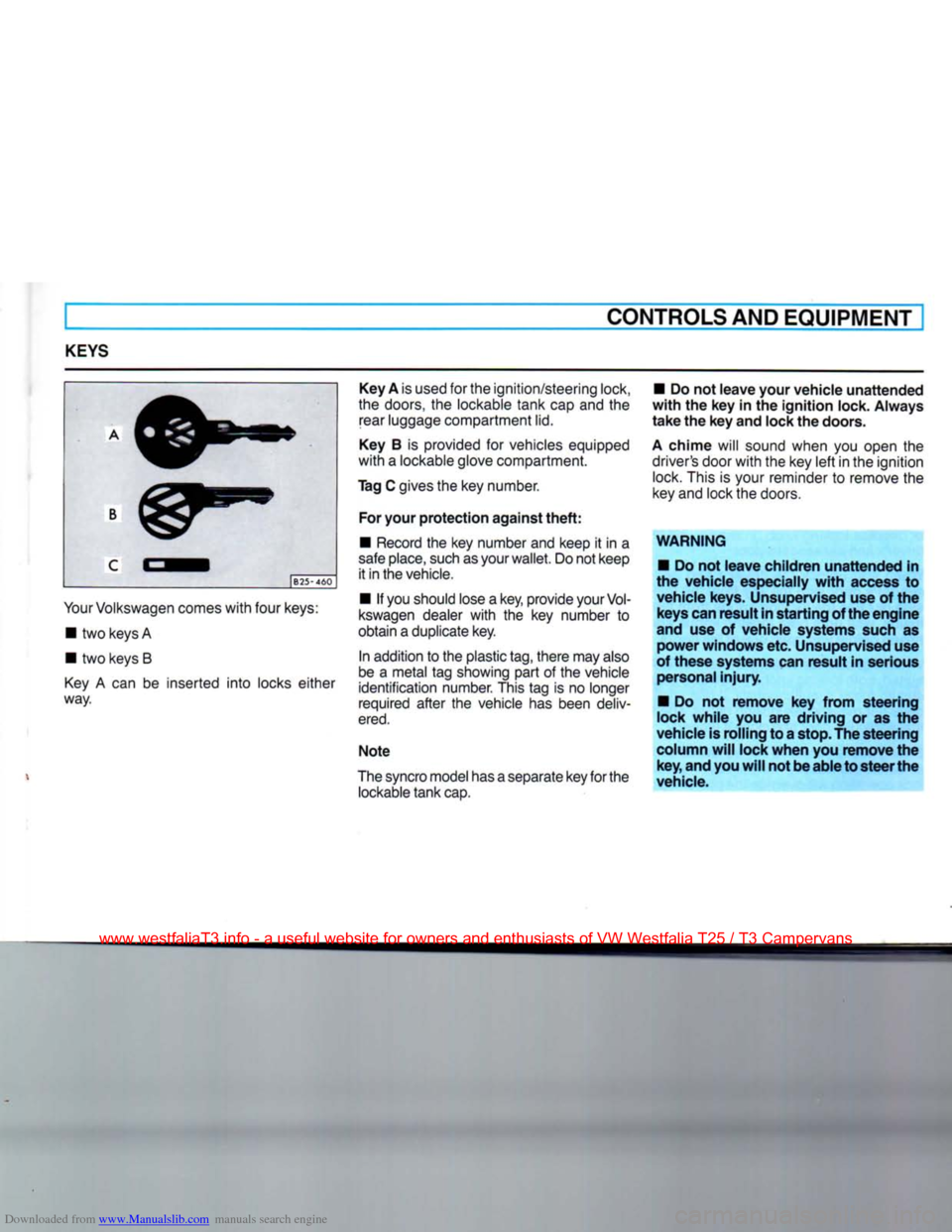
KEYS
B25-460
Your
Volkswagen comes
with
four keys: • two keys A
• two keys B
Key
A can be inserted
into
locks either
way. Key B is provided for vehicles equipped
with
a lockable glove compartment.
Tag C gives the key number.
For
your
protection
against
theft:
• Record the key number and keep it in a
safe
place, such as your wallet. Do not keep it in the vehicle.
• If you should lose a key, provide your
Vol
kswagen dealer
with
the key number to
obtain a duplicate key.
In addition to the plastic tag, there may also
be a metal tag snowing part of the vehicle
identification number. This tag is no longer
required after the vehicle has been deliv
ered.
Note
The syncro model has a separate key for the lockable tank cap.
A
chime
will sound when you open the
driver's door
with
the key
left
in the ignition lock. This is your reminder to remove the
key and lock the doors.
WARNING
• Do not
leave
children
unattended
in
the
vehicle
especially
with
access to
vehicle
keys. Unsupervised use of the
keys
can
result
in
starting
of the
engine
and use of
vehicle
systems such as
power
windows
etc. Unsupervised use
of
these
systems can
result
in serious
personal
injury.
• Do not
remove
key
from
steering
lock
while
you are
driving
or as the
vehicle
is
rolling
to a stop. The
steering
column
will
lock
when
you
remove
the key, and you
will
not be
able
to
steer
the
vehicle.
www.westfaliaT3.info - a useful website for owners and enthusiasts of VW Westfalia T25 / T3 Campervans
Page 33 of 165
Downloaded from www.Manualslib.com manuals search engine
CONTROLS AND EQUIPMENT
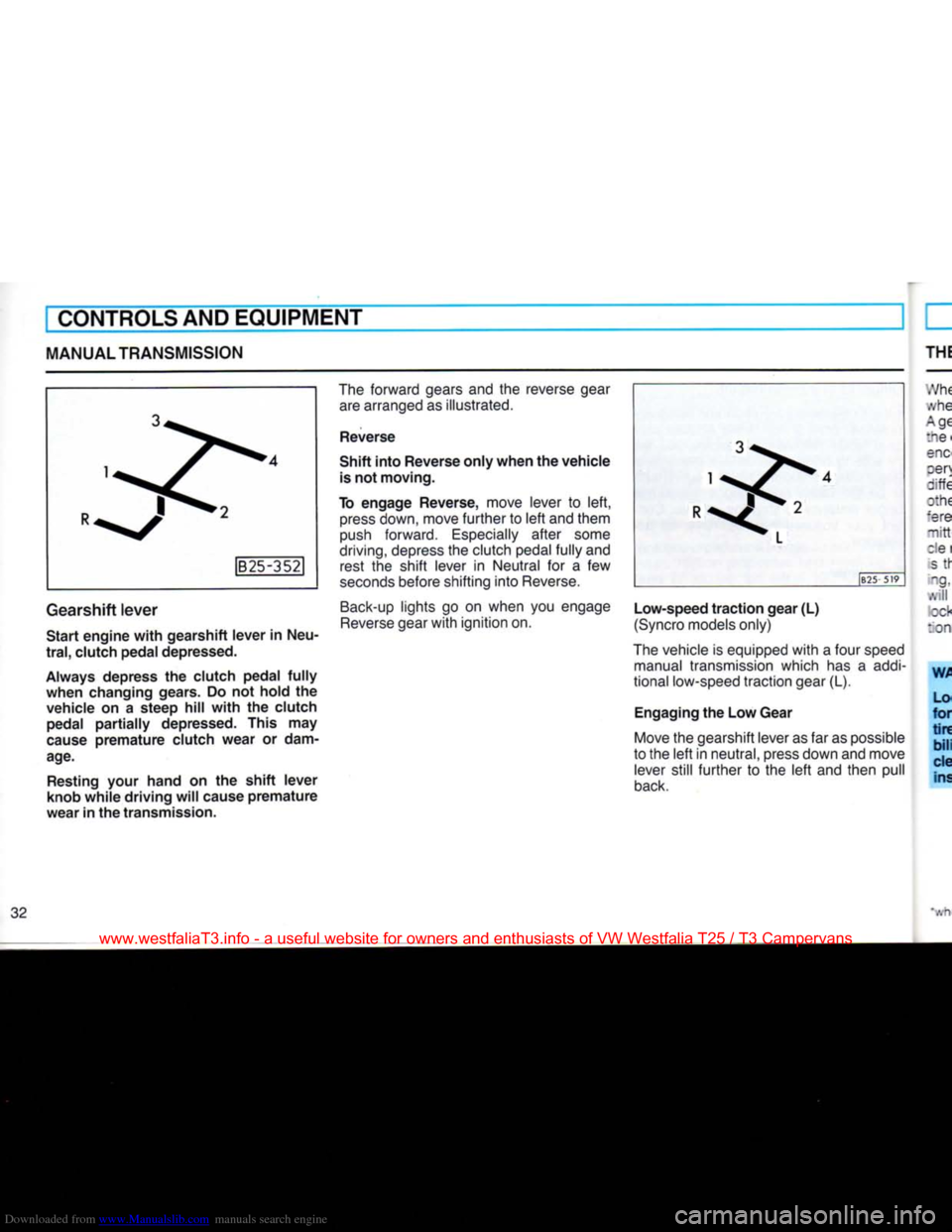
MANUAL TRANSMISSION
B25-352
Gearshift lever
Start engine with gearshift lever in Neu
tral,
clutch pedal depressed.
Always depress the clutch pedal fully
when changing gears. Do not hold the vehicle on a steep hill with the clutch pedal partially depressed. This may
cause premature clutch wear or dam
age.
Resting your hand on the shift lever
knob while driving will cause premature
wear in the transmission. The forward gears and the reverse gear
are arranged as illustrated.
Reverse
Shift into Reverse only when the vehicle is not moving.
To engage Reverse, move lever to left, press down, move further to left and them
push forward. Especially after some
driving,
depress the clutch pedal fully and rest the shift lever in Neutral for a few
seconds before shifting into Reverse.
Back-up lights go on when you engage Reverse gear with ignition on. JB25-519
Low-speed traction gear (L)
(Syncro models only)
The vehicle is equipped with a four speed manual transmission which has a
addi
tional low-speed traction gear (L).
Engaging the Low Gear
Move the gearshift lever as far as possible
to the left in neutral, press down and move lever still further to the left and then pull
back.
www.westfaliaT3.info - a useful website for owners and enthusiasts of VW Westfalia T25 / T3 Campervans
Page 34 of 165
Downloaded from www.Manualslib.com manuals search engine
CONTROLS AND
EQUIPMENT
THE
DIFFERENTIAL
LOCK*
(SYNCRO)
When driving around a curve, the outside
.vheels
turn
more than the inside wheels.
A
gear set, part of the transmission, called :he differential, compensates for the differ
ence.
If, however, one wheel gets on a slip pery surface and starts to spin, the
differential will not transmit power to the
ether wheel. The car will be stuck. The
dif
ferential lock will allow power to be trans
mitted
to both wheels to help get the vehi-
:!e
moving again. Because the differential
5
then unable to compensate for corner-
~.g, vehicle handling and maneuverability
.'.ill
be reduced. Therefore the differential zck may only be used under limited condi-
:ons.
WARNING
Locked
differential
cannot
compensate
for
cornering
and
therefore
increases
tire
wear,
reduces
vehicle
maneuvera
bility,
driveability
and can
impair
vehi
cle
handling
performance.
See
detailed
instructions
on
next
page.
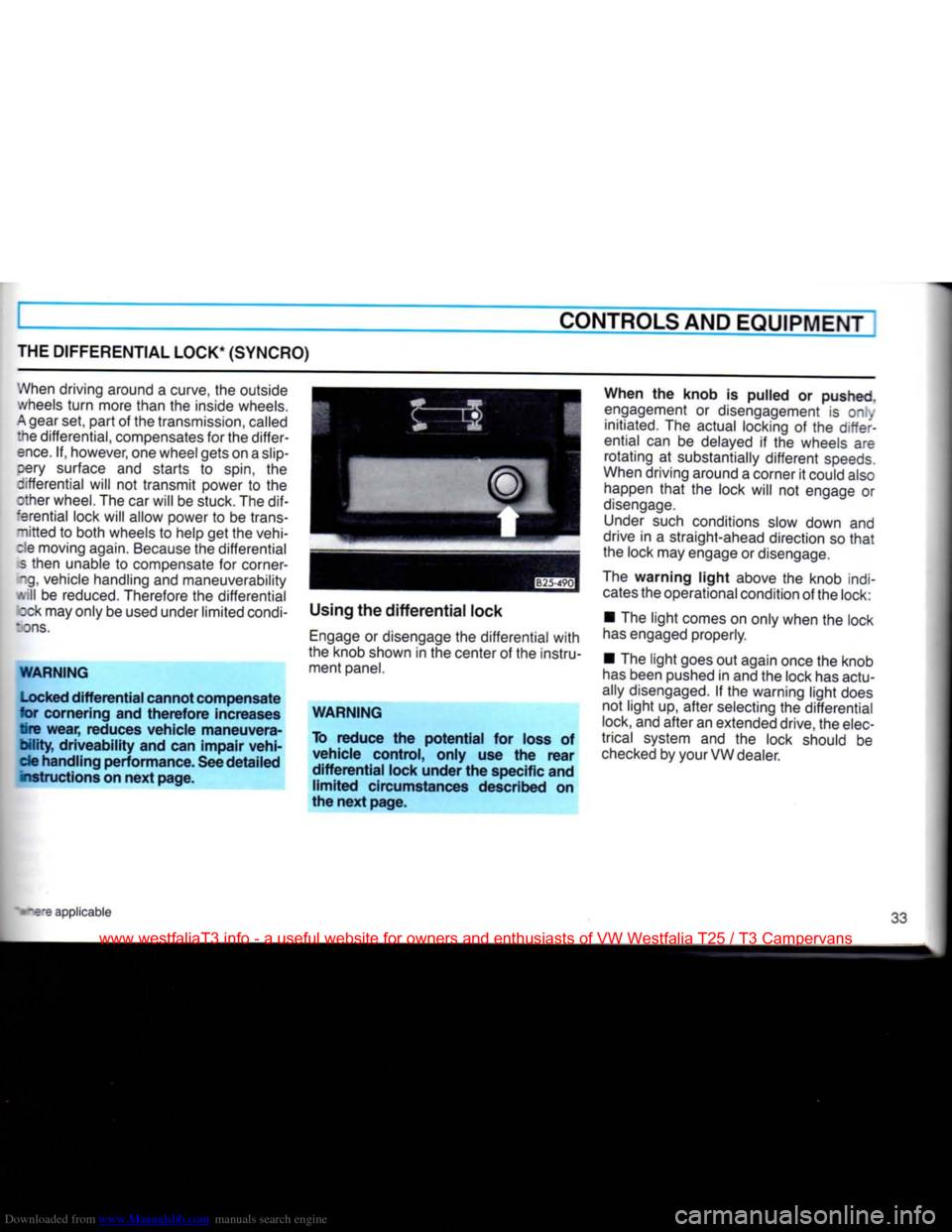
Using the
differential
lock
Engage
or disengage the differential
with
the knob shown in the center of the instru ment panel.
WARNING
To
reduce
the
potential
for loss of
vehicle
control,
only
use the
rear
differential
lock
under
the specific and
limited
circumstances described on
the
next
page.
When
the
knob
is
pulled
or pushed.
engagement or disengagement is ony initiated. The actual locking of the differ
ential can be delayed if the wheels are rotating at substantially different speeds.
When driving around a corner it could also happen
that
the lock will not engage or
disengage.
Under
such conditions slow down and
drive in a straight-ahead direction so
that
the lock may engage or disengage.
The
warning
light
above the knob indi
cates
the operational condition of the lock:
• The
light
comes on only when the lock
has
engaged properly.
• The
light
goes out again once the knob
has
been pushed in and the lock has actu
ally disengaged. If the warning
light
does not
light
up, after selecting the differential
lock, and after an extended drive, the elec
trical system and the lock should be
checked
by your VW dealer.
e applicable
www.westfaliaT3.info - a useful website for owners and enthusiasts of VW Westfalia T25 / T3 Campervans
Page 43 of 165
Downloaded from www.Manualslib.com manuals search engine
CONTROLS
AND
EQUIPMENT
WARNING continned •
The
engine compartment
of any
motor vehicle
is a
potentially hazard
ous
area.
Before you check anything in the engine compartment, stop
the
engine and
let it
cool down. Always
exercise extreme caution when work
ing
one the
engine. Heed
all of the
WARNINGS on page
97.
Reduce the risk
of
scalding from
hot
coolant by following these steps.
• If the coolant reservoir cap must be
removed, wait until
the
engine
has
cooled down.
• Protect face, hands
and
arms
by
covering
the cap
with
a
large, thick
rag
to
protect against escaping fluid
and
steam.
• Carefully and slowly
turn
cap
one
turn
to
allow excess pressure
to es
cape before completely removing
cap.
•
To
help avoid being burned,
do not
spill
antifreeze
or
coolant
on the ex
haust system
or hot
engine parts.
Under
some conditions, the ethylene
glycol
in
engine coolant
is
combusti
ble.
If a
visual check shows that coolant level
and V-belt
are
normal,
but the
warning light continues to
flash,
contact
your
near
est dealer
to
have
the
cause located
and
corrected.
For more details see "Cooling system"
on
page 104.
If the
coolant gauge needle nears
the
upper end
of
the scale and the engine ap
pears
to be
overheating,
turn
off the air
conditioner.
Do
not
install accessories
(fog
lights
or
in
sect screens,
for
example)
on top of the
front
bumper.
They
may
restrict engine
cooling.
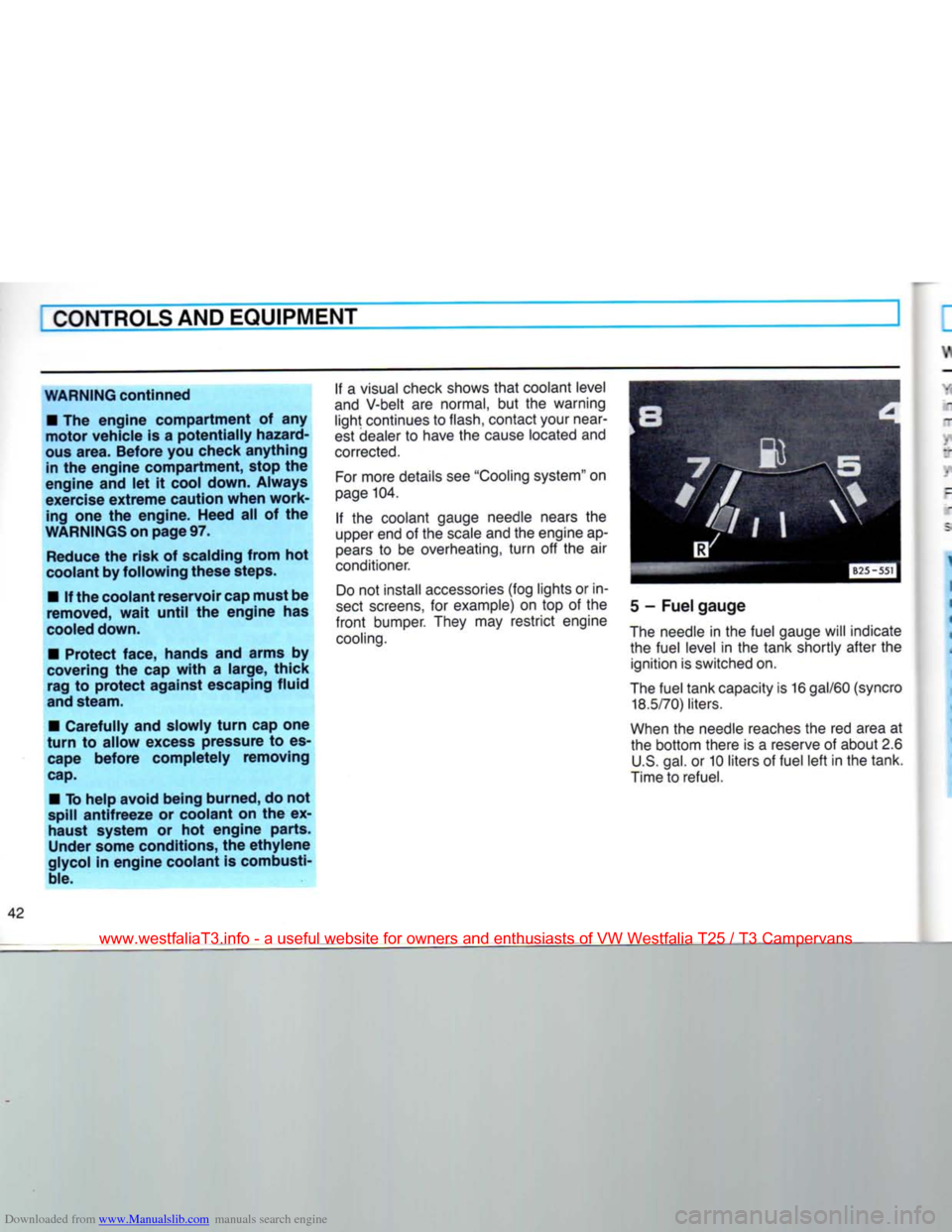
5
-
Fuel gauge
The needle
in
the fuel gauge will indicate the fuel level
in the
tank shortly after
the
ignition is switched on.
The fuel tank capacity is
16
gal/60
(syncro
18.5/70)
liters.
When
the
needle reaches the
red
area
at
the bottom there
is a
reserve
of
about 2.6 U.S. gal.
or
10 liters
of
fuel left in the tank.
Time to refuel.
www.westfaliaT3.info - a useful website for owners and enthusiasts of VW Westfalia T25 / T3 Campervans
Page 61 of 165
Downloaded from www.Manualslib.com manuals search engine
I
CONTROLS AND EQUIPMENT
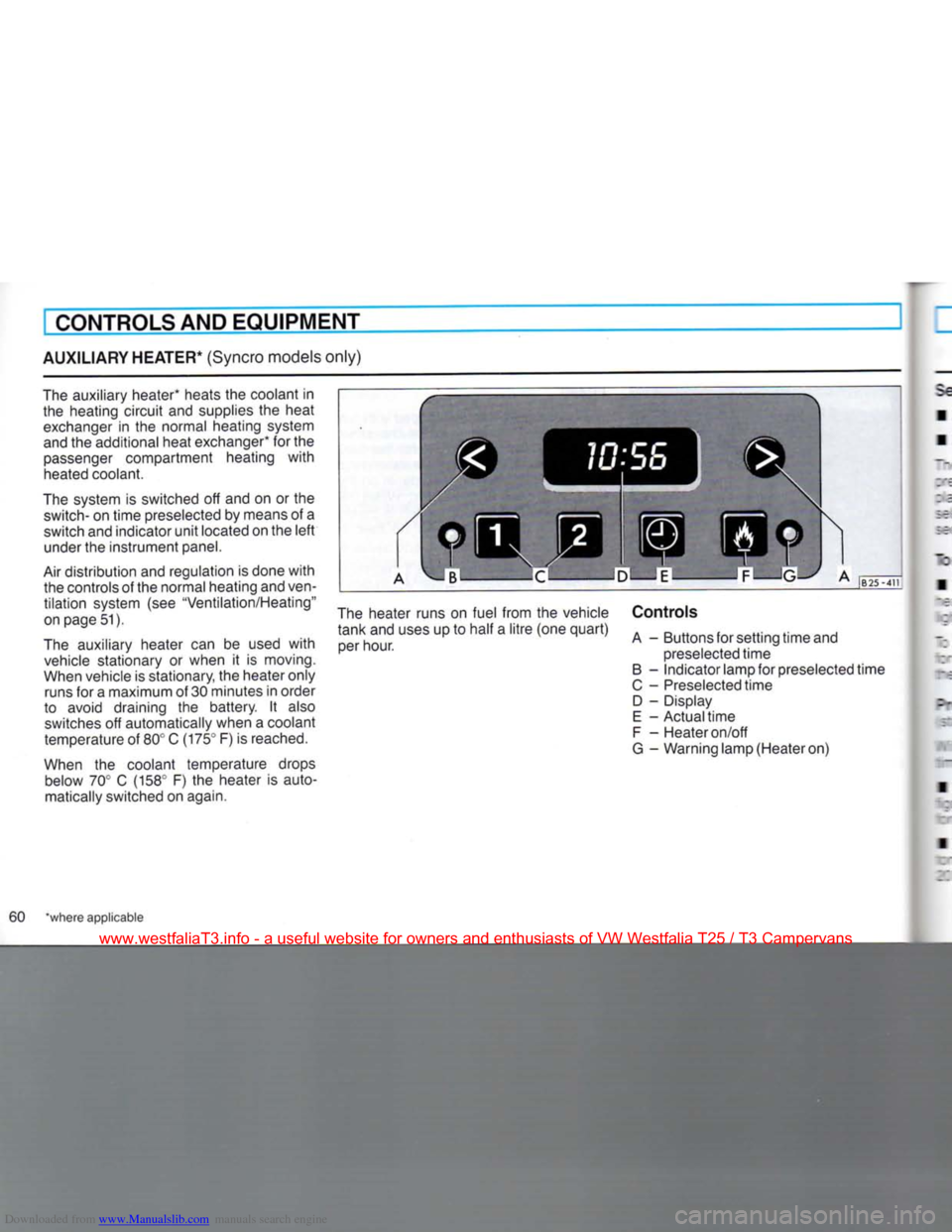
AUXILIARY HEATER* (Syncro models only)
The auxiliary heater* heats the coolant in the heating circuit and supplies the heat exchanger in the normal heating system
and the additional heat exchanger* for the
passenger compartment heating with heated coolant.
The system is switched off and on or the
switch-
on time preselected by means of a
switch and indicator unit located on the left under the instrument panel.
Air distribution and regulation is done with the controls of the normal heating and
ven
tilation system (see "Ventilation/Heating"
on page 51).
The auxiliary heater can be used with vehicle stationary or when it is moving.
When vehicle is stationary, the heater only runs for a maximum of 30 minutes in order
to avoid draining the battery. It also switches off automatically when a coolant
temperature of 80° C (175° F) is reached.
When the coolant temperature drops below 70° C (158° F) the heater is automatically switched on again. The heater runs on fuel from the vehicle
tank and uses up to half a litre (one quart) per hour. Controls
A - Buttons for setting time and
preselected time
B - Indicator lamp for preselected time
C - Preselected time D - Display
E - Actual time
F - Heater on/off
G - Warning lamp (Heater on)
60 "where applicable
www.westfaliaT3.info - a useful website for owners and enthusiasts of VW Westfalia T25 / T3 Campervans
Page 76 of 165
Downloaded from www.Manualslib.com manuals search engine
VEHICLE
OPERATION
IVING
YOUR
SYNCRO
me Vanagon/Transporter Syncro is
quipped
with
a new type of four-wheel :'>/e system, very much
different
from
rcnventional systems
that
have to be man- -=i!y engaged when needed. The
Vol
kswagen all wheel drive system is always
e-gaged.
Only the amount of power being
-ansmitted to the
front
and rear wheels
:~anges
according to requirements.
Cue
to this extraordinary drive concept,
:~e
Syncro is a very efficient road vehicle I
nich
has a wide variety of
uses
and appli-
:ations. It has proved its virtues in poor Bather and road conditions and
posses
ses
limited off-road capabilities.
This
chapter is provided to help you to
sen
sibly and safely use the superior driving
characteristics of the Vanagon Syncro to
their best advantage. It also contains tech
nical
information and operating instruc
tions to the extent
that
these vary
from
those applicable to the conventional
Vana
gon or Transporter.
Be
sure to carefully read this chapter be
fore starting to drive your Syncro so
that
you
will
become thoroughly familiar
with
its features and be able to operate it cor
rectly and safely. Always heed the warn
ings and other instructions contained in
this chapter and in your Owner's
Manual.
Because
the Vanagon/Transporter Syncro
is
not an off-road or all terrain vehicle, this
chapter does not contain all of the informa
tion
required to operate such a vehicle under all types of off-road or weather
con
ditions.
Above
all use common
sense.
Do not let the excellent traction of your Vanagon/
Transporter Syncro lead you to under estimate the difficulties and risks involved in driving on wet, slippery and rough road
surfaces.
Always drive defensively and
adapt vehicle operation and driving speed
to road,
traffic
and weather conditions.
www.westfaliaT3.info - a useful website for owners and enthusiasts of VW Westfalia T25 / T3 Campervans
Page 77 of 165
Downloaded from www.Manualslib.com manuals search engine
VEHICLE
OPERATION
The
function
of the
all-wheel
drive
and how it
works
In contrast to conventional four wheel
drive systems
that
require transmissions
to be manually engaged when needed,
the Vanagon/Transporter Syncro all-wheel
drive system is always engaged. Only the
amount of power being transmitted to the
front
and rear wheels changes automati
cally
as the road surface demands.
The automatic distribution of power is
accomplished
through a
fluid
shear
cou
pling (viscous coupling)
that
is
part
of the
front
axle. The design of the viscous
cou
pling keeps driving force losses to a mini
mum while distributing the forward
thrust
to all four wheels when needed. When the going gets rough, especially
when wet, slippery or snow covered roads
cause
the rear or
front
wheels to slip, the
viscous
coupling automatically transfers driving force to the other wheels to help
you keep moving.
The distribution of drive forces allows the
Syncro
to adapt to changing road surfaces
and provide increased traction automati
cally.
The Syncro driver is therefore able to
fully
concentrate on the road and
traffic
conditions.
This
extraordinary drivetrain concep:
makes
the Vanagon/Transporter Syncrc
an extremely efficient road vehicle suit
able for a wide variety of uses and applica
tions. While it has proved is ability to han
dle poor weather and road conditions anc
has
limited off-road capabilities, re
member your Vanagon/Transporter
Syn
cro is not an off-road or all-terrain vehicle.
76
www.westfaliaT3.info - a useful website for owners and enthusiasts of VW Westfalia T25 / T3 Campervans
Page 79 of 165
Downloaded from www.Manualslib.com manuals search engine
VEHICLE OPERATION
Advantages off the all-wheel drive
The Vanagon/Transporter Syncro
all-
wheel drive system
has the
following
ad
vantages over
a
two-wheel drive vehicle:
Driving Power
Driving Power
is
greatly increased
by the
continual all-wheel drive especially
on
snow
and
slippery surfaces, when starting
off from
a
standstill,
and
when driving
on
rough roads.
Within reason, your Vanagon/Transporter Syncro
can go
places where other
vehi
cles
may
likely
get
stuck.
It is
easier
to
stop
on slippery hills
and get
going again.
Moving Force
As
the
driving force applied
to the
road goes
to
four wheels instead
of two, the
amount
of
slip
is
considerably reduced.
This improves
the
traction between tire and road surface
and
thereby,
the
drive-
ability
on
slippery road surfaces. On vehicles with two-wheel drive,
the
driv
ing wheels
can
spin
on
slippery surfaces
if
too much acceleration
is
applied. This
greatly reduces tire grip
and can
result
in
loss
of
vehicle control.
By distributing
the
driving forces
to
four
in
stead
of two
wheels,
the
wheels
of the
Va nagon/Transporter Syncro
are
less likely
to spin under
the
same conditions.
Snow tires
With
the
all-wheel drive system
the
Vana gon/Transporter Syncro
is
good
for
winter
driving even with standard tires. However,
we recommend
the use of all
season tires
or radial snow tires (M
+
S) with
or
without
studs*,
on all
wheels,
for
better driving,
cornering
and
braking,
in
winter weather.
Details under "Snow tires"
on
page
118
also apply.
Snow chains
Snow chains can improve both road traction
and braking when driving
in
severe winter
weather. Therefore,
use
snow chains
on
your all-wheel drive vehicle when required. For additional information,
see
page
119.
Operation
In contrast
to
conventional all-wheel drive
systems that require transmissions
to be
manually engaged when needed,
the Va
nagon/Transporter Syncro all-wheel drive
system
is
always engaged. Only
the
amount
of
power being transmitted
to the
front
and
rear wheels changes automati cally
as the
road surface demands.
The
Syncro driver
is
therefore able
to
fully
con
centrate
on the
road and traffic conditions.
The differential lock*
for the
rear axle must only
be
used when
the
vehicle
is
stuck
or
in immediate danger
of
becoming stuck. For further information
on the
differential
lock,
see
page
33.
78 "Check with your local Motor Vehicle Bureau
for
possible restrictions.
'where applicable
www.westfaliaT3.info - a useful website for owners and enthusiasts of VW Westfalia T25 / T3 Campervans
Page 80 of 165
Downloaded from www.Manualslib.com manuals search engine
-
VEHICLE
OPERATION
Driving on dry roads
Attention
"his
is an
all-wheel drive multipurpose
rassenger
vehicle which
will
handle
and
maneuver
differently
from
an ordinary
pas
senger
car in driving conditions which may
occur
on
streets
and
highways
and off-
'oad.
As
with
other vehicles
of
this type,
if
you make sharp turns
or
abrupt maneu
vers,
the
vehicle
may
roll over
or
may
go
kit
of
control and
crash.
You should read
:he driving guidelines
and
instructions
in
the Owner's
Manual.
The
driver
and all
oassengers
should wear safety belts
at all
times.
Do
not
engage
the
differential lock on nor
mal
dry
roads
as it
will
not
provide any ad
vantage. Under these circumstances,
an
engaged differential lock
will
impair the ve-
nicle's
maneuverability and
will
cause
ex
cessive
tire
wear.
Driving on wet, slippery roads
Due
to the
all-wheel drive,
the
engine
power
is
transmitted evenly
to a
moder
ately slippery road surface.
On
wet surface
As
with
any
other vehicle, excessive driv ing speed on very wet roads can cause hy
droplaning
and
loss
of
vehicle control.
Therefore, slow down.
The
differential lock* must
not be
engaged.
Important
instructions
on
the
differential
locks
are to be found on page
33/34.
On
slippery surfaces
On
slippery surfaces the rear axle differen
tial
lock may only be engaged when
start
ing
from
a
standstill
or at
very low
speeds.
When
the
road surface has improved
the
lock should
be
disengaged again. On
snow covered surfaces
On
a
snow covered road, maintain traction by making gradual changes
in
speed
or
di
rection. Avoid sudden maneuvers. Be alert
to problems other drivers around you may be having which could create
a
hazardous
situation
for
you.
In heavy snow, maintaining reasonable
momentum
is
important
for
safe vehicle
operation. Try
to
keep moving
by
using
the
L-gear and
a
steady accelerator pedal
at
low
speed.
WARNING
•
Always
maintain
a safe driving
speed,
especially
when
road and
weather
conditions are poor.
•
Excessive
driving speed on very wet
roads can cause hydroplaning and
loss
of vehicle control.
•
Always avoid forceful and
abrupt
braking action.
You
could block all four
wheels simultaneously and lose
con
trol
of the vehicle.
•
The braking capability of your Vana-
gon/Transporter Syncro is
greatly
de
pendent on the
traction
of your tires.
'where applicable 79
www.westfaliaT3.info - a useful website for owners and enthusiasts of VW Westfalia T25 / T3 Campervans
Page 81 of 165
Downloaded from www.Manualslib.com manuals search engine
VEHICLE
OPERATION
WARNING continued
•
The permanently engaged allwheel-
drive
will
provide
good
performance on relatively wet or slippery
roads.
Be
sure
to use these features and advantages
wisely. Do not let the excellent traction
which your VW
SYNCRO
offers lead
you
to underestimate the difficulties
and risks involved in negotiating wet or
slippery
roads. Always drive defen
sively
and adapt vehicle operation and
driving speed to road and
traffic
condi
tions.
Driving Off-Road
WARNING
The Vanagon/Transporter
Syncro
is not an off-road or all
terrain
vehicle. Use of
this or any other vehicle under off-road
conditions
requires special skills and knowledge. The off-road operation of
this or any other
vehicle
can
lead
to per
sonal
injury.
•
Driver and all
passengers
must
wear
safety belts at all times.
•
Keep your thumbs and fingers on
the outside of the steering wheel.
Potholes
or rocks can
jerk
the
wheel
from your grip; it really hurts if a spoke
catches
you on the way around.
Off-Road
Driving
Driving off-road places extra demands
on
your vehicle and on you, the driver.
If
under
exceptional
circumstances
you
judge
it
safe
and
appropriate
to
leave
the
paved highway,
first
make sure
that
your vehicle
is
in top
mechanical condition. Make cer
tain
that
all
vehicle systems
are
function ing normally,
in
particular,
for
example,
that
the engine, especially the cooling
sys
tem,
is
operating properly and
that
trans
mission,
brakes and steering are function ing normally. Tires must have adequate
tread,
be
free
of
damage
and be
adequately inflated.
Before
driving over
difficult
terrain, such as
mud,
sand,
water, snow
or
steep
slopes,
we recommend engaging
the
differentia lock*
at low
speed.
Important
information
regarding
the
differential lock
is on
page
33/34.
Whenever
you
operate your
car you
should
be
well
and fit, but
your physical
and
mental condition
are
especially
im
portant
when driving
off
the road.
As
a
general rule
you
should
go
only where others have gone before.
Always
obey applicable
Federal,
State
and
local regulations
and
above
all re
spect
and protect the environment. Do
not
scar
the
land, avoid unnecessary wheel
spinning and other driving behavior which
will
create
ruts
and destroy vegetation.
Be
careful when parking and when standing
with
a hot
engine. The catalytic converter
with
which your vehicle
is
equipped devel
ops
very high temperatures which can set
dry grass and brush
on
fire. Respect
the
wildlife, leave animals
to
themselves
and
do not destroy their areas
of
refuge. Above
all,
be
considerate and operate your vehi
cle
sensibly and safely. Nature
is a
natural
resource
which belongs
to
all
of
us.
'where applicable
www.westfaliaT3.info - a useful website for owners and enthusiasts of VW Westfalia T25 / T3 Campervans