stop start VOLKSWAGEN TRANSPORTER 1990 T4 / 4.G Owners Manual
[x] Cancel search | Manufacturer: VOLKSWAGEN, Model Year: 1990, Model line: TRANSPORTER, Model: VOLKSWAGEN TRANSPORTER 1990 T4 / 4.GPages: 165, PDF Size: 24.87 MB
Page 8 of 165
Downloaded from www.Manualslib.com manuals search engine
CONTROLS AND
EQUIPMENT
Key A is used for the ignition/steering lock, • Do not
leave
your
vehicle
unattended
the doors, the lockable tank cap and the
with
the key in the
ignition
lock.
Always
rear luggage compartment lid.
take
the key and lock the doors.
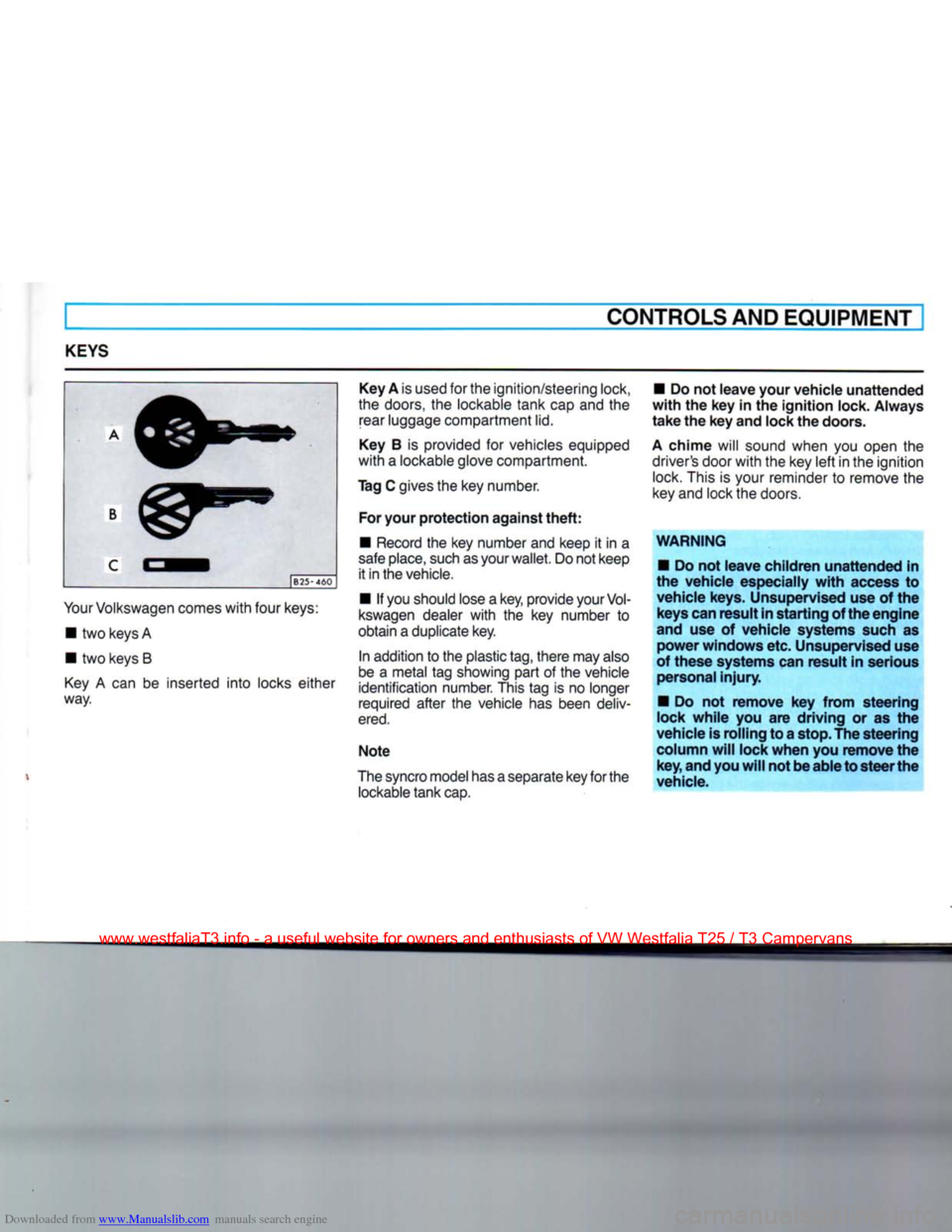
KEYS
B25-460
Your
Volkswagen comes
with
four keys: • two keys A
• two keys B
Key
A can be inserted
into
locks either
way. Key B is provided for vehicles equipped
with
a lockable glove compartment.
Tag C gives the key number.
For
your
protection
against
theft:
• Record the key number and keep it in a
safe
place, such as your wallet. Do not keep it in the vehicle.
• If you should lose a key, provide your
Vol
kswagen dealer
with
the key number to
obtain a duplicate key.
In addition to the plastic tag, there may also
be a metal tag snowing part of the vehicle
identification number. This tag is no longer
required after the vehicle has been deliv
ered.
Note
The syncro model has a separate key for the lockable tank cap.
A
chime
will sound when you open the
driver's door
with
the key
left
in the ignition lock. This is your reminder to remove the
key and lock the doors.
WARNING
• Do not
leave
children
unattended
in
the
vehicle
especially
with
access to
vehicle
keys. Unsupervised use of the
keys
can
result
in
starting
of the
engine
and use of
vehicle
systems such as
power
windows
etc. Unsupervised use
of
these
systems can
result
in serious
personal
injury.
• Do not
remove
key
from
steering
lock
while
you are
driving
or as the
vehicle
is
rolling
to a stop. The
steering
column
will
lock
when
you
remove
the key, and you
will
not be
able
to
steer
the
vehicle.
www.westfaliaT3.info - a useful website for owners and enthusiasts of VW Westfalia T25 / T3 Campervans
Page 38 of 165
Downloaded from www.Manualslib.com manuals search engine
CONTROLS
AND
EQUIPMENT
•
Never shift into Reverse (R) or Park
(P) when the vehicle is in motion.
•
Do not remove the key from the ig
nition steering lock until you have
parked the vehicle, because removal
of the key
will
lock the steering wheel.
•
If the selector lever is unintention
ally moved into Neutral (N)
while
driv
ing,
take
your foot off the accelerator pedal and
wait
until the engine speed
has
dropped to idling before selecting
a driving position.
Maneuvering
•'/hen
alternating between forward and
-averse
- for
instance,
while
maneuvering
ne
vehicle
into a tight parking
space
-
:nly
shift when the
vehicle
has
come
to a
full stop and the
engine
is running at idle
soeed.
Stuck
in snow, mud or sand
When
alternating between forward and
reverse
in an effort to free the
vehicle,
depress
the
accelerator
pedal
slightly
while
the
transmission
is in
gear,
and
release
the
accelerator
pedal
while
shifting.
Do not
race
the
engine
and
avoid
spinning
the
wheels.
Do not repeat
"rocking"
back and
forth
with
wheels
spinning
at high engine speed and heavy
throttle,
as serious damage may
be caused to the automatic transmis
sion
and other critical parts.
Kickdown
device
The
kickdown
device
gives
maximum
acceleration
when the
accelerator
pedal
is
pressed
down
past
the full throttle
posi
tion.
Depending
on
road
speed
and
engine
speed,
either the upshift is
delayed
(forced
throttle) or the box
changes
down
into
the next lower
gear.
WARNING
Be
careful when using the kickdown on
slippery
roads. Rapid acceleration may
cause
skidding.
Stopping
•
When
stopping briefly, at a traffic light
for
example,
it is not
necessary
to
move
the
selector
lever
to
Neutral.
Simply
apply
the
brakes.
To start
again
release
brake
and
accelerate.
•
The driving
positions
must
never
be
used
for holding the
vehicle
at rest
uphill.
Always
use your foot
brakes
when
stopped
on
inclines.
WARNING
•
Never get out of the driver's seat
when the engine is running and the
selector
lever is not securely locked in
the P position.
•
If you must leave the vehicle move
the selector lever securely into the P
position
and apply parking brake
firmly.
Towing
To
tow the
vehicle
see instructions
"Emergency
towing" on
page
138.
www.westfaliaT3.info - a useful website for owners and enthusiasts of VW Westfalia T25 / T3 Campervans
Page 40 of 165

Downloaded from www.Manualslib.com manuals search engine
CONTROLS
AND
EQUIPMENT
STARTING
PROCEDURES
WARNING
•
Fasten safety belts before driving.
•
Never
start or let the engine run in a
confined or enclosed, unventilated
area.
Exhaust fumes from the engine
contain carbon monoxide, which is a
colorless
and odorless gas. Carbon monoxide can be
fatal
if inhaled.
•
Never
leave engine idling unatten
ded.
An unattended vehicle with a run
ning
engine is potentially hazardous.
•
Do not park or operate the vehicle in
areas
where the hot exhaust system may come in contact with dry grass,
brush,
fuel
spill
or other
material,
which can cause a fire.
•
Do not leave engine unattended at
idle.
When starting engine, be ready to
drive off immediately. Maintain moder
ate
speed until the engine is
com
pletely warm. Remember that
your
en
gine performs best at operating
tem
perature.
Automatic
Transmission
Engine will only start with selector lever in
Neutral or Park.
Manual
Transmission
Start with gearshift lever in Neutral, clutch
pedal
depressed, so that the starter only
has
to crank the engine.
Starting
engine
•
Do not depress accelerator pedal
when starting. At extrem low temperatures
the engine will probably start better, if you depress accelerator pedal slighly.
•
As soon as the engine starts, release
the ignition key.
•
If the engine does not start the first time
or
stalls,
turn
the ignition off and restart. Depress the accelerator pedal slowly
during the second starting attempt.
•
Operate the starter for no more than
10
seconds.
•
Allow about 30 seconds between each
starting
attempt.
STOPPING
ENGINE
Do not stop engine immediately after
hard or extended driving. Keep engine
running for about two minutes to pre
vent
excessive heat build-up.
WARNING
•
Before you check anything in the
engine compartment, stop the engine and let it cool down. Hot components
can
burn skin on contact.
•
The radiator fan switches on auto
matically
when the coolant reaches a cer
tain
temperature and will continue to run
(even
with ignition off) until the coolant
temperature drops.
39
www.westfaliaT3.info - a useful website for owners and enthusiasts of VW Westfalia T25 / T3 Campervans
Page 42 of 165

Downloaded from www.Manualslib.com manuals search engine
CONTROLS AND EQUIPMENT
I - Tachometer*
"he red shaded area at the end of the scale indicates the maximum permissible
engine rpm (revolutions per minute) for all gears after the break-in period. Before
'eaching this area, the next higher gear
snould be selected or the foot eased off
the accelerator pedal. Earlier shifting saves fuel and reduces noise.
Sniff to the next lower gear when the en-
; ne rpm drops below 1500 rpm.
~ne green shaded area on the scale snows the speed at which the engine is de-
•
eloping its most favourable torque.
3 - Normal clock*
~J
set the clock, depress the knob in the : al center and
turn.
4 - Coolant temperature
gauge X
tare applicable The needle in the coolant temperature
gauge will indicate the temperature of the
coolant shortly after the ignition is
switched on.
When ignition is switched on the warning light (c) will flash for a few seconds as a
functional check.
a - Engine cold
Avoid high engine speeds and heavy throt tle when the needle is still in this area of
the
dial.
b - Normal temperature During normal running the needle will re
main somewhere in the middle of the
dial.
If the engine is working hard at hign a--
bient temperatures, the needle may as:
go further to the right, but this is no cause
for concern so long as the coolant
tem
perature warning light does not start
flashing.
c - Warning light If the light flashes when driving first check
the coolant temperature gauge. If the nee
dle is in the normal range, add coolant at the next opportunity. If the needle is in the warn
ing range, either the coolant level is too low
or the coolant temperature is too high. Move the vehicle a safe distance off the
road,
stop the engine and depress the
emergency flasher switch.
The fan should be operating when the warning light is on (listen for fan, located in
front of car behind grille).
WARNING • To reduce the risk of being burned,
never open the hood if you see or hear
steam or coolant escaping from the
engine compartment. Wait until no
steam or coolant can be seen or heard
before carefully opening the hood.
www.westfaliaT3.info - a useful website for owners and enthusiasts of VW Westfalia T25 / T3 Campervans
Page 44 of 165
Downloaded from www.Manualslib.com manuals search engine
CONTROLS
AND
EQUIPMENT
WARNING
/ INDICATOR
LIGHTS
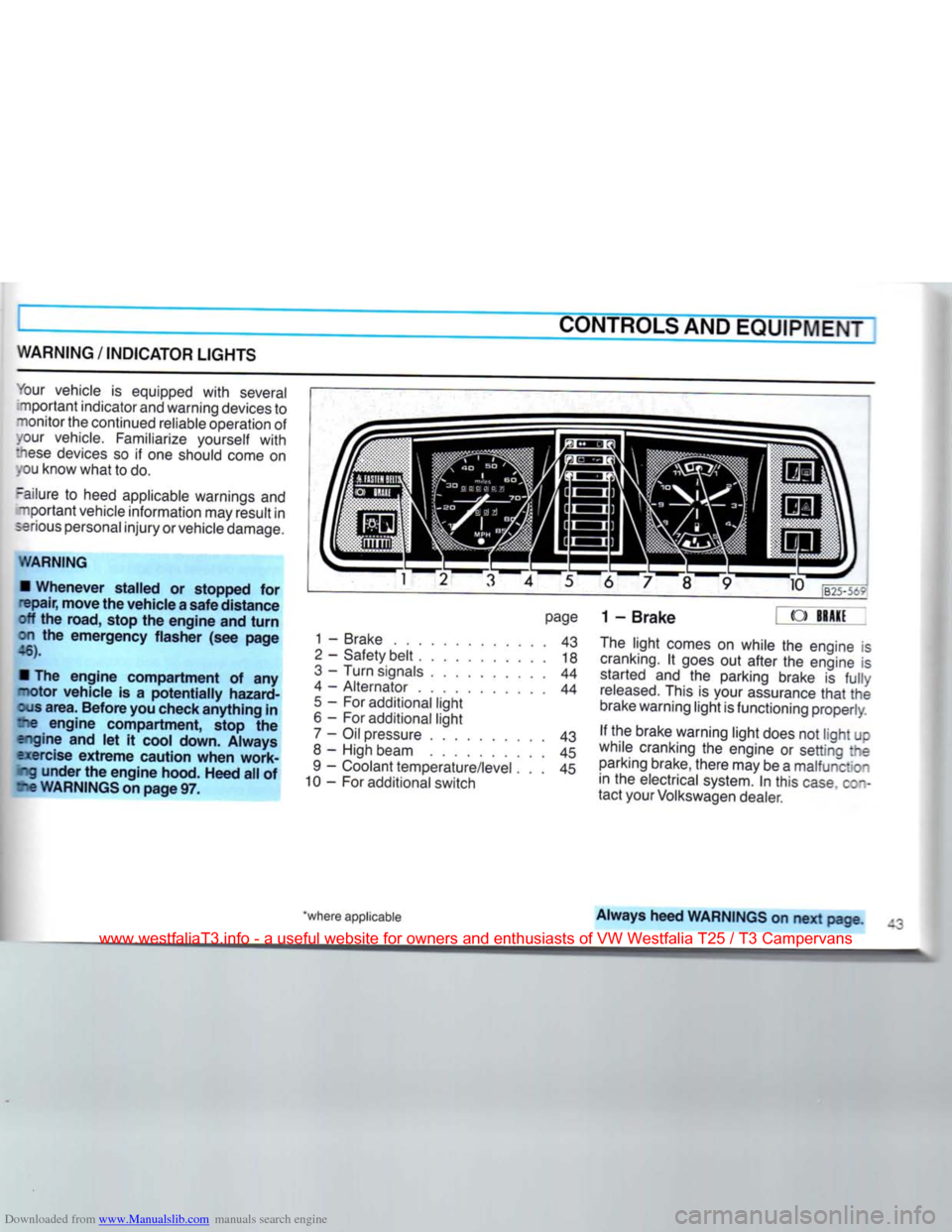
1 2 3 4 5 6 7 8
your vehicle is equipped
with
several
•nportant indicator and warning devices to
~ionitor the continued reliable operation of .our vehicle. Familiarize yourself
with
:hese
devices so if one should come on .ou know what to do.
-allure to heed applicable warnings and "nportant vehicle information may result in
serious
personal injury or vehicle damage.
WARNING
•
Whenever
stalled
or stopped for
epair,
move
the
vehicle
a
safe
distance
off the road, stop the
engine
and
turn
on the
emergency
flasher
(see
page
46).
• The
engine
compartment
of any
-lotor
vehicle
is a
potentially
hazard
ous
area.
Before
you check
anything
in
?ie
engine
compartment,
stop the
engine
and let it cool down.
Always
exercise
extreme
caution
when
work
ing
under
the
engine
hood.
Heed
all of
re
WARNINGS
on
page
97.
page
1 - Brake 43
2
- Safety belt 18
3
- Turn signals 44
4 - Alternator 44
5
- For additional light
6 - For additional light 7 - Oil pressure 43
8 - High beam 45
9 - Coolant temperature/level . . . 45
10 - For additional switch 9 10
B25-5t?
1-Brake
« ->
The
light comes on while the engine is
cranking.
It goes out after the engine is started and the parking brake is
fully
released.
This is your assurance
that
the
brake warning light is functioning properly.
If the brake warning light does not light JC
while cranking the engine or setting :ne parking brake, there may be a malfunction in the electrical system. In this
case
c;~-
tact your Volkswagen dealer.
'where applicable
Always
heed
WARNINGS
on next page
www.westfaliaT3.info - a useful website for owners and enthusiasts of VW Westfalia T25 / T3 Campervans
Page 45 of 165
Downloaded from www.Manualslib.com manuals search engine
I CONTROLSAND EQUIPMENT
WARNING If the brake warning
light
does not go
out
with
the engine running and the parking brake released or lights up
while driving, the fluid level
in
the brake
fluid reservoir may
be
too low.
This might be
due
to
a
leak in one of the two independently functioning brake circuits.
If the brake pedal travel has increased,
one of the brake circuits may have
failed.
Avoid driving the vehicle and have it towed to the nearest Volkswa
gen dealer or qualified workshop for re pair.
If brake pedal travel has not increased
and
braking performance remains un
impaired,
proceed carefully to
your
nearest Volkswagen dealer or qualified
workshop to have the braking system inspected and corrected.
For detailed information see
"Brakes" on
page 29. 2-
Safety belt
|
A
FASTEN
BELTS
Refer
to
"Safety belts"
on
page
14 for
details.
3
-
Turn
signals E^
Refer
to
"Turn
signal/headlight dimmer
switch lever" on page 49 for details.
4
- Alternator
This
light comes
on
when
the
ignition
is
turned on and goes out after the engine
is
started.
If the
light does
not go out
after
starting
and
revving-up
the
engine
momentarily
or
lights
up
while driving,
there may be a malfunction
in
the electrical system
or
the V-belt
to
the alternator may be loose
or
broken.
In
this
case,
turn
the engine off and
contact
your
Volkswagen dealer.
5
- For additional
light
6
- For additional
light
7
- Engine Oil pressure
When
the
ignition
is
turned
on, the oil
pressure warning light comes on for a bulb
check.
It
should
go out
after
the
engine
has
started.
If the
warning light does
not go out or
flashes
while driving
(above
2000
engine rpm a buzzer
will
sound simultaneously),
it
indicates,
that the oil pressure is too low.
Stop the engine immediately, check the
engine
oil
level
and add
oil, if necessary.
If engine oil level is normal, but the
light
continues to flash, do not continue to
operate the vehicle. This could damage
the engine.
Turn
the engine off and contact the nearest Volkswagen dealer for assistance.
The oil pressure warning
light
is not an indicator for low engine oil level. To
check
the oil level, always use dipstick
(see page 99).
Make
it a habit to have the engine oil
level checked
with
every
fuel filling.
www.westfaliaT3.info - a useful website for owners and enthusiasts of VW Westfalia T25 / T3 Campervans
Page 47 of 165

Downloaded from www.Manualslib.com manuals search engine
CONTROLS AND EQUIPMENT
SWITCHES
3 4 5
page
1 - Lights
1
-
Lights
46
2
-
Instrument illumination
46
3
-
Emergency flasher
46
4
-
Rear window defogger
47
5
- For
additional switch Depress
the
rocker switch
to the
first stop
to turn
on the
parking, side marker, license
plate,
tail
and
instrument panel lights. Depress
the
switch
to the
second stop
to
turn
on the
headlights (ignition
on).
To conserve battery power,
the
headlights will
go out
automatically when
the
ignition is turned
off or
when
the
engine
is
started.
Headlight dimmer and
headlight flasher see
page
48. 2 - InstrumeriL illumination
Turn
the
thumb wheel below rocker switch
to adjust
the
brightness
of
instrument
lights.
3 - Emergency
flasher
The emergency flasher works indepen dently
of the
ignition switch position.
If your vehicle
is
disabled
or
parked under
emergency conditions, depress the switch
to make
all
four turn signals flash simul
taneously.
The
warning light
in the
rocker
switch flashes,
too.
WARNING
Move the vehicle a safe distance off the
road when stalled or stopped for
repairs. Do not park or operate the
vehicle in areas where the hot exhaust system may come in contact with dry
grass, brush, fuel spill or other material
which can cause a fire.
46
www.westfaliaT3.info - a useful website for owners and enthusiasts of VW Westfalia T25 / T3 Campervans
Page 60 of 165
Downloaded from www.Manualslib.com manuals search engine
CONTROLS AND EQUIPMENT
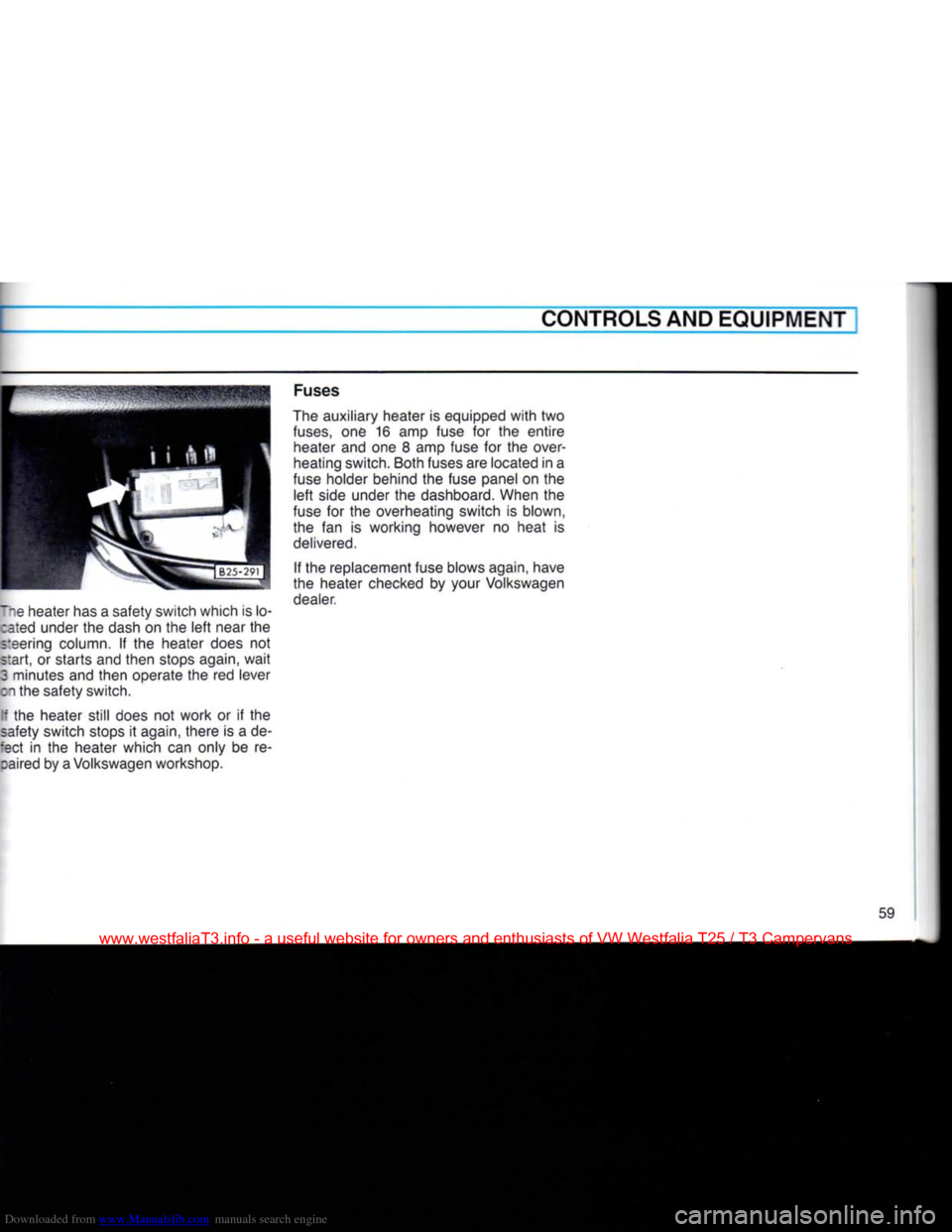
lie heater has a safety switch which is lo- :ated under the dash on the left near the
steering column. If the heater does not
start, or starts and then stops again, wait
3 minutes and then operate the red lever
on the safety switch.
[f the heater still does not work or if the
safety switch stops it again, there is a de-
:ect in the heater which can only be re- :aired by a Volkswagen workshop. Fuses
The auxiliary heater is equipped with two
fuses,
one 16 amp fuse for the entire heater and one 8 amp fuse for the over
heating switch. Both fuses are located in a
fuse holder behind the fuse panel on the left side under the dashboard. When the
fuse for the overheating switch is blown,
the fan is working however no heat is
delivered.
If the replacement fuse blows again, have
the heater checked by your Volkswagen dealer.
59
www.westfaliaT3.info - a useful website for owners and enthusiasts of VW Westfalia T25 / T3 Campervans
Page 70 of 165
![VOLKSWAGEN TRANSPORTER 1990 T4 / 4.G Owners Manual Downloaded from www.Manualslib.com manuals search engine
3REAK-IN
PERIOD
VEHICLE
OPERATION]
DURING AND
AFTER
BREAK-IN PERIOD
Turing
the first few operating
hours,
the
r-gines
internal](/img/18/7415/w960_7415-69.png "VOLKSWAGEN TRANSPORTER 1990 T4 / 4.G Owners Manual Downloaded from www.Manualslib.com manuals search engine
3REAK-IN
PERIOD
VEHICLE
OPERATION]
DURING AND
AFTER
BREAK-IN PERIOD
Turing
the first few operating
hours,
the
r-gines
internal")
Downloaded from www.Manualslib.com manuals search engine
3REAK-IN
PERIOD
VEHICLE
OPERATION]
DURING AND
AFTER
BREAK-IN PERIOD
Turing
the first few operating
hours,
the
r-gine's
internal friction is higher than
a:er
when all the moving parts
have
been
:-oken
in. How well this break-in
process
e
done
depends
to a
considerable
extent
:n
the way the
vehicle
is driven during the
-"-3t
900
miles
(1500 kilometers).
For
the first 600 miles
(1000 kilometers):
•
Do not use full
throttle.
•
Do not drive faster
than
3A of top
speed.
•
Avoid high engine speeds.
From
600 to 900 miles
(1000 to 1500 kilometers):
The
speed
can gradually be
increased
to
:he
maximum road
speed
or
engine
speed.
After break-in period
The maximum permissible engine speed
is
5200
rpm and should not be exceeded.
Shift into the higher gear before reaching the red area at the end of the scale of
the tachometer. See page 41.
Excessive
engine
speeds
are automati
cally
reduced.
•
Details
on how to operate the
Manual
and
Automatic
transmission
are outlined
in
the
"Controls
and
equipment"
chapter.
•
Avoid full
throttle
starts and abrupt
stops.
•
Try to avoid running the engine at
maximum speed. Shifting up early helps
to save fuel and reduces noise.
•
Do not overstrain engine; select pro
per gear before reaching top speeds.
•
Do not let engine labor. Shift down
when engine no longer runs smoothly.
•
All
revs
are only
valid
when
engine
is
properly
warm.
•
Always
observe
local
and national
speed
limits.
Applies
in addition to vehicles
with
Automatic
Transmission:
Make
it a habit to
accelerate
gradually
instead
of
using
full throttle. During
gra
dual
acceleration
the
transmission
shifts
earlier
into the next higher
gear
thus
saving
fuel.
WARNING
•
New tires do not
possess
maximum
traction. They tend to be slippery. Break new tires in by driving cautiously
at moderate speed for the first 100 miles (160 kilometers).
•
New brake pads and linings do not
have optimum friction properties and
must be "broken in" during the
initial
100 to 150 miles (150 to 200 kilometers)
of normal city driving. You can compen sate for this by applying more pressure
on
the brake pedal. This also applies
later
when new pads or linings are
installed.
www.westfaliaT3.info - a useful website for owners and enthusiasts of VW Westfalia T25 / T3 Campervans
Page 72 of 165
Downloaded from www.Manualslib.com manuals search engine
VEHICLE
OPERATION
In the
driver's
seat
•
Check operation of horn.
•
Adjust seat for easy reach of controls.
•
Adjust head restraints to your
size.
•
Adjust inside and outside rear view mir-
brs.
•
Use safety belts as directed.
•
Assure yourself
that
all passengers,
especially
children, are properly buckled up.
•
Check operation of
foot
and parking
orakes.
•
Check all warning and indicator lights
v/hen starting the engine.
•
Do not leave vehicle idling unattended.
•
Lock all doors
from
inside to prevent in advertent opening of doors
from
inside
and unwanted
entry
from
outside. On the
road
•
Always drive defensively. Expect the
unexpected.
•
Observe speed
limits
and obey road
signs.
•
Use signals to indicate
turns
and lane
changes.
•
Turn on headlights at dusk.
•
Always keep a safe distance
from
the
vehicle in
front
of you, depending on
traf
fic, road and weather conditions.
•
Reduce speed at
night
and during incle
ment weather.
•
If you smell gas fumes in the vehicle,
drive
with
the windows open, but keep the rear lid
closed.
Have the cause im
mediately located and corrected.
•
Make frequent rest stops, at least
after
every two hours of driving.
•
When
tired
pull off the road, stop and
take a rest. Turn the engine off. Do not sit in the vehicle
with
engine idling. Engine exhaust is dangerous if inhaled.
•
When stopped or parked, always set
the parking brake. Move the selector lever
to "P" (Automatic transmission) or move
the gearshift lever to reverse or
first
gear (Manual transmission). When parking on
hills,
turn
wheels
toward
the curb.
•
When stalled or stopped for repairs,
move the vehicle well off the road. Turn on
emergency flasher and use other warning
devices
to alert other motorists. Do not park or operate the vehicle in areas where
the hot exhaust system may come in
con
tact
with
dry
grass,
brush, fuel spill or other material which can cause a fire.
•
Make it a habit to have the engine oil
checked
with
every fuel filling.
www.westfaliaT3.info - a useful website for owners and enthusiasts of VW Westfalia T25 / T3 Campervans