Page 97 VOLKSWAGEN TRANSPORTER 1992 T4 / 4.G User Guide
[x] Cancel search | Manufacturer: VOLKSWAGEN, Model Year: 1992, Model line: TRANSPORTER, Model: VOLKSWAGEN TRANSPORTER 1992 T4 / 4.GPages: 164, PDF Size: 25 MB
Page 29 of 164

Downloaded from www.Manualslib.com manuals search engine
CONTROLS
AND EQUIPMENT
igggage
compartment cover*
I
-
/ehicles with
a
rear seat bench,
a
lug-
zazs
compartment cover
can
be
installed, :e rending
on the
vehicle version.
~en loading,
the
luggage compartment
::.
er
can
be
tipped upwards.
Attention
When
the
vehicle
is
moving
no
persons,
animals
or
heavy items
of luggage
are to be
carried
on
the luggage compartment cover
- danger
of
injury when brakes are applied suddenly
or
when vehicle
is
involved
in
an
accident.
further important instructions
on
oading are
to
be
found
on
page 28.
27
www.vwT4camper.info - a useful website for owners and enthusiasts of VW T4 Transporter Campervans
Page 30 of 164

Downloaded from www.Manualslib.com manuals search engine
CONTROLS AND
EQUIPMENT
Luggage
compartment/load
surface
To
enlarge
luggage
space
Lower
backrest and seat as described on
page 23.
Notes
on loading
In the interests of good handling ensure
that
the load (persons and luggage) is distributed evenly. Heavy items should always be carried as near to the rear axle as possible or
better still, between the
axles.
The permissible axle and gross
weights must not be exceeded under any circumstances.
Attention
• It should be noted
that
when
transporting heavy items the handling
will
change due to the
displacement of the centre of
gravity. Driving style and speed must be altered to suit.
• The load must be stowed so
that
no items of luggage can fly
forward if brakes are applied suddenly. - If necessary use the lashing
eyes.
• One should ensure
that
the heater el
ements in the rear window on the Variant
are not damaged by articles rubbing against
them.
• The stale air
escapes
through ventilation openings at the rear. The function of these openings must not be impaired.
Attention
• When vehicle is on the move no persons may be in the luggage
compartment. This includes
children.
Every passenger must
be belted in properly - see page
15.
• Never drive
with
the tailgate or
wing doors not properly closed otherwise exhaust gas can be
drawn
into
the vehicle
interior.
On
vehicles
with
lashing eyes the load
should always be secured to the
eyes.
Each
eye has a tensile strength of 500 kg.
28
www.vwT4camper.info - a useful website for owners and enthusiasts of VW T4 Transporter Campervans
Page 31 of 164

Downloaded from www.Manualslib.com manuals search engine
CONTROLS AND EQUIPMENT
3edals
• e ~ cvement of the pedals must not be re-
:: :~is reason, do not put articles in the
—•".•.ell which could roll or slide underneath
—-E-
zedals.
•Vr^-d the pedal area there should not be •r. -;otmatsorotheradditionalfloorcover- •: -aterials:
• In the
case
of defects on the brake sys-
r~
3 greater pedal travel may be
necess-
• : should always be possible to depress
~3
: _tch and accelerator pedals fully.
• - pedals must be able to return, unhin-
z-z'^z.
to their rest positions,
""•e'efore, the only
foot
mats which may be
are those which leave the pedal area
::—oletely free and which are prevented . " slipping. Brakes
The following points are of particular import
ance
to the safe operation of the brakes.
• New brake linings must also be run in and do not have the optimum
friction
prop
erties during the
first
200 km. The slightly reduced braking effect can be compen
sated for by more pressure on the brake
pedal.
This also applies when new linings have been fitted.
• If the brake pedal travel increases suddenly, it may be
that
one of the two
brake circuits has failed. You can still drive
on to the next Volkswagen dealer but be prepared to use more pressure on the pedal
and allow for longer braking distances on
the way.
• The brake
fluid
level must be checked regularly-see page 105.
The brake warning lamp
will
come on to indi cate
that
the brake
fluid
level is too low (see
also
page 48).
• Brake lining wear depends to a large ex
tent
on the operating conditions and style of driving. On vehicles which are used mainly in
town
traffic
and stop/start conditions or
are driven hard it may be necessary to have
the thickness of the brake linings checked by a Volkswagen dealer in between the in
tervals given in the Service Schedule.
• Change down in good time when driving downhill, in orderto make use of the engine braking effect. This relieves strain on the
brake system. When the brakes are applied do not keep them on con::rjc_s , =" .
and release alternately.
• Under certain operating conditions, *c example after driving through water, a^e' heavy rain or after washing the vehicle the
braking effect may be retarded by wet, or in
winter iced-up brake discs and linings - the brakes must be dried out
first
by applying
the footbrake.
The
full
braking effect may also be delayed when vehicle has been driven for some time
on heavily salted roads
without
using the
brakes,
because the layer of salt on discs
and pads has to be removed
first.
Attention
If a
front
spoiler,
full
size
wheel
trims
etc., is
retrofitted,
it is necessary to
ensure
that
the
flow
of air to the
front
brakes
is not re
stricted
-
otherwise
the
brakes
can
overheat.
www.vwT4camper.info - a useful website for owners and enthusiasts of VW T4 Transporter Campervans
Page 32 of 164

Downloaded from www.Manualslib.com manuals search engine
CONTROLS AND EQUIPMENT
Brake servo Attention
The servo
is
operated
by
vacuum which
is
only generated when
en
gine
is
running.
For
this reason
the vehicle should
not be
allowed
to roll with
the
engine switched off.
When
the
brake servo
is not
working because,
for
example,
the vehicle
is
being towed
or be
cause
a
defect
has
occurred
on
the brake servo itself,
the
brake pedal must
be
pressed consider
ably harder
to
compensate
for
the absence
of
servo assistance. Anti-locking brake system
*
The ABS plays a major part in increasing the
active safety of the vehicle. The big advan
tage when compared with a conventional brake system is that even when braking
hard on a slippery road surface the best
possible steerability is retained for the road
condition because the wheels do not lock.
However, one must not expect the ABS sys
tem to shorten the braking distance in all conditions. When driving on gravel or on
fresh snow covering a slippery surface, i.e.
when one should be driving very carefully in
any case, the stopping distance may even be slightly longer.
How
the ABS
system works
When the turning speed of a wheel reaches
a level which is too lowforthe vehicle speed
and it tends to lock, the brake pressure to
this wheel is reduced. On the front axle the brake pressure is regulated for each wheel
individually, whereas on the rear axle, the
pressure is regulated for both wheels at the
same time. As a result the braking effect is
the same for both rear wheels and the driv ing stability is retained as far as possible.
This regulating process makes itself known by movement of the brake pedal and is ac
companied by noises. This is done deliber
ately as a warning to the driver that a wheel
or the wheels are in the locking range. So
that the ABS can regulate effectively in this range the brake pedal must remain de pressed - on no account should it be
pumped!
Attention However
the ABS
system cannot
overcome
the
physical limits.
This must
be
borne
in
mind par
ticularly
on
slippery
or wet
roads.
When
the ABS
comes into
the
control range
the
speed must
im
mediately
be
adapted
to the
road
and traffic conditions.
The in
creased amount
of
safety avail
able must
not
tempt
one
into tak ing risks.
If a defect occurs on the ABS it is indicated
by a warning lamp - see page 49.
www.vwT4camper.info - a useful website for owners and enthusiasts of VW T4 Transporter Campervans
Page 37 of 164

Downloaded from www.Manualslib.com manuals search engine
CONTROLS
AND EQUIPMENT
Notes on driving Starting
\
e
engine
can only be started when
selec-
pr
ever
is at
"N"
or
"P".
See
also
"Starting
Br:
re" on
page
37.
Selecting
a driving range When the vehicle is stationary and
the engine is running always de
press
the foot brake when selecting
i gear.
When the vehicle is stationary do
•ot depress the accelerator when
•electing a gear. f the lever is moved accidentally nto "IM" when driving, release ac
celerator and let the engine speed
trop to idling before selecting a for
ward
gear again.
•
Attention
•
When the engine is running it
is
necessary to hold the vehicle
with
the foot brake in all gears.
Because
with
an automatic gear
box the transfer of power is not
fully interrupted even at idling
speed
- and the vehicle tends to
"creep".
When the vehicle is stationary
and a gear is engaged, the
throttle
must not be opened inad
vertently
on any account (for in
stance
by hand from the engine
compartment). Otherwise the vehicle
will
move immediately -
even if the handbrake has been
fully applied.
Before working on the vehicle
with
the engine running, apply
the handbrake and put the selec
tor lever in "P".
Moving off
Select
driving
range
(R, D, 3, 2, 1).
Wait
until
the gearbox has
shifted
and the
power
flow
is made to the
driving
wheels
(light
selection
jerk
perceptible).
Then
one can accelerate.
Stopping
To
stop
vehicle
temporarily
such
as at traffic
lights,
it is only
necessary
to
apply
the
brakes.
It is not
necessary
to
move
selector
lever
to
"N".
The
engine
should
however
only
be running at idling
speed.
Parking
On
level
ground all you
need
do is
engage
the
parking
lock.
On a gradient the
hand
brake
should
be
applied
firmly first
and
then
the
parking
lock
engaged.
This
will
ensure
that the
locking
mechanism
is not too
heav
ily
loaded
and
makes
the
lock
easier
to
dis
engage.
Tow starting
On
vehicles
with
automatic
gearbox
the en
gine
cannot
be started by towing or
pushing
the
vehicle.
See
page
133.
When
the battery is flat, the
engine
can be
started
from the battery of another
vehicle
by
using
jumper
cables.
See
"Emergency
starting",
page
130.
Towing If the
vehicle
has to be towed at any time,
you
must
read
the instructions in the
sec
tion
"Towing/tow
starting on
page
132.
www.vwT4camper.info - a useful website for owners and enthusiasts of VW T4 Transporter Campervans
Page 39 of 164

Downloaded from www.Manualslib.com manuals search engine
CONTROLS AND EQUIPMENT
Starting
the
engine
General
hints
Attention
When
starting
the
engine
in con
fined
spaces
there
is a
danger
of poisoning.
• Before starting, move gear lever to neu- ml
(with
automatic gearbox, selector lever -
"P"
or "N" position) and apply handbrake
I 'mly.
• On vehicles
with
a manual gearbox de-
:"9ss
the clutch pedal when operating
=:arter
so
that
starter only has to
turn
en
gine.
• As soon as engine starts, release the gnition key so
that
starter can disengage.
• After starting a cold engine it may sound
_oisy
for a moment or two because the oil pressure has to build up in the hydraulic
tappets
first.
This is normal and no cause for
a
arm. Do not
warm
engine
up by run-
W>
ning
it
with
vehicle
stationary.
Drive
off
straight
away.
Do
not overrev or use
full
throttle
until the
engine has reached the normal operating
Temperature. • On vehicles
with
a
catalytic
con
verter
the
engine
must
not be
started
by
towing
the
vehicle
in ex
cess
of 50 m.
Otherwise
unburnt
fuel
can pass
into
the
converter
and
lead
to
damage.
•
Before
trying
to
start
engine
by
towing,
the
battery
from
another
ve
hicle
should be used for
starting
if
possible - see
page
130.
Petrol
engines
These
engines are equipped
with
a cer: ~-
jection system
that
automatically s^c; es the correct fuel/air mixture at ail anc e~:
temperatures.
When
engine is cold or at
operating
temperature
do not accelerate before or
during the starting procedure.
Applicable to all engines:
If the engine does not start at once, stop
using
the starter after 10
sees,
wait about
half a minute and then try again. If the engine still does not start, the electric
fuel pump fuse may have blown - see page
122.
When
the engine is
very
hot it may be
necessary
to accelerate slightly after the
engine has started.
37
www.vwT4camper.info - a useful website for owners and enthusiasts of VW T4 Transporter Campervans
Page 40 of 164

Downloaded from www.Manualslib.com manuals search engine
CONTROLS AND EQUIPMENT
Diesel
engines
Glow plug system
The
engine is
fitted
with
a glow plug
sys
tem.
The required glow plug warm-up time
is
indicated by a lamp which is controlled by
the coolant temperature - see page 49.
Cold
starting
aid
To
assist cold starting, there is a device (cold starting aid)
fitted
in the injection
pump.
The
cold starting aid is actuated when the knob on the
left
of the steering column is
fully
pulled out.
Starting
a cold
engine
• At ambient temperatures down to -15
degrees
C, pull the cold start knob our
fully
before operating the starter.
At lower temperatures, the knob should not
be
pulled out
until
engine
is
firing
reg
ularly
- the engine will then start more
readily.
• Turn the key in the ignition lock to
posi
tion 2 (see page 36) - the glow plug warning lamp comes on. It goes out when the igni
tion temperature is reached (see page 49).
While
the
glow
plugs are
working
do not
switch
on any
other
heavy
cur
rent
consumers because
this
would
place an unnecessary load on the
battery.
• When the warning lamp goes out, start the engine immediately.
Do
not depress the accelerator while start
ing.
If the engine only fires irregularly, continue
to operate the starter a few seconds longer (30 seconds at maximum) until the engine runs under its own power.
If the engine does not start, switch the glow
plugs on again and try starting it again as de
scribed.
If the engine still does not start the
fuse for the glow plugs may have blown -
page123.
•
Push
the cold start aid knob in fully as
soon
as the engine has reached its normal
operating temperature.
Starting
a
warm
engine
The
glow plug lamp does not come on - the engine can be started straight away. Do not pull the cold start aid knob and do not press
the accelerator pedal.
38
www.vwT4camper.info - a useful website for owners and enthusiasts of VW T4 Transporter Campervans
Page 42 of 164
Downloaded from www.Manualslib.com manuals search engine
CONTROLS AND EQUIPMENT
Instruments
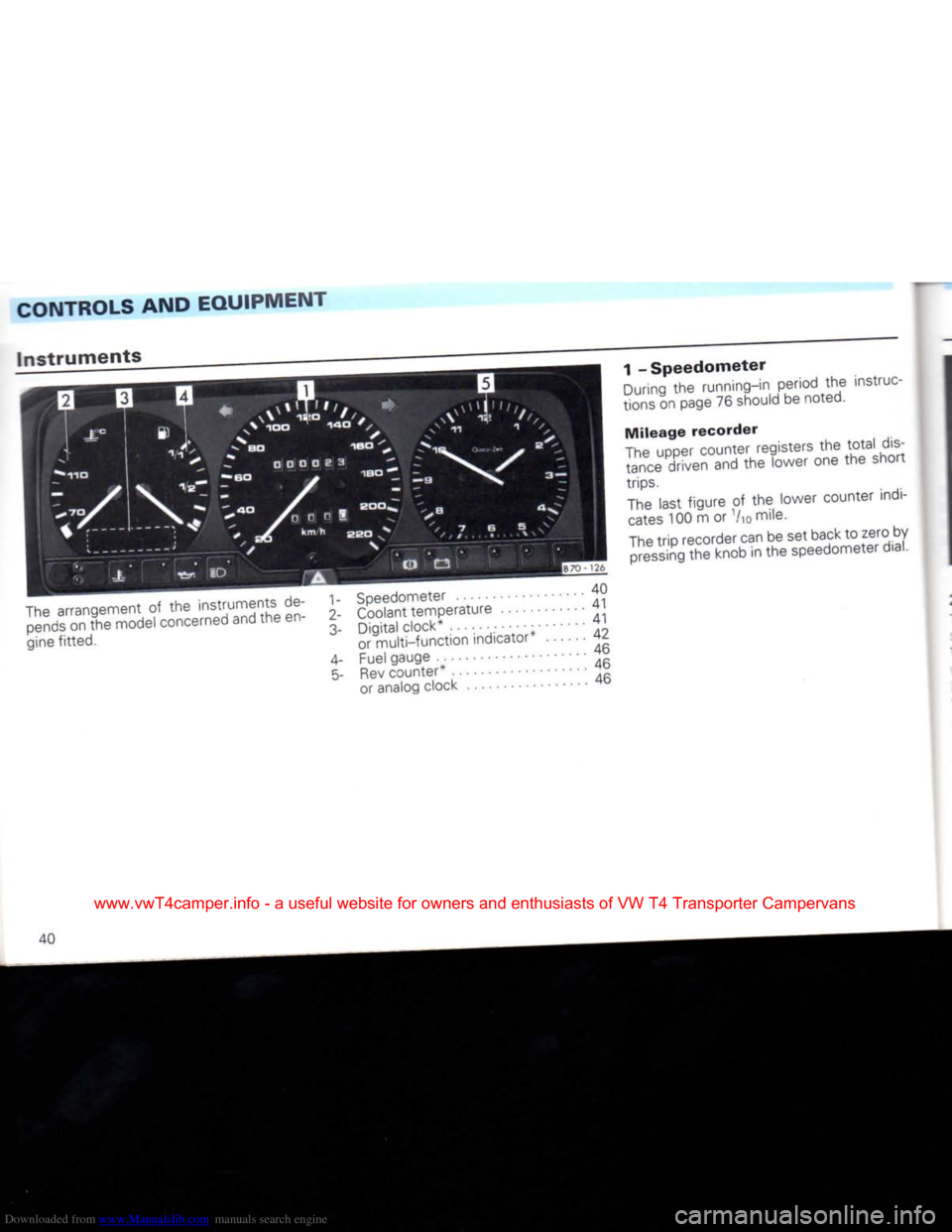
The arrangement of the instruments de pends on the model concerned and the en
gine fitted. 70 - 126
1-
Speedometer 40
2-
Coolant temperature 41
3- Digital clock* 41 or multi-function indicator* 42
4-
Fuel gauge 46 5- Rev counter* 46 or analog clock 46 1 - Speedometer
During the running-in period the instruc
tions on page 76 should be noted.
Mileage recorder
The upper counter registers the total dis
tance driven and the lower one the short
trips.
The last figure of the lower counter
indi
cates 100 m or Vio mile.
The trip recorder can be set back to zero by pressing the knob in the speedometer
dial.
40
www.vwT4camper.info - a useful website for owners and enthusiasts of VW T4 Transporter Campervans
Page 43 of 164
Downloaded from www.Manualslib.com manuals search engine
CONTROLS AND EQUIPMENT
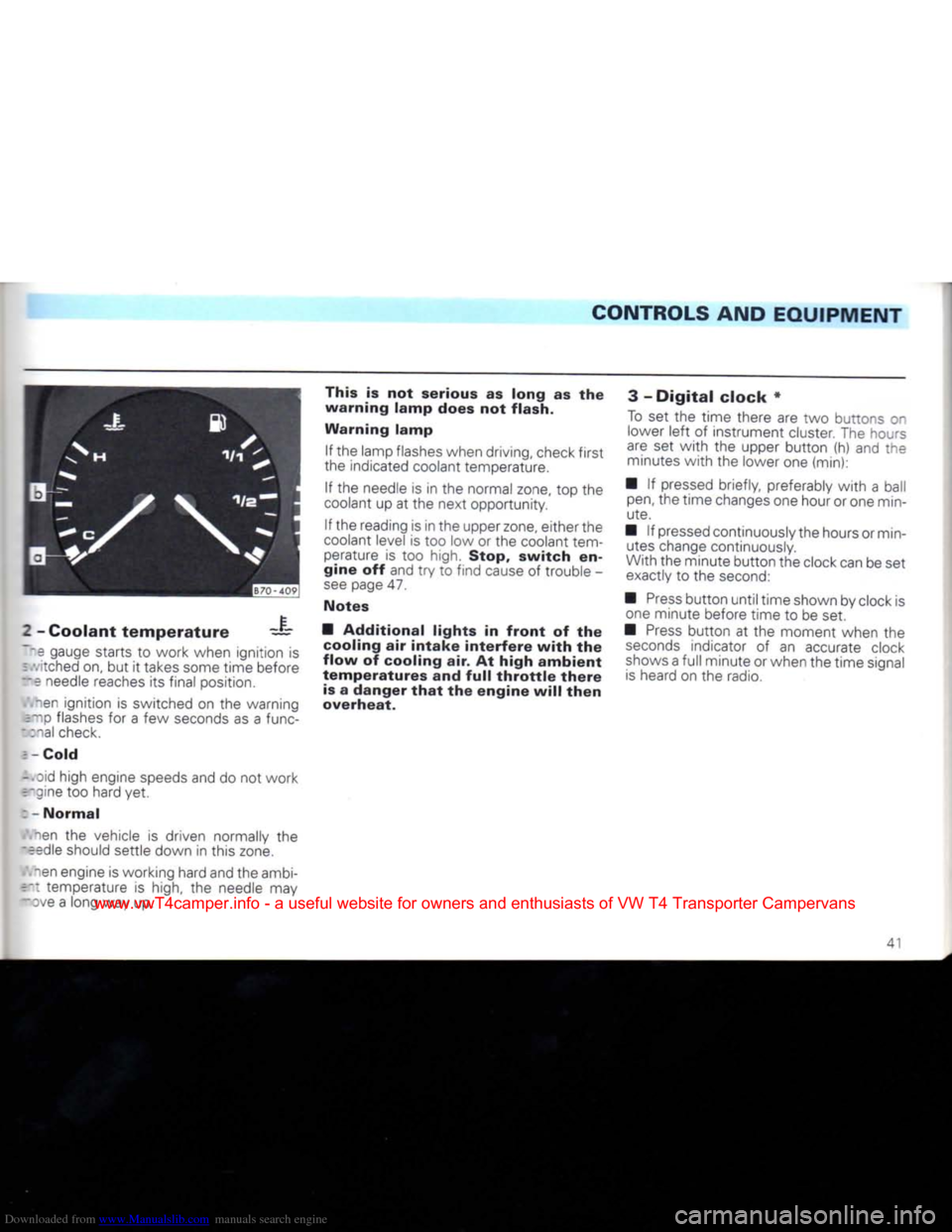
2
-
Coolant temperature
—
~~s
gauge starts
to
work
when ignition
is
=
.vitched on,
but it
takes some time before
~e needle reaches
its
final position.
-en ignition
is
switched
on the
warning
c~ip flashes
for a few
seconds
as a
func-
•
:nal check.
5
- Cold
-. Did
high
engine speeds and
do not
work
r-gine
too
hard
yet.
:
- Normal
nen
the
vehicle
is
driven normally
the
~eedle
should settle
down
in
this zone.
-en engine
is
working hard and the ambi-
r~t
temperature
is
high,
the
needle
may
-ove
a
long
way up. This is not serious as long as the
warning lamp does not flash.
Warning lamp
If
the lamp flashes when driving, check first
the indicated coolant temperature.
If the
needle
is in the
normal zone,
top the
coolant
up at the
next
opportunity.
If
the reading
is
in the upper zone, either the
coolant level
is too low or the
coolant tem
perature
is too
high.
Stop,
switch
en
gine off
and
try to
find cause
of
trouble
-
see
page 47.
Notes
•
Additional
lights
in
front
of the cooling air intake interfere
with
the
flow
of cooling air. At
high
ambient
temperatures and
full
throttle
there is a danger that the engine
will
then
overheat.
3
-
Digital clock
*
To
set the
time there
are two
buttons
on
lower left
of
instrument cluster.
The
hours
are
set
with
the
upper button
(h) and the
minutes
with
the
lower one
(min):
•
If
pressed briefly, preferably
with
a ball
pen,
the time changes one hour
or
one min
ute.
•
If
pressed continuously the hours
or
min
utes
change continuously.
With
the minute button the clock can be set exactly
to the
second:
•
Press button until time shown
by
clock
is
one minute before time
to be set.
•
Press button
at the
moment when
the
seconds
indicator
of an
accurate clock
shows a full minute
or
when the time signal
is
heard
on the
radio.
41
www.vwT4camper.info - a useful website for owners and enthusiasts of VW T4 Transporter Campervans
Page 45 of 164
Downloaded from www.Manualslib.com manuals search engine
CONTROLS AND EQUIPMENT
call up the data the memories are se-
r ::ed by means of the switch A in the wiper
- Single journey memory
'- - Total journey memory
_~e
"allowing data can be obtained from the ~ r~iories:
• Driving time • -verage fuel consumption
• Distance driven
• -verage speed
E-asing the
memories
:~ the ignition switched on, both mem-
: es can be erased separately in each
: :ch position by pressing switch A : --sed the appropriate detent position to 0
::; tion for longer than one
second.
" :~.e battery is disconnected for any rea-
::" the stored information is automatically
Ksed.
The displays
When
the ignition is switched on
"MF11"
or
"MFI 2" appears in the display according to
which memory is switched on.
No symbol -
Time
The
time is shown even when the ignition is switched off.
The
time can be set
with
the buttons (h and min) on the lower
left
of instrument cluster
- see "Digital
Clock"
page 41.
—'— -
Driving
time
In
switch
position 1 the driving time
which has elapsed since ignition was
switched on or the memory cancelled is indicated - see previous page also "Single
journey memory".
In
switch
position 2 the total driving
time for all individual journeys is indicated -
see
previous page also "Total journey mem
ory".
The
maximum time in both switch positions
is
99 hours 59 minutes. When this figure is
exceeded
the indication starts at zero again. MPG
(1/100
km) -
Average
fuel
consumption
The
average consumption is indicated not
the actual consumption at the time of read
ing.
The
average fuel consumption is indicated,
after switching on the ignition or erasing the memory being
used,
after a distance of
about 100 metres. Up to this point a dash
appears
instead of a figure. When vehicle is moving the indicated value is up-dated
every 5
seconds.
In
switch
position 1 the average
con
sumption for the single journey is indicated.
In
switch
position 2 the average
con
sumption indicated is
that
obtained during
all
single journeys - see "Total journey memory" on previous page
also.
Note
The
amount of fuel used is not indicated.
43
www.vwT4camper.info - a useful website for owners and enthusiasts of VW T4 Transporter Campervans