Page 49 VOLKSWAGEN TRANSPORTER 1992 T4 / 4.G Repair Manual
[x] Cancel search | Manufacturer: VOLKSWAGEN, Model Year: 1992, Model line: TRANSPORTER, Model: VOLKSWAGEN TRANSPORTER 1992 T4 / 4.GPages: 164, PDF Size: 25 MB
Page 112 of 164

Downloaded from www.Manualslib.com manuals search engine
GENERAL
MAINTENANCE
Wheels
General
notes
• New tyres do not give maximum grip straight away and should therefore be run in
at moderate speeds and a careful style of
driving for about the
first
100 km. This will help to make the tyres last longer.
• Check tyres for damage from time to time (cuts, splits, cracks and lumps) and remove any foreign bodies embedded in the
treads.
• To avoid damage to tyres and wheels crive over curbs and similar obstacles very
slowly and as nearly at
right
angles as
poss
ible.
Damage
to wheels and tyres is not always
easy
to see, so if you
think
that
a wheel is
damaged,
it must be checked by a Volks
wagen dealer.
• Keep grease, oil and fuel off the tyres.
• Replace missing dust caps as soon as
possible.
• Mark wheels before taking them off so
that
they rotate in the same direction when put back on again. • When taken off, the tyres should be
stored in a
cool,
dry and preferably dark
place.
Tyres
which are not on wheels should be stored in a vertical position.
Tyre
life
Tyre life depends to a considerable extent on the following factors:
Inflation
pressure
The inflation pressure is very important par
ticularly at high
speeds.
Therefore, the pres
sures
should be checked at least once a month and before every long journey.
At this opportunity do not forget the spare
wheel:
• The spare wheel should always be in flated to the highest pressure required on
the vehicle.
Always
check the pressures when the tyres are cold.
When
warm,
the pressure is
higher
but do not
reduce.
The pressur
es
are given on page 147 and on a sticker on
the driver's door lock pillar.
Pressures
which are too high or too low
shorten
tyre
life - quite apart from the detri mental influence on vehicle handling.
Attention
At
continuous
high
speeds a
tyre
in
which
the pressure is too low
flexes
more
and
heats
up excess
ively.
This can cause
tread
separ
ation
and
tyre
blow
out.
pCU
A
pressure
which
is too low in- oo
creases
the
fuel
consumption
and
this
burdens
the
environment
unnecessarily.
Mode
of
driving
Fast
cornering, hard acceleration and viol
ent braking also increase
tyre
wear.
'0
www.vwT4camper.info - a useful website for owners and enthusiasts of VW T4 Transporter Campervans
Page 116 of 164

Downloaded from www.Manualslib.com manuals search engine
GENERAL
MAINTENANCE
Winter
tyres
In winter conditions winter tyres will dis
tinctly improve the vehicle's handling. This
applies
in particular to vehicles that are
equipped
with wide tyres.
Because
of their
construction (width, rubber mixture, tread
formation etc.) these tyres provide
less
trac
tion on ice and snow.
When
fitting
winter tyres note the follow
ing:
• Only radial ply winter tyres may be fitted.
The
factory recommended tyre
sizes
are
givenonpagel
46.
• To obtain the best possible handling
characteristics,
winter tyres must be
fitted
on all four wheels. • Winter tyres are no longer fully effective
when the tread has worn down to a depth
of 4 mm.
• All-weather tyres can also be used in
stead
of winter tyres.
• If you have a
flat
tyre the remarks on
using
the spare wheel on page 112 should
be
noted.
• Do not leave winter tyres
fitted
for an un
necessary
long period because when the
roads
are free of snow and ice the handling
with summer tyres is better.
For
environmental
reasons
summer
tyres
should
be
fitted
again
as soon as possible
because
normally
they
are
quieter
in
running,
tyre
wear
is
reduced
and the
fuel
consumption is
lower.
Snow chains
Snow chains may only be
fitted
on
the
front
wheels.
Snow
chains must not be
fitted
on 215/65 F
16
tyres. When
necessary
the vehicle mus:
be
equipped with smaller tyres - see
Wheels,page146.
Only
use thin chains which do not stanc
clear
more than 15 mm (including ten-
sioner).
When
using snow chains wheel
trim
plates
and
trim
rings must be taken off. For safet
reasons
the wheel bolts must then be f ittec
with caps which are available from
Volks
wagen
dealers.
When
driving over roads which are free of
snowyou
must remove the
chains.
On such
roads
they are detrimental to vehicle handl
ing,
damage the tyres and wear out quickly.
In Germany, the maximum permissible
speed
with snow chains is 50 km/h.
114
www.vwT4camper.info - a useful website for owners and enthusiasts of VW T4 Transporter Campervans
Page 117 of 164

Downloaded from www.Manualslib.com manuals search engine
GENERAL
MAINTENANCE
Arduous
operating
conditions
ne vehicle construction and equipment is
resigned for normal operating conditions.
his also applies to the frequency and the
extent of the maintenance laid down in the
service
Schedule.
f the vehicle is used in arduous operating
conditions (e.g. continuous trailer towing,
exceptionally high or low ambient tempera-
:ures,
very dusty conditions, poor quality
ruel,
etc.) it may be necessary to carry out
special
technical preparations, such as ;hanging the oil to the appropriate viscosity, ^stalling special air cleaners, modifying the
ignition timing etc. Furthermore, the main
tenance must also be matched to the oper
ating conditions - see also page 93.
Driving
abroad
If the vehicle is to be taken abroad, the fol
lowing must also be borne in mind:
• If the vehicle has a catalytic converter, one must ensure
that
unleaded petrol will be available during the journey - see
page 86.The automobile clubs offer infor mation about the unleaded filling station
network.
• Although there are more than 10 000
Volkswagen
dealers all over the world to
service
Volkswagen vehicles there are
countries in which only a limited amount of
service
is available or none at all.
• In certain countries it is also possible
that
your vehicle model is not soid so
that
certain
spare
parts will not be available or
that
the
Volkswagen
personnel are not familiar
with
the repair procedure should anything go
wrong.
The Volkswagen
Sales
Centres in Germany or the
Importer
concerned will be only too
pleased
to give advice on the necessary
technical preparation of the vehicle, on the maintenance required and on the repair
possibilities.
The addresses are given in the vehicle wallet. • When the vehicle is used in a country
which drives on the opposite side of the road to the home country the wedge
shaped
areas on the headlight lenses must be masked - see page 129.
Driving
on
holiday
Before starting off note the following
points:
• The roadworthiness and driving safety are particularly important when on holiday-
see
page 78.
• With a fully laden vehicle and/or roof rack, the handling changes. The driving
style must be adapted to the different condi
tions - more information on loading is given
on page 28.
The
tyre
pressures must be checked - see
page147.
• When a trailer is to be towed, there are many special points to note - see page 81.
• If an oil change or an Inspection Service
is
probably going to become necessary dur
ing the
trip,
it is advisable to have this work
done before going on holiday if possible.
115
www.vwT4camper.info - a useful website for owners and enthusiasts of VW T4 Transporter Campervans
Page 118 of 164

Downloaded from www.Manualslib.com manuals search engine
GENERAL
MAINTENANCE
Winter
driving
T
Ac
The an«
safe
high
ensi
supf
with
poin
sub:
tech latei
• /
fori
any
thro
SWc
pete
A
In
m
s<
V
G
u
P
SI
a
s|
r<
In winter the following points should be
noted:
• Winter weather is particularly hard on the
battery
and it should therefore be
checked,
preferably by a Volkswagen
dealer, before the onset of cold weather. If the vehicle is not driven for several weeks
when the temperatures are very low, the
battery
should be taken out - for
further
in
formation see page 107.
• On a vehicle
with
a Diesel engine, winter
Diesel
must be used at temperatures below
0 degrees C - see page 87.
• The water should be drained out of the
Diesel
fuel
filter
before the onset of
winter.
This
operation is also included in the Lubri cation
Service.
• The anti-freeze in the cooling system should be checked before the cold
season
starts - see page 101.
• The engine oil viscosity must be correct for the ambient temperature - see page 99.
• Particularly in
winter,
frequent washing and waxing of the vehicle is the best way to protect it against harmful environmental in
fluences.
• In winter the windscreen washer
sys
tem should always be filled
with
a window
cleaning solution containing an anti-freeze
additive.
• To remove snow and ice
from
the win dows and mirrors, a plastic scraper should be used - see page 90.
• The road holding and handling can be im proved in winter road conditions by the use
of winter or All-weather tyres - see pages 114and146.
• When driving in mountainous districts in winter it is advisable to take snow chains
with
you. On some such roads, snow chains
are obligatory - see also page 114.
www.vwT4camper.info - a useful website for owners and enthusiasts of VW T4 Transporter Campervans
Page 122 of 164
Downloaded from www.Manualslib.com manuals search engine
DO-IT-YOURSELF
Changing
wheels
Park
the vehicle as far as possible away
from the
traffic
flow, if necessary switch on emergency warning lights and place the
warning triangle in position - note legal re
quirements.
• All vehicles occupants should leave the vehicle and move to a safe area (e.g. behind
the barrier).
• Apply handbrake firmly. If the car is on a
slope,
block one of the wheels on the oppo
site side
with
a stone or some similar object.
• Take the tools out of the vehicle.
• Take spare wheel out of carrier at rear of vehicle - see previous page.
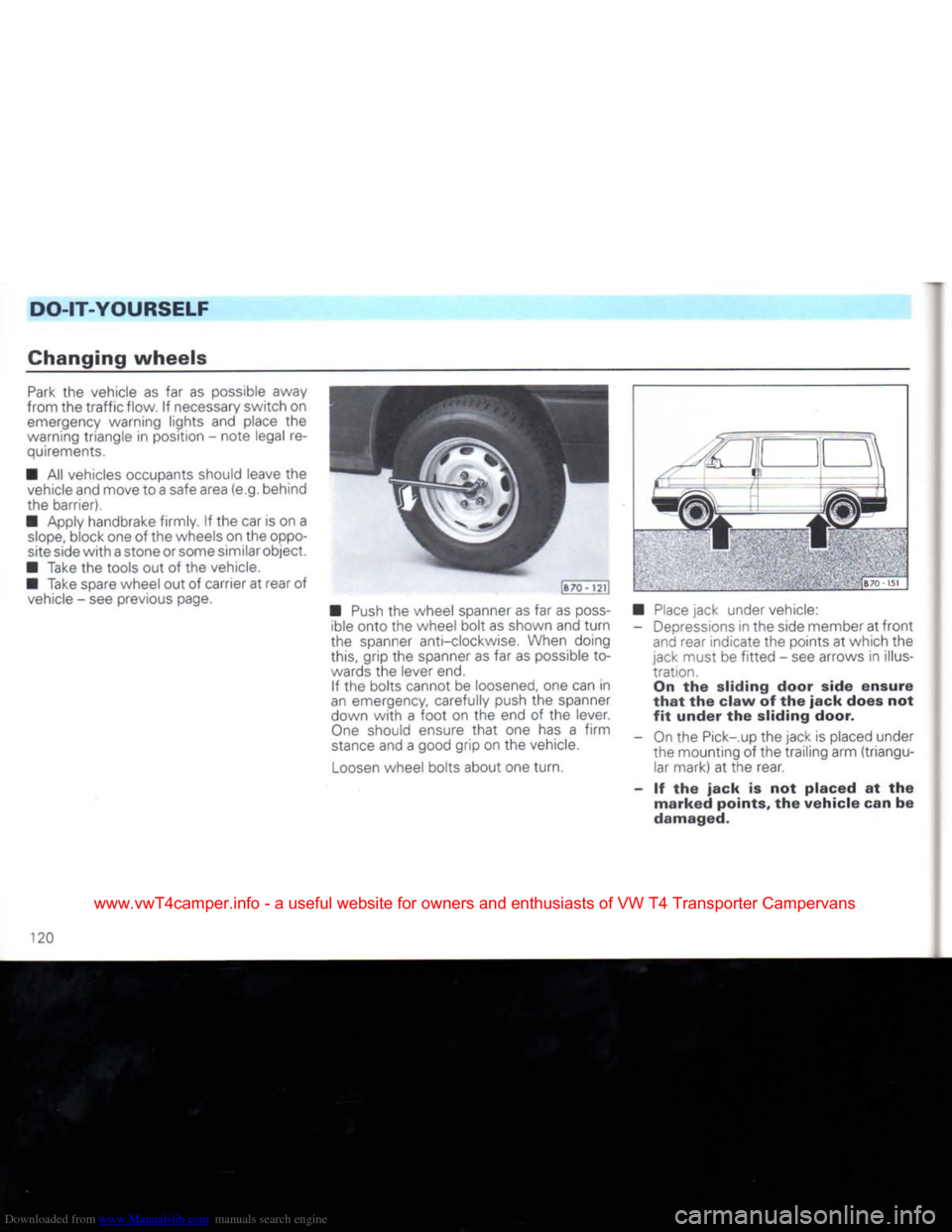
JB70
- 121J
•
Push
the wheel spanner as far as
poss
ible onto the wheel bolt as shown and
turn
the spanner anti-clockwise. When doing this, grip the spanner as far as possible to
wards the lever end.
If the bolts cannot be loosened, one can in
an emergency, carefully push the spanner
down
with
a
foot
on the end of the lever.
One
should ensure
that
one has a
firm
stance
and a good grip on the vehicle.
Loosen
wheel bolts about one turn. 8"" 1 •>!
•
Place
jack under vehicle: - Depressions in the side member at
front
and rear indicate the points at which the
jack must be
fitted
- see arrows in illus
tration. On the sliding door side
ensure
that
the
claw
of the
jack
does not
fit
under
the sliding door.
- On the Pick-.up the jack is placed under the mounting of the trailing arm (triangular mark) at the rear.
- If the
jack
is not
placed
at the
marked
points, the
vehicle
can be
damaged.
120
www.vwT4camper.info - a useful website for owners and enthusiasts of VW T4 Transporter Campervans
Page 123 of 164

Downloaded from www.Manualslib.com manuals search engine
DO-IT-YOURSELF
- Wind jack arm up by turning the crank handle
until
the jack
just
goes under the
vehicle.
- The claw of the jack must fit round the vertical rib on the side member so
that
the jack cannot slip when vehicle is
lifted
- see illustration.
- If the ground is soft, place a large strong
piece
of packing under the jack base
plate.
- Align jack and at same time wind claw up
further
until
it contacts the vertical rib on
side
member. •
Lift
vehicle
until
the defective wheel is
clear
of ground.
• Remove wheel bolts and place them on
a
clean surface (hub cap, cloth, paper) next
to the jack and take the wheel off.
• Fit spare wheel and lightly tighten all bolts. The wheel bolts must be clean and
easy
to
turn
- do not under any circum
stances
use grease or oil!
• Lowervehicleand fully tighten bolts indi- agonal sequence.
• Refit the wheel trim.
•
Place
defective wheel in spare wheel carrier and secure it - see page 119.
Notes
• Pay attention to the following after changing a wheel:
- Check the
tyre
pressure immediately on the spare wheel which has been fitted.
- Have the tightening torque of the wheel bolts checked
with
a torque wrench as
soon
as possible. The torque for steel
and alloy wheels is 160 Nm. If it has been established when changing
the wheel
that
wheel bolts are corroded and hard to screw in, they must be renewed be
fore checking the tightening torque.
Until these checks have been carried out
one should, for safety reasons, only drive at
a
moderate
speed.
• The defective wheel should be repaired
as
soon as possible.
Attention
If the
vehicle
is to be
subsequent
ly
fitted
with
wheels
or
tyres
which
differ
from
those
fitted
by
the
factory,
it is
essential
to
read
the
remarks
in the
centre
and
right
hand
columns on
page
113.
121
www.vwT4camper.info - a useful website for owners and enthusiasts of VW T4 Transporter Campervans
Page 124 of 164

Downloaded from www.Manualslib.com manuals search engine
DO-IT-YOURSELF
Fuses
The
individual current circuits are protected by fuses..
The
central electrics
with
the relays is on
the
left
in the footwell behind a hinged shelf. It is advisable to always carry a few spare
fuses
on the vehicle. These can be obtained
from any Volkswagen dealer. Changing a fuse
• Switch off the component concerned. • Take box or lid off by turning knob 90 de
grees
to
right
or
left,
then pull and unhook box or lid out of retainers at the bottom.
• With the aid of the list of fuses (see next
page),
determine which fuse belongs to the
component
that
has failed. • Pull out the fuse concerned.
• Replace blown fuse - can be recognised
by the burnt metal strip -
with
a fuse of
same
amperage.
• Insert box or lid by turning knob again
905
to
right
or
left,
hook box or lid on at bot
tom, swing up and press knob in.
Notes
• If the newly inserted fuse blows again after a short time, the electrical system must be checked by
a
Volkswagen dealer as
soon
as possible.
• On no account should fuses be
patched
up because
this
can cause
serious
damage
elsewhere
in the
electrical
system.
• Some of the components listed are only found on certain models or are optional ex
tras.
122
www.vwT4camper.info - a useful website for owners and enthusiasts of VW T4 Transporter Campervans
Page 134 of 164
Downloaded from www.Manualslib.com manuals search engine
DO-IT-YOURSELF
Tow
starting/towing
General
notes
• "owing eyes are provided on the
right
under
front
and rear bumpers.
Tow-ropes
or bars should be attached at
these
points only.
On
vehicles
with
a factory
fitted
towing bracket a towing eye is not fitted. On those
vehicles
the towing bracket can be used for
towing.
• The tow-rope should be slightly elastic to reduce the risk of damage to both ve
hicles.
It is advisable to use synthetic fibre
ropes,
or ropes of similar elastic material. It
is
however
safer
to use a
tow-bar!
Avoid
excessive towing
effort
and do not
jerk.
During towing operations on other than
surfaced
roads there is always the danger
that
the attachment points will be over
loaded
and damaged.
•
Before
trying
to
start
engine
by
towing,
the
battery
from
another
ve
hicle
should be used for
starting
if
possible - see previous page. If the
vehicle
has to be tow
started
or
towed
at any
time,
the
following
must
be noted:
•
Check
whether there are any local traffic regulations concerning the towing of ve
hicles.
• Both drivers must be familiar
with
tow ing procedures. Inexperienced drivers
should
not attempt to tow start or tow.
• When using a tow-rope the driver of the towing vehicle must engage the clutch very gently when moving off and changing gear.
• The driver of the vehicle being towed must ensure
that
the tow-rope is always
taut.
• The emergency lights must be switchec
on on both vehicles - unless local regula
tions differ.
• Turn ignition key to "Drive" position sc
that
the steering wheel is free and the
turr
signals,
horn, and, if necessary, the wind
screen
wiper and washer can be
used.
• As the brake servo only works when the engine is running, considerably more pres
sure
is required on the brake pedal when the
engine is not running.
• On vehicles
with
power assisted steer ing more force is required to
turn
steering
wheel when engine is not running.
• When there is no lubricant in the manua or automatic gearbox, the vehicle may only
be
towed
with
driving wheels lifted.
132
www.vwT4camper.info - a useful website for owners and enthusiasts of VW T4 Transporter Campervans
Page 135 of 164
Downloaded from www.Manualslib.com manuals search engine
DO-IT-YOURSELF
Tow
starting
The
following
points
must
be
noted
when
tow
starting:
•
Before
moving off, engage 2nd or 3rd gear.
• Switch ignition on.
• As soon as engine starts, depress clutch and move gear lever
into
neutral to avoid running
into
the towing vehicle.
• On
vehicles
with
a
catalytic
con
verter
the
engine
must
not be
started
by
towing
the
vehicle
in ex
cess of 50 m1. Because
then,
un-
burnt
fuel
can pass
into
the con
verter
and cause
damage.
• For
technical
reasons tow
start
ing a
vehicle
with
an
automatic
gearbox
is not possible.
Towing
When
towing
vehicles
with
an
auto
matic
gearbox,
the following points must be noted in addition to the details on
the previous page:
• Selector lever at "N".
• Do not have the vehicle towed faster than 30 mph (50 km/h).
• To not tow
further
than 30 miles (50 kilo meters). If the vehicle has to be towed long distances
it must be
lifted
at the
front.
Reason:
When the engine is not running,
the gearbox oil pump is not working and the
gearbox is not adequately lubricated for high speeds or long distances.
• With a breakdown vehicle the vehicle may only be suspended at the
front.
Reason:
If given a rear suspended tow, the
drive shafts
turn
backwards. The planetary
gears
in the automatic gearbox then
turn
at
such
high speeds
that
the gearbox will be
severely
damaged in a short time.
Does
not apply to 50 kW Diesel engine
with
catalytic converter
133
www.vwT4camper.info - a useful website for owners and enthusiasts of VW T4 Transporter Campervans
Page 137 of 164
Downloaded from www.Manualslib.com manuals search engine
DO-IT-YOURSELF
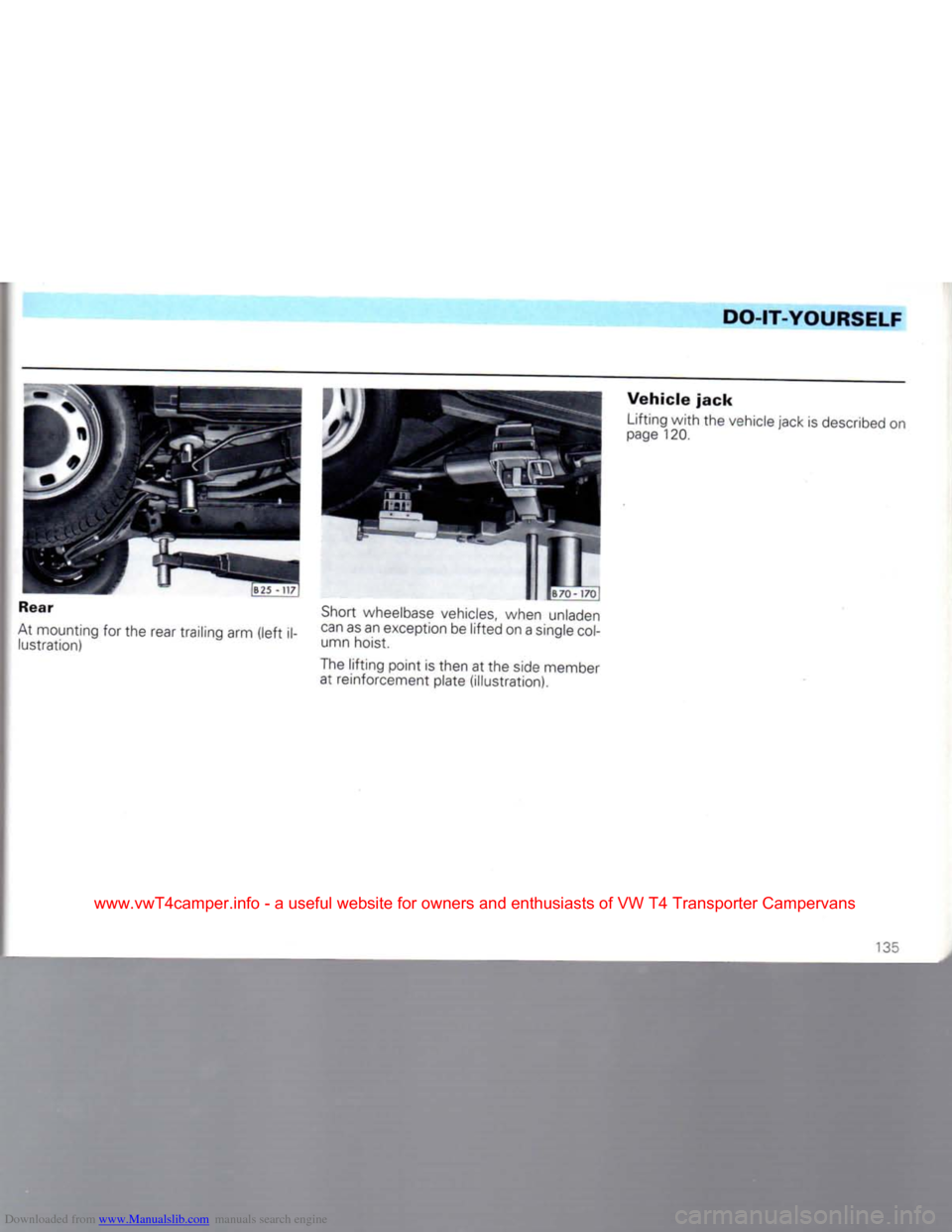
Rear
At mounting for the rear trailing arm (left i lustration) Short wheelbase vehicles, when unladen
can as an exception be lifted on a single
col
umn hoist.
The lifting point is then at the side member at reinforcement plate (illustration).
Vehicle
jack
Lifting with the vehicle jack is described on
page 120.
135
www.vwT4camper.info - a useful website for owners and enthusiasts of VW T4 Transporter Campervans