oil pressure VOLKSWAGEN TRANSPORTER 2010 User Guide
[x] Cancel search | Manufacturer: VOLKSWAGEN, Model Year: 2010, Model line: TRANSPORTER, Model: VOLKSWAGEN TRANSPORTER 2010Pages: 486, PDF Size: 69.28 MB
Page 354 of 486
A WARNING
Incorrect handling of engine oil can cause se-rious burns and other Injuries.
• Always wear eye protection when han-dling engine oil.
• Engine oil is toxic and must be stored out of the reach of children.
• Engine oil must be kept in the closed orig-inal container. This also applies to used oil until it is disposed of.
• Never use empty food containers, bottles or other containers to store engine oil as oth-er people may then drink the engine oil.
Warning and indicator lamps
A WARNING (Continued)
• Regular contact with engine oil can dam-age the skin. Skin that has been in contact with engine oil should be washed thoroughly with water and soap.
• Engine oil becomes extremely hot when the engine is running and can scald skin se-verely. Always allow the engine to cool down.
Leaking or spilt engine oil can pollute the en-(!Jtf vironment. Spilt service fluids must be collec-ted then disposed of properly and in an environ-mentally responsible way.
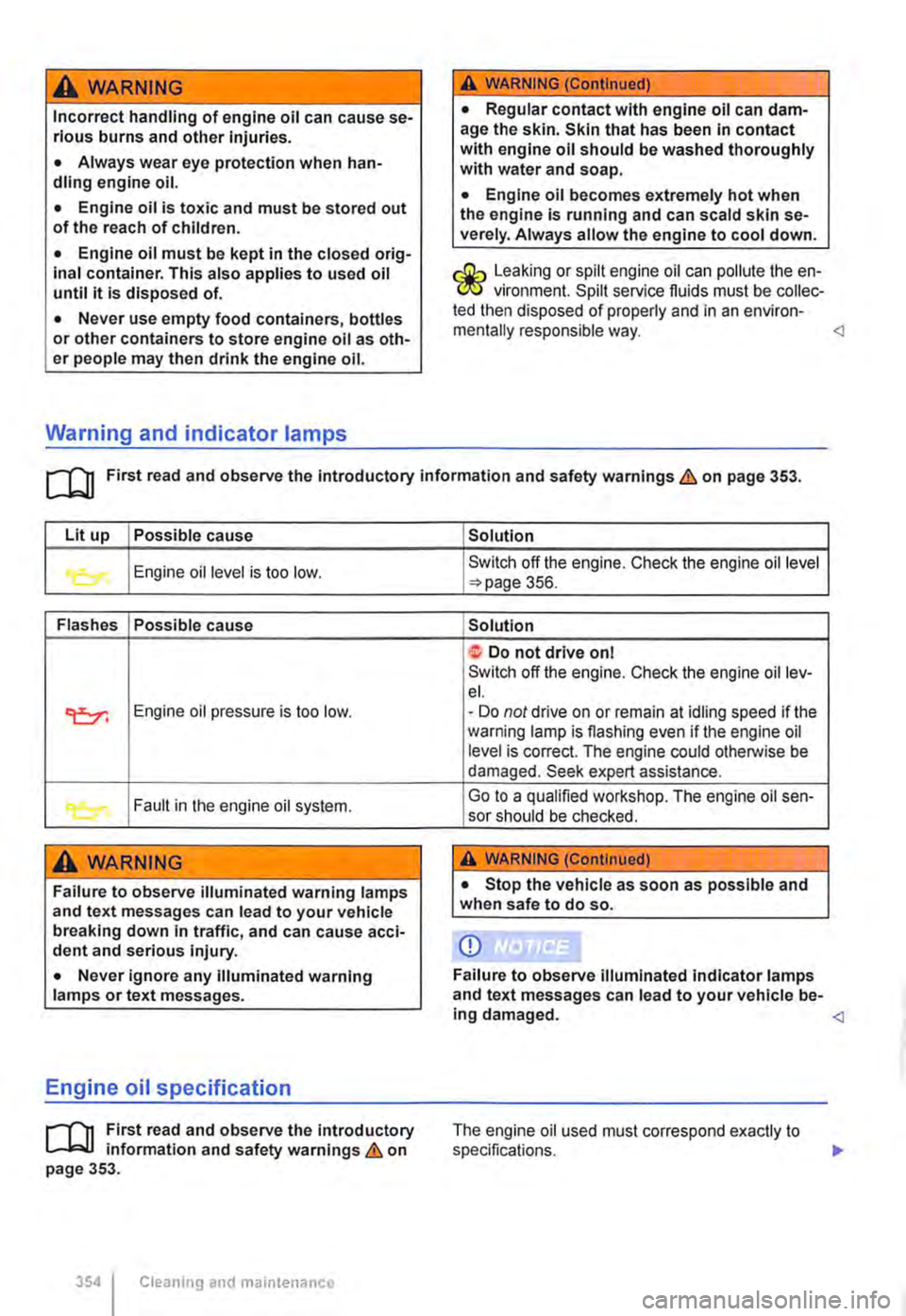
Lit up Possible cause
Engine oil level is too low. -
Flashes Possible cause
c:e:r. Engine oil pressure is too low.
r... Fault in the engine oil system.
A WARNING
Failure to observe illuminated warning lamps and text messages can lead to your vehicle breaking down in traffic, and can cause acci-dent and serious injury.
• Never ignore any illuminated warning lamps or text messages.
Engine oil specification
rT'n First read and observe the introductory L-J,::.U information and safety warnings & on page 353.
354 I Cleaning and maintenance
Solution
Switch off the engine. Check the engine oil level "'Page 356.
Solution
t Do not drive on I Switch off the engine. Check the engine oillev-el. • Do not drive on or remain at idling speed if the warning lamp is flashing even if the engine oil level is correct. The engine could otherwise be damaged. Seek expert assistance.
Go to a qualified workshop. The engine oil sen-sor should be checked.
A WARNING (Continued)
• Stop the vehicle as soon as possible and when safe to do so.
Q)
Failure to observe illuminated Indicator lamps and text messages can lead to your vehicle be-ing damaged.
Page 369 of 486
Storing tyres
Mark tyres before you remove them to indicate the direction of rotation. This ensures you will be able to mount them correctly when you replace them (left, right, front, rear). When removed, the wheels or tyres should be stored in a cool, dry and pref-erably dark place. Do not store tyres mounted on the rim vertically.
Any tyres not fitted on rims should be kept in suita-ble sleeves to protect against dirt and should be stored vertically (standing on the tread).
All-terrain tyres
Some vehicles can be fitted at the factory with "all-terrain tyres". These tyres have a deep-tread pro-file that alters the vehicle's driving properties (such as comfort, consumption, braking distance, corner-Ing behaviour, rolling noise)=>&.
A WARNING
Corrosive liquids and other substances can cause visible and Invisible damage to the tyres, which can cause the tyre to burst.
• Always keep chemicals, oils, lubricants, fuel, brake fluid and other corrosive substan-ces away from the tyres.
A WARNING
Old tyres (even if never used) can suddenly lose pressure or burst, especially at high speeds. This can cause accidents and seri-ous injuries.
• Avoid using tyres that are more than six years old. If you have no alternative, drive slowly and with extra care at all times.
Rims
,....-('n First read and observe the Introductory L-J.:.ll information and safety warnings & on page 367.
The design of the wheel bolts is matched to the rims. If different rims are fitted, the correct wheel bolts with the right length and correctly shaped bolt heads must be used. This ensures that wheels are fitted securely and that the brake system works properly =>page 420.
For technical reasons, it is not generally possible to use the wheels from other vehicles. This can al-so apply to wheels of the same vehicle type.
A WARNING
The deep-tread profile of all-terrain tyres can considerably increase the braking distance or cornering behaviour and thus cause acci-dents and serious injuries.
• Always bear the modified vehicle handling in mind, and drive carefully.
CD
Avoid heavy impacts and drive round obstacles whenever possible. Tyres, particularly low-pro-file tyres, can be considerably compressed and deformed by potholes and curb edges especial-ly. This can cause the tyre's webbing reinforce-ment to brake, and cause dents or rips on the side walls or deformations or cracks on the rims.
Old tyres should be disposed of as required !!IS by legislation.
Wheel bolts
Wheel boils must always be tightened with the cor-rect tightening torque =>page 420.
Rims with bolted-on rings
Rims with bolted-on rings consist of several com-ponents. These components are fastened using special bolts and special fastening technology. This ensures that the wheel functions proper1y, does not leak, remains safe and runs true. For this reason, damaged rims should be replaced. They may only .,..
Wheels and tyres I 369
Page 380 of 486
Vehicle care and maintenance
Caring for and cleaning the vehicle exterior
o:n Introduction
This chapter contains information on the following subjects:
Washing the vehicle . . . . . . . . . . . . . . . 381
Washing the vehicle with a high-pressure cleaner . . . . . . . . . . . . . . . . . . . . . . . . . . . 382 Cleaning windows and exterior mirrors . . . . . . 382
Cleaning and changing wiper blades 383
Waxing and polishing the vehicle 384
Cleaning and caring for chrome and aluminium trim parts . . . . . . . . . . . . . . 385
Cleaning and caring for the decorative film . . 385
Cleaning wheels . . . . . . . . . . . . . . . . . . . . . 386
Care of rubber seals . . . . . . . . . . . . . . . . . . . . . 386
De-icing door lock cylinders . . . . . . • . . . . . . . . 387
Undersea! . . . . . . . . . . . . . . . . . . . . . . . . . . . . . . 387
Cleaning the engine compartment . 387
Regular and expert care helps to maintain the val-ue of the vehicle. Proper maintenance may also be one of the requirements for the approval of warran-ty claims in the event of corrosion or paint defects.
Suitable care products are available from Volkswa-gen Commercial Vehicles dealers.
Additional information and warnings:
• Preparation for working in the engine compart-ment ::-page 350
• Cleaning and caring for the interior ::-page 388
• Accessories, modifications, repairs and renewal of parts ::-page 394
A WARNING
Car care products can be toxic and hazard-ous. Unsuitable care products and Incorrect application of care products can cause acci-dents, serious Injuries, burns or poisoning.
• The care product must be kept In Its origi-nal sealed container.
380 Cleaning and maintenance
A WARNING (Continued)
• Read the manufacturer's Instructions .
• Never store car care products in empty food containers, bottles or any other non-original containers as people finding these containers may not know that they contain care products.
• Keep children away from care products .
• The products can give off harmful fumes during use. They should therefore only be used outside or In well-ventilated spaces.
• Never use fuel, turpentine, engine oil, nail varnish remover or other volatile fluids to wash, clean or care for your vehicle. These substances are toxic and highly Inflammable.
A WARNING
Incorrect care and cleaning of vehicle parts can Impair the safety features of the vehicle and thus cause serious Injury.
• Vehicle parts must be cleaned according to the manufacturer's Instructions.
• Only use approved or recommended cleaning products.
CD
Cleaning agents that contain solvents attack the material and can cause damage.
r:Q:... In the interests of environmental protection, "C!S the vehicle should only be washed in special-ly provided wash bays. This prevents waste water contaminated with oil, grease or fuel from entering the sewerage system. In some countries, washing vehicles anywhere else may be prohibited.
r:Q:... Environmentally-friendly care products "C!S should be used.
r:Q:... Leftover car care products should not be dis-"C!S posed of with ordinary household waste. Read the manufacturer's instructions.
Page 381 of 486
Washing the vehicle
r-f'n First read and observe the introductory Information and safety warnings & on page 380.
The longer substances such as insects, bird drop-pings, resinous tree sap, road dirt, industrial de-posits, tar, soot or road salt and other corrosive materials remain on the vehicle, the more damage they do to the paintwork. High temperatures (for in-stance in strong sunlight) accelerate the corrosion process. The underside of the vehicle should also be cleaned thoroughly and regularly.
Car washes
Please observe the signs on the automatic car wash. Before using an automatic car wash take the usual precautions, such as closing all windows and folding in the exterior mirrors, in order to avoid damage to the vehicle. You must consult the car wash operator if there are special parts on your ve-hicle such as spoilers, roof luggage carrier systems or radio aerials ::.CD.
The paint is so hard-wearing that the car can nor-mally be washed without problems in an automatic car wash. However, the effect on the paint de-pends to a large extent on the design of the car wash. Volkswagen Commercial Vehicles recom-mends the use of car washes without brushes.
To remove any wax residue from the windows and to stop wipers rubbing, please note the following points ::.page 382, Cleaning windows and exterior mirrors.
Washing the car by hand
When washing by hand, first soften the dirt with plenty of water and rinse off as well as possible.
Then clean the vehicle with a soft sponge, a glove or a brush using only light pressure. Start with the roof and work from the top to the bottom. Use a shampoo for very stubborn dirt only.
The sponge or glove should be wrung out thor-oughly at regular intervals.
Clean the wheels, sill panels etc. last. Use a differ-ent sponge for this purpose.
A WARNING
Parts of the vehicle with sharp edges can cause Injury.
• Protect your hands and arms from cuts on sharp parts, for example when cleaning the underbody or the inside of the wheel hous-lngs.
A WARNING
After the car has been washed, the braking effect could set in later than normal and ex-tend the braking distance as the brake discs and brake pads will be wet, or iced up In win-ter.
• You can "dry and de-ice" the brakes by performing careful braking manoeuvres. Make sure that you do not endanger any oth-er road users or violate any legal regulations when doing so.
CD
• The water should be no warmer than +so•c (+140.FJ.
• Do not wash the vehicle in direct sunlight in order to avoid damage to the vehicle palntwork.
• Never clean with insect sponges, rough kitchen sponges or similar products as these can damage the surface.
• Never clean the headlights with a dry cloth or sponge. Always use a wet cloth or sponge. lt is best to use soapy water.
• Washing the vehicle In cold weather: if the vehicle is rinsed with a hose, do not direct the water at the lock cylinders or the gaps around the doors, boot, or bonnet. The locks and seals could freeze.
CD
Observe the following guidelines before driving the vehicle into an automatic car wash in order to avoid damage to the vehicle:
• Ensure that the gap between the guide rails In the car wash is sufficient for the vehicle track. If the track is too narrow your wheels and tyres will be damaged.
• Switch off the rain sensor before driving the vehicle Into an automatic car wash.
• Check that the car wash is tall and wide enough for your vehicle.
• Fold In the exterior mirrors. Electrically fold-Ing exterior mirrors must be moved electrically. Do not fold them in and out by hand.
• In order to prevent damage to the palntwork on the bonnet, fold the wipers back onto the windscreen after drying the wiper blades. Do not drop the wipers onto the glass.
• Lock the tailgate to prevent it from opening accidentally In the car wash.
Page 382 of 486
Washing the vehicle with a high-pressure cleaner
I""""'T'n First read and observe the Introductory L.-lo:oJ.I information and safety warnings & on page 380.
Follow the instructions provided by the manufactur-er when cleaning your vehicle using a high-pres-sure cleaner. This applies in particular to the pres-sure and the spraying distance=>&.
Maintain sufficient distance to soft materials such as rubber hoses, insulation, and the ParkPilot sen-sors. The ParkPilot sensors are located in the front bumper, and in some cases also in the rear bump-er =>
A WARNING
The incorrect use of a high-pressure cleaner can cause visible and invisible long-term damage to tyres and other materials. This can cause accidents and serious injuries.
• Maintain sufficient distance between the washer jet and the tyres.
• Never clean the tyres with concentrated jet nozzles (dirt blasters). The tyres may incur visible and invisible damage even if cleaned briefly with the spray at a distance.
A WARNING
After the car has been washed, the braking effect could set in later than normal and ex-tend the braking distance as the brake discs and brake pads will be wet, or iced up in win-ter.
• You can "dry and de-ice" the brakes by performing careful braking manoeuvres. Make sure that you do not endanger any oth-er road users or violate any legal regulations when doing so.
CD
• The water may be no warmer than +so·c (+140.FJ.
• Do not wash the vehicle In direct sunlight In order to avoid damage to the vehicle palntwork.
• The ParkPilot sensors In the bumpers must be kept clean and free of Ice. When cleaning with pressure hoses or steam cleaners, the sensors should only be sprayed briefly and the steam/hose nozzle must be kept more than 10 cm away.
• Do not clean windows that are iced over or covered In snow with a high-pressure cleaner.
• Washing the vehicle in cold weather: If the vehicle is rinsed with a hose, do not direct the water Into the lock cylinders or the gaps round the doors, boot, or bonnet. The locks and seals could freeze.
I""""'T'n First read and observe the introductory L.-lo:oJ.I information and safety warnings & on page 380.
Cleaning windows and exterior mirrors
Moisten the windows and exterior mirrors with commercially available, alcohol-based glass clean-er.
382 Cleaning and maintenance
Dry the glass surfaces with a clean chamois leath-er or a lint-free cloth. Chamois leathers that have been used on painted surfaces are not suitable for use on glass surfaces. They will be soiled with wax deposits which could smear the surfaces.
Use window cleaner or a silicone remover to clean off rubber, oil, grease and silicone deposits =>
Page 385 of 486
Cleaning and caring for chrome and aluminium trim parts
r-('n First read and observe the Introductory l..Jo:-1.1 Information and safety warnings & on page 380.
• Use a damp, clean, lint-free and soft cloth to clean the surfaces.
• For heavy soiling use a special solvent-free cleaning product.
• Polish the chrome and aluminium trim parts us-ing a soft, dry cloth.
CD
To ensure that the chrome and aluminium parts are not damaged:
• Do not clean or polish In direct sunlight.
• Do not clean or polish in sandy or dusty en-vironments.
CD
• Do not use any abrasive care products (e.g. cream cleaners).
• Never clean with Insect sponges, rough kitchen sponges or similar products.
• Do not polish any dirty surfaces.
• Do not use solvent-based cleaning prod-ucts.
• Do not use hard wax.
CD
Chrome rims or wheel covers may also have an additional varnish finish and should not be treated using chrome or aluminium cleaning agents or chrome or aluminium polish. A nor-mal commercially available paint cleaning product should be used instead.
r-('n First read and observe the introductory l..Jo:-1.1 information and safety warnings & on page 380.
Decorative film is a design feature and is made up of soft polyvinyl chloride (PVC).
In the areas of the vehicle where there is decora-tive film, the underlying paint layer is protected from weather and environmental conditions.
If the decorative film remains on the vehicle for a long time, the appearances of paint on the area protected by the decorative film and the area not covered by the film may begin to show differences. This can usually be rectified by polishing.
Volkswagen Commercial Vehicles recommends that you seek advice from a Volkswagen Commer-cial Vehicles partner or workshop as to a suitable care product.
Durability of the decorative film
Environmental conditions such as sunlight, mois-ture, pollution, stone impact, etc. affect the durabili-ty and colour of the decorative film. Signs of wear and age are normal and do not indicate a defect in quality.
After the decorative film is fitted, bubble formation may appear due to strong summer heat for exam-ple. These bubbles will usually go away without in-tervention. This will not limit the serviceability of the film in any way.
In warm or moderate climates slight bubble forma-tion may be noticeable after two or three years. In warm or hot climates the decorative film can show signs of wear and slight bubble formation may ap-pear after just one year.
Decorative film may become faded within one year in very hot climates, particularly when there is a build-up of heat due to exposure to sunlight.
Cleaning the decorative film
Decorative film is suitable for automatic car washes provided you do not select a programme with hot wax.
Please pay attention to the information and notes on washing the vehicle =>page 381 and on wash-ing using a high-pressure cleaner =>page 382.
When using presprays and vapour jets always maintain a distance of at least 20 cm between the spray nozzle and the decorative film =>CD.
Insect residue, bird droppings, road dirt, industrial deposits. tar, soot, road salt and other aggressive deposits can cause damage to the decorative film.
The longer the aggressive deposits remain on the decorative film, the worse the negative impact will be. High temperatures (for instance in strong sun-light) accelerate the corrosion process. Immediate-ly wash the vehicle thoroughly using warm water or soapy water =>CD. .,.
Vehicle care and maintenance 385
Page 390 of 486
• We recommend that you use a soft sponge or commercially available lint-free microfibre cloth for cleaning jobs
• Clean Alcantara® surfaces with a slightly damp cotton or woollen cloth or a commercially available lint-free microfibre cloth
General surface soiling of the upholstery and fabric trim can be cleaned with a commercially available foam cleaner.
If the upholstery and fabric trims are generally heavily soiled, consult a Volkswagen dealership for information on suitable cleaning methods before attempting any cleaning. If required, take the vehi-cle to a specialist cleaning company.
Treating stains
When treating stains, it may be necessary to clean the entire surface and not just the stain itself. This particularly applies if the surface shows general signs of wear. The cleaned area could otherwise be lighter than the surrounding area. If in doubt, consult a specialist cleaning company.
Type of stain Recommended cleaning method for seat cushions and upholstery
Water-based stains, e.g. cof-fee, fruit juice. -Moisten a sponge using water from a spray bottle and treat the stain by wiping in a circular motion. -Wipe clean with an absorbent, dry cloth.
Stubborn stains, e.g. choco--Only use detergents that have been approved by Volkswagen. late, foundation. -If required, have the upholstery cleaned by a specialist cleaning compa-ny.
Oily stains, e.g. oil, lipstick. -Only use detergents that have been approved by Volkswagen. -If required, have the upholstery cleaned by a specialist cleaning compa-ny.
A WARNING CD
If there is a fault in the airbag system, the air-bag may not trigger correctly, may not trigger at all or may trigger unexpectedly. This can cause severe or fatal injuries.
• The airbag system should be checked by a qualified workshop as soon as possible.
Q)
If the upholstery on electrically adjustable seats or on seat cushions containing airbag components gets wet, electric components and the vehicle electrics could be damaged.
• Wet seat cushions should be promptly dried out, and their system components checked, at a qualified workshop.
• Do not use steam cleaners as the steam pushes the soiling into the fabric and sets it.
390 Cleaning and maintenance
• High-pressure cleaners and coolant sprays can damage the upholstery.
Q)
• Brushes should be used on carpets and mats only. Other surfaces could be damaged by brushes.
• When washing paste or fine detergent solu-tions are applied with a damp cloth or sponge, visible edges may appear on the upholstery once it has dried. This can be due to substan-ces such as surfactants. These edges are usu-ally difficult or even Impossible to remove.
Q)
• Do not soak Alcantara® under any circum-stances.
• Do not use leather care products, solvents, wax polish, shoe cream, stain removers or sim-ilar products on Alcantara®.
• Do not use brushes if cleaning with liquids. This could damage the surface of the material.
Page 425 of 486
• Clean the area around the fastening holes of the spare wheel.
• Position the spare wheel.
• Insert the anti-theft wheel bolt using the adapter at position 298 @or® and tighten it slight-ly.
• Screw in all the other wheel bolts in a clockwise direction and use the box spanner to tighten them gently.
• Lower the vehicle with the jack.
• Use the box spanner to tighten all the wheel bolts securely in a clockwise direction &. Do not tighten the bolts in clockwise or anticlockwise se-quence. Tighten them in diagonal sequence.
• Fit the cover caps, centre covers or wheel cov-ers 417.
After changing a wheel
rl'l1 First read and observe the Introductory L-.lo:.ll Information and safety warnings & on page 420.
• If necessary, clean the vehicle tools and stow them safely in the vehicle 416.
• Stow the spare wheel or the removed wheel safely under the vehicle.
Breakdown set
CQJ Introduction
This chapter contains information on the following subjects:
Storing . . . . . . . . . . . . . . . . . . . . 426
Contents of the breakdown set . . . . . . . . . . . . 427 Preparation . . . . . . . . . . . . . . . . . . . . . . . . . . . 427
Sealing and inflating tyres . . . . • . . . . . . . 428
Test after driving for 10 minutes . . . . 429
You can use the breakdown set (tyre mobility set) to safely seal any tyre damage caused by foreign bodies or punctures (up to 4 mm (0.16 Inches) in diameter). Do not remove foreign objects (e.g. screws or nails) from the tyrel
Once the sealant has been added to the tyre, the tyre pressure must be checked again after approxi-mately 10 minutes of driving.
,A WARNING
Incorrect torque or incorrect use of wheel bolts can lead to a loss of control of the vehi-cle, cause accidents and serious Injuries.
• Always keep all wheel bolts and threads In the wheel hubs clean and free from oil and grease. The wheel bolts must be easy to turn and be tightened to the specified torque.
• The hexagonal socket In the screwdriver handle should only be used for turning wheel bolts, not use for loosening or tightening them.
• The damaged wheel should be replaced as soon as possible.
m In vehicles with a tyre monitoring system, the L!..J system may have to "re-learn" if new tyres are fitted 318.
Only use the breakdown set if the car is parked in a safe place, you are familiar with the required ac-tions and safety procedures, and you have access to the correct breakdown set. Seek expert assis-tance if this is not the case.
The tyre sealant must not be used:
• If the rim is damaged.
• If the outside temperature is below -2o•c (-4 ·F).
• If there are cuts or punctures in the tyre that are larger than 4 mm. .,.
Practical tips 425
Page 428 of 486
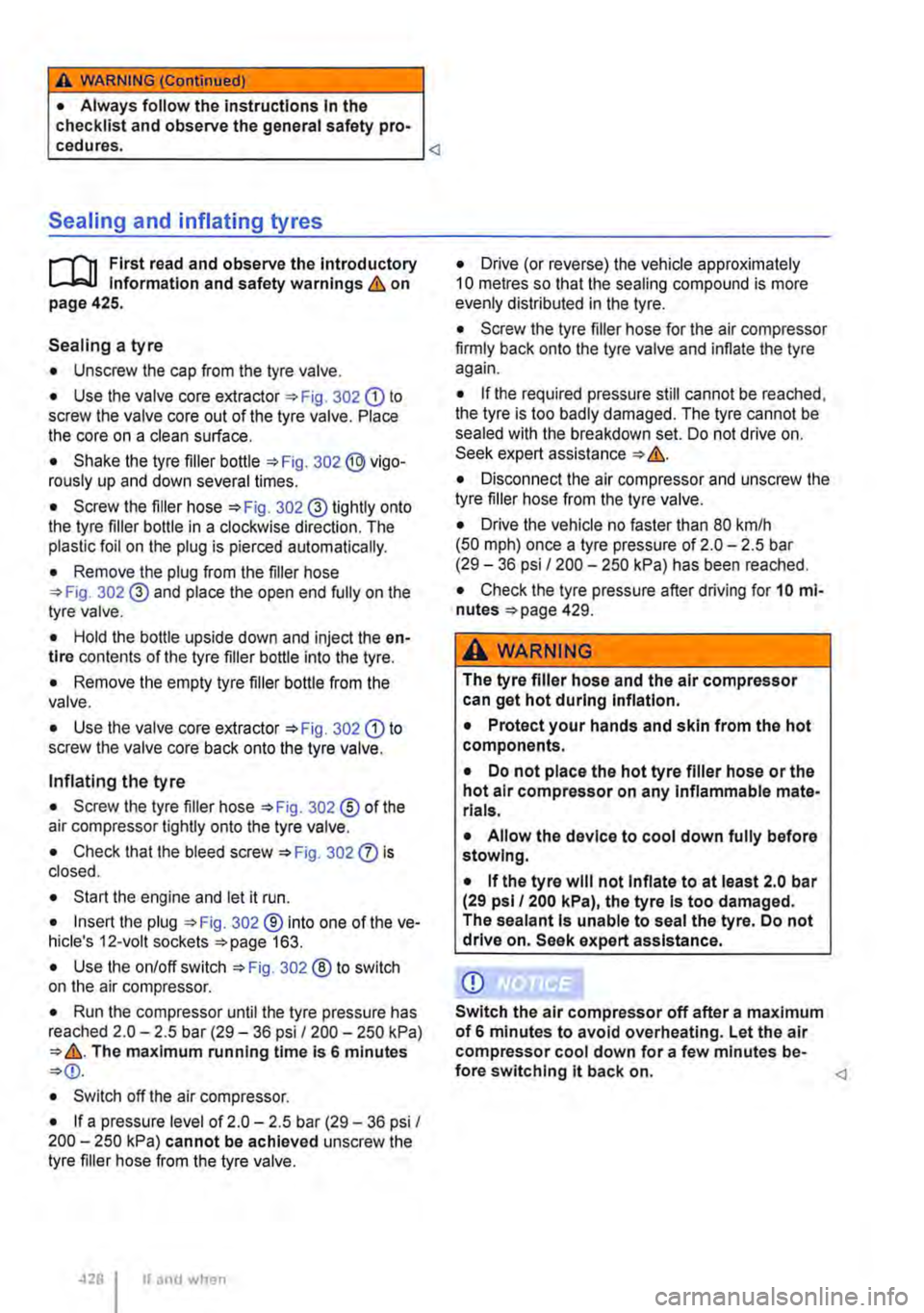
A WARNING (Continued)
• Always follow the instructions In the checklist and observe the general safety pro-
Sealing and inflating tyres
r-"'('n First read and observe the Introductory L-J,.:.U Information and safety warnings & on page 425.
Sealing a tyre
• Unscrew the cap from the tyre valve.
• Use the valve core extractor 302 CD to screw the valve core out of the tyre valve. Place the core on a clean surface.
• Shake the tyre filler bottle 302 ® vigo-rously up and down several times.
• Screw the filler hose 302 @tightly onto the tyre filler bottle in a clockwise direction. The plastic foil on the plug is pierced automatically.
• Remove the plug from the filler hose 302@ and place the open end fully on the tyre valve.
• Hold the bottle upside down and inject the en-tire contents of the tyre filler bottle into the tyre.
• Remove the empty tyre filler bottle from the valve.
• Use the valve core extractor 302 CD to screw the valve core back onto the tyre valve.
Inflating the tyre
• Screw the tyre filler hose 302 ® of the air compressor tightly onto the tyre valve.
• Check that the bleed screw 302 (?) is closed.
• Start the engine and let it run.
• Insert the plug 302 ®into one of the ve-hicle's 12-volt sockets 163.
• Use the on/off switch 302 ®to switch on the air compressor.
• Run the compressor until the tyre pressure has reached 2.0-2.5 bar (29-36 psi I 200-250 kPa) maximum running time is 6 minutes
• Switch off the air compressor.
• If a pressure level of 2.0-2.5 bar (29-36 psi I 200 -250 kPa) cannot be achieved unscrew the tyre filler hose from the tyre valve.
428 I If and when
• Drive (or reverse) the vehicle approximately 1 0 metres so that the sealing compound is more evenly distributed in the tyre.
• Screw the tyre filler hose for the air compressor firmly back onto the tyre valve and inflate the tyre again.
• If the required pressure still cannot be reached, the tyre is too badly damaged. The tyre cannot be sealed with the breakdown set. Do not drive on. Seek expert assistance &.
• Disconnect the air compressor and unscrew the tyre filler hose from the tyre valve.
• Drive the vehicle no faster than 80 km/h (50 mph) once a tyre pressure of 2.0-2.5 bar (29-36 psi I 200-250 kPa) has been reached.
• Check the tyre pressure after driving for 10 mi-nutes 429.
A WARNING
The tyre filler hose and the air compressor can get hot during Inflation.
• Protect your hands and skin from the hot components.
• Do not place the hot tyre filler hose or the hot air compressor on any Inflammable mate-rials.
• Allow the device to cool down fully before stowing.
• If the tyre will not Inflate to at least 2.0 bar (29 psi/ 200 kPa), the tyre Is too damaged. The sealant Is unable to seal the tyre. Do not drive on. Seek expert assistance.
CD
Switch the air compressor off after a maximum of 6 minutes to avoid overheating. Let the air compressor cool down for a few minutes be-fore switching it back on.
Page 473 of 486
Gear-change Indicator . . . . . . . . . . • . . . . . 268
Glasses compartent . . . . . . . . . . . . . . . . . . 152
Glove compartment Lights ............................. 114 see Stowage areas . . . . . . . . . . . . . . . . . 151
Gross vehicle weight rating . . . . . . . . . . . . 450
Guide rail system In the rear vehicle floor Business . . . . . . . . . . . . . . . . . . . . . . . . . 133 California . . . . . . . . . . . . . . . . . . . . . . . . . 133 Multivan . . . . . . . . . . . . . . . . . . . . . . . . . . 133
H
Handbrake
Hands-free system in the passenger com· partment
271
See Rear-seat telephony . . . . . . . . . . . . . 187 Hazard warning lights . . . . . . . . . . . . . . . . . 412
Headlight range control ............. 11,113 Dynamic headlight range control . . . . . . . . 113
Headlights . . . . . . . . . . . . . . . . . . . . . . . . . . 108 Cleaning system . . • . . . . . . . . . . . . . . . . . 118 Driving abroad . . . . . . . . . . . . . . . . . . . . . . 111 Headlight (LED) . . . . . . . . . . . . . . . . . . . . . . 434
Head restraints . . . . . . . . . . . . . . . . . . . . . . . 67
Heat-insulating glass windscreen . . . . . . . . . . . . . . . . . . . . . . . . . 116
Heated seats . . . . . . . . . . . . . . . . . . . . . . . . . 69
Heating and fresh air system Controls . . . . . . . . . . . . . . . . . . . . . . . . . . 327
High-pressure cleaner . . . . . . . . . . . . . . . . 382
High-visibility waistcoat . . . . . . . . . . . . . . . 413
Hill Descent Assist . . . . . . . . . . • . . • . . . . . 285
Hill Hold Assist . . . . . . . . . . . . . . . . . . . . . . 284
Horn ................•................ 11
Hubcaps . . . . . . . . . . . . . . . . . . . . . . . . 417, 420 Centre cover . . . . . . . . . . . . . . . . . . . . . . 418 Wheel bolt caps . . . . . . . . . . . . . . • . . . . . 419 Wheel cover . . . . . . . . . . . . . . . . . . . . . . . 419
ICC 173
Identification number . . . . . . . . . . . . . . . . . 451
If and when.......................... 410
Ignition see Engine and ignition . . . . . . . . . . . . . . 257
Ignition key see Key . . . . . . . . . . . . . . . . . . . . . . . . . . . 37
Ignition lock . . . . . . . . . . . . . . . . . . . . 258 Non-authorised vehicle key . . . . . . . . . . . 258 Withdrawal lock . . . . . . . . . . . . . . . . . . . . 258
Immobilizer . . . . . . . . . . . . . . . . . . . . . . . . . . 260 Fault ............................. 257 In-car communication system . . . . . 173
Indicator lamp Adaptive chassis control (DCC) 317 Adaptive cruise control (ACC) . . . . • . . . . 300 AdBiue . . . . . . ............. 347 Airbag system . . . . . . . . . . . . . . . . . . . . . . 89 Brake pad wear indicator . . . . . . . . . . . . . 270 Brake system . . . . . . . . . . . . . . . . . . . . . . 270 Catalytic converter . . . . . . . . . . . . . . . . . . 407 Changing bulbs . . . . . . . . . . . . . . . . . . . . 433 Changing gear . . . . . . . . . . . . . . . . . . . . . 261 Checking the oil level . . . . . . • . . . . . . . . . 354 Coolant . . . . . . . . . . . . . . . . . • . . . . . . . . . 359 Cruise control system . . . . . . . . . . . . . . . 296 Depress brake . . . . . . . . . . . . . . . . . . . . . 270 Diesel particulate filter . . . . . . . . . . . . . . . 407 Engine management system . . . . . . . . . . 407 Engine oil sensor . . . . . . . . . . . . . . . . . . . 354 ESC . . . . . . . . . . . . . . . . . . . . . . . . . . . . . 270 Exhaust purification system . . . . . . . . . . . 407 Filling the tank . . . . . . . . . . . . . . . . . . . . . 341 Fuel level . . . . . . . . . . . . . . . . . . . . . . . . . 341 In the driver door . . . . . . . . . . . . . . . . . . . . 43 Lane change assist system . . . . . . . . . . . 313 Lights . . . . . . . . . . . . . . . . . . . . . . . . . . . . 106 Overview . . . . . . . . . . . . . . . . . . . . . . . . . . 16 Remote control key . . . . . . . . . . . . . . . . . . 38 Seat belt . . . . . . . . . . . . . . . . . . . . . . . . . . . 80 Tyre monitoring system . . . . . . . . . . . . . . 319 Windscreen washer fluid level . . . . . . . . . . 117
Indirect ventilation . . . . . . . . . . . . . . . . . . . . 329
Information stored in the control units . . . 398 Infrared-reflecting windscreen . . . . . . . . . . . 116
Instrument cluster . . . . . . . . . . . . . . . . . . . . . 16 Displays . . . . . . . . . . . . . . . . . . . . . 20, 21, 25 Indicator lamps . . . . . . . . . . . . . . . . . . . . . . 16 Instruments . . . . . . . . . . . . . . . . . . . . . . . . 20 Menu structure . . . . . . . . . . . . . . . . . . . . . . 25 Service interval display . . . . . . . . . . . . . . . 22 Symbols ........................... 16 Using menus . . . . . . . . . . . . . . . . . . . . . . . 27 Warning lamps . . . . . . . . . . . . . . . . . . . . . . 16 Instruments . . . . . . . . . . . . . . . . . • . . . . . . . . 20
Integrated child seat . . . . . . . . . . . . . . . . . . 102 Seat belt routing . . . . . . . . . . . . . . . . . . . . 1 05
Interior lights ................ , ........ 114
Interior lights, California . . . . . . . . . . . . . . . 208 Living area . . . . . . . . . . . . . . . . . . . . . . . . 209 Pop-up roof . . . . . . . . . . . • . . . . . . . . • . . 21 0 Interior mirror . . . . . . . . . . . . . . . . . . . . . . . . 122
Interior monitoring system . . . . . . . . . . . . . . 44 ISOFIX.............................. 100 see Child seat . . . . . . . . . . . . . . . . . . • . . . 96
Index 473