seat VOLKSWAGEN TRANSPORTER 2013 Owners Manual
[x] Cancel search | Manufacturer: VOLKSWAGEN, Model Year: 2013, Model line: TRANSPORTER, Model: VOLKSWAGEN TRANSPORTER 2013Pages: 486, PDF Size: 69.28 MB
Page 393 of 486
A wARNING
Check the condition of all seat belts regularly. If the belt webbing or any other part of the seat belt becomes damaged have it removed and replaced immediately by a qualified workshop. Damaged seat belts are very dan-gerous and can cause severe or fatal injuries.
• Never use chemical cleaning agents on the seat belts or their components. Further-more the seat belts may not come Into con-tact with corrosive fluids, solvents or sharp objects. These could considerably weaken the webbing.
• After cleaning, allow seat belts to dry completely before rolling them up. Otherwise the automatic belt retractors could become damaged and thus Impair their function.
Cleaning cool box
)""""'('n First read and observe the Introductory L.-J,:,JJ Information and safety warnings & on page 388.
Cleaning seat rails
)""""'('n First read and observe the introductory information and safety warnings & on page 388.
Clean the surface of the seat rails on a regular ba-sis
• Use a narrow nozzle on a vacuum cleaner to remove sand, dirt etc. from the seat rails.
Cleaning opaque shades
)""""'('n First read and observe the introductory information and safety warnings & on page 388.
For the best cleaning results have the opaque shades dry cleaned.
A WARNING (ConUnued)
• Avoid allowing foreign bodies or liquids to enter the slot for the seat belt buckle. This could prevent the belt buckle and seat belt from working properly.
• Never try to repair, modify or remove the seat belts yourself.
• Damaged seat belts must be replaced im-mediately with new seat belts approved by Volkswagen Commercial Vehicles for your ve-hicle type. Seat belts subjected to stress and stretched during an accident must be re-placed by a qualified workshop. Renewal may be necessary even if there is no apparent damage. The belt anchorage should also be checked.
• Clean the cool box with a household detergent before using it for the first time and whenever it needs cleaning.
• To prevent mould and mildew from forming in the cool box when it is not being used for long peri-ods, place a folded dry towel between the box and its lid.
CD
If seats are moved when the seat rails are soiled, the seat rails and the seat feet could be damaged.
Please refer to the information on the labels sewn into the opaque shades before cleaning in a wash-ing machine.
Vehicle care and maintenance 393
Page 394 of 486
Accessories, modifications, repairs and renewal of parts
o::n Introduction
This chapter contains information on the following subjects:
Running-in 394
Accessories and replacement parts 395 Service fluids and consumables . . . . . . . . . . . 395
Repairs and technical modifications . . . . . . . . 396
Repairs and faults in the airbag system . . . . . 397
Retrofitting two-way radios . . . . . . . . . . . . . . . . 398
Information stored in the control units . . . . . . . 398 Using a mobile telephone in the vehicle without a connection to the external aerial . . 399
Vehicle lifting points 401
Additional information and warnings:
• Seat belts '*page 79
• Airbag system '*page 87
• Towing a trailer 139
• Ashtray and cigarette lighter 161
• Electrical sockets 163
• Braking, stopping and parking '*page 269
• Pull-away assist systems 282
• ParkPilot 287
• Reversing camera (Rear Assist) '*page 291
• Cruise control system (CCS) 295
• Driver Alert System 315
• Tyre monitoring system 318
• Preparation for working in the engine compart-ment page 350
• Engine oil 353
• Engine coolant '*page 358
• Battery 362
Running-in
r--('n First read and observe the introductory L-J.:.lJ information and safety warnings & on page 394.
Please follow the regulations concerning running-in new parts.
394 I Cleaning and maintenance
• Cleaning and caring for the vehicle exterior 380
• Cleaning and caring for the interior 388
• Consumer information 404
• Radio, provision for mobile tele-phone, infotainment system, navigation system
A WARNING
Unsuitable spare parts and accessories, In-correctly carried out work, modifications and repairs can lead to damage to the vehicle and cause accidents and serious Injuries.
• Volkswagen Commercial Vehicles strongly recommends you use only approved Volks-wagen accessories and Volkswagen Genuine Parts®. These parts and accessories have been specially tested by Volkswagen Com-mercial Vehicles for suitability, reliability and safety.
• Repairs and modifications to your vehicle should only be carried out by a qualified workshop. Qualified workshops have the nec-essary tools, diagnostic equipment, repair In-formation and qualified personnel.
• Never fit parts to your vehicle that are In any way different from the factory-fitted parts.
• Never secure or mount objects such as drink holders or telephone holders on or next to the airbag covers or within the deployment zone of the airbag.
• Only use rim/tyre combinations which have been approved by Volkswagen Commer-cial Vehicles for your vehicle type.
Any new engine has to be run in during the first 1 ,500 kilometres. During its first few hours of run-ning, the internal friction in the engine is greater than later on when all the moving parts have bed-ded down.
The style of driving during the first 1 ,500 kilometres will also affect the engine quality. Even after this time-and especially with a cold engine-drive the .,.
Page 397 of 486
or sensors has been damaged, e.g. by stone im-pact, the windscreen must be replaced. Repairing the crack can lead to malfunction or functional faults in the equipment.
After changing the windscreen, the camera and sensors must be set up and calibrated by a quali-fied workshop.
A WARNING
Incorrect repairs and modifications can cause functional problems and damage to the vehicle and impair the effectiveness of the driver assist systems. This can result In acci-dents and severe Injuries.
• Repairs and modifications to your vehicle should only be carried out by a qualified workshop.
Repairs and faults in the airbag system
,....,..,. First read and observe the introductory l.-Jo:-11 Information and safety warnings&. on page 394.
Repairs and modifications must always be car-ried out according to Volkswagen Commercial Vehicles specifications"*&.!
Modifications and repairs to the front bumper, the doors, the front seats, the headliner, or the body-work should be carried out by a qualified work-shop. System components and airbag system sen-sors might be fitted on these vehicle components.
If you work on the airbag system or remove and in-stall parts of the system when performing other re-pair work, parts of the airbag system may be dam-aged. The consequence may be that, in the event of an accident, the airbag inflates incorrectly or does not inflate at all.
Regulations must be observed to ensure that the effectiveness of the airbags is not reduced and that removed parts do not cause any injuries or envi-ronmental pollution. Qualified workshops are famili-ar with these requirements.
Any modifications to the vehicle's suspension could prevent the airbag system from working properly during a collision. For example, using tyre/ rim combinations which have not been approved by Volkswagen Commercial Vehicles, lowering the vehicle, making modifications to the suspension rate including work on the springs, struts and shock absorbers could cause the forces which are measured by the airbag sensors and sent to the electronic control unit to change. Some changes to the suspension could cause the forces measured by the sensors to increase. This can lead to the airbag system being triggered in collision scenarios
where it normally would not be triggered if modifi-cations to the suspension had not been made. Other modifications can cause the forces meas-ured by the sensors to decrease. therefore pre-venting the airbag system from being triggered when it should have been.
A WARNING
Incorrect repairs and modifications can cause function problems and damage to the vehicle and Impair the effectiveness of the alrbag system. This can result In accidents and serious or even fatal injuries.
• Repairs and modifications to your vehicle should only be carried out by a qualified workshop.
• Alrbag modules cannot be repaired. They must be replaced.
• Never use recycled airbag components or components that have been taken from end-of-life vehicles In your vehicle.
A WARNING
Modifications to the vehicle's suspension, in-cluding the use of unsuitable tyre/rim combi-nations, can cause the alrbag system to work differently and increase the risk of serious or fatal injuries In the event of an accident.
• Never install any components in the sus-pension system that do not have the same characteristics as the original factory-fitted components.
• Never use tyre/rim combinations that have not been approved by Volkswagen Commer-cial Vehicles.
Vehicle care and maintenance 397
Page 398 of 486
Retrofitting two-way radios
.--m First read and observe the introductory L-.lc.U information and safety warnings & on page 394.
You will need an external aerial to use a two-way radio in the vehicle.
Any retrofit installation of electrical or electronic equipment in the vehicle will affect its vehicle type approval. Under certain circumstances, this can negate the type approval for the vehicle.
Volkswagen Commercial Vehicles has approved the vehicle for use with two-way radios providing the following conditions are observed:
• Correct installation of external aerial.
• A maximum transmitting power of 10 watts.
The equipment can only operate at maximum range with an external aerial.
Check first with a qualified workshop if you wish to use a two-way radio with a transmitting power of over 10 watts. Qualified workshops are familiar with the technical options for retrofitting. Volkswa-gen Commercial Vehicles recommends using a Volkswagen Commercial Vehicles dealership for this purpose.
Information stored in the control units
.--m First read and observe the introductory L-.lc.U Information and safety warnings & on page 394.
Your vehicle is factory fitted with electronic control units which are responsible for engine and gearbox management. The control units also monitor the function of the exhaust system and the airbags.
These electronic control units continuously evalu-ate data relevant to the vehicle while the vehicle is being driven. Only these data will be stored if there are any faults recorded or any deviations from the specified values. This is generally displayed by the indicator lamps on the instrument cluster.
Special units are required to read and evaluate da-ta stored in the control units.
These data are stored so that specialist workshops can diagnose and solve problems. The following data may have been stored:
• Engine and gearbox-relevant data.
• Speed.
• Direction of travel.
398 Cleaning and maintenance
Please comply with relevant legislation and the in-structions and information given in the operating manuals for radio equipment.
A WARNING
If radio equipment is not secured or not prop-erly secured in the vehicle, it could be flung though the interior during a sudden driving or braking manoeuvre, or In the event of an accident. This can cause Injuries.
• While the vehicle is in motion, always se-cure radio equipment properly outside the airbag deployment zone or stow them away safely.
A CAUTION
If you use two-way radios in the car without an external aerial, electromagnetic radiation in the vehicle could exceed limit values. This also applies to external aerials which have not been correctly installed.
• Two-way radios should only be used In the vehicle If an external aerial Is properly connected.
• Braking power.
• Seat belt monitor.
The control units never record conversations that take place in the vehicle. it is neither possible nor permitted to use the stored data to create move-ment profiles.
When the vehicle is being used, situations may arise in which the stored data (alone or in conjunc-tion with other information such as accident re-ports, vehicle damage, witness statements etc.) can become assignable to a particular person, whereby consultation of an expert and use of the expert's information may be necessary.
In vehicles with an emergency call function via a mobile telephone or other units, the current loca-tion can be transmitted. In the event of an accident in which the control units register that an airbag has been triggered, the system can automatically send out a signal. This depends on your service provider. Transmission is possible only in areas
Page 399 of 486
Additional functions that are contractually agreed with the customer, e.g. vehicle positioning in an emergency, allow certain vehicle data to be trans-mitted from the vehicle.
Event data recorder
The vehicle is not fitted with an event data record-er.
Event data recorders temporarily store vehicle in-formation. This provides precise information in the event of an accident. In vehicles with an airbag system, data that might be relevant in the event of an accident can be stored, e.g. impact speed, belt buckle status, seat positions and trigger speed. The scope of the data is manufacturer-specific.
An event data recorder may only be fitted if the owner has approved the procedure. This is cov-ered by legislation in some countries.
Reprogramming control units
All data for the control of components are stored in the control units. Some convenience functions, such as lane change flash, single door unlocking and displays, can be reprogrammed using special workshop equipment. If this is the case, the de-scriptions in your vehicle wallet will no longer cor-respond with the original functions. Volkswagen Commercial Vehicles recommends that any re-programming should be confirmed in the service schedule under "Workshop comments".
Information about possible reprogramming can be obtained from the Volkswagen dealership.
Reading the vehicle's event memory
There is a diagnostic interface for reading the event memories in the vehicle interior &. Data relating to the function and status of the electronic control units are stored in the event memory. Addi-tional information on the stored data is available from qualified workshops.
The diagnosis interface is located in the footwell on the driver side behind a cover next to the lever for opening the bonnet.
The event memory should only be read and reset by a qualified workshop.
After a fault has been rectified, the information in the memory pertaining to the fault is deleted. Other memory content is overwritten on an on-going ba-sis.
A WARNING
Incorrect use of the diagnostic Interface can cause faults, which can result in accidents and serious injuries.
• Never read the event memory using the di-agnostic Interface yourself.
• The diagnostic Interface should only be read by a qualified workshop.
external aerial
,...--.m First read and observe the introductory L--I=>U information and safety warnings & on page 394.
Both during telephone calls and in standby mode, mobile telephones transmit and receive radio waves, which may also be termed "high-frequency energy". Current scientific literature warns us that radio waves can be harmful to human beings if they exceed certain limits. Government bodies and international committees have introduced threshold values and guidelines to ensure that electromag-netic radiation produced by mobile telephones does not pose a hazard to health. However, there is no proven scientific evidence that demonstrates that cordless telephones are absolutely safe.
For this reason, some experts are calling for more precautions to be taken in the use of mobile tele-phones, by taking steps to reduce the level of per-sonal exposure to electromagnetic radiation.
If a mobile telephone that is not connected to the vehicle's external aerial is used inside the vehicle, the level of electromagnetic radiation could be higher than when the mobile telephone is connec-ted to an integrated aerial or any other external aerial.
If the vehicle is fitted with a suitable hands-free unit which enables the use of innumerable additional functions of Bluetooth® compatible mobile tele-phones, this will satisfy the legal requirements in many countries which permit the use of a mobile telephone in a vehicle only if a hands-free unit is used.
The factory-fitted hands-free system in your vehicle has been developed for use with mobile tele-phones that are compatible with Bluetooth®_ Mo-bile telephones must be carried in a suitable tele-phone holder or be stored securely in the vehicle. If a telephone holder is used it must be securely at-tached to the base plate. This is the only way to .,.
Vehicle care and maintenance 399
Page 410 of 486
If and when
Practical tips
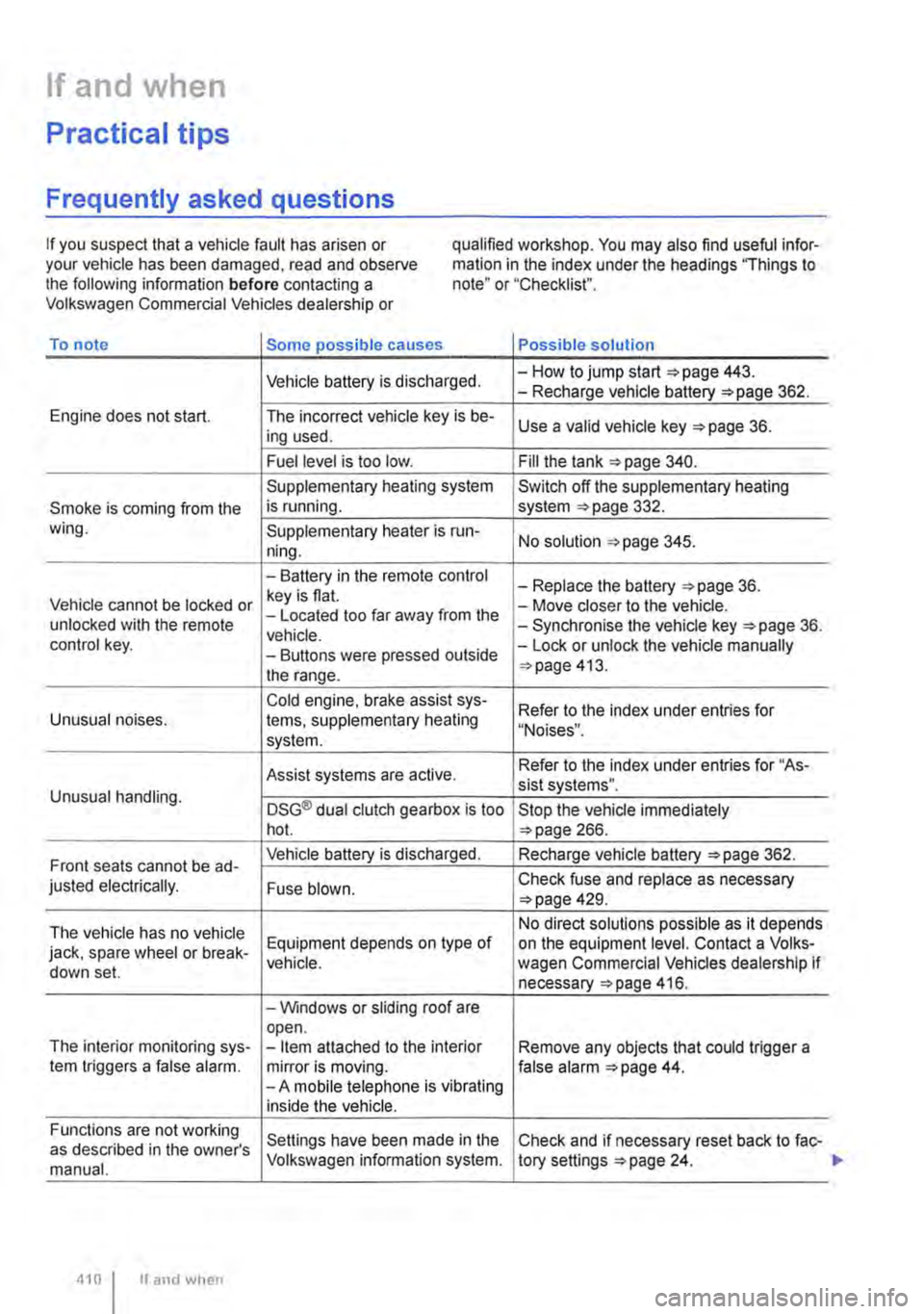
Frequently asked questions
If you suspect that a vehicle fault has arisen or your vehicle has been damaged, read and observe the following information before contacting a Volkswagen Commercial Vehicles dealership or
qualified workshop. You may also find useful infor-mation in the index under the headings "Things to note" or "Checklist".
To note Some possible causes Possible solution
Vehicle battery is discharged. -How to jump start =>page 443. -Recharge vehicle battery 362.
Engine does not start. The incorrect vehicle key is be-Use a valid vehicle key 36. ing used.
Fuel level is too low. Fill the tank 340.
Supplementary heating system Switch off the supplementary heating
Smoke is coming from the is running. system 332. wing. Supplementary heater is run-No solution 345. ning.
-Battery in the remote control -Replace the battery 36. Vehicle cannot be locked or key is flat. -Move closer to the vehicle. unlocked with the remote -Located too far away from the -Synchronise the vehicle key =>page 36. vehicle. control key. -Buttons were pressed outside -Lock or unlock the vehicle manually
the range. 413.
Cold engine. brake assist sys-Refer to the index under entries for Unusual noises. tems, supplementary heating "Noises". system.
Assist systems are active. Refer to the index under entries for "As-sist systems". Unusual handling. DSG® dual clutch gearbox is too Stop the vehicle immediately hot. 266.
Front seats cannot be ad-Vehicle battery is discharged. Recharge vehicle battery 362.
justed electrically. Fuse blown. Check fuse and replace as necessary 429.
The vehicle has no vehicle No direct solutions possible as it depends
jack, spare wheel or break-Equipment depends on type of on the equipment level. Contact a Volks-vehicle. wagen Commercial Vehicles dealership if down set. necessary 416.
-Windows or sliding roof are open. The interior monitoring sys--Item attached to the interior Remove any objects that could trigger a tem triggers a false alarm. mirror is moving. false alarm 44. -A mobile telephone is vibrating inside the vehicle.
Functions are not working Settings have been made in the Check and if necessary reset back to fac-as described in the owner's manual. Volkswagen information system. tory settings 24.
410 I If and when
Page 416 of 486
Vehicle toolkit
CCll Introduction
This chapter contains information on the following subjects:
Stowage Contents 416 417
Observe any country-specific legislation when se-curing your vehicle in the event of a breakdown.
Additional information and warnings:
• Seat functions, passenger compartment 72
• Stowage =>page 150
• Preparation for working in the engine compart-ment page 350
• In an emergency =>page 411
• Changing a wheel 420
• Breakdown set =>page 425
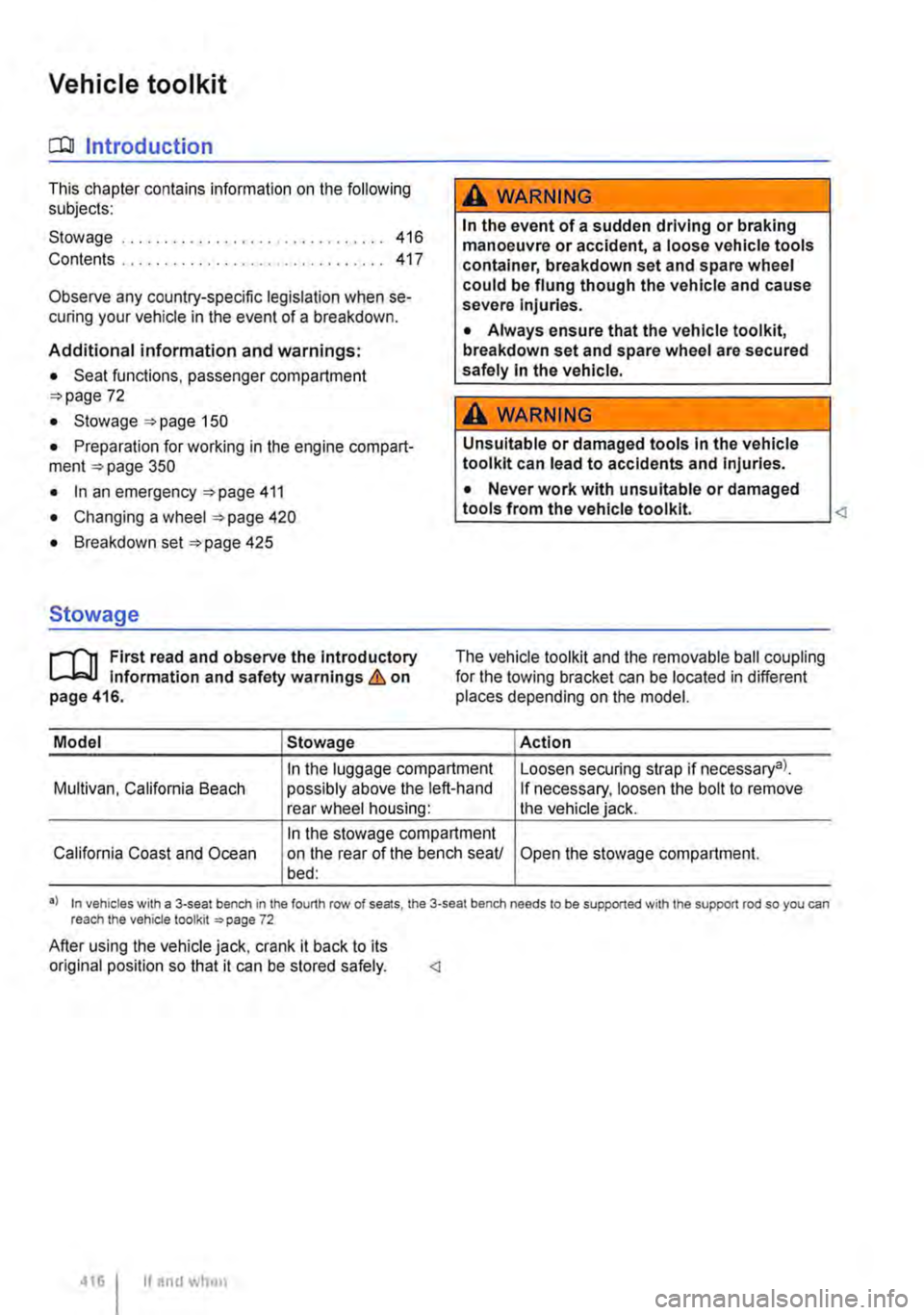
Stowage
r-111 First read and observe the introductory L-J,::.U information and safety warnings & on page 416.
Model Stowage
A WARNING
In the event of a sudden driving or braking manoeuvre or accident, a loose vehicle tools container, breakdown set and spare wheel could be flung though the vehicle and cause severe injuries.
• Always ensure that the vehicle toolkit, breakdown set and spare wheel are secured safely in the vehicle.
A WARNING
Unsuitable or damaged tools in the vehicle tool kit can lead to accidents and injuries.
• Never work with unsuitable or damaged tools from the vehicle toolklt.
Action
In the luggage compartment Loosen securing strap if necessarya)_ Multivan, California Beach possibly above the left-hand If necessary, loosen the bolt to remove rear wheel housing: the vehicle jack.
In the stowage compartment California Coast and Ocean on the rear of the bench sea V Open the stowage compartment. bed:
•I In vehicles with a 3-seat bench in the fourth row of seats, the 3-seat bench needs to be supported with the support rod so you can reach the vehicle toolkit , page 72
After using the vehicle jack, crank it back to its original position so that it can be stored safely.
Page 426 of 486
• If the tyre pressure is very low or the tyres are flat.
• If the use-by date on the tyre filler bottle has ex-pired.
Additional information and warnings:
• Vehicle key set 36
• Seat functions, front 69
• Stowage 150
• Braking, stopping and parking =>page 269
• Wheels and tyres 367
• In an emergency 411
• Hubcaps 417
A WARNING
Using the breakdown set can be dangerous, especially if the tyres are inflated at the road-side. Please note the following points In or-der to reduce the risk of serious injuries:
• Stop the vehicle as soon as possible and when safe to do so. Park the vehicle at a safe distance from moving traffic in order to fill the tyre.
• Check that the surface the vehicle is parked on is level and firm.
• All passengers, and children in particular, must be at a safe distance and away from your area of work.
• Switch on the hazard warning lights to warn other road users.
• The breakdown set should only be used if you feel confident with carrying out the pro-cedure. If not, seek expert assistance.
Storing
rT'n First read and observe the introductory L-W.I information and safety warnings & on page 425.
Model
Multivan
California
426 I If and when
A WARNING (Continued)
• Tyres repaired with the breakdown set are intended for temporary, emergency use only. They should only be used until you can reach the nearest qualified workshop.
• Tyres that have been repaired using the breakdown set should be replaced as soon as possible.
• Sealant Is hazardous to health and must be washed off Immediately if it gets onto the skin.
• The breakdown set must be stored out of the reach of children.
• Never use a vehicle jack, even If it Is ap-proved for the vehicle.
• Always switch off the engine, apply the handbrake and move the selector lever to the position P or select a gear on a manual gear-box In order to reduce the risk of unintended vehicle movement.
A WARNING
Tyres that have been filled with sealant will not handle In the same way as a standard tyre.
• Never drive faster than 80 km/h (50 mph).
• Avoid full acceleration, sudden braking and fast driving through bends In the road.
• Drive for just 10 minutes at no more than 80 km/h (50 m ph) and then check the tyre.
Dispose of used or out-of-date sealant in ac-W cordance with legal requirements.
m You can get a new tyre filler bottle from a L!:J Volkswagen Commercial Vehicles dealership.
m Observe the separate instructions from the l!:J manufacturer of the breakdown set. <1
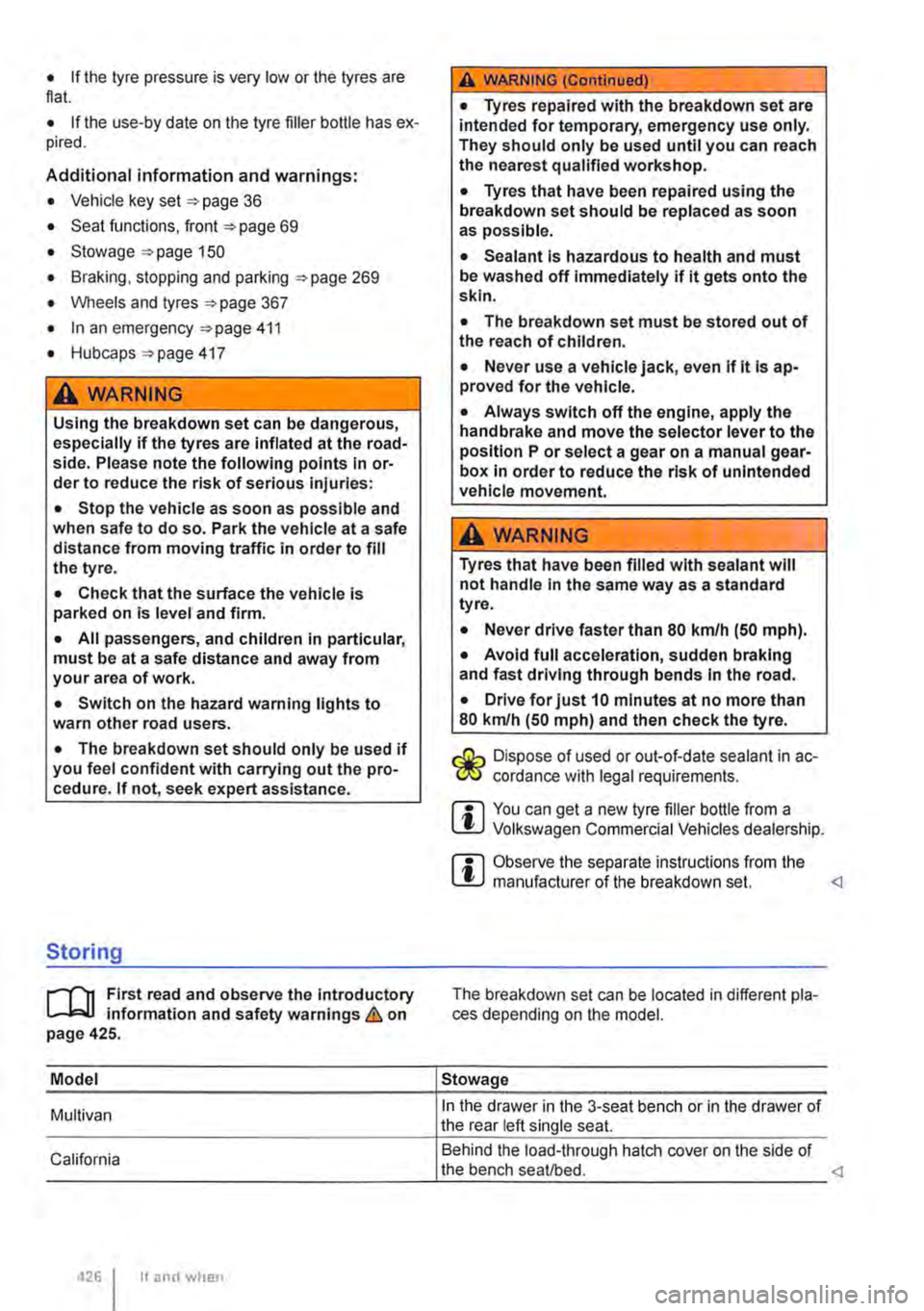
The breakdown set can be located in different pla-ces depending on the model.
Stowage
In the drawer in the 3-seat bench or in the drawer of the rear left single seat.
Behind the load-through hatch cover on the side of the bench seat/bed. <1
Page 439 of 486
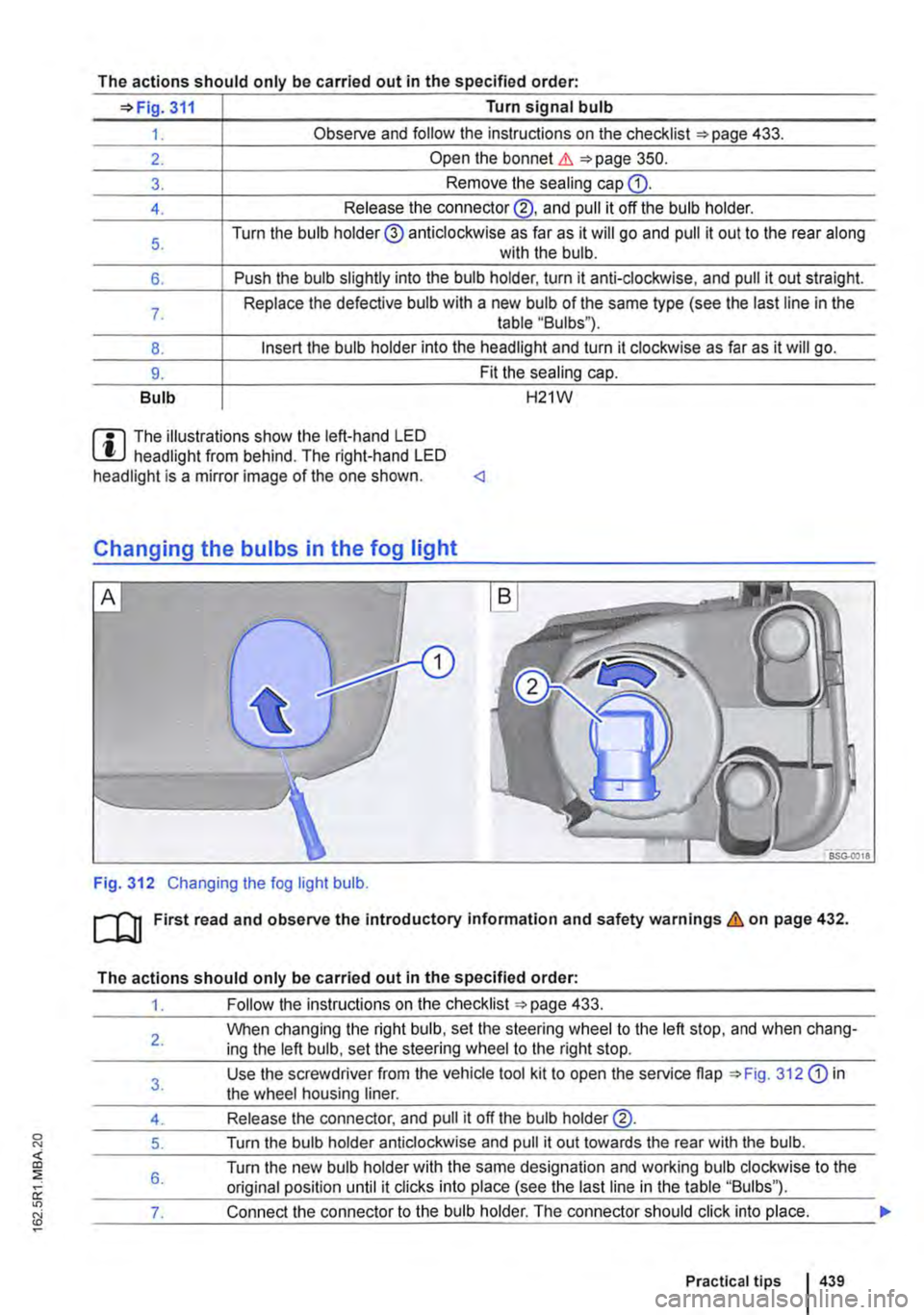
The actions should only be carried out in the specified order·
311 Turn signal bulb
1. Observe and follow the instructions on the checklist ""page 433.
2. Open the bonnet.&. 350.
3. Remove the seating cap Q).
4. Release the connector@, and pull it off the bulb holder.
5. Turn the bulb holder@ anticlockwise as far as it will go and pull it out to the rear along with the bulb.
6. Push the bulb slightly into the bulb holder, turn it anti-clockwise, and pull it out straight.
7. Replace the defective bulb with a new bulb of the same type (see the last line in the table "Bulbs").
8. Insert the bulb holder into the headlight and turn it clockwise as far as it will go.
9. Fit the sealing cap.
Bulb H21W
m The illustrations show the left-hand LED W headlight from behind. The right-hand LED headlight is a mirror image of the one shown.
Fig. 312 Changing the fog light bulb.
m First read and observe the introductory information and safety warnings & on page 432.
The actions should only be carried out in the specified order:
1. Follow the instructions on the checklist 433.
2.
3.
4.
5.
6.
When changing the right bulb, set the steering wheel to the left stop, and when chang-ing the left bulb, set the steering wheel to the right stop.
Use the screwdriver from the vehicle tool kit to open the service flap 312 Q) in the wheel housing liner.
Release the connector, and pull it off the bulb holder@.
Turn the bulb holder anticlockwise and pull it out towards the rear with the bulb.
Turn the new bulb holder with the same designation and working bulb clockwise to the original position until it clicks into place (see the last line in the table "Bulbs").
__ ___:7...:.. ___ ..::.sh...:.o:...:u:....ld::.....:.c:...:lic.::.k:....i:....nt.:..:.o-"p-'-la:....c:..:e...:.. ___
Practical tips 439
Page 465 of 486
Index
Numbers and Symbols
12-volt socket California . . . . . . . . . . . . . . . . . . . . . . . . . 244
2-seat arrangement Stowage compartment in armrest . . . . . . 184
2-seat arrangement, Business . . . . . . . . . . 182 Adjusting armrest . . . . . . . . . . . . . . . . . . . 184 Adjusting seats . . . . . . . . . . . . . . . . . . . . . 183 Ash tray . .. .. . . . .. . . .. . . • . .. . .. .. . 186 Centre console . . . . . • . . . . . . . . . . . . . . . 185 Cigarette lighter . . . . . . . • . . • . . . . . . . . . 186 Controls . . . . . . . . . . . . . . . . . . . . . . . . . . 183 Drink holder . . . . . . . . . . . . . . . . . . . . . . . 186 Features . . . . . . . . . . . . . . . . . . . . . . . . . . 182 Front stowage compartment . . . . . . . . . . 186 Moving . . . . . . . . . . . . . . . . . . . . . . . . . . . 185 Refrigerator box . . . . . . . . . . . . . . . . . . . . 186 Seat heater . . . . . . . . . . . . . . . . . . . . . . . 183 Upper stowage compartment . . . . . . . . . . 186 230-volt Euro socket . . . . . . . . . . . . . . . . . . 245
230-volt grounded safety socket . . . . . . . . 246
230-volt power supply . . . . . . . . . . . . . . . . . 245 Residual current circuit breaker . . . . . . . . 247
3-seat bench
A
Folding out the table . . . . . . . . . . . . . . . . . 74 Setting up the bed . . . . . . . . . . . . . • . . . . . 74
Abroad Extended trips with your vehicle 405 Selling the vehicle . . . . . . . . . . . . . . . . . . 405
ABS see Brake support systems . . . . . . . . . . . 275
ACC see Adaptive cruise control (ACC) . . . . . . 298
Accessing a service message . . . . . . . . . . . 23
Accessories . . . . . . . . . . . . . . . . . . . . . . . . . 394
Acoustic warnings Seat belt not fastened . . . . . . . . . . . . . . . . 80
Adaptive chassis control Fault . . . . . . . . . . . . . . . . . . . . . . . . . 317, 318 Function . . . . . . . . . . . . . . . . . . . . . . . . . . 318 Operation . . . . . . . . . . . . . . . . . 318
Adaptive chassis control (DCC) . . . . . . . . . 317 Indicator lamp . . . . . . . . . . . . . . . . . . . . . 317
Adaptive cruise control (ACC) . . . . . . . . . . 298 Displays . . . . . . . . . . . . . . . . . . . . . . . . . . 300 Fault . . . . . . . . . . . . . . . . . . . . . . . . . . . . . 299 Indicator lamp . . . . . . . . . . . . . . . . . . . . . 300 Operating . . . . . . . . . . . . . . . . . . . . . . . . . 302 Radar sensor . . . . . . . . . . . . . . . . . . . . . . 301 Special driving situations . . . . . . . . . . . . . 305
Switching off temporarily . . . . . . . . . . . . . 304 Warning lamp . . . . . . . . . . . . . . . • . . • . . . 300
Ad Blue Indicator lamp . . . . . . . . . . . . . . . . . • . . . 347 Information . . . . . . . . . . . . . . . . . . . . . . . . 346 Refilling . . . . . . . . . . . . . . . . . . . . . . . . . . 348 Specification . . . . . . . . . . . . . . . . . . . . . . . 348 Tank capacity . . . . . . . . . . . . . . . . . . . . . . 346 Warning lamp . . . . . . . . . . . . . . . . . . . . . . 347
Additional battery California . . . . . . . . . . . . . . . . . . . . . . . . . 248 Charging . . . . . . . . . . . . . . . . . . . . . . . . . 247
Adjust Electrically adjustable front seat . . . . . . . . 66 Single seats in the passenger compartment .7.3
Adjusting Correct sitting position . . . . . . . . . . . . . . . . 63 Headlight range ..................... 113 Head restraints . . . . . . . . . . . . . . . . . . . . . . 67 Mechanical front seats . . . . . . . . . . . . . . . . 65 Memory seats . . . . . . . . . . . . . . . . . . . . . . 70 Single seats in the passenger compartment .73 Steering wheel . . . . . . . . . . . . . . . . . . . . . . 68
Adjusts Electric lumbar support adjustment . . . . . . 66
Aerial . . . . . . . . . . . . . . . . . . . . . . . . . . 124.406
AGM battery . . . . . . . . . . . . . . . . . . . . . . . . . 248
........................ Cleaning the dash panel . . . . . . . . . . . . . 392 Combined curtain and side airbags . . . . . . 94 Curtain airbags . . . . . . . . . . . . . . . . . . . . . . 95 Description . . . . . . . . . . . . . . . . . . . . . . . . . 90 Differences between front passenger front airbag systems . . . . . . . . . . . . . . . . . . . . 89 Faults . . . . . . . . . . . . • . . • . . . . . . . . . . . . 397 Front airbags . . . • . . • . . . . . • . . . . . • . . . . 92 Function . . . . . . . . . . . . . . . . . . . . . . . . . . . 90 Indicator lamp . . . . . . . . . . . . . . . . . . . . . . 89 Repairs . . . . . . . . . . . . . . . . . . . . . . . . . . . 397 Switching off the front passenger front air-bag . . . . . . . . . . . . . . . . . . . . . . . . . . . . . 93 Switching off with the key switch . . . . . . . . 93 Using child seats . . . . . . . . . . . . . . . . . . . . 93 Vehicle care . . . . . . . . . . . . . . . . . . . . . . . 392
Air conditioning system . . . . . . . . . . . . . . . 322 Air recirculation mode . . . . . . . . . . . . . . . 330 Climatic . . . . . . . . . . . . . . . . . . . . . . . . . . 323 Climatronic . . . . . • . . . . . . . . . . . . . . . . . . 325 Controls . . . . . . . . . . . . . . . . . . . . . . 323, 325 Fault . . . . . . . . . . . . . . . . . . . . . . . . . . . . . 328 Indirect ventilation . . . . . . . . . . . . . . . . . . 329 Information . . . . . . . . . . • . . • . . . . . . . . . . 328 Settings . . . . . . . . . . . . . . . . . . . . . . . . . . 328 Things to note . . . . . . . . . . . . . . . . . . . . . 328
Index 465