seat VOLKSWAGEN TRANSPORTER 2013 Workshop Manual
[x] Cancel search | Manufacturer: VOLKSWAGEN, Model Year: 2013, Model line: TRANSPORTER, Model: VOLKSWAGEN TRANSPORTER 2013Pages: 486, PDF Size: 69.28 MB
Page 113 of 486
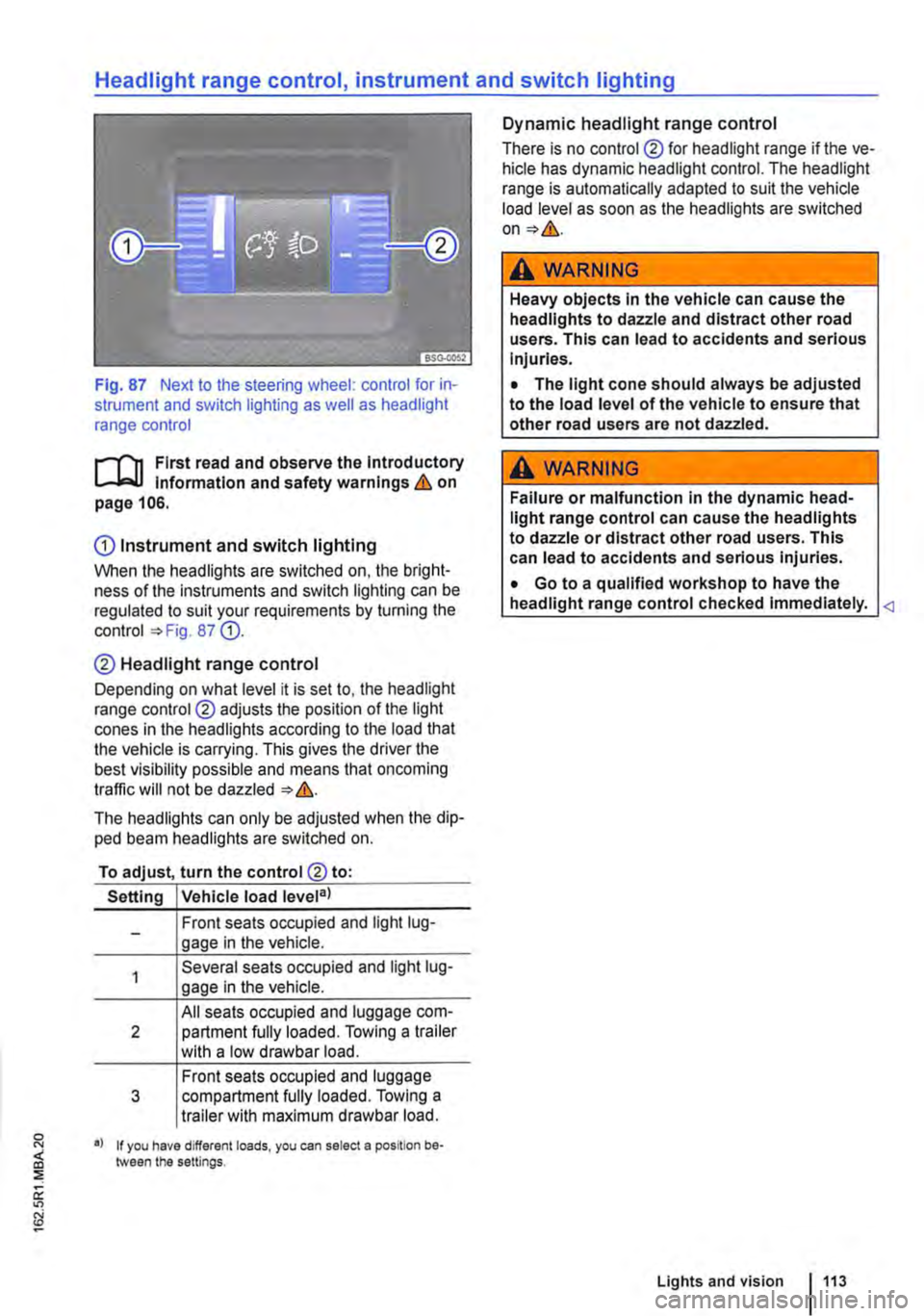
Fig. 87 Next to the steering wheel: control for in-strument and switch lighting as well as headlight range control
,....-('n First read and observe the Introductory l-Jo:-1.1 information and safety warnings & on page 106.
CD Instrument and switch lighting
When the headlights are switched on. the bright-ness of the instruments and switch lighting can be regulated to suit your requirements by turning the control =>Fig. 87 Q).
0 Headlight range control
Depending on what level it is set to. the headlight range control ® adjusts the position of the light cones in the headlights according to the load that the vehicle is carrying. This gives the driver the best visibility possible and means that oncoming traffic will not be dazzled => &.
The headlights can only be adjusted when the dip-ped beam headlights are switched on.
To adjust, turn the control® to:
Setting Vehicle load level3l
Front seats occupied and light lug-gage in the vehicle.
Several seats occupied and light lug-gage in the vehicle.
All seats occupied and luggage com-2 partment fully loaded. Towing a trailer with a low drawbar load.
Front seats occupied and luggage 3 compartment fully loaded. Towing a trailer with maximum drawbar load.
•l If you have different loads, you can select a position be-;:j tween the settings. :::;; a: "'
Dynamic headlight range control
There is no control ® for headlight range if the ve-hicle has dynamic headlight control. The headlight range is automatically ad a pled to suit the vehicle load level as soon as the headlights are switched on=>&.
,A WARNING
Heavy objects in the vehicle can cause the headlights to dazzle and distract other road users. This can lead to accidents and serious Injuries.
• The light cone should always be adjusted to the load level of the vehicle to ensure that other road users are not dazzled.
,A WARNING
Failure or malfunction in the dynamic head-light range control can cause the headlights to dazzle or distract other road users. This can lead to accidents and serious injuries.
• Go to a qualified workshop to have the headlight range control checked immediately.
Lights and vision 113
Page 125 of 486
Transporting items
Driving notes
ClJl Introduction
This chapter contains information on the following subjects:
Stowing items of luggage . . . . . . . . . . . . . . . . . 126
Stowing cargo . . . . . . . . . . . . . . . . . . 127
Buckle straps . . . . . . . . . . . . . . . . . . . . . . . . . . . 128
Ratchet straps . . . . . . . . . . . . . . . . . . . 128 Driving with an open tailgate or open wing doors . . . . . . . . . . . . . . . . . . . . . 129
Driving a loaded vehicle .... 130
Always secure the load transported in the luggage compartment or load compartment, on the roof car-rier, on the load surface or trailer. Always use suita-ble securing straps with the fastening rings to se-cure heavy items. Never exceed the vehicle's max-imum payload. Both the payload and the distribu-tion of the load in the vehicle will have an effect on the driving response and braking distance &.
Using securing straps
• Follow the instructions for the securing straps.
• Observe specifications for maximum load rat-ing.
• The securing straps must be long enough for the item you wish to secure.
Damaged securing straps
Never use the securing straps if:
• Damage to the warp and weft of the webbing (cuts or fraying) accounts for more than 10% of the webbing.
• The seams are damaged.
• The webbing is deformed by friction or heat.
• The securing straps are cracked, especially if cracked across the strap, or if the straps have notches.
• The securing straps have splits or corrosion damage.
• There is damage to the tightening device and connection elements.
Additional information and warnings:
• Tailgate 49
• Wing doors 52
• Lights 106
• Luggage compartment 130
• Roof carrier 137
• Towing a trailer 139
• Wheels and tyres 367
• Vehicle weight and axle weight rating 450
A WARNING
Objects that are not secured, or are secured incorrectly, can cause serious injuries in the event of a sudden driving or braking manoeu-vre or accident. This applies particularly if objects are struck by the airbag when activa-ted and then flung through the vehicle interi-or. To reduce the risk of accidents, please ob-serve the following guidelines:
• Always stow all objects in the vehicle se· curely.
• Always use suitable straps to prevent ob-jects entering the deployment zones of the curtain alrbag, the combined curtain and side airbag or the front airbag during a sudden driving or braking manoeuvre.
• Objects should be stowed in the vehicle interior In such a way that they can never en-ter the alrbag deployment zones while the ve-hicle is In motion.
• Always keep stowage compartments closed while the vehicle is In motion.
• The front airbag must be switched off and the indicator lamp PASSENGER AIR BAG OFF 'Ji; must light up for as long as the front passenger seat backrest is folded forwards.
• Stowed objects must never cause passen-gers to assume an incorrect sitting position.
• If an item is being stowed on a seat, this seat must not be used by any passengers.
A WARNING
Transporting heavy objects changes the vehi-cle driving characteristics and increases the braking distance. Heavy loads which are not properly stowed or secured in the vehicle can lead to a loss of vehicle control and cause se-rious injury. .,..
Transporting items 125
Page 126 of 486
A WARNING (Continued)
• Transporting heavy objects changes the vehicle's handling and the centre of gravity.
• The load should be distributed as evenly and low as possible In the vehicle.
• Always secure heavy objects in the lug-gage compartment as far in front of the rear axle as possible.
A WARNING
The vehicle handling and braking effect may alter significantly If large or heavy objects are being transported.
• Always adapt your speed and driving style to suit visibility, weather, road and traffic con-ditions.
• Accelerate carefully and gently .
• Avoid sudden braking and driving ma-noeuvres.
• Brake earlier than in normal driving.
A WARNING
Unsuitable or damaged securing straps could rip In the event of a braking manoeuvre or ac-cident. This could cause objects to be flung through the interior and lead to severe or fa-tal injuries.
• Always use suitable and undamaged se-curing straps.
• Attach securing straps securely to the fas-tening rings.
• Never load the securing straps in excess of the load rating.
A wARNING
Securing straps, if used incorrectly, may get detached in the event of a sudden braking manoeuvre or accident. This could cause ob-jects to be flung through the interior and lead to severe or fatal injuries.
Stowing items of luggage
1'"'1'11 First read and observe the introductory L-.lr::.U information and safety warnings & on page 125. .,..
1261 Before the journey
A WARNING (Continued)
• Never fix securing straps between the fas-tening rings In the side panel and the fasten-ing rings in the vehicle floor.
• Never fix securing straps between oppo-site side walls.
• Observe the Information on the side trim panels.
A WARNING
Incorrect use of fastening rings can cause se-vere or fatal accidents.
• Always use suitable and undamaged se-curing straps.
• Attach securing straps securely to the fas-tening rings.
• loose objects in the vehicle can suddenly slide and change the way the vehicle han-dles.
• Never exceed the maximum load rating of the fastening rings when securing objects.
• Small and light objects should also be se-cured.
• Never secure a child seat to the fastening rings.
• Rotating single seats must always be turned In the direction of travel If a load is se-cured behind this seat using fastening rings.
• Never use elastic straps or nets to tie down loads.
• Distribute the load on the fastening rings evenly.
• Ensure that the load retains its form and position once it has been secured. Use stable packaging and anti-slip floor surfacing for your load.
m Suitable fastening belts and luggage stowage L!.J systems are available from a qualified work-shop. Volkswagen Commercial Vehicles recom-mends using a Voikswagen Commercial Vehicles dealership for this purpose.
Page 127 of 486
Always stow all items of luggage in the vehicle securely.
• Distribute items in the vehicle, on the roof and on the trailer as evenly as possible.
• Place heavy objects as far forward in the lug-gage compartment as possible. Position the rear seat backrests securely in the upright position.
• Secure luggage in the luggage compartment to the fastening rings with suitable straps 130.
• Adjust the headlight range 106.
• Adjust the tyre pressure according to the vehi-cle load. Adhere to the tyre pressure plate 367.
• In vehicles with a tyre monitoring system, set the new vehicle load level as necessary 318.
Stowing cargo
r-111 First read and observe the introductory L-l=:.LI information and safety warnings & on page 125.
Stow the load securely in the vehicle or on the load surface
• Before loading the vehicle, place a sturdy mat or similar cover flush with the vehicle floor. Where necessary, do not cover protruding parts of the ve-hicle floor.
• If necessary, remove the seats to increase the load area.
• The vehicle floor must be free of oil and dust, dry and fully clean in order to help prevent the load from sliding.
• Observe gross axle weight ratings and the gross vehicle weight rating.
• Distribute items in the vehicle, on the load sur-face, on the roof and on the trailer as evenly as possible.
• Stow heavy objects directly on the floor and above or in front of the rear axle and engage the rear seat backrests securely in an upright position.
CD
Hard objects on the shelf can chafe against the wires of the heating element in the rear window and cause damage.
m • Observe any information concerning the l!J loading of a trailer 139 .
• Observe any information concerning the load-ing of a roof carrier 137.
• Protect the seat rails or seat anchor points from damage.
• Secure luggage with suitable securing straps on the fastening rings 130.
• Adjust the headlight range 106.
• Adjust the tyre pressure according to the vehi-cle load. Adhere to the tyre pressure plate 367.
• In vehicles with a tyre monitoring system, set the new vehicle load level as necessary 318.
CD
Hard objects on the shelf can chafe against the wires of the heating element in the rear window and cause damage.
m • Observe any information concerning the l!J loading of a trailer =>page 139 .
• Observe any information concerning the load-ing of a roof carrier =>page 137 .
Page 130 of 486
A WARNING (Continued)
• Any objects protruding from the luggage compartment must be marked to ensure that they are visible to other road users. Comply with legal regulations.
• If items protrude out of the luggage com-partment, never use the tail gate or wing doors to "hold them in position".
• If you drive with the tailgate or wing doors open, remove any racks and luggage from the tail gate or a wing door.
A WARNING
Poisonous exhaust fumes can get into the in-terior when the tailgate or wing doors are open. This can result in loss of conscious-ness, carbon monoxide poisoning, serious Injury and accidents.
Driving a loaded vehicle
1"''l1 First read and observe the introductory L--Wl information and safety warnings & on page 125.
For good vehicle handling when driving a loaded vehicle, please observe the following:
• Stow all items of luggage page 127.
• Accelerate carefully and gently.
• Avoid sudden braking and driving manoeuvres.
• Brake earlier than in normal driving.
• If applicable, heed the information about driving with a trailer 139.
• If applicable, observe the information concern-ing the roof carrier 137.
Luggage compartment
CO Introduction
This chapter contains information on the following subjects:
Luggage compartment cover . . . . . . . . . . . . . . 132
130 Before the JOUrney
A WARNING (Continued)
• Always drive with the wing doors or tail-gate closed to prevent poisonous exhaust fumes getting into the vehicle.
• If exceptional circumstances require you to drive with an open tallgate or open wing doors, do the following to reduce the amount of poisonous exhaust fumes that could enter into the vehicle:
CD
-Close all windows and the sliding/tilting roof.
-Switch off air reclrculatlon mode.
-Open all vents In the dash panel.
-Switch the blowers to the highest set-ting.
The vehicle length and height are different when the wing doors or tailgate are open.
A wARNING
Moving loads can severely impair the vehi-cle's stability and driving safety which could cause accidents and severe Injuries.
• Secure objects properly to prevent them from sliding.
• Use suitable straps when securing heavy objects.
• Engage the rear seat backrests securely In
Page 132 of 486
Luggage compartment cover
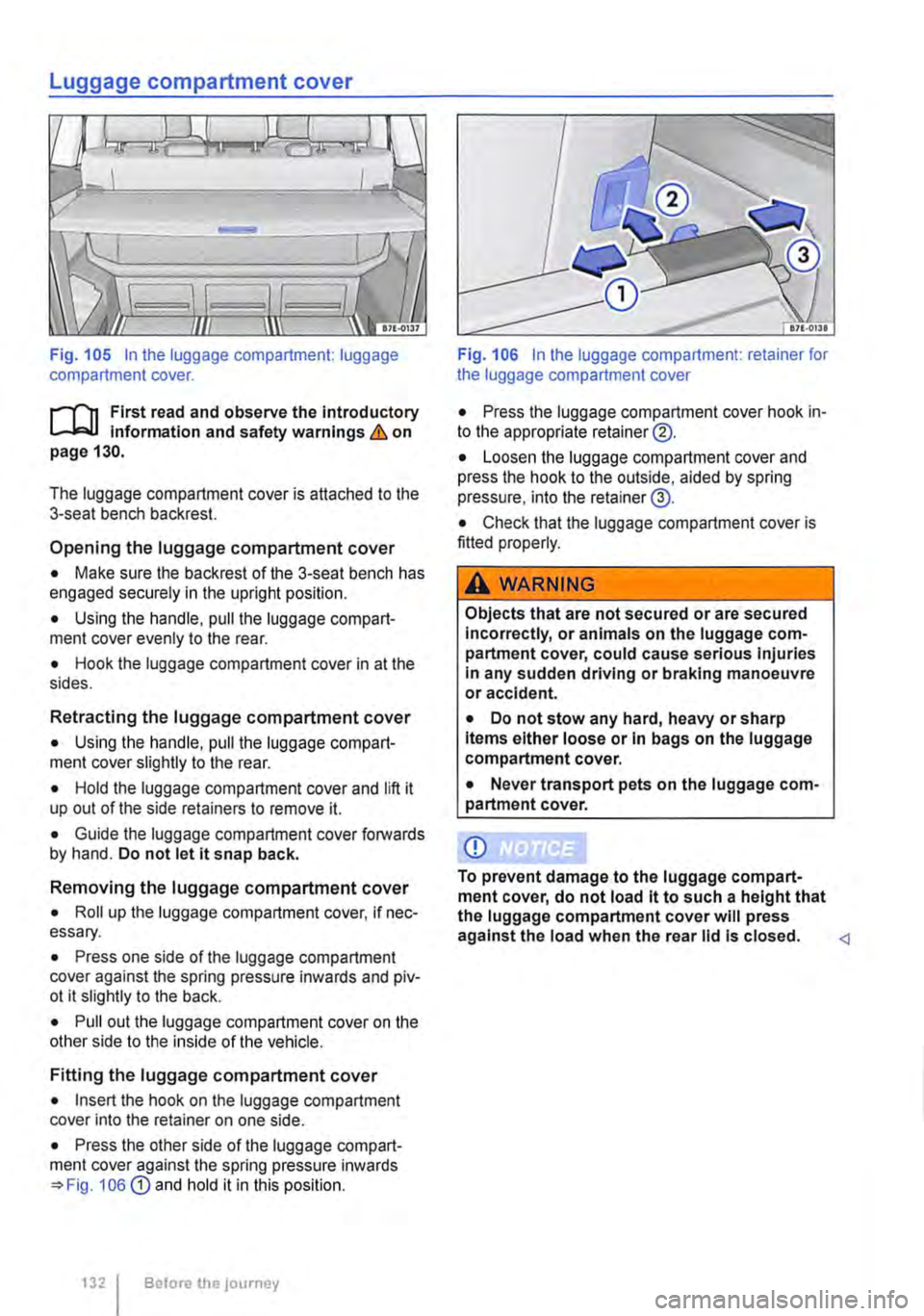
Fig. 105 In the luggage compartment: luggage compartment cover.
f"'l1 First read and observe the Introductory L-Jc.l.l Information and safety warnings & on page 130.
The luggage compartment cover is attached to the 3-seat bench backrest.
Opening the luggage compartment cover
• Make sure the backrest of the 3-seat bench has engaged securely in the upright position.
• Using the handle, pull the luggage compart-ment cover evenly to the rear.
• Hook the luggage compartment cover in at the sides.
Retracting the luggage compartment cover
• Using the handle, pull the luggage compart-ment cover slightly to the rear.
• Hold the luggage compartment cover and lift it up out of the side retainers to remove it.
• Guide the luggage compartment cover forwards by hand. Do not let it snap back.
Removing the luggage compartment cover
• Roll up the luggage compartment cover, if nec-essary.
• Press one side of the luggage compartment cover against the spring pressure inwards and piv-ot it slightly to the back.
• Pull out the luggage compartment cover on the other side to the inside of the vehicle.
Fitting the luggage compartment cover
• Insert the hook on the luggage compartment cover into the retainer on one side.
• Press the other side of the luggage compart-ment cover against the spring pressure inwards 106 G) and hold it in this position.
132 I Before the journey
Fig. 106 In the luggage compartment: retainer for the luggage compartment cover
• Press the luggage compartment cover hook in-to the appropriate retainer@.
• Loosen the luggage compartment cover and press the hook to the outside, aided by spring pressure, into the retainer@.
• Check that the luggage compartment cover is fitted properly.
A WARNING
Objects that are not secured or are secured incorrectly, or animals on the luggage com-partment cover, could cause serious injuries in any sudden driving or braking manoeuvre or accident.
• Do not stow any hard, heavy or sharp items either loose or In bags on the luggage compartment cover.
• Never transport pets on the luggage com-partment cover.
Page 133 of 486
Guide rail system in the rear vehicle floor
CQJ Introduction
This chapter contains information on the following subjects:
Opening and closing the rail system 133
Fastening rings in the rail system . . . . 134
T-shaped fastening ring . . . . . . . . . 135
Net partition . . . . . . . . . . . . . . . . . . . . . . 136
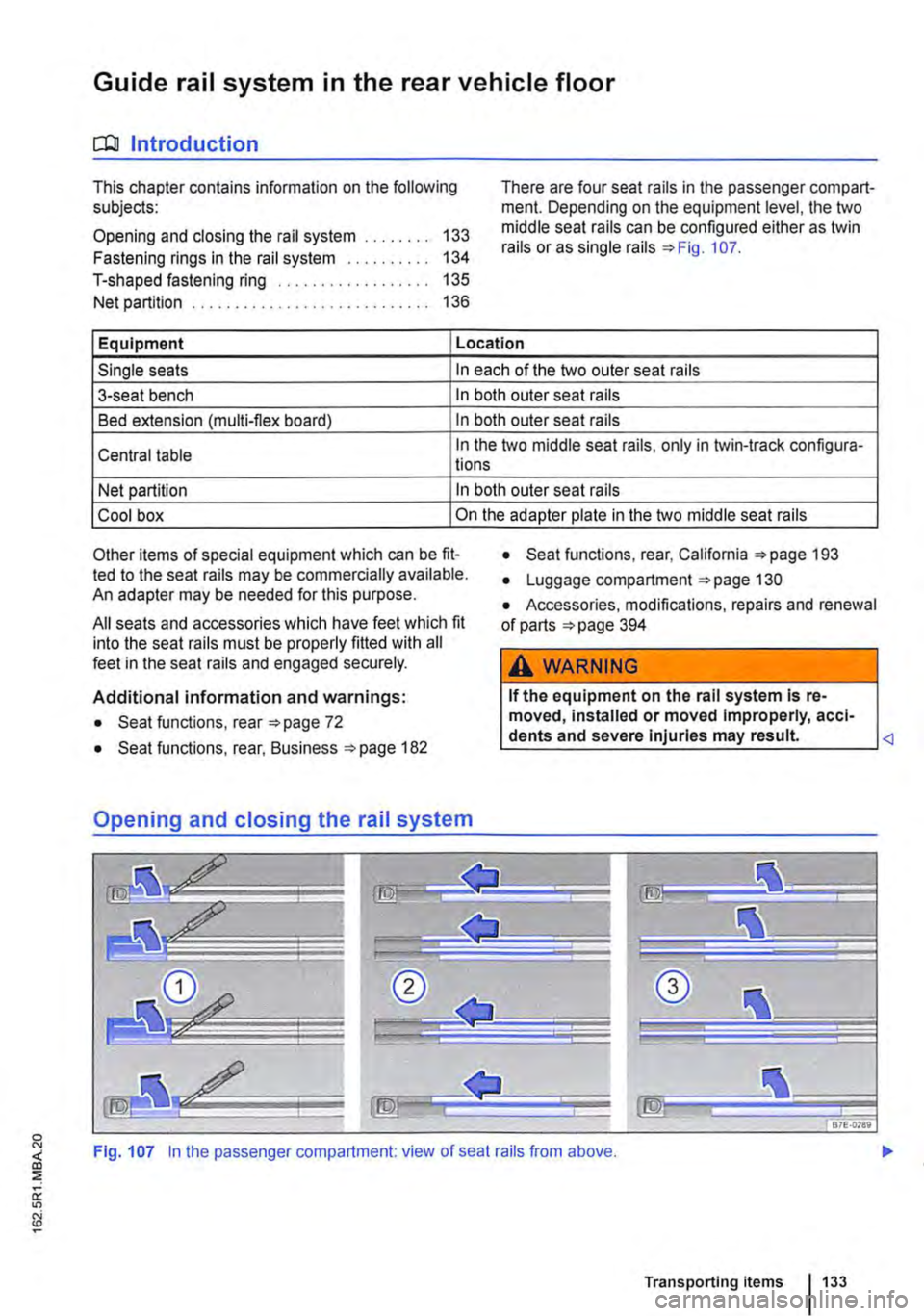
There are four seat rails in the passenger compart-ment. Depending on the equipment level, the two middle seat rails can be configured either as twin rails or as single rails =>Fig. 107.
Equipment Location
Single seats In each of the two outer seat rails
3-seat bench In both outer seat rails
Bed extension (multi-flex board) In both outer seat rails
Central table In the two middle seat rails, only in twin-track configura-lions
Net partition In both outer seat rails
Cool box On the adapter plate in the two middle seat rails
Other items of special equipment which can be fit-ted to the seat rails may be commercially available. An adapter may be needed for this purpose.
All seats and accessories which have feet which fit into the seat rails must be properly fitted with all feet in the seat rails and engaged securely.
Additional information and warnings:
• Seat functions, rear =>page 72
• Seat functions, rear, Business =>page 182
• Seat functions, rear, California =>page 193
• Luggage compartment =>page 130
• Accessories, modifications, repairs and renewal of parts =>page 394
A WARNING
If the equipment on the rail system Is re-moved, Installed or moved Improperly, acci-dents and severe Injuries may result
Transporting items 133
Page 134 of 486
t"""""fl1 First read and observe the introductory l..--bll information and safety warnings & on page 133.
Removing plastic covers
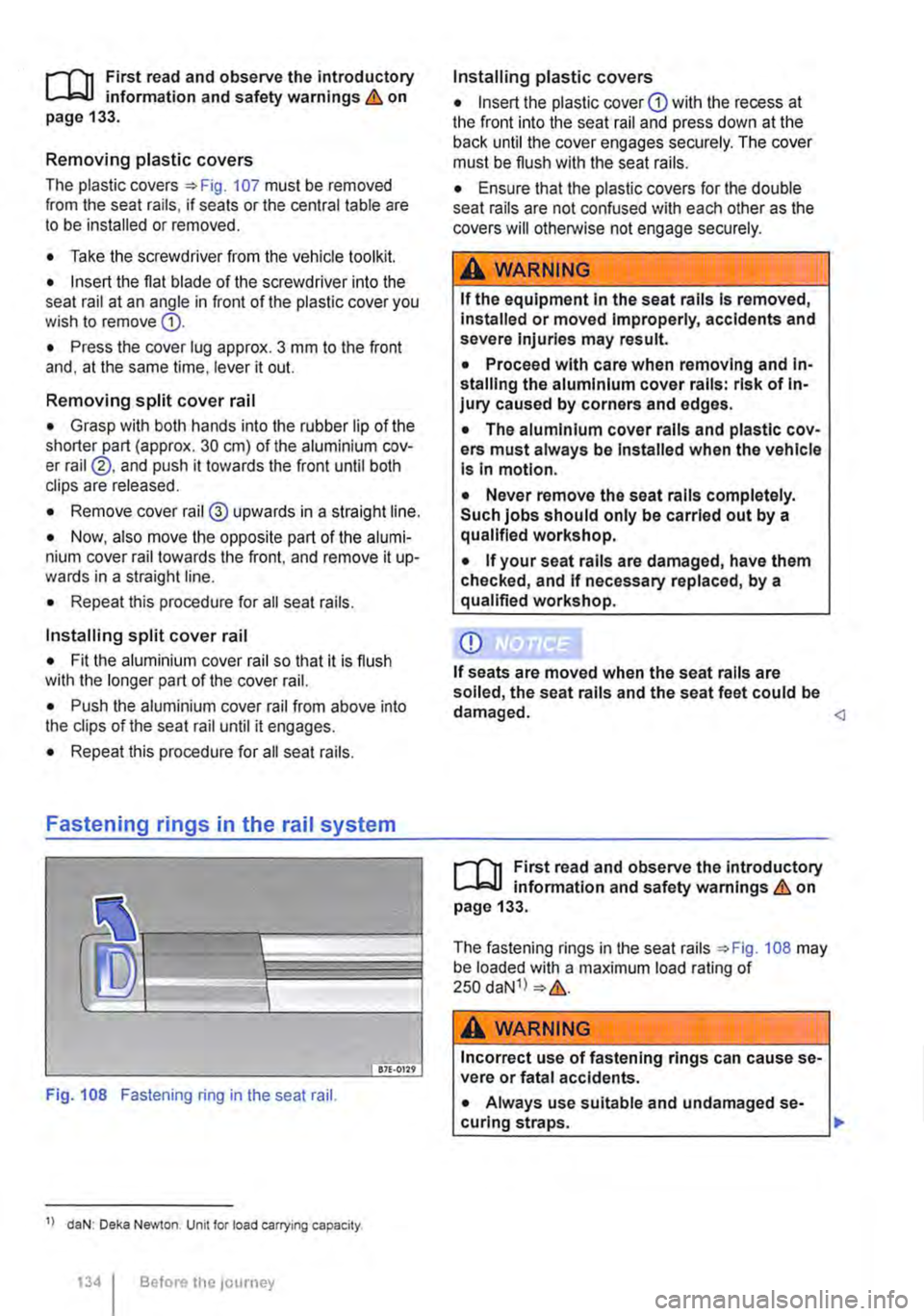
The plastic covers=:. Fig. 107 must be removed from the seat rails, if seats or the central table are to be installed or removed.
• Take the screwdriver from the vehicle tootkit.
• Insert the flat blade of the screwdriver into the seat rail at an angle in front of the plastic cover you wish to remove G).
• Press the cover lug approx. 3 mm to the front and, at the same time, lever it out.
Removing split cover rail
• Grasp with both hands into the rubber lip of the shorter part (approx. 30 cm) of the aluminium cov-er rail ®. and push it towards the front until both clips are released.
• Remove cover rail@ upwards in a straight line.
• Now, also move the opposite part of the alumi-nium cover rail towards the front, and remove it up-wards in a straight line.
• Repeat this procedure for all seat rails.
Installing split cover rail
• Fit the aluminium cover rail so that it is flush with the longer part of the cover rail.
• Push the aluminium cover rail from above into the clips of the seat rail until it engages.
• Repeat this procedure for all seat rails.
Fastening rings in the rail system
Fig. 108 Fastening ring in the seat rail.
1> daN: Deka Newton. Unit for load carrying capacity.
134 Before the JOUrney
Installing plastic covers
• Insert the plastic cover CD with the recess at the front into the seat rail and press down at the back until the cover engages securely. The cover must be flush with the seat rails.
• Ensure that the plastic covers for the double seat rails are not confused with each other as the covers will otherwise not engage securely.
A WARNING
If the equipment In the seat rails Is removed, Installed or moved Improperly, accidents and severe Injuries may result.
• Proceed with care when removing and In-stalling the aluminium cover rails: risk of In-jury caused by corners and edges.
• The aluminium cover rails and plastic cov-ers must always be Installed when the vehicle Is In motion.
• Never remove the seat rails completely. Such jobs should only be carried out by a qualified workshop.
• If your seat rails are damaged, have them checked, and If necessary replaced, by a qualified workshop.
CD
If seats are moved when the seat rails are soiled, the seat rails and the seat feet could be damaged.
The fastening rings in the seat rails ::.Fig. 108 may be loaded with a maximum load rating of 250 daN1l ::.&.
A wARNING
Incorrect use of fastening rings can cause se-vere or fatal accidents.
• Always use suitable and undamaged se-curing straps. ..,.
Page 135 of 486
A WARNING (Continued)
• Attach securing straps securely to the fas-tening rings.
• Loose objects in the vehicle can suddenly slide and change the way the vehicle han-dles.
• Never exceed the maximum load rating of the fastening rings when securing objects.
• Small and light objects should also be se-cured.
• Never secure a child seat to the fastening rings.
• Rotating single seats must always be turned in the direction of travel if a load is se-cured behind this seat using fastening rings.
T-shaped fastening ring
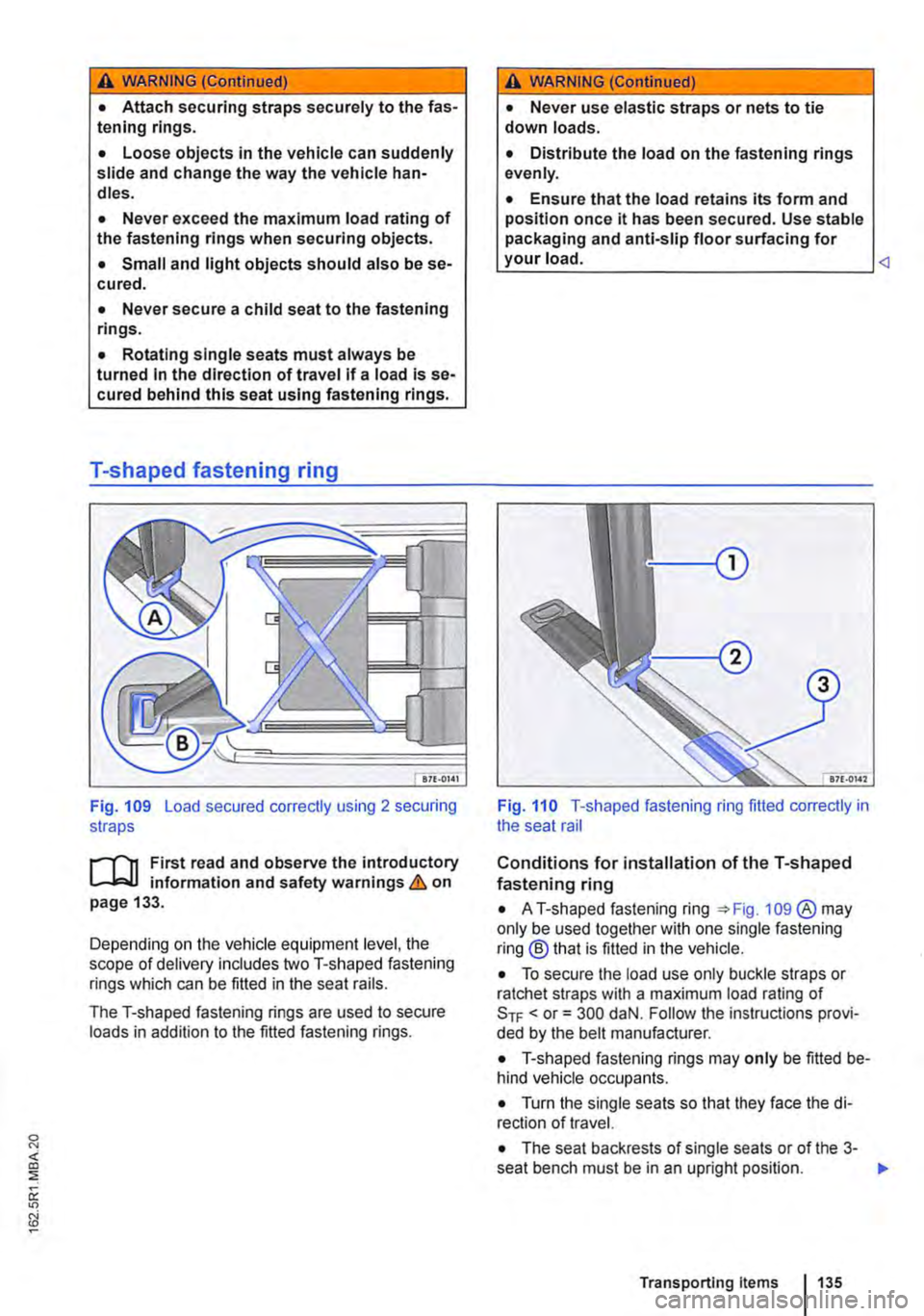
Fig. 109 Load secured correctly using 2 securing straps
il11 First read and observe the introductory L-J,.:.U information and safety warnings & on page 133.
Depending on the vehicle equipment level, the scope of delivery includes two T-shaped fastening rings which can be fitted in the seat rails.
The T-shaped fastening rings are used to secure loads in addition to the fitted fastening rings.
A WARNING (Continued)
• Never use elastic straps or nets to tie down loads.
• Distribute the load on the fastening rings evenly.
• Ensure that the load retains its form and position once it has been secured. Use stable packaging and anti-slip floor surfacing for your load.
Conditions for installation of the T-shaped fastening ring
• AT-shaped fastening ring 109 ®may only be used together with one single fastening ring® that is fitted in the vehicle.
• To secure the load use only buckle straps or ratchet straps with a maximum load rating of SrF < or= 300 daN. Follow the instructions provi-ded by the belt manufacturer.
• T-shaped fastening rings may only be fitted be-hind vehicle occupants.
• Turn the single seats so that they face the di-rection of travel.
• The seat backrests of single seats or of the 3-seat bench must be in an upright position. .,.
Transporting Items 135
Page 136 of 486
Fitting the T-shaped fastening ring
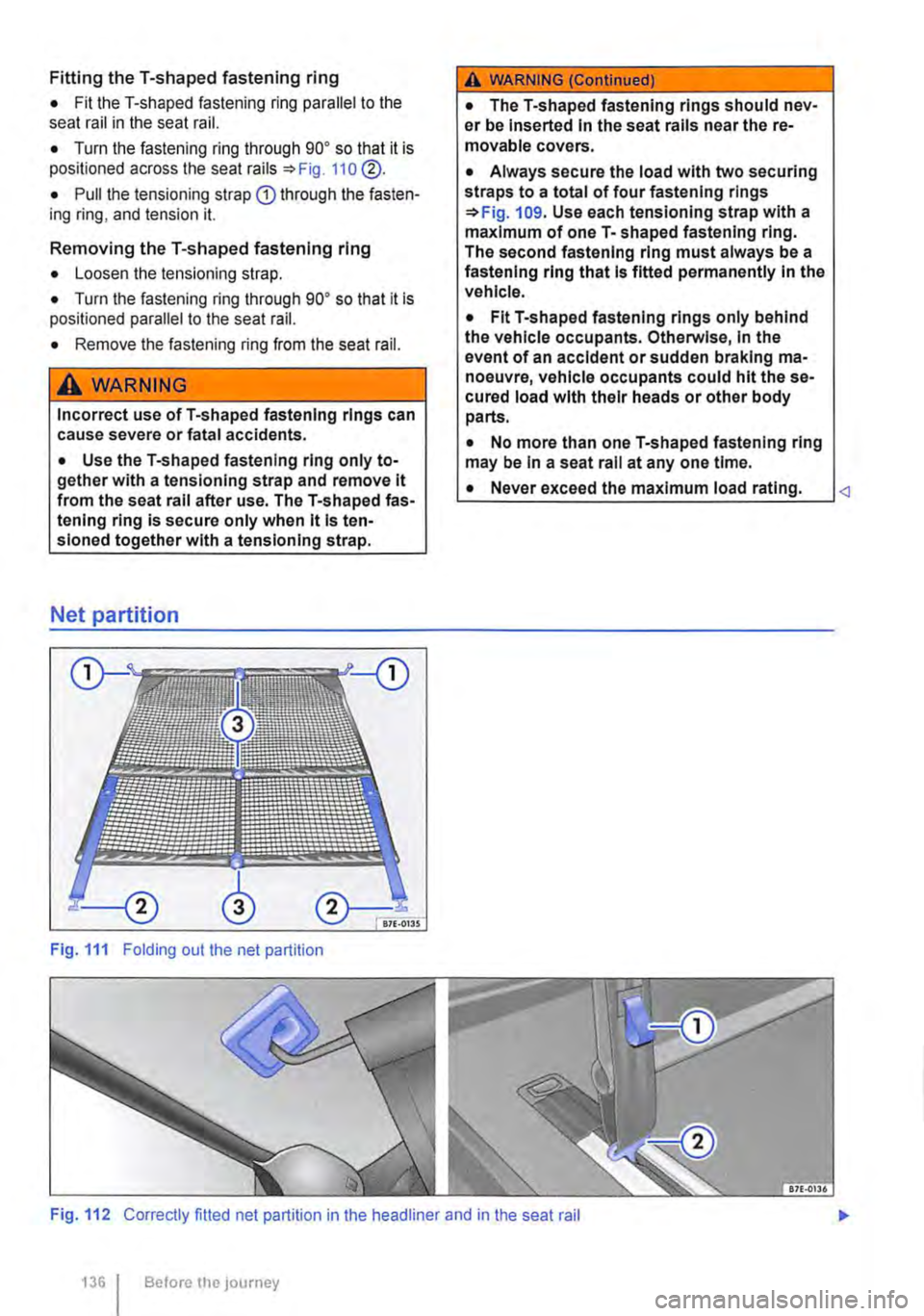
• Fit the T-shaped fastening ring parallel to the seat rail in the seat rail.
• Turn the fastening ring through go• so that it is positioned across the seat rails =:>Fig. 110 @.
• Pull the tensioning strap Q) through the fasten-ing ring, and tension it.
Removing the T-shaped fastening ring
• Loosen the tensioning strap.
• Turn the fastening ring through go• so that it is positioned parallel to the seat rail.
• Remove the fastening ring from the seat rail.
A WARNING
Incorrect use ofT-shaped fastening rings can cause severe or fatal accidents.
• Use the T-shaped fastening ring only to-gether with a tensionlng strap and remove it from the seat rail after use. The T-shaped fas-tening ring is secure only when it Is ten-sloned together with a tenslonlng strap.
Net partition
Fig. 111 Folding out the net partition
A WARNING (Continued)
• The T-shaped fastening rings should nev-er be Inserted In the seat rails near the re-movable covers.
• Always secure the load with two securing straps to a total of four fastening rings =:>Fig. 109. Use each tensloning strap with a maximum of one T-shaped fastening ring. The second fastening ring must always be a fastening ring that Is fitted permanently In the vehicle.
• Fit T-shaped fastening rings only behind the vehicle occupants. Otherwise, In the event of an accident or sudden braking ma-noeuvre, vehicle occupants could hit the se-cured load with their heads or other body parts.
• No more than one T-shaped fastening ring may be In a seat rail at any one time.
• Never exceed the maximum load rating.
1361 Before the journey