brake VOLKSWAGEN TRANSPORTER 2014 Owners Manual
[x] Cancel search | Manufacturer: VOLKSWAGEN, Model Year: 2014, Model line: TRANSPORTER, Model: VOLKSWAGEN TRANSPORTER 2014Pages: 486, PDF Size: 69.28 MB
Page 441 of 486
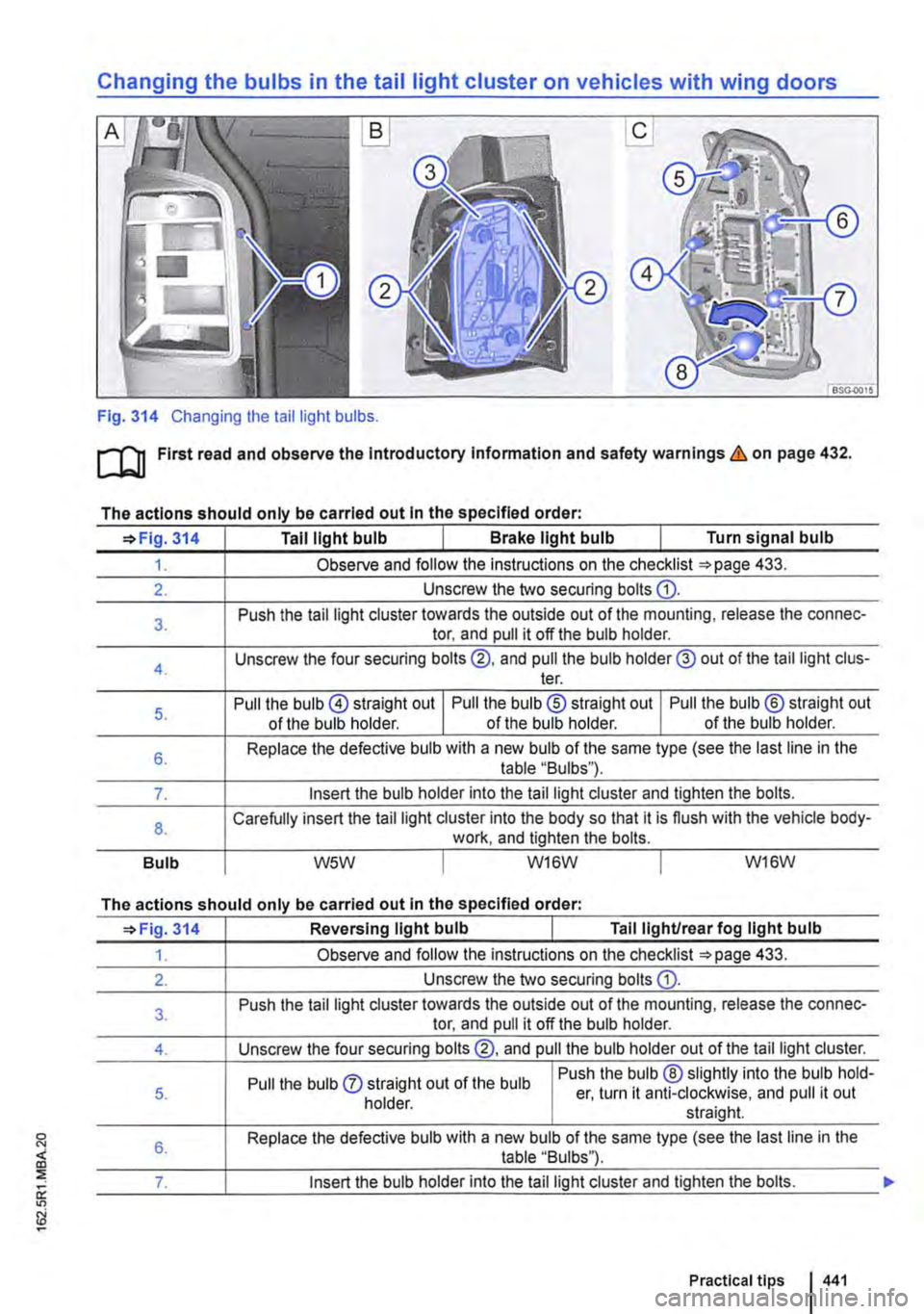
Changing the bulbs in the tail light cluster on vehicles with wing doors
Fig. 314 Changing the tail light bulbs.
ru First read and observe the Introductory Information and safety warnings&, on page 432.
The actions should only be carried out In the specified order:
'*Fig. 314 Tall light bulb 1 Brake light bulb I Turn signal bulb
1. Observe and follow the instructions on the checklist =:-page 433.
2. Unscrew the two securing bolts G).
3. Push the tail light cluster towards the outside out of the mounting, release the connec-tor, and pull it off the bulb holder.
4. Unscrew the four securing bolts®. and pull the bulb holder@ out of the tail light cl us-ter.
5. Pull the bulb @ straight out I Pull the bulb ® straight out I Pull the bulb ® straight out of the bulb holder. of the bulb holder. of the bulb holder.
6. Replace the defective bulb with a new bulb of the same type (see the last line in the table "Bulbs").
7. Insert the bulb holder into the tail light cluster and tighten the bolts.
8. Carefully insert the tail light cluster into the body so that it is flush with the vehicle body-work, and tighten the bolts.
Bulb wsw I W16W I W16W
The actions should only be carried out In the specified order:
'*Fig. 314 Reversing light bulb Tall light/rear fog light bulb
1. Observe and follow the instructions on the checklist =:-page 433.
2. Unscrew the two securing bolts G).
3. Push the tail light cluster towards the outside out of the mounting, release the connec-tor, and pull it off the bulb holder.
4. Unscrew the four securing bolts ®. and pull the bulb holder out of the tail light cluster.
Pull the bulb 0 straight out of the bulb Push the bulb ®slightly into the bulb hold-5. er, turn it anti-clockwise, and pull it out holder. straight.
6. Replace the defective bulb with a new bulb of the same type (see the last line in the table "Bulbs").
7. Insert the bulb holder into the tail light cluster and tighten the bolts.
Practical tips 441
Page 445 of 486
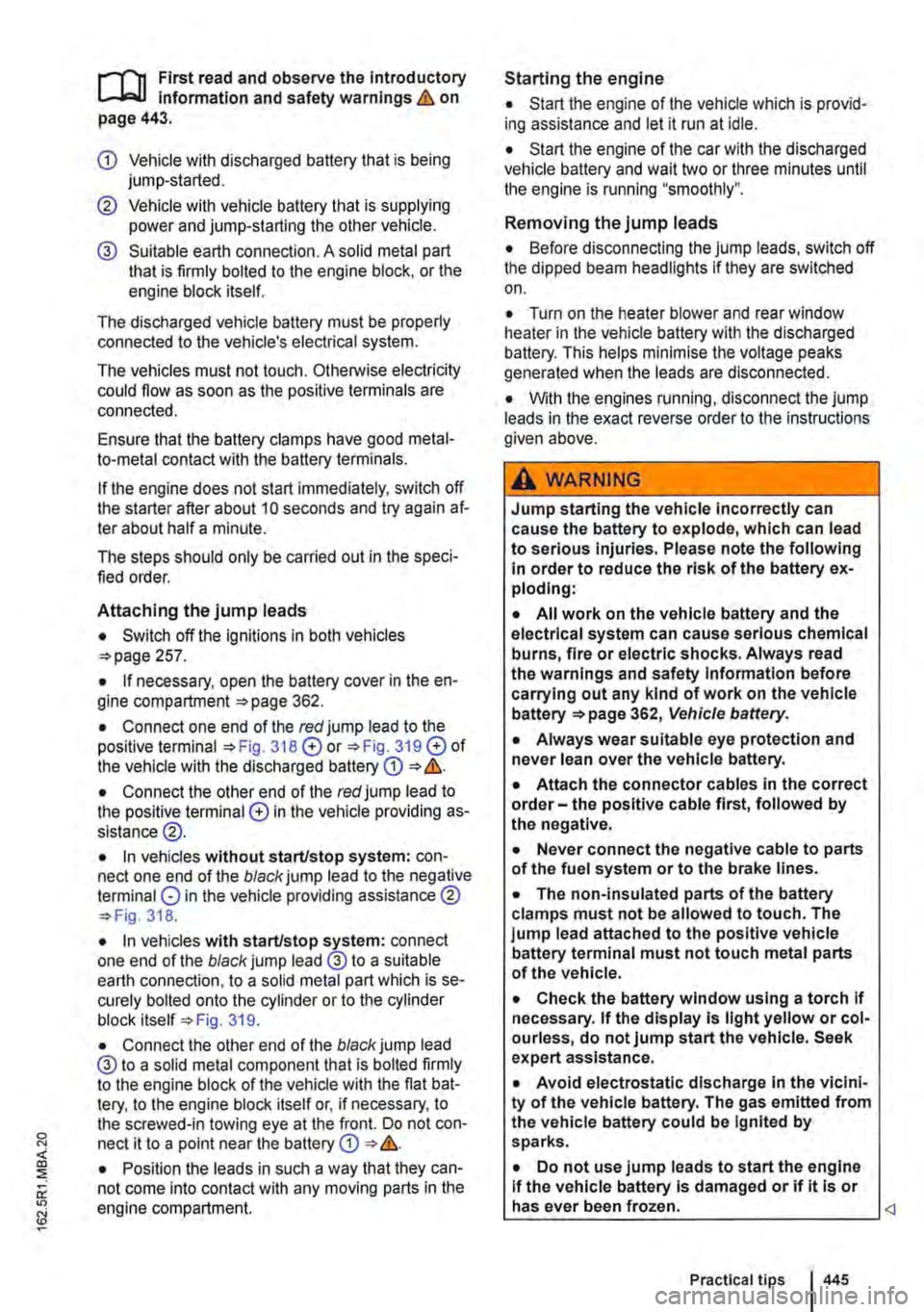
r'l11 First read and observe the Introductory L-J,:.,U Information and safety warnings & on page 443.
CD Vehicle with discharged battery that is being jump-started.
@ Vehicle with vehicle battery that is supplying power and jump-starting the other vehicle.
@ Suitable earth connection. A solid metal part that is firmly bolted to the engine block, or the engine block itself.
The discharged vehicle battery must be properly connected to the vehicle's electrical system.
The vehicles must not touch. Otherwise electricity could flow as soon as the positive terminals are connected.
Ensure that the battery clamps have good metal-to-metal contact with the battery terminals.
If the engine does not start immediately, switch off the starter after about 10 seconds and try again af-ter about half a minute.
The steps should only be carried out in the speci-fied order.
Attaching the jump leads
• Switch off the ignitions In both vehicles 257.
• If necessary, open the battery cover in the en-gine compartment 362.
• Connect one end of the red jump lead to the positive terminal 318 E) or 319 E) of the vehicle with the discharged battery CD &.
• Connect the other end of the red jump lead to the positive terminal E) In the vehicle providing as-sistance@.
• In vehicles without start/stop system: con-nect one end of the black jump lead to the negative terminal 0 in the vehicle providing assistance @ 318.
• In vehicles with start/stop system: connect one end of the black jump lead @to a suitable earth connection, to a solid metal part which is se-curely bolted onto the cylinder or to the cylinder block itself =:-Fig. 319.
• Connect the other end of the black jump lead @ to a solid metal component that is bolted firmly to the engine block of the vehicle with the flat bat-tery, to the engine block itself or, if necessary, to the screwed-in towing eye at the front. Do not con-nect it to a point near the battery CD &.
• Position the leads in such a way that they can-not come into contact with any moving parts in the engine compartment.
Starting the engine
• Start the engine of the vehicle which is provid-ing assistance and let it run at idle.
• Start the engine of the car with the discharged vehicle battery and wait two or three minutes until the engine is running "smoothly".
Removing the jump leads
• Before disconnecting the jump leads, switch off the dipped beam headlights If they are switched on.
• Turn on the heater blower and rear window heater in the vehicle battery with the discharged battery. This helps minimise the voltage peaks generated when the leads are disconnected.
• With the engines running, disconnect the jump leads in the exact reverse order to the instructions given above.
A WARNING
Jump starting the vehicle Incorrectly can cause the battery to explode, which can lead to serious injuries. Please note the following In order to reduce the risk of the battery ex-ploding:
• All work on the vehicle battery and the electrical system can cause serious chemical burns, fire or electric shocks. Always read the warnings and safety Information before carrying out any kind of work on the vehicle battery 362, Vehicle battery.
• Always wear suitable eye protection and never lean over the vehicle battery.
• Attach the connector cables In the correct order-the positive cable first, followed by the negative.
• Never connect the negative cable to parts of the fuel system or to the brake lines.
• The non-insulated parts of the battery clamps must not be allowed to touch. The jump lead attached to the positive vehicle battery terminal must not touch metal parts of the vehicle.
• Check the battery window using a torch If necessary. If the display Is light yellow or col-ourless, do not jump start the vehicle. Seek expert assistance.
• Avoid electrostatic discharge In the vicini-ty of the vehicle battery. The gas emitted from the vehicle battery could be Ignited by sparks.
• Do not use jump leads to start the engine If the vehicle battery Is damaged or if it is or has ever been frozen.
Page 446 of 486
Tow-starting and towing
0::0 Introduction
This chapter contains information on the following subjects:
Notes on tow-starting . . . . . . . . . . . . . . . . . . . . 446
Notes on towing . . . . . . . . . . . . . . . . . . . . . . . . . 447
Fitting the towing eye at front . . . . . . . . . . . . 448 Notes on driving while towing . . . . . . . . . . . . . . 448
Observe any legal requirements when towing.
For technical reasons, vehicles with a dis-charged battery must not be tow-started.
Towing a vehicle when the engine is switched off and the ignition is switched on discharges the vehi-cle battery. Depending on the vehicle battery charge level, the drop in voltage can be large enough after just a few minutes that electrical con-sumers in the vehicle will no longer function, e.g. the hazard warning lights.
Additional information and warnings:
• Exterior views =>page 5
• Changing gear =>page 257
• Engine management system and exhaust puri-fication system =>page 407
• Jump starting =>page 443
A wARNING
Never tow a vehicle that has no power sup-ply.
• Never remove the key from the ignition. The steering lock may be activated and you will no longer be able to steer the vehicle. This can lead to a loss of control of the vehi-cle, accidents and serious injuries.
Notes on tow-starting
t""""("'n First read and observe the introductory L-.lc:.JJ information and safety warnings & on page 446.
Vehicles should not be tow-started wherever possible. Use jump leads to start the engine in· stead =>page 443.
For technical reasons, the following vehicles can-not be tow-started:
4461 If and when
A WARNING (Continued)
• If the power supply to the towed vehicle is disconnected, stop towing immediately and seek expert assistance.
A WARNING
If a vehicle is being towed, the vehicle han-dling and braking effect will change signifi-cantly. Please note the following in order to reduce the risk of an accident or serious inju-ries:
• Notes for the driver of the towed vehicle:
-You will need to depress the brake ped-al more vigorously than normal as the brake servo is not working. Always be careful not to drive Into the vehicle that is pulling your vehicle.
-You will need to turn the steering wheel more vigorously as the power-assisted steering function Is not working.
• Notes for the driver of the towing vehicle
-Accelerate carefully and gently.
-Avoid sudden braking and driving ma· noeuvres.
-Brake earlier than normal by pressing lightly on the brake pedal.
CD
• Remove and install the cover and the tow-ing eye carefully so as to avoid damage to the vehicle, e.g. the palntwork.
• Unburnt fuel can enter the catalytic convert· er and damage it while the vehicle Is being tow-ed.
• If the vehicle battery has discharged, the en-gine control units will not function properly.
However, if the vehicle still has to be tow-started (manual gearbox):
• Engage second or third gear.
• Keep the clutch pressed down.
Page 447 of 486
• Switch on the ignition and the hazard warning lights.
• Once both vehicles are in motion, release the clutch.
• As soon as the engine starts, press the clutch and put the gear into neutral. This helps to prevent driving into the towing vehicle.
Notes on towing
i"""fl1 First read and observe the introductory L-W! information and safety warnings & on page 446.
Fixed towing eye at rear
On vehicles without a towing bracket there is a fixed towing eye under the bumper at the rear right.
Towing bracket instead of a fixed towing eye
If the vehicle has a factory-fitted towing bracket, it should also be used for towing other vehicles.
Tow rope or tow bar
lt is easier and safer to tow a vehicle with a tow bar. Only use a tow rope if you do not have a tow bar.
The tow rope should be slightly elastic to reduce the strain on both vehicles. lt is advisable to use a tow rope made of synthetic fibre or similarly elastic material.
Only attach the tow rope or tow bar to the specially provided towing eyes or to the towing bracket.
Vehicles with a factory-fitted towing bracket must be towed only with a tow bar that is specially designed for fitting to a ball coupling 139.
When your vehicle has to be towed:
• Switch on the ignition.
• Select the neutral position or move the selector lever to N 257.
• Release the handbrake. if necessary.
CD
When tow-starting, unburnt fuel can enter the catalytic converter and damage it. <1
• Do not allow the vehicle to be towed at speeds faster than 50 km/h (30 mph).
• Do not allow the vehicle to be towed further than 50 km.
• Vehicles with a DSG® dual clutch gearbox may only be towed by the breakdown truck with the front wheels raised.
Towing vehicles with four-wheel drive (4MOTION)
Vehicles with four-wheel drive (4MOTION) may be towed with a tow bar or tow rope. If the vehicle is towed with the rear or front axle raised, the engine must be switched off otherwise the drive train could be damaged.
When should your vehicle not be towed?
• If, due to damage, the vehicle gearbox no lon-ger contains any lubricant.
• If the vehicle battery is discharged.
• If the distance to be towed is further than 50 km -applies only to vehicles with the DSG® dual clutch gearbox.
• If the steering function or the operating clear-ance of the wheels cannot be ensured, e.g. after an accident.
Please comply with the following when towing another vehicle:
• Comply with legal regulations.
• Comply with the information on towing con-tained in the owner's manual for the other vehicle. <1
Practical tips
Page 449 of 486
• You will need to depress the brake pedal more vigorously than normal as the brake servo is not working. Do not drive too close to the towing vehi-cle.
• Read and comply with the Information and notes In the owner's manual of the towing vehicle.
Notes for the driver of the towing vehicle
• Accelerate carefully and gently. Avoid any sud-den driving manoeuvres.
• Brake earlier than normal by pressing lightly on the brake pedal.
• Read and comply with any information and notes in the owner's manual of the towed vehicle.
Page 453 of 486
CD
• Take care when driving In car parks with protruding kerbstones or bollards. Objects that protrude from the ground can damage the bumper and other components when parking the vehicle.
Petrol engines
CD
• Drive carefully through dips in the road, over driveways, ramps, kerbstones and other objects. Low-lying vehicle components such as the bumper, spoiler and parts of the running gear, engine or exhaust system could be dam-aged.
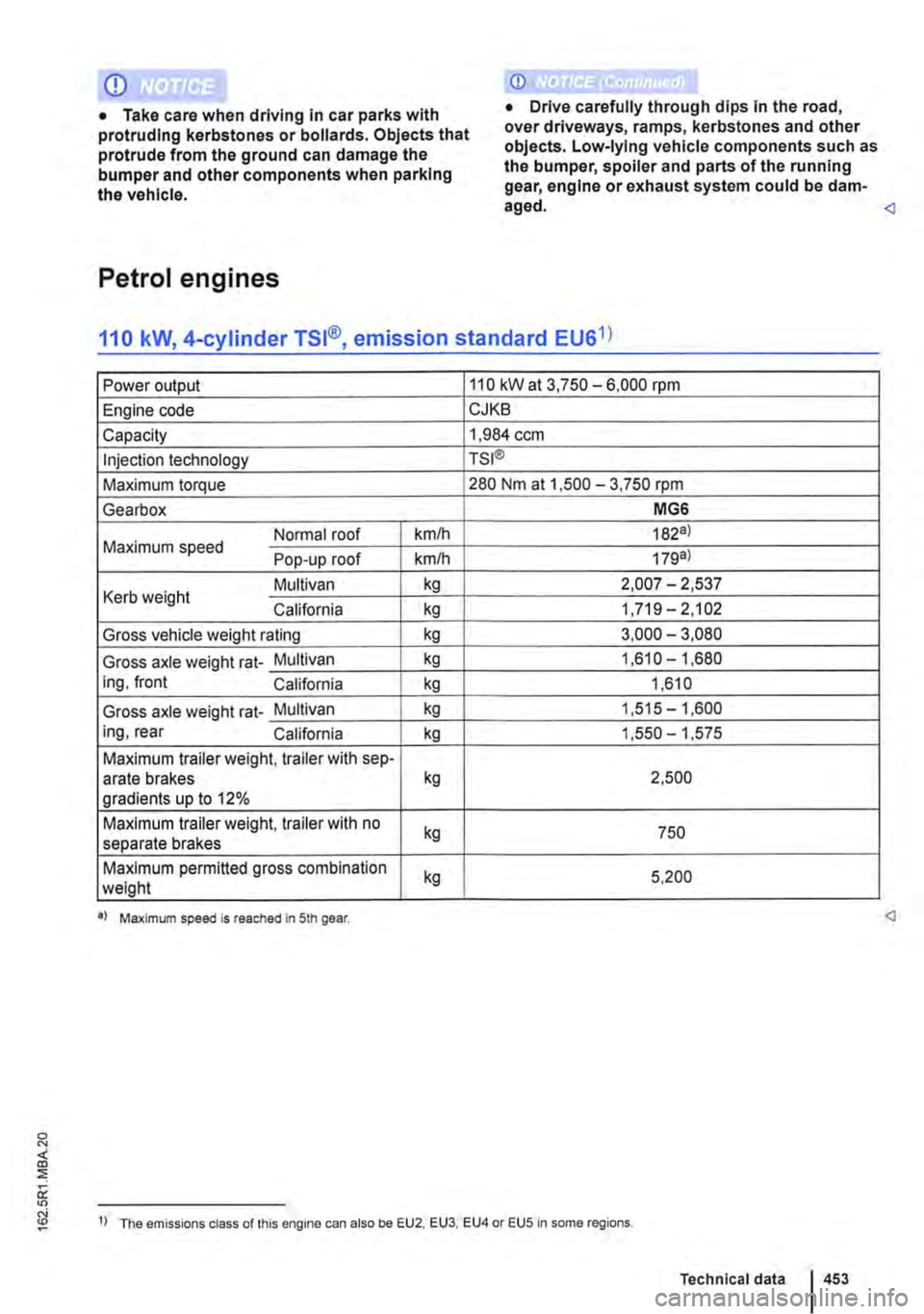
110 kW, 4-cylinder TSI®, emission standard EUG1)
Power output 110 kW at 3,750-6,000 rpm
Engine code CJKB
Capacity 1,984 ccm
Injection technology rs1®
Maximum torque 280 Nm at 1,500-3,750 rpm
Gearbox MGS
Maximum speed Normal roof km/h 1828)
Pop-up roof km/h 1798)
Kerb weight Multivan kg 2,007-2,537
California kg 1,719-2,102
Gross vehicle weight rating kg 3,000-3,080
Gross axle weight rat-Multivan kg 1,610-1,680
ing, front California kg 1,610
Gross axle weight rat-Multivan kg 1,515 -1,600
ing, rear California kg 1,550 1,575
Maximum trailer weight, trailer with sep-arate brakes kg 2,500 gradients up to 12%
Maximum trailer weight, trailer with no kg 750 separate brakes
Maximum permitted gross combination kg 5,200 weight
•> Maximum speed IS reached in 5th gear.
I) The emissions class of this engine can also be EU2, EU3, EU4 or EUS in some regions.
Technical data 453
Page 454 of 486
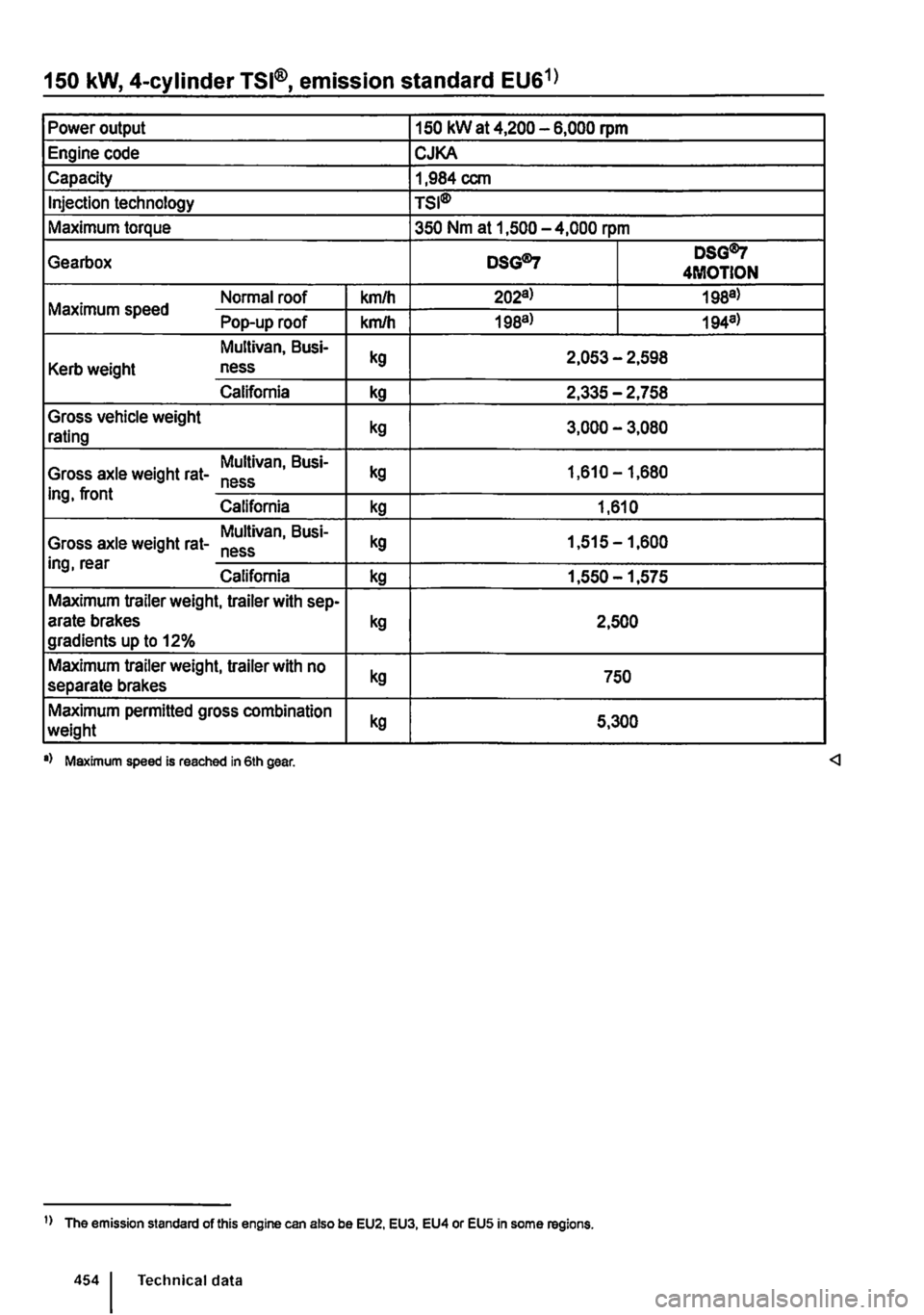
150 kW, 4-cylinder TSI®, emission standard EU61)
Power output 150 kW at 4,200-6,000 rpm
Engine code CJKA
Capacity 1,984 ccm
Injection technology TSI®
Maximum torque 350 Nm at 1 ,500-4,000 rpm
Gearbox DSG®r 4MOTION
Maximum speed Normal roof km/h 2028> 1988>
Pop-up roof km/h 1988> 1948>
Multivan, Busi-kg 2,053-2,598 Kerb weight ne ss
California kg 2,335-2,758
Gross vehicle weight kg 3,000 -3,080 rating
Gross axle weight rat-Multivan, Busi-kg 1,610-1,680 ness ing, front California kg 1,610
Gross axle weight rat-Multivan, Busi-kg 1,515-1,600 ness ing, rear California kg 1,550-1,575
Maximum trailer weight, trailer with sep-arate brakes kg 2,500 gradients up to 12%
Maximum trailer weight, trailer with no kg 750 separate brakes
Maximum permitted gross combination kg 5,300 weight
•> Maximum speed is reached in 6th gear.
1> The emission standard of this engine can also be EU2, EU3, EU4 or EU5 in some regions.
4541 Technical data
Page 455 of 486
Diesel engines
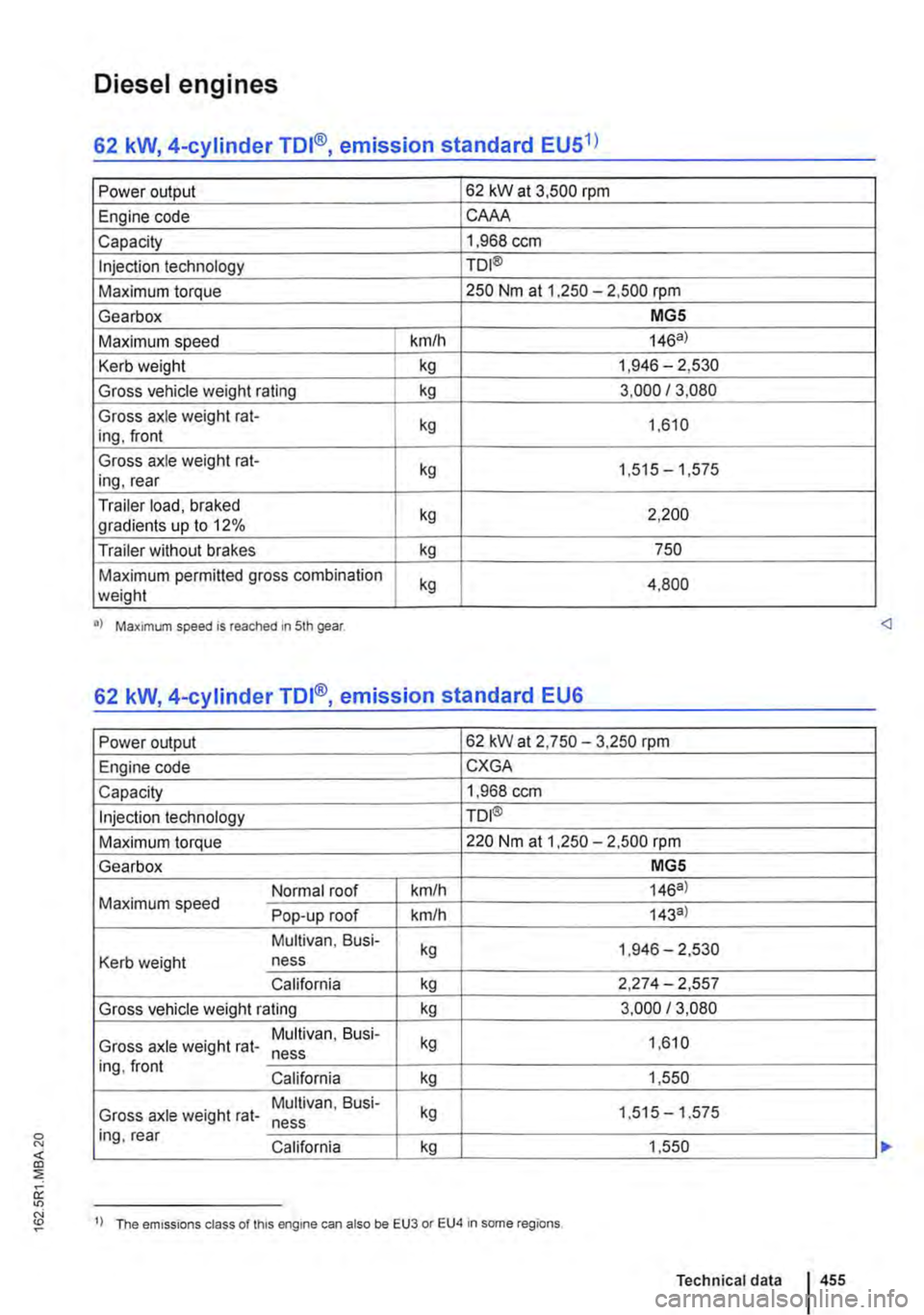
62 kW, 4-cylinder TDI®, emission standard EU51l
Power output 62 kW at 3,500 rpm
Engine code CAAA
Capacity 1,968 ccm
Injection technology TO I®
Maximum torque 250 Nm at 1 ,250 -2,500 rpm
Gearbox MGS
Maximum speed km/h 146a)
Kerb weight kg 1,946-2,530
Gross vehicle weight rating I kg 3,000 I 3,080
Gross axle weight rat-kg 1,610 ing, front
Gross axle weight rat-kg 1,515-1,575 ing, rear
Trailer load, braked kg 2,200 gradients up to 12%
Trailer without brakes kg 750
Maximum permitted gross combination kg 4,800 weight
•l Maximum speed is reached 1n 5th gear.
Power output 62 kW at 2,750-3,250 rpm
Engine code CXGA
Capacity 1,968 ccm
Injection technology TDI®
Maximum torque 220 Nm at 1,250-2,500 rpm
Gearbox MGS
Normal roof km/h 146a) Maximum speed Pop-up roof km/h 143a)
Multivan, Busi-kg 1,946-2,530 Kerb weight ne ss
California kg 2,274-2,557
Gross vehicle weight rating kg 3,000 /3,080
Gross axle weight rat-Multivan, Busi-kg 1,610 ne ss ing, front California kg 1,550
Gross axle weight rat-Multivan, Busi-kg 1,515-1,575 ne ss ing, rear California kg 1,550
11 The emissions class of this engine can also be EU3 or EU4 in some regions.
Technical data 455
Page 456 of 486
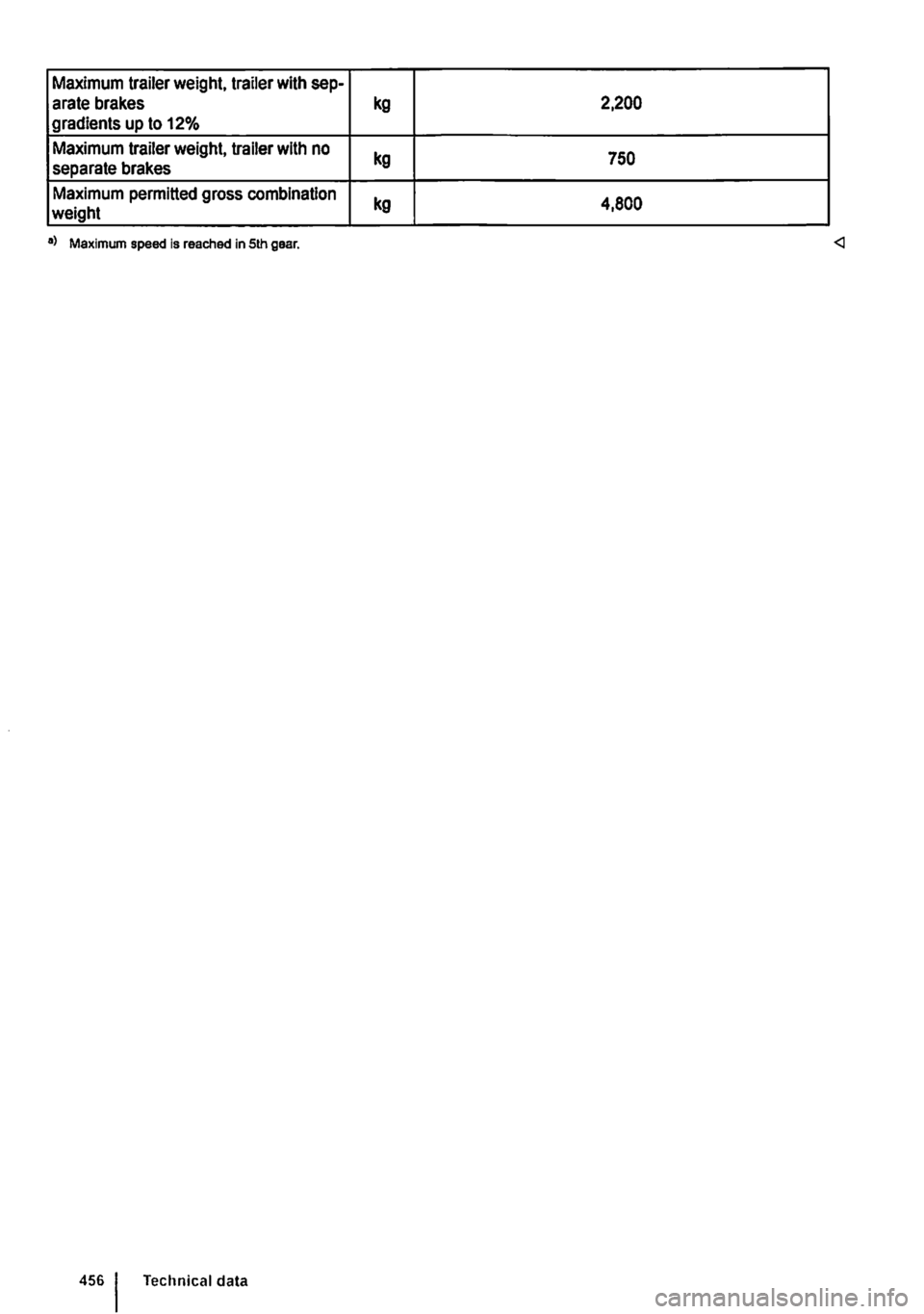
Maximum trailer weight, trailer with sep-arate brakes kg 2,200 gradients up to 12%
Maximum trailer weight, trailer with no kg 750 separate brakes
Maximum permitted gross combination kg 4,800 weight
a) Maximum speed is reached in 5th gear.
Page 457 of 486
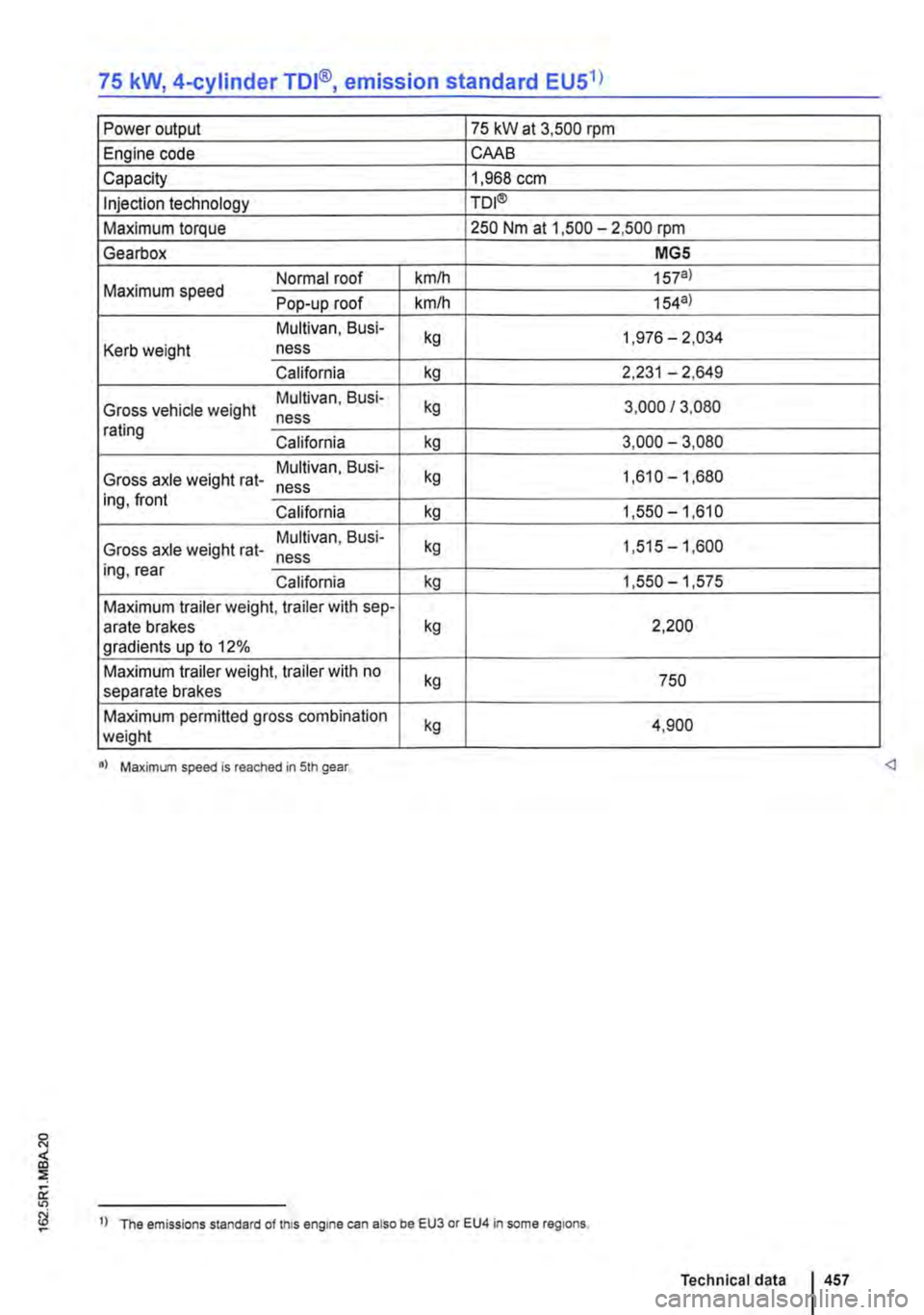
75 kW, 4-cylinder TDI®, emission standard EUS1l
Power output 75 kW at 3,500 rpm
Engine code CAAB
Capacity 1,968 ccm
Injection technology TDI®
Maximum torque 250 Nm at 1,500-2,500 rpm
Gearbox MGS
Normal roof kmlh 157a) Maximum speed Pop-up roof km/h 154a)
Multivan, Busi-kg 1,976-2,034 Kerb weight ne ss
California kg 2,231 -2,649
Gross vehicle weight Multivan, Busi-kg 3,000 I 3,060 ne ss rating California kg 3,000-3,080
Gross axle weight rat-Multivan, Busi-kg 1,610-1,680 ne ss ing, front California kg 1,550-1,61 0
Gross axle weight rat-Multivan, Busi-kg 1,515-1,600 ne ss ing, rear California kg 1,550 -1,575
Maximum trailer weight, trailer with sep-arate brakes kg 2,200 gradients up to 12%
Maximum trailer weight, trailer with no kg 750 separate brakes
Maximum permitted gross combination kg 4,900 weight
•> Maximum speed is reached in 5th gear.
Technical data 457