ice warning VOLKSWAGEN TRANSPORTER 2014 Owners Manual
[x] Cancel search | Manufacturer: VOLKSWAGEN, Model Year: 2014, Model line: TRANSPORTER, Model: VOLKSWAGEN TRANSPORTER 2014Pages: 486, PDF Size: 69.28 MB
Page 406 of 486
CD
• Volkswagen Commercial Vehicles Is not re-sponsible for any vehicle damage which Is caused by low-quality fuel, inadequate servic-ing work or lack of availability of Genuine Parts.
Radio reception and aerials
i"""(")1 First read and observe the Introductory l-J.::.U information and safety warnings & on page 404.
The vehicle aerials are located in the exterior mir-rors. If any metallic chrome plates, such as chrome mirror caps, are retrofitted to the exterior mirrors you may experience problems with the radio,
CD
• Volkswagen Commercial Vehicles cannot be held responsible If the vehicle does not comply with or only partly complies with the relevant legal requirements In other countries and conti-nents.
m Interference with AM radio reception could W occur if electrical devices are used in the vi-cinity of the aerial.
i"""(")1 and observe the introductory l-J.::.U mformat1on and safety warnings & on page 404.
Volkswagen Commercial Vehicles Service infonna-tion and official Volkswagen Commercial Vehicles repair infonnation can be purchased from the fol-lowing addresses:
Please contact a Volkswagen Commercial Vehicles dealership or a qualified workshop or order the lit-erature you require from www.erwin.volkswagen.de.
Declaration of conformity
i"""(")1 First read and observe the introductory l-J.::.U information and safety warnings & on page 404.
The individual manufacturer declares herewith that the following products conform, at the time of vehi-cle production, with the basic requirements and other relevant laws and regulations, including FCC Part 15.19, FCC Part 15.21 and RSS-Gen Issue 1:
4061 Clean1ng and mamtenance
A WARNING
Incorrect repairs and modifications can cause functional problems and damage to the vehicle and impair the effectiveness of the driver assist systems and the alrbag sys-tems. This can result In accidents and severe Injuries.
• Repairs and modifications to your vehicle should only be carried out by a qualified workshop.
• Electronic immobilizer.
• Remote control key for the vehicle.
• Remote control for the supplementary heating system (auxiliary heater).
Electrical equipment
• 12-volt socket.
Page 409 of 486
• Use unleaded petrol only.
• Do not allow the fuel tank to run empty.
• Do not overfill engine oil 353.
• Do not tow-start the vehicle. Use jump leads 443.
If you notice misfiring, uneven running or loss of power when the vehicle is moving, reduce speed Immediately. The vehicle should be inspected at
Diesel particulate filter
r-f'n First read and observe the Introductory L-J,:,.IJ Information and safety warnings & on page 407.
The diesel particulate filter filters out soot particles in the exhaust gas. The soot particles gather in the filter and are burnt under high temperatures peri-odically (regeneration). Heat produced can warm the engine.
Regeneration can cause noises, light smells and delay in radiator fan irrespective of the outside temperature, even after the engine is switched off.
To assist the regeneration of diesel particle filter, Volkswagen recommends that you avoid making only short journeys. In vehicles with a DSG® dual clutch gearbox the engine speed can increase while the vehicle is being driven. However, the indi-cator lamp • will not light up.
Observe the following points to ensure that the ex-haust system and the diesel particulate filter will work properly for a long time:
the nearest qualified workshop. If this happens, un-bumt fuel can enter the exhaust system and es-cape into the atmosphere. The catalytic converter can also be damaged by overheating.
Even when the exhaust purification system is W working perfectly, there may be a smell of sulphur from the exhaust in some conditions. This depends on the sulphur content of the fuel being used. <1
• Only use diesel with low sulphur levels 343.
• Never use biodiesel, petrol or heating oil.
• Do not allow the fuel tank to run empty.
• Do not overfill engine oil 353.
• Do not tow-start the vehicle. Use jump leads =page 443.
Even when the exhaust purification system is W working perfectly, there may be a smell of sulphur from the exhaust in some conditions. This depends on the sulphur content of the fuel being used.
m Note for courier vehicles: vehicles with diesel l!J particulate filter are identified accordingly with
Vehicle care and maintenance 409
Page 428 of 486
A WARNING (Continued)
• Always follow the instructions In the checklist and observe the general safety pro-
Sealing and inflating tyres
r-"'('n First read and observe the Introductory L-J,.:.U Information and safety warnings & on page 425.
Sealing a tyre
• Unscrew the cap from the tyre valve.
• Use the valve core extractor 302 CD to screw the valve core out of the tyre valve. Place the core on a clean surface.
• Shake the tyre filler bottle 302 ® vigo-rously up and down several times.
• Screw the filler hose 302 @tightly onto the tyre filler bottle in a clockwise direction. The plastic foil on the plug is pierced automatically.
• Remove the plug from the filler hose 302@ and place the open end fully on the tyre valve.
• Hold the bottle upside down and inject the en-tire contents of the tyre filler bottle into the tyre.
• Remove the empty tyre filler bottle from the valve.
• Use the valve core extractor 302 CD to screw the valve core back onto the tyre valve.
Inflating the tyre
• Screw the tyre filler hose 302 ® of the air compressor tightly onto the tyre valve.
• Check that the bleed screw 302 (?) is closed.
• Start the engine and let it run.
• Insert the plug 302 ®into one of the ve-hicle's 12-volt sockets 163.
• Use the on/off switch 302 ®to switch on the air compressor.
• Run the compressor until the tyre pressure has reached 2.0-2.5 bar (29-36 psi I 200-250 kPa) maximum running time is 6 minutes
• Switch off the air compressor.
• If a pressure level of 2.0-2.5 bar (29-36 psi I 200 -250 kPa) cannot be achieved unscrew the tyre filler hose from the tyre valve.
428 I If and when
• Drive (or reverse) the vehicle approximately 1 0 metres so that the sealing compound is more evenly distributed in the tyre.
• Screw the tyre filler hose for the air compressor firmly back onto the tyre valve and inflate the tyre again.
• If the required pressure still cannot be reached, the tyre is too badly damaged. The tyre cannot be sealed with the breakdown set. Do not drive on. Seek expert assistance &.
• Disconnect the air compressor and unscrew the tyre filler hose from the tyre valve.
• Drive the vehicle no faster than 80 km/h (50 mph) once a tyre pressure of 2.0-2.5 bar (29-36 psi I 200-250 kPa) has been reached.
• Check the tyre pressure after driving for 10 mi-nutes 429.
A WARNING
The tyre filler hose and the air compressor can get hot during Inflation.
• Protect your hands and skin from the hot components.
• Do not place the hot tyre filler hose or the hot air compressor on any Inflammable mate-rials.
• Allow the device to cool down fully before stowing.
• If the tyre will not Inflate to at least 2.0 bar (29 psi/ 200 kPa), the tyre Is too damaged. The sealant Is unable to seal the tyre. Do not drive on. Seek expert assistance.
CD
Switch the air compressor off after a maximum of 6 minutes to avoid overheating. Let the air compressor cool down for a few minutes be-fore switching it back on.
Page 439 of 486
The actions should only be carried out in the specified order·
311 Turn signal bulb
1. Observe and follow the instructions on the checklist ""page 433.
2. Open the bonnet.&. 350.
3. Remove the seating cap Q).
4. Release the connector@, and pull it off the bulb holder.
5. Turn the bulb holder@ anticlockwise as far as it will go and pull it out to the rear along with the bulb.
6. Push the bulb slightly into the bulb holder, turn it anti-clockwise, and pull it out straight.
7. Replace the defective bulb with a new bulb of the same type (see the last line in the table "Bulbs").
8. Insert the bulb holder into the headlight and turn it clockwise as far as it will go.
9. Fit the sealing cap.
Bulb H21W
m The illustrations show the left-hand LED W headlight from behind. The right-hand LED headlight is a mirror image of the one shown.
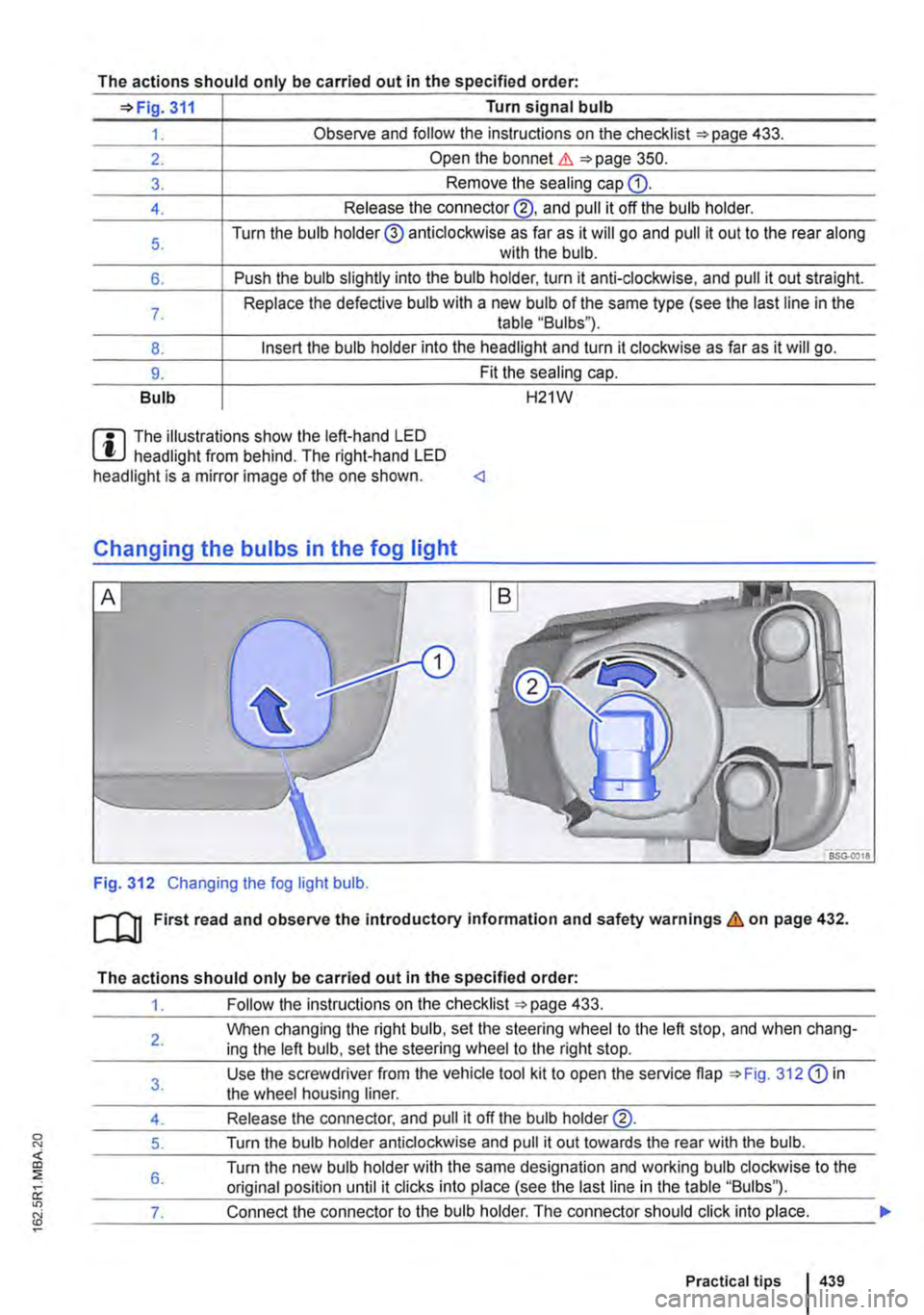
Fig. 312 Changing the fog light bulb.
m First read and observe the introductory information and safety warnings & on page 432.
The actions should only be carried out in the specified order:
1. Follow the instructions on the checklist 433.
2.
3.
4.
5.
6.
When changing the right bulb, set the steering wheel to the left stop, and when chang-ing the left bulb, set the steering wheel to the right stop.
Use the screwdriver from the vehicle tool kit to open the service flap 312 Q) in the wheel housing liner.
Release the connector, and pull it off the bulb holder@.
Turn the bulb holder anticlockwise and pull it out towards the rear with the bulb.
Turn the new bulb holder with the same designation and working bulb clockwise to the original position until it clicks into place (see the last line in the table "Bulbs").
__ ___:7...:.. ___ ..::.sh...:.o:...:u:....ld::.....:.c:...:lic.::.k:....i:....nt.:..:.o-"p-'-la:....c:..:e...:.. ___
Practical tips 439
Page 440 of 486
![VOLKSWAGEN TRANSPORTER 2014 Owners Manual The actions should only be carried out in the specified order:
8. Close the service flap CD in the wheel housing liner.
Bulb H11 <]
Fig. 313 Changing the tail light bulbs.
ro First read and observ](/img/18/55783/w960_55783-439.png "VOLKSWAGEN TRANSPORTER 2014 Owners Manual The actions should only be carried out in the specified order:
8. Close the service flap CD in the wheel housing liner.
Bulb H11 <]
Fig. 313 Changing the tail light bulbs.
ro First read and observ")
The actions should only be carried out in the specified order:
8. Close the service flap CD in the wheel housing liner.
Bulb H11 <]
Fig. 313 Changing the tail light bulbs.
ro First read and observe the introductory Information and safety warnings & on page 432.
The actions should only be carried out in the specified order:
Brake light/tail Rear fog light bulb '*Fig. 313 Tail light bulb Turn signal bulb light bulb or reversing light bulb
1. Observe and follow the instructions on the checklist =>page 433.
2. Unscrew the two securing bolts G).
3. Push the tail light cluster towards the outside out of the mounting, release the connec-tor, and pull it off the bulb holder.
4. Unscrew the four securing bolts@, and pull the bulb holder@ out of the tail light cl us-ter.
Push the bulb® Push the bulb 0 Pull the bulb@ Pull the bulb ® slightly into the bulb slightly into the bulb 5. straight out of the straight out of the holder, turn it anti-holder, turn it anti-bulb holder. bulb holder. clockwise, and pull it clockwise, and pull it out straight. out straight.
6. Replace the defective bulb with a new bulb of the same type (see the last line in the table "Bulbs").
7. Insert the bulb holder into the tail light cluster and tighten the bolts.
8. Carefully insert the tail light cluster into the body so that it is flush with the vehicle body-work, and tighten the bolts.
Bulb W5W I W16W I P21/4W I H21Wor P21W <]
440 I If and whon
Page 450 of 486
Technical data
Technical data
Vehicle data
COJ Introduction
This chapter contains information on the following subjects:
Vehicle identification data . . . . . . . . . . . . . . . . . 451
Dimensions ........................... . 452
Unless otherwise specified, the technical data of the basic model apply. The values quoted here may differ if additional equipment is fitted, for differ-ent models, for special vehicles or if country-specif-ic equipment is fitted. All data in the official vehicle documents take precedence over these data.
Engine
The vehicle data sticker and the official vehicle documents show which engine is installed in your vehicle.
Weight
The values for the kerb weight in the following ta-bles apply for the road-ready vehicle with driver (75 kg), service fluids including fuel tank carrying 90% of its capacity and, if applicable, toolkit and spare tyre =>&.Additional equipment and retrofit-ted accessories increase the stated kerb weight and reduce the maximum permitted load accord-ingly.
The load comprises the weights of the following:
• Passengers
• Allluggage
• Roof load including the mounts or roof bars and the load carrier system
• Drawbar load when towing a trailer
Performance figures
The performance figures were measured without equipment which may influence performance, such as a roof carrier or mud flaps.
Gross combination weight rating
The gross combination weight ratings listed are on-ly applicable for altitudes up to 1 ,000 m above sea level. The maximum weight of the car and trailer must be reduced by approximately 10% for every further 1 ,000 m in altitude.
450 I Tcchn1cal data
Descriptions of the tables
Gearbox abbreviations: MG = manual gearbox, DSG® = dual clutch gearbox DSG®.
Additional information and warnings:
• Transporting =:o page 125
• Driving with respect for the environment =:.page 278
• Fuel =:.page 343
• Engine oil =:o page 353
• Engine coolant =:o page 358
• Wheels and tyres =>page 367
• Consumer information =>page 404
,A WARNING
Exceeding the maximum permissible weights, payload, dimensions, vehicle speed and axle weight rating could cause damage to the vehicle, accidents and serious Injuries.
• Do not exceed the permitted weights, loads, dimensions and maximum speeds.
• The actual axle loads must never exceed the maximum permissible axle loads.
• The payload and the distribution of the load In the vehicle have an effect on the driv-ing response and braking distance of the ve-hicle. Adjust your speed accordingly.
,A WARNING
Accidents and severe injuries can occur if the maximum permitted gross combination weight Is exceeded.
• Never exceed the specified gross combi-nation weight rating.
Page 451 of 486
Vehicle identification data
A B
0--1674 16-5-0471 188 55 lN1,1ZZZ3C Z 9E134769
®-
360 5LD
PRSSRT Lim. TREND 155 kW D6F
®---CCZB KPZ
LRnJ QQ
BOA CIG GOK H08 JOH 091 IAT IG2 228 5RQ 5SL TQ3 352 STC Ql4 8AV SGV SRM 1211 L02 OVI> Q07 7116
en.(A71!
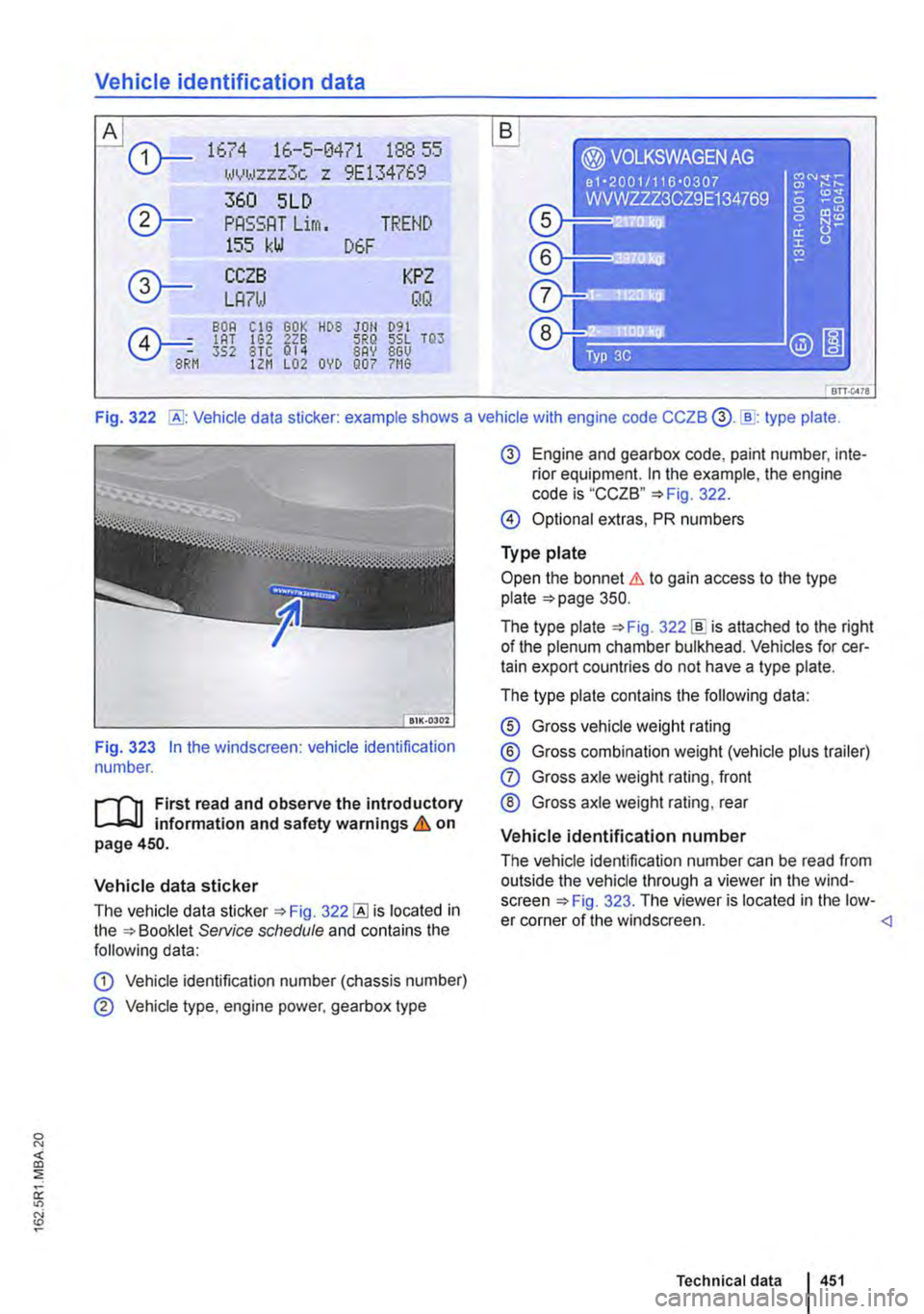
Fig. 322 data sticker: example shows a vehicle with engine code CCZB plate.
0 Engine and gearbox code, paint number, inte-rior equipment. In the example, the engine code is "CCZB" =)Fig. 322.
Fig. 323 In the windscreen: vehicle identification number.
r--('n First read and observe the introductory L-lc.J.I information and safety warnings & on page 450.
Vehicle data sticker
The vehicle data sticker =)Fig. 322 located in the =)Booklet SeNice schedule and contains the following data:
G) Vehicle identification number (chassis number)
® Vehicle type, engine power, gearbox type
G) Optional extras, PR numbers
Type plate
Open the bonnet &. to gain access to the type plate =)page 350.
The type plate =)Fig. 322 [[is attached to the right of the plenum chamber bulkhead. Vehicles for cer-tain export countries do not have a type plate.
The type plate contains the following data:
® Gross vehicle weight rating
® Gross combination weight (vehicle plus trailer)
Q) Gross axle weight rating, front
® Gross axle weight rating, rear
Vehicle identification number
The vehicle identification number can be read from outside the vehicle through a viewer in the wind-screen =)Fig. 323. The viewer is located in the low-er corner of the windscreen.
Page 452 of 486
Dimensions
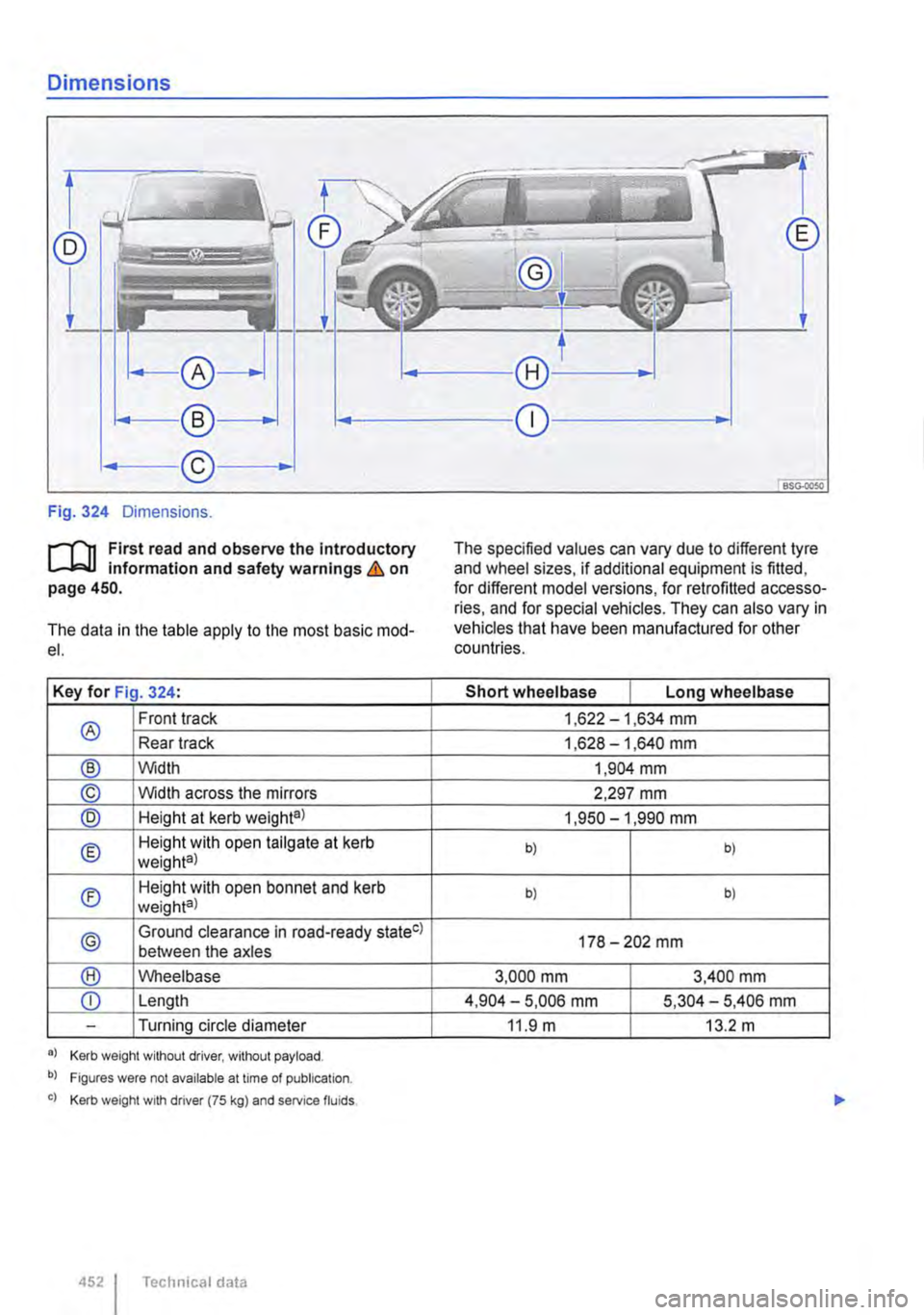
Fig. 324 Dimensions.
l""""'('n First read and observe the introductory L-J,.:.U information and safety warnings & on page 450.
The data in the table apply to the most basic mod-el.
Key for Fig. 324:
® Front track
Rear track
® Width
© Width across the mirrors
@ Height at kerb weight8l
® Height with open tailgate at kerb weight8l
® Height with open bonnet and kerb weight8l
@ Ground clearance in road-ready statecl between the axles
® Wheelbase
CD Length
-Turning circle diameter
•l Kerb weight without driver, without payload.
b) Figures were not available at time of publication.
c) Kerb weight with driver (75 kg) and service fluids.
452 I Technical data
The specified values can vary due to different tyre and wheel sizes, if additional equipment is fitted, for different model versions, for retrofitted accesso-ries, and for special vehicles. They can also vary in vehicles that have been manufactured for other countries.
Short wheelbase Long wheelbase
1,622 -1,634 mm
1,628 -1,640 mm
1,904 mm
2,297 mm
1,950-1 ,990 mm
b) b)
b) b)
178-202 mm
3,000 mm 3,400 mm
4,904-5,006 mm 5,304 -5,406 mm
11.9 m 13.2 m
Page 465 of 486
Index
Numbers and Symbols
12-volt socket California . . . . . . . . . . . . . . . . . . . . . . . . . 244
2-seat arrangement Stowage compartment in armrest . . . . . . 184
2-seat arrangement, Business . . . . . . . . . . 182 Adjusting armrest . . . . . . . . . . . . . . . . . . . 184 Adjusting seats . . . . . . . . . . . . . . . . . . . . . 183 Ash tray . .. .. . . . .. . . .. . . • . .. . .. .. . 186 Centre console . . . . . • . . . . . . . . . . . . . . . 185 Cigarette lighter . . . . . . . • . . • . . . . . . . . . 186 Controls . . . . . . . . . . . . . . . . . . . . . . . . . . 183 Drink holder . . . . . . . . . . . . . . . . . . . . . . . 186 Features . . . . . . . . . . . . . . . . . . . . . . . . . . 182 Front stowage compartment . . . . . . . . . . 186 Moving . . . . . . . . . . . . . . . . . . . . . . . . . . . 185 Refrigerator box . . . . . . . . . . . . . . . . . . . . 186 Seat heater . . . . . . . . . . . . . . . . . . . . . . . 183 Upper stowage compartment . . . . . . . . . . 186 230-volt Euro socket . . . . . . . . . . . . . . . . . . 245
230-volt grounded safety socket . . . . . . . . 246
230-volt power supply . . . . . . . . . . . . . . . . . 245 Residual current circuit breaker . . . . . . . . 247
3-seat bench
A
Folding out the table . . . . . . . . . . . . . . . . . 74 Setting up the bed . . . . . . . . . . . . . • . . . . . 74
Abroad Extended trips with your vehicle 405 Selling the vehicle . . . . . . . . . . . . . . . . . . 405
ABS see Brake support systems . . . . . . . . . . . 275
ACC see Adaptive cruise control (ACC) . . . . . . 298
Accessing a service message . . . . . . . . . . . 23
Accessories . . . . . . . . . . . . . . . . . . . . . . . . . 394
Acoustic warnings Seat belt not fastened . . . . . . . . . . . . . . . . 80
Adaptive chassis control Fault . . . . . . . . . . . . . . . . . . . . . . . . . 317, 318 Function . . . . . . . . . . . . . . . . . . . . . . . . . . 318 Operation . . . . . . . . . . . . . . . . . 318
Adaptive chassis control (DCC) . . . . . . . . . 317 Indicator lamp . . . . . . . . . . . . . . . . . . . . . 317
Adaptive cruise control (ACC) . . . . . . . . . . 298 Displays . . . . . . . . . . . . . . . . . . . . . . . . . . 300 Fault . . . . . . . . . . . . . . . . . . . . . . . . . . . . . 299 Indicator lamp . . . . . . . . . . . . . . . . . . . . . 300 Operating . . . . . . . . . . . . . . . . . . . . . . . . . 302 Radar sensor . . . . . . . . . . . . . . . . . . . . . . 301 Special driving situations . . . . . . . . . . . . . 305
Switching off temporarily . . . . . . . . . . . . . 304 Warning lamp . . . . . . . . . . . . . . . • . . • . . . 300
Ad Blue Indicator lamp . . . . . . . . . . . . . . . . . • . . . 347 Information . . . . . . . . . . . . . . . . . . . . . . . . 346 Refilling . . . . . . . . . . . . . . . . . . . . . . . . . . 348 Specification . . . . . . . . . . . . . . . . . . . . . . . 348 Tank capacity . . . . . . . . . . . . . . . . . . . . . . 346 Warning lamp . . . . . . . . . . . . . . . . . . . . . . 347
Additional battery California . . . . . . . . . . . . . . . . . . . . . . . . . 248 Charging . . . . . . . . . . . . . . . . . . . . . . . . . 247
Adjust Electrically adjustable front seat . . . . . . . . 66 Single seats in the passenger compartment .7.3
Adjusting Correct sitting position . . . . . . . . . . . . . . . . 63 Headlight range ..................... 113 Head restraints . . . . . . . . . . . . . . . . . . . . . . 67 Mechanical front seats . . . . . . . . . . . . . . . . 65 Memory seats . . . . . . . . . . . . . . . . . . . . . . 70 Single seats in the passenger compartment .73 Steering wheel . . . . . . . . . . . . . . . . . . . . . . 68
Adjusts Electric lumbar support adjustment . . . . . . 66
Aerial . . . . . . . . . . . . . . . . . . . . . . . . . . 124.406
AGM battery . . . . . . . . . . . . . . . . . . . . . . . . . 248
........................ Cleaning the dash panel . . . . . . . . . . . . . 392 Combined curtain and side airbags . . . . . . 94 Curtain airbags . . . . . . . . . . . . . . . . . . . . . . 95 Description . . . . . . . . . . . . . . . . . . . . . . . . . 90 Differences between front passenger front airbag systems . . . . . . . . . . . . . . . . . . . . 89 Faults . . . . . . . . . . . . • . . • . . . . . . . . . . . . 397 Front airbags . . . • . . • . . . . . • . . . . . • . . . . 92 Function . . . . . . . . . . . . . . . . . . . . . . . . . . . 90 Indicator lamp . . . . . . . . . . . . . . . . . . . . . . 89 Repairs . . . . . . . . . . . . . . . . . . . . . . . . . . . 397 Switching off the front passenger front air-bag . . . . . . . . . . . . . . . . . . . . . . . . . . . . . 93 Switching off with the key switch . . . . . . . . 93 Using child seats . . . . . . . . . . . . . . . . . . . . 93 Vehicle care . . . . . . . . . . . . . . . . . . . . . . . 392
Air conditioning system . . . . . . . . . . . . . . . 322 Air recirculation mode . . . . . . . . . . . . . . . 330 Climatic . . . . . . . . . . . . . . . . . . . . . . . . . . 323 Climatronic . . . . . • . . . . . . . . . . . . . . . . . . 325 Controls . . . . . . . . . . . . . . . . . . . . . . 323, 325 Fault . . . . . . . . . . . . . . . . . . . . . . . . . . . . . 328 Indirect ventilation . . . . . . . . . . . . . . . . . . 329 Information . . . . . . . . . . • . . • . . . . . . . . . . 328 Settings . . . . . . . . . . . . . . . . . . . . . . . . . . 328 Things to note . . . . . . . . . . . . . . . . . . . . . 328
Index 465
Page 467 of 486
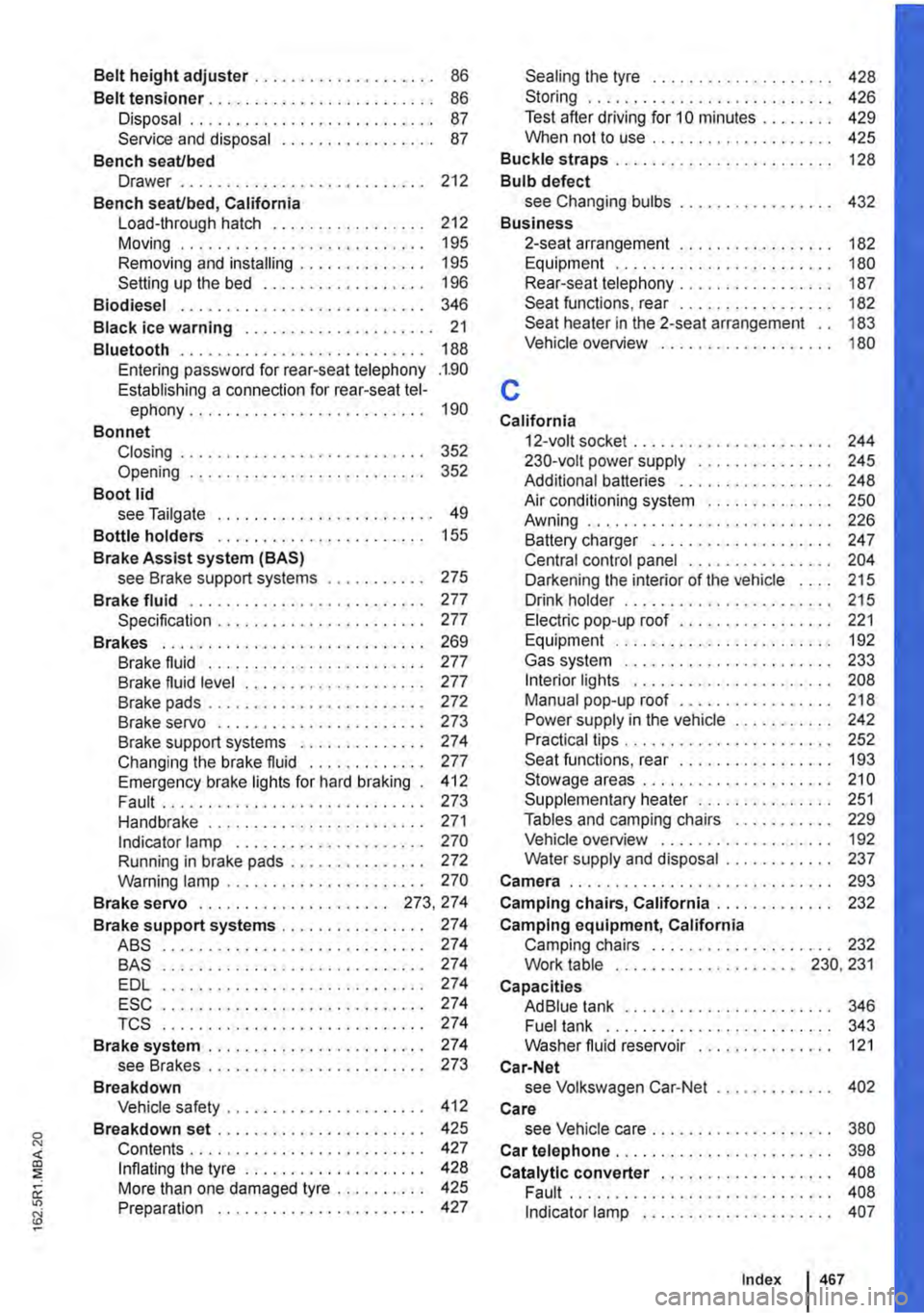
Belt height adjuster . . . . . • . . . . . . . . . . . . . . 86
Belt tensioner . . . . . . . . . . . . . . . . . . . . . . . . . 86 Disposal . . . . . . . . . . . . . . . . . . . . . . . . . . . 87 Service and disposal . . . . . . . . • . . . . . . . . 87
Bench seaUbed Drawer . . . . . . . . . . . . . . . . . . . . . . . . . . . 212
Bench seaUbed, California Load-through hatch . . . . . . . . . . . . . . . . . 212 Moving . . . . . . . . . . . . . . . . . . . . . . . . . . . 195 Removing and installing . . . . . . . . . . . . . . 195 Setting up the bed . . . . . . . . . . . . . . . . . . 196
Biodiesel . . . . . . . . . . . . . . . . . . . . . . . . . . . 346
Black ice warning . . . . . . . . . . . . . . . . . . . . . 21
Bluetooth . . . . . . . . . . . . . . . . . . . . . . . . . . . 188 Entering password for rear-seat telephony .1.90 Establishing a connection for rear-seat tel-ephony. . . . . . . . . . . . . . . . . 190
Bonnet Closing . . . . . • . . . . . . . . . . . • . . . . . . . . . 352 Opening . . . . . . . . . . . . . . . . . . . . . . . . . . 352
Boot lid see Tail gate . . . . . . . . . . . . . . . . . . . . . . . . 49
Bottle holders . . . . . . . . . . . . . . . . . . . . . . . 155
Brake Assist system (BAS) see Brake support systems . . . . . . . . . . . 275 Brake fluid . . . . . . . . . . . . . . . . . . . . . . . . . . 277 Specification . . . . . . . . . . . . . . . . . . . . . . . 277
Brakes . . . . . . . . . . . . . • . . . . . . . . . . . . . . . 269 Brake fluid . . . . . . . . . . . . . . . . . . . . . 277 Brake fluid level . . . . . . . . . . . . . . . . . . . . 277 Brake pads . . . . . . . . . . . . . . . . . . . • . . . . 272 Brake servo . . . . . . . . . . . . . . . . . . . . . . . 273 Brake support systems . . . . . . . . . . . . . . 274 Changing the brake fluid . . . . . . . . . . . . 277 Emergency brake lights for hard braking . 412 Fault . . . . . . . . . . . . . . . . . . . . . . . . . . 273 Handbrake . . . . . . . . . . . . . . . . . . . . . . . . 271 Indicator lamp . . . . . . . . . . . . . . . . . . . . . 270 Running in brake pads . . . . . . . . . . . . . . . 272 Warning lamp . . . . . . . . . . . . . . . . . . . . . . 270
Brake servo . . . . . . . . . . . . . . . . . . . . . 273, 274
Brake support systems . . . • . . . . . . . . . . . . 274 ABS ............................. 274 BAS . . . . . . . . . . . . . . . . . . . . . . . . . . . . . 274 EDL ............................. 274 ESC ............................. 274 TCS ............................. 274 Brake system . . . . . . . . . . . . . . . . . . . . . . . . 274 see Brakes . . . . . . . . . . . . . . . . . . . . . . . . 273
Breakdown Vehicle safety...................... 412
Breakdown set . . . . . . . . . . . . . . . . . . . . . . . 425 Contents . . . . . . . . . . . . . . . . . . . . . . . . . . 427 Inflating the tyre . . . . . . . . . . . . . . . . . . . . 428 More than one damaged tyre . . . . . . . . . . 425 Preparation . . . . . . . . . . . . . . . . . . . . . . . 427
Sealing the tyre . . . . . . . . . . . . . . . . . . . . 428 Storing . . . . . . . . . . . . . . . . . . . . . . . . . . . 426 Test after driving for 10 minutes . . . . . . . . 429 When not to use . . . . . . . . . . . . . . . . . . . . 425
Buckle straps . . . . . . . . . . . . . . . . . . . . . . . . 128 Bulb defect see Changing bulbs . . . . . . . • . . . . . . . . . 432 Business
c
2-seat arrangement . . . . • . . . . . . . . • . . . 182 Equipment . . . . . . . . . . . . . . . . . . . . . . . . 180 Rear-seat telephony . . . . . . . . . . . . . . . . . 187 Seat functions. rear . . . . . . . . . . . . . . . . . 182 Seat heater in the 2-seat arrangement 183 Vehicle overview . . . . . . . . . . . . . . . . . . . 180
California 12-volt socket . . . . . . . . . . . . . . . . . . . . . . 244 230-volt power supply . . . . . . . . . . . . . . . 245 Additional batteries . . . . . . . . . . . . . . . . . 248 Air conditioning system . . . . . . . . . . • . . . 250 Awning ........................... 226 Battery charger . . . . . . . . . . . . . . . . . . . . 247 Central control panel . . . . . . . . . . . . . . . . 204 Darkening the interior of the vehicle . . . . 215 Drink holder . . . . . . . . . . . . . . . . . . . . . . . 215 Electric pop-up roof . . . . . . . . . . . . . . . . . 221 Equipment . . . . . . . . . . . . . . . . . . . . . . . . 192 Gas system . . . . . . . . . . . . . . . . . . . . . . . 233 Interior lights . . . . . . . . . . . . . . . . . . . . . . 208 Manual pop-up roof . . . . . . . . . . . . . . . . . 218 Power supply in the vehicle . . . . . . . . . . . 242 Practical tips . . . . . . . . . . . . . . . . . . . . . . . 252 Seat functions, rear . . . . . . . . . . . . . • . . . 193 Stowage areas . . . . . . . . . . . . . . . . . . . . . 210 Supplementary heater . . . . . . . . . . . . . . . 251 Tables and camping chairs . . . . . . . . . . . 229 Vehicle overview . . . . . . . . . . . . . . . . . . . 192 Water supply and disposal . . . . . . . . . . . . 237
Camera ............................. 293 Camping chairs, California . . . . . . . . . . . . . 232 Camping equipment, California Camping chairs . . . . . . . . . . . . . . 232 Work table . . . . . . . . . . . • . . . . . . . . 230, 231
Capacities Ad Blue tank . . . . . . . . . . . . . . . . . . . • . . . 346 Fuel tank . . . . . . . . . . . . . . . . . . . 343 Washer fluid reservoir . . . . . . . . . . . . . . . 121
Car-Net see Volkswagen Car-Net . . . . . . . . . • . . . 402
Care see Vehicle care . . . . • . . • . . . . . . . . • . . . 380 Car telephone . . . . . . . . . . . . . . . . . . . . . . . . 398
Catalytic converter . . . . . . . . . . . . . . . . . . . 408 Fault . . . . . . . . . . . . . . . . . . . • . . . . . . . . . 408 Indicator lamp . . . . . . . . . . . . . . . . . . . . . 407
Index 467