service interval VOLKSWAGEN TRANSPORTER 2014 User Guide
[x] Cancel search | Manufacturer: VOLKSWAGEN, Model Year: 2014, Model line: TRANSPORTER, Model: VOLKSWAGEN TRANSPORTER 2014Pages: 486, PDF Size: 69.28 MB
Page 139 of 486
Loading the roof carrier
ill1 First read and observe the introductory L-l.:.l.l information and safety warnings & on page 137.
Loads can only be attached securely when the roof carrier system is fitted correctly &.
Maximum permissible roof load
The maximum permissible roof load for vehicles with a normal roof is 150 kg and for vehicles with a pop-up roof it is 50 kg. The roof load limit refers to the combined weight of the roof carrier and the load carried on the roof &.
Each mount can bear a maximum load of 50 kg if the weight of the load is evenly distributed over the entire length of the mount.
Ensure that you know the weight of the roof rack and the items to be transported on the roof, and weigh them if necessary. Never exceed the maxi-mum permissible roof load.
However, you will not be able to carry the maxi-mum roof load if you are using a roof carrier with a lower weight rating. In this instance, do not exceed the maximum weight limit for the roof carrier. This weight limit is listed in the fitting instructions.
Distributing the load
Distribute the load evenly and secure it correctly
Checking the fittings
After the mounts and roof carrier have been at-tached, check the bolted connections and fasten-ings once you have travelled a short distance and then at regular intervals.
Towing a trailer
o:n Introduction
This chapter contains information on the following subjects:
Technical requirements . . . . . . . . . . 141 Fitting the removable ball coupling 142
Removing the ball coupling . . . . . . . . . 144
Hitching and connecting the trailer . . . 144 Loading the trailer . . . . . . . . . .. . . 146 Towing a trailer . . . . . . . . . . . . . . . . . . . . . . . . 146
Trailer stabilisation . . . . . . . . . . . . . . . . . . . . . . 147
Retrofitting a towing bracket............... 149
A WARNING
Accidents and vehicle damage can occur if the maximum permitted roof load is excee-ded.
• Never exceed the quoted roof load, the maximum permissible axle loads, and the permissible gross vehicle weight for the vehi-cle.
• Do not exceed the weight rating of the roof carrier, even if the maximum roof load has not been reached.
• Secure heavy objects as far forwards as possible and distribute the load evenly.
A WARNING
Loose and Incorrectly secured loads can fall off the roof carrier and cause accidents and injuries.
• Always use suitable and undamaged se-curing straps.
• Secure loads properly.
The additional load will affect the durability, fuel consumption and performance of the vehicle and, in certain circumstances, could shorten the service intervals.
Driving with a trailer not only places an extra load on the vehicle, but also requires increased concen-tration on the part of the driver.
Transporting items 139
Page 142 of 486
Never connect the trailer lights directly to the elec-trical system of your vehicle. If you are uncertain whether the trailer has been connected correctly, please contact a qualified workshop. Volkswagen Commercial Vehicles recommends using a Volks-wagen Commercial Vehicles dealership for this purpose.
Exterior mirrors
If you are unable to see the traffic behind the trailer in the vehicle's standard exterior mirrors, additional exterior mirrors should be fitted in accordance with any country-specific regulations. Before setting off, adjust the mirrors so that you have a sufficient view of the rear.
Maximum power consumption of the trailer
Electrical consumers Maximum output
All brake lights 84 watts
Turn signal per side 42 watts
All side lights 100 watts
All tail lights 42 watts
Rear fog light 42 watts
Never exceed the specified values.
A wARNING
If the towing bracket is unsuitable or is in cor-rectly fitted, the trailer can become detached from the vehicle and cause serious Injury.
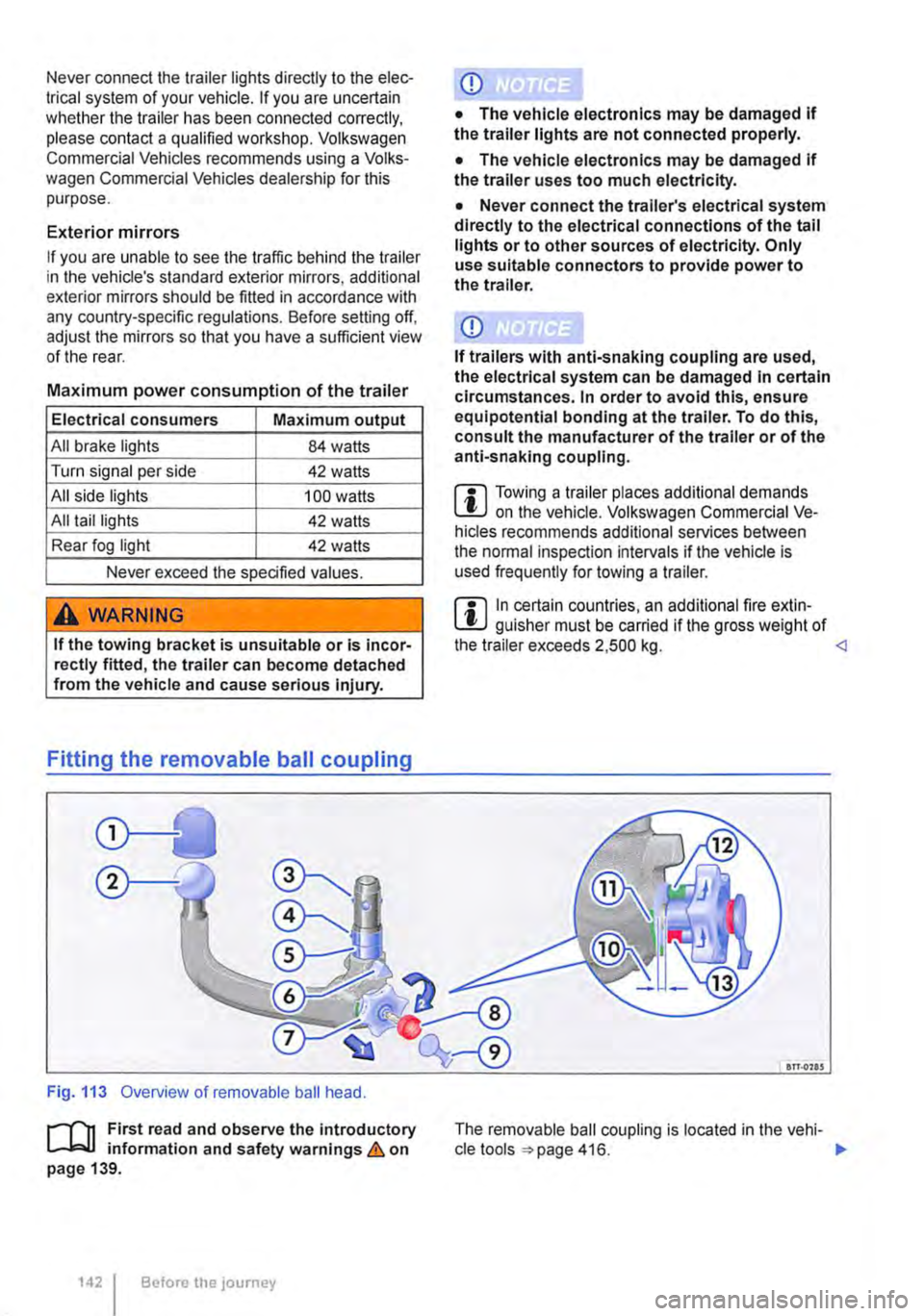
Fitting the removable ball coupling
Fig. 113 Overview of removable ball head.
r-f1t First read and observe the introductory L-J,::,JJ information and safety warnings & on page 139.
1421 Before the journey
• The vehicle electronics may be damaged If the trailer uses too much electricity.
• Never connect the trailer's electrical system directly to the electrical connections of the tail lights or to other sources of electricity. Only use suitable connectors to provide power to the trailer.
m Towing a trailer places additional demands L!J on the vehicle. Volkswagen Commercial Ve-hicles recommends additional services between the normal inspection intervals if the vehicle is used frequently for towing a trailer.
m In certain countries, an additional fire extin-L!J guisher must be carried if the gross weight of the trailer exceeds 2,500 kg. <1
an.ons
The removable ball coupling is located in the vehi-cle tools 416. ..,.
Page 280 of 486
Saving fuel
1/100 km
-10°C
+20 oc
L----------------tkm 5 15 25 30
en-o11S
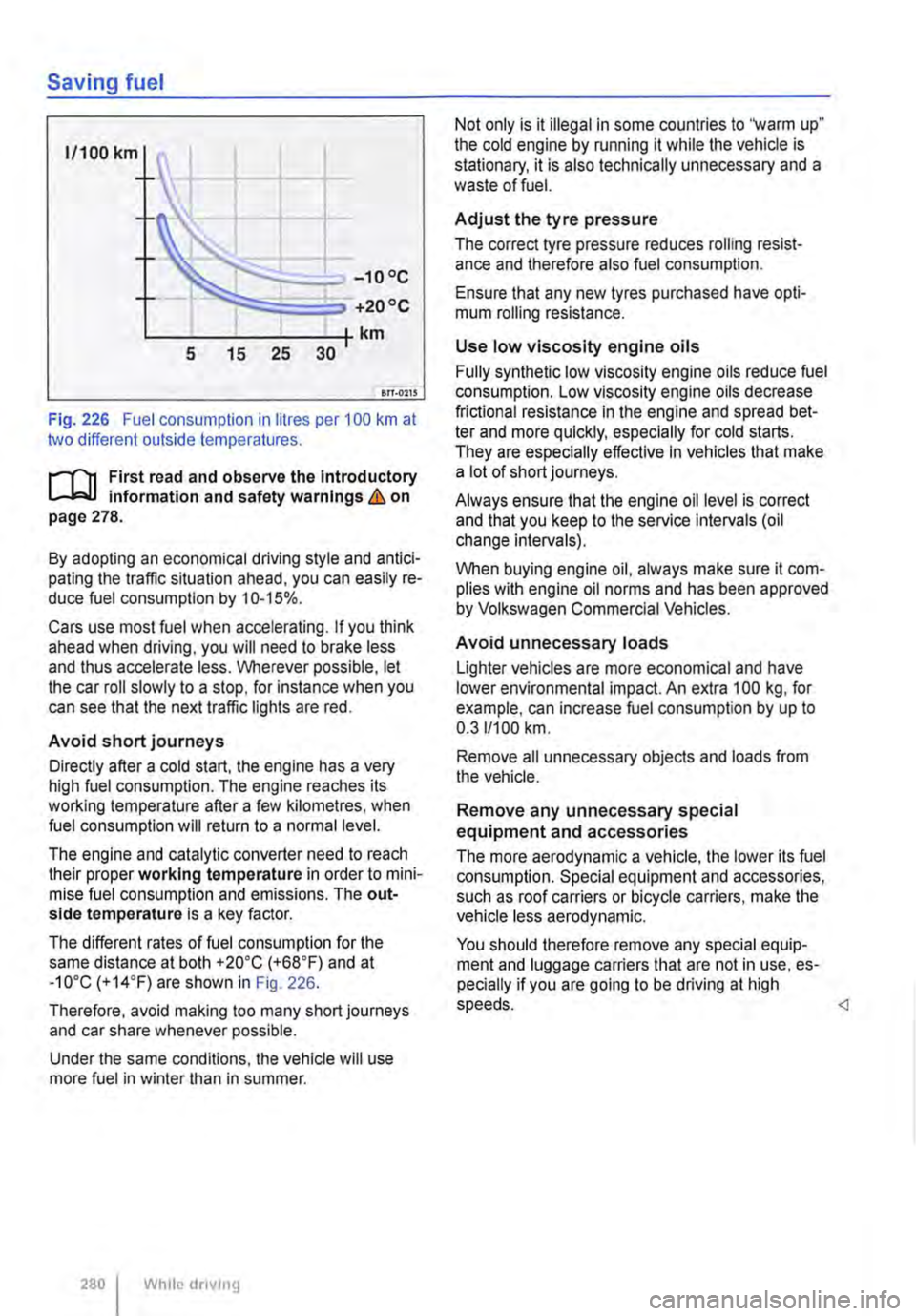
Fig. 226 Fuel consumption in litres per 100 km at two different outside temperatures.
r-1"'11 First read and observe the Introductory Information and safety warnings&. on page 278.
By adopting an economical driving style and antici-pating the traffic situation ahead, you can easily re-duce fuel consumption by 10-15%.
Cars use most fuel when accelerating. If you think ahead when driving, you will need to brake less and thus accelerate less. Wherever possible, let the car roll slowly to a stop, for instance when you can see that the next traffic lights are red.
Avoid short journeys
Directly after a cold start, the engine has a very high fuel consumption. The engine reaches its working temperature after a few kilometres, when fuel consumption will return to a normal level.
The engine and catalytic converter need to reach their proper working temperature in order to mini-mise fuel consumption and emissions. The out-side temperature is a key factor.
The different rates of fuel consumption for the same distance at both +20"C (+68"F) and at -10"C (+14"F) are shown in Fig. 226.
Therefore, avoid making too many short journeys and car share whenever possible.
Under the same conditions, the vehicle will use more fuel in winter than in summer.
280 I While dnvmg
Not only is it illegal in some countries to "warm up" the cold engine by running it while the vehicle is stationary, it is also technically unnecessary and a waste of fuel.
Adjust the tyre pressure
The correct tyre pressure reduces rolling resist-ance and therefore also fuel consumption.
Ensure that any new tyres purchased have opti-mum rolling resistance.
Use low viscosity engine oils
Fully synthetic low viscosity engine oils reduce fuel consumption. Low viscosity engine oils decrease frictional resistance in the engine and spread bet-ter and more quickly, especially for cold starts. They are especially effective In vehicles that make alotofshortjourneys.
Always ensure that the engine oil level is correct and that you keep to the service intervals (oil change intervals).
When buying engine oil, always make sure it com-plies with engine oil norms and has been approved by Volkswagen Commercial Vehicles.
Avoid unnecessary loads
Lighter vehicles are more economical and have lower environmental impact. An extra 100 kg, for example, can increase fuel consumption by up to 0.311100 km.
Remove all unnecessary objects and loads from the vehicle.
Remove any unnecessary special equipment and accessories
The more aerodynamic a vehicle, the lower its fuel consumption. Special equipment and accessories, such as roof carriers or bicycle carriers, make the vehicle less aerodynamic.
You should therefore remove any special equip-ment and luggage carriers that are not in use, es-pecially if you are going to be driving at high speeds.
Page 345 of 486
CD
• Fuels that are identified at the fuel pump as containing metallic additives may not be used. LRP fuel (lead replacement petrol) also con-tains high concentrations of metallic additives. Risk of engine damage I
Diesel
r'""'('n First read and observe the Introductory L-J,:.U Information and safety warnings & on page 343.
Diesel
Diesel fuel must comply with the European stand-ard EN 590 (in Germany DIN EN 590).
The service intervals are shorter if you use diesel with a high sulphur content =>Booklet Service schedule =>CD. A Volkswagen Commercial Vehicles dealership will be able to tell you which countries have diesel with a high sulphur content.
Where diesel fuel complying with the EN 590 standard is not available, Volkswagen Commercial Vehicles dealerships and filling stations will have information on which fuels do comply with the EN 590 standard.
Do not mix fuel additives (thinners. or similar addi-tives) with diesel.
Winter diesel
When using summer-grade diesel. difficulties may be experienced at temperatures below o•c (+32.F)
because the fuel thickens due to paraffin separa-tion. For this reason winter-grade diesel which can be used at temperatures below -2o•c (·4°F) is available in countries such as Germany during the cold months.
In countries with different climatic conditions the diesel sold generally has different temperature characteristics. Check with a Volkswagen Com-mercial Vehicles dealer or filling stations in the country concerned regarding the type of diesel fuels available.
it is not unusual for a cold diesel engine to be loud-er in cold temperatures that in warm weather. In addition, exhaust emissions may be tinged with blue while the engine starts and reaches operating temperature. The amount of exhaust fumes de-pends on the outside temperature.
CD
• Just one tankful of leaded fuel, or fuel con-taining other metallic additives, can seriously Impair the efficiency of the catalytic converter and can also cause considerable damage to the catalytic converter and engine.
Diesel vehicles are equipped with a filter pre-heat-er system. This ensures that the fuel system re-mains operational even down to approximately -24•c (-11.F) provided that winter-grade diesel which is safe down to -15•c (+5.F) is used.
However, if the fuel has thickened to such an ex-tent that the engine will not start at temperatures below -24•c (-11.F) simply place the vehicle in a warm garage or workshop for a while.
Supplementary heater
Vehicles fitted with a diesel engine may also be equipped with a fuel-driven supplementary heater. This heater is powered with fuel from the vehicle tank. In this case, odour and water vapour may es-cape from the vehicle, and there may be a greater quantity of smoke. This is quite normal when the system is in use, and does not indicate damage or a fault in the system.
The supplementary heater will be switched off au-tomatically if the level in the fuel tank is low (re-serve level).
A WARNING
Never use a start booster. Start boosters may explode or cause the engine to suddenly run at high revs, which can cause serious Injuries and engine damage.
CD
• Before filling up with diesel, check whether the fuel corresponds to the vehicle's require-ments according to the fuel standard Informa-tion at the pump.
• Only use fuel that complies with the EN 590 standard and has the correct cetane number. Otherwise, the engine and the fuel system can suffer considerable damage. The engine can al-so lose power or fall. ..,.
At the filling station 1345
Page 357 of 486
A WARNING (Continued)
• If engine oil is spilt on cold engine parts it can heat up and Ignite when the engine Is running.
• Always ensure that the engine oil filler cap Is securely tightened after refilling, and that the dipstick Is properly Inserted back Into the guide tube. This will prevent the engine oil from draining out on to hot engine compo-nents when the engine Is running.
CD
• Do not start the engine if the engine oil level Is above area@. Seek expert assistance. The catalytic converter and the engine could other-wise be damaged.
• When refilling or changing service fluids, please ensure that the correct fluids are added through the correct openings. Incorrect service fluids can cause serious functional problems and engine damage.
Engine oil consumption
n"'n First read and observe the introductory l.-J,:.ll information and safety warnings & on page 353.
Engine oil consumption can vary from engine to engine and can change during the working life of an engine.
The vehicle may consume up to 1.0 litre of engine oil per 2,000 km, depending on how you drive and the conditions in which the car is used. In new ve-
Changing engine oil
n"'n First read and observe the Introductory l.-J,:.ll Information and safety warnings & on page 353.
The engine oil must be changed regularly in ac-cordance with the data given in the service sched-ule.
The engine oil and filter change should be carried out by a qualified workshop due to the special tools and knowledge required, this also applies to the disposal of used oil. Volkswagen Commercial Vehi-cles recommends using a Volkswagen Commercial Vehicles dealership for this purpose.
The engine oil level must never be above I!!S area @. Otherwise oil can be drawn in through the crankcase breather and escape into the atmosphere via the exhaust system. <1
hicles. consumption is likely to be higher for the first 5,000 km. The engine oil level must therefore be checked at regular intervals, preferably when refuelling and before long journeys.
When the engine is working hard the oil level must be kept within area =>Fig. 274 @,for instance dur-ing long motorway cruising in summer, trailer tow-ing or climbing mountain passes. <1
More details on the service intervals can be found in the service schedule.
Additives in the engine oil can cause new engine oil to discolour quickly. This is normal and does not mean that the engine oil should be changed more frequently.
A WARNING
If, In exceptional cases, you have to carry out an oil change yourself, please note the fol-lowing:
• Always wear eye protection. .,.
In the engine compartment 357
Page 365 of 486
Colour dis-Action play
Light yellow The electrolyte level of the vehicle
or without is too low. The vehicle battery
colour should be checked and replaced by a qualified workshop if necessary.
Black The electrolyte level of the vehicle battery is correct.
A WARNING
Any work on the vehicle battery can cause serious chemical burns, explosions and elec-trlc shocks.
• Always wear eye protection and protective gloves.
A WARNING (Continued)
• Electrolyte is very aggressive. lt can burn the skin and can cause blindness. When working with the battery, ensure that your hands, arms and face in particular are protec-ted from acid spillages.
• Never tilt the vehicle battery. Electrolyte may spill out of the battery vents and cause chemical burns.
• Never open a vehicle battery.
• if acid is spilt in your eye or on your skin, rinse immediately for several minutes with cold water. Then consult a doctor immediate-ly.
• If acid is swallowed, consult a doctor im-mediately.
r-"f'n First read and observe the introductory L-Jo:.l.l information and safety warnings & on page 362.
Charging the battery
The vehicle battery should always be charged by a qualified workshop, as the technology used in fac-tory-fitted batteries requires voltage-limited charg-ing => &. Volkswagen Commercial Vehicles recom-mends using a Volkswagen Commercial Vehicles dealership for this purpose.
If the battery cannot be charged in a qualified workshop, the charging cables of a suitable battery charger must be connected as described in =>page 443, Jump starting for vehicles with a Start/Stop system.
Replacing a vehicle battery
The battery has been developed to suit the condi-tions of its location and has special safety features. If a vehicle battery has to be replaced, discuss the electromagnetic compatibility, size and necessary servicing, output and safety requirements for the new vehicle battery with a Volkswagen Commercial Vehicles dealer before purchase. The vehicle bat-tery should be replaced by a qualified workshop. Volkswagen Commercial Vehicles recommends us-ing a Volkswagen Commercial Vehicles dealership for this purpose.
Only maintenance-free vehicle batteries compliant with the standards TL 825 06 and VVV 7 50 73 should be used. These standards must be dated July 2012 or later.
Vehicles with a Start/Stop system =>page 282 or auxiliary heater =>page 332 are fitted with a special vehicle battery. These vehicle batteries may only be replaced by a vehicle battery with the same specifications.
Disconnecting the vehicle battery
Please note the following if the vehicle battery has to be disconnected from the electrical system in the vehicle:
• Switch off all electrical consumers and the igni-tion.
• Unlock the vehicle before disconnecting the battery in order to avoid triggering the alarm.
• First disconnect the negative cable and then the positive cable => &.
Connecting the vehicle battery
• Switch off all electrical consumers and the igni-tion before reconnecting the vehicle battery.
• First reconnect the positive cable and then the negative cable=>&.
Various indicator lamps may light up after the vehi-cle battery has been connected and the ignition is switched on. They will go out if you drive a short distance at a speed of 15-20 kmlh (10-12 mph). If the indicator lamps remain lit up, the vehicle should be checked by a qualified workshop.
if the vehicle battery was disconnected for long pe-riods, the system may not able to calculate or cor-rectly display the time when the next service is due =>page 19. Comply with the maximum permissible service intervals =>Booklet Service schedule. ""
In the engine compartment 365
Page 403 of 486
The radio communications connection required for Volkswagen Car-Net services is provided by the user's mobile end device, e.g. mobile telephone, SIM card reader. This network signal allows Volks-wagen Car-Net services to receive data online, pass on vehicle data online and transmit additional information, new functions or extended vehicle functions. Volkswagen Car-Net offers the driver or user support functions based on vehicle data to-gether with data obtained from the Internet and IT systems.
The use of Volkswagen Car-Net and the necessary mobile network connection may be subject to a fee. Due to the potentially high volume of data in use, Volkswagen recommends using a mobile phone tariff which includes a data flatrate. For more information contact your mobile telephone provider.
Depending on the service, Volkswagen Car-Net can be operated via the factory-fitted radio or navi-gation system, via mobile devices or via the online customer portal (www.volkswagen-commercial-vehicles-camet.com).
Availability
Volkswagen Car-Net services can be subject to a limited period or changed, set, deactivated, reacti-vated and expanded without prior notice.
Content, scope and provider of Volkswagen Car-Net services can vary. They may also be specific to the vehicle and country/market. Some Volkswagen Car-Net services also depend on availability of service offered by third parties.
Volkswagen Car-Net services can be subject to re-gion-specific limitations. This means that a service may not be available in all parts of a country. This applies in particular to large countries such as Russia. Availability also depends on the network coverage in each country.
Determining the current vehicle position
Some services require the exact location of the ve-hicle in order to provide functions. Depending on the service installed the current vehicle position will be transmitted to the service provider. The driver can choose this option or this will take place auto-matically. When automatic transmission is selec-ted, the current location can also be transmitted at regular intervals.
Lending or selling the vehicle to others
When the vehicle is being sold or lent, the owner or rentaUieasing firm must inform the purchasing or lending party about Volkswagen Car-Net services installed in the vehicle and their functions.
Interferences
The following situations could lead to the interrup-tion of a data transfer or operation of Volkswagen Car-Net services, or impairment of one of the serv-ices which has been installed:
• High speeds
• Areas with insufficient mobile and GPS recep-tion
• Maintenance, repairs, software updates and technical changes to your service provider's tele-communication networks and databases
• Impairment or interruption to mobile and GPS reception, for instance due to weather, tunnels, ga-rages, car parks, underpasses or intensive use of the mobile network
• In countries where Volkswagen Car-Net serv-ices are not available
• A fault in the vehicle electrical system
• Vehicle battery empty or voltage too low
• If the control unit for the Volkswagen Car-Net service or the compatible radio navigation system is not working properly
Exchanging your system
If the factory-fitted radio-navigation system is dam-aged or must be exchanged in a vehicle with Volkswagen Car-Net services installed, go to a qualified workshop. This may entail re-registering or re-activating the Volkswagen Car-Net services.
Necessary registration
Use of Volkswagen Car-Net services requires reg-istration, authentication and activation of a contract only if Volkswagen Car-Net services for the rele-vant vehicle can also be activated on the customer portal. Further information about this can be found on the Internet at (www.volkswagen-commercial-vehicles-carnet.com) or obtained from a Volkswa-gen dealer.
If Volkswagen Car-Net services can only be activa-ted using the radio navigation system, registration on the customer portal is not required.
Volkswagen recommends seeking advice from a Volkswagen dealership before using and activating Volkswagen Car-Net services. Your Volkswagen dealership can provide information on the country-specific range of services and the compatibility of the radio or navigation systems.
If a Volkswagen Car-Net service is activated for a vehicle, the person who has entered Into the mobile telephone contract Is obliged to provide information to each driver of the vehicle re-garding the transmission and reception of data .-
Vehicle care and maintenance 1403
Page 473 of 486
Gear-change Indicator . . . . . . . . . . • . . . . . 268
Glasses compartent . . . . . . . . . . . . . . . . . . 152
Glove compartment Lights ............................. 114 see Stowage areas . . . . . . . . . . . . . . . . . 151
Gross vehicle weight rating . . . . . . . . . . . . 450
Guide rail system In the rear vehicle floor Business . . . . . . . . . . . . . . . . . . . . . . . . . 133 California . . . . . . . . . . . . . . . . . . . . . . . . . 133 Multivan . . . . . . . . . . . . . . . . . . . . . . . . . . 133
H
Handbrake
Hands-free system in the passenger com· partment
271
See Rear-seat telephony . . . . . . . . . . . . . 187 Hazard warning lights . . . . . . . . . . . . . . . . . 412
Headlight range control ............. 11,113 Dynamic headlight range control . . . . . . . . 113
Headlights . . . . . . . . . . . . . . . . . . . . . . . . . . 108 Cleaning system . . • . . . . . . . . . . . . . . . . . 118 Driving abroad . . . . . . . . . . . . . . . . . . . . . . 111 Headlight (LED) . . . . . . . . . . . . . . . . . . . . . . 434
Head restraints . . . . . . . . . . . . . . . . . . . . . . . 67
Heat-insulating glass windscreen . . . . . . . . . . . . . . . . . . . . . . . . . 116
Heated seats . . . . . . . . . . . . . . . . . . . . . . . . . 69
Heating and fresh air system Controls . . . . . . . . . . . . . . . . . . . . . . . . . . 327
High-pressure cleaner . . . . . . . . . . . . . . . . 382
High-visibility waistcoat . . . . . . . . . . . . . . . 413
Hill Descent Assist . . . . . . . . . . • . . • . . . . . 285
Hill Hold Assist . . . . . . . . . . . . . . . . . . . . . . 284
Horn ................•................ 11
Hubcaps . . . . . . . . . . . . . . . . . . . . . . . . 417, 420 Centre cover . . . . . . . . . . . . . . . . . . . . . . 418 Wheel bolt caps . . . . . . . . . . . . . . • . . . . . 419 Wheel cover . . . . . . . . . . . . . . . . . . . . . . . 419
ICC 173
Identification number . . . . . . . . . . . . . . . . . 451
If and when.......................... 410
Ignition see Engine and ignition . . . . . . . . . . . . . . 257
Ignition key see Key . . . . . . . . . . . . . . . . . . . . . . . . . . . 37
Ignition lock . . . . . . . . . . . . . . . . . . . . 258 Non-authorised vehicle key . . . . . . . . . . . 258 Withdrawal lock . . . . . . . . . . . . . . . . . . . . 258
Immobilizer . . . . . . . . . . . . . . . . . . . . . . . . . . 260 Fault ............................. 257 In-car communication system . . . . . 173
Indicator lamp Adaptive chassis control (DCC) 317 Adaptive cruise control (ACC) . . . . • . . . . 300 AdBiue . . . . . . ............. 347 Airbag system . . . . . . . . . . . . . . . . . . . . . . 89 Brake pad wear indicator . . . . . . . . . . . . . 270 Brake system . . . . . . . . . . . . . . . . . . . . . . 270 Catalytic converter . . . . . . . . . . . . . . . . . . 407 Changing bulbs . . . . . . . . . . . . . . . . . . . . 433 Changing gear . . . . . . . . . . . . . . . . . . . . . 261 Checking the oil level . . . . . . • . . . . . . . . . 354 Coolant . . . . . . . . . . . . . . . . . • . . . . . . . . . 359 Cruise control system . . . . . . . . . . . . . . . 296 Depress brake . . . . . . . . . . . . . . . . . . . . . 270 Diesel particulate filter . . . . . . . . . . . . . . . 407 Engine management system . . . . . . . . . . 407 Engine oil sensor . . . . . . . . . . . . . . . . . . . 354 ESC . . . . . . . . . . . . . . . . . . . . . . . . . . . . . 270 Exhaust purification system . . . . . . . . . . . 407 Filling the tank . . . . . . . . . . . . . . . . . . . . . 341 Fuel level . . . . . . . . . . . . . . . . . . . . . . . . . 341 In the driver door . . . . . . . . . . . . . . . . . . . . 43 Lane change assist system . . . . . . . . . . . 313 Lights . . . . . . . . . . . . . . . . . . . . . . . . . . . . 106 Overview . . . . . . . . . . . . . . . . . . . . . . . . . . 16 Remote control key . . . . . . . . . . . . . . . . . . 38 Seat belt . . . . . . . . . . . . . . . . . . . . . . . . . . . 80 Tyre monitoring system . . . . . . . . . . . . . . 319 Windscreen washer fluid level . . . . . . . . . . 117
Indirect ventilation . . . . . . . . . . . . . . . . . . . . 329
Information stored in the control units . . . 398 Infrared-reflecting windscreen . . . . . . . . . . . 116
Instrument cluster . . . . . . . . . . . . . . . . . . . . . 16 Displays . . . . . . . . . . . . . . . . . . . . . 20, 21, 25 Indicator lamps . . . . . . . . . . . . . . . . . . . . . . 16 Instruments . . . . . . . . . . . . . . . . . . . . . . . . 20 Menu structure . . . . . . . . . . . . . . . . . . . . . . 25 Service interval display . . . . . . . . . . . . . . . 22 Symbols ........................... 16 Using menus . . . . . . . . . . . . . . . . . . . . . . . 27 Warning lamps . . . . . . . . . . . . . . . . . . . . . . 16 Instruments . . . . . . . . . . . . . . . . . • . . . . . . . . 20
Integrated child seat . . . . . . . . . . . . . . . . . . 102 Seat belt routing . . . . . . . . . . . . . . . . . . . . 1 05
Interior lights ................ , ........ 114
Interior lights, California . . . . . . . . . . . . . . . 208 Living area . . . . . . . . . . . . . . . . . . . . . . . . 209 Pop-up roof . . . . . . . . . . . • . . . . . . . . • . . 21 0 Interior mirror . . . . . . . . . . . . . . . . . . . . . . . . 122
Interior monitoring system . . . . . . . . . . . . . . 44 ISOFIX.............................. 100 see Child seat . . . . . . . . . . . . . . . . . . • . . . 96
Index 473
Page 479 of 486
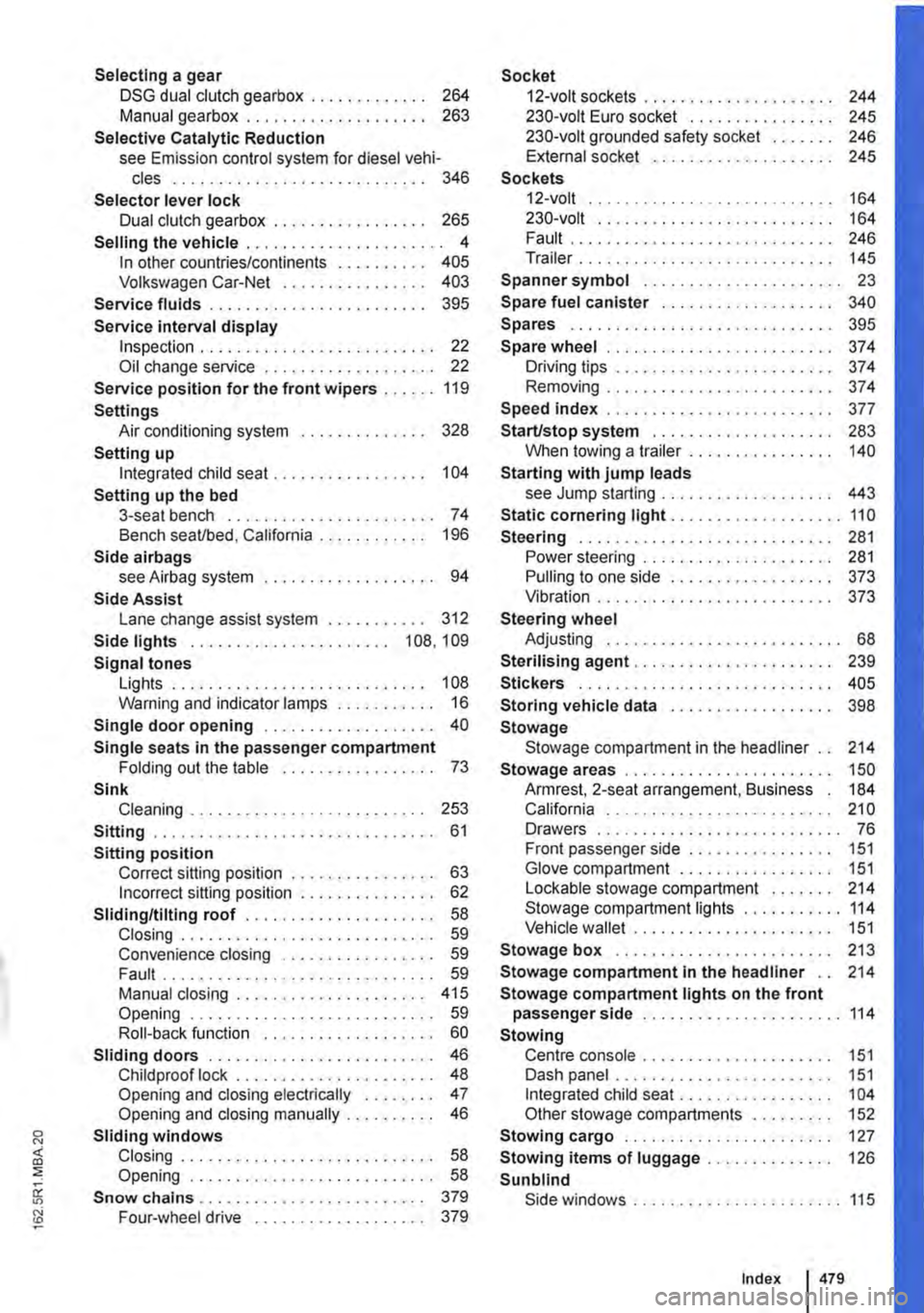
Selecting a gear DSG dual clutch gearbox . . . . . . . . . . . . . 264 Manual gearbox . . . . . . . . . . . . . . . . . . . . 263
Selective Catalytic Reduction see Emission control system for diesel vehi-cles . . . . . . . . . . . . . . . . . . . . . . . . . . . . 346
Selector lever lock Dual clutch gearbox . . . . . . . . . . . . . . . . . 265
Selling the vehicle . . . . . . . . . . . . . . . . . . . . . . 4 In other countries/continents . . . . . . . • . . 405 Volkswagen Car-Net . . . . . . . . . . . . . . . . 403 Service fluids . . . . . . . . . . . . . . . . . . . . . . . . 395
Service interval display Inspection . . . . . . . . . . . . . . . . . . . . . . . . . . 22 Oil change service . . . . . . . . . . . . . . . . . . . 22 Service position for the front wipers ...... 119
Settings Air conditioning system . . . . . . . . . . . . . . 328
Setting up Integrated child seat . . . . . . . . . . . . . . . . . 104
Setting up the bed 3-seat bench . . . . . . . . . . . . . . . . . . . . . . . 74 Bench seaVbed, California . . . . . . . . . . . . 196
Side airbags see Airbag system . . . . . . . . . . . . . . . . . . . 94
Side Assist Lane change assist system . . . . . . . . . . . 312 Side lights . . . . . . . . . . . . . . . . . . . . 108, 109
Signal tones Lights . . . . . . . . . . . . . . . . . . . . . . . . . . . . 108 Warning and indicator lamps . . . . . . . . . . . 16
Single door opening . . . . . . . . . . . . . . . . . . . 40 Single seats in the passenger compartment Folding out the table . . . . . . . . . . . . . . . . . 73
Sink Cleaning . . . . . . . . . . . . . . . . . . . . . . . . . 253
Sitting . . . . . . . . . . . . . . . . . . . . . . . . . . . . . . . 61
Sitting position Correct sitting position . . . . . . . . . . . . . . . 63 Incorrect sitting position . . . . . . . . . . . . . . . 62 Sliding/tilting roof . . . . . . . . . . . . . . . . . . . . . 58 Closing . . . . . . . . . . . . . . . . . . . . . 59 Convenience closing . . . . . . . . . . . . . . . . . 59 Fault . . . . . . . . . . . . . . . . . . . . . . . . . . . . . . 59 Manual closing . . . . . . . . . . . . . . . . . . . . . 415 Opening . . . . . . . . . . . . . . . . . . . . . . . . . . . 59 Roll-back function . . . . . . . . . . . . . . . . . . . 60 Sliding doors . . . . . . . . . . . . . . . . . . . . . . . . . 46 Childproof lock . . . . . . . . . . . . . . . . . . . • . . 48 Opening and closing electrically 47 Opening and closing manually . . 46 Sliding windows Closing ............................ 58 Opening . . . ...................... 58
Snow chains . . . . . . . . . . . . . . . . . . . . . . . . . 379 Four-wheel drive . . . . . . . . . . . . . . . . . . . 379
Socket 12-volt sockets . . . . . . . . . . . . . 244 230-volt Euro socket . . . . . . . . . . . . . 245 230-volt grounded safety socket 246 External socket . . . . . . . . . . . . . . . . 245
Sockets 12-volt . . . . . . . . . . . . . . . . . 164 230-volt . . . . . . . . . . . . . . . . . . . . . . . . . . 164 Fault . . . . . . . . . . . . . . . . . . . . . . . . . . . . . 246 Trailer . . . . . . . . . . . . . . . . . . . . . . . . . . . . 145
Spanner symbol . . . . . . . . . . . . . . . . . . . . . . 23 Spare fuel canister . . . . . . . . . . . . . . . . . . . 340
Spares . . . . . . . . . . . . . . . . . . . . . . . . . . . . . 395
Spare wheel . . . . . . . . . . . . . . . . . . . . . . . . . 374 Driving tips . . . . . . . . . . . . . . . . . . . . . . . . 37 4 Removing . . . . . . . . . . . . . . . . . . . . . . . . . 374 Speed index . . . . . . . . . . . . . . . . . . . . . . • . . 377
Start/stop system . . . . . . . . . . . . . . . . . 283 When towing a trailer . . . . . . . . . . . . . . . . 140
Starting with jump leads see Jump starting . . . . . . . . . . . • . . . . . . . 443 Static cornering light ..........•........ 110
Steering . . . . . . . . . . . . . . . . . . . . . . . . . . . . 281 Power steering . . . . . . . . . . . . . • . . . . . . . 281 Pulling to one side . . . . . . . . . . . 373 Vibration . . . . . . . . . . . . . . . • . . . . . . . . . . 373
Steering wheel Adjusting . . . . . . . . . . . . . . . . . . . . . . . . . . 68
Sterilising agent . . . . . • . . . . . . . . • . . . . . . . 239
Stickers . . . . . . . . . . . . . . . . . . . . . . . . . . . . 405
Storing vehicle data . . . . . . . . . . . . . . . . . . 398
Stowage Stowage compartment in the headliner . . 214 Stowage areas . . . . . . . . . . . . . . . . . . . . . . . 150 Armrest, 2-seat arrangement, Business . 184 California . . . . . . . . . . . . . . . . . . . . . . . . . 210 Drawers ........................... 76 Front passenger side . . . . . . . . . . . . . . . . 151 Glove compartment . . . . . . . . . . . . . . . . . 151 Lockable stowage compartment . . . . . . . 214 Stowage compartment lights ........... 114 Vehicle wallet . . . . . . . . . . . . . . . . . . . . . . 151
Stowage box . . . . . . . . . . . . . . . . . . . . . . . . 213
Stowage compartment in the headliner . . 214 Stowage compartment lights on the front passenger side ...................... 114 Stowing Centre console . . . . . . . . . . • . . . . . . . . . . 151 Dash panel . . . . . . . . . . . . . . . . . . . . . . . . 151 Integrated child seat . . . . . . . . . . . . . . . . . 104 Other stowage compartments . . . . . . . . . 152 Stowing cargo . . . . . . . . . . . . . . . . . . . . . . . 127 Stowing items of luggage . . . • . . . . . . . . . . 126
Sunbllnd Side windows . . . . . . . . . . . . . . . . . . . . . . . 115
Index I 479