warning VOLKSWAGEN TRANSPORTER 2014 Owners Manual
[x] Cancel search | Manufacturer: VOLKSWAGEN, Model Year: 2014, Model line: TRANSPORTER, Model: VOLKSWAGEN TRANSPORTER 2014Pages: 486, PDF Size: 69.28 MB
Page 370 of 486
be repaired by a qualified workshop. Volkswagen Commercial Vehides recommends using a Volks-wagen Commercial Vehicles dealership for this purpose => &.
Rims with bolted-on trims
Rims may have removable trims that are attached to the rim with self-locking bolts. Damaged trims may only be repaired by a qualified workshop. Volkswagen Commercial Vehicles recommends us-ing a Volkswagen Commercial Vehicles dealership for this purpose => &.
Rim identification
In some countries, new rims are legally required to contain certain specifications on them. The follow-ing information may appear on the rims (varying from region to region):
• Seal of conformity
• Rim size
• Name of manufacturer or brand name
• Date manufactured (month/year)
• Country of origin
• Production number
New wheels and tyres
r--f'n First read and observe the introductory L-Wl information and safety warnings & on page 367.
New tyres
• Drive particularly carefully for the first 600 km with new tyres as the tyres have to be run in. Tyres that have not been run in have reduced grip=>& and braking effect => &.
• All four wheels must be fitted with radial tyres of the same type, size (rolling circumference) and the same tread.
• The tread depth of new tyres may vary, accord-ing to the type and make of tyre and the tread pat-tern.
370 I Clcanmg and maintenance
• Raw materials batch number
• Product code
A WARNING
The use of unsuitable or damaged rims can impair vehicle safety and cause accidents and serious injury.
• Only use rims that have been approved for the vehicle.
• Check the rims regularly for damage and replace as necessary.
A WARNING
Incorrect loosening and tightening of the bolts on rims with bolted-on rings can cause accidents and serious Injury.
• Never remove the bolts on rims with bot-ted-on rings.
• All work on rims with bolted-on rings must be carried out by a qualified workshop. Volks-wagen Commercial Vehicles recommends us-ing a Volkswagen Commercial Vehicles deal-ership for this purpose.
Replacing tyres
• Tyres should be replaced at least in pairs and not individually (i.e. both front tyres or both rear tyres together) => &.
• Old tyres should only be replaced by tyres that have been approved by Volkswagen Commercial Vehicles for the vehicle type. Make sure that the tyres used are correct in respect of size, diameter. load-carrying capacity and maximum speed.
• Never use tyres with an effective size that is larger than tyres approved by Volkswagen Com-mercial Vehicles. Larger wheels could rub against the body or other parts of the vehide.
Additional information for vehicles with tyre monitoring system
For vehides with a tyre monitoring system, the sys-tem will have to be "re-synchronised" after any wheel changes, regardless of whether the wheel in question is being fitted in the same or in a different position =>page 318.
Further information about the tyre monitoring sys-tem, how it functions and what you must know
Page 371 of 486
A wARNING
New tyres will have to be run in as they will Initially have reduced grip and braking effect.
• Drive particularly carefully for the first 600 km in order to prevent accidents and se-rious injury.
A WARNING
Wheels must have the necessary freedom of operation. If the wheels do not have the nec-essary freedom of operation, the tyre could rub on parts of the running gear, the vehicle body and the brake lines. This can lead to a fault in the brake system and to tread separa-tion and thus to a tyre bursting.
Tyre pressure
r-T'n First read and observe the introductory L-k.U Information and safety warnings & on page 367.
The correct tyre pressure for factory-fitted tyres is shown on the tyre pressure label and applies to all-season, summer and winter tyres. The tyre pres-sure label is located on the lock column on the left front door.
If the tyre pressure is too low or too high, the tyres will wear prematurely and the vehicle will not han-dle well => &. The correct tyre pressure is particu-larly important at high speeds. Incorrect tyre pres-sure causes premature wear and can cause a tyre burst.
The pressure should therefore be checked at least once a month and before starting a journey.
The given tyre pressure applies to cold tyres. Tyre pressure is always higher in warm tyres than it is in cold tyres.
For this reason, never reduce the pressure in warm tyres to adjust the tyre pressure. This would result in low tyre pressures that could potentially cause the tyre to burst suddenly.
Checking tyre pressure
Always check the tyre inflation pressure on "cold" tyres. A "cold" tyre can be defined as one on a ve-hicle that has only been driven a few kilometres (miles) within 3 hours prior to the test and at low speeds.
A WARNING (Continued)
• The actual tyre size must not exceed the tyre dimensions of manufacturers approved by Volkswagen Commercial Vehicles and must not rub on any vehicle body parts.
m Despite identical size details, the actual size L!..J of the various tyre makes may vary from these specified dimensions, or the tyre contours may vary considerably.
m Volkswagen Commercial Vehicles-approved L!..J tyres are guaranteed to have the dimensions that are suitable for the vehicle. The salesperson will have to provide a certificate from the tyre man-ufacturer for other tyre makes to prove that the tyre is also suitable for the vehicle. This certificate must be stored in a safe place in the vehicle.
• The tyre pressures must be adjusted to suit a heavy vehicle load.
• After altering the tyre pressures, please ensure that the valve caps are screwed on and observe any information and instructions on setting the tyre monitoring system =>page 318.
The temporary spare wheel is filled to the highest tyre pressure permissible for the vehicle.
A WARNING
Too high or too low a pressure may cause the tyre to suddenly lose pressure or burst while the vehicle is in motion. This can cause seri-ous accidents and fatal Injuries.
• If the tyre pressure Is too low, it is possi-ble that the tyre temperature will increase to such an extent when driving that the tread peels off and the tyre bursts.
• Fast speeds or overloading of the vehicle can cause overheating, sudden tyre damage including tyre bursts and ripping of the tread surface and thus to a loss of control of the vehicle.
• If the tyre pressure is too low or too high, the tyres will wear prematurely and the vehi-cle will not handle well. .,.
Wheels and tyres 371
Page 372 of 486
A WARNING (Continued)
• Check tyre pressures regularly, at least once a month, and before every long journey.
• All tyres must have the correct tyre pres-sure to suit the vehicle load.
• Never reduce excess pressure when the tyres are warm.
CD
• When attaching the tyre pressure gauge make sure that you do not position it at an an-gle to the valve shaft. This can damage the tyre valve.
Tread depth and wear indicators
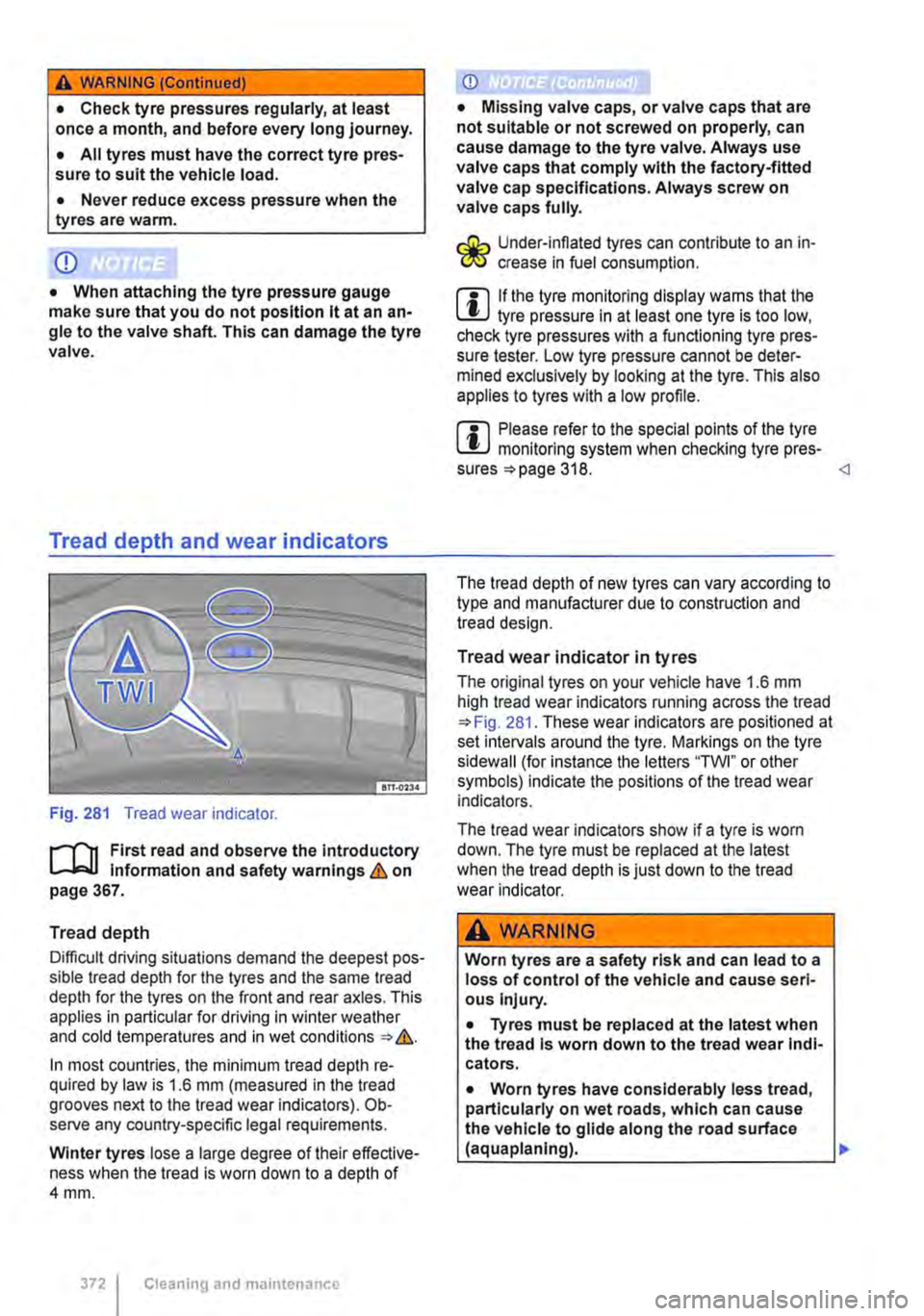
Fig. 281 Tread wear indicator.
r-fl1 First read and observe the Introductory L-.lo:::.l.l Information and safety warnings & on page 367.
Tread depth
Difficult driving situations demand the deepest pos-sible tread depth for the tyres and the same tread depth for the tyres on the front and rear axles. This applies in particular for driving in winter weather and cold temperatures and in wet conditions=>&.
In most countries, the minimum tread depth re-quired by law is 1.6 mm (measured in the tread grooves next to the tread wear indicators). Ob-serve any country-specific legal requirements.
Winter tyres lose a large degree of their effective-ness when the tread is worn down to a depth of 4mm.
3721 Cleaning and maintenance
CD
• Missing valve caps, or valve caps that are not suitable or not screwed on properly, can cause damage to the tyre valve. Always use valve caps that comply with the factory-fitted valve cap specifications. Always screw on valve caps fully.
Under-infiated tyres can contribute to an in-I!IS crease in fuel consumption.
m If the tyre monitoring display warns that the W tyre pressure in at least one tyre is too low, check tyre pressures with a functioning tyre pres-sure tester. Low tyre pressure cannot be deter-mined exclusively by looking at the tyre. This also applies to tyres with a low profile.
m Please refer to the special points of the tyre W monitoring system when checking tyre pres-sures =>page 318.
Tread wear indicator in tyres
The original tyres on your vehicle have 1.6 mm high tread wear indicators running across the tread =>Fig. 281. These wear indicators are positioned at set intervals around the tyre. Markings on the tyre sidewall (for instance the letters "TWI" or other symbols) indicate the positions of the tread wear indicators.
The tread wear indicators show if a tyre is worn down. The tyre must be replaced at the latest when the tread depth is just down to the tread wear indicator.
A WARNING
Worn tyres are a safety risk and can lead to a loss of control of the vehicle and cause seri-ous Injury.
• Tyres must be replaced at the latest when the tread Is worn down to the tread wear Indi-cators.
• Worn tyres have considerably less tread, particularly on wet roads, which can cause the vehicle to glide along the road surface (aquaplaning).
Page 373 of 486
A WARNING (Continued)
• Worn tyres reduce the possibility of con-trolling the vehicle well in normal and difficult driving situations and Increase braking dis-tance and the risk of sliding.
...--m First read and observe the introductory l-.W.I Information and safety warnings&,. on page 367.
Damage to tyres and rims is often not readily visi-ble. Any unusual vibrations or signs that the car is pulling to one side may indicate that one of the tyres is damaged =:. &,..
• Reduce your speed immediately if you suspect that a wheel is damaged.
• Check the tyres and rims for damage.
• If the tyre is damaged, do not drive on. Seek expert assistance.
• If there is no visible damage, drive slowly and cautiously to the next qualified workshop in order to have the vehicle checked.
Foreign bodies in the tyre
• Leave the foreign body in the tyre if it has en-tered the inner tyre. However, foreign bodies that are stuck between the tyre tread blocks can be re-moved.
• For vehicles with a spare wheel: where appro-priate, change the damaged wheel =:>page 420 If required, seek expert assistance when changing the damaged wheel. Volkswagen Commercial Ve-hicles recommends using a Volkswagen Commer-cial Vehicles dealership for this purpose.
• For vehicles with a breakdown set: the tyre can be sealed and pumped up using the tools in the breakdown set =:.page 425. Go to a qualified workshop. Volkswagen Commercial Vehicles rec-ommends using a Volkswagen Commercial Vehi-cles dealership for this purpose.
Tyre wear
The tyre wear is affected by several factors, for ex-ample:
• Driving style.
• Unbalanced wheels.
• Running gear setting.
Driving style-fast cornering, heavy acceleration and hard braking all increase tyre wear. The run-ning gear should be checked by a qualified work-shop if the tyres show excessive wear despite a normal driving style.
Unbalanced wheels -the wheels on new vehicles are balanced. However, various factors encoun-tered in normal driving can cause them to become unbalanced, which results in steering vibration. Un-balanced wheels will affect levels of wear on the steering system and the suspension. In this case the wheels should be balanced again. New tyres have to be balanced after fitting.
Running gear setting-incorrect wheel alignment causes excessive tyre wear, impairing the safety of the vehicle. The wheel alignment should be checked by a qualified workshop if tyres show ex-cessive wear.
A WARNING
If you notice unusual vibration or the car pull-Ing to one side while the vehicle is In motion, this may indicate that one of the tyres is dam-aged.
• Reduce speed immediately and park the vehicle without obstructing traffic.
• Check the tyres and rims for damage.
• Never drive on if wheels or tyres are dam-aged. Seek expert assistance Instead.
• If there Is no visible damage, drive slowly and cautiously to the next qualified workshop In order to have the vehicle checked.
Page 374 of 486
Spare wheel
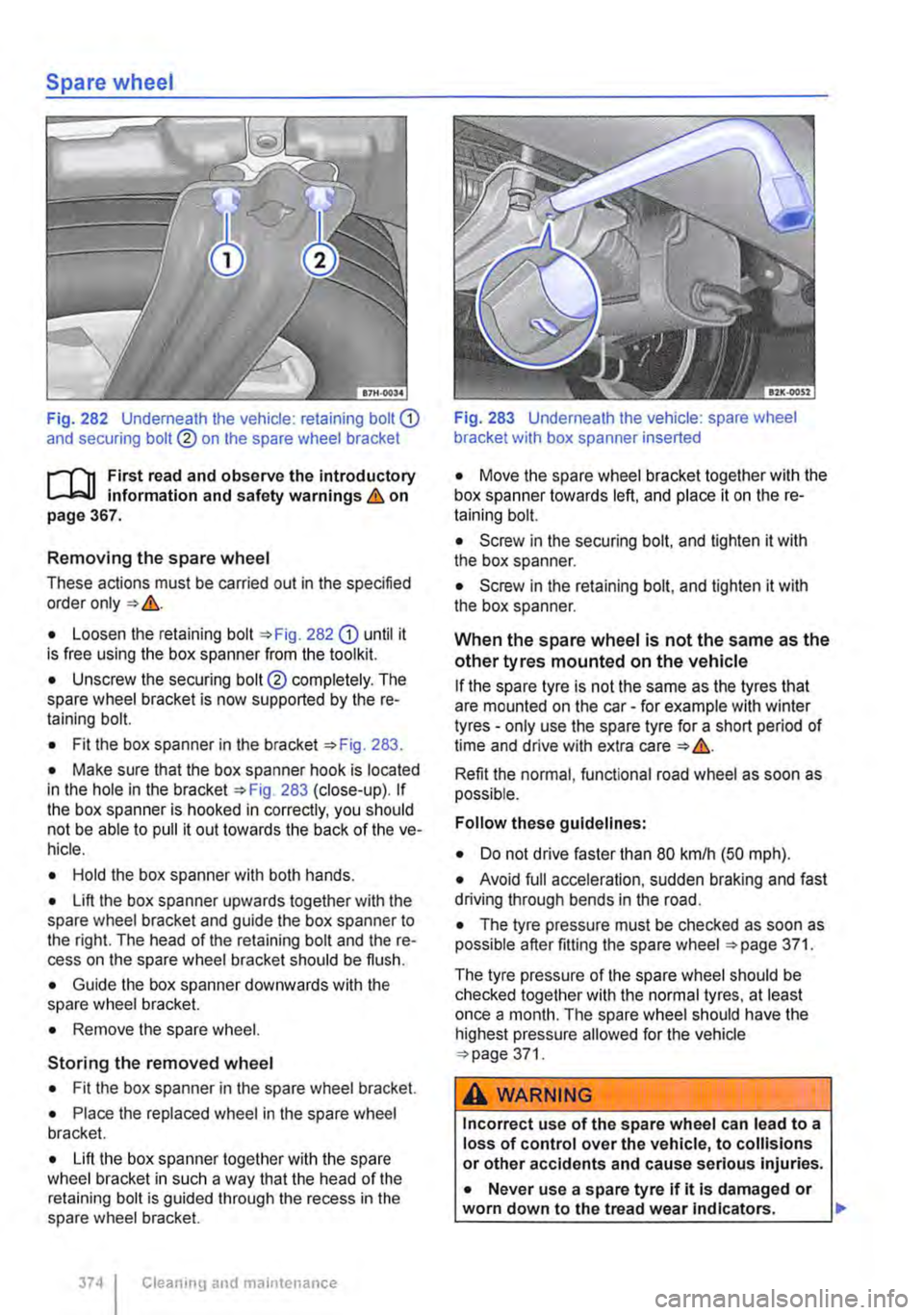
Fig. 282 Underneath the vehicle: retaining bolt G) and securing bolt® on the spare wheel bracket
r-T'n First read and observe the introductory L.-.lo:.U Information and safety warnings & on page 367.
Removing the spare wheel
These actions must be carried out in the specified order only &.
• Loosen the retaining bolt 282 G) until it is free using the box spanner from the toolkit.
• Unscrew the securing bolt® completely. The spare wheel bracket is now supported by the re-taining bolt.
• Fit the box spanner in the bracket 283.
• Make sure that the box spanner hook is located in the hole in the bracket 283 (close-up). If the box spanner is hooked in correctly, you should not be able to pull it out towards the back of the ve-hicle.
• Hold the box spanner with both hands.
• Lift the box spanner upwards together with the spare wheel bracket and guide the box spanner to the right. The head of the retaining bolt and the re-cess on the spare wheel bracket should be flush.
• Guide the box spanner downwards with the spare wheel bracket.
• Remove the spare wheel.
Storing the removed wheel
• Fit the box spanner in the spare wheel bracket.
• Place the replaced wheel in the spare wheel bracket.
• Lift the box spanner together with the spare wheel bracket in such a way that the head of the retaining bolt is guided through the recess in the spare wheel bracket.
374 I Cleaning and maintenance
Fig. 283 Underneath the vehicle: spare wheel bracket with box spanner inserted
• Move the spare wheel bracket together with the box spanner towards left, and place it on the re-taining bolt.
• Screw in the securing bolt, and tighten it with the box spanner.
• Screw in the retaining bolt, and tighten it with the box spanner.
When the spare wheel is not the same as the
other tyres mounted on the vehicle
If the spare tyre is not the same as the tyres that are mounted on the car-for example with winter tyres -only use the spare tyre for a short period of time and drive with extra care &.
Refit the normal, functional road wheel as soon as possible.
Follow these guidelines:
• Do not drive faster than 80 km/h (50 m ph).
• Avoid full acceleration, sudden braking and fast driving through bends in the road.
• The tyre pressure must be checked as soon as possible after fitting the spare wheel =>page 371.
The tyre pressure of the spare wheel should be checked together with the normal tyres, at least once a month. The spare wheel should have the highest pressure allowed for the vehicle 371.
A WARNING
Incorrect use of the spare wheel can lead to a loss of control over the vehicle, to collisions or other accidents and cause serious injuries.
• Never use a spare tyre if it is damaged or worn down to the tread wear Indicators. .,..
Page 375 of 486
A WARNING (Continued)
• In some vehicles, the spare wheel could be smaller than the standard wheel. The small spare wheel has a sticker with the text "80 km/h" or "50 mph". This is the maximum speed at which you are permitted to drive with this tyre.
• Never drive faster than 80 km/h (50 mph). Do not accelerate quickly, brake suddenly or drive at high speed through bends.
• The spare wheel must always be secured firmly with the wheel bolts supplied by the factory.
Tyre lettering
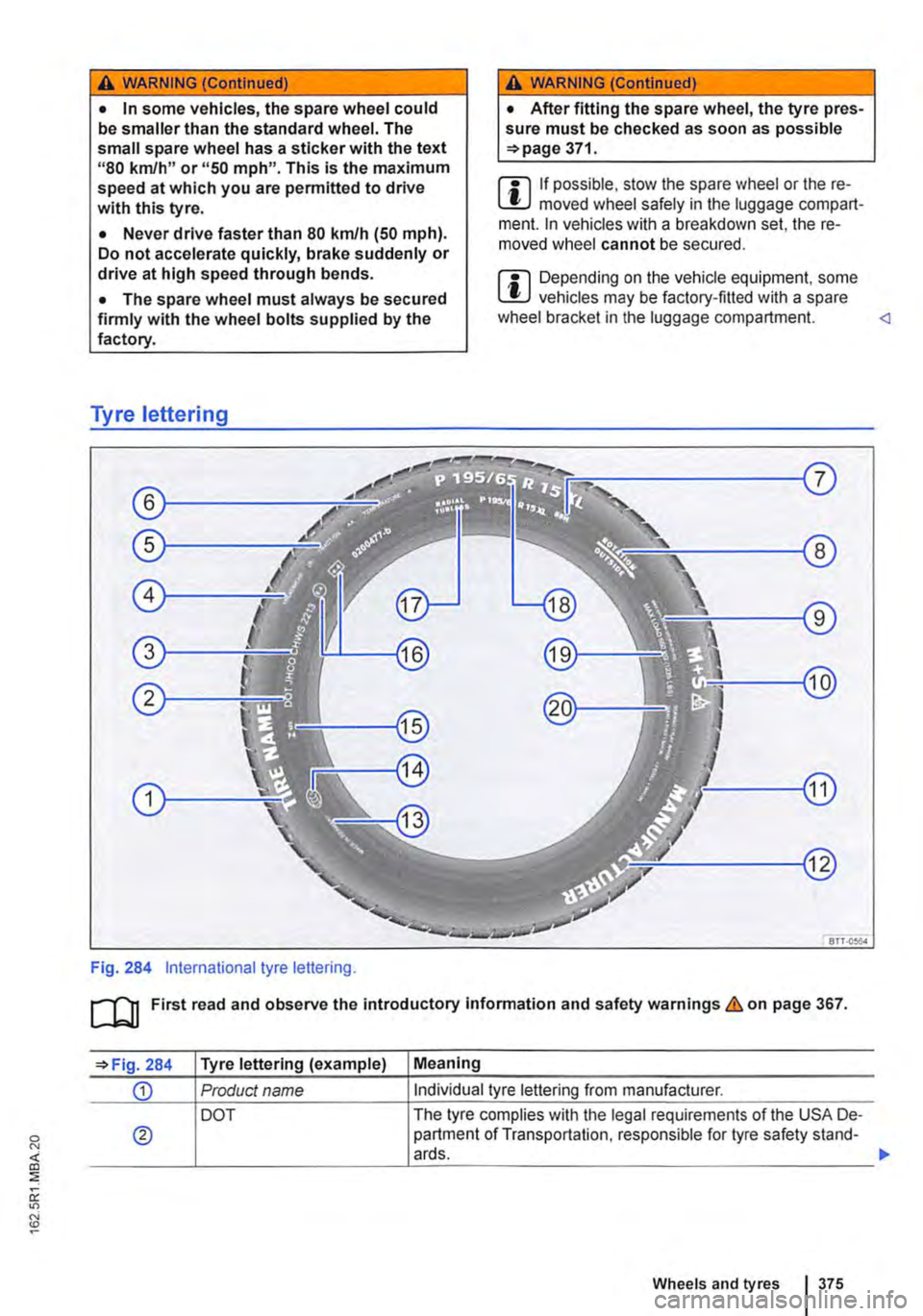
Fig. 284 International tyre lettering.
A WARNING (Continued)
• After fitting the spare wheel, the tyre pres-sure must be checked as soon as possible =>page 371.
m If possible, stow the spare wheel or the re-L!..J moved wheel safely in the luggage compart-ment. In vehicles with a breakdown set, the re-moved wheel cannot be secured.
m Depending on the vehicle equipment, some L!..J vehicles may be factory-fitted with a spare wheel bracket in the luggage compartment.
=>Fig. 284 Tyre lettering (example) Meaning
G) Product name Individual tyre lettering from manufacturer.
DOT The tyre complies with the legal requirements of the USA De-
0 partment of Transportation, responsible for tyre safety stand-ards.
Wheels and tyres 375
Page 378 of 486
z
w y
over 240 km/h (149 mph)
max. 270 kmlh (168 mph)
max. 300 kmlh (186 mph)
Winter tyres
r-f'n First read and observe the introductory L-J,::JJ information and safety warnings & on page 367.
In winter road conditions, winter tyres will consider-ably improve the car's handling. The design of summer tyres (width, rubber compound, tread pat-tern) gives less grip on ice and snow. Volkswagen Commercial Vehicles urgently recommends you use winter tyres or all-year tyres on all 4 wheels of the vehicle, particularly if winter conditions are ex-pected on the roads. Winter tyres will also improve the braking response of the vehicle and will help to reduce braking distances in winter weather. Volks-wagen Commercial Vehicles recommends that win-ter tyres be fitted to the vehicle at temperatures un-der+ 7•c (+45°F).
Winter tyres lose their effectiveness when the tread is worn down to a depth of 4 mm. Winter tyres also largely lose their effectiveness through ageing-regardless of the tread depth.
The following applies when using winter tyres:
• Observe any country-specific legal require-ments.
• Use winter tyres on all four wheels at the same time.
• Only use in winter road conditions.
• Only use the sizes of winter tyre that have been approved for the vehicle.
• Winter tyres must have the same type, size (rolling circumference) and the same tread pattern.
• Heed the maximum speed permitted by the speed index => &.
Speed limitation
Winter tyres have a speed limitation depending on the speed index =>page 375.
In some vehicle versions, a speed warning can be set in the menu MFD (multi function display) in the instrument cluster =>page 24.
378 I Cleaning and maintenance
Some tyre manufacturers use the code "ZR" for tyres with a highest permitted speed of over 240 km/h (149 mph).
If you use V-rated tyres the speed limits and re-quired tyre pressure will be determined by the en-gine size. You must ask a Volkswagen Commercial Vehicles dealership about the highest permitted speed and required tyre pressure.
Four-wheel drive (4MOTION)
Thanks to its four-wheel drive, the vehicle will have plenty of traction in winter conditions, even with the standard tyres. Nevertheless, Volkswagen Com-mercial Vehicles still recommends that winter tyres or all-year tyres should be fitted on all four wheels when winter road conditions are expected, mainly because this will give a better braking response.
Please refer to the appropriate information and notes when using snow chains =>page 379.
A WARNING
The Improved winter driving characteristics afforded by the winter tyres should not en-courage you to take any risks.
• Always adapt your speed and driving style to suit visibility, weather, road and traffic con-ditions.
• Never exceed the top speed and load per-mitted for the winter tyres that are fitted.
r:Q;-.. Summer tyres should be fitted in good time at the end of the winter. The vehicle handling is better if summer tyres are fitted at temperatures above +7•c (+45.F). They are quieter, do not wear so quickly and reduce fuel consumption.
m In vehicles with a tyre monitoring system, the l!.J systems have to "re-synchronise" after wheels are changed =>page 318.
m Volkswagen Commercial Vehicles dealer-l!.J ships can provide details on permissible win-
Page 379 of 486
Snow chains
r-"f"'n First read and observe the introductory L-J=.IJ information and safety warnings & on page 367.
Please heed legislation and also the permitted speed when driving your vehicle with snow chains.
In winter conditions, snow chains will not only im-prove acceleration, but also braking response.
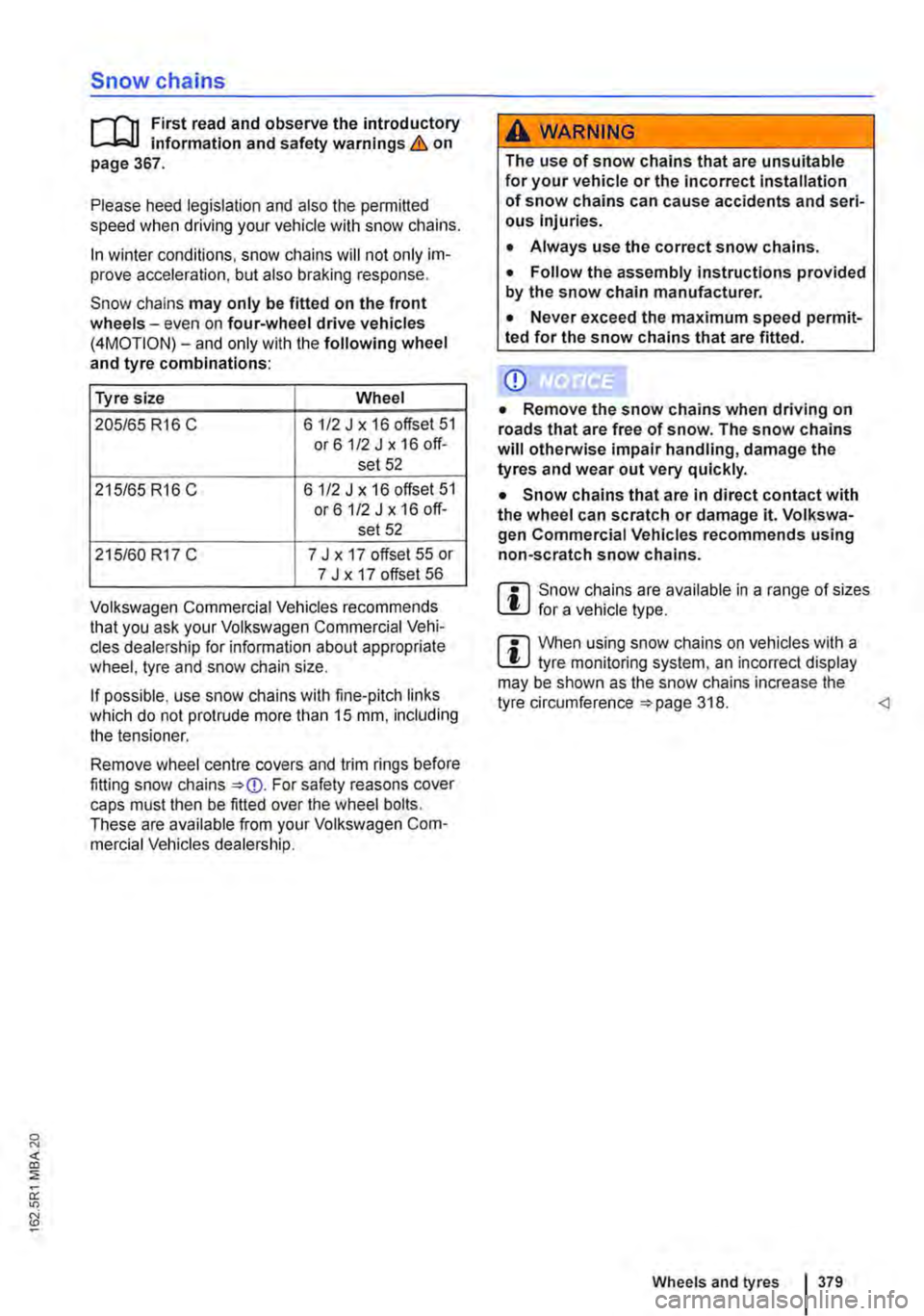
Snow chains may only be fitted on the front wheels-even on four-wheel drive vehicles (4MOTION)-and only with the following wheel and tyre combinations:
Tyre size Wheel
205/65 R16 C 6 1/2 J x 16 offset 51 or61/2Jx16off-set 52
215/65 R16 C 6 112 J x 16 offset 51 or61/2 J x 16 off-set 52
215/60 R17 C 7 J x 17 offset 55 or 7 J x 17 offset 56
Volkswagen Commercial Vehicles recommends that you ask your Volkswagen Commercial Vehi-cles dealership for information about appropriate wheel, tyre and snow chain size.
If possible, use snow chains with fine-pitch links which do not protrude more than 15 mm, including the tensioner.
Remove wheel centre covers and trim rings before fitting snow chains For safety reasons cover caps must then be fitted over the wheel bolts. These are available from your Volkswagen Com-mercial Vehicles dealership.
A WARNING
The use of snow chains that are unsuitable for your vehicle or the incorrect installation of snow chains can cause accidents and seri-ous Injuries.
• Always use the correct snow chains.
• Follow the assembly instructions provided by the snow chain manufacturer.
• Never exceed the maximum speed permit-ted for the snow chains that are fitted.
Q)
• Remove the snow chains when driving on roads that are free of snow. The snow chains will otherwise impair handling, damage the tyres and wear out very quickly.
• Snow chains that are in direct contact with the wheel can scratch or damage it. Volkswa-gen Commercial Vehicles recommends using non-scratch snow chains.
m Snow chains are available in a range of sizes l!:.J for a vehicle type.
m When using snow chains on vehicles with a l!:.J tyre monitoring system, an incorrect display may be shown as the snow chains increase the tyre circumference 318.
Page 380 of 486
Vehicle care and maintenance
Caring for and cleaning the vehicle exterior
o:n Introduction
This chapter contains information on the following subjects:
Washing the vehicle . . . . . . . . . . . . . . . 381
Washing the vehicle with a high-pressure cleaner . . . . . . . . . . . . . . . . . . . . . . . . . . . 382 Cleaning windows and exterior mirrors . . . . . . 382
Cleaning and changing wiper blades 383
Waxing and polishing the vehicle 384
Cleaning and caring for chrome and aluminium trim parts . . . . . . . . . . . . . . 385
Cleaning and caring for the decorative film . . 385
Cleaning wheels . . . . . . . . . . . . . . . . . . . . . 386
Care of rubber seals . . . . . . . . . . . . . . . . . . . . . 386
De-icing door lock cylinders . . . . . . • . . . . . . . . 387
Undersea! . . . . . . . . . . . . . . . . . . . . . . . . . . . . . . 387
Cleaning the engine compartment . 387
Regular and expert care helps to maintain the val-ue of the vehicle. Proper maintenance may also be one of the requirements for the approval of warran-ty claims in the event of corrosion or paint defects.
Suitable care products are available from Volkswa-gen Commercial Vehicles dealers.
Additional information and warnings:
• Preparation for working in the engine compart-ment ::-page 350
• Cleaning and caring for the interior ::-page 388
• Accessories, modifications, repairs and renewal of parts ::-page 394
A WARNING
Car care products can be toxic and hazard-ous. Unsuitable care products and Incorrect application of care products can cause acci-dents, serious Injuries, burns or poisoning.
• The care product must be kept In Its origi-nal sealed container.
380 Cleaning and maintenance
A WARNING (Continued)
• Read the manufacturer's Instructions .
• Never store car care products in empty food containers, bottles or any other non-original containers as people finding these containers may not know that they contain care products.
• Keep children away from care products .
• The products can give off harmful fumes during use. They should therefore only be used outside or In well-ventilated spaces.
• Never use fuel, turpentine, engine oil, nail varnish remover or other volatile fluids to wash, clean or care for your vehicle. These substances are toxic and highly Inflammable.
A WARNING
Incorrect care and cleaning of vehicle parts can Impair the safety features of the vehicle and thus cause serious Injury.
• Vehicle parts must be cleaned according to the manufacturer's Instructions.
• Only use approved or recommended cleaning products.
CD
Cleaning agents that contain solvents attack the material and can cause damage.
r:Q:... In the interests of environmental protection, "C!S the vehicle should only be washed in special-ly provided wash bays. This prevents waste water contaminated with oil, grease or fuel from entering the sewerage system. In some countries, washing vehicles anywhere else may be prohibited.
r:Q:... Environmentally-friendly care products "C!S should be used.
r:Q:... Leftover car care products should not be dis-"C!S posed of with ordinary household waste. Read the manufacturer's instructions.
Page 381 of 486
Washing the vehicle
r-f'n First read and observe the introductory Information and safety warnings & on page 380.
The longer substances such as insects, bird drop-pings, resinous tree sap, road dirt, industrial de-posits, tar, soot or road salt and other corrosive materials remain on the vehicle, the more damage they do to the paintwork. High temperatures (for in-stance in strong sunlight) accelerate the corrosion process. The underside of the vehicle should also be cleaned thoroughly and regularly.
Car washes
Please observe the signs on the automatic car wash. Before using an automatic car wash take the usual precautions, such as closing all windows and folding in the exterior mirrors, in order to avoid damage to the vehicle. You must consult the car wash operator if there are special parts on your ve-hicle such as spoilers, roof luggage carrier systems or radio aerials ::.CD.
The paint is so hard-wearing that the car can nor-mally be washed without problems in an automatic car wash. However, the effect on the paint de-pends to a large extent on the design of the car wash. Volkswagen Commercial Vehicles recom-mends the use of car washes without brushes.
To remove any wax residue from the windows and to stop wipers rubbing, please note the following points ::.page 382, Cleaning windows and exterior mirrors.
Washing the car by hand
When washing by hand, first soften the dirt with plenty of water and rinse off as well as possible.
Then clean the vehicle with a soft sponge, a glove or a brush using only light pressure. Start with the roof and work from the top to the bottom. Use a shampoo for very stubborn dirt only.
The sponge or glove should be wrung out thor-oughly at regular intervals.
Clean the wheels, sill panels etc. last. Use a differ-ent sponge for this purpose.
A WARNING
Parts of the vehicle with sharp edges can cause Injury.
• Protect your hands and arms from cuts on sharp parts, for example when cleaning the underbody or the inside of the wheel hous-lngs.
A WARNING
After the car has been washed, the braking effect could set in later than normal and ex-tend the braking distance as the brake discs and brake pads will be wet, or iced up In win-ter.
• You can "dry and de-ice" the brakes by performing careful braking manoeuvres. Make sure that you do not endanger any oth-er road users or violate any legal regulations when doing so.
CD
• The water should be no warmer than +so•c (+140.FJ.
• Do not wash the vehicle in direct sunlight in order to avoid damage to the vehicle palntwork.
• Never clean with insect sponges, rough kitchen sponges or similar products as these can damage the surface.
• Never clean the headlights with a dry cloth or sponge. Always use a wet cloth or sponge. lt is best to use soapy water.
• Washing the vehicle In cold weather: if the vehicle is rinsed with a hose, do not direct the water at the lock cylinders or the gaps around the doors, boot, or bonnet. The locks and seals could freeze.
CD
Observe the following guidelines before driving the vehicle into an automatic car wash in order to avoid damage to the vehicle:
• Ensure that the gap between the guide rails In the car wash is sufficient for the vehicle track. If the track is too narrow your wheels and tyres will be damaged.
• Switch off the rain sensor before driving the vehicle Into an automatic car wash.
• Check that the car wash is tall and wide enough for your vehicle.
• Fold In the exterior mirrors. Electrically fold-Ing exterior mirrors must be moved electrically. Do not fold them in and out by hand.
• In order to prevent damage to the palntwork on the bonnet, fold the wipers back onto the windscreen after drying the wiper blades. Do not drop the wipers onto the glass.
• Lock the tailgate to prevent it from opening accidentally In the car wash.